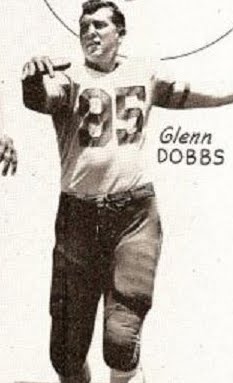
Showing posts with label Glenn Dobbs. Show all posts

August 25, 2015

1943: College All-Stars Thrash Redskins in Game at Northwestern


The tenth College All-Star Game was held on August 25, 1943 and was the first to be played at a venue other than Soldier Field in Chicago. The Wednesday night contest was held instead in nearby Evanston at Dyche Stadium of Northwestern University with 48,471 fans in attendance.

The NFL Champions, the Washington Redskins, were heavy favorites coming into the game. They had a new head coach in Dutch Bergman but capable returning veterans in tailback Sammy Baugh, HB Wilbur Moore, FB Bob Seymour, end Bob Masterson, and tackle Willie Wilkin.

Harry Stuhldreher, former member of Notre Dame’s “Four Horsemen” backfield and now head coach at Wisconsin, coached the All-Stars and prepared them well, running a simple but effective offense. The team was chosen by coaches rather than a nationwide newspaper poll, as in past years, and included future pro stars in Indiana end Pete Pihos, tackle Al Wistert of Michigan, Stanford center Vic Lindskog, Northwestern tailback Otto Graham, HB Charley Trippi of Georgia, and FB Pat Harder from Wisconsin (pictured above).

There was a heavy rain as the game started and it was hot and muggy for the remainder of the contest, which seemed to wear the Redskins down more than the collegians. The Redskins had first possession and drove from their 35 to the All-Star 38 in seven plays before being stopped and coming up empty.

The next Washington series ended with a punt by Sammy Baugh from his own 21 and HB Bob Steuber from Missouri picked up the bouncing ball and returned it 50 yards behind outstanding blocking for the first touchdown of the game. Pat Harder added the extra point.

The All-Stars got another break when Bob Seymour fumbled and Al Wistert recovered at the Washington 48. But after advancing 20 yards in four plays, highlighted by an Otto Graham pass to Pete Pihos for 12 yards, Harder fumbled and end Bob Masterson recovered for the Redskins to end the threat.

Washington then put together a 70-yard drive that stretched into the second quarter. Baugh completed two passes for first downs along the way and ended the series with a touchdown pass to end Joe Aguirre that covered six yards. Masterson kicked the extra point to tie the score. It would prove to be the high point for the pro champs.

Late in the second quarter, the All-Stars scored again. A penalty on a Washington punt gave the collegians good starting field position at their 42 and, with Tulsa’s passing tailback Glenn Dobbs now in the game, they went to the air. Dobbs was sacked on first down but completed five passes, including one to Washington State back Bob Kennedy for 19 yards and another to Harder for 14. The last was also to Harder, a short toss that ended up covering 36 yards for a TD. Harder again added the point after and the All-Stars took a 14-7 lead into halftime.


In the third quarter, the Redskins advanced to the All-Star 17, but a second down pass intended for Bob Seymour in the end zone was instead intercepted by Otto Graham (pictured at left), who made a spectacular play with a 97-yard interception return for another touchdown. Harder failed to add the PAT, but the rejuvenated All-Stars were ahead by 20-7.

Washington would never seriously threaten again.  In the fourth quarter, Harder scored a second TD on a 30-yard run to put the game away. Graham kicked the extra point and the All-Stars won in convincing fashion by a final score of 27-7.

Washington had the edge in total yards (325 to 212), with 273 of that total coming through the air, and first downs (16 to 9). However, the Redskins turned the ball over five times, three of them by interception, to two suffered by the collegians.

Pat Harder led the All-Stars in rushing with 53 yards on 12 carries and scored two touchdowns, and also played well at linebacker on defense. Sammy Baugh completed 21 of 41 passes for Washington.

It was the first win for the All-Stars since 1938, also over the Redskins, and the third since the series began in 1934 (there had been two ties). Washington went on to top the Eastern Division for the third time in four years but lost the NFL Championship game to the Bears.

Pat Harder and Otto Graham both appeared in the 1946 College All-Star Game (during World War II restrictions on participation were lifted, which allowed underclassmen to appear, and several players played in multiple games). They moved on to successful pro careers, and both would return to the College All-Star Game as members of NFL Championship clubs (Harder with the Cardinals and Lions, Graham with the Browns). Graham would later coach the All-Stars for ten games of the series that lasted until 1976, two of which they won.

January 26, 2015

Highlighted Year: Glenn Dobbs, 1948

Tailback/Defensive Back, Los Angeles Dons


Age:  28
3rd season in pro football, 2nd with Dons
College: Tulsa
Height: 6’4”   Weight: 210

Prelude:
A star tailback and punter in college, Dobbs was chosen by the Chicago Cardinals in the first round of the 1943 NFL draft, but went into the military instead. After starring in service football, he joined the Dodgers of the new AAFC in 1946, a club that utilized a single-wing attack. Brooklyn went only 3-10-1, but Dobbs led the circuit in passing yards (1886) as well as punting (47.8 avg.) and was named MVP by the league. In a major trade early in the 1947 season, Dobbs was dealt to the Los Angeles Dons. Playing quarterback in the T-formation, his performance suffered, but in ’48 a new head coach, Jimmy Phelan, created a new offense (the Phelan spread) in order to more fully utilize Dobbs’ talents.

1948 Season Summary
Appeared in all 14 games
[Bracketed numbers indicate league rank in Top 20]

Passing
Attempts – 369 [1]
Completions – 185 [1]
Yards – 2403 [4]
Completion percentage – 50.1 [5]
Yards per attempt – 6.5 [7]
TD passes – 21 [3]
Most TD passes, game – 4 vs. Chicago 10/8
Interceptions – 20 [2]
Passer rating – 67.4 [5]

Rushing
Attempts – 91 [14]
Yards – 539 [11]
Yards per attempt – 5.9 [5]
TDs – 4 [13, tied with four others]

Pass Receiving
Receptions – 2
Yards – 11
Yards per catch – 5.5
TDs - 0

Punting
Punts – 68 [1]
Yards – 3336 [1]
Average – 49.1 [1]
Punts blocked – 3 [1]

Interceptions
Interceptions – 1
Return yards – 32
TDs – 0

Kickoff Returns
Returns – 2  
Yards – 38
Average per return – 19.0
TDs – 0

Scoring
TDs – 4         
Points – 24

Awards & Honors:
2nd team All-NFL/AAFC: Sporting News
2nd team All-AAFC: League, UPI, NY Daily News

Dons went 7-7 to finish third in the AAFC Western Division.

Aftermath:
Injuries significantly diminished Dobbs’ performance in 1949, and with the demise of the AAFC following that season, he retired from pro football. After an absence of a year, in which he was a sportscaster in Tulsa, Dobbs joined the Saskatchewan Roughriders in Canada, playing three more seasons (and winning MVP honors in the Western league, the WIFU, in ’51) before further injuries set in, and serving as a player/coach. Overall, in the AAFC he passed for 5876 yards and 45 TDs, rushed for 1039 yards and 12 TDs, and had a 46.4 punting average. In Canada, Dobbs passed for 5196 yards and 51 TDs, rushed for 241 yards and 7 TDs, and had a 44.7 punting average. He returned to his alma mater, Tulsa, where he was athletic director and head football coach. 

--

Highlighted Years features players who were consensus first-team All-League* selections or league* or conference** leaders in the following statistical categories:

Rushing: Yards, TDs (min. 10)
Passing: Yards, Completion Pct., Yards per Attempt, TDs, Rating
Receiving: Catches, Yards, TDs (min. 10)
Scoring: TDs, Points, Field Goals (min. 5)
All-Purpose: Total Yards
Defense: Interceptions, Sacks
Kickoff Returns: Average
Punt Returns: Average
Punting: Average

*Leagues include NFL (1920 to date), AFL (1926), AFL (1936-37), AAFC (1946-49), AFL (1960-69), WFL (1974-75), USFL (1983-85)

**NFC/AFC since 1970

August 30, 2013

1944: Bears Rally to Beat College All-Stars


The Chicago Bears, defending NFL Champions, were missing several veteran players due to World War II military service as they faced the College All-Stars on August 30, 1944. Owner/Head Coach George Halas was in the service as well, with assistants Hunk Anderson and Luke Johnsos acting as co-coaches. Fortunately for them, star QB Sid Luckman (pictured above) was available thanks to a ten-day furlough from the Merchant Marine.

For the All-Stars, coached by Northwestern’s Lynn “Pappy” Waldorf, Tulsa QB Glenn Dobbs was available on a 20-day furlough from the Army. Due to relaxed wartime eligibility rules that allowed underclassmen to play, Dobbs was making his second appearance in the annual contest. Other notable players included HB Charlie Trippi from Georgia, Ohio State tackle Bill Willis, guards Dick Barwegan of Purdue and Bruno Banducci from Stanford, Indiana QB Lou Saban, and HB Steve Van Buren of LSU.

For the second straight year the game was played at Northwestern University’s Dyche Stadium. There were 48,769 fans on hand in rainy conditions for the Wednesday night contest. Chicago got the first break when Charlie Trippi fumbled a punt and HB Ray Nolting recovered for the Bears at the All-Star 36. However, the Bears were unable to capitalize and penalties moved them back to midfield, from where they were forced to punt.

The All-Stars couldn’t move either but Dobbs booted the ball 85 yards on a quick-kick punt that pinned the Bears at their own two yard line. Chicago was forced to punt in turn and Luckman’s kick gave the All-Stars good field position at the Bears’ 33. The All-Stars scored in four plays. Dobbs threw to Notre Dame end John Yonakor for 30 yards to the Chicago three and, after failing to cross the goal line on the next two plays, Dobbs passed to another Notre Dame player, HB Creighton Miller, in the corner of the end zone for a four-yard touchdown. Lou Saban added the extra point.

The Bears were forced to punt again and the All-Stars again drove to a score, helped along by Indiana HB Billy Hillenbrand’s 32-yard punt return. Dobbs completed two passes and, on a third down play, faded back to pass but instead ran 12 yards and, at the one, fumbled but C John Tavener from Indiana recovered in the end zone for a touchdown. Saban again added the extra point and the All-Stars held a 14-0 lead.


With the game rapidly getting away from the Bears, the defending champs put together a solid 80-yard drive in response. After HB Ray “Scooter” McLean (pictured at right) ran for 11 yards, Luckman completed two passes, the longest to Nolting for 21 yards as the first quarter ended. The Bears finally got on the board on the fourth play of the second quarter when FB Gary Famiglietti ran for a three-yard TD.

Two minutes later the All-Stars had to punt and Dobbs’ kick was partially blocked. Luckman threw to McLean to advance to the All-Star 14. On a fourth down play from the 12, end Jim Benton caught the game-tying touchdown pass. Pete Gudauskas successfully converted following each score. Each team had another shot to put more points on the board in the second quarter but interceptions blunted the drives.

The halftime featured a tribute to college football players serving in the military during World War II. In the darkened stadium, entertainer Don Ameche took particular note of the six former All-Star participants who had died during the conflict.

The All-Stars took the second half kickoff and went 65 yards to re-take the lead with Hillenbrand in for Dobbs. The drive featured three pass completions and Saban ran for a one-yard TD and added the extra point. The Bears responded with a 64-yard scoring drive of their own. Three Luckman completions, the last to McLean for 16 yards, set up the scoring play as McLean weaved his way to an 18-yard touchdown to again tie the score.

A Chicago punt pinned the All-Stars back at their eight yard line. Dobbs tried another quick-kick, but with a torrential rain falling the kick was partially blocked and the Bears took over at the All-Star 29. With Famiglietti and McLean running effectively, Chicago moved inside the ten yard line before the series stalled. Pete Gudauskas kicked a 14-yard field goal early in the fourth quarter that gave the Bears the lead for the first time.

The All-Stars fought back during the final period and at one point reached the Chicago 38 but Luckman intercepted a pass to snuff out the threat. The Bears held on to win the hard-fought contest by a score of 24-21.

The Bears outrushed the All-Stars (143 to 73) and had the edge in first downs (14 to 9) while the collegians went to the air more times and gained more yards (146 to 128). However, four of their 32 passes were intercepted. Along with a fumble, the All-Stars suffered five turnovers to just two by the Bears. Neither team was able to mount a credible pass rush.

The win was the eighth thus far for the pro teams against three for the collegians and two ties. The Bears were participants for the fifth time and improved their record to 4-0-1.

In the season that followed, the Bears, who had topped the Western Division for four straight years, fell into a tie for second place with Detroit at 6-3-1. Sid Luckman was usually able to get away from his Merchant Marine duties to play on Sundays, but a slow start kept Chicago behind the Packers.

Glenn Dobbs (pictured below), the MVP for the All-Stars, returned to his military duties and played service football before joining the All-America Football Conference, where he played for Brooklyn and Los Angeles. He continued to be a top passer and punter and went on to play in Canada after the AAFC’s demise.


October 15, 2011

1948: Colts Score 15 Points in 4th Quarter to Pull Away from Dons


The Los Angeles Dons were two-touchdown favorites coming into their All-America Football Conference game against the Baltimore Colts on October 15, 1948. Jimmy Phelan, who was in his first year as head coach of the Dons, had developed an offensive formation, the Phelan Spread, in an effort to better utilize star passing tailback Glenn Dobbs. Dobbs, the AAFC’s MVP in 1946 with Brooklyn, had come to Los Angeles in a celebrated trade early in the ’47 season and was a disappointment. Further efforts had been made to revamp the team, which was caught in a struggle with the NFL’s Rams for fan support and revenue, and new players included rookies Herm Wedemeyer, a halfback out of St. Mary’s of California, and end Len Ford from Michigan. LA had a 4-2 record coming into the game, having won their previous two contests.

The visiting Colts, coached by Cecil Isbell, had been 2-11-1 in ’47 but were improved, most notably thanks to the performance of rookie QB Y.A. Tittle out of LSU. They routed the New York Yankees, who had dominated the Eastern Division in each of the AAFC’s first two seasons, in the opening game in which Tittle threw four scoring passes and beat them again two games later, but were 3-3 following a 56-14 loss to the 49ers the previous week.

There was a crowd of 40,019 in attendance on a Friday night at the LA Memorial Coliseum. HB Bill Reinhard scored first by intercepting a deflected Tittle pass and running it back for a 10-yard touchdown.

In the second quarter, and with the ball on the one foot line on a drive helped along by a pass interference penalty, Dobbs surprised the Colts by throwing for a touchdown to end Joe Aguirre, who was all alone in the end zone. Down 14-0, Tittle threw a touchdown pass of 40 yards to end Lamar Davis to make the score 14-7 at halftime. LA’s defensive line, featuring Ford and tackle Butch Levy, dominated for much of the first half – but the tables would turn in the second half.

Wedemeyer and FB John Kimbrough both were injured early, hurting LA’s offense, but then the Colts suffered a blow when Tittle was lost to an injury in the third quarter. Charley O’Rourke, formerly a quarterback for the Dons, entered the game for Baltimore.

O’Rourke engineered a drive that led to a 26-yard TD pass to end Windell Williams that tied the game at 14-14 going into the final period. From there, the Colts proceeded to dominate the fourth quarter.

HB Billy Hillenbrand put Baltimore ahead with a one-yard run and Rex Grossman (grandfather of the modern NFL quarterback of the same name) extended the lead to 24-14 with a 23-yard field goal. The defense added a safety when Dobbs was tackled in his end zone. Grossman kicked his second field goal, from 20 yards, and the Colts came away with a convincing 29-14 win.

Baltimore rolled up 438 total yards and 19 first downs, to 235 yards and 9 first downs for the Dons. FB Buzz Mertes, another ex-Don, led a running game for the Colts that accounted for 169 of that yardage total. Tittle and O’Rourke combined for 269 net passing yards.


The Colts defensive line put heavy pressure on Dobbs, already hurting from an injured hip, who was sacked for a total of 91 yards in losses, including the safety. Dobbs completed just 10 of 28 passes for 173 yards.

Baltimore lost its next three games, all on the road, but won three of the last four and, while that meant finishing with a 7-7 record, it was enough to put the Colts in a tie atop the mediocre Eastern Division with the Buffalo Bills; they lost the resulting playoff. The Dons remained an inconsistent team and also ended up at 7-7 which, in the tough Western Division, meant third place.

Y.A. Tittle ended up as the third-ranked passer in the AAFC and was also third with 2522 passing yards. His 16 TD passes tied for fourth with Buffalo’s George Ratterman, and he also ranked fourth in attempts (289) and completions (161). He threw just nine interceptions. It was a promising start to a Hall of Fame career.

Glenn Dobbs led the league in pass attempts (369) and completions (185), was third in touchdown passes (21), and fourth in passing yards (2403). However, his 20 interceptions placed second. The versatile Dobbs also led the team in rushing with 539 yards on 91 carries (5.9 avg.) and was the AAFC’s top punter with a 49.1 average.

Rex Grossman led the league in field goals with 10, out of 18 attempts. Billy Hillenbrand, who put the Colts ahead to stay against the Dons, accumulated 2067 all-purpose yards, including 510 by rushing and an AAFC-leading 970 yards on his 50 pass receptions. LA’s Len Ford was outstanding on both sides of the ball and caught 31 passes for 598 yards (19.3 avg.) and seven touchdowns. While he performed well again on offense in 1949, with the demise of the league he joined the Cleveland Browns in the NFL and was used exclusively on defense in an outstanding career that was honored, like Tittle’s, with enshrinement in the Pro Football Hall of Fame.

September 20, 2011

MVP Profile: Glenn Dobbs, 1946

Tailback/Defensive Back, Brooklyn Dodgers


Age: 26
1st season in pro football
College: Tulsa
Height: 6’4” Weight: 210

Prelude:
A star tailback and punter in college, Dobbs was chosen by the Chicago Cardinals in the first round of the 1943 NFL draft, but went into the military instead. After starring in service football, he joined the Dodgers of the new AAFC in 1946, a club that utilized a single-wing attack.

1946 Season Summary
Appeared in 12 of 14 games
[Bracketed numbers indicate league rank in Top 20]

Passing
Attempts – 269 [1]
Completions – 135 [1]
Yards – 1886 [1]
Completion percentage – 50.2 [4]
Yards per attempt – 7.0 [3]
TD passes – 13 [4]
Most TD passes, game – 2 vs. Buffalo 11/10, at Miami 12/13
Interceptions – 15 [1]
Passer rating – 66.0 [4]

Rushing
Attempts – 95
Yards – 208
Yards per attempt – 2.2
TDs – 4

Pass Receiving
Receptions – 1
Yards – -5
TDs - 0

Punting
Punts – 80 [1]
Yards – 3826 [1]
Average – 47.8 [1]
Punts blocked – 2

Interceptions
Interceptions – 2 [20, tied with many]
Return yards – 44 [18]
TDs – 0

Kickoff Returns
Returns – 12 [6, tied with Edgar Jones]
Yards – 214 [12]
Average per return – 17.8
TDs – 0

Punt Returns
Returns – 7 [17, tied with four others]
Yards – 146 [11]
Average per return – 20.9
TDs – 1
Longest return – 78 yards

All-Purpose yards – 563

Scoring
TDs – 6 [9, tied with five others]
Points – 36 [15, tied with six others]

Awards & Honors:
AAFC MVP: League
1st team All-NFL/AAFC: Chicago Herald-American
1st team All-AAFC: League, AP, UPI, NY Daily News

Dodgers went 3-10-1 to finish in a tie for second place in the Eastern Division, although they ranked second in the AAFC in passing offense (2258 yards).

Aftermath:
In a major trade early in the 1947 season, Dobbs was dealt to the Los Angeles Dons. Playing quarterback in the T-formation, his performance suffered, but in ’48 a new head coach, Jimmy Phelan, created a new offense (the Phelan spread) in order to more fully utilize Dobbs’ talents. Dobbs responded with an outstanding season in which he set pro football records for pass attempts (369) and completions (185). He also had his best pro rushing season (539 yards) and again led the league in punting (49.1). Injuries significantly diminished Dobbs’ performance in 1949, and with the demise of the AAFC following that season, he retired from pro football. After an absence of a year, in which he was a sportscaster in Tulsa, Dobbs joined the Saskatchewan Roughriders in Canada, playing three more seasons (and winning MVP honors in the Western league in ’51) before further injuries set in, and serving as a player/coach. Overall, as a pro he passed for 11,072 yards and 96 TDs, rushed for 1280 yards, and had a 45.7 punting average.

--

MVP Profiles feature players who were named MVP or Player of the Year in the NFL, AAFC (1946-49), AFL (1960-69), WFL (1974), or USFL (1983-85) by a recognized organization (Associated Press, Pro Football Writers Association, Newspaper Enterprise Association, United Press International, The Sporting News, Maxwell Club – Bert Bell Award, or the league itself).

[Updated 2/14/14]