Showing posts with label Baltimore Colts (AAFC). Show all posts

August 27, 2015

Highlighted Year: Billy Hillenbrand, 1948

Halfback, Baltimore Colts


Age: 26
3rd season in pro football, 2nd with Colts
College: Indiana
Height: 6’0”   Weight: 188

Prelude:
Hillenbrand was a consensus first-team All-American in 1942 and was chosen by the New York Giants in the first round of the 1944 NFL draft. However, he went into the military for two years during World War II and played service football. The versatile halfback signed with the Chicago Rockets of the new AAFC in 1946 and had a good year for a poor team, gaining 490 yards from scrimmage, intercepting three passes on defense, and returning both a punt and kickoff for touchdowns. He moved on to the Colts in 1948 and further developed as a receiver out of the backfield, catching 39 passes for 702 yards (18.0 avg.) and seven TDs and, adding in kick returns, he gained 1573 all-purpose yards.

1948 Season Summary
Appeared in all 14 games
[Bracketed numbers indicate league rank in Top 20]

Rushing
Attempts – 100 [10, tied with Edgar Jones]
Yards – 510 [12]
Most yards, game – 112 yards (on 12 carries) at Brooklyn 11/28
Average gain – 5.1 [9]
TDs – 7 [5, tied with Lou Tomasetti]

Pass Receiving
Receptions – 50 [3, tied with Fay King]
Yards – 970 [1]
Average gain – 19.4 [2]
TDs – 6 [8, tied with Jack Russell]

Kickoff Returns
Returns – 16 [4]
Yards – 356 [5]
Average per return – 22.3 [4]
TDs – 0
Longest return – N/A

Punt Returns
Returns – 18 [4]
Yards – 231 [6]
Average per return – 12.8 [5]
TDs – 0
Longest return – N/A

All-Purpose yards – 2067 [2]

Scoring
TDs – 13 [3]
Points – 78 [4]

Postseason: 1 G (Eastern Division playoff vs. Buffalo)
Rushing attempts – 6
Rushing yards – 5
Average gain rushing – 0.8
Rushing TDs – 0

Pass receptions – 7
Receiving yards – 75
Average yards per reception – 10.7
Pass receiving TDs – 0

Kickoff returns – 3
Kickoff return yards – 35
Average yards per return – 11.7
Kickoff return TDs – 0

Punt returns – 1
Punt return yards – 0
Punt return TDs – 0

Awards & Honors:
2nd team All-AAFC: League, UPI, NY Daily News

Colts went 7-7 to tie for first in the AAFC Eastern Division while leading the league in passing yards (2899). Lost Eastern Division playoff to Buffalo Bills (28-17).

Aftermath:
Hillenbrand’s outstanding 1948 season turned out to be his last. He retired, having caught 110 passes for 1987 yards (18.1 avg.) and 17 touchdowns, rushed for 889 yards on 216 carries (4.1 avg.) and another 11 TDs, returned 44 punts for a 13.9 average and a TD and 42 kickoffs for a 24.8-yard average and two scores. Overall, he scored 31 touchdowns in his three seasons.

--

Highlighted Years features players who were consensus first-team All-League* selections or league* or conference** leaders in the following statistical categories:

Rushing: Yards, TDs (min. 10)
Passing: Yards, Completion Pct., Yards per Attempt, TDs, Rating
Receiving: Catches, Yards, TDs (min. 10)
Scoring: TDs, Points, Field Goals (min. 5)
All-Purpose: Total Yards
Defense: Interceptions, Sacks
Kickoff Returns: Average
Punt Returns: Average
Punting: Average

*Leagues include NFL (1920 to date), AFL (1926), AFL (1936-37), AAFC (1946-49), AFL (1960-69), WFL (1974-75), USFL (1983-85)

**NFC/AFC since 1970

May 10, 2015

Highlighted Year: Rex Grossman, 1948

Fullback/Linebacker/Placekicker, Baltimore Colts


Age: 24
1st season in pro football
College: Indiana
Height: 6’1”   Weight: 215

Prelude:
Grossman’s college years, which started in 1942, were interrupted by three years of military service in World War II, after which he returned to play fullback, linebacker and kicker in 1946 and quarterback in ‘47. He chose to give up his final year of eligibility and turned pro. The Philadelphia Eagles picked him in the 29th round of the NFL draft, but he signed with the Colts of the AAFC.

1948 Season Summary
Appeared in all 14 games
[Bracketed numbers indicate league rank in Top 20]

Kicking
Field goals – 10 [1]
Most field goals, game – 2 at New York 9/16, at Los Angeles 10/15
Field goal attempts – 18 [2]
Field goal percentage – 55.6 [1]
PATs – 43 [3]
PAT attempts – 43 [3]
Longest field goal – 51 yards vs. New York 9/5

Rushing
Attempts – 8
Yards – -3
Average gain – -0.4
TDs – 0

Interceptions
Interceptions – 2
Int. return yards – 13
Int. TDs – 0

Scoring
Field Goals – 10
PATs – 43
Points – 73 [6]

Postseason: 1 G (AAFC Eastern Division Playoff at Buffalo)
Field goals – 1
Field goal attempts – 2
PATs – 2
PAT attempts – 2
Longest field goal – 16 yards

Colts went 7-7 to tie for first in the AAFC Eastern Division while leading the league in passing yards (2899) and field goals (10). Lost Divisional playoff to Buffalo Bills (28-17).

Aftermath:
Grossman followed up in 1949 by hitting on six of 11 field goal attempts as well as all 19 tries for extra point and also punted 28 times for a 38.8-yard average. He moved on to the NFL along with the Colts in ’50 and was dealt to Detroit during the season. Traded to the Cleveland Browns in 1951, he chose to retire instead. Overall, Grossman kicked 16 field goals in 32 attempts plus 78 extra points, for a total of 126 points. He was inducted into the Indiana Football Hall of Fame. His grandson of the same name has played quarterback in the NFL, primarily with the Bears and Redskins.

--

Highlighted Years features players who were consensus first-team All-League* selections or league* or conference** leaders in the following statistical categories:

Rushing: Yards, TDs (min. 10)
Passing: Yards, Completion Pct., Yards per Attempt, TDs, Rating
Receiving: Catches, Yards, TDs (min. 10)
Scoring: TDs, Points, Field Goals (min. 5)
All-Purpose: Total Yards
Defense: Interceptions, Sacks
Kickoff Returns: Average
Punt Returns: Average
Punting: Average

*Leagues include NFL (1920 to date), AFL (1926), AFL (1936-37), AAFC (1946-49), AFL (1960-69), WFL (1974-75), USFL (1983-85)

**NFC/AFC since 1970

December 12, 2013

1948: Bills Rally Past Colts in AAFC East Division Playoff


The Baltimore Colts hosted the Buffalo Bills on December 12, 1948 in a playoff to determine the winner of the All-America Football Conference’s Eastern Division. The Colts had forced the playoff a week earlier by defeating the Bills soundly by a score of 35-15 in the regular season finale, with the clubs thus finishing in a dead heat at 7-7. The records were mediocre, to be sure, and they benefited from the collapse of the New York Yankees, who dominated the division in the AAFC’s first two seasons. But it still meant a chance to play in the league championship game – even if that meant facing off against the powerful, and undefeated, Cleveland Browns.

The Bills, coached by Red Dawson, actually had a better record in 1947, when they finished second to New York. QB George Ratterman (pictured above) was the key player on offense and had a productive receiver in end Al Baldwin, who caught 54 passes during the regular season. HB Chet Mutryn was an outstanding all-purpose back who led the AAFC with 2288 total yards and 96 points and FB Lou Tomasetti ran effectively between the tackles.

Baltimore, under Head Coach Cecil Isbell, was the more surprising participant in the contest. The Colts were coming off a 2-11-1 campaign in ’47. Added to holdover HB Billy Hillenbrand and end Lamar Davis were a fine rookie crop that included QB Y.A. Tittle, HB Bob Pfohl, DHB Jack Leight, and FB/PK Rex Grossman. The team had won three of its last four games, including the convincing win over Buffalo, and appeared to have the momentum heading into the playoff.

There were 27, 327 fans on hand at Babe Ruth Stadium. The Colts took the early lead on a 16-yard field goal by Rex Grossman in the first quarter. George Ratterman tossed a five-yard jump-pass to end Bill O’Connor to give Buffalo the lead at 7-3, which was the score at halftime as the defenses controlled the game.

The Colts appeared to take command in the third quarter. A 71-yard drive ended with FB Bus Mertes running for a touchdown from nine yards out. Baltimore then put together an 88-yard series that also ended with a Mertes TD, this from a yard. Both were followed by Grossman extra points and the home team was up by 17-7 heading into the final period.

Five minutes into the fourth quarter, Buffalo’s Ratterman passed to HB Bill Gompers, who was all alone for a 66-yard touchdown, and with Graham Armstrong’s PAT, that narrowed the score to 17-14.

A key play occurred with five minutes left on the clock when Chet Mutryn caught a short pass from Ratterman, but then dropped the ball. Tackle John Mellus recovered what he – and many of those present – thought was a fumble for the Colts, but sideline judge Tommy Whelan ruled it an incomplete pass. Six plays later, with the Baltimore defense reeling following the disputed incompletion, the Bills scored when Ratterman connected with Al Baldwin for a 25-yard touchdown. Armstrong tacked on the extra point.

Buffalo’s lead was padded when LB Ed “Buckets” Hirsch intercepted a Tittle pass and returned it 20 yards for a TD. The final score was 28-17 as the Bills won the Eastern Division title.

Police had to escort the officials to the locker room after the game due to the partisan crowd that was angered over the incomplete pass call. The AAFC’s deputy commissioner, O.O. Kessing, spoke with the official, Whelan, afterward and quoted him as saying of the disputed call, “That’s the way I saw it and I’d call it that way seven days a week.”

The Colts outgained Buffalo (393 yards to 297) and had far more first downs (24 to 11). Both teams were productive on the ground, with the Colts rushing for 176 yards to Buffalo’s 162. Each team turned the ball over three times – although a turnover-that-wasn’t was the most discussed play of the game.

George Ratterman completed 10 of 18 passes for 135 yards and three touchdowns with one interception, and was at his best with the game on the line in the late going. Lou Tomasetti led the Bills with 56 rushing yards on 12 attempts and Chet Mutryn was right behind with 54 yards on 11 carries. Bill Gompers had 52 yards on 14 rushes and, with his 66-yard scoring catch, led the club in pass receiving yards. Al Baldwin and Bill O’Connor each caught three passes, for 21 and 20 yards, respectively, and one TD apiece.

For the Colts, Y.A. Tittle was successful on 17 of 36 throws for 217 yards with no TDs and one intercepted. Bus Mertes, who scored the two third quarter touchdowns, ran for 73 yards on 15 attempts and Bob Pfohl contributed 63 yards on 16 carries. Billy Hillenbrand, who ran six times for five yards, was the top receiver with 7 catches for 75 yards. Lamar Davis had 73 yards on his 5 pass receptions.

The come-from-behind win over the Colts did not translate into an upset in the AAFC Championship game for Buffalo. As expected, the Bills were routed by the Browns, 49-7, who won their third consecutive league title. Buffalo went 5-5-2 in 1949 and made the postseason again in the restructured league’s final season, again falling to the Browns in the first playoff round. Baltimore, however, dropped to the cellar with a 1-11 record. 

October 15, 2011

1948: Colts Score 15 Points in 4th Quarter to Pull Away from Dons


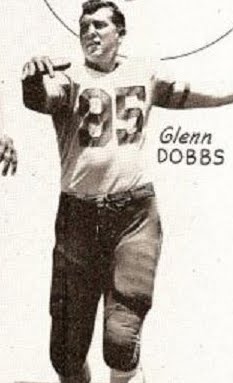
The Los Angeles Dons were two-touchdown favorites coming into their All-America Football Conference game against the Baltimore Colts on October 15, 1948. Jimmy Phelan, who was in his first year as head coach of the Dons, had developed an offensive formation, the Phelan Spread, in an effort to better utilize star passing tailback Glenn Dobbs. Dobbs, the AAFC’s MVP in 1946 with Brooklyn, had come to Los Angeles in a celebrated trade early in the ’47 season and was a disappointment. Further efforts had been made to revamp the team, which was caught in a struggle with the NFL’s Rams for fan support and revenue, and new players included rookies Herm Wedemeyer, a halfback out of St. Mary’s of California, and end Len Ford from Michigan. LA had a 4-2 record coming into the game, having won their previous two contests.

The visiting Colts, coached by Cecil Isbell, had been 2-11-1 in ’47 but were improved, most notably thanks to the performance of rookie QB Y.A. Tittle out of LSU. They routed the New York Yankees, who had dominated the Eastern Division in each of the AAFC’s first two seasons, in the opening game in which Tittle threw four scoring passes and beat them again two games later, but were 3-3 following a 56-14 loss to the 49ers the previous week.

There was a crowd of 40,019 in attendance on a Friday night at the LA Memorial Coliseum. HB Bill Reinhard scored first by intercepting a deflected Tittle pass and running it back for a 10-yard touchdown.

In the second quarter, and with the ball on the one foot line on a drive helped along by a pass interference penalty, Dobbs surprised the Colts by throwing for a touchdown to end Joe Aguirre, who was all alone in the end zone. Down 14-0, Tittle threw a touchdown pass of 40 yards to end Lamar Davis to make the score 14-7 at halftime. LA’s defensive line, featuring Ford and tackle Butch Levy, dominated for much of the first half – but the tables would turn in the second half.

Wedemeyer and FB John Kimbrough both were injured early, hurting LA’s offense, but then the Colts suffered a blow when Tittle was lost to an injury in the third quarter. Charley O’Rourke, formerly a quarterback for the Dons, entered the game for Baltimore.

O’Rourke engineered a drive that led to a 26-yard TD pass to end Windell Williams that tied the game at 14-14 going into the final period. From there, the Colts proceeded to dominate the fourth quarter.

HB Billy Hillenbrand put Baltimore ahead with a one-yard run and Rex Grossman (grandfather of the modern NFL quarterback of the same name) extended the lead to 24-14 with a 23-yard field goal. The defense added a safety when Dobbs was tackled in his end zone. Grossman kicked his second field goal, from 20 yards, and the Colts came away with a convincing 29-14 win.

Baltimore rolled up 438 total yards and 19 first downs, to 235 yards and 9 first downs for the Dons. FB Buzz Mertes, another ex-Don, led a running game for the Colts that accounted for 169 of that yardage total. Tittle and O’Rourke combined for 269 net passing yards.


The Colts defensive line put heavy pressure on Dobbs, already hurting from an injured hip, who was sacked for a total of 91 yards in losses, including the safety. Dobbs completed just 10 of 28 passes for 173 yards.

Baltimore lost its next three games, all on the road, but won three of the last four and, while that meant finishing with a 7-7 record, it was enough to put the Colts in a tie atop the mediocre Eastern Division with the Buffalo Bills; they lost the resulting playoff. The Dons remained an inconsistent team and also ended up at 7-7 which, in the tough Western Division, meant third place.

Y.A. Tittle ended up as the third-ranked passer in the AAFC and was also third with 2522 passing yards. His 16 TD passes tied for fourth with Buffalo’s George Ratterman, and he also ranked fourth in attempts (289) and completions (161). He threw just nine interceptions. It was a promising start to a Hall of Fame career.

Glenn Dobbs led the league in pass attempts (369) and completions (185), was third in touchdown passes (21), and fourth in passing yards (2403). However, his 20 interceptions placed second. The versatile Dobbs also led the team in rushing with 539 yards on 91 carries (5.9 avg.) and was the AAFC’s top punter with a 49.1 average.

Rex Grossman led the league in field goals with 10, out of 18 attempts. Billy Hillenbrand, who put the Colts ahead to stay against the Dons, accumulated 2067 all-purpose yards, including 510 by rushing and an AAFC-leading 970 yards on his 50 pass receptions. LA’s Len Ford was outstanding on both sides of the ball and caught 31 passes for 598 yards (19.3 avg.) and seven touchdowns. While he performed well again on offense in 1949, with the demise of the league he joined the Cleveland Browns in the NFL and was used exclusively on defense in an outstanding career that was honored, like Tittle’s, with enshrinement in the Pro Football Hall of Fame.

June 5, 2011

Past Venue: Municipal Stadium

Baltimore, MD
aka Babe Ruth Stadium


Year opened: 1922
Capacity: 40,000 at opening, increased to 78,000 within two years, but eventually reduced to 58,917

Names:
Venable Stadium, 1922-24
Municipal Stadium, 1924-49
Babe Ruth Stadium, 1949-50

Pro football tenants:
Baltimore Colts (AAFC), 1947-49

Postseason games hosted:
AAFC Eastern Division playoff, Bills 28 Colts 17, Dec. 12, 1948

Other tenants of note:
Baltimore Orioles (minor league baseball), 1944-49
Baltimore Elite Giants (baseball Negro leagues), 1944-49

Notes: Hosted Army vs. Navy football games, 1924 and 1944. Stadium opened with a football game between teams fielded by the US Army Third Corps and Marines from Quantico, VA on Dec. 3, 1922. Regularly hosted Navy home games against significant opponents. Primarily a football stadium, the minor league baseball Orioles moved in during 1944 season after their home park was destroyed by fire. Briefly renamed for Baltimore native Babe Ruth following the baseball star’s death in 1948.

Fate: Gradually demolished between 1949 and ‘50 and rebuilt into Memorial Stadium.