November 13, 2016

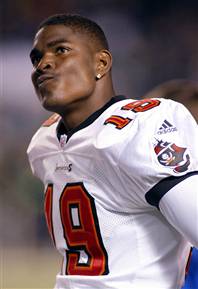
Highlighted Year: Keyshawn Johnson, 2001

Wide Receiver, Tampa Bay Buccaneers


Age: 29
6th season in pro football, 2nd with Buccaneers
College: Southern California
Height: 6’4”   Weight: 212

Prelude:
In two seasons at USC after transferring from West Los Angeles College, Johnson caught 168 passes for 2796 yards (16.6 avg.) and 16 touchdowns, including 102 for 1434 yards and 7 TDs in 1995. He received consensus first-team All-America recognition and was chosen by the New York Jets as the top overall selection in the 1996 NFL draft. Johnson showed off his potential, with 63 receptions for 844 yards and 8 TDs as a rookie, but also a distracting brashness. Big and physical, if not particularly fast, he followed up with another solid season in ’97 and, with the club improving dramatically overall, had consecutive Pro Bowl seasons in 1998 and ’99 as he caught over 80 passes and gained a thousand yards in each, scoring a combined 18 touchdowns. Johnson was traded to Tampa Bay in 2000 and had a lesser year, catching 71 passes for 874 yards and 8 TDs.

2001 Season Summary
Appeared in 15 of 16 games
[Bracketed numbers indicate league rank in Top 20]

Pass Receiving
Receptions – 106 [4, 1st in NFC]  
Most receptions, game – 12 (for 89 yds.) vs. Chicago 11/18
Yards – 1266 [7]
Most yards, game – 159 (on 10 catches) vs. Pittsburgh 10/21
Average gain – 11.9
TDs – 1
100-yard receiving games – 4

Scoring
TDs – 1
Points – 6

Postseason: 1 G (NFC Wild Card playoff at Philadelphia)
Pass receptions – 3
Pass receiving yards – 75
Average yards per reception – 25.0
Pass Receiving TDs – 0

Awards & Honors:
Pro Bowl

Buccaneers went 9-7 to finish third in the NFC Central and qualified for a Wild Card playoff spot. Lost NFC Wild Card playoff to Philadelphia Eagles (31-9).

Aftermath:
Johnson followed up with 76 catches for 1088 yards (14.3 avg.) and five touchdowns in 2002 as the Buccaneers won the NFL title, but as his relationship with the coaching staff deteriorated, he was deactivated for the last seven games of the ’03 season. Dealt to the Dallas Cowboys in 2004, Johnson continued to be a productive possession receiver for two seasons and finished up by catching 70 passes for 815 yards with Carolina in 2006. For his career, Johnson had 814 pass receptions for 10,571 yards (13.0 avg.) and 64 TDs. Of those totals, 298 for 3828 yards and 17 TDs were with Tampa Bay. He was selected to three Pro Bowls.

--

Highlighted Years features players who were consensus first-team All-League* selections or league* or conference** leaders in the following statistical categories:

Rushing: Yards, TDs (min. 10)
Passing: Yards, Completion Pct., Yards per Attempt, TDs, Rating
Receiving: Catches, Yards, TDs (min. 10)
Scoring: TDs, Points, Field Goals (min. 5)
All-Purpose: Total Yards
Defense: Interceptions, Sacks
Kickoff Returns: Average
Punt Returns: Average
Punting: Average

*Leagues include NFL (1920 to date), AFL (1926), AFL (1936-37), AAFC (1946-49), AFL (1960-69), WFL (1974-75), USFL (1983-85)

**NFC/AFC since 1970

November 12, 2016

1979: Eagles Defeat Cowboys in Monday Night Showdown


The Philadelphia Eagles faced an uphill battle as they took on the Dallas Cowboys in a Monday night game on November 12, 1979. Head Coach Dick Vermeil’s team had gotten off to a 6-1 start but, following three straight losses, was at 6-4 and in danger of falling out of contention in the NFC East. QB Ron Jaworski provided gritty leadership, HB Wilbert Montgomery was highly productive both running and receiving, and WR Harold Carmichael (pictured at right) had set a new NFL record by catching a pass in his 106th consecutive game the previous week. The defense lost its leader, MLB Bill Bergey, to a knee injury in the third week but was proving to be formidable and the kicking game, which had been a sore spot the previous year, was also much improved with the arrival of the barefoot-kicking rookie Tony Franklin.

The Cowboys were the defending NFC Champions and atop the division with an 8-2 record. In their twentieth season under Head Coach Tom Landry, they remained strong on offense with QB Roger Staubach throwing the ball and HB Tony Dorsett carrying, while the defense had weathered some key losses to retirement and injury to keep the club on track. Moreover, they had not lost to the Eagles at home since 1965 and were nine-point favorites.

There were 62,417 fans in attendance at Texas Stadium as well as a national television audience. The Cowboys had the first possession and, after Tony Dorsett ran for 24 yards on a sweep and FB Scott Laidlaw gained another eight, they came through with a big play when Roger Staubach went long to WR Tony Hill for a 48-yard touchdown. Rafael Septien added the extra point for the early 7-0 advantage.

Following a short series by the Eagles that resulted in a punt, Dallas was again on the move thanks to the running of Dorsett as well as Staubach but, after catching a second down pass, Dorsett was stripped of the ball by LB Jerry Robinson at the Philadelphia 41. It looked as though the reprieve would be a short one, but helped by a defensive holding call that nullified a third down sack, the Eagles maintained possession and Ron Jaworski passed to Harold Carmichael for 16 yards. A few plays later the drive stalled and, facing fourth-and-six, Tony Franklin was short on a 53-yard field goal attempt, but once again a Dallas penalty intervened and moved the visitors up five yards. Now facing fourth-and-one, the offense returned to the field and took the Cowboys by surprise as Jaworski passed to Carmichael for a 32-yard TD. Franklin added the game-tying point after.

Midway through the second quarter, the Eagles were back in scoring position after DB John Sciarra returned a Dallas punt 32 yards. Jaworski threw to Wilbert Montgomery for 15 yards but the series ultimately came up empty when Franklin was wide to the left on a 45-yard field goal try. With Staubach out due to a thigh injury, QB Danny White entered the game and the Cowboys were forced to punt following a short possession.

The Eagles lost their quarterback as well when Jaworski also had to leave the game due to a wrist injury suffered when he was hit by DE Harvey Martin and they turned to their backup, John Walton. The series ended with a punt but WR Steve Wilson of the Cowboys muffed the kick and LB Frank LeMaster recovered at the Dallas 29 with a minute remaining in the first half. The visitors immediately capitalized when Walton threw to WR Charlie Smith for a 29-yard touchdown and, with Franklin’s conversion, Philadelphia was ahead by 14-7.

However, the Eagles weren’t done as SS Randy Logan intercepted a White pass on the ensuing series at the Dallas 42 that set up a club-record 59-yard field goal by Franklin, giving the Eagles not only a 17-7 halftime lead but a psychological lift.

Both starting quarterbacks were back in the game in the third quarter. In a drive that featured the running of Montgomery and FB Leroy Harris, the Eagles advanced into Dallas territory and scored on a Jaworski pass to Carmichael in the right corner of the end zone for a 13-yard touchdown. Franklin added the extra point to make it a 24-7 contest.

The Cowboys, now in a deeper hole, responded with a five-play possession that started with Staubach passing to Hill for 36 yards to the Philadelphia 31, but they came up empty when Septien’s field goal attempt from 47 yards was short. Later in the period, the Eagles failed to extend their lead when Franklin missed from 52 yards.


With six minutes left to play, Dallas finally got on the board again in electrifying fashion when Staubach threw long again to Hill (pictured at left) for a 75-yard touchdown. Getting the ball back with 2:48 remaining on the clock, the Cowboys advanced 72 yards in nine plays that concluded with another Staubach scoring pass, this time to TE Billy Joe DuPree from five yards out. Septien successfully converted after each TD and the margin was thus narrowed further to 24-21 with 1:19 to play. But any hopes of a stunning comeback were dashed when, on the following series and facing a crucial third down, the Eagles sealed the win as Montgomery broke away for a 37-yard TD. Franklin’s point after capped the 31-21 victory.

The Cowboys had the edge in total yards (408 to 328) while the teams were even with 17 first downs apiece. However, Dallas turned the ball over five times, to none by the Eagles, and Philadelphia recorded five sacks, to three by the home team.

Ron Jaworski completed just 12 of 29 passes for 145 yards, but two were for touchdowns and there were no interceptions. John Walton was two-of-six for 41 yards and a TD in his relief appearance. Wilbert Montgomery rushed for 127 yards on 25 carries that included a touchdown. Harold Carmichael had four catches for 69 yards and two TDs and Charlie Smith contributed four receptions for 54 yards and a score. John Sciarra had an outstanding night averaging 13.8 yards on six punt returns. Tony Franklin made good on only one of his four field goal attempts, but it was a big one.

For the Cowboys, Roger Staubach was successful on 17 of 28 throws for 308 yards and three TDs with none intercepted. Tony Hill (pictured at left) had a big night in defeat, catching 7 passes for 213 yards and two touchdowns. Tony Dorsett gained 53 yards on 13 rushing attempts and had 7 catches for 64 more yards.

The Eagles climbed to a game behind Dallas with the win. It was the first of four straight and five in the last six games, but Philadelphia lost the rematch with the Cowboys and, while both clubs finished at 11-5, it was Dallas winning the division and the Eagles placing second, although reaching the postseason as a Wild Card. They defeated the Bears in the first round but lost to Tampa Bay at the Divisional level. Dallas also fell in the Divisional round, losing to the Rams.

Both Harold Carmichael and Wilbert Montgomery had Pro Bowl seasons, with Carmichael catching 52 passes for 872 yards (16.8 avg.) and 11 touchdowns and Montgomery gaining 2006 yards from scrimmage (1512 on 338 rushing attempts, 494 on 41 pass receptions) and compiling 14 TDs.


Tony Franklin (pictured at right) ended up kicking 23 field goals out of 31 attempts, with three of them coming from over 50 yards. Prone to inconsistency, his 74.2 percentage was the best of his five years in Philadelphia, although he would go on to better years in New England. The 59-yard field goal against the Cowboys remained his career high by far.

Tony Hill ended up with 60 catches for 1062 yards (17.7 avg.) and 10 touchdowns, and received Pro Bowl honors for the second year. His 213-yard pass receiving total against the Eagles remained his career best.

November 10, 2016

Highlighted Year: Norm Johnson, 1984

Placekicker, Seattle Seahawks


Age:  24
3rd season in pro football & with Seahawks
College: UCLA
Height: 6’2”   Weight: 193

Prelude:
Undrafted coming out of college, Johnson signed with the Seahawks and made the club, hitting on 10 of 14 field goal attempts during the strike-shortened 1982 season. He followed up with another solid year in ’83, kicking 18 field goals out of 25 attempts and 49 of his 50 extra point tries for a total of 103 points.

1984 Season Summary
Appeared in all 16 games
[Bracketed numbers indicate league rank in Top 20]

Kicking
Field goals – 20 [14, tied with five others]
Most field goals, game – 4 vs. Cleveland 9/3
Field goal attempts – 24
Most field goal attempts, game – 4 vs. Cleveland 9/3
Field goal percentage – 83.3 [3]
PATs – 50 [3]
PAT attempts – 51 [3, tied with Mark Moseley & Neil O’Donoghue]
Longest field goal – 50 yards vs. Cleveland 9/3

Scoring
Field Goals – 20
PATs – 50
Points – 110 [7]

Postseason: 2 G
Field goals – 3
Most field goals, game – 2 vs. LA Raiders, AFC Wild Card playoff
Field goal attempts – 4
Most field goal attempts, game – 2 vs. LA Raiders, AFC Wild Card playoff; at Miami, AFC Divisional playoff
PATs – 2
Most PATs, game – 1 vs. LA Raiders, AFC Wild Card playoff; at Miami, AFC Divisional playoff
PAT attempts – 2
Longest field goal – 44 yards vs. LA Raiders, AFC Wild Card playoff

Awards & Honors:
1st team All-NFL: AP, PFWA, Pro Football Weekly, Sporting News
2nd team All-NFL: NEA
1st team All-AFC: UPI, Pro Football Weekly
Pro Bowl

Seahawks went 12-4 to finish second in the AFC West and qualified for the postseason as a Wild Card. Won AFC Wild Card playoff over Los Angeles Raiders (13-7). Lost AFC Divisional playoff to Miami Dolphins (31-10).   

Aftermath:
Outstanding at kicking off as well as consistent on field goals, Johnson went on to spend nine seasons with the Seahawks, through 1990. He left as the franchise leader in field goals (159) and scoring (810 points). Johnson went on to spend four years with Atlanta, gaining Pro Bowl recognition in 1993 when he was successful on 26 of 27 field goal attempts for a league-leading percentage of 96.3. Joining Pittsburgh in 1995 he led the NFL with a career-high 34 field goals and the AFC by scoring 141 points. He spent four years with the Steelers and finished his career with the Philadelphia Eagles in 1999 at the age of 39. Over the course of 18 seasons, Johnson kicked 366 field goals in 477 attempts (76.7 %) and 638 PATs for a total of 1736 points, which ranked fourth in NFL history at the time. He added another 20 field goals in 26 postseason attempts, including four in Pittsburgh’s AFC Divisional playoff win over Buffalo following the 1995 season. Johnson received consensus first-team All-NFL honors after one season, some first- and second-team recognition after one other year, and was twice selected to the Pro Bowl.

--

Highlighted Years features players who were consensus first-team All-League* selections or league* or conference** leaders in the following statistical categories:

Rushing: Yards, TDs (min. 10)
Passing: Yards, Completion Pct., Yards per Attempt, TDs, Rating
Receiving: Catches, Yards, TDs (min. 10)
Scoring: TDs, Points, Field Goals (min. 5)
All-Purpose: Total Yards
Defense: Interceptions, Sacks
Kickoff Returns: Average
Punt Returns: Average
Punting: Average

*Leagues include NFL (1920 to date), AFL (1926), AFL (1936-37), AAFC (1946-49), AFL (1960-69), WFL (1974-75), USFL (1983-85)

**NFC/AFC since 1970

November 8, 2016

1976: Bengals Break Out in Third Quarter to Defeat Rams


The Monday night NFL game on November 8, 1976 featured two contenders, the Cincinnati Bengals and Los Angeles Rams, both of which were battling for control in their respective divisions.

The Bengals were 6-2 under first-year Head Coach Bill Johnson, successor to Paul Brown (the founding coach and still owner and GM), and seeking to remain ahead of the Pittsburgh Steelers in the AFC Central. The offense featured the efficient passing of QB Ken Anderson while the defense, which already had an outstanding backfield that included CB Ken Riley and SS Tommy Casanova, was benefiting from the pass-rushing prowess of DE Coy Bacon. 

The Rams, coached by Chuck Knox, had a 6-1-1 record and were looking to pick up ground on the 49ers in the NFC West, which they had topped in each of the previous three seasons. While there was instability at quarterback, with James Harris the current starter, the running game, featuring HB Lawrence McCutcheon, was sound and the tough defense was effective against both the run and the pass.

It was a cold 27-degree night at Riverfront Stadium with 52,480 fans in attendance. On the first play from scrimmage, Coy Bacon clotheslined FB John Cappelletti of the Rams behind the line of scrimmage, causing a fumble that DT Bob Brown recovered for the Bengals. They were unable to cash in a few plays later, however, when Chris Bahr’s 44-yard field goal was nullified by a penalty and his second try from 50 yards missed the mark.

Cincinnati’s next possession ended with a punt and Pat McInally’s shanked kick traveled only 24 yards. That set up a 50-yard drive in seven plays by the Rams in which Cappelletti had runs of 9 and 17 yards and a pass interference penalty gave Los Angeles a first down at the Cincinnati 24. But after advancing to the two, the visitors couldn’t reach the end zone and settled for Tom Dempsey’s 19-yard field goal that nevertheless put them ahead by 3-0.

The Bengals had a breakaway run by rookie HB Archie Griffin canceled by a penalty and remained stymied on offense for the remainder of the half. Meanwhile, the Rams had another shot when they gained possession at midfield, but penalties kept them out of scoring range.

In the second quarter, the Rams put together a 13-play, 80-yard possession but, after reaching the Cincinnati 15, Lawrence McCutcheon was stopped for a three-yard loss on first down and the drive stalled. Dempsey booted a 23-yard field goal that extended the lead to 6-0. In their last series of the first half, LA reached the Cincinnati 28 but QB James Harris fumbled when sacked by Bacon, and while the Rams recovered, they lost 14 yards and were taken out of field goal range. The score remained unchanged at halftime.

The Rams outgained Cincinnati 173 yards to 57 in the first half, but had only two field goals to show for it. Ken Anderson was ineffective in the first 30 minutes, completing just two of 12 passes for five yards as the Los Angeles defense kept the receivers in check.

The tables began to turn early in the third quarter. Harris fumbled while being sacked by DE Gary Burley and Ken Riley’s recovery gave the Bengals possession at the LA nine. Cincinnati quickly cashed in as FB Boobie Clark (pictured below) ran for a touchdown on the next play and Chris Bahr kicked the extra point to put the home team in the lead by 7-6.


The score off of the turnover ignited the Cincinnati offense. On their next series, the Bengals advanced 80 yards in six plays as Ken Anderson threw to Clark for 19 yards, had a 25-yard run, and followed up by firing a pass to TE Bob Trumpy, who split the safeties for a 30-yard TD. The extra point try failed, but Cincinnati’s lead was now 13-6.

The Rams were forced to punt from deep in their own territory and Cincinnati went 53 yards in seven plays on the next possession. Anderson completed passes to WR Billy Brooks for 14 yards and TE Bruce Coslet for 17 before a toss to Clark coming out of the backfield went the distance for a 17-yard touchdown. Bahr successfully converted this time and the Bengals were up by 20-6.

There was still plenty of time and the Rams had scoring opportunities in the fourth quarter. First, they reached the Cincinnati 14, but a second down pass by Harris intended for WR Ron Jessie bounced off the receiver’s hands and was intercepted by Tommy Casanova. On their next possession, the Rams advanced to the Cincinnati five, but again turned the ball over when McCutcheon fumbled and FS Bernard Jackson recovered.

Late in the game, and following a fumble by HB Tony Davis that LB Isiah Robertson recovered at the Cincinnati 38, LA finally reached the end zone three plays later. Harris completed passes to McCutcheon for 21 yards and to Jessie for a 17-yard TD. But Dempsey missed the point after, maintaining an eight-point spread, and the Bengals held on to win by a final score of 20-12.

The Rams led in total yards (342 to 299) and first downs (21 to 15). However, they also turned the ball over four times, to two by Cincinnati, and squandered too many scoring opportunities.

Ken Anderson overcame his slow start to complete 11 of 26 passes for 132 yards and two touchdowns while giving up one interception, and was particularly sharp during Cincinnati’s scoring drives in the third quarter. Boobie Clark rushed for 70 yards on 16 carries that included a TD and added another score among his three catches for 30 yards. Billy Brooks also contributed three pass receptions for 44 yards.


For the Rams, James Harris was successful on 16 of 28 throws for 193 yards and a TD as well as an interception. John Cappelletti (pictured at right) topped the runners with 86 yards on 20 carries and Lawrence McCutcheon added 76 yards on his 20 attempts. WR Harold Jackson and Ron Jessie caught 5 passes apiece, for 75 and 59 yards, respectively, and Jessie scored LA’s only touchdown.

Cincinnati kept on winning and was at 9-2 before losing two straight contests, including the rematch with the Steelers. Both ended up at 10-4 and the Bengals, having been swept by Pittsburgh in the season series, found themselves in second place and out of the playoffs. As for the Rams, Coach Knox made a change at quarterback following the loss to the Bengals, replacing James Harris with Pat Haden. They went 4-1 the rest of the way to once again top the NFC West with a 10-3-1 record but, after edging the Cowboys in the Divisional playoff round, lost the NFC Championship game to Minnesota.

Ken Anderson didn’t lead the NFL in passing, as he had in 1974 and ’75, but he still had a respectable year as he threw for 2367 yards and 19 touchdowns, while giving up 14 interceptions, and had a passer rating of 76.9. He was selected to the Pro Bowl.

November 7, 2016

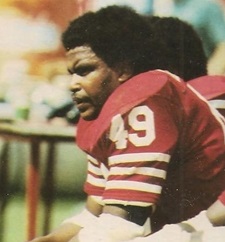
Highlighted Year: Earl Cooper, 1980

Fullback, San Francisco 49ers


Age: 23 (Sept. 17)
1st season in pro football
College: Rice
Height: 6’2”   Weight: 227

Prelude:
Cooper was an effective all-around back in college, rushing for 1583 yards on 407 carries and catching 101 passes for 802 yards. Altogether he totaled 2385 yards from scrimmage and 21 touchdowns. Attracted by his size and ability to catch the ball, he was chosen by the 49ers in the first round of the 1980 NFL draft (13th overall) and proved to be a productive receiver out of the backfield in Head Coach Bill Walsh’s West Coast offense.

1980 Season Summary
Appeared and started in all 16 games
[Bracketed numbers indicate league rank in Top 20]

Rushing
Attempts – 171
Most attempts, game – 21 (for 86 yds.) vs. NY Giants 11/23
Yards – 720
Most yards, game – 90 yards (on 15 carries) vs. Buffalo 12/21
Average gain – 4.2 [16]
TDs – 5

Pass Receiving
Receptions – 83 [2, 1st in NFC]
Most receptions, game – 10 (for 71 yds.) at New Orleans 9/7
Yards – 567
Most yards, game – 84 (on 3 catches) vs. NY Giants 11/23
Average gain – 6.8
TDs – 4

Scoring
TDs – 9 [12, tied with eight others]
Points – 54

49ers went 6-10 to finish third in the NFC West.

Aftermath:
Cooper rushed for 330 yards on 98 carries and caught 51 passes for 477 yards during the 1981 season that ended with a win in the Super Bowl, where he also contributed a touchdown catch. However, he proved to not be an effective inside runner and lost his starting job during the strike-shortened 1982 season. Cooper was shifted to backup tight end in ’83 due to his pass receiving skills and had his best year at that position in 1984, with 41 catches for 459 yards and four TDs, but lasted just one more season in San Francisco and finished his career in 1986 with the Raiders. Overall, Cooper rushed for 1152 yards on 298 carries (3.9 avg.) and caught 213 passes for 1908 yards (9.0 avg.), scoring a total of 18 touchdowns.

--

Highlighted Years features players who were consensus first-team All-League* selections or league* or conference** leaders in the following statistical categories:

Rushing: Yards, TDs (min. 10)
Passing: Yards, Completion Percentage, Yards per Attempt, TDs, Rating
Receiving: Catches, Yards, TDs (min. 10)
Scoring: TDs, Points, Field Goals (min. 5)
All-Purpose: Total Yards
Defense: Interceptions, Sacks
Kickoff Returns: Average
Punt Returns: Average
Punting: Average

*Leagues include NFL (1920 to date), AFL (1926), AFL (1936-37), AAFC (1946-49), AFL (1960-69), WFL (1974-75), USFL (1983-85)

**NFC/AFC since 1970

November 5, 2016

1989: Oilers Outlast Lions in Back-and-Forth Battle


The Houston Oilers had a 4-4 record as they hosted the Detroit Lions on November 5, 1989. The Oilers were a talented team, most notably on offense where QB Warren Moon (pictured above) was a formidable passer in the team’s version of the run-and-shoot. However, under Head Coach Jerry Glanville, they were also prone to undisciplined play and inconsistency. 

Detroit also operated a run-and-shoot offense, but Head Coach Wayne Fontes’ club was struggling at 1-7. Rookie RB Barry Sanders was having an impact but the passing game had yet to click. The Lions were also leading the league in turnovers with 30 thus far.

There were 48,056 fans in attendance at the Astrodome. The Lions had the first possession and drove 83 yards in nine plays as rookie QB Rodney Peete started off with a completion to WR Robert Clark for 47 yards to the Houston 36. From there it was Barry Sanders carrying on almost every play until diving into the end zone from a yard out for a touchdown. Ed Murray added the extra point for the 7-0 lead.

Houston responded with a 10-play, 75-yard series. Facing third-and-four, Warren Moon threw to WR Ernest Givins on a crossing pattern to pick up 32 yards to the Detroit 37 and, three plays later, RB Mike Rozier converted a fourth-and-one situation with a run for the necessary yard. A pass interference penalty in the end zone set up RB Lorenzo White’s one-yard carry for a TD and Tony Zendejas added the game-tying point after.

As the game headed into the second quarter, the Oilers again had the ball in Detroit territory. But after reaching the 32, Moon fumbled when hit by SS Bennie Blades and LB Chris Spielman recovered for the Lions, with his 19-yard return giving them possession at the Houston 49. Eight plays later, a scrambling Peete passed to Clark for a 16-yard touchdown, Murray converted, and the visitors were back in front by 14-7.


The Oilers came back with a long drive of 89 yards in 15 plays. Moon completed six passes along the way, with tosses to WR Haywood Jeffires for 25 yards and WR Drew Hill (pictured at right) for 18. Another throw to Hill for six yards converted a fourth-and-one situation and a personal foul on the Oilers on a third down play gave the home team first-and-goal at the Detroit six. Rozier ran the last yard for a TD, Zendejas added the extra point, and the score was again knotted at 14-14.

With the time down to less than three minutes to go in the first half, the Lions put together an eight-play, 60-yard possession. Peete connected with WR Walter Stanley for 18 yards and Clark for 25 as Detroit advanced into scoring territory, and Murray kicked a 47-yard field goal to put the visitors ahead by 17-14 at halftime.

On the first play from scrimmage of the third quarter, Rozier fumbled and, after Detroit DE Kevin Brooks grabbed the ball in the air but also couldn’t maintain possession, FS William White picked it up and ran 20 yards for a touchdown. Murray’s point after put the Lions further ahead at 24-14. Now down by ten points and following a 28-yard kickoff return by DB Kenny Johnson to the Houston 43, the Oilers drove 57 yards in seven plays. Six of them were pass completions by Moon, the longest to Hill for 25 yards and the last to Givins in the back of the end zone for a six-yard TD. Zendejas converted to again make it a three-point contest.

After a punt by the Lions, Houston had another scoring drive, advancing 78 yards in ten plays. Detroit’s defense still couldn’t stop Moon’s passes, including the last one to Hill for a seven-yard touchdown. Zendejas added the extra point and the home team was in front, 28-24.

The Lions had the ball as the game entered the fourth quarter and punted, but immediately got the ball back when Moon’s throw down the middle was intercepted by LB Jimmy Williams. Two plays later Peete connected with Clark for a 22-yard gain to the Houston 18, but the receiver fumbled and LB Eric Fairs recovered for the Oilers. The home team proceeded to put together a long 18-play, 87-yard drive that ran more than ten minutes off the clock. Moon finished it off with a run this time, carrying for a two-yard TD, and Zendejas converted.

With 3:15 left to play, Detroit fought back with an eight-play, 69-yard possession that was kept going when a Peete completion to Clark gained 19 yards in a fourth-and-nine situation. The series concluded with Sanders running 14 yards for a TD on a draw play. Murray kicked the point after and it was a four-point contest, although with the time remaining down to 1:41. 

It appeared that the Oilers would be able to run out the clock, but the Lions got a break when, after catching a third down pass, Givins fumbled and CB Terry Taylor recovered and ran 35 yards to give Detroit the ball at midfield. But any chance of the visitors pulling out a dramatic win ended three plays later when a sideline pass by Peete was deflected and picked off by a leaping DB Tracey Eaton with 56 seconds to go. Houston won by a final score of 35-31.

The Oilers led in total yards (455 to 351), first downs (30 to 19), and time of possession (39:39 to 20:21). Houston never punted but turned the ball over four times, to two by the Lions, and was penalized 10 times at a cost of 85 yards, to seven flags for 50 yards thrown on Detroit.

Warren Moon completed 30 of 38 passes for 345 yards and two touchdowns while giving up one interception. He also ran the ball 8 times for 22 yards and a TD. Drew Hill topped the Houston receivers with 9 catches for 101 yards and a touchdown. Ernest Givins and WR Curtis Duncan had six pass receptions apiece, for 77 and 66 yards, respectively, and Givins had a score. RB Allen Pinkett led the runners with 40 yards on 8 attempts.


For the Lions, Rodney Peete (pictured at left) was successful on 18 of 29 throws for 273 yards and a TD while being intercepted once. Robert Clark grabbed 6 passes for 141 yards and a touchdown and WR Richard Johnson contributed 6 receptions for 77 yards. Barry Sanders rushed for 91 yards on 19 carries that included two TDs.

“We felt our offense could score every time we went out on the field,” said Warren Moon. “When we did get stopped it was because we stopped ourselves with fumbles and penalties.”

The Oilers surged to four wins in their next five games, but tailed off badly at the end and finished with a 9-7 record that placed second in the AFC Central and qualified for a Wild Card playoff slot. They lost to Pittsburgh in the first round. Detroit caught fire following the close loss to Houston, winning six of their last seven and ending up with a respectable 7-9 tally that ranked third in the NFC Central.

November 4, 2016

Highlighted Year: Dan Fouts, 1980

Quarterback, San Diego Chargers


Age:  29
8th season in pro football & with Chargers
College: Oregon
Height: 6’3”   Weight: 210

Prelude:
A third-round draft choice by the Chargers in 1973, Fouts gradually took over the starting job as a rookie while an over-the-hill Johnny Unitas faded from the scene in his last season. He struggled for the next two years but benefited from the presence of Bill Walsh as offensive coordinator in 1976. Fouts missed the first 10 games in ’77 due to a lawsuit against the NFL, although he performed well upon his return. Head Coach Tommy Prothro was replaced by the pass-oriented Don Coryell during the 1978 season, and the sturdy drop-back passer’s career benefited greatly. After leading the NFL in yards per attempt in ’78 (7.9), he set a new passing yardage record in 1979 with 4082, led the league in completion percentage (62.6), and was a consensus first-team All-NFL and Pro Bowl selection.  

1980 Season Summary
Appeared and started in all 16 games
[Bracketed numbers indicate league rank in Top 20]

Passing
Attempts – 589 [1]
Most attempts, game – 45 vs. Denver 11/9
Completions – 348 [1]
Most completions, game – 29 vs. Oakland 9/14, vs. Denver 11/9
Yards – 4715 [1]
Most yards, game – 444 vs. NY Giants 10/19
Completion percentage – 59.1 [10]
Yards per attempt – 8.0 [2]
TD passes – 30 [2, tied with Vince Ferragamo & Brian Sipe, 1st in AFC]
Most TD passes, game – 4 at Seattle 9/7
Interceptions – 24 [5]
Most interceptions, game – 5 vs. Oakland 9/14
Passer rating – 84.7 [6]
400-yard passing games – 1
300-yard passing games – 8
200-yard passing games – 15

Rushing
Attempts – 23
Most attempts, game – 5 (for -5 yds.) vs. Philadelphia 11/30
Yards – 15
Most yards, game – 12 yards (on 2 carries) at Miami 11/20
Yards per attempt – 0.7
TDs – 2

Scoring
TDs – 2
Points – 12

Postseason: 2 G
Pass attempts – 82
Most pass attempts, game – 45 vs. Oakland, AFC Championship
Pass completions – 44
Most pass completions, game – 22 vs. Buffalo, AFC Divisional playoff; vs. Oakland, AFC Championship
Passing yardage – 650
Most passing yards, game – 336 vs. Oakland, AFC Championship
TD passes – 4
Most TD passes, game – 2 vs. Buffalo, AFC Divisional playoff; vs. Oakland, AFC Championship
Interceptions – 3
Most interceptions, game – 2 vs. Oakland, AFC Championship

Rushing attempts – 3
Most rushing attempts, game – 2 vs. Buffalo, AFC Divisional playoff
Rushing yards – -4
Most rushing yards, game – 2 vs. Oakland, AFC Championship
Average gain rushing – -1.3
Rushing TDs – 0

Awards & Honors:
2nd team All-NFL: AP
2nd team All-AFC: UPI
Pro Bowl

Chargers went 11-5 to finish first in the AFC West while leading the NFL in total yards (6410) and passing yards (4531). Won AFC Divisional playoff over Buffalo Bills (20-14). Lost AFC Championship to Oakland Raiders (34-27).

Aftermath:
With an outstanding group of receivers to throw to in the Air Coryell passing game, Fouts broke his passing yardage record once again with 4802 yards in 1981 while leading the NFL in attempts (609) and completions (360) as well as TD passes (33). He was a Pro Bowl selection for a third straight year, although the Chargers once again came up short in the playoffs. In the strike-shortened ’82 season Fouts led the NFL in passing yards (2883), TD passes (17), and yards per attempt (8.7) and received MVP honors from the PFWA and NEA as well as Offensive Player of the Year recognition from AP. Playing in just 10 games in 1983, Fouts again achieved Pro Bowl recognition. While he never again passed for 4000 yards in the remaining five years of his career, he did throw for over 3000 three more times, led the league in yards per attempt (8.5) and TD percentage (6.3) in 1985, and was twice more selected to the Pro Bowl (for a total of six). At the time of his retirement, he ranked second all-time in NFL career pass attempts (5604), completions (3297), and yards (43,040) and had a passer rating of 80.2. The Chargers retired his #14 and Fouts was inducted into the Pro Football Hall of Fame, Class of 1993.

--

Highlighted Years features players who were consensus first-team All-League* selections or league* or conference** leaders in the following statistical categories:

Rushing: Yards, TDs (min. 10)
Passing: Yards, Completion Pct., Yards per Attempt, TDs, Rating
Receiving: Catches, Yards, TDs (min. 10)
Scoring: TDs, Points, Field Goals (min. 5)
All-Purpose: Total Yards
Defense: Interceptions, Sacks
Kickoff Returns: Average
Punt Returns: Average
Punting: Average

*Leagues include NFL (1920 to date), AFL (1926), AFL (1936-37), AAFC (1946-49), AFL (1960-69), WFL (1974-75), USFL (1983-85)

**NFC/AFC since 1970