January 21, 2011

2007: Colts Come from Behind to Defeat Patriots for AFC Championship


In the first four seasons under Head Coach Tony Dungy, the Indianapolis Colts had reached the postseason. However, they had yet to advance to the Super Bowl, and in two of those years it had been losses to the New England Patriots that had brought them up short. The Patriots, led by Head Coach Bill Belichick, had proceeded to win championships in both of those postseasons. On January 21, 2007 the two teams met in the AFC Championship game at the RCA Dome in Indianapolis, with New England looking to advance to the Super Bowl for the fourth time in six years, and the Colts seeking to finally get past them.

The key to the Colts offense was QB Peyton Manning (pictured above), as had been the case since his rookie season in 1998. He led the NFL in passing (101.0 rating) and touchdown passes (31) in 2006, and was second in passing yards (4397) and third in completion percentage (65.0). With the departure of RB Edgerrin James to the Cardinals, Joseph Addai and Dominic Rhodes combined for 1722 yards on the ground and 76 pass receptions. Pro Bowl wide receivers Marvin Harrison (95 catches, 1366 yards) and Reggie Wayne (86 receptions for 1310 yards) were outstanding, as usual. However, the defense had great difficulty against the run and the team slumped during the second half of the season as a result, losing four of the last seven games. Still, they won the AFC South for the fourth straight year with a 12-4 record and defeated the Chiefs and Ravens to get to the conference title game.

New England had a star quarterback as well, Tom Brady, who had taken over for the injured Drew Bledsoe during the 2001 season and had proceeded to lead the Patriots to ten straight postseason victories (including three Super Bowls) before finally suffering a loss in the Divisional round following the ’05 season. Despite a lack of quality receivers, Brady still threw for 3529 yards and 24 touchdowns in 2006. Veteran RB Corey Dillon and rookie Lawrence Maroney ran for a total of 1557 yards. The defense featured the outstanding line of ends Richard Seymour and Ty Warren and NT Vince Wilfork, a capable linebacking corps, and CB Asante Samuel, with his 10 interceptions.

There were 57,433 fans in attendance under the dome, and the home crowd made plenty of noise during key points in the contest. Things began quietly on the field, however, as the teams traded punts to start the game. On their second possession, the Patriots opened with Brady completing an 18-yard pass to WR Reche Caldwell and, on fourth-and-one at the Indianapolis 48, Dillon took off on a 35-yard run to the 13 yard line. Three plays later, Maroney fumbled, the ball rolled into the end zone, and G Logan Mankins fell on it for a touchdown.

The Colts responded with a long, 14-play drive in which Manning completed six passes. Ex-Patriot Adam Vinatieri kicked a 42-yard field goal to narrow New England’s lead to 7-3.


The Patriots started off the second quarter by finishing a 72-yard possession with a seven-yard run by Dillon. Two plays after the ensuing kickoff, Manning was intercepted by Samuel (pictured at left), who returned it 39 yards for a TD. The Patriots were ahead by 21-3 and it seemed as though they would once again prevail over the Colts. Indianapolis scored once again before the half, on a 26-yard Vinatieri field goal, and the tally was 21-6 at the intermission.

The Colts received the second half kickoff and proceeded to drive 76 yards in 14 plays that culminated in a one-yard touchdown run by Manning. Following a three-and-out possession by the Patriots, the Colts drove to another score as Manning completed a 25-yard pass to TE Dallas Clark and Rhodes had a 19-yard run. A pass interference call on New England CB Ellis Hobbs moved the ball to the one, and from there Manning tossed a TD pass to OT Dan Klecko on a tackle-eligible play. The Colts went for a two-point conversion and succeeded on a Manning pass to Harrison, tying the score at 21-21.

The Patriots came right back as Hobbs, making up for the big penalty, returned the ensuing kickoff 80 yards to the Indianapolis 21 yard line. Following a one-yard loss on a run by Maroney, Brady completed a 17-yard pass to WR Jabar Gaffney and three plays later threw to Gaffney again for a six-yard touchdown to put New England back in front at 28-21.

In a drive that extended into the fourth quarter, the Colts went 67 yards in seven plays, featuring a Manning-to-Clark pass play that covered 23 yards down to the New England nine. On second-and-goal from the one, Rhodes got the ball but fumbled and C Jeff Saturday recovered in the end zone for a Colts touchdown – the third lineman to score a TD in the game, with Mankins having scored in the same manner in the first quarter for the Patriots and Klecko catching the scoring pass for Indianapolis. In any event, following the successful extra point, the back-and-forth game was again tied at 28-28.

Both teams went three-and-out on their next possessions. With just over ten minutes remaining in regulation, Brady fired completions of 16 yards to Caldwell, 14 yards to Gaffney, and seven to WR Troy Brown as the Patriots reached the Indianapolis 13 yard line. The drive sputtered at the 10 and Stephen Gostkowski kicked a 28-yard field goal to give New England the lead at 31-28.

Once again the Colts responded in kind, as on the first play of their next possession Manning completed a pass to Clark that covered 52 yards to the Patriots’ 25. Four plays later, Vinatieri connected on a 36-yard field goal to once more knot the score at 31-31.

Hobbs returned the kickoff 41 yards and Brady threw to TE Daniel Graham for a 25-yard gain down to the Indianapolis 25. Gostkowski booted a 43-yard field goal, and with the clock now down to 3:49, the Patriots were back in front at 34-31.

Manning threw three incomplete passes on the next possession and the Colts punted. The Patriots reached nearly to midfield and had to punt it back. Taking over at the 20 yard line with 2:17 to play, Manning threw to Wayne for 11 yards and then, after an incomplete pass, connected with TE Bryan Fletcher for 32 yards to the New England 37. A 14-yard completion to Wayne received additional yardage due to a roughing-the-passer penalty, and following the two-minute warning, Addai ran the ball three straight times, the last for a three-yard touchdown (pictured below).


With the successful PAT, the Colts were up by four points, but the Patriots got the ball back with 54 seconds on the clock and two timeouts left. Following an incompletion, Brady was successful on passes of 19 yards to TE Ben Watson and 15 to RB Heath Evans to get the ball into Colts territory. But DB Marlin Jackson intercepted a pass intended for Brown to snuff out the threat and preserve the 38-34 win for Indianapolis.

The Colts outgained New England (455 yards to 319) and had more first downs (32 to 17). Both teams suffered just one turnover apiece. The Patriots sacked Manning three times, while Brady was dumped just once, but were penalized eight times, to four flags thrown on the Colts.

Peyton Manning completed 27 of 47 passes for 349 yards with a touchdown and an interception. Dallas Clark (pictured below) caught 6 passes for 137 yards while Reggie Wayne grabbed 5 for 68 and Marvin Harrison had a relatively quiet day at 4 receptions for 41 yards. Dominic Rhodes led the Indianapolis runners with 69 yards on 14 carries and Joseph Addai contributed 56 yards and the winning TD on his 14 attempts.


For the Patriots, Tom Brady (pictured below left) was successful on 21 of 34 passes for 232 yards, also with a TD and an interception. Ben Watson caught 5 passes for 48 yards to lead the receivers, while Reche Caldwell had 46 yards on his 4 receptions. Corey Dillon was the leading rusher with 48 yards on seven carries.


“I'm so proud of the way our guys fought,” said Tony Dungy afterward. “I'm very happy for Peyton. He was very, very calm. He had to bring us from behind three or four times. It's just fitting. Our team went the hard way the whole year.”

The Colts went on to defeat the Chicago Bears in the Super Bowl, finally reaching the NFL summit. New England would retool in the offseason and come back stronger.

January 20, 2011

1985: Montana & 49ers Beat Marino & Dolphins in Super Bowl XIX


The playoffs have often yielded surprises when it comes to Super Bowl participants, but such was not the case in Super Bowl XIX on January 20, 1985. Both the San Francisco 49ers and Miami Dolphins were widely perceived to be the best that their respective conferences had to offer.

The 49ers had roared to the top of the NFC West with a 15-1 record in 1984 and easily dispatched the Giants and Bears in the postseason. Under the innovative guidance of Head Coach Bill Walsh, the club was best known for its offense but was solid on defense as well. QB Joe Montana (pictured above) skillfully directed the attack, RB Wendell Tyler ran for 1262 yards, and there were three Pro Bowlers on the offensive line in C Fred Quillan, G Randy Cross, and OT Keith Fahnhorst. The defense had to make due without star pass rushing DE Fred Dean for much of the season due to a contract dispute, but still had solid performers in DE Dwaine Board and OLB Keena Turner. All four members of the backfield were selected for the Pro Bowl (cornerbacks Ronnie Lott and Eric Wright, FS Dwight Hicks, and SS Carlton Williamson).

Miami, under Head Coach Don Shula, went 14-2 in winning the AFC East and defeated the Seahawks and Steelers in the playoffs on the way to the Super Bowl. The passing game was nothing short of spectacular as second-year QB Dan Marino re-wrote the record book in setting new season records for passing yards (5084) and touchdown passes (48, exceeding the previous mark by 12). WR Mark Clayton set a new standard for TD catches in a season (18) and he and WR Mark Duper each caught over 70 passes and exceeded 1300 yards. The defense included the “Killer Bees”, ends Doug Betters and Kim Bokamper, NT Bob Baumhower, and LB Bob Brudzinski, plus Pro Bowl ILB A.J. Duhe.

There were 84,059 fans in attendance at Stanford Stadium along with the usual mammoth television audience. Following a punt by the 49ers, the Dolphins drove 45 yards on six plays, featuring a 25-yard pass from Marino to RB Tony Nathan, and scored the first points of the game on a 37-yard field goal by Uwe van Schamann. San Francisco wasted no time in responding, however, as short passes by Montana and runs by Tyler got the Niners to the Miami 48 yard line. Facing a third-and-seven situation, Montana took off on a 15-yard run for a first down, and on the next play he threw to RB Carl Monroe for a 33-yard touchdown.

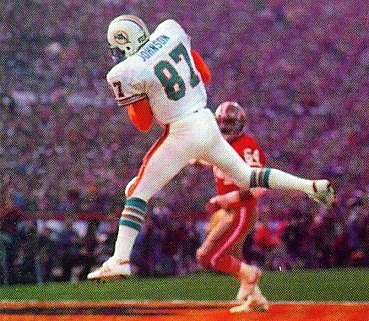
Miami went into a no-huddle offense the next time it had the ball and Marino completed five straight passes, including the last for a two-yard TD to TE Dan Johnson (pictured below). The Dolphins held a 10-7 lead after one quarter.


The 49ers punted following their next possession, but a defensive adjustment caused Miami to go three-and-out the next three times it was on offense. Coach Walsh had gone to an “elephant” defense, a 4-2-5 alignment with safety Tom Holmoe as a nickel back and another safety, Jeff Fuller, lined up at linebacker along with Turner, and it proved to be effective. Marino, who had completed nine of his first ten passes, didn’t complete another until near the end of the half.

Meanwhile, San Francisco took control of the game. Following a poor 37-yard punt by Reggie Roby from his own end zone, the 49ers had good field position at the Miami 47. Montana again showed off his mobility by running for a 19-yard gain on the first play, and then passed to WR Dwight Clark for another 16 yards. Two plays later, he tossed an eight-yard scoring pass to RB Roger Craig and the 49ers retook the lead at 14-10.

With the 49ers getting the ball in good field position at their own 45 to start their next possession, Tyler and Craig ran the ball for a total of 15 yards and then Montana threw back-to-back completions to TE Russ Francis for another 29. Following a five-yard carry by Craig, Montana ran six yards for a touchdown on a quarterback keeper and the lead was strechted to 21-10.

San Francisco scored once more in the second quarter, on a nine-yard drive that covered 52 yards and culminated in a two-yard run by Craig for a touchdown. Coming down to the last two minutes of the half, Marino began completing passes again, going 7 for 11 as the Dolphins drove to the 49ers’ 13 yard line and van Schamann kicked a 31-yard field goal with 12 seconds remaining.

It wasn’t over, however, as G Guy McIntyre fumbled the squibbed Miami kickoff and WR Jim Jensen recovered for the Dolphins at the San Francisco 12. Another van Schamann field goal, this time from 30 yards, made the score 28-16 at halftime.

Miami received the second half kickoff but wasn’t able to maintain the momentum generated at the end of the second quarter. Nathan was thrown for a one-yard loss, Marino threw an incompletion, and then the quarterback was sacked for a nine-yard loss by Board. Following Roby’s punt, the 49ers took nine plays to drive 43 yards and Ray Wersching kicked a 27-yard field goal.


Once again the Dolphins had difficulty moving the ball as Marino (pictured at left) faced tremendous pressure from the San Francisco defense. The Niners’ offense continued to move effectively – on their next possession following the field goal, Montana hit on five passes, including 40 yards to Tyler and 14 to Francis, and completed a 16-yard TD pass to Craig for the second-year running back’s third score of the day.

Miami, desperate to get back in the game, moved to the San Francisco 27 on its next possession, but Marino threw a long pass intended for Clayton that Wright intercepted at the one yard line. The third quarter ended with the 49ers ahead by 22 points.

The Dolphins had to punt at the end of their next possession but got a break when CB Dana McLemore fumbled the kick and WR Vince Heflin recovered for Miami at the San Francisco 21. But on the first play, Marino threw into the end zone and was intercepted by Carlton Williamson. For all intents and purposes, the game was over.

Each team got the ball once more, but there was no more scoring and the 49ers came away the winner, 38-16.

San Francisco ran up 537 yards to Miami’s 314 and also had a significant edge in first downs (31 to 19). The 49ers ran a well-balanced attack, gaining 211 yards on the ground and 331 through the air. Meanwhile, the Dolphins, with a suspect running game to begin with, were held to just 25 yards rushing. Marino was sacked four times, especially notable since the quarterback had suffered only 13 sacks during the entire regular season.


Joe Montana, the game’s MVP, completed 24 of 35 passes for 331 yards with three touchdowns and no interceptions, and also ran five times for 59 yards and a TD. Wendell Tyler led the rushers with 65 yards on 13 carries, catching four passes for 70 yards as well, while Roger Craig (pictured at right) gained 58 yards on 15 attempts and in addition had 7 pass receptions for another 77 yards, both team-leading figures to go with his three TDs. Dwight Clark also gained 77 yards on his 6 catches.

For Miami, Dan Marino threw 50 passes and completed 29 of them for 318 yards with a TD and two interceptions. Tony Nathan caught 10 passes, for 83 yards, to lead the club both in receptions and rushing - albeit with just 18 yards on five attempts. Mark Clayton gained 92 yards on 6 catches, and TE Joe Rose contributed 6 receptions for 73 yards. Mark Duper was held to just one catch for 11 yards.

“Montana is the guy who made it go for them,” said Don Shula afterward. “He beat everything we put against him. Whenever they needed him to, he wiggled loose and kept them going.”

Montana spoke in terms of the whole team’s effort. “All week, all we heard was ‘Miami, Miami, Miami’,” he said. “That motivated us. We felt we had more tools than Miami – passing, running, a great defense – and we wanted to prove it.”

Bill Walsh summed up by saying, “This is the best game we have played since I joined the 49ers. It was a great performance by a truly great team. This is one of the best teams of all time.”

For Walsh, Montana, and the 49ers, it was the second championship in four years, and they would win twice more before the conclusion of the decade (although Walsh had stepped aside as coach by the last one).

Dan Marino went on to play 17 seasons in the NFL, all with the Dolphins. Altogether, he passed for 61,361 yards and 420 touchdowns over the course of his Hall of Fame career. But he never again played in the Super Bowl.

January 19, 2011

List of the Day: Progression of Individual Season Interception Record


Dick "Night Train" Lane

NOTE: The NFL first began tracking individual interceptions in 1940. Information not available for the first three AFLs (1926, 1936-37, 1940-41)

NFL
6- Ace Parker, Brooklyn Dodgers, 1940
6- Kent Ryan, Detroit Lions, 1940
6- Don Hutson, Green Bay Packers, 1940

7- Marshall Goldberg, Chicago Cardinals, 1941
7- Art Jones, Pittsburgh Steelers, 1941

8- Bulldog Turner, Chicago Bears, 1942

11- Sammy Baugh, Washington Redskins, 1943

13- Dan Sandifer, Washington Redskins, 1948
13- Spec Sanders, New York Yanks, 1950

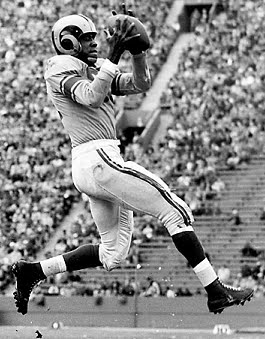
14- Dick “Night Train” Lane, Los Angeles Rams, 1952


Sammy Baugh


Dan Sandifer

AAFC (1946-49)
10- Tom Colella, Cleveland Browns, 1946

11- Otto Schnellbacher, New York Yankees, 1948


AFL (1960-69)
11- Goose Gonsoulin, Denver Broncos, 1960
11- Lee Riley, New York Titans, 1962

12- Fred Glick, Houston Oilers, 1963
12- Dainard Paulson, New York Jets, 1964


WFL (1974-75)
10- David Thomas, Memphis Southmen, 1974


USFL (1983-85)
12- Luther Bradley, Chicago Blitz, 1983
12- Marcus Quinn, Oakland Invaders, 1984

16- Chuck Clanton, Birmingham Stallions, 1985


XFL (2001)
5- Corey Ivy, Chicago Enforcers


Luther Bradley

January 18, 2011

1962: Bills Hire Lou Saban as Head Coach


On January 18, 1962 the Buffalo Bills of the AFL hired Lou Saban to be the team’s second head coach. The Bills had gone a combined 11-16-1 in their first two seasons under Buster Ramsey, and owner Ralph Wilson decided that a change was in order.

The 40-year-old Saban had been the original head coach of the Boston Patriots and was dismissed in favor of assistant coach Mike Holovak during the ’61 season. Immediately hired by the Bills as director of player personnel, he was Wilson’s choice to replace Ramsey. General Manager Dick Gallagher, who had been an assistant coach with Cleveland under Paul Brown when Saban was a player, also strongly supported the decision. Harvey Johnson took over Saban’s player personnel position.

Saban had played professionally with the Browns in the AAFC for four seasons until a shoulder injury forced his retirement in 1949. Prior to entering the pro coaching ranks, he was head football coach at Case Institute, Northwestern, and Western Illinois.

“I don't feel I have to prove myself as a coach,” Saban said upon being introduced. “What happened in Boston is behind. It was the best I could do under the circumstances and I make no apology for our record (7-12) or anything else.”

“There are no big mysteries to coaching pro football,” he added. “It's basically a game of blocking and tackling and working towards the goal of securing the best available talent together to get the job done.”

With regard to securing the best available talent, the Bills had a major void at quarterback. Veteran Al Dorow was obtained from the New York Titans and started the first four games of the season before yielding to young holdover Warren Rabb. The issue was decisively resolved during the 1962 season when Jack Kemp, who had twice led the Chargers to the AFL title game, was put on waivers due to an injured hand in order to make room on the roster (injured players had to be carried on the active roster in the AFL at that time). While it was reported that there was a so-called gentlemen’s agreement in place with regard to injury-waiver situations, several teams claimed Kemp, including the Bills. Commissioner Joe Foss awarded the quarterback to Buffalo for the $100 waiver price, and once the injury healed late in the season, Kemp became the starting quarterback.

Another key pickup on offense was FB Cookie Gilchrist, an eight-year veteran of Canadian pro football. The 250-pound power runner had a reputation for wearing out his welcome with several Canadian clubs (something that Saban would find to be true in Buffalo as well), but in ’62 he led the AFL in rushing with 1096 yards and scored 15 touchdowns. He also handled the team’s placekicking.

Beyond adding Kemp and Gilchrist, Saban revamped much of the lineup. Stew Barber was moved from linebacker to offensive tackle and Tom Day from defensive end to guard to supplement the group of young starters that featured G Billy Shaw, C Al Bemiller, OT Harold Olson, flanker Elbert “Golden Wheels” Dubenion, and split end Glenn Bass. Ernie Warlick became the tight end and led the club in receptions.

On defense, which was already a decent unit, several rookies immediately moved into the starting lineup with good results, including DT Tom Sestak, LB Mike Stratton, CB Booker Edgerson, and safety Carl Charon.

The Bills got off to a sluggish start in ’62, losing their first five games, but went 7-1-1 the rest of the way to finish with the first winning record in franchise history (7-6-1). It set the stage for high expectations in 1963, but instead came another 7-6-1 season, although that was enough for the Bills to tie for first in the mediocre Eastern Division - they lost the resulting playoff to the Patriots. However, in 1964 and ’65 it came together when Buffalo won consecutive AFL Championships.

Saban displayed coaching acumen in building the club into a contender. He went from inheriting a weak situation at quarterback to having impressive depth when Daryle Lamonica joined the team in ’63 as a rookie out of Notre Dame – in backing up the capable Kemp, Saban frequently used him in relief with good results. The defense was superb, perhaps most significantly evidenced by the two title game wins over the quick-striking Chargers, and in particular the second, a shutout in San Diego. There was also the added innovation of Pete Gogolak, the first soccer style placekicker who joined the team in 1964 and became a reliable producer of points. Even when the running game sagged in ’65 following the trade of Gilchrist to Denver, the Bills had enough to keep winning.

Saban’s coaching career was marked by frequent departures, and after four years in Buffalo and having twice reached the pinnacle in the American Football League, he quit to become head coach at the University of Maryland. He didn’t stay away from pro coaching for long, however, as he returned to the AFL in 1967 amid much fanfare to run the Denver Broncos. Saban failed to lift the Broncos out of the doldrums, however, and he resigned in 1971, barely half way through his ten-year contract as head coach/general manager.

The veteran coach returned to Buffalo in 1972. The Bills had fallen on hard times, and under Saban’s guidance put together three straight winning seasons, albeit with just one playoff appearance. He departed in ’76, ending his last stint as an AFL/NFL head coach.

Saban’s career took off on an eclectic course thereafter. He was at the University of Miami for two years and moved on to West Point to coach Army for a season, and then switched gears and became a major league baseball executive. Years before, New York Yankees owner George Steinbrenner had been an assistant coach under Saban at Northwestern, and he returned the favor by making Saban the president of the Yankees, a post he held in 1981 and ’82.

After that, it was a whirlwind of short football coaching stints at various levels, from college (University of Central Florida, Peru State in Nebraska, SUNY Canton), to high school (Georgetown High in South Carolina), semi-pro (the Middle Georgia Heat Wave), and arena football (Milwaukee Mustangs). His last stop was Chowan University, where he coached in 2001 and ’02 in his early eighties.

Being that he typically took on either rebuilding projects or new programs, his overall record was not impressive. Saban was 41-52-3 as a college coach and 94-99-7 in the AFL and NFL combined. By far his most successful stop was Buffalo, especially the first stint from 1962 to ’65 where he compiled a 36-17-3 tally, won two of three postseason games and two league championships.

January 17, 2011

1971: Colts Beat Cowboys in Super Bowl V with FG in Last Seconds


It has been referred to as the “Blooper Bowl” for the sloppiness of much of the play, yet Super Bowl V was also a closely-fought contest that came down to the final seconds. It was the first to be played in the newly-restructured NFL and, unlike its four predecessors, was no longer a contest between champions of rival leagues – it now served as the NFL Championship game.

The American Football Conference (AFC) was the remnant of the American Football League that had merged into the NFL for the 1970 season, although its Super Bowl representative was one of three existing franchises from the older league that was moved into the AFC in order to provide two balanced 13-team conferences. The Baltimore Colts had gone 11-2-1 in 1970 to win the AFC East, and had beaten the Bengals in the Divisional round and Raiders for the conference title.

The Colts were an aging club with a new head coach in Don McCafferty, who had replaced Don Shula when he departed for Miami. 37-year-old QB Johnny Unitas still guided the offense, with occasional relief from 36-year-old backup Earl Morrall. The running game was mediocre due to injuries, while wide receivers Eddie Hinton and Roy Jefferson were primary targets for the passing game. The defense was solid, however, featuring DE Bubba Smith, MLB Mike Curtis, OLB Ted Hendricks, and safeties Rick Volk and Jerry Logan.


Representing the National Football Conference (NFC), the old NFL minus the three transferred clubs, were the Dallas Cowboys. Under Head Coach Tom Landry, the Cowboys were in the postseason for the fifth consecutive year and topped the NFC East at 10-4 before beating the Lions and 49ers to advance to the Super Bowl for the first time. QB Craig Morton (pictured at right) fended off a challenge from second-year backup Roger Staubach and the running game didn’t suffer when RB Calvin Hill was injured and replaced by rookie FB Duane Thomas. Like the Colts, defense was the key to the team’s success and included such stalwarts as DT Bob Lilly, DE George Andrie, MLB Lee Roy Jordan, OLB Chuck Howley, CB Mel Renfro, and safeties Cliff Harris and Charlie Waters.

The game was played at the Orange Bowl in Miami on January 17, 1971 with 80,055 fans in attendance on a pleasant day under clear skies. Dallas got the initial break of the game in the first quarter when Howley intercepted a Unitas pass. The Cowboys weren’t able to move the ball and had to punt, but got it back when Baltimore DB Ron Gardin fumbled the kick and Harris recovered at the Colts’ nine yard line. Dallas couldn’t score a touchdown, with Morton overthrowing WR Reggie Rucker in the end zone on third down, but Mike Clark kicked a 14-yard field goal to put the Cowboys ahead at 3-0.


Late in the opening period, the Cowboys commenced a drive that covered 57 yards in eight plays, featuring a 41-yard pass play from Morton to WR Bob Hayes, and, just into the second quarter, culminated in another Clark field goal, from 30 yards. The Colts responded quickly as, on the third play of the ensuing possession, Unitas fired a pass intended for Hinton that the wide receiver tipped and, after Renfro of the Cowboys also got a hand on it, TE John Mackey (pictured at left), who had been trailing the play, grabbed the ball at the Dallas 45 and ran unmolested the rest of the way for a 75-yard touchdown. The extra point attempt was blocked by DB Mark Washington, leaving the score tied at 6-6.

The Cowboys got another break halfway through the period when Unitas, forced to run out of the pocket, was hit hard by Jordan and fumbled; DT Jethro Pugh recovered for Dallas at the Baltimore 28. Three plays later, Morton connected with Thomas on a swing pass for a seven-yard touchdown.

Unitas left the game due to a rib injury and Morrall took over at quarterback for the Colts. Morrall started off well, completing two passes as Baltimore’s offense drove quickly down to the Dallas two yard line. However, three straight runs gained just a yard and on fourth-and-goal at the one, Coach McCafferty chose to go for the touchdown rather than attempt an easy field goal. Morrall’s pass intended for TE Tom Mitchell was incomplete and the Colts came away empty. The Cowboys led by 13-6 at halftime.

It looked as though Dallas might take decisive control of the game when the Colts fumbled away the second half kickoff at their own 21 yard line and the Cowboys proceeded to drive down to the one. But Thomas fumbled when hit by Baltimore’s Logan and CB Jim Duncan recovered for the Colts. Baltimore drove to the Dallas 44 in 11 plays, but Jim O’Brien was short on a 52-yard field goal attempt.

Baltimore failed to capitalize on a couple more opportunities as the second half progressed. Still in the third quarter, Morrall threw a pass to FB Tom Nowatzke that covered 45 yards to the Dallas 15 before the slow-footed back was pulled down from behind by CB Herb Adderley (pictured below). Following two running plays, Morrall threw into the end zone on third-and-six and was intercepted by Howley.


On their next possession, and now into the fourth quarter, the Colts tried a flea-flicker play, with Morrall pitching out to HB Sam Havrilak. However, due to Bob Lilly’s presence in the backfield near the quarterback, Havrilak didn’t toss it back and threw downfield. Eddie Hinton had broken into the clear and hauled in the pass at the Dallas 20 and appeared to be on his way to a score when he was hit hard by safety Cornell Green at the five and fumbled. The loose ball bounced through the end zone for a touchback despite the pursuit of several players.

Finally, three plays later it was Baltimore’s turn to benefit from a turnover. A pass from Morton intended for FB Walt Garrison was intercepted by Volk, who returned it 30 yards to the Dallas three. Two plays later, Nowatzke scored from two yards out, and with the successful PAT the score was tied at 13-13 with 7:35 remaining on the clock.

The teams traded punts, and with just inside of two minutes remaining, the Cowboys gained possession at the Baltimore 48. Thomas lost a yard on the first play and Morton was sacked by DT Fred Miller for a nine-yard loss on the second. To make matters worse, a holding penalty on the Cowboys took the ball all the way back to the Dallas 27 with the time down to 1:09. Morton threw a pass intended for HB Dan Reeves, but the ball bounced off the halfback’s hands as he was being hit by Logan and was intercepted by Curtis, who ran it back 13 yards to the Dallas 28.

The Colts ran two plays to the Dallas 25, running 50 seconds off the clock and setting up the field goal attempt. O’Brien, who had missed an extra point and a long field goal earlier, was successful from 32 yards (pictured at top) and the Colts came away as champions by a score of 16-13.

Baltimore outgained the Cowboys (329 yards to 217) and led in first downs (14 to 9). However, the numbers that drew the most attention were the 11 turnovers (7 by the Colts on four fumbles and three interceptions, 4 by Dallas on a fumble and three interceptions) and 14 penalties (10 called on the Cowboys, 4 on Baltimore).

Johnny Unitas completed just three of nine passes for 88 yards, with the TD on the deflected pass and two interceptions. Earl Morrall (pictured below), who gained some measure of vindication after having a poor performance in the Super Bowl III upset loss to the Jets, was successful on 7 of 15 throws for 147 yards with one picked off. Neither team was able to move the ball well on the ground, and of the 69 rushing yards for the Colts, Tom Nowatzke accounted for 33 on 10 carries with a TD while rookie RB Norm Bulaich, who had run well in the prior playoff games, carried 18 times for just 28 yards. Roy Jefferson caught three passes for 52 yards while John Mackey, with the long TD, gained a club-leading 80 yards on two receptions.


For the Cowboys, Craig Morton went to the air 26 times and completed 12 for 127 yards with a touchdown and three interceptions. Walt Garrison ran for 65 yards on 12 attempts while Duane Thomas was held to 35 yards on 18 carries. Dan Reeves led the team with 5 pass receptions for 46 yards out of the backfield - only one completion wasn’t to a running back, and that was the 41-yard reception by Hayes in the first half.

Among the contest’s oddities, Chuck Howley (pictured below) became the first member of a losing team to be named MVP of the game. “It’s nice, but I wish we had won the game,” he said.


“The big play was in the third period,” said Tom Landry. “That was when Duane Thomas fumbled on the Colt goal line. If he had scored, we would have had a 20-6 lead and the Colts would have had to do a lot of catching up. After that, it was nothing but errors for us.”

While John Mackey commented afterward, “We were lucky and I’d rather be lucky than good”, veteran OT Bob Vogel said, “So what if we were lucky? I’ve had luck decide against us so many times that I’m sick of it…The way I look at it, we’re getting the Super Bowl ring because we won the games that counted. We deserve it.”

For the Colts as a team, as well as Morrall personally, the win laid to rest the ghost of the Super Bowl upset two years before. It was also a last hurrah for many of the older players who had made the club an annual contender for several seasons, including Unitas, Morrall, Vogel, Mackey, Logan, and DT Billy Ray Smith. While Baltimore advanced to the AFC Championship game in ’71, most of those veterans were gone soon thereafter and the next time the franchise played in a Super Bowl, it was representing Indianapolis following the 2006 season.

The defeat added to the perception of the Cowboys as a team that came up short in big games, which was not eradicated until the next year when they dominated the Dolphins to win their first championship in Super Bowl VI.

January 16, 2011

2000: Eddie George & Titans Beat Colts in Peyton Manning’s Postseason Debut


The two teams that met in the AFC Divisional playoff game on January 16, 2000 at the RCA Dome in Indianapolis had both gone 13-3 during the 1999 regular season and were on the upswing.

The host Colts, champions of the AFC East under Head Coach Jim Mora, had been in the AFC Championship game as recently as the 1995 season, but had gone 3-13 in both 1997 and ’98. Spurring the turnaround was second-year QB Peyton Manning, the first overall draft pick in 1998 who was rapidly developing into a star; rookie RB Edgerrin James, who ran for 1553 yards and caught 62 passes; and fourth-year WR Marvin Harrison, NFL leader in receiving yards with 1663 on his 115 catches. Tight ends Ken Dilger and Marcus Pollard combined for 74 receptions. However, the defense was vulnerable against the run and the secondary intercepted only nine passes.

The visiting Tennessee Titans, under the guidance of Head Coach Jeff Fisher, had not been in the postseason since they were still the Houston Oilers back in 1993. The Titans placed second in the AFC Central and won an exciting, last-minute Wild Card playoff contest over the Buffalo Bills that came to be referred to as the “Music City Miracle”. The offense, directed by QB Steve McNair, was conservative and featured RB Eddie George (1304 yards). TE Frank Wycheck was the leading receiver (69 catches) while WR Kevin Dyson provided the downfield speed. The defense was key to the team’s success and featured rookie DE Jevon Kearse, aka “The Freak”, with his 14.5 sacks and included DT Josh Evans, CB Samari Rolle, and SS Blaine Bishop.

There were 57,097 in attendance for the first Colts home playoff game since the franchise had relocated to Indianapolis. Neither offense was able to score a touchdown in the first half, although they had opportunities. In the first quarter, the Colts had a first down at the Tennessee 25 yard line, but Manning threw two incompletions and the drive stalled. They had to settle for a 40-yard field goal by Mike Vanderjagt and led by 3-0 after one period of play.

Tennessee’s Al Del Greco kicked a 49-yard field goal on the first play of the second quarter to tie the score. Indianapolis once again drove into Titans territory, reaching the 22, but lost yardage due to penalties and again had to go with a Vanderjagt field goal, again from 40 yards.

Tennessee again tied the score on a 37-yard Del Greco field goal. With time running out in the first half, the Colts put together their longest drive of the game, going 66 yards in 12 plays. It also included their longest play, a 33-yard pass completion to WR E.G. Green, but he broke his leg on the play and the game was stopped for about five minutes, which hindered the club’s momentum. After reaching the Tennessee 16 with eight seconds remaining in the half, Indianapolis once more turned to Vanderjagt, who kicked a 34-yard field goal. The Colts took a 9-6 lead into halftime.

On the third play of the second half, Eddie George (pictured at top), who had gained just 38 yards on 9 carries in the first half, ran 68 yards for a touchdown. It not only gave the Titans the lead at 13-9, but changed the momentum of the game as the Tennessee defense, which had played well, stepped up even further. The Titans held the Colts to just 51 yards passing and six rushing in the third quarter.


Five minutes into the fourth quarter, it appeared the Colts had made a big, game-changing play when WR Terrence Wilkins returned a punt an apparent 87 yards to the Tennessee three. However, while the officials on the field didn’t see it, he had stepped out of bounds in front of the Tennessee bench. Coach Fisher had difficulty notifying the officials that he wanted to challenge the ruling on the field (he didn’t have the red flag issued by the league with him) and had to use a timeout, but it proved to be worth it. Upon review, the replay confirmed that Wilkins did go out of bounds (pictured at left) and the ball was brought back 63 yards to the Indianapolis 33.

The deflated Colts went three-and-out and punted, much to the displeasure of the fans who had been cheering wildly one moment and were booing the next. WR Derrick Mason returned the kick 19 yards for the Titans to the Indianapolis 42 and the resulting drive culminated in a 25-yard Del Greco field goal. Instead of the Colts potentially retaking the lead, Tennessee extended its margin to 16-9.

On the next Indianapolis possession, Kearse deflected a third-down pass by Manning, forcing another punt. A fourth field goal by Del Greco put Tennessee up by 19-9, which meant Indianapolis would now need to score twice in the 4:19 remaining to retake the lead.

The Colts had to give up the ball on downs on their next possession, but got a break when George fumbled and DE Mark Thomas recovered. Indianapolis finally scored a touchdown on a 15-yard bootleg by Manning with 1:51 left, but with no timeouts left. The ensuing onside kick was recovered by WR Yancey Thigpen of the Titans, thus sewing up the 19-16 Tennessee win and sending the club to its first AFC Championship game in 20 years.

Total yardage was practically even, with Tennessee gaining just four yards more than the Colts (309 to 305) while Indianapolis led in first downs (19 to 13). The fumble by Eddie George was the only turnover of the game, although there were 16 penalties (9 by Tennessee, 7 flagged against Indianapolis).


Peyton Manning (pictured at right) wasn’t sacked but threw under pressure all game, and it showed in the statistics as he completed fewer than half of his passes – he was successful on 19 of 42 throws for 227 yards and no TDs as well as no interceptions. Marvin Harrison was limited to 5 catches for 65 yards while WR Jerome Pathon also had 5 receptions, for 44 yards. Edgerrin James ran for 56 yards on 20 carries, averaging just 2.8 yards per attempt.

For Tennessee, Eddie George was the star on offense as he gained 162 yards on 26 carries, including the long scoring run. Steve McNair completed 13 of 24 passes for 112 yards and ran for 35 yards on 7 attempts. No receiver for the Titans caught more than three passes (George was one of them), and the leader in yards was WR Chris Sanders with 38 on his two receptions. Jevon Kearse deflected two passes, but had no sacks. Craig Hentrich averaged 52 yards per punt, resulting in half of the Indianapolis drives starting from inside the 20 yard line.

Afterward, Eddie George recounted a conversation he had prior to the game with Coach Fisher. “He asked me to relive draft day back in 1996,” George said. “He told me to remember that he drafted me because he felt I could lead this team to where we are now. He challenged me to live up to expectations.” The former Heisman Trophy winner from Ohio State responded accordingly.

“We just came up short against a very good team,” Jim Mora said. “We had trouble making a play, particularly making big plays. It was a struggle all day, both sides of the ball.” The Colts had been a big-play team all year, but failed to make big plays against the Titans.

As to the big play that wasn’t, the punt return brought back upon review, Ken Dilger said, “I wouldn't say it took the heart out of us but I do think it deflated us a little.”

The Titans, after winning two close games in the playoffs, handily defeated Jacksonville for the AFC Championship. They lost to the Rams in a closely-fought Super Bowl. Tennessee went on to reach the postseason in three of the next four seasons, making it as far as the conference title game once more.

The Colts went to the playoffs again in 2000 under Mora, who ended up winless in six playoff games as a NFL head coach (he was far more successful in the USFL, where his Philadelphia/Baltimore Stars teams made it to the title game all three years and won the last two). With Manning at quarterback, Indianapolis would become a regular participant in the postseason from 2002 on.

January 15, 2011

1939: Champion Giants Win First Pro All-Star Game


While the Pro Bowl dates back to the 1950 season as the NFL’s annual postseason all-star game, there was an earlier version called the Pro All-Star Game. The first was held on January 15, 1939 at Wrigley Field in Los Angeles, better known as a minor league baseball ballpark.

Referred to in the media as the first “professional bowl football game”, the format was different than that of the Pro Bowl. Instead of being a matchup of the top players from two different conferences, the Pro All-Star Game featured the winner of the NFL Championship game against a squad of stars from the rest of the league. In the case of the first contest, the New York Giants faced an All-Star roster that was filled by not only players from the other NFL teams, but from two local independent pro football clubs, the Los Angeles Bulldogs and Hollywood Stars. Game proceeds were donated to the Salvation Army.

There was a disappointing crowd estimated at around 20,000 on hand on a bleak and cold day, with fog covering much of the Los Angeles basin. The starting backfield for the All-Stars consisted of Washington tailback Sammy Baugh, FB Clarke Hinkle of the Packers, QB Ernie Pinckert of the Redskins, and Detroit HB Lloyd Cardwell. Starting linemen included ends Gaynell Tinsley of the Cardinals and Perry Schwartz of Brooklyn, tackles Bruiser Kinard of the Dodgers and Joe Stydahar of the Bears, guards Byron Gentry of Pittsburgh and Pete Mehringer of the LA Bulldogs, and Detroit center John Wiatrak. The team was coached by Washington’s Ray Flaherty and Gus Henderson of the Lions.

The Giants, coached by Steve Owen, had gone 8-2-1 during the 1938 season and defeated the Packers by a score of 23-17 for the NFL title. Center Mel Hein was the league’s MVP, QB Ed Danowski (pictured above) was an All-Pro and one of the better passers, and FB Tuffy Leemans was the second-leading rusher (463 yards). New York had a deep and talented club.

Despite the array of outstanding players, the first half was unexciting, and both sides were especially ragged during the first quarter. The Giants finally scored in the second quarter as Len “Feets” Barnum kicked an 18-yard field goal following an interception at midfield by LB/FB Johnny “Bull” Karcis. The All-Stars came back to tie the score with a 19-yard field goal by Green Bay’s Ernie Smith with 20 seconds left in the half after driving from their 35.


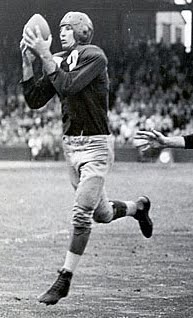
Following a missed 47-yard field goal attempt by New York’s Ward Cuff in the third quarter, the All-Stars took over at their 20. Baugh threw a 10-yard pass to Schwartz and then, on second and inches, a pass to Cardwell (pictured at left), who caught it at the New York 40 and ran the rest of the way for a 70-yard touchdown in the game’s most spectacular play. Joe Stydahar kicked the extra point to give the All-Stars a 10-3 lead.

Late in the same period, the Giants began a 73-yard drive that carried over into the fourth quarter. Danowski completed five straight passes with the last one being a 32-yard scoring throw to end Chuck Gelatka at the goal line. Cuff kicked the tying extra point.

The All-Stars moved deep into Giants territory on a drive that featured the running of FB Johnny Drake of the Rams and Green Bay tailback Cecil Isbell. However, they came up empty when a 21-yard field goal try was partially blocked.


With less than five minutes remaining in the game, Rams tailback Ed Goddard fumbled a punt inside his own 20 that G Orville Tuttle recovered for the Giants. Leemans ran three times for seven yards and then Cuff (pictured at right) kicked a 20-yard field goal. The Giants held on to win, 13-10.

New York had the edge in first downs over the All-Stars, 13 to 10. Ed Danowski completed 9 of 13 passes to overshadow Sammy Baugh, who was successful on 4 of 9.

There was much disappointment over the low turnout and comments in the newspapers to the effect that Los Angeles was not yet a major league pro football venue.

“They told me the game would turn the customers away,” Giants owner Tim Mara said, “and I believed 'em. So I brought the team out and the game cost me plenty of money, not to mention the tough afternoons I had at Santa Anita (a local racetrack).”

Despite the complaints, the next two Pro All-Star games were held in Los Angeles, although at Gilmore Stadium rather than Wrigley Field. The last two games of the series, following the 1941 and ’42 seasons, were held in New York and Philadelphia, respectively, due to World War II restrictions on crowd-drawing events in West Coast cities that might be vulnerable to attack. In all, the NFL champions won four of the games, the All-Stars one.