February 26, 2011

1984: Outlaws Defeat Maulers in USFL Debut Game for Each


The United States Football League added six new franchises for its second season, and two of those teams were matched up on February 26, 1984 at Tulsa’s Skelly Stadium to open their regular season.

The host Oklahoma Outlaws, coached by the former defensive coordinator of the NFL Steelers, Woody Widenhofer, featured a veteran quarterback in Doug Williams (pictured above). Williams, dissatisfied with his contract with the Tampa Bay Buccaneers, was lured to the Outlaws and provided instant credibility at the key position on offense.

The visiting Pittsburgh Maulers, under Head Coach Joe Pendry, also had a marquee name on the roster, although it was a rookie rather than veteran player. RB Mike Rozier won the 1983 Heisman Trophy at Nebraska and would be starting his first pro game. The team’s quarterback was Glenn Carano, a veteran backup with the Cowboys.

The weather conditions were far from ideal, as the contest was played in a steady downpour with gusty winds and a wind chill that dipped into the 20s. It certainly dampened the turnout, as 11,638 attended the game; there were 4300 reported no-shows.

The bad weather induced sloppy play. Three first half drives by the Outlaws ended in fumbles, but the Maulers were unable to capitalize on the turnovers despite making it inside the Oklahoma 30 on two occasions. The first ended with Mickey Barilla missing a 40-yard field goal attempt, and the second came up empty when Rozier was thrown for a two-yard loss in a fourth-and-one situation at the Oklahoma 29.

Pittsburgh finally scored on a Barilla field goal from 32 yards out with eight seconds left in the half, finishing a drive that was highlighted by a 20-yard Carano scramble to the Outlaws’ 28 yard line. Meanwhile, Oklahoma’s offense was unable to advance at all into Pittsburgh territory during the first half, and the Maulers held a 3-0 lead at the intermission.

Oklahoma finally put together a scoring drive in the second half, going 80 yards for the only touchdown of the game. In a key play, former Steelers RB Sidney Thornton ran 34 yards on a trap to the Pittsburgh 8. At just over a minute into the fourth quarter, Williams threw a swing pass to FB Derek Hughes that covered 12 yards for the TD.

Pittsburgh responded by driving to the Oklahoma 19 yard line as Carano completed a 13-yard pass to WR Greg Anderson on a fourth-and-six play along the way, but the Maulers were stopped when Carano threw incomplete on a fourth-and-12 pass intended for WR Reggie Butts.

With 2:56 remaining, Pittsburgh’s last shot came up short when Carano was intercepted by LB Terry Beeson at the Oklahoma 37. The Outlaws came away the winners of the sloppy contest by a final score of 7-3.

Neither team mounted much offense, with the Maulers outgaining Oklahoma (219 yards to 172) and accumulating the most first downs (11 to 9). The Outlaws also turned the ball over four times, to three by Pittsburgh.

Doug Williams completed just 9 of 22 passes for 62 yards with a touchdown and an interception. Sidney Thornton paced the running game for the Outlaws with 66 yards on 12 carries. WR Lonnie Turner led the team with a mere 17 yards on two catches.

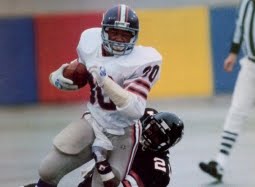
For the Maulers, Glenn Carano was successful on 10 of 21 passes for 101 yards, and was picked off twice. Greg Anderson led all receivers with three catches for 45 yards. Carano also was the team’s leading rusher with 29 yards on 10 carries. Mike Rozier (pictured below) had a rough debut, running for only 27 yards on 16 attempts - he had just two carries for four yards in the second half. Having joined the team late, his lack of familiarity with the offense’s plays proved a hindrance.

“This is the first time we've won and if feels great,” Woody Widenhofer said. “We needed to win the first game to get the feeling of what it's like.”

Widenhofer stated further, “They are an excellent football team defensively, but our offense broke open their defense in the second half. We made adjustments after halftime. We ran the ball very well in the second half against their five defensive backs.”

“I sure can't complain about how it turned out,” summed up Doug Williams. “I can't complain at all. I wanted to win this game as bad as I've ever wanted to win a game.”

“I thought our defense did extremely well,” said Coach Pendry of the Maulers. “With a good passing game like Oklahoma has with Doug Williams, sometimes you're .going to break a draw or a trap and that's exactly what happened.”

However, Pendry wasn't happy with the offense. “We have to go back to Pittsburgh and look at the films and see what happened,” he said. “We made lots of first-game mistakes out there.”

Pendry failed to last the entire season as the Maulers compiled a 3-15 record, tying the Washington Federals not only at the bottom of the Atlantic Division, but for the USFL's worst record. Mike Rozier ultimately rushed for 792 yards on 223 carries (3.6 avg.).

Oklahoma got off to a promising 6-2 start, but lost the remaining 10 games to end up at 6-12 and in fourth place in the Central Divison. The lack of an effective running attack, combined with the collapse of the defense and late-season loss of Doug Williams to a knee injury, ultimately did the Outlaws in.

February 25, 2011

MVP Profile: Bob Waterfield, 1945

Quarterback, Cleveland Rams


Age: 25
1st season in pro football
College: UCLA
Height: 6’1” Weight: 200

Prelude:
Following a college career at UCLA, interrupted by a stint in the army during World War II, in which he led the Bruins to the Rose Bowl and starred in the East-West Shrine Game, Waterfield finally joined the Rams, who had chosen him in the 5th round of the 1944 NFL draft. He won the starting quarterback job during the preseason for a team that was just installing the T-formation under new Head Coach Adam Walsh.

1945 Season Summary
Appeared in all 10 games
[Bracketed numbers indicate league rank in Top 20]

Passing
Attempts – 171 [4]
Completions – 89 [3, tied with Paul Christman]
Yards – 1609 [3]
Completion percentage – 52.0 [4]
Yards per attempt – 9.4 [1]
TD passes – 14 [1, tied with Sid Luckman]
Most TD passes, game – 3 at Chicago Cardinals 11/18
Interceptions – 17 [1]
Passer rating – 72.4 [4]

Rushing
Attempts – 18
Yards – 18
Yards per attempt – 1.0
TDs – 5

Kicking
Field goals – 1 [8, tied with Pete Gudauskas, Dave Ryan & Robert Nelson]
Field goal attempts – 3 [9, tied with Dave Ryan & Joe Kuharich]
Percentage – 33.3
PATs – 31 [1, tied with Don Hutson]
PAT attempts – 34 [2]
Longest field goal – 28 yards vs. Chicago Bears 10/7

Punting
Punts – 39 [4]
Yards – 1585 [4]
Average – 40.6 [3]
Punts blocked – 1
Longest punt – 68 yards

Interceptions
Interceptions – 6 [2, tied with Bob Davis & Bob Margarita]
Return yards – 92 [3]
TDs – 0

Punt Returns
Returns – 2
Yards – 34
Average per return – 17.0
TDs – 0
Longest return – 18 yards

Scoring
TDs – 5 [13, tied with four others]
Field goals – 1
PATs - 31
Points – 64 [3]

Postseason: 1 G (NFL Championship vs. Washington)
Pass attempts – 14
Pass completions – 27
Passing yardage – 192
TD passes – 2
Interceptions – 2

Rushing attempts – 3
Rushing yards – -1
Average gain rushing – -0.3
Rushing TDs – 0

Punt returns – 1
Yards – 0
Average per return – 0.0
TDs – 0

Awards & Honors:
NFL MVP: Joe F. Carr Trophy
1st team All-NFL: AP, UPI, Chicago Herald-American, Pro Football Illustrated, NY Daily News
2nd team All-NFL: INS

Rams went 9-1 to win Western Division. Defeated Washington Redskins (15-14) for NFL Championship.

Aftermath: Played 7 more seasons, all with the Rams, who moved to Los Angeles in 1946. Was a consensus 1st team All-Pro selection two more times, and was selected to the first two Pro Bowls. Led league in passing once, although after 1949 he split the quarterbacking with Norm Van Brocklin – an arrangement neither player liked but that proved highly effective. He also became an accomplished placekicker as well as punter, leading the NFL in field goals on three occasions and field goal percentage twice. A true all-purpose talent, Waterfield intercepted a total of 20 passes over the course of his first four seasons. His #7 was retired by the Rams and Waterfield was inducted into the Pro Football Hall of Fame, Class of 1965.

--

MVP Profiles feature players who were named MVP or Player of the Year in the NFL, AAFC (1946-49), AFL (1960-69), WFL (1974), or USFL (1983-85) by a recognized organization (Associated Press, Pro Football Writers Association, Newspaper Enterprise Association, United Press International, The Sporting News, Maxwell Club – Bert Bell Award, or the league itself).

[Updated 2/15/14]

February 24, 2011

1985: Doug Flutie Has Rough Debut as Generals Fall to Stallions


Entering its third season, the United States Football League once again began play with the reigning Heisman Trophy winner on one of its rosters. In 1983, it had been RB Herschel Walker, and in ’84, RB Mike Rozier. Now in 1985, Doug Flutie (pictured at right), the diminutive (5’9”) but strong-armed and mobile Heisman-winning quarterback from Boston College, was under contract in the USFL.

Flutie signed a five-year deal with owner Donald Trump’s New Jersey Generals for $7 million. The Generals took the further step of dealing their 1984 starting quarterback, veteran Brian Sipe, to the Jacksonville Bulls. Ready or not, Flutie was expected to step in and start right away.

Flutie had been with the team for just two weeks after signing his contract, and appeared in one preseason game where his performance was underwhelming. His regular season debut came on February 24, 1985 at Birmingham’s Legion Field against the Stallions, a good team that was coming off of a 14-4 record and Southern Division title in ’84.

New Jersey had also gone 14-4 in 1984, good enough for a wild card slot, but the Generals lost to the eventual league champs, the Philadelphia Stars, in the first round of the playoffs. It was a big improvement over the 6-12 record of the inaugural season in ’83, and reflected many changes. Walt Michaels, formerly of the Jets, had taken over as head coach, and veterans such as Sipe, G Dave Lapham, CB Kerry Justin, FS Gary Barbaro, SS Greggory Johnson, and linebackers Jim LeClair and Bobby Leopold were grabbed away from the NFL. Walker, the USFL’s leading rusher in 1983, was joined as a thousand-yard ground-gainer by FB Maurice Carthon, better known for his outstanding blocking.

There were 34,785 in attendance at Legion Field, along with a national television audience as ABC heavily hyped the game. What they saw was a dominant first half performance by the home team and a rookie quarterback whose lack of preparation was clearly evident.

Flutie missed on his first nine passes, most of which were poorly thrown, and two of them intercepted. He didn’t complete his first pass of the game, for six yards to WR Clarence Collins, until late in the third quarter.

Meanwhile, ninth-year veteran QB Cliff Stoudt, the league’s second-rated passer in ’84, operated Birmingham’s conservative offense smoothly and effectively. The ex-Steeler threw for three touchdowns and led long drives for two more.

Birmingham scored the game’s first touchdown at the end of a 10-play, 73-yard first quarter drive that was highlighted by Stoudt’s 28-yard run in a third down situation that advanced the ball to the New Jersey five yard line. The possession was capped by a two-yard touchdown pass from Stoudt to TE Darryl Mason.

Three plays after Birmingham’s TD, and just seconds into the second quarter, the Generals responded when Carthon ran off tackle and broke away for a 55-yard touchdown to tie the score at 7-7.

It appeared that the Stallions had retaken the lead later in the period when, in a fourth-and-four situation, Stoudt completed an apparent 36-yard touchdown pass to RB Joe Cribbs. However, a holding call on Mason nullified the score, and Birmingham came up empty.

The Stallions did retake the lead before the first half ended. Cribbs ran for a two-yard touchdown with 19 seconds left, capping a seven-play drive that ran 7:29 off the clock. Birmingham had dominated the first half, holding onto the ball for 22 of the 30 minutes, but the score was just 14-7 at halftime.

The Stallions took control of the game in the third quarter, scoring 17 points while New Jersey’s offense floundered. In their first possession, they drove 69 yards in 11 plays that led to a two-yard scoring run by RB Leon Perry.

Four minutes later, and after FS Chuck Clanton intercepted a Flutie pass and returned it to the New Jersey 19, Birmingham scored again when Stoudt connected with RB Earl Gant on a swing pass that resulted in a six-yard TD. Late in the period, Danny Miller kicked a 33-yard field goal that made the score 31-7.

At this point, Flutie completed his first pass to the derisive cheers of the Birmingham fans. However, making that first completion seemed to settle the rookie quarterback, and he began to flash the form that had made him a star in college.

Flutie tossed a well-thrown bomb to Walker that covered 51 yards and set up Walker’s one-yard touchdown run, cutting the Birmingham lead to 31-14. Following Kerry Justin’s interception of a Stoudt pass, Flutie led a drive that culminated in his first pro TD pass, rolling out and throwing four yards to WR Danny Knight.

Down now by just 10 points, it seemed as though the Generals might pull off a big comeback when they got the ball again with seven minutes left to play. However, CB Dennis Woodberry intercepted a Flutie pass and returned it 22 yards to the New Jersey 44. Two plays later, Stoudt threw to WR Jim Smith for a 44-yard touchdown that effectively put the game out of reach at 38-21.

Flutie’s second TD pass was similar to the first, coming on a rollout and covering five yards to WR Marcus Hackett (his only catch of the season), but with 3:13 remaining it was too little, too late. Birmingham came away with a 38-28 opening-day win.

The Stallions had a huge edge in time of possession (41:37 to 18:33). They also led in total yards (372 to 288) and first downs (25 to 12). The Generals turned the ball over five times, to three by Birmingham.


Cliff Stoudt completed 21 of 33 passes for 220 yards and three touchdowns against two interceptions, and rushed 9 times for 65 yards to lead the club. Joe Cribbs was the most productive of the running backs, gaining 46 yards on 16 attempts and scoring a TD. Jim Smith caught 6 passes for 98 yards, including the long touchdown.

Doug Flutie ended up completing 12 of 27 passes for 189 yards with two TDs and three interceptions; he gained 17 yards on two carries as well. Herschel Walker was held to only 5 yards on 6 carries, but caught 3 passes for 71 yards. Maurice Carthon, thanks to the long touchdown carry, ran for 74 yards on 8 attempts. Danny Knight also caught 3 passes, for 38 yards.

“I think I'm ready,” said Flutie. “I didn't prove it today, but I believe I will next week.”

The Generals won their next two games, on the way to an 11-7 record and second place finish in the Eastern Conference (they once again lost to their nemesis, the Stars, in the first round of the playoffs). Flutie played respectably, passing for 2109 yards and 13 touchdowns against 14 interceptions. However, it was Herschel Walker who keyed the offense – despite his low total against Birmingham, he ran for 2411 yards and 21 touchdowns and led the club in receiving with 37 catches for 467 yards and another TD.

As for the Stallions, they ended up placing first in the Eastern Conference at 13-5 and won their first round playoff game, but lost to the Stars in the Semifinal round.

February 23, 2011

Past Venue: Mile High Stadium

Denver, CO
aka Bears Stadium


Year opened: 1948
Capacity: 76,273, up from 17,000 at opening and 34,000 for the first AFL season.

Names:
Bears Stadium, 1948-68
Mile High Stadium, 1968-2002

Pro football tenants:
Denver Broncos (AFL/NFL), 1960-2000
Denver Gold (USFL), 1983-85

Postseason games hosted:
AFC Divisional playoff, Broncos 34 Steelers 21, Dec. 24, 1977
AFC Championship, Broncos 20 Raiders 17, Jan. 1, 1978
USFL Championship, Panthers 24 Stars 22, July 17, 1983
AFC Divisional playoff, Steelers 24 Broncos 17, Dec. 30, 1984
AFC Divisional playoff, Broncos 22 Patriots 17, Jan. 4, 1987
AFC Divisional playoff, Broncos 34 Oilers 10, Jan. 10, 1988
AFC Championship, Broncos 38 Browns 33, Jan. 17, 1988
AFC Divisional playoff, Broncos 24 Steelers 23, Jan. 7, 1990
AFC Championship, Broncos 37 Browns 21, Jan. 14, 1990
AFC Divisional playoff, Broncos 26 Oilers 24, Jan. 4, 1992
AFC Divisional playoff, Jaguars 30 Broncos 27, Jan. 4, 1997
AFC Wild Card playoff, Broncos 42 Jaguars 17, Dec. 27, 1997
AFC Divisional playoff, Broncos 38 Dolphins 3, Jan. 9, 1999
AFC Championship, Broncos 23 Jets 10, Jan. 17, 1999

Other tenants of note:
Denver Bears/Zephyrs (minor league baseball), 1948-92
Denver Dynamos (NASL), 1974-75
Colorado Caribous (NASL), 1978
Colorado Rockies (MLB – NL), 1993-94
Colorado Rapids (MLS), 1996-2001

Notes: The east stands could be moved in their entirety in order to accommodate baseball. First stadium expansion in late 1950s was in hopes of landing a baseball franchise in the proposed Continental League, which never got off the ground. Stadium was originally privately owned by the Howsam family, owner of the minor league baseball Bears (and later the founding owners of the AFL Broncos), but was sold to the City of Denver in 1968, when it was renamed. Major expansions followed in ’68 and between 1975 and ’77.

Fate: Demolished in 2002, the site is now part of the parking lot for INVESCO Field at Mile High.


(Above is earlier view of then-Bears Stadium, as it looked in early days of AFL. Below view shows the stadium several expansions later)

February 22, 2011

1972: Packers Trade Donny Anderson to Cards for MacArthur Lane


On February 22, 1972 the NFL announced a straight-up swap of former Pro Bowl running backs as the Green Bay Packers sent Donny Anderson to the St. Louis Cardinals for MacArthur Lane.

Anderson, a two-time All-American at Texas Tech, had come to the Packers amidst great fanfare in 1966. Drafted in the first round of the ’65 draft as a future pick (a practice that was allowed at the time; he still had a year of college eligibility remaining), he signed for an estimated $600,000. Along with FB Jim Grabowski, the 1966 first round selection out of Illinois who signed for $400,000, much was made of the combined million dollar commitment made by Green Bay to both keep the highly-touted runners away from the AFL as well as provide successors to the aging starting backfield of HB Paul Hornung and FB Jim Taylor.

The 6’3”, 210-pound Anderson started off slowly in the NFL, running tentatively and blocking poorly – Coach Vince Lombardi considered moving him to flanker after the ’66 season. But while Grabowski, the power runner, was never able to fully recover from a 1967 knee injury and had a mediocre career (he was cut a year prior to the Anderson trade, signing on with the Bears), Anderson broke into the starting lineup when injuries began to decimate the backfield during the ’67 season and rose to the occasion, contributing to a third straight championship as well as a win in Super Bowl II.

While the Packers dropped to 6-7-1 in the first post-Lombardi coaching year of 1968, Anderson led the team in rushing with 761 yards and was selected to the Pro Bowl. With a crowded situation in the backfield (veteran Elijah Pitts and speedy Travis Williams were also available at halfback), he saw less action in ’69, but bounced back with 853 yards rushing and 36 pass receptions in 1970. In addition to his play at halfback, Anderson also was a highly-regarded left-footed punter.

Anderson was involved in a contract dispute with the team in 1971 and considerable animosity arose between him and Head Coach/GM Dan Devine, who arrived that same year. Also arriving was rookie FB John Brockington, who pushed him into a supporting role. Devine was critical of Anderson’s blocking and expressed a preference for backup HB Dave Hampton, who he considered to be a better blocker.

“I tried to overcome the fact that there was a line between us,” said Anderson immediately following the trade to St. Louis. “I tried to play better football. I couldn't do it because when someone is down on you, you've got to prove yourself day after day. I didn't feel I had to prove myself on that basis, but maybe I'll have to do it in St. Louis.”

MacArthur Lane was a year older than Anderson (Anderson was 28 and Lane 29 at the time of the deal), but also bigger at 6’1” and 220 pounds, which seemed a better fit in tandem with the 6’1”, 225-pound Brockington. Lane had also been a first round draft choice, taken by the Cardinals in the 1968 draft with the thirteenth overall pick. He also stepped into a crowded backfield situation in St. Louis and saw scant action as a backup and kick returner in his first two years with the club.

Lane had a breakout season in 1970, showing off his power-running skill to gain 977 yards on the ground while catching 32 passes for another 365 yards, and scoring a league-leading 13 touchdowns. He was named to the Pro Bowl. But like Anderson, he also ran afoul of a new head coach, Bob Hollway, in 1971. Lane slumped to 502 yards rushing and was suspended for the season finale after publicly criticizing the team’s vice president, Bill Bidwill, due to a salary dispute.

Following the trade, Hollway said. “As far as the Cardinals - myself and management – are concerned, we resolved any problems we had with Lane. The trade came
about because we were able to get a more versatile running back.”

Both players expressed relief at the trade, although Anderson paid tribute to his prior experiences and the fans in Green Bay. “Certainly I will miss the players and the fans in Green Bay,” he said. “There's nobody in the world like them and I wish them the best of everything. I cannot deny that the greatest, most rewarding athletic experiences of my life were having the honor to play for Vince Lombardi and to have played in the first two Super Bowls.”


The deal worked more to the benefit of the Packers in 1972. Following a 4-8-2 record in ’71, the team went 10-4 and won the NFC Central Division title. The running game was the key to the conservative offense led by young quarterback Scott Hunter, who only went to the air 199 times and completed just 43.2 percent of those passes. While Brockington, who had gained 1105 yards as a rookie, followed up with 1027 in ’72 (thus becoming the first player in NFL history to rush for a thousand yards in each of his first two seasons), Lane (pictured at left) contributed 821 yards on 177 carries for a healthy 4.6-yard average, led the team with 26 pass receptions for another 285 yards, and was named the club’s MVP.

In St. Louis, the 4-9-1 record of 1971 was duplicated in ’72. Anderson played respectably in combination with veteran RB Johnny Roland, leading the team with 536 yards on 153 rushing attempts (3.5 avg.) and catching 28 passes for 298 yards. As he had in Green Bay, he also handled the punting, averaging 39.5 yards on 72 kicks.

The situation was different in 1973, when things did not go so well for the Packers. While the running tandem of Brockington and Lane was still considered to be one of the best in the NFL, there was still no viable passing attack to complement them. Hunter failed to improve at quarterback, and when backup QB Jerry Tagge was given the opportunity to start, he was found wanting as well, as was young veteran backup Jim Del Gaizo, obtained from the Dolphins amid much fanfare. Brockington ran for 1144 yards and Lane 528, although Lane’s yards per carry average dropped to 3.1. The team as a whole fell to 5-7-2.

Lane played one more season in Green Bay, with the numbers continuing to diminish, and played four years in Kansas City, where he ran the ball less but was used effectively as a receiver out of the backfield – he led the NFL with 66 catches in 1976. Overall, in 11 seasons he ran for 4656 yards on 1206 carries (3.9 avg.) with 30 touchdowns and caught 287 passes for 2786 yards (9.7 avg.) and 7 more TDs.

As for Anderson in St. Louis, his numbers improved in 1973 as he again led the team in rushing with 679 yards on 167 carries (4.1 avg.) with 10 touchdowns and caught a career-high 41 passes for 409 yards and three more scores. The team was still 4-9-1 for the third straight year, but under a new head coach, Don Coryell.

Coryell turned the team around dramatically in 1974, winning the NFC East with a 10-4 tally, but Anderson’s production dropped off significantly with the emergence of explosive all-purpose HB Terry Metcalf. Traded to Miami in the offseason, Anderson retired during the 1975 preseason. His overall totals were 4696 yards rushing on 1197 attempts (3.9 avg.), including 41 touchdowns, and 209 pass receptions for 2548 yards (12.2 avg.) with 14 TDs. He also averaged 39.6 yards on 387 punts.

February 21, 2011

MVP Profile: Tony Adams, 1974

Quarterback, Southern California Sun


Age: 24
1st season in pro football
College: Utah State
Height: 6’1” Weight: 195

Prelude:
Following an outstanding season at Utah State in 1972, Adams was drafted in the 14th round by the NFL’s San Diego Chargers for 1973, but could not get past a fellow rookie, Dan Fouts, or young veteran Wayne Clark and an over-the-hill Johnny Unitas on the depth chart. He signed with the Southern California Sun of the new World Football League for ’74.

1974 Season Summary
Appeared in all 20 games
[Bracketed numbers indicate league rank in Top 20]

Passing
Attempts – 510 [2]
Completions – 276 [2]
Yards – 3905 [1]
Most yards, game – 376
Completion percentage – 54.1 [4]
Yards per attempt – 7.7 [2]
TD passes – 23 [4]
Interceptions – 18 [4]
Passer rating – 79.4 [3]
300-yard passing games – 3

Rushing
Attempts – 60
Yards – 217
Yards per attempt – 3.6
TDs – 8 [8, tied with four others]

Scoring
TDs – 8 [15, tied with five others]
Action Points - 2
Points – 58 [16, tied with Dennis Homan]
(Note: Touchdowns counted for 7 points in the WFL)

Postseason: 1 G (WFL First Round playoff vs. The Hawaiians)
Pass attempts – 21
Pass completions – 11
Passing yardage – 189
TD passes – 1
Interceptions – 1

Rushing attempts – 1
Rushing yards – 3
Average gain rushing – 3.0
Rushing TDs – 0

Awards & Honors:
WFL MVP: League (co-winner), Sporting News
1st team All-WFL: Sporting News

Sun went 13-7 to win Western Division. Lost WFL First Round playoff to The Hawaiians (32-14) – several key players refused to play after failing to be paid for the regular season finale.

Aftermath: Joined the NFL’s Kansas City Chiefs in 1975 and played four seasons there. Strictly a backup, Adams started a total of seven games and never threw more than 92 passes in any one year. Moved on to the CFL and played for the Toronto Argonauts, where he again achieved some success as he passed for 2692 yards and 13 TDs in 1979. However, injuries limited his playing time in ’80 and he eventually retired. Adams made a brief comeback, returning to the Minnesota Vikings as a 37-year-old replacement player for three games during the NFL players’ strike in 1987, and put up good numbers, although the replacement team lost all three contests.

--

MVP Profiles feature players who were named MVP or Player of the Year in the NFL, AAFC (1946-49), AFL (1960-69), WFL (1974), or USFL (1983-85) by a recognized organization (Associated Press, Pro Football Writers Association, Newspaper Enterprise Association, United Press International, The Sporting News, Maxwell Club – Bert Bell Award, or the league itself).

[Updated 4/12/12]
[Updated 2/15/14]

February 20, 2011

Past Venue: Cotton Bowl

Dallas, TX


Year opened: 1930
Capacity: 92,100, up from 72,000 when the Cowboys played there and 45,000 at opening

Names:
Fair Park Bowl, 1930-36
Cotton Bowl, 1936 to date

Pro football tenants:
Dallas Rams (AFL), 1934
Dallas Texans (NFL), 1952
Dallas Cowboys (NFL), 1960-71
Dallas Texans (AFL), 1960-62

Postseason games hosted:
NFL Championship, Packers 34 Cowboys 27, Jan. 1, 1967
NFL Eastern Conf. Championship, Cowboys 52 Browns 14, Dec. 24, 1967
NFL Eastern Conf. Championship, Browns 38 Cowboys 14, Dec. 28, 1969
NFC Divisional playoff, Cowboys 5 Lions 0, Dec. 26, 1970

Other tenants of note:
Southern Methodist University (college football), 1932-78, 95-2000
Dallas Tornado (NASL), 1967-68
Dallas Burn/FC Dallas (MLS), 1996-2002, 04-05

Notes: Hosted first two home games of Cowboys’ 1971 season before they moved to Texas Stadium in Irving. Hosted annual Cotton Bowl Classic, 1937-2009. Hosts annual Red River Shootout/Rivalry college football game between Univ. of Oklahoma and Univ. of Texas, 1932 to date. Hosts annual Dallas Independent School District Football Playoffs, 1974 to date. Hosted TicketCity Bowl, 2011. Used as a venue for FIFA World Cup, 1994. Referred to as “The House That Doak Built” due to expansions in 1940s that increased capacity to 60,000 to accommodate crowds who came to see SMU’s Heisman-winning halfback Doak Walker in action. Stadium is located at the state fairgrounds and replaced the Fair Park Football Stadium, which had stood at the same location. The grass field of 1930 to ’69 was replaced with AstroTurf from 1970 to ’93 before returning to grass in 1994.

Fate: Still in use following three major renovations, most recently in 2008.


(more recent view of stadium below, showing expansion that has completely enclosed the upper deck)


[Updated 2/16/15]