November 3, 2012

1946: Dons Upset Browns with Late FG


The Cleveland Browns had quickly asserted themselves in the first year of the All-America Football Conference, winning their first seven games of the 1946 season and most by lopsided scores. Head Coach Paul Brown’s team was strong on both sides of the ball. But they had finally been tripped up by the San Francisco 49ers and, on November 3 they faced another tough Western Division opponent – although one they had beaten two weeks earlier.

The Los Angeles Dons had solid financing and a well-known name in entertainer Don Ameche as the club president. Head Coach Dudley DeGroot had led the NFL Redskins to the league title game the previous year. There was much veteran talent and the Dons were adept at scoring points, but the defense had shown a tendency to give up too many points in turn. After starting off at 3-0-1, they had lost three straight to come into the game against the Browns at 3-3-1.

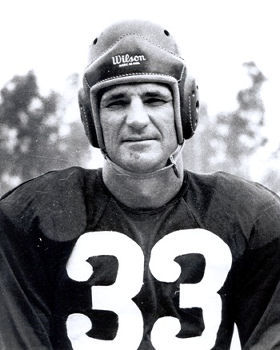
There was a crowd of 24,800 at the Memorial Coliseum, which was the largest of the season thus far for Los Angeles. On the first play from scrimmage, HB Chuck Fenenbock (pictured above) ran for a 75-yard touchdown to give the Dons the early lead. Lou Groza got the Browns on the board later in the first quarter with a 25-yard field goal.

In the second quarter, Cleveland went ahead after DB Tom Colella recovered a fumble at the LA 16. The Browns scored four plays later with HB Bill Lund sweeping around right end from five yards out and Groza added the extra point to make the score 10-7.

The Dons drove to another field goal attempt, but the try by Bob Nelson from 26 yards was wide. The Browns scored again when QB Otto Graham passed to end Mac Speedie for a 79-yard touchdown. However, Groza missed the extra point, snapping a string of 22 consecutive successful conversions, and while Cleveland carried a 16-7 lead into halftime, it would have repercussions in the end.

Los Angeles came out strong in the third quarter and drove to the Cleveland 22 before turning the ball over on downs. Shortly thereafter, tackle Bob Reinhard recovered a Cleveland fumble and returned it 43 yards to the Browns’ 14, but again the Dons ran out of downs at the seven.

LA’s defense played inspired football in the second half and the ground game on offense wore Cleveland down. Early in the fourth quarter, the Browns gambled by faking a punt on fourth-and-nine at their own 21. Colella gained just two yards, giving the ball back to LA in excellent field position. Five plays later, end Dale Gentry ran for an eight-yard touchdown. Joe Aguirre kicked the extra point and Cleveland’s lead was narrowed to 16-14.

Another Cleveland fumble set up the winning score for LA. Taking over at the Cleveland 43, the Dons battled for 15 plays to reach the three yard line, from where Aguirre kicked the game-winning 11-yard field goal on fourth down with 20 seconds left to play.

The Browns made a last-gasp effort to pull out the win with Graham completing two passes, but he was sacked on the last play and time ran out. The Dons came away with a stunning 17-16 upset win.


The Dons outgained the Browns by 291 yards to 284 and significantly outperformed them on the ground with 220 yards to just 43. Cleveland had the edge in first downs (13 to 12) and both teams turned the ball over three times. Mac Speedie (pictured at left) had the biggest individual performance, catching 4 passes for 134 yards and the one long TD.

It was the second straight loss for the Browns but they righted the ship in a rematch with the 49ers the next week that they won 14-7, and they didn’t lose again. Cleveland topped the Western Division with a 12-2 record and defeated the New York Yankees for the first AAFC title.

The Dons, meanwhile, ended a three-game losing streak with the upset of the Browns. They won three of their next four contests and finished third in the division at 7-5-2.

November 1, 2012

1970: Giants Defeat Jets in First Regular Season Meeting


The culmination of the AFL-NFL merger in 1970 made possible the birth of new pro football rivalries, perhaps most notably that between the teams located in New York City. On November 1, 1970 the long-established Giants met the younger league’s Jets for the first time in a regular season game.

While the Jets, coached by Weeb Ewbank, had experienced more recent success with back-to-back AFL Eastern Division titles in 1968 and ’69 and a victory in Super Bowl III, they came into the contest against the Giants as ten-point underdogs. The squad had been decimated by injuries, most notably the broken wrist suffered by star QB Joe Namath but also including the loss of both starting running backs HB Emerson Boozer and FB Matt Snell. As a result, their record was 1-5 as they prepared to meet their intra-city rivals.

Meanwhile the Giants, coached by former star running back Alex Webster, appeared to be on the upswing after six years of not breaking the .500 barrier. QB Fran Tarkenton (pictured above) was joined by HB Ron Johnson and WR Clifton McNeil to fuel the offense and, while the defense had its share of holes, it also had DE Fred Dryer, LB Jim Files, and FS Carl “Spider” Lockhart to bring talent to the unit. After losing their first three games, they had won three straight to improve to 3-3.

A record crowd of 63,903 was in attendance at Shea Stadium. They saw the Jets score first on a pass from QB Al Woodall, the fill-in for Namath, to HB George Nock that covered eight yards. Still in the first quarter, Pete Gogolak booted a 25-yard field goal for the Giants. The score remained 7-3 at halftime. The Giants had difficulty on offense and Tarkenton completed just two of eight pass attempts in the first half.

The Jets added to their lead with a 31-yard field goal by Jim Turner in the third quarter. The game then took a significant turn, however, and oddly enough, the Jets were victimized by their own success on defense. The Giants, down 10-3, drove into Jets territory and had a third-and-goal situation at the one yard line but failed on two plays from there – the last with FB Tucker Frederickson coming up a foot short of the goal line - and had to turn the ball over on downs, although not before a bench-clearing brawl ensued between the teams.

Frederickson had attempted to lateral back to Tarkenton at the end of the fourth-down play, which was already blown dead, and the veteran quarterback was tackled by Jets LB Larry Grantham. Words ensued between Tarkenton and Grantham, and they were followed by CB Earlie Thomas of the Jets throwing a punch at Tarkenton. Both benches quickly emptied.

Once order was restored and the Jets took possession, two quarterback sneaks by Woodall failed to gain ground and then FB Chuck Mercein (an ex-Giant) was tackled in the end zone by Jim Files and Fred Dryer for a safety.

Losing by 10-5 and getting the ball following the free kick, the Giants struck quickly when Tarkenton passed to Johnson for a 50-yard gain to the Jets’ nine. The remaining distance was covered on the next play as Tarkenton passed to TE Bob Tucker and, with Gogolak’s extra point, the older club was in front by 12-10.

On the next Jets series, Woodall was picked off by CB Willie Williams who proceeded to return the interception 36 yards to the Jets’ 29. Three plays later, and helped by a face mask penalty on the Jets, Tarkenton threw another touchdown pass of 11 yards to Clifton McNeil. The Giants had scored 16 points in a period of six plays that covered less than two minutes of the third quarter to take control of the game.

After the flurry of excitement, the remainder of the contest was anticlimactic. Gogolak added a 37-yard field goal in the fourth quarter and the Giants ended up winning handily by a score of 22-10.

The Giants barely outgained the Jets (240 yards to 237) while the Jets had the slight edge in first downs (16 to 15). However, the Giants sacked Woodall six times, to one sack of Tarkenton, and the Jets turned the ball over four times while the Giants suffered no turnovers.

Overcoming the rough first half, Fran Tarkenton ended up completing 11 of 22 passes for 153 yards and two touchdowns with none intercepted. Ron Johnson (pictured below) rushed for 69 yards on 25 carries and also caught two passes for 52 more yards. Bob Tucker and Clifton McNeil each had three catches, for 41 and 35 yards respectively, and a TD apiece.


For the Jets, Al Woodall was successful on 12 of 16 throws for 164 yards and a TD, but two were intercepted. George Nock rushed for 45 yards on 14 carries and FB Lee White was right behind at 42 yards on 6 attempts. TE Pete Lammons led the receivers with 6 catches for 73 yards.

“The fight keyed our guys up,” said Alex Webster of the effect of the third quarter brawl on his Giants.

“It wasn’t just any ballgame – and it was gratifying,” said Giants co-owner Wellington Mara. “You know, you’ve got to be champions of your neighborhood before you think of conquering the world.”

It was the fourth win in a row of an eventual six straight for the Giants who finished second in the NFC East with a 9-5 record – they just missed the postseason. Meanwhile, the Jets dropped their fifth straight game and ended up placing third in the AFC East at 4-10.

Fran Tarkenton ranked second in the NFL in pass attempts (389), completions (219), and yards (2777) while tossing 19 TD passes. He was named to the Pro Bowl. So was Ron Johnson, who was also a consensus first-team All-NFL selection. Johnson ranked second in the league in rushing with 1025 yards on 263 carries (3.9 avg.), becoming the first player in Giants history to top the thousand-yard mark in ball-carrying, and also caught 48 passes for 487 more yards (10.1 avg.). His 1514 yards from scrimmage were the most in the NFL and he scored 12 touchdowns in all.

October 30, 2012

2005: Bengals Intercept Favre Five Times on Way to Win Over Packers


The Cincinnati Bengals entered the 2005 NFL season having not finished with a winning record since 1990. However, following two 8-8 tallies under Head Coach Marvin Lewis, the Bengals were clearly on the rise and entered the October 30 contest against the Green Bay Packers at 5-2. Second-year QB Carson Palmer was coming into his own and had fine wide receivers to throw to in Chad Johnson (later known as Chad Ochocinco) and T.J. Houshmandzadeh. The running back tandem of power-running Rudi Johnson and speedy Chris Perry was productive. A major concern was that the defense tended to give up too many yards against the run.

The Packers, coached by Mike Sherman, were still overly dependent on 13th-year QB Brett Favre and, at 1-5, were in a state of decline after making the playoffs in each of the previous four seasons. WR Donald Driver was a dependable target for Favre’s passes, but injuries had depleted the running game and the defense was mediocre.

There was a crowd of 65,940 in attendance at Paul Brown Stadium. The Bengals had first possession and drove 60 yards in 11 plays. Carson Palmer finished it off with a four-yard touchdown pass to Chris Perry for the early lead. The teams traded punts to conclude the opening period, but the Packers put together a 66-yard scoring drive in 11 plays to start the second quarter. Favre completed all five of his passes, including one to TE Bubba Franks for 21 yards to the Cincinnati seven in a third-and-six situation. RB Tony Fisher scored a TD from a yard out and, with Ryan Longwell’s successful conversion the contest was tied at 7-7.

Cincinnati responded with another long drive. Helped along by two defensive penalties, Palmer passed to T.J. Houshmandzadeh for an eight-yard touchdown. The Bengals had a chance to score again in the first half as Favre’s tipped pass was intercepted by LB Odell Thurman (pictured above). Starting at their 43, the Bengals advanced to the Green Bay 29 but time ran out and the score remained 14-7 in favor of the home team at halftime.

The clubs again traded punts to start the third quarter but a promising Green Bay drive into Cincinnati territory that included a 28-yard gain on a pass to Donald Driver ended with Favre being intercepted for a second time. CB Deltha O’Neal grabbed the throw at his own two yard line, which stopped a potential Green Bay score but also pinned the Bengals back deep in their own territory. After getting out to their 40, they had to punt.

Once again O’Neal picked off a Favre pass, this time returning it to the Green Bay 42 for more favorable field position. The Bengals gained nothing in three plays, however, and again kicked it away. This time it was CB Tory James intercepting Favre on the first play of Green Bay’s ensuing possession. Cincinnati still couldn’t move the ball as the game headed into the fourth quarter, but again the Bengals kicked and got the ball back on an interception. It was the second pickoff for Thurman, and finally Cincinnati capitalized on the very next play when Palmer passed to FB Jeremi Johnson for a 27-yard touchdown.

The Packers followed up with a series that didn’t end with an interception, but they had to punt after losing ground. Cincinnati’s next series ended with Palmer being intercepted by CB Ahmad Carroll to give Green Bay another shot with 8:28 remaining. The Packers made the most of the opportunity, going 88 yards in 13 plays and converting three third downs along the way. A one-yard Favre completion to Franks for a touchdown followed by Longwell’s successful extra point made it a seven-point game with just over three minutes on the clock.

The Bengals played conservatively on their next series as the Packers used up their timeouts. Kyle Larson’s 47-yard punt was downed at the Green Bay 10 and there were now only 56 seconds remaining on the clock. A 48-yard pass interference penalty moved the ball into Cincinnati territory and Favre threw to WR Antonio Chatman for 19 yards to the 28 yard line. With the defense reeling a bizarre circumstance ensued as a fan ran onto the field, causing the next play to be blown dead by the officials. Grabbing the ball out of Favre’s hand, the inebriated man eluded security and caused play to be halted for several minutes until he was removed.

Once the action resumed, Favre was sacked for a two-yard loss by the re-grouped defense and then threw a pass from beyond the line of scrimmage that resulted in a game-ending penalty. The Bengals had held on for the 21-14 win.

The Packers outgained Cincinnati (353 yards to 317) and had the edge in first downs (23 to 21). However, they suffered the five turnovers on interceptions as opposed to one by the Bengals.


Carson Palmer completed 22 of 34 passes for 237 yards with three touchdowns against one interception. Rudi Johnson ran for 72 yards on 22 carries and Chris Perry (pictured at left) added three attempts for 18 yards in addition to a team-high 6 pass receptions that gained 25 yards and included a TD. T.J. Houshmandzadeh gained 77 yards on 5 catches and Chad Johnson, who also caught 5 passes, added 62 yards.

For the Packers, Brett Favre was successful on 26 of 39 throws for 279 yards and a TD, although he was picked off five times. Antonio Chatman caught 8 passes for 97 yards while Bubba Franks contributed 62 yards and a touchdown on 7 receptions and Donald Driver had 5 catches for 76 yards. Tony Fisher led the running attack with 51 yards and a TD on 17 carries.

Regarding the circumstance with the fan that entered the field and halted play, Cincinnati LB Brian Simmons said “That did slow it down and give us a chance to huddle, and we kind of came together as a defense. But you don’t want to see that because somebody could get hurt.”

It was the single event that rendered the game notorious, and while it disrupted a Green Bay possession that could potentially have tied the score, the five interceptions had the greater cumulative impact on the outcome.

Cincinnati ended up with an 11-5 record and topped the AFC North. However, they lost in the Wild Card round of the playoffs when Carson Palmer went down with a major knee injury early in the contest. The Packers continued to flounder and, at 4-12, ended up at the bottom of the NFC North with their first losing season since 1991 – the year before Brett Favre’s arrival.

October 28, 2012

1945: Baugh Passes Redskins Over Giants


The Washington Redskins had a 2-1 record as they faced their traditional division rivals, the New York Giants, on October 28, 1945. In their second year under Head Coach Dudley DeGroot, the team’s key player was still QB Sammy Baugh (pictured above), who was successfully completing the transition from single-wing tailback to T-formation quarterback. Other formidable weapons on offense were FB Frank Akins, HB Steve Bagarus, and end Joe Aguirre, who also handled the placekicking.

The Giants, in their 15th year under Head Coach Steve Owen, had topped the Eastern Division in 1944 but had taken a much more significant hit in key personnel lost to the military in the offseason than had Washington. They came into the contest at 1-1-1.

There was a sellout crowd of 55,461 on hand at the Polo Grounds. The Giants scored first when, five minutes into the game, they recovered a Baugh fumble at the Washington 33. After losing ground on a pass attempt, QB Marion Pugh threw for a 39-yard touchdown to end John Weiss, who outmaneuvered Baugh for the score. This was the high point of the contest for the Giants, as well as the nadir for Sammy Baugh.

The Redskins were held on downs in their next possession, but tied the score on a second quarter drive in which Baugh threw to Bagarus for 21 yards, end Doug Turley for 17 more, and then HB Wilbur Moore for a 17-yard touchdown. Joe Aguirre’s successful extra point made it 7-7. Just before the half, the Redskins scored again on an Aguirre field goal from 37 yards.

Washington kept up the momentum on the first series of the third quarter, taking the second half kickoff and driving to another TD. Moore started the possession off with a 27-yard run and Baugh completed a 26-yard throw to Bagarus along the way. Frank Akin plowed into the line for a three-yard touchdown to finish the drive.

Penalties nullified two apparent Washington touchdowns later in the second half as the visitors completely dominated the Giants. Baugh, a fine safety on defense, intercepted a pass and returned it 69 yards to set up the final Washington score. It was Baugh passing to end Wayne Millner for a six-yard TD following the long return.

New York took the ensuing kickoff and scored one last time in the last 30 seconds of the fourth quarter. The Redskins came away with a 24-14 win that was not as close as the tally implied.

Washington was well ahead in total yards (413 to 237) and first downs (18 to 11). The Redskins not only were strong through the air but on the ground, outgaining the Giants in rushing yardage by 182 yards to 30. Each team turned the ball over twice.

Aside from Sammy Baugh, with the two touchdown passes and long interception return, the top performer for Washington was Steve Bagarus, who caught 8 passes for 162 yards.

“That guy (Baugh) is getting better all the time,” said Steve Owen. “And I don’t mean better for us. He’s the best ever.”

The Redskins lost just one of their remaining games to finish atop the Eastern Division with an 8-2 record. They lost a close-fought NFL Championship game by one point to the Cleveland Rams. New York dropped to 3-6-1, the franchise’s first losing record in nine years, to end up tied for third in the division with the Boston Yanks.

Sammy Baugh, in his ninth season with the Redskins, set a league record that lasted until 1982 by completing 70.3 percent of his passes. He led the NFL in pass completions (128), ranked second in yards (1669), and third in touchdown passes (11). “Slingin’ Sammy” was intercepted just four times, thus also giving him the league’s lowest interception percentage among qualifiers (2.2). By today’s passer rating system he registered a 109.9 – a formidable rating by current standards, let alone those of the 1940s.

Frank Akins ran the ball 147 times, more than any other NFL back, and ranked second in rushing with 797 yards (5.4 avg. per attempt). Steve Bagarus (pictured below) was third in pass receptions (34) and receiving yards (617), thus averaging 18.1 yards per catch. 


October 27, 2012

1963: Raiders Upset Chargers in Wild Cliffhanger


The Oakland Raiders were a franchise transformed in 1963. After three seasons in the American Football League that produced a 9-33 record and little fan support, 34-year-old Al Davis was hired away from the San Diego Chargers to become head coach and general manager. He brought a new attitude as well as a new look to the club, and it was beginning to show on the field. By the time the Raiders faced Davis’ old team, the Chargers, on October 27 the record was just 3-4 – but that was two more wins than they had in all of 1962.

San Diego, under Head Coach Sid Gillman, was a powerful and well-balanced team with a 5-1 record. Veteran QB Tobin Rote directed an offense that was potent both on the ground with HB Paul Lowe and all-purpose FB Keith Lincoln as well as through the air thanks to flanker Lance Alworth. Moreover, the Raiders had never beaten the Chargers, going back six games in series history, and most of the scores had been lopsided.

There were 30,182 fans at Balboa Stadium in San Diego. They saw the Raiders get a major break following a first quarter interception by LB Archie Matsos, who lateraled to CB Claude “Hoot” Gibson for a 13-yard return to the San Diego 25. After two short carries by HB Clem Daniels, split end Art Powell, who was double-covered all day, put Oakland on the board by catching a 20-yard pass from QB Tom Flores.

Keith Lincoln returned the ensuing kickoff for San Diego 43 yards to near midfield. In a series highlighted by a 17-yard run by Paul Lowe and 13-yard Keith Lincoln carry, the Chargers advanced to the Oakland 16 where the defense stiffened and George Blair kicked a 23-yard field goal.

A punt by the Raiders from deep in their own territory gave the Chargers good starting field position at their own 42 on their next possession. Rote threw to Alworth for 15 yards and Lowe ran for 10. On first down, Rote fired to Alworth in the end zone for a 32-yard touchdown and, with the successful extra point, San Diego was in front by 10-7.

Following the touchdown by Alworth, Al Davis moved CB Fred Williamson to cover him, with good results as the fleet receiver was essentially shut down the rest of the way.

In the second quarter, Williamson set up Oakland’s second touchdown with an interception at the San Diego 30. Daniels got the ball to the 10 on two carries and, after advancing to the five, Flores threw to FB Alan Miller for a TD. The Raiders were back in front at 14-10.

The Chargers retook the lead by 17-14 after a pass from QB John Hadl, subbing for Rote, to TE Jacque MacKinnon that covered 69 yards and concluded the first half scoring. In addition, Oakland’s Flores had to leave the game late in the second quarter due to a head injury and was replaced by Cotton Davidson.

On the second play of the third quarter, CB Dick Harris returned an interception 23 yards for a TD to make it 23-14. Blair’s extra point attempt failed following a bad snap. A fumble recovery by Gibson set up a 39-yard scoring pass from Davidson to flanker Dobie Craig that, with Mike Mercer’s successful PAT, brought the Raiders back to within two points behind. George Blair kicked another field goal for San Diego, this time from 36 yards, to make it a five-point game at 26-21 heading into the final period.

On the first play of the fourth quarter, Powell (pictured below) scored another touchdown, this time on an outstanding 46-yard catch on a pass from Davidson in which he pulled the ball in over his shoulder while well-covered by two defenders. The Raiders were back in front at 28-26.


Oakland’s lead didn’t last long, however. San Diego’s Lincoln took off on a 51-yard scoring run on the next series. Following a key defensive stand by the Raiders, they got the ball back with just under four minutes remaining on the clock. Daniels took off on a 41-yard run to the San Diego 20. Davidson, unable to find any receivers on the next play, ran for 11 yards to the nine. Two plays lost a yard before Davidson, with 1:52 left on the clock, scrambled for time and threw to FB Glenn Shaw in the end zone for a ten-yard touchdown. A two-point conversion attempt failed, but Oakland had the lead.

There was still time for the Chargers, but Rote was tossed for a 20-yard loss and then Gibson intercepted a pass with a minute left to seal the exciting 34-33 win for the Raiders.

The Chargers had more total yards (380 to 296) and first downs (18 to 13) than Oakland, but they also turned the ball over six times against three turnovers by the Raiders.


In relief of Tom Flores, who was successful on three of 11 passes for 31 yards with two touchdowns and two interceptions, Cotton Davidson (pictured at left) was very effective, completing 5 of 10 throws for 115 yards with three good for TDs against one intercepted. He also gained 27 yards on five runs. Clem Daniels was outstanding as he rushed for 125 yards on 19 carries. Art Powell caught three passes for 77 yards, two of them for scores.

As for the Chargers, Tobin Rote, who encountered heavy pressure, had a subpar performance as he completed 6 of 14 passes for 67 yards and a TD with four interceptions. Keith Lincoln was sensational in rushing for 130 yards and a touchdown on 15 carries, but while Paul Lowe gained 82 yards on 12 attempts, most of that came in the first half - he was largely a nonfactor in the last two quarters. Thanks to the long TD reception, Jacque MacKinnon had 111 yards on three catches while Lance Alworth gained 50 yards, also on three receptions.

San Diego’s a great football team, but we’ve got a great bunch on our club and they just wanted that game so badly today they wouldn’t quit,” summed up Al Davis.

The win for Oakland was the second straight of an eventual eight in a row to close out the season and included another victory over the Chargers at home. The Raiders, at 10-4, ended up second to San Diego (11-3) in the AFL Western Division. The Chargers routed the Boston Patriots in the league’s title game.

Clem Daniels went on to lead the AFL in rushing with 1099 yards on 215 carries (5.1 avg.). Art Powell ranked second with 73 pass receptions for a league-leading 1304 yards and 16 touchdowns. Both were All-AFL selections and Daniels received Player of the Year consideration from The Sporting News.

October 25, 2012

1959: Eagles Overcome 24-Point Deficit to Defeat Cardinals


In the second season under Head Coach Buck Shaw, and after four straight losing records, the Philadelphia Eagles began to show improvement in 1959. Veteran QB Norm Van Brocklin (pictured at right) brought strong leadership qualities as well as skill to the offense, flanker Tommy McDonald had emerged as one of the NFL’s most potent deep receivers, and the combination of HB Billy Barnes and FB Clarence Peaks was a good, if not flashy, one. Chuck Bednarik, once a great linebacker was now a capable center and provided stability to the line. The Eagles were off to a 2-2 start, with one of the wins an upset of the Giants.

On October 25 the Eagles faced the Chicago Cardinals in a game played at Metropolitan Stadium in Bloomington, Minnesota, auditioning as a future expansion locale (the Vikings would arrive in 1961). The Cardinals, in what would be their final season as a Chicago-based team, moved two of their home games to the Twin Cities due to the lure of a substantial guaranteed gate. While second-year HB John David Crow was developing into a formidable player in Head Coach Frank “Pop” Ivy’s intricate offense, the Cards were 1-3 and John Roach was starting his first game at quarterback due to injuries to King Hill and M.C. Reynolds.

Attendance was 20,112 in near-freezing weather. They saw the Cardinals dominate the first half. In the first quarter, Crow scored on a 10-yard pass from Roach. In the second quarter, DB Jimmy Hill returned a blocked field goal attempt by Paige Cothren for a 77-yard touchdown for the Cards (Cothren, a newcomer to the Eagles, had a tough debut as he failed on all three of his three-point attempts). A 15-yard field goal by Bobby Joe Conrad made it 17-0 at the half.

Early in the third quarter, the lead for the Cardinals increased to 24-0 when DHB Dick “Night Train” Lane intercepted a pass and returned it 37-yards for a TD. However, that proved to be the high water mark for Chicago.

The Eagles came right back on their next possession as Van Brocklin went long to Tommy McDonald for a 71-yard gain to the Chicago 14. HB Billy Barnes plowed in from a yard out for a touchdown that finally put Philadelphia on the board.

On the next series, LB Bob Pellegrini intercepted a pass by Roach that set up a 29-yard touchdown pass play from Van Brocklin to McDonald. The next Chicago series also ended with an interception, this time by LB Chuck Weber. Barnes covered 17 yards in two carries, the second for a two-yard TD. The Eagles were down by just three points heading into the final period.

Late in the fourth quarter, Philadelphia completed its comeback. Van Brocklin again threw to McDonald, this time in the end zone for a 22-yard TD that put the Eagles in the lead with just over three minutes left to play. The Cards were unable to respond offensively and Philadelphia won by a final score of 28-24.

The Eagles led in total yards (399 to 313) and first downs (22 to 14). While the rushing totals were nearly identical (each team ran the ball 38 times, with Philadelphia gaining 168 yards to Chicago’s 163), Philadelphia was the more proficient passing club. The Cards turned the ball over six times, four on interceptions, to two turnovers by the Eagles.

Norm Van Brocklin passed for 207 yards and two TDs in the second half as he led Philadelphia back. Tommy McDonald (pictured below) caught three key passes for 122 yards and two touchdowns. Billy Barnes rushed for 111 yards on 23 carries and scored twice. As for the Cardinals, HB John David Crow gained 74 yards on 16 carries and caught four passes for 51 yards.


“We loosened up in the second half and once we started hitting we were on our way,” said Buck Shaw on behalf of his Eagles.

“That Van Brocklin, you can’t give that fellow any openings,” lamented Cardinals DT Frank Fuller. “We put a hard rush on him in the first half but they gave him a split second more time to throw in the second half. He doesn’t need any more than that.”

The Eagles continued their improved play, ending up with a 7-5 record to finish in a tie with Cleveland for second place in the Eastern Conference. The Cardinals won their next game but lost the remainder to close out the long run in Chicago at the bottom of the conference with a 2-10 tally.

Norm Van Brocklin ranked second in the NFL in pass attempts (340), completions (191), and yards (2617). His 16 touchdown passes were third and he was selected to the Pro Bowl for the eighth time.

Tommy McDonald tied for second in catches (47, along with Lenny Moore of the Colts and Del Shofner of the Rams) and third in receiving yards (846, tied with Moore). His 10 touchdowns via receiving placed second. He earned a second trip to the Pro Bowl as a result.

October 24, 2012

2011: Scobee Kicks Jaguars to Upset of Ravens


The Jacksonville Jaguars were floundering at 1-5 with no relief in sight as they took on the Baltimore Ravens on October 24, 2011. It had been nothing but one defeat after another for Head Coach Jack Del Rio’s team following an opening-week victory over the Titans. While the offense contained a formidable talent in RB Maurice Jones-Drew, scoring points was difficult with QB Blaine Gabbert very much a work in progress and a weak receiving corps. The defense was the far better unit, but could only do so much without more point production.

Meanwhile the Ravens, under Head Coach John Harbaugh, had been to the postseason in each of the previous three seasons and was 4-1 coming into the contest at Jacksonville. Long known for solid defense, Baltimore’s offense featured an outstanding running back of its own in Ray Rice and a skilled, if oft-criticized, quarterback in Joe Flacco.

There was a crowd of 62,976 for the Monday night game at EverBank Field. Neither offense was able to move effectively during the first quarter. The Jaguars got the first break when Rice fumbled (his first in 522 touches) and CB Rashean Mathis recovered at the Baltimore 34. But after a drive that featured Jones-Drew runs of 11 and 12 yards, the star running back fumbled on a first-and-goal play at the three and LB Jameel McClain recovered for the Ravens (originally ruled down by contact, the call was reversed upon replay).

Baltimore couldn’t get beyond its own seven yard line in the ensuing series and Sam Koch’s punt was returned 28 yards by WR Mike Thomas to give the Jaguars good field position at the Ravens’ 33. A nine-yard sack of Gabbert by LB Terrell Suggs in a third-and-four situation moved the ball back to the 36, but Josh Scobee (pictured above) successfully kicked a 54-yard field goal to make it a 3-0 game in favor of Jacksonville.

The defensive struggle continued into the second quarter. Midway through the period, Gabbert started a series for the Jaguars with back-to-back completions of 24 yards to WR Jason Hill and 11 yards to WR Mike Sims-Walker to get to the Baltimore 38. The drive stalled there and once again Gabbert was sacked on third down, but the ensuing punt was nullified when DE Paul Kruger was penalized for running into the kicker. While it was just a five-yard penalty, it led to three more points for the Jaguars as Scobee again connected from 54 yards. Neither of the teams was able to get out of its own territory for the remainder of the period and the score remained 6-0 at halftime. The Ravens had failed to register a first down and gained a total of just 25 yards of offense for the half (as opposed to 85 yards for the home team).

Jacksonville got the ball first in the third quarter and put together a long drive of 68 yards in 16 plays, helped along by three costly penalties on the Ravens. Scobee kicked his third field goal of the game from 22 yards to extend the lead for the Jaguars to 9-0.

Baltimore responded with a series that made it to the Jacksonville 27, but on third down Flacco was sacked for a seven-yard loss by FS Dwight Lowery and Billy Cundiff missed a field goal attempt from 52 yards.

Heading into the fourth quarter the teams traded punts until, with 5:22 on the clock, the Ravens put together a long scoring drive. Starting from their 10, Flacco completed five straight passes and, going to the air on every play, went 10 for 13. The last was complete to WR Anquan Boldin for a five-yard touchdown and, with the successful extra point, it was a two-point game at 9-7.

Now with just over two minutes remaining, Baltimore attempted an onside kick, but it was touched by a Raven before going the required distance and Jacksonville took over. Three short carries by Jones-Drew set up a 51-yard field goal attempt by Scobee that was successful. While there was still time for the Ravens to try and win the game, a Flacco pass was intercepted by CB Drew Coleman to nail down the 12-7 win for the Jaguars.

In a game in which neither offense had much success, Jacksonville led in total yards (205 to 146) and first downs (13 to 11). Baltimore’s normally proficient ground game was held to 34 yards while the Jaguars had just 73 net passing yards. The Ravens turned the ball over twice, to one turnover by Jacksonville, and also hurt themselves with 10 penalties.


Maurice Jones-Drew (pictured above) was, not surprisingly, the key to the offense with 105 yards on 30 carries, making him the first running back to reach the 100-yard mark in a game against the Ravens defense in 2011. Blaine Gabbert completed 9 of 20 passes for 93 yards, and while none were for scores, he also threw no interceptions. Jason Hill was the top receiver with 4 catches for 62 yards. Josh Scobee became the sixth NFL placekicker to boot three field goals from over 50 yards in a game.

For the Ravens, Joe Flacco was successful on 21 of 38 throws for 137 yards with a TD and an interception. Ray Rice rushed for just 28 yards on 8 carries but also led the club in receptions with 5 catches for 35 yards. Anquan Boldin gained 40 yards on his four receptions that included the only touchdown of the game.

“It finally feels good to win one after all those losses,” said Maurice Jones-Drew.

“They basically beat us with their defense,” summed up Coach Harbaugh for the Ravens. “I don’t think it was any one thing. It was a lack of execution. It’s almost as bad as you can play on offense.”

“You’ve got to give them (the Jaguars) credit,” added Anquan Boldin. “They played like it was their Super Bowl.”

The Jaguars lost the next week and won just once more before Coach Del Rio was fired. Overall, they ended up with a 5-11 record to finish third in the AFC South. Baltimore recovered to win 8 of their remaining 10 regular season contests and top the AFC North at 12-4. The Ravens advanced to the AFC Championship game before succumbing to the New England Patriots.

Maurice Jones-Drew led the league with 343 carries for 1606 yards and was a consensus first-team All-Pro as well as Pro Bowl selection.

In his eighth season with Jacksonville, Josh Scobee ranked third in field goal percentage (92 %) as he connected on 23 of 25 attempts. He was five of six from 50 or more yards out.

-------

(NOTE TO READERS: Today's post marks the third anniversary of the launch of Today in Pro Football History. For regular readers, thank you, I hope you have enjoyed it and will continue to do so. For newcomers, I encourage you to take a look at the archived material. Feedback and suggestions are always welcome - there is an e-mail link on my profile page.)