June 17, 2013

1983: Denver Explodes on Offense to Defeat Wranglers


In the inaugural United States Football League season, the Denver Gold were hardly known for explosive offense. They turned the ball over with great frequency and were at the bottom of the USFL in offensive production. Denver had also experienced the first head coaching change of any team in the new league when Red Miller, formerly of the NFL Broncos, gave way to Craig Morton, an ex-Broncos quarterback. But on June 17, 1983 the Gold exploded against the Arizona Wranglers to not only post their highest point total of the year but also the most yards of total offense by any USFL club in the first season.

To be sure, the Wranglers had their own problems. After getting off to a 4-4 start, Head Coach Doug Shively’s team had lost seven straight. Arizona also had difficulty putting points on the board. While rookie QB Alan Risher showed promise, the club simply couldn’t remain competitive - even in the weak Pacific Division, where the 6-9 Gold were still mathematically in the hunt for the division title.

The one thing the Gold could do better than any other USFL team was draw fans, and there were 42,621 on hand for the Friday night game at Mile High Stadium, which was also the last home game of the year. The Gold wasted no time, getting on the board less than four minutes into the first quarter by driving 91 yards in six plays that culminated in a 75-yard touchdown pass from QB Craig Penrose (pictured above) to WR John Dirden.

The Wranglers responded with a 76-yard drive into scoring territory, but on a fourth-and-two play TE Phil Denfield fumbled the pitchout from Alan Risher and CB David Dumars recovered at the Denver 17. It was Arizona’s only threat of the first half.

Meanwhile, Denver put together an 82-yard drive in less than two minutes as RB Vincent White had runs of 29, 25, and 11 yards and backup QB Fred Mortensen threw to TE Bob Niziolek for a 12-yard TD. On the extra point attempt, the Gold lined up for a kick but instead the snap went to RB Bo Matthews, who powered into the end zone for two points. The score remained 15-0 at the half.

The Gold took the second half kickoff and drove 80 yards with Penrose completing a five-yard scoring pass to TE Darryl Goosby. Denver, pulling out all of its tricks, added to the lead later in the third quarter with the benefit of a flea-flicker pass from Penrose to WR Richard Matheney that gained 26 yards. It set up a 33-yard Brian Speelman field goal to make the score 25-0.

The Wranglers finally got on the board in the fourth quarter when SS Aaron Mitchell intercepted a Penrose pass and returned it 66 yards to the Denver 11. QB Dan Manucci threw a nine-yard touchdown pass to TE Mark Keel but the try for two points was unsuccessful. The Gold came back to score one more TD, on a Penrose pass to WR Victor James that covered seven yards, and with the successful Speelman point after finished up with a 32-6 win.

Denver rolled up an impressive 509 yards, to just 167 for the Wranglers. The attack was well balanced as the Gold gained 256 yards on the ground and 253 through the air. They also accumulated 22 first downs to Arizona’s 9 and dominated time of possession (35:22 to 24:38). However, Denver was also penalized 15 times, to 9 flags thrown on the visitors. There were remarkably few turnovers, with each club suffering one apiece.

Craig Penrose, a former teammate of Morton’s with the Broncos who joined the club after he became head coach, completed 12 of 21 passes for 271 yards and three touchdowns with one interception. Vincent White  (pictured below) had a big day as he rushed for 159 yards on 20 carries. Victor James caught four passes for 60 yards while Bob Niziolek gained 93 yards on three receptions. John Dirden’s 75-yard scoring catch was his only one of the game.


For the Wranglers, Alan Risher was successful on just 10 of 25 throws for 105 yards and replacement Dan Manucci went 5-for-14 and 52 yards with one TD. Mark Keel caught 4 passes for 57 yards and a TD to pace the club. The running game that produced just 25 yards overall on 18 attempts was led by RB Darryl Clark’s 10 yards on 6 carries.

The Gold returned to their losing ways, finished the season at 7-11 and third in the Pacific Division. Arizona did likewise, ending up at the bottom of the division with a 4-14 record. 

Vincent White, like Penrose a late addition to the team, had by far his most productive game against the Wranglers. For the year, he ended up rushing for 291 yards on 52 carries for an impressive 5.6-yard average gain. He would see far more action in 1984.

June 15, 2013

1985: Bandits Intercept 5 Passes in Defeating Stallions to Wrap Up Playoff Spot


Both the Tampa Bay Bandits and Birmingham Stallions were attempting to secure spots in the postseason as they met in a United States Football League game on June 15, 1985. Birmingham came into the contest at 12-4, having won five straight and with a turnover differential of +16, the best in the league. Head Coach Rollie Dotsch’s team had a well-balanced offense with QB Cliff Stoudt, WR Jim Smith, and RB Joe Cribbs as the featured performers as well as a fine defense.

Tampa Bay, meanwhile, was 9-7 and in the midst of a four-game losing streak. Coached by Steve Spurrier, the Bandits were typically explosive on offense with veteran QB John Reaves behind center and also had a talented all-purpose running back in Gary Anderson (pictured above). But there had been numerous injuries, which were at the root of the club’s recent problems.

There were approximately 24,000 fans in attendance at Tampa Stadium. The Stallions drove 92 yards in 11 plays the first time they had the ball to take the early lead. Cliff Stoudt got off to a good start, completing six of his seven passes for 71 yards, including a three-yard scoring toss to Jim Smith. Birmingham’s series was also helped along by a personal foul penalty on LB Tony Office.

But while up by 7-0, the Stallions were unable to build upon their lead in the second quarter, thanks to a missed field goal attempt by Danny Miller and an interception by Tampa Bay safety Dwayne Anderson. Instead, Tampa Bay completed a seven-play, 50-yard drive with 35 seconds left in the half as John Reaves threw to WR Spencer Jackson for a five-yard TD. Zenon Andrusyshyn tied the game with his successful extra point and it was 7-7 at the half.

The third quarter proved to be decisive for the home team. First, Andrusyshyn kicked a 34-yard field goal that put the Bandits in front. Then, with just over a minute left in the period Gary Anderson ran for an 11-yard touchdown and, with the successful PAT, extended Tampa Bay’s lead to 17-7. Meanwhile, the defense did its part by intercepting three of Stoudt’s passes during the quarter, causing Coach Dotsch to bench him in favor of backup QB Bob Lane.

Tampa Bay’s lead held up through the fourth quarter. In the last minute, Lane tossed a seven-yard scoring pass to Smith, but it was too-little, too-late as the Bandits came away with a 17-14 win.

Birmingham gained more yards (416 to 253) and had the edge in first downs (24 to 17) and time of possession (37:13 to 22:47). However, the Stallions turned the ball over five times, most critically in the crucial third quarter, to four by the Bandits and Danny Miller missed both of his field goal attempts, from 38 and 40 yards. Both clubs were heavily penalized, with Tampa Bay drawing 12 flags at a cost of 48 yards while the Stallions had fewer penalties with 9 but at a loss of 57 yards.

Gary Anderson rushed for 98 yards on 19 carries that included a touchdown and gained 16 more yards on three catches. John Reaves had a mediocre performance by his standards, completing just 13 of 30 passes for 112 yards and a TD but with three interceptions. WR Willie Gillespie, like Anderson, caught three passes and gained a team-high 40 yards.

“I think this is the first time in three years we beat a good team and we didn’t play well on offense,” said Steve Spurrier in summing up his team’s win.

For the Stallions, Cliff Stoudt was successful on 16 of 27 throws for 187 yards and a touchdown but was intercepted four times before being removed. Tellingly, he also led the team in rushing with 29 yards on four carries while Joe Cribbs was held to 28 yards on his 12 attempts. Bob Lane, who ran for 20 yards on three carries, completed 10 of his 17 passes for 130 yards and a TD with one picked off. Jim Smith had 11 pass receptions for 139 yards and two TDs while WR Ken Toler contributed 5 catches for 90 yards.


The much-needed victory secured a playoff spot for the Bandits, who finished fifth in the Eastern Conference at 10-8. They lost in the Quarterfinal round to the Oakland Invaders. Birmingham recovered to top the conference at 13-5. The Stallions won their Quarterfinal game over the high-powered Houston Gamblers but lost to the eventual league champs, the Baltimore Stars, in the Semifinal round (they had fallen to the then-Philadelphia Stars at a similar juncture in 1984).

John Reaves was highly productive, as he was throughout his USFL career, passing for 4193 yards and 25 touchdowns, but he also tossed 29 interceptions. Gary Anderson made the Top 10 in both rushing and pass receiving, gaining 1207 yards and scoring 16 TDs on the ground and catching 72 passes for 678 yards and four more scores through the air.

Cliff Stoudt was the league’s second-ranked passer, throwing for 3358 yards and 34 touchdowns with 19 interceptions. Jim Smith ranked third in pass receiving with 87 catches for 1322 yards and 20 touchdowns.

June 14, 2013

Rookie of the Year: Calvin Hill, 1969

Halfback, Dallas Cowboys


Age: 22
College: Yale
Height: 6’3”   Weight: 230

Prelude:
Originally recruited by Yale to play quarterback, Hill was briefly shifted to linebacker and then halfback. He received first-team All-Ivy League honors as a junior and senior as Yale won conference titles in each season. Hill was chosen by the Cowboys in the first round of the 1969 NFL draft (24th overall).

1969 Season Summary
Appeared in 13 of 14 games
[Bracketed numbers indicate league rank in Top 20]

Rushing
Attempts – 204 [3]
Most attempts, game - 27 (for 150 yds.) at Washington 11/16
Yards – 942 [2]
Most yards, game – 150 yards (on 27 carries) at Washington 11/16
Average gain – 4.6 [5, tied with Walt Garrison & Dave Hampton]
TDs – 8 [3, tied with Gale Sayers]
100-yard rushing games – 3

Pass Receiving
Receptions – 20      
Most receptions, game – 3 (for 71 yds.) at Philadelphia 10/5, (for 21 yds.) at Atlanta 10/12
Yards – 232
Most yards, game - 71 (on 3 catches) at Philadelphia 10/5
Average gain – 11.6
TDs – 0

Passing
Attempts – 3
Completions – 3
Yards – 137
TDs – 2

Kickoff Returns
Returns – 4
Yards – 125
Average per return – 31.3
TDs – 0
Longest return – 46 yards

All-Purpose Yards – 1299 [6]

Scoring
TDs – 8 [15, tied with five others]
Points – 48

Postseason: 1 G (Eastern Conference Championship vs. Cleveland)
Rushing attempts – 8
Rushing yards – 17
Average gain rushing – 2.1
Rushing TDs – 0

Pass receptions – 1
Pass receiving yards - 7
Average yards per reception – 7.0
Pass Receiving TDs – 0

Kickoff Returns – 4
Yards – 90
Average per return – 22.5
TDs – 0

Awards & Honors:
NFL Rookie of the Year: UPI, NEA, Sporting News
NFL Offensive Rookie of the Year: AP, PFWA
1st-team All-NFL: AP, PFWA, Hall of Fame, NEA, NY Daily News, Pro Football Weekly, Sporting News
2nd-team All-NFL: UPI

Cowboys went 11-2-1 to finish first in the Capitol Division of the NFL Eastern Conference while leading the league in total yards (5122) and rushing yards (2276). Lost Eastern Conference Championship to Cleveland Browns (38-14).

Aftermath:
Injuries limited Hill to 577 and 468 yards, respectively, in 1970 and ’71 and Duane Thomas emerged as an alternative, but in 1972 he became the first Dallas running back to gain a thousand yards rushing in a season (1036) while also catching 43 passes for 364 more yards and, in ’73, he gained a career-high 1142 yards on the ground. He was selected to the Pro Bowl for three straight seasons, including 1974, when he ran for 844 yards, but left the Cowboys for The Hawaiians of the WFL in ’75. Hill played in three WFL games before being sidelined by a knee injury, and with the demise of the league returned to the NFL with the Washington Redskins for 1976. As a backup for two years in Washington, he ran for 558 yards and caught 25 passes before moving on to the Cleveland Browns in 1978. Used primarily for his pass receiving skills out of the backfield in his four years with Cleveland, Hill ran the ball for just 516 yards but had 107 receptions for 1248 yards and 16 TDs. For his career in the NFL, he rushed for 6083 yards on 1452 carries (4.2 avg.) and 42 touchdowns, caught 271 passes for 2861 yards (10.6 avg.) and another 23 TDs, and was named to the Pro Bowl four times. His brief hiatus in the WFL added another 218 rushing yards and four catches.

--

Rookie of the Year Profiles feature players who were named Rookie of the Year in the NFL, AFL (1960-69), or USFL (1983-85) by a recognized organization (Associated Press – Offense or Defense, Newspaper Enterprise Association, United Press International, The Sporting News, or the league itself – Pepsi NFL Rookie of the Year).


June 12, 2013

MVP Profile: Bob Griese, 1977

Quarterback, Miami Dolphins


Age:  32
11th season in pro football & with Dolphins
College: Purdue
Height: 6’1”   Weight: 190

Prelude:
A multi-talented player in college, Griese was taken by the Dolphins in the first round of the 1967 AFL/NFL draft. When starting QB John Stofa was lost to a broken ankle, Griese took over and had a solid rookie season as he threw for 2005 yards and 15 TD passes for a second-year franchise. He earned selection to the AFL All-Star game in 1967 and ’68, but suffered along with a struggling team until Don Shula took over as head coach in 1970. The Dolphins went 10-4 and made it to the playoffs and the quarterback was selected for the Pro Bowl in the newly-merged league. In 1971, the Dolphins won the AFC title and Griese was a consensus first-team All-NFL selection. He didn’t have the strongest arm, but it was accurate and he proved to be a good fit in Shula’s ball-control offense. Griese suffered a broken leg five games into the 1972 season but returned in the playoffs as the team went undefeated and won the Super Bowl. They won again in ’73 and he was again selected to the Pro Bowl even though the offense ran the ball more than it passed. Injuries factored into a couple of lesser seasons in 1975 and ’76, with personnel factors also an issue, but fitted with glasses, he came back strong in 1977.

1977 Season Summary
Appeared in all 14 games
[Bracketed numbers indicate league rank in Top 20]

Passing
Attempts – 307 [9]
Most attempts, game – 38 at New England 12/11
Completions – 180 [5]
Most completions, game – 22 at New England 12/11
Yards – 2252 [6]
Most yards, game – 264 at Baltimore 10/9
Completion percentage – 58.6 [2, 1st in AFC]
Yards per attempt – 7.3 [4, tied with Roger Staubach]
TD passes – 22 [1]
Most TD passes, game – 6 at St. Louis 11/24
Interceptions – 13 [17, tied with Gary Huff & Steve Bartkowski]
Most interceptions, game – 3 vs. San Diego 10/30, at Cincinnati 11/20
Passer rating – 87.8 [1]
200-yard passing games – 4

Rushing
Attempts – 16
Most attempts, game - 3 (for 7 yds.) vs. New England 11/13
Yards – 30
Most yards, game – 8 yards (on 2 carries) vs. Houston 10/2, (on 1 carry) vs. Baltimore 12/5
Yards per attempt – 1.9
TDs – 0

Awards & Honors:
NFL Player of the Year: Bert Bell Award
1st team All-NFL: AP, PFWA, NEA, Pro Football Weekly
1st team All-AFC: AP, UPI, Pro Football Weekly
Pro Bowl

Dolphins went 10-4 to finish second in the AFC East.

Aftermath:
Griese was selected to a sixth Pro Bowl in ’78 while leading the league in completion percentage (63.0) but injuries began to wear him down and ultimately ended his career in 1980. He ended up passing for 25,092 yards with 192 TD passes and the team went 92-56-3 with him behind center. The Dolphins retired Griese’s #12 and he was inducted into the Pro Football Hall of Fame, Class of 1990. His son Brian followed him into the NFL.

--

MVP Profiles feature players who were named MVP or Player of the Year in the NFL, AAFC (1946-49), AFL (1960-69), WFL (1974), or USFL (1983-85) by a recognized organization (Associated Press, Pro Football Writers Association, Newspaper Enterprise Association, United Press International, The Sporting News, Maxwell Club – Bert Bell Award, or the league itself).

[Updated 11/29/14]

June 10, 2013

Rookie of the Year: Al Baker, 1978

Defensive End, Detroit Lions


Age: 22 (Dec. 9)
College: Colorado State
Height: 6’6”   Weight: 260

Prelude:
Al “Bubba” Baker was moved from the offensive line to defensive end in college, and quickly displayed his pass rushing prowess. He was taken in the second round of the 1978 NFL draft by the Lions and moved into the starting lineup.

1978 Season Summary
Appeared in all 16 games
[Bracketed numbers indicate league rank in Top 20]

Sacks – 23 (unofficial)
Most sacks, game – 5 vs. Tampa Bay 11/12 (unofficial)
Interceptions – 0
Fumble recoveries – 1
Forced fumbles – 0

Awards & Honors:
NFL Defensive Rookie of the Year: AP, PFWA
NFC Rookie of the Year: UPI, Sporting News
1st team All-NFL: AP, PFWA, NEA, Pro Football Weekly
1st team All-NFC: Pro Football Weekly
2nd team All-NFC: UPI
Pro Bowl

Lions went 7-9 to finish third in the NFC Central while placing second in the NFL in sacks (55).

Aftermath:
Following up his outstanding rookie year, he solidified his reputation as possibly the best pure pass rusher in the NFL and leader of Detroit’s “Silver Rush” by unofficially accumulating 16 sacks in 1979, 18 in ’80, and 10 in 1981, a year in which he missed five games due to injury (sacks became an official statistic in 1982). He was selected to the Pro Bowl following the 1979 and ’80 seasons. Following a strike-shortened 1982 season in which Baker was credited with 8.5 sacks in 9 games – thus giving him an unofficial total of 75.5 in 67 games for his Detroit career – he was dealt to the Cardinals just prior to the 1983 season, where he was reunited with defensive line coach Floyd Peters, who had molded the “Silver Rush”. He had an official career high of 13 sacks in ’83 and a total of 37.5 in four years with the Cards. Baker moved on to the Browns in 1987 and the Vikings in ’88, returning to Cleveland for his final two years. Officially, Baker retired with 65.5 sacks, but adding in the unofficial totals from his first and most productive years, the total was 132.5.

--

Rookie of the Year Profiles feature players who were named Rookie of the Year in the NFL (including NFC/AFC), AFL (1960-69), or USFL (1983-85) by a recognized organization (Associated Press – Offense or Defense, Newspaper Enterprise Association, United Press International, The Sporting News, or the league itself – Pepsi NFL Rookie of the Year).


June 8, 2013

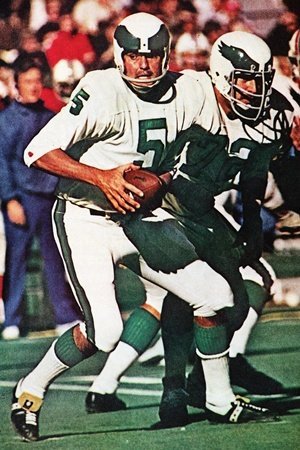
1973: Eagles Pay Heavy Price in Trade with Rams for Roman Gabriel


On June 8, 1973 the Philadelphia Eagles took a major step in revamping their offense by acquiring QB Roman Gabriel from the Los Angeles Rams. The acquisition of the 32-year-old quarterback came at great cost, however – they gave up All-Pro WR Harold Jackson, FB Tony Baker, and their first round draft choices for 1974 and ’75 plus a third round choice for 1975.

Gabriel had been taken by the Rams in the first round of the 1962 NFL draft out of North Carolina State (second overall). Big, especially for his time at 6’5” and 220 pounds, and with an accurate throwing arm, he showed potential during his first four seasons but shared time with Zeke Bratkowski, Terry Baker, and Bill Munson. The arrival of George Allen as head coach in 1966 brought improvement to the team in general and Gabriel in particular, who no longer faced challenges for the starting job. Operating in a ball control offense that complemented a ferocious defense, Gabriel took few risks and threw few interceptions. Over the course of the five seasons through 1970, the Rams went 49-17-4 during the regular season, although they lost both of their postseason games. The big quarterback was selected to the Pro Bowl three times (1967, ’68, and ’69) and was a consensus NFL MVP selection in 1969.

Things began to unravel after Allen’s departure following the 1970 season, and Gabriel suffered with tendonitis in his throwing elbow in ’72. His numbers dropped appreciably as he passed for 2027 yards (his lowest total since 1965) and he tossed more interceptions (15) than touchdowns (12).

Earlier in the offseason, the Rams acquired QB John Hadl from San Diego and Gabriel sought a trade. Because he had a no-trade, as well as no-cut, clause in his contract, he filed suit against the Rams, saying that his no-trade clause had been invalidated when Carroll Rosenbloom became owner of the Rams through a franchise swap for the Baltimore Colts with Robert Irsay.

Since Gabriel’s approval was necessary for any trade to occur, he was allowed to negotiate with other teams and agreed to terms with the Eagles the week before the deal, with the condition that a trade could be worked out. The suit was withdrawn in order to clear the way for the transaction with Philadelphia, but Rosenbloom, reacting to negative local press, nearly called off the trade at the last minute.

With regard to the players the Rams received in the trade, WR Harold Jackson was returning to the organization he had been with originally. A 12th round draft pick by LA in 1968, he appeared in just two games on special teams and was traded to the Eagles. His star rose quickly in Philadelphia as he led the NFL in pass receiving yards in ’69 with 1116 while catching 65 passes and scoring nine touchdowns. In four years with Philadelphia he caught a total of 215 passes for 3493 yards (16.2 avg.) and 21 TDs and was twice selected to the Pro Bowl, including after a 1972 season in which he led the league in both pass receiving (62 catches) and yards (1048).

FB Tony Baker played for the Saints before coming to Philadelphia, gaining selection to the Pro Bowl in 1969 when he led the NFL in average gain per carry (4.8) while rushing for 642 yards on 134 attempts and catching 34 passes for 352 more yards and another TD. Dealt to the Eagles during the ’71 season, he was coming off a year in which he ran the ball 90 times for 322 yards (3.6 avg.). He had nearly been traded to Atlanta during the ’72 season for RB Jim “Cannonball” Butler, but Butler flunked the team physical. The acquisition of FB Norm Bulaich from the Colts made Baker expendable.

The Eagles were coming off a 2-11-1 record in 1972 and were especially dreadful on offense, despite the presence of Jackson. They ranked at the bottom of the league in points scored (145) and touchdowns (12). Veteran QB Pete Liske gave way to John Reaves, the team’s first round draft choice out of Florida, and while Reaves had his moments, he also lost all of his starts. Head Coach Ed Khayat was fired and successor Mike McCormack sought to bolster the attack.

Gabriel did indeed make a difference in 1973. Dubbed “The Messiah” by the media and hopeful fans, his offseason regimen of martial arts training helped in overcoming his arm problems. 6’8” WR Harold Carmichael took over Harold Jackson’s place in the starting lineup with admirable results as he led the NFL in catches (67) and receiving yards (1116). Together with 6’4” rookie TE Charle Young and 6’3” WR Don Zimmerman, the receiving corps became known as “The Fire High Gang”. Gabriel led the NFL in pass attempts (460), completions (270), yards (3219), and TD passes (23) and he was selected to the Pro Bowl as well as receiving Comeback Player of the Year recognition. The team scored 310 points and 34 touchdowns, and while the record was still under .500 at 5-8-1, it was a notable improvement.

Gabriel played another four years with the Eagles, but with far less success. When a strike by the NFL Players Association delayed the start of training camps in 1974, Gabriel chose to report after three weeks and prior to a settlement, which damaged his relationship with his teammates. The club started out at 4-1 but then lost six straight games and Coach McCormack benched Gabriel in favor of rookie QB Mike Boryla for the final three contests of the season. His numbers declined to 1867 passing yards with 9 TD passes and 12 interceptions.

Gabriel regained the starting job in 1975 but lost it again to Boryla during a poor season that proved to be the last for McCormack. With the arrival of Dick Vermeil as head coach in ’76, he remained in a backup role for the last two years of his career, first to Boryla and then Ron Jaworski. Overall with the Eagles, Gabriel completed 661 of 1185 passes (55.8 %) for 7221 yards and 47 touchdowns with 37 interceptions. The team went 12-25-1 during his starts.

Meanwhile in Los Angeles, the Rams improved to 12-2 and won the NFC West in 1973 under new Head Coach Chuck Knox. Harold Jackson (pictured below) maintained his All-Pro form, catching fewer passes in a ball control offense (40) but averaging 21.9 yards per reception as he gained 874 yards and scored 13 TDs, including four in one game in which he accumulated 238 yards on 7 catches against the Cowboys. In five years with the Rams, he was selected to the Pro Bowl on three occasions. Tony Baker, utilized as a short-yardage specialist, ran the ball 85 times for 344 yards and 7 TDs. He lasted just one more year before moving on to San Diego.


The first round draft choices that the Rams obtained in the Gabriel deal were used to take RB John Cappelletti, the Heisman Trophy winner out of Penn State, in 1974 and G Dennis Harrah from the Univ. of Miami in ’75. The third round pick in 1975 went for Auburn TE Dan Nugent. Cappelletti was a serviceable back in LA for five years before moving on to the Chargers, rushing for a total of 2246 yards. Harrah became a mainstay on the offensive line for 13 seasons and was selected to the Pro Bowl six times. Nugent saw no action with the Rams and, converted to guard, was traded to the Redskins in 1976 for two draft choices.

The Gabriel trade was typical of deals made by the Rams that allowed them to stockpile high draft picks. They remained contenders throughout the decade, going to the playoffs in eight straight seasons and reaching the Super Bowl once. Meanwhile, the Eagles traded away more high draft choices in 1974 for LB Bill Bergey, who helped solidify the defense. They remained a mediocre team, breaking even at 7-7 that year and dropping to 4-10 in 1975. The situation would not improve until 1978, Dick Vermeil’s third year with the franchise. Ultimately, Roman Gabriel would not be a part of the team’s rise, and despite his fine first year with the club, the trade ultimately proved to be more of a hindrance to the club’s progress than a benefit.

June 7, 2013

MVP Profile: John Hadl, 1973

Quarterback, Los Angeles Rams


Age:  33
12th season in pro football, 1st with Rams
College: Kansas
Height: 6’1”   Weight: 214

Prelude:
Hadl was taken by the San Diego Chargers in the third round of the 1962 AFL draft (and first round by Detroit in the NFL, who had visions of converting him into an option halfback) and, with the injury and subsequent waiver departure of QB Jack Kemp, saw considerable action as a rookie. With the signing of veteran Tobin Rote for 1963, Hadl learned from the bench for a year but gradually saw more action in ’64 and took over as the starting quarterback in 1965 – a season in which he led the AFL in passing yards (2798) and yards per attempt (8.0). With a strong arm, he fit well in Head Coach Sid Gillman’s passing offense, although he was prone to throwing interceptions. In 1968, Hadl led the league in pass attempts (440), completions (208), yards (3473), TD passes (27), but also interceptions (32). Following the 1970 AFL/NFL merger, he led the NFL in pass attempts (431), completions (233), yards (3075), and TD passes (21) in 1971, a year when he also was picked off 25 times, and in 1972 he led the league in interceptions thrown with 26. Still, he was selected to four AFL All-Star games and one Pro Bowl with the Chargers through ’72, passing for a total of 26,938 yards and 201 TDs in 11 seasons. Dissatisfied with changes to the post-Gillman offense, Hadl was traded to the Rams for 1973 and, with the dispatch of veteran QB Roman Gabriel to Philadelphia, he took over as the starting quarterback in LA.

1973 Season Summary
Appeared and started in all 14 games
[Bracketed numbers indicate league rank in Top 20]

Passing
Attempts – 258 [12]
Most attempts, game – 26 at New Orleans 11/25
Completions – 135 [12]
Most completions, game – 13 vs. New Orleans 11/11
Yards – 2008 [8]
Most yards, game – 279 vs. Dallas 10/14
Completion percentage – 52.3 [16]
Yards per attempt – 7.8 [2, tied with Bob Lee]
TD passes – 22 [3]
Most TD passes, game – 4 vs. Dallas 10/14
Interceptions – 11 [15]
Most interceptions, game – 2 Dallas 10/14, at Minnesota 10/28, at New Orleans 11/25, vs. NY Giants 12/10
Passer rating – 88.8 [3]
200-yard passing games – 3

Rushing
Attempts – 14
Most attempts, game – 2 on 5 occasions
Yards – 5
Most yards, game – 6 yards (on 1 carry) vs. New Orleans 11/11
Yards per attempt – 0.4
TDs – 0

Postseason: 1 G (NFC Divisional playoff at Dallas)
Pass attempts – 23
Pass completions – 7
Passing yardage – 133
TD passes – 0
Interceptions – 1

Rushing attempts – 2
Rushing yards – 10
Average gain rushing – 5.0
Rushing TDs – 0

Awards & Honors:
NFC Player of the Year: Sporting News
1st team All-NFL: AP, PFWA, Pro Football Weekly
2nd team All-NFL: NEA
1st team All-NFC: AP, UPI, Pro Football Weekly, Sporting News
Pro Bowl

Rams went 12-2 to finish first in NFC West while leading NFL in total offense (4906 yards) and scoring (388 points) and the conference in rushing (2925 yards). Lost NFC Divisional playoff to Dallas Cowboys (27-16).

Aftermath:
With his performance declining in 1974, the Rams traded Hadl to Green Bay at midseason. He took over as starting quarterback for the Packers and stayed through ’75, but passed for just 9 TDs with 29 interceptions for a losing team. Hadl was traded again, to the Houston Oilers for QB Lynn Dickey, and finished out the last two seasons of his 16-year career as a backup. Overall, he threw for 33,503 yards (which ranked third all-time in AFL/NFL history at the time) and 244 touchdowns with 268 interceptions (second all-time) and had an 82-76-9 record as a starting quarterback in the AFL and NFL.

--


MVP Profiles feature players who were named MVP or Player of the Year in the NFL, AAFC (1946-49), AFL (1960-69), WFL (1974), or USFL (1983-85) by a recognized organization (Associated Press, Pro Football Writers Association, Newspaper Enterprise Association, United Press International, The Sporting News, Maxwell Club – Bert Bell Award, or the league itself).