December 5, 2015

1977: Harris & Defense Spur Dolphins to Win Against Colts


In a key AFC East showdown, the Miami Dolphins had an 8-3 record and were trying to catch the Baltimore Colts, the team they hosted on December 5, 1977. Under Head Coach Don Shula for the eighth season, the Dolphins were retooling after dipping to 6-8 in ’76. QB Bob Griese was still outstanding behind center, but behind him in the backfield were rookie FB Leroy Harris and second-year HB Gary Davis, who had both started out the season as reserves. The defense had undergone the bigger transformation, with five rookies starting and performing capably. Miami had been beaten badly at Baltimore in the season’s fourth week, but surrendered more than twenty points in a game only once since then.

Baltimore was coached by Ted Marchibroda and, at 9-2, was seeking to top the division for the third straight year. QB Bert Jones had a powerful and accurate passing arm and HB Lydell Mitchell was highly productive as a runner and pass receiver while the defensive line was adept at rushing opposing quarterbacks. The club had lost at Denver the previous week after winning four straight.

There were 68,977 fans in attendance for the Monday night game at the Orange Bowl. The Colts had first possession, punted, and Miami drove 69 yards in 11 plays. Leroy Harris started off with two carries for seven yards and, after an offside penalty gave the Dolphins a first down, Gary Davis and Harris picked up another 14 yards between them. The big play came on a pass from Bob Griese to WR Nat Moore for a pickup of 41 yards to the Baltimore 11. Miami couldn’t reach the end zone from there but scored first when Garo Yepremian kicked a 27-yard field goal.

The teams traded punts, but the Colts got a break when the kick by Mike Michel of the Dolphins traveled only 22 yards to give Baltimore possession at the Miami 36. Lydell Mitchell ran twice for 12 yards and caught a pass from Bert Jones for eight more. The drive stalled at the 15 and Toni Linhart tied the score with a field goal from 32 yards.

The Colts regained possession shortly thereafter when, on the second play after the kickoff, a Griese pass intended for TE Andre Tillman bounced off the receiver’s hands and was intercepted by LB Tom McCleod, who returned it 33 yards to the Miami 12. Following a three-yard run by Mitchell, Jones threw two incomplete passes, the second of which was dropped by TE Raymond Chester, and the visitors settled for a 27-yard Linhart field goal that nevertheless put them in front by 6-3.

As the game moved into the second quarter, the Dolphins responded with a 49-yard drive in just four plays. Griese threw to Moore for seven yards on first down, Harris ran for 15 yards, and Griese went to the air again, completing to Davis for 12 more. A Griese scramble was nullified by a penalty, but he then passed to Tillman, who ran through two defenders for a 15-yard touchdown. Yepremian added the extra point and the home team was ahead by 10-6.


The Colts turned the ball over on the next series when FB Ron Lee fumbled at midfield after being hit by CB Norris Thomas. It looked promising for the Dolphins as Griese threw to WR Duriel Harris for 10 yards, completed a short toss to Moore for four, and then Leroy Harris gained 11 yards around end. But after getting inside the Baltimore 10, Davis fumbled and CB Nelson Munsey recovered for the Colts.

Baltimore was forced to punt from its own territory and a 17-yard return by WR Freddie Solomon had the Dolphins starting their next series from the 50. They advanced to the Baltimore 11, primarily thanks to a Griese completion to Duriel Harris for 21 yards, but Yepremian missed a 29-yard try for a field goal. The score remained unchanged at the half.

The teams exchanged punts to start the third quarter until the Colts, starting from their 34, put together a promising drive. Jones completed all four of his passes and Mitchell and FB Don McCauley handled the running load. But with first-and-goal at the Miami four, FB Roosevelt Leaks fumbled into the end zone and Thomas recovered for the Dolphins to end the threat.

The Dolphins were driving as the game entered the fourth quarter. Griese made good on four passes, the longest to Moore for 18 yards on a third-and-22 play that put the ball on the Baltimore 31. However, Yepremian was short on a 49-yard field goal attempt and the home team continued to cling to a four-point lead.

The Colts reached the Miami 49 before having to punt again.  With the ball at their 23, the Dolphins made the biggest play of the game on first down when Leroy Harris carried to his right and headed down the sideline before cutting back to the middle and going the distance for a 77-yard touchdown. It was the longest scoring run in franchise history at the time and, with Yepremian’s kick, the Dolphins had an 11-point lead with 7:42 remaining to play.

Jones went to the air on every play in response. He connected with WR Roger Carr for 22 yards on a third-and-10 play and picked up another first down with a screen pass to McCauley for 13. But the series stalled at the Baltimore 45 and the Colts punted. Miami managed to run the clock down on the ensuing possession, with Harris and Davis running effectively and picking up two first downs. The Dolphins finally had to punt from their 40, but Baltimore had only a minute to work with and the Colts were starting from their 24. Jones completed three straight passes, two of them to McCauley, to get to the Miami 44, but a bomb intended for Doughty was incomplete and, on the game’s final play, a pass to Chester gained 29 yards. Miami came away with a 17-6 win.

The Dolphins had the edge in total yards (352 to 311) while the teams were even in first downs with 17 apiece. Of Miami’s yardage total, 207 came on the ground. The clubs were also even with two turnovers each while the Miami defense forced the Colts to punt seven times.

Including the long scoring carry, Leroy Harris rushed for 140 yards on 17 attempts. Gary Davis also was productive with 56 yards on 12 carries. Bob Griese completed 13 of 22 passes for 170 yards and a touchdown along with an interception. Nat Moore topped the Miami receivers with 5 catches for 83 yards.

For the Colts, Bert Jones was successful on 18 of 34 throws for 189 yards with no TDs but also none intercepted. Lydell Mitchell (pictured below) rushed for 84 yards on 20 attempts and caught 6 passes for another 62 yards. Don McCauley, who gained a modest 14 yards on the ground, also had 6 receptions, for 51 yards. Only four of Jones’ completions were to wide receivers.


The win put the Dolphins in a tie for first in the AFC East with Baltimore but they lost the following week and, while the Colts did also, the teams both ended up at 10-4. Baltimore won the division title due to a better record in the conference and Miami finished second and, with only one wild card spot available at that time (a second would be added the next year), out of the postseason. Oakland, with an 11-3 record, was the wild card participant and defeated the Colts in a Divisional round overtime thriller.

The 140-yard rushing performance ended up being the career best for Leroy Harris, who rushed for 417 yards on 91 carries (4.6 avg.) and four touchdowns in 1977 and would go on to play a total of five seasons with the Dolphins and Eagles. Gary Davis gained 533 yards on 126 attempts (4.2 avg.), which was his highest yardage total over the course of six years in the NFL.

December 4, 2015

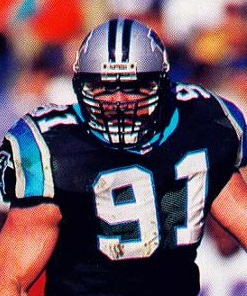
Highlighted Year: Kevin Greene, 1996

Linebacker, Carolina Panthers


Age: 34
12th season in pro football, 1st with Panthers
College: Auburn
Height: 6’3”   Weight: 247

Prelude:
A walk-on in college who was the SEC Defensive Player of the Year in 1984, Greene was chosen by the Los Angeles Rams in the fifth round of the ‘85 NFL draft. He was utilized on special teams and as a pass rushing specialist for his first three seasons, accumulating a total of 13.5 sacks, before moving into the starting lineup at left OLB in 1988 and registering 16.5 sacks. He received first-team All-NFL recognition from NEA and The Sporting News and was also a Pro Bowl selection for the first time in ’89 following another 16.5-sack season. Strong and fast, Greene had good range and instincts, and while a holdout led to a slow start in 1990, he still ended up with 13 sacks. With a shift to a 4-3 defense in ’91, Greene was moved to defensive end and his sack total dropped to three. He moved back to outside linebacker in 1992, recorded 10 sacks, and signed as a free agent with the Pittsburgh Steelers in ’93, where he was again able to play in a 3-4 alignment. The result over the course of three years in Pittsburgh was 35.5 sacks, including a league-leading 14 in 1994, a year in which he also received consensus first-team All-NFL honors, and two Pro Bowl selections. He joined the Panthers as a free agent in ’96.

1996 Season Summary
Appeared in all 16 games
[Bracketed numbers indicate league rank in Top 20]

Sacks – 14.5 [1]
Most sacks, game – 2.5 at St. Louis 11/17
Multi-sack games – 4
Interceptions – 0
Fumble recoveries – 3
Fumble recovery TDs – 1
Forced fumbles – 2
Tackles – 37
Assists – 14

Scoring
TDs – 1
Points – 6

Postseason: 2 G
Sacks – 0
Interceptions – 0
TD – 0

Awards & Honors:
1st team All-NFL: AP, PFWA
1st team All-NFC: UPI, Pro Football Weekly
Pro Bowl

Panthers went 12-4 to finish first in the NFC West, reaching the postseason in just their second season of existence, while leading the NFL in sacks (60) and ranking second in fewest points allowed (210). Won NFC Divisional playoff over Dallas Cowboys (26-17). Lost NFC Championship to Green Bay Packers (30-13).  

Aftermath:
Greene held out in 1997 due to a contract dispute and was released by the Panthers during the preseason. He signed with San Francisco and was used primarily as a pass rushing specialist, accumulating 10.5 sacks. Greene returned to Carolina in ’98, moved back into the starting lineup, and recorded 15 sacks and was chosen to the Pro Bowl at age 36. He played for one more year with the Panthers in 1999 and finished up with 12 sacks, his tenth double-digit total in 15 NFL seasons. Overall, Greene compiled 160 sacks, which ranked third all-time, in addition to 26 fumble recoveries, two of which he returned for touchdowns, and five interceptions, one of which resulted in a TD. 41.5 of his sacks came during his three seasons with Carolina. Greene received at least some first-team All-NFL honors after three seasons and was selected to the Pro Bowl five times, four of them after age 30.

--

Highlighted Years features players who were consensus first-team All-League* selections or league* or conference** leaders in the following statistical categories:

Rushing: Yards, TDs (min. 10)
Passing: Yards, Completion Pct., Yards per Attempt, TDs, Rating
Receiving: Catches, Yards, TDs (min. 10)
Scoring: TDs, Points, Field Goals (min. 5)
All-Purpose: Total Yards
Defense: Interceptions, Sacks
Kickoff Returns: Average
Punt Returns: Average
Punting: Average

*Leagues include NFL (1920 to date), AFL (1926), AFL (1936-37), AAFC (1946-49), AFL (1960-69), WFL (1974-75), USFL (1983-85)

**NFC/AFC since 1970

December 3, 2015

1989: Cunningham’s 91-Yard Punt Highlights Win by Eagles Over Giants


The New York Giants had a 9-3 record as they hosted the Philadelphia Eagles, who were just a game behind in the NFC East at 8-4, on December 3, 1989. The Eagles, coached by the brash and defense-minded Buddy Ryan, were the defending division champions and had won the last three meetings between the clubs, including earlier in the season at Philadelphia. QB Randall Cunningham was the key to the offense, and while having a rather ordinary year by his standards, was still formidable both throwing and running with the ball. The loss of star WR Mike Quick left the team lacking a deep threat although TE Keith Jackson was an outstanding receiver. The tough defense, anchored by DE Reggie White, was adept at both rushing opposing passers and forcing turnovers. The loss of punter John Teltschik to a knee injury caused the team to sign Max Runager, whose leg was no longer as strong as when he had been with the club at the beginning of his pro career, but Cunningham, who averaged 45.2 yards as a punter in college, could boot the ball a long way in a pinch, although he lacked proper technique.

New York, under the guidance of Head Coach Bill Parcells for the seventh year, also fielded a tough defense led by LB Lawrence Taylor, who was playing with a bad ankle (and only made it through the first half against the Eagles). The conservative offense was directed by gritty QB Phil Simms while 32-year-old RB Ottis Anderson, once a star with the Cardinals, had resurrected his career.

There were 74,809 fans in attendance at Giants Stadium on a bitterly cold day in the New Jersey Meadowlands with temperatures in the teens and a wind chill factor that was below zero due to the 35 mph gusts. Anticipating a defensive struggle on a windy day, the Eagles won the toss and chose to kick. On New York’s third offensive play, Phil Simms fumbled when hit by Reggie White and CB William Frizzell recovered, returned it 12 yards, and, about to be tackled by RB Dave Meggett, lateraled to SS Andre Waters, who covered the remaining three yards for a touchdown. Roger Ruzek added the extra point and Philadelphia had the early 7-0 lead.

The Giants moved effectively on their next series. Ottis Anderson carried six straight times for 32 yards that included a long gain of 17 yards, but the drive stalled at the Philadelphia 30 and Bjorn Nittmo was short on a 47-yard field goal attempt.

The Eagles had to punt following a short possession and the defense again came up with a big play when DE Clyde Simmons intercepted a short Simms pass and returned it 60 yards for a TD. Ruzek again converted and the visitors were ahead by 14-0 thanks to the two turnovers.

Now in a two-touchdown hole, the Giants came back with a 70-yard drive in six plays. Simms threw to WR Lionel Manuel (pictured below) for a 24-yard gain in a third-and-seven situation and another completion to WR Mark Ingram resulted in a 41-yard touchdown. Nittmo added the point after and the Philadelphia lead was cut to 14-7.


With time running down in the first quarter, the Eagles advanced into New York territory. Randall Cunningham threw passes to Keith Jackson for 29 yards and WR Ron Johnson for 31 to reach the Giants’ 29. However, two penalties backed them up and, on the first play of the second quarter, Max Runager’s punt pinned the Giants back at their seven yard line.

New York had to punt in turn and Sean Landeta’s 53-yard boot went out of bounds at the Philadelphia 37. The Eagles again advanced into enemy territory, with a Cunningham throw to Jackson picking up 23 yards, but Cunningham’s next pass was picked off by LB Pepper Johnson. However, the Giants were penalized for holding on their first offensive play, negating a 23-yard pass completion, and two plays later CB Eric Allen intercepted a Simms throw and returned it to the New York 30. The Eagles kept the ball on the ground and Ruzek kicked a 35-yard field goal that made the score 17-7.

The Giants reached the Philadelphia 42 but had to turn the ball over on downs after failing to convert a fourth-and-11 play. They got the ball back shortly thereafter when Jackson fumbled after catching a short pass that Pepper Johnson recovered at the New York 29. It looked promising for the home team when, five plays later, Simms connected with Manuel for a 49-yard gain that had yardage added on due to an illegal head slap on the defense to put the ball on the Philadelphia 16. But on the next play, Dave Meggett fumbled and LB Byron Evans recovered for the Eagles. The clock was down to 1:47 remaining in the first half and the visitors ran it out to go into halftime maintaining a ten-point lead.

The Giants had the ball first in the third quarter and drove 37 yards in six plays, helped along by two penalties on the Eagles, one of which negated an interception. Simms again threw to Manuel for a big gain, picking up 39 yards to the Philadelphia 23. Facing third-and-five at the 13, Simms was sacked by FS Wes Hopkins for a loss of seven yards, but New York added three more points on a 38-yard Nittmo field goal to narrow the score to 17-10.

The Eagles moved effectively in response with FB Anthony Toney and RB Keith Byars handling the running load and Cunningham completing passes to Jackson for 33 yards and Byars for 10. After an 11-yard carry by Toney gave Philadelphia first-and-goal at the New York six, Byars ran for five yards up the middle, but three consecutive carries by Toney were stopped short of the end zone and the visitors turned the ball over on downs. The Giants could get no further than a yard on offense, but were helped out by an offsides penalty on the Eagles and Landeta boomed a 71-yard punt.

Philadelphia managed only a short series before punting, and Runager’s kick traveled only 21 yards to give the Giants possession at the Eagles’ 49. Simms immediately threw to TE Zeke Mowatt for 29 yards and, after two more passes fell incomplete, he connected with Ingram for 14 yards on a third-and-10 play to the Philadelphia six. A pass interference call moved the ball to the one and Anderson scored a touchdown from there. Nittmo kicked the extra point and the score was tied at 17-17.

The Eagles punted from deep in their own territory following the next possession and Runager’s 37-yard kick was returned 10 yards by Meggett to the Philadelphia 39. Simms threw to Meggett for seven yards to finish off the period but a tripping penalty moved the Giants back ten yards and DT Mike Pitts sacked Simms for a nine-yard loss. A third down pass was incomplete and New York was forced to punt, with Landeta’s 26-yard boot downed at the Philadelphia 25.

After an incompletion on first down, a holding penalty moved the Eagles back ten yards, a toss to Byars lost another three, and Cunningham was sacked on third down by NT Erik Howard. It looked good for the Giants as Philadelphia was forced to punt from its own end zone. But this time it was Cunningham back to punt, rather than Runager (pictured at top). His wind-aided kick went 70 yards in the air and bounced past Meggett, who finally chased it down after it had traveled 91 yards in all. Meggett returned it nine yards, but instead of having favorable field position in Philadelphia territory, the Giants were back at their 16 and facing the wind. New York was penalized for an illegal formation on first down and on the next play Simms fumbled when sacked by DT Mike Golic and Pitts recovered at the New York seven. Three plays later, Byars ran for a two-yard touchdown and, with Ruzek adding the point after, the Eagles were back in front by seven points.

There were still nearly 11 minutes left to play and the Giants drove into Philadelphia territory. Simms converted a third-and-four play with a completion to Meggett for 11 yards and a pass interference penalty on Waters gained 21 yards. But the advance was halted at the Philadelphia 30 and a fourth-and-seven pass by Simms intended for Ingram was incomplete.

The Eagles were able to run significant time off the clock as Byars ran six straight times, including a 15-yard gain on a draw play when facing third-and-eight. By the time they had to punt, there was only a little over a minute remaining in regulation. However, a bad snap over Runager’s head had the punter recovering at the Philadelphia 46, from where the Giants had possession with 1:04 left. Simms threw to Manuel for 14 yards, but his next four throws fell incomplete and the Eagles came away with a hard-fought 24-17 win.   

New York had the edge in total yards (294 to 279) and first downs (17 to 13). However, the Giants also turned the ball over five times and all of Philadelphia’s points came off of New York turnovers. The Eagles turned the ball over twice but were penalized 16 times at a cost of 111 yards, to six flags thrown on the Giants. Philadelphia recorded five sacks, to one by New York.


Randall Cunningham completed 9 of 16 passes for 140 yards with no touchdowns and one interception, ran the ball five times for 10 yards, and of course booted the 91-yard punt. Keith Jackson topped the Philadelphia receivers with 5 catches for 97 yards. Anthony Toney (pictured at left) rushed for 68 yards on 22 carries and Keith Byars contributed 66 yards and a TD on his 14 attempts plus three pass receptions for 12 yards.

For the Giants, Phil Simms was successful on just 11 of 37 throws for 265 yards and a TD with two intercepted. Lionel Manuel had a big day with four receptions for 126 yards while Mark Ingram gained 83 yards on his three catches that included a touchdown. Ottis Anderson ran for 46 yards on 16 carries and scored a TD.

“I’m disappointed in the way we played,” said Coach Parcells of the Giants. “We turned the ball over far too much. Even though we did that, we had enough chances to win, but we didn’t.”

The Eagles drew even with the Giants at 9-4 while holding the tiebreaker due to having now swept the season series. However, they lost one of their three remaining games while New York won all of theirs and thus the Giants topped the AFC East with a 12-4 record and Philadelphia settled for second place and a wild card slot at 11-5. Both teams lost to the Los Angeles Rams in the postseason, the Eagles in the Wild Card playoff and the Giants in the Divisional round.

Randall Cunningham punted 20 times over the course of his 16-year NFL career, averaging 44.7 yards. 12 of those punts, for a 51.7-yard average, came with the Eagles, with the 91-yard kick against the Giants the longest and most memorable. It remains a franchise record, by a full eight yards.

December 2, 2015

Highlighted Year: Butch Byrd, 1965

Cornerback, Buffalo Bills


Age: 24 (Sept. 20)
2nd season in pro football & with Bills
College: Boston Univ.
Height: 6’0”   Weight: 211

Prelude:
Byrd was an outstanding runner, pass receiver, and kick returner in college in addition to his play on defense. He was chosen by the Bills in the fourth round of the 1964 AFL draft and immediately moved into the starting lineup, intercepting 7 passes, one of which he returned for a touchdown. He received second-team All-AFL honors from the NEA and was chosen to the AFL All-Star Game while the Bills won the AFL Championship.

1965 Season Summary
Appeared in all 14 games
[Bracketed numbers indicate league rank in Top 20]

Interceptions – 5 [9, tied with six others]
Most interceptions, game – 2 at Oakland 11/14
Int. return yards – 119 [5]
Most int. return yards, game – 66 (on 2 int.) at Oakland 11/14
Int. TDs – 0
Fumble recoveries – 0

Punt Returns
Returns – 22 [3]
Yards – 220 [4]
Most yards, game – 42 (on 3 ret.) at San Diego 11/25
Average per return – 10.0 [4]
TDs – 0
Longest return – 30 yards

Postseason: 1 G (AFL Championship at San Diego)
Interceptions – 1
Int. return yards – 24
TDs – 0

Punt returns – 3
Punt return yards – 87
TDs – 1
Longest return – 74 yards

Awards & Honors:
1st team All-AFL: League, AP, NY Daily News
2nd team All-AFL: UPI
AFL All-Star Game

Bills went 10-3-1 to finish first in the AFL Eastern Division while leading the league in interceptions (32) and fewest points allowed (226). Won AFL Championship over San Diego Chargers (23-0).

Aftermath:
Byrd followed up with another outstanding season in 1966, intercepting six passes, returning one for a touchdown, and averaging 8.1 yards on his 23 punt returns that also included a TD. He played another four years for the Bills and continued to perform at a high level, even as the team’s record dropped off. He was named to two more AFL All-Star Games, was a consensus first-team All-AFL choice in 1969 and a second-team selection in ’68. After starting 143 consecutive games through 1970, he was dealt to Denver just prior to the ’71 season, his last. Overall, Byrd intercepted 40 passes for 666 yards, all with Buffalo and both team records, and returned five of them for touchdowns. He also returned 86 punts for a 7.0 average and one TD, with another score on a punt return in the postseason. Byrd was a consensus All-AFL first-team choice three times and was named to five AFL All-Star Games.

--

Highlighted Years features players who were consensus first-team All-League* selections or league* or conference** leaders in the following statistical categories:

Rushing: Yards, TDs (min. 10)
Passing: Yards, Completion Pct., Yards per Attempt, TDs, Rating
Receiving: Catches, Yards, TDs (min. 10)
Scoring: TDs, Points, Field Goals (min. 5)
All-Purpose: Total Yards
Defense: Interceptions, Sacks
Kickoff Returns: Average
Punt Returns: Average
Punting: Average

*Leagues include NFL (1920 to date), AFL (1926), AFL (1936-37), AAFC (1946-49), AFL (1960-69), WFL (1974-75), USFL (1983-85)

**NFC/AFC since 1970

December 1, 2015

1985: Packers Shut Out Bucs in “Snow Bowl”


It was a snowy day in Green Bay on December 1, 1985 as the Packers hosted the Tampa Bay Buccaneers. A foot of snow had already fallen by game time and it was accompanied by high winds that gusted to 40 mph and made for a wind chill of zero degrees.

Neither team was in contention coming into the game. The Packers, coached for the second year by Forrest Gregg, had a 5-7 record, although they had won two of their last three contests. WR James Lofton was outstanding but QB Lynn Dickey was showing signs of wear. There was a fair group of running backs but, overall, the team was mediocre. Tampa Bay, under Head Coach Leeman Bennett, also won two of its last three, but had lost the nine games before that and was at 2-10. There was talent in workhorse RB James Wilder and promising new QB Steve Young, who had gained experience in the USFL and recently moved into the starting lineup, but the defense was a liability.  

Attendance was held to 19,856 at Lambeau Field due to the severe weather. The snow did not let up and the conditions didn’t improve during the course of the game, obliterating the yard markers and obscuring visibility. Green Bay won the toss but chose to kick. The Buccaneers thus had the first possession, ran the ball three times, and punted. Lynn Dickey completed a pass to James Lofton, but the star receiver fumbled after gaining 27 yards to midfield and LB Ervin Randle recovered for Tampa Bay. The Bucs were unable to generate offense and punted once again. Green Bay responded with a long drive that took up nearly the remainder of the first quarter. RB Eddie Lee Ivery and FB Jessie Clark carried the ball for the most part but Dickey completed passes to Lofton for 14 and 17 yards and to TE Ed West for 11. The advance finally stalled at the Tampa Bay eight and the Packers came up empty when Al Del Greco’s 25-yard field goal attempt was blocked.

As the game proceeded into the second quarter, the Bucs again had to punt and the Packers put together a 61-yard possession in 11 plays that was helped along when, forced to punt, the Buccaneers were penalized for running into the kicker. Dickey completed passes to Lofton for 11 yards and WR Phillip Epps for seven to start the series and, following the penalty that kept the drive alive, he threw to Lofton for a pickup of 18 yards. Three plays later, and facing third-and-22, Dickey passed to TE Paul Coffman for 19 yards and shortly thereafter, unable to find an open receiver, kept the ball on a one-yard touchdown run. Del Greco added the extra point and the home team was ahead by 7-0.

That remained the score at halftime as the teams traded punts for the remainder of the half. While Dickey was able to complete passes and the Packers generated 243 yards in the wintry conditions, the Bucs were held to 43 yards and one first down.

RB Gerry Ellis returned the second half kickoff 40 yards and it took the Packers just four plays to score again. On second-and-12, Dickey connected with Coffman for a gain of 19 yards and, two plays after that, Ellis broke away for a 35-yard touchdown run. Del Greco again converted to put the home team up by 14-0.

Following another punt by the Bucs, the Packers, starting with good field position at their 48, again drove into Tampa Bay territory, helped along by a pass interference penalty. However, they came up empty this time when Del Greco was wide to the left on a 24-yard field goal attempt.

Another short series by the visitors concluded with another punt, and the teams exchanged turnovers in short order as FS Ivory Sully intercepted a Dickey pass at the goal line, CB Tim Lewis picked off a Steve Young throw two plays later, and Clark fumbled the ball back two plays after that. It appeared that the Bucs might finally get on the board when a long pass by Young intended for WR Kevin House on first down drew a 34-yard pass interference penalty on Lewis that put the ball at the Green Bay 30. Young completed a pass to House for 10 yards but the drive stalled at the 16 and Donald Igwebuike’s 33-yard field goal attempt to start the fourth quarter sailed wide to the left.

The Packers responded by advancing 80 yards in nine plays. Ivery gained 11 yards on a draw play and Ellis had a 15-yard run. Dickey had four pass completions, two of them to Epps for 19 and 18 yards, and the second set up Clark’s three-yard touchdown run up the middle. Del Greco added the extra point and, with Tampa Bay unable to threaten for the remainder of the game, it capped Green Bay’s 21-0 win.

The Packers completely dominated the Buccaneers, gaining far more yards (512 to 65) and first downs (31 to 5), and running 72 plays to Tampa Bay’s 36. Green Bay almost evenly distributed the yardage between running (232) and passing (280). The Packers were credited with five sacks, to two by the Bucs, but also turned the ball over four times, to one suffered by Tampa Bay.


Lynn Dickey completed 22 of 36 passes for 299 yards, and while none were for touchdowns and two were intercepted, it was still a fine showing under the circumstances. Eddie Lee Ivery (pictured at right) and Gerry Ellis both gained over a hundred rushing yards, with Ivery accumulating 109 yards on 13 carries and Ellis contributing 101 on just 9 attempts that included a TD. James Lofton had 6 catches for 106 yards.

For the Bucs, Steve Young was successful on just 8 of 17 throws for 53 yards with no TDs and one interception. He also led the club with 31 rushing yards on 7 carries. James Wilder was held to 23 yards on 12 attempts but led the team with 6 pass receptions for 33 yards.

“Some people can handle cold weather and some can’t. The big thing is, you have to give Lynn Dickey a lot of credit. To be able to throw the football in these conditions is phenomenal,” said Green Bay’s Coach Gregg with reference to his quarterback’s strong outing. “He did a hell of a job.”

Green Bay lost the next week but won the last two games of the season to finish with an 8-8 record for the third straight year, which placed a distant second behind the Bears in the NFC Central. The Buccaneers lost their remaining games, including the rematch with the Packers in the more agreeable climate of Tampa, to end up last in the division at 2-14. While the “Snow Bowl” had no impact on the race for the 1985 postseason, it has maintained a place in the lore regarding pro football games played in extreme weather conditions.

November 30, 2015

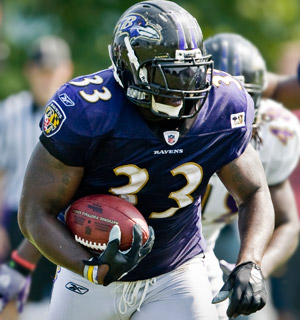
Highlighted Year: Le’Ron McClain, 2008

Fullback, Baltimore Ravens


Age: 24 (Dec. 27)
2nd season in pro football & with Ravens
College: Alabama
Height: 6’0”   Weight: 260

Prelude:
Recognized for his strong blocking ability in college, McClain was chosen by the Ravens in the fourth round of the 2007 NFL draft. He showed promise as a rookie, although rarely touching the ball (8 rushing attempts for 18 yards, 9 catches for 55 yards and a TD). He saw more action in ’08, often used as a tailback in combination with RB Willis McGahee and rookie RB Ray Rice due to his punishing running style.

2008 Season Summary
Appeared in all 16 games
[Bracketed numbers indicate league rank in Top 20]

Rushing
Attempts – 232 [18]
Most attempts, game – 25 (for 86 yds.) at Cincinnati 11/30, (for 70 yds.) vs. Jacksonville 12/28
Yards – 902 [20]
Most yards, game – 139 yards (on 22 carries) at Dallas 12/20
Average gain – 3.9
TDs – 10 [8, tied with four others]
100-yard rushing games – 1

Pass Receiving
Receptions – 19      
Most receptions, game – 3 (for 26 yds.) at Pittsburgh 9/29, (for 10 yds.) at Miami 10/19, (for 31 yds.) at NY Giants 11/16
Yards – 123
Most yards, game – 31 (on 3 catches) at NY Giants 11/16
Average gain – 6.5
TDs – 1

Scoring
TDs – 11 [13, tied with Anquan Boldin & Randy Moss]
Points – 66

Postseason: 3 G
Rushing attempts – 32
Most rushing attempts, game – 19 at Miami, AFC Wild Card playoff
Rushing yards – 90
Most rushing yards, game – 75 at Miami, AFC Wild Card playoff
Average gain rushing – 2.8
Rushing TDs – 1

Kickoff returns – 1
Kickoff return yards – 23
Kickoff return TDs – 0

Awards & Honors:
1st team All-NFL: AP
Pro Bowl

Ravens went 11-5 to finish second in the AFC North while leading the conference in rushing yards (2376) and qualified for a Wild Card spot in the postseason. Won AFC Wild Card playoff over Miami Dolphins (27-0) and AFC Divisional playoff over Tennessee Titans (13-10). Lost AFC Championship to Pittsburgh Steelers (23-14).

Aftermath:
McClain never again carried more than 46 times in a season as he returned to a primarily blocking role in 2009. Still, he received second-team All-NFL recognition from the Associated Press and Pro Football Focus and was named to the Pro Bowl again. After one more year with Baltimore in 2010, McClain signed with Kansas City in 2011 and moved on to the San Diego Chargers in 2012 and ’13, his last two seasons, where he was still an effective lead blocker but rarely touched the ball and saw scant action. Overall, McClain rushed for 1310 yards and caught 94 passes for another 557 yards, scoring a total of 16 touchdowns. Most of his production came with the Ravens, amounting to 1185 yards on 314 carries (3.8 avg.) and 70 pass receptions for 453 yards, with 14 total TDs. He was a first-team All-NFL selection once and was twice chosen to the Pro Bowl.

--

Highlighted Years features players who were consensus first-team All-League* selections or league* or conference** leaders in the following statistical categories:

Rushing: Yards, TDs (min. 10)
Passing: Yards, Completion Pct., Yards per Attempt, TDs, Rating
Receiving: Catches, Yards, TDs (min. 10)
Scoring: TDs, Points, Field Goals (min. 5)
All-Purpose: Total Yards
Defense: Interceptions, Sacks
Kickoff Returns: Average
Punt Returns: Average
Punting: Average

*Leagues include NFL (1920 to date), AFL (1926), AFL (1936-37), AAFC (1946-49), AFL (1960-69), WFL (1974-75), USFL (1983-85)

**NFC/AFC since 1970

November 29, 2015

1976: Jackson & Williams Lead 49ers to Upset of Vikings


The San Francisco 49ers were trying to remain in contention in the NFC West as they faced the Minnesota Vikings on November 29, 1976. Under the guidance of Head Coach Monte Clark, the 49ers had gotten off to a 6-1 start before dropping four straight games, and were now 6-5. To make matters worse, starting QB Jim Plunkett, an offseason acquisition from the Patriots, was injured and untested rookie QB Scott Bull, a sixth-round draft choice out of Arkansas, would have to start in his place. They did have a reliable ground game with HB Delvin Williams (pictured above) and FB Wilbur Jackson, and would be even more dependent upon them.

Minnesota was coached by Bud Grant for the tenth year and was used to contending, having topped the NFC Central in each of the last three seasons. The Vikings were 9-1-1 as they came to San Francisco. 36-year-old QB Fran Tarkenton was still one of the league’s best and the receiving corps was bolstered by the addition of wide receivers Ahmad Rashad, formerly with Buffalo, and rookie Sammy White. HB Chuck Foreman was outstanding both running the ball and catching it out of the backfield. The defense had been the team’s bedrock over the years and, while age was becoming a factor, it was still a tough unit.

There were 56,775 fans in attendance at Candlestick Park on a cool, clear Monday evening. The Vikings had the game’s first possession and punted. With Wilbur Jackson and Delvin Williams running effectively, the 49ers advanced 51 yards in eight plays. Jackson finished the drive off with a two-yard touchdown carry, Steve Mike-Mayer added the extra point, and San Francisco had the early 7-0 lead.

The Vikings responded with a promising drive that was fueled by the running of Chuck Foreman, who gained 27 yards on the first three plays. However, the visitors came up empty when the series stalled at the San Francisco 34 and Fred Cox was short on a 51-yard field goal attempt. Jackson (pictured below) carried five times for 21 yards and Williams had a 30-yard run as the Niners drove to the Minnesota eight, but they failed to add to their lead when Mike-Mayer hit the right upright on a 25-yard field goal try.


As the game headed into the second quarter, the Vikings had to punt and this time the 49ers didn’t come up empty. Jackson had a 24-yard run to advance the ball into Minnesota territory and Scott Bull threw to WR Jim Lash, an ex-Viking, for 10 yards. Bull was sacked for a ten-yard loss on third down, but Mike-Mayer was successful on a field goal from 45 yards and San Francisco was ahead by 10-0.

The Vikings put together a long drive of 85 yards in 17 plays. Facing a third-and-11 situation from their own 14, Fran Tarkenton threw to Ahmad Rashad for a 33-yard gain and a third-and-six play from the San Francisco 36 resulted in a Tarkenton completion to Foreman for nine yards. A pass interference penalty allowed Minnesota to convert another third down and the final play of the series resulted in a Tarkenton toss to Sammy White in the end zone for a 17-yard TD. Cox converted to make it a three-point game at 10-7.

The 49ers had to punt from deep in their own territory and the Vikings needed just five plays this time to score again. Tarkenton threw to Rashad for a 47-yard pickup and, two plays later, it was Tarkenton-to-Rashad once more for an eight-yard touchdown. DT Cleveland Elam blocked the extra point attempt but the visitors were ahead by 13-10 with 2:24 remaining in the first half.

San Francisco responded by advancing 83 yards in seven plays. Williams started the series off with a 23-yard run and, just after the two-minute warning, Bull completed a pass to WR Gene Washington for 16 more yards. A pass interference call on CB Nate Wright placed the ball on the Minnesota one, and Bull dove into the end zone from there for a TD. Mike-Mayer converted and the 49ers were back in front by 17-13 at halftime.

The 49ers had the ball first in the third quarter but FS Paul Krause intercepted a Bull pass and that resulted in Cox kicking a 37-yard field goal that narrowed the score to 17-16. Once again it was Jackson and Williams carrying the load as the Niners kept the ball on the ground, but the drive stalled at the Minnesota 30 and Mike-Mayer was short on a 47-yard try for a field goal.

The teams exchanged punts for the remainder of the period, but the 49ers were winning the field position battle and had advanced to the Minnesota 25 as the contest entered the fourth quarter. Mike-Mayer booted a 38-yard field goal early in the final period and San Francisco was up by four points.

The Vikings punted following their next series and, on the second play of the ensuing possession, Williams took off on a 26-yard run that put him over a thousand yards for the season. However, he also had to leave the game with a sprained ankle, hobbling off the field to a loud ovation from the crowd. The teams returned to exchanging punts and now it was Minnesota benefiting from the exchanges. A 44-yard kick by Neil Clabo had the 49ers pinned back at their five yard line with 9:38 remaining to play.

The Niners went three-and-out and punted, giving the Vikings possession at the San Francisco 24 following a 14-yard return by DB Autry Beamon. Foreman ran the ball three straight times and, after LB Skip Vanderbundt stopped him short of a first down on a three-yard carry, the Vikings faced fourth-and-one at the 15. Foreman carried once more, and this time it was LB Dave Washington stopping him for no gain.

The 49ers were unable to maintain control of the ball as Bull’s six-yard run on third down came up inches short of a first down and forced a punt. Minnesota still had 1:19 to work with after taking over at the San Francisco 47. On second down, following an incomplete pass, Tarkenton was penalized for intentional grounding in order to avoid being sacked for a sizeable loss. As it was, it cost the Vikings 15 yards and a down, and a completion to Rashad for seven yards had them facing fourth-and-18. Tarkenton threw to WR Bob Grim for a gain of 27 yards to keep the series alive, but two passes into the end zone fell incomplete as time ran out. The 49ers held on to win by a final score of 20-16.  

San Francisco had the edge in total yards (331 to 282), with 317 on the ground, and first downs (17 to 16). The 49ers also were credited with three sacks, to two for Minnesota, although they also suffered the game’s only turnover and drew more penalties (9 to 8). Both teams had problems with placekicking as Minnesota’s Fred Cox missed an extra point as well as a field goal attempt and Steve Mike-Mayer failed on two of four field goal tries.

Wilbur Jackson and Delvin Williams both gained over 150 rushing yards, with Jackson accumulating 156 on 30 carries that included a touchdown and Williams compiling 153 yards on 20 attempts despite being knocked out of the game with an injury during the fourth quarter. Scott Bull went to the air only eight times and completed three for 32 yards with one interception. Three receivers had a catch apiece for the 49ers, with Gene Washington gaining a team-leading 16 yards on his reception.


For the Vikings, Fran Tarkenton (pictured at right) completed 16 of 37 passes for 200 yards and two touchdowns while giving up no interceptions. Ahmad Rashad had 6 receptions for 103 yards and a TD. Chuck Foreman rushed for 93 yards on 23 carries and gained another 23 yards on three catches.

“We wanted to run at them and that’s what we did,” explained Delvin Williams. “We ran it straight up the middle. Our plan was to run the ball and to pass as little as possible, to keep the pressure off Scott (Bull).”

The 49ers split their last two games of the season with Scott Bull at quarterback and finished with an 8-6 record that was good for second place in the AFC West but not good enough to qualify for the postseason. Minnesota recovered to win its last two games to once more top the NFC Central at 11-2-1 and advanced to the Super Bowl before losing to the Oakland Raiders.

Delvin Williams broke Joe Perry’s 22-year-old franchise rushing record with 1203 yards on 248 carries (4.9 avg.) and scored seven touchdowns. He was selected to the Pro Bowl. Wilbur Jackson gained 792 yards on 200 attempts (4.0 avg.) with one TD. Scott Bull ended up completing 21 of 48 passes for 252 yards (43.8 %) with two touchdowns and four interceptions. He also rushed for 66 yards and two TDs.