March 27, 2016

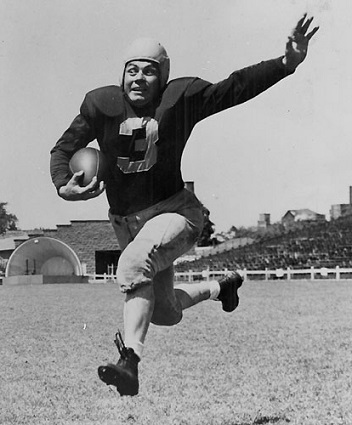
Highlighted Year: Tony Canadeo, 1943

Tailback/Defensive Back, Green Bay Packers


Age: 24
3rd season in pro football & with Packers
College: Gonzaga
Height: 5’11” Weight: 195

Prelude:
“The Gray Ghost of Gonzaga” was an All-West Coast and Little All-American selection in college for his play at halfback. He was chosen by the Packers in the seventh round of the 1941 NFL draft and backed up Cecil Isbell at tailback. His statistical totals were thus modest during his first two seasons as he rushed for a total of 409 yards, caught 10 passes for 66 yards, passed for 364 yards and five touchdowns, and returned 10 kickoffs for a 24.7-yard average and 11 punts for an average of 9.3 yards, and scored six TDs. Canadeo made up for lack of ideal size and speed with determination, savvy, and versatility. With the departure of Isbell, he saw more action in 1943 in combination with rookie Irv Comp.  

1943 Season Summary
Appeared in all 10 games
[Bracketed numbers indicate league rank in Top 20]

Rushing
Attempts – 94 [6]
Yards – 489 [5]
Yards per attempt – 5.2 [3]
TDs – 3 [6, tied with seven others]

Pass Receiving
Receptions – 3
Yards – 31
Yards per catch – 10.3
TDs – 2

Passing
Attempts – 129 [3]
Completions – 56 [3]
Yards – 875 [3]
Completion percentage – 43.4 [4]
Yards per attempt – 6.8 [3]
TD passes – 9 [3, tied with Roy Zimmerman]
Most TD passes, game – 3 vs. Detroit 10/10
Interceptions – 12 [5, tied with Sid Luckman]
Passer rating – 51.0 [3]

Kickoff Returns
Returns – 10 [6]
Yards – 242 [5]
Average per return – 24.2 [3]
TDs – 0
Longest return – 43 yards

Punt Returns
Returns – 8 [12, tied with Lou Brock]
Yards – 93 [12]
Average per return – 11.6
TDs – 0
Longest return – 22 yards

Interceptions
Interceptions – 2 [20, tied with eighteen others]
Return yards – 15
TDs – 0

Punting
Punts – 3
Yards – 102
Average – 34.0
Punts blocked – 0
Longest punt – 39 yards

Scoring
TDs – 5 [10, tied with Tony Bova, Hamp Pool & George Wilson]       
Points – 30 [14, tied with Tony Bova, Hamp Pool & George Wilson]

Awards & Honors:
1st team All-NFL: AP, INS, NY Daily News
2nd team All-NFL: UPI, Pro Football Illustrated, Chicago Herald-American

Packers went 7-2-1 to finish second in the NFL Western Division.

Aftermath:
Canadeo was with the Packers for three games in 1944 before leaving for World War II military duty. Upon his return to the team in ’46, he was utilized more as a halfback. He led Green Bay in rushing for four straight seasons, receiving second-team All-NFL honors from UPI and Pro Football Illustrated in 1948 and first-team recognition from UPI and INS in ’49, a year in which he ran for 1052 yards, becoming the third player in NFL history to cross the thousand-yard rushing threshold and the first to do so without leading the league. Canadeo’s ground-gaining totals dropped off thereafter as HB Billy Grimes took over more of the rushing duties, but he averaged 25.7 yards on a career-high 16 kickoff returns in 1950 and set another high in ’51 with 22 pass receptions for 226 yards. His career, spent entirely with the Packers, finally ended after the 1952 season. Overall, he rushed for a then-team record 4197 yards on 1025 carries (4.1 avg.) with 26 TDs, caught 69 passes for 579 yards and five scores, passed for 1642 yards and 16 touchdowns, returned 46 punts for an 11.2-yard average and averaged 23.1 yards on 75 kickoff returns, and intercepted 9 passes on defense. He scored a total of 31 touchdowns. Canadeo remained active with the Packers following his retirement, as a broadcaster and also a member of the team’s board of directors. The club retired his #3 and he was inducted into the Pro Football Hall of Fame, Class of 1974.

--

Highlighted Years features players who were consensus first-team All-League* selections or league* or conference** leaders in the following statistical categories:

Rushing: Yards, TDs (min. 10)
Passing: Yards, Completion Pct., Yards per Attempt, TDs, Rating
Receiving: Catches, Yards, TDs (min. 10)
Scoring: TDs, Points, Field Goals (min. 5)
All-Purpose: Total Yards
Defense: Interceptions, Sacks
Kickoff Returns: Average
Punt Returns: Average
Punting: Average

*Leagues include NFL (1920 to date), AFL (1926), AFL (1936-37), AAFC (1946-49), AFL (1960-69), WFL (1974-75), USFL (1983-85)

**NFC/AFC since 1970

March 25, 2016

1991: Bell Throws 5 TD Passes as Thunder Edge Riders in WLAF Debut


The NFL’s developmental circuit, the World League of American Football, took the field in the spring of 1991. The first week’s games, which for the most part were rather conservatively played and low-scoring, concluded with a Monday night contest between the Orlando Thunder and San Antonio Riders on March 25, 1991.

The Thunder were coached by Don Matthews, who had previously been with several CFL clubs, and utilized a no-huddle offense. QB Kerwin Bell (pictured at right) was a local product out of the Univ. of Florida and was the Southeastern Conference’s all-time leader in passing yards and TD passes. While he had been with three NFL teams, Bell had never thrown a regular season pass for any of them, and he was coming off of a major knee injury the previous year.

San Antonio, under Head Coach Mike Riley, had the sibling combination of QB Jason Garrett (future head coach of the Dallas Cowboys) and WR John Garrett (future assistant coach with many pro and college teams) on a roster that, like the league’s other clubs, primarily contained players that were young and unknown, seeking to catch the attention of NFL teams.

There were 21,714 enthusiastic fans in attendance on a Monday night at the Florida Citrus Bowl. On the first play from scrimmage, Bell connected with RB Eric Mitchell on a crossing pattern for a 75-yard touchdown. Charlie Baumann added the extra point for the quick 7-0 Orlando advantage.

The Riders responded with a possession that advanced 74 yards in nine plays. Jason Garrett threw to RB Ricky Blake for a 24-yard gain along the way and the series concluded with Blake running for an eight-yard TD. Teddy Garcia tied the score with the point after.

The Thunder advanced to another score, with Bell this time connecting with WR Byron Williams, a veteran of the CFL, for a 42-yard touchdown. Baumann again successfully converted to make the score 14-7 with 4:49 remaining in the opening period.

To start the second quarter, Bell again threw to Williams for a 37-yard TD, but the try for the point after was blocked. Still, Orlando took a 20-7 lead into halftime. Bell had completed only 7 of 19 passes, but they were good for 197 yards and three touchdowns.

San Antonio had the momentum in the third quarter. Garrett passed to Blake from a yard out for one touchdown and RB Undra Johnson ran three yards for another. Garcia successfully converted after each to put the visitors in front by 21-20. Later in the period, the Thunder rebounded to re-take the lead. Bell threw to Williams once again for a 23-yard TD. Another Bell pass, to TE Bruce LaSane, was complete for a two-point conversion.

In the fourth quarter, Bell connected with WR Chris Roscoe for a one-yard touchdown, his fifth of the game, and Baumann booted the extra point. Down 35-21, San Antonio narrowed the gap as backup QB Lee Saltz threw to John Garrett for a 25-yard touchdown. The Riders scored again when Johnson ran for a five-yard TD with 1:24 remaining to play in regulation. Rather than attempt a two-point conversion for the potential win, Coach Riley chose to play for the tie, but Garcia hooked the extra point attempt to the left and Orlando held on to win by a final score of 35-34.

San Antonio had the edge in total yards (377 to 365), first downs (24 to 18), and time of possession (32:52 to 27:08). The Thunder had six sacks, to two by the Riders, who were also penalized 10 times to four flags thrown on Orlando. Each team turned the ball over once.

Kerwin Bell completed 14 of 34 passes, good for 269 yards and five touchdowns with one interception. Byron Williams had four catches for 113 yards and three TDs and Eric Mitchell, with the one long score to start the game, gained 95 yards on his three receptions. RB Myron Jones led Orlando’s rushers with 85 yards on 15 carries.

For the Riders, Jason Garrett was successful on 16 of 25 throws for 121 yards and a TD with none picked off and Lee Saltz was 9-of-15 for 127 yards with a touchdown and no interceptions. WR Dwight Pickens caught 8 passes for 52 yards and John Garrett gained 95 yards on his three receptions. Undra Johnson ran for 79 yards on 15 rushing attempts that included two TDs and Ricky Blake gained 73 yards on 8 carries that also included a touchdown.

Orlando won big the next week but then lost five straight games. While the Thunder rebounded with three wins to finish out the regular season, they ended up with a 5-5 record and finished second in the North American East Division. The Riders placed second in the North American West Division at 4-6.

Kerwin Bell went on to complete 181 of 325 passes for 2214 yards and tied for the league lead with 17 touchdown passes while giving up 14 interceptions. He ranked fourth in passing with a 76.4 rating. He was back with the Thunder in 1992, but as a little-used backup to Scott Mitchell. While he finally saw some brief regular season action for the Colts in 1995, his most significant playing time came during eight CFL seasons, most notably with Toronto in 1998 when he threw for 4991 yards and 27 TDs.

March 24, 2016

1984: Gunslingers Edge Invaders for First Win


The United States Football League game in San Antonio on March 24, 1984 featured two teams seeking their first win of the season. The Oakland Invaders and San Antonio Gunslingers were both at 0-4 and struggling to put points on the board.

The Gunslingers were one of six expansion teams for the USFL’s second year, and all of the others had recorded at least one win in the early going (two of them were off to 3-1 starts). The club was underfinanced but well coached by Gil Steinke and featured a scrappy defense, although the offense, directed by promising rookie QB Rick Neuheisel (pictured at right), was less impressive.  

Oakland topped the weak Pacific Division in 1983 but was off to a dreadful start in ’84, having scored a mere 14 points thus far. Head Coach John Ralston was dismissed after three games and Chuck Hutchison, the Director of Player Personnel, was now in command. QB Fred Besana, who performed ably the previous year, was ineffective thus far although he had a standout in WR Gordon Banks for his passes. Like the Gunslingers, the defense was the better unit, but the failure of the offense to generate points was too damaging.

There was a small but enthusiastic crowd of 11,012 fans at Alamo Stadium. In the first quarter, the Invaders methodically advanced 65 yards in seven plays that concluded with a pass from Fred Besana to Gordon Banks down the middle for a 19-yard touchdown. Kevin Shea added the extra point for the 7-0 advantage.

Good gains on passes by Rick Neuheisel to TE Joey Hackett and WR Danny Buggs moved San Antonio into Oakland territory at the end of the opening period. But the drive finally stalled at the 20 and Nick Mike-Mayer’s 37-yard field goal attempt was blocked.

A short punt by the Invaders gave the Gunslingers the ball in good field position. The offense couldn’t move but LB Putt Choate ran 25 yards on a fake punt for a first down at the Oakland 22. Shortly thereafter, Neuheisel threw to Hackett for a nine-yard TD and Mike-Mayer converted to tie the score.

There was no further scoring in the first half as Shea was far off the mark on a 51-yard try for a field goal on the final play before halftime.

Oakland moved back into the lead midway through the third quarter on a 36-yard Shea field goal, his first of the season. The Gunslingers had a drive that featured a 32-yard gain thanks to a pass from Neuheisel to Buggs that had 15 yards tacked on to the end due to a roughing-the-passer penalty. RB Scott Stamper ran for 10 yards and San Antonio reached the Oakland 11, but a pass attempt on a fourth-and-one play was batted down.

The teams exchanged punts as the game headed into the fourth quarter. With time running down to less than two minutes, the Gunslingers put together an eight-play, 42-yard drive that concluded with RB Al Penn-White punching in for a touchdown from a yard out. Mike-Mayer added the point after to make it a four-point game. The fired-up San Antonio defense then stopped the Invaders in four downs to win by a final score of 14-10.

The Gunslingers led in total yards (270 to 201), first downs (17 to 12), and time of possession (34:23 to 25:37). However, Oakland recorded four sacks, to two by the Gunslingers, and San Antonio was penalized eight times, at a cost of 55 yards, to five penalties for 35 yards on the Invaders. There were no turnovers by either club.


Rick Neuheisel completed 13 of 26 passes for 156 yards with one touchdown. Scott Stamper led San Antonio’s rushers with 46 yards on 17 carries and RB Marcus Bonner and Joey Hackett (pictured at left) were the top receivers with 45 yards on four and three catches, respectively, and Hackett scored a TD.

For the Invaders, Fred Besana was successful on 19 of 34 throws for 154 yards and a TD. Gordon Banks caught 6 of those passes for 81 yards and a touchdown. RB Arthur Whittington gained 43 yards on 13 rushing attempts. On defense, LB Randy McClanahan accounted for two sacks.

The Gunslingers didn’t immediately build upon their initial victory as they lost twice more before winning three of four games on the way to a 7-11 record that placed third in the Central Division. Oakland’s losing streak reached nine games, and a third head coach, Charlie Sumner, was in charge before the Invaders abruptly turned around and reeled off seven straight wins to move into contention in the still-mediocre Pacific Division. They ultimately fell short and also finished at 7-11.

March 22, 2016

Highlighted Year: Jack Christiansen, 1952

Safety/Halfback, Detroit Lions


Age: 24 (Dec. 20)
2nd season in pro football & with Lions
College: Colorado A & M (now Colorado State)
Height: 6’1”   Weight: 180

Prelude:
Christiansen initially concentrated on track but became an all-conference football selection at Colorado A & M in 1949 and ’50 and was chosen by the Lions in the sixth round of the 1951 NFL draft. While he starred on both offense and defense in college, Head Coach Buddy Parker put Christiansen on defense as a free safety where he intercepted two passes. He also was an explosive punt returner who averaged 19.1 yards on 18 returns that included four touchdowns. Opposing teams altered their punt return coverage in an effort to contain him.

1952 Season Summary
Appeared in 11 of 12 games
[Bracketed numbers indicate league rank in Top 20]

Interceptions – 2
Return yards – 47
Fumbles recovered – 1
TDs – 0

Kickoff Returns
Returns – 16 [10, tied with Woodley Lewis & Don Stevens]
Yards – 409 [10]
Average per return – 25.6 [6]
TDs – 0
Longest return – 46 yards

Punt Returns
Returns – 15 [14]
Yards – 322 [5]
Average per return – 21.5 [1]
TDs – 2 [1, tied with Woodley Lewis, Ray Mathews & Johnny Williams]
Longest return – 79 yards

Rushing
Attempts – 19
Yards – 148
Yards per attempt – 7.8
TDs – 2

Pass Receiving
Receptions – 3
Yards – 32
Yards per catch – 10.7
TDs – 0

Scoring
TDs – 4         
Points – 24

Postseason: 2 G
Rushing attempts – 4
Rushing yards – 9
Average gain rushing – 2.3
Rushing TDs – 0

Pass receptions – 1
Pass receiving yards – 5
Pass receiving TDs – 0

Kickoff returns – 3
Kickoff return yards – 71
Kickoff return average – 23.7
Kickoff return TDs – 0

Punt returns – 1
Punt return yards – 18
Punt return TDs – 0

Awards & Honors:
1st team All-NFL: AP
2nd team All-NFL: UPI

Lions went 9-3 to finish first in the NFL National Conference, tied with the Los Angeles Rams, while leading the league in fewest rushing yards allowed (1145) and fewest points allowed (192). Won National Conference playoff over Los Angeles Rams (31-21) & NFL Championship over Cleveland Browns (17-7).

Aftermath:
Christiansen was a consensus first-team All-NFL selection in each of the next five seasons, when he was also chosen to the Pro Bowl. Leader of the outstanding defensive backfield that became known as “Chris’ Crew”, he twice led the league in interceptions and ended up with 46 in all, three of which were returned for TDs. The Lions won four Western Conference titles and three NFL Championships during his tenure with the club, which ended in 1958. His first two years were his best for returning punts, and he ended up with a 12.8-yard average on 85 returns that included eight touchdowns. Christiansen later went into coaching and was head coach of the San Francisco 49ers from 1963 to ’67 and collegiately at Stanford from 1972 to ’76. He was inducted into the Pro Football Hall of Fame, Class of 1970.

--

Highlighted Years features players who were consensus first-team All-League* selections or league* or conference** leaders in the following statistical categories:

Rushing: Yards, TDs (min. 10)
Passing: Yards, Completion Pct., Yards per Attempt, TDs, Rating
Receiving: Catches, Yards, TDs (min. 10)
Scoring: TDs, Points, Field Goals (min. 5)
All-Purpose: Total Yards
Defense: Interceptions, Sacks
Kickoff Returns: Average
Punt Returns: Average
Punting: Average

*Leagues include NFL (1920 to date), AFL (1926), AFL (1936-37), AAFC (1946-49), AFL (1960-69), WFL (1974-75), USFL (1983-85)

**NFC/AFC since 1970

March 19, 2016

Highlighted Year: Jay Cutler, 2008

Quarterback, Denver Broncos


Age: 25
3rd season in pro football & with Broncos
College: Vanderbilt
Height: 6’3”   Weight: 233

Prelude:
Cutler set school records in pass attempts (1242) and completions (710) as well as passing yards (8697) and TD passes (59) and was SEC Player of the Year as a senior in 2005. He was chosen by the Broncos in the first round of the 2006 NFL draft (11th overall) and replaced Jake Plummer as starting quarterback for the last five games of the season. Mobile and with a strong and accurate arm, Cutler showed enough of his potential, completing 59.1 percent of his passes for 1001 yards and 9 TDs, to take over the starting job in 2007. While he passed for 3497 yards and 20 TDs, he lost weight and was lacking energy as the season progressed. Diagnosed with Type 1 diabetes in the offseason, he was fitted with an insulin pump.

2008 Season Summary
Appeared in all 16 games
[Bracketed numbers indicate league rank in Top 20]

Passing
Attempts – 616 [2]
Most attempts, game – 50 vs. San Diego 9/14
Completions – 384 [3]
Most completions, game – 36 vs. San Diego 9/14
Yards – 4526 [3, 1st in AFC]
Most yards, game – 447 at Cleveland 11/6
Completion percentage – 62.3 [15]
Yards per attempt – 7.3 [12]
TD passes – 25 [7]
Most TD passes, game – 4 vs. San Diego 9/14
Interceptions – 18 [2]
Most interceptions, game – 3 vs. Miami 11/2
Passer rating – 86.0 [16]
400-yard passing games – 1
300-yard passing games – 8
200-yard passing games – 13

Rushing
Attempts – 57
Most attempts, game – 8 (for 16 yds.) vs. Kansas City 12/7, (for 30 yds.) vs. Buffalo 12/21
Yards – 200
Most yards, game – 30 yards (on 8 carries) vs. vs. Buffalo 12/21
Average gain – 3.5
TDs – 2

Scoring
TDs – 2
2-pt conversions – 1 [2, tied with many others]
Points – 14

Awards & Honors:
Pro Bowl

Broncos went 8-8 to finish second in the AFC West while leading the conference in total yards (6333) and passing yards (4471).

Aftermath:
After appearing to have established himself in Denver, Cutler, in conflict with newly-hired head coach Josh McDaniels, demanded a trade and was accommodated by being dealt to the Chicago Bears in 2009. He had difficulties, passing for 3666 yards and 27 TDs but giving up a league-leading 26 interceptions. In 2010, although sacked a NFL-high 52 times, he had a better year overall and the Bears went 11-5 and reached the NFC title game, although Cutler was criticized when he left that contest, a loss to the Packers, with a knee sprain. Injuries were a factor in 2011, when he missed six games with a broken thumb, and 2013, missing five contests due to a groin injury. Cutler achieved career highs in 2014 with a 66.0 completion percentage and 28 TD passes, but he again led the league in interceptions with 18 in a losing season for the club. He threw for 3659 yards and 21 TDs in 2015, with just 11 interceptions. Overall, over ten seasons he has passed for 31,408 yards and 204 TDs, with 141 interceptions, for a passer rating of 86.0. Of those totals, 9024 yards and 54 touchdowns, with 37 INTs, came with the Broncos, where he achieved his only Pro Bowl selection to date.

--

Highlighted Years features players who were consensus first-team All-League* selections or league* or conference** leaders in the following statistical categories:

Rushing: Yards, TDs (min. 10)
Passing: Yards, Completion Pct., Yards per Attempt, TDs, Rating
Receiving: Catches, Yards, TDs (min. 10)
Scoring: TDs, Points, Field Goals (min. 5)
All-Purpose: Total Yards
Defense: Interceptions, Sacks
Kickoff Returns: Average
Punt Returns: Average
Punting: Average

*Leagues include NFL (1920 to date), AFL (1926), AFL (1936-37), AAFC (1946-49), AFL (1960-69), WFL (1974-75), USFL (1983-85)

**NFC/AFC since 1970

March 17, 2016

Highlighted Year: Tony Dorsett, 1978

Running Back, Dallas Cowboys


Age: 24
2nd season in pro football & with Cowboys
College: Pittsburgh
Height: 5’11” Weight: 192

Prelude:
Dorsett had a brilliant college career, receiving All-American recognition in all four years and culminating in Pitt winning a national championship and the star running back winning the 1976 Heisman Trophy. The Cowboys traded for Seattle’s second overall pick in the first round of the ’77 NFL draft to get Dorsett. He spent most of his rookie season backing up HB Preston Pearson until being inserted into the starting lineup for the last four games and still managed to gain 1007 rushing yards, which included 206 in a contest against the Eagles, and score a total of 13 TDs. Dorsett received numerous Rookie of the Year honors and capped his first season with a touchdown in the Super Bowl win over Denver.

1978 Season Summary
Appeared in all 16 games
[Bracketed numbers indicate league rank in Top 20]

Rushing
Attempts – 290 [4]
Most attempts, game – 29 (for 121 yds.) at NY Jets 12/17
Yards – 1325 [3]
Most yards, game – 154 yards (on 21 carries) vs. St. Louis 9/24
Average gain – 4.6 [9]
TDs – 7 [15, tied with seven others]
100-yard rushing games – 6

Pass Receiving
Receptions – 37      
Most receptions, game – 6 (for 32 yds.) at LA Rams 9/17
Yards – 378
Most yards, game – 107 (on 3 catches) vs. Baltimore 9/4
Average gain – 10.2
TDs – 2
100-yard receiving games – 1

Passing
Pass attempts – 1
Pass completions – 0
Interceptions – 0

All-Purpose yards – 1703 [4]

Scoring
TDs – 10 [8, tied with six others]
Points – 60

Postseason: 3 G
Rushing attempts – 47
Most rushing attempts, game – 17 at LA Rams, NFC Championship
Rushing yards – 262
Most rushing yards, game – 101 at LA Rams, NFC Championship
Average gain rushing – 5.6
Rushing TDs – 1

Pass receptions – 8
Most pass receptions, game – 5 vs. Pittsburgh, Super Bowl
Pass receiving yards – 68
Most pass receiving yards, game – 44 vs. Pittsburgh, Super Bowl
Average yards per reception – 8.5
Pass Receiving TDs – 0

Awards & Honors:
1st team All-NFC: UPI
Pro Bowl

Cowboys went 12-4 to finish first in the NFC East while leading the NFL in touchdowns (48) and scoring (384 points) and the conference in total yards (5965) and rushing yards (2783). Won NFC Divisional playoff over Atlanta Falcons (27-20) & NFC Championship over Los Angeles Rams (28-0). Lost Super Bowl to Pittsburgh Steelers (35-31).

Aftermath:
Dorsett went on to compile eight thousand-yard rushing seasons in his initial nine years with the Cowboys (missing out only during the strike-shortened 1982 campaign). He had a career-high of 1646 rushing yards in 1981, when he was a consensus All-NFL selection, and received at least some All-NFL or All-NFC recognition five times and was selected to the Pro Bowl on four occasions. His career highs for pass receiving were 51 catches for 459 yards in 1984.  Dorsett was with the Cowboys for 11 seasons, eventually splitting time with Herschel Walker, and finished his career in 1988 with the Denver Broncos. At the time of his retirement, Dorsett’s 12,739 rushing yards ranked second all-time. He also caught 398 passes for another 3554 yards and scored a total of 91 TDs. In 17 postseason games, he rushed for 1383 yards. Dorsett was inducted into the Pro Football Hall of Fame, Class of 1994. His son Anthony played defensive back for eight years in the NFL.

--

Highlighted Years features players who were consensus first-team All-League* selections or league* or conference** leaders in the following statistical categories:

Rushing: Yards, TDs (min. 10)
Passing: Yards, Completion Pct., Yards per Attempt, TDs, Rating
Receiving: Catches, Yards, TDs (min. 10)
Scoring: TDs, Points, Field Goals (min. 5)
All-Purpose: Total Yards
Defense: Interceptions, Sacks
Kickoff Returns: Average
Punt Returns: Average
Punting: Average

*Leagues include NFL (1920 to date), AFL (1926), AFL (1936-37), AAFC (1946-49), AFL (1960-69), WFL (1974-75), USFL (1983-85)

**NFC/AFC since 1970

March 15, 2016

Highlighted Year: Thom Darden, 1978

Safety, Cleveland Browns


Age: 28
7th season in pro football (6th active) & with Browns
College: Michigan
Height: 6’2”   Weight: 193

Prelude:
Darden played all of the positions in the defensive backfield during three varsity college seasons and he intercepted 11 passes, three of which were returned for touchdowns, the longest covering 92 yards. He received All-American recognition from four organizations as a senior and was chosen by the Browns in the first round of the 1972 NFL draft (18th overall). Darden moved directly into the starting lineup at strong safety and played well, intercepting three passes, as well as returning punts. He was shifted to free safety, where his speed could be better utilized, and intercepted 8 passes in 1974 in addition to returning a fumble for a TD. However, Darden missed the entire 1975 season due to a major knee injury suffered in the preseason that required surgery. He came back strong in ’76 to intercept 7 passes and had 6 in 1977, one of which he ran back for a score.

1978 Season Summary
Appeared in all 16 games
[Bracketed numbers indicate league rank in Top 20]

Interceptions – 10 [1]
Most interceptions, game – 2 at Atlanta 9/17, at Pittsburgh 9/24, vs. Buffalo 10/29
Int. return yards – 200 [1]
Most int. return yards, game – 46 (on 2 int.) at Atlanta 9/17
Int. TDs – 0
Fumble recoveries – 2

Awards & Honors:
1st team All-NFL: PFWA, NEA, Pro Football Weekly
2nd team All-NFL: AP
1st team All-AFC: Pro Football Weekly, Sporting News
Pro Bowl

Browns went 8-8 to finish third in the AFC Central.  

Aftermath:
Darden played another three seasons with the Browns, through 1981. Good in pass coverage, he was also capable against the run. He ended up intercepting 45 passes, making him Cleveland’s career leader, two of which he returned for touchdowns. He also returned 45 punts for a 6.3-yard average. His Pro Bowl selection in 1978 was the only one of his career, although he did receive second-team All-NFL honors from the Pro Football Writers in 1976 and the Associated Press in ’79.

--

Highlighted Years features players who were consensus first-team All-League* selections or league* or conference** leaders in the following statistical categories:

Rushing: Yards, TDs (min. 10)
Passing: Yards, Completion Pct., Yards per Attempt, TDs, Rating
Receiving: Catches, Yards, TDs (min. 10)
Scoring: TDs, Points, Field Goals (min. 5)
All-Purpose: Total Yards
Defense: Interceptions, Sacks
Kickoff Returns: Average
Punt Returns: Average
Punting: Average

*Leagues include NFL (1920 to date), AFL (1926), AFL (1936-37), AAFC (1946-49), AFL (1960-69), WFL (1974-75), USFL (1983-85)

**NFC/AFC since 1970