September 22, 2016

1997: Jaguars Avoid Defeat with Blocked FG Return Against Steelers


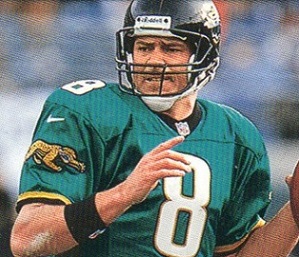
The Jacksonville Jaguars were 2-0 and coming off of their bye week as they hosted the Pittsburgh Steelers on September 22, 1997. Moreover, Head Coach Tom Coughlin’s team had won those games with two different backup quarterbacks at the helm due to a knee injury suffered by QB Mark Brunell (pictured above), who led the NFL with 4367 passing yards in 1996, and he was now returning to action. Overachievers who went all the way to the AFC title game the previous year, the third-year expansion team had won six straight regular season games dating back to the previous November.

Pittsburgh, coached by Bill Cowher, was accustomed to contending. Third-year QB Kordell Stewart was new to the starting lineup but the ground game was led by dependable RB Jerome Bettis and the defense was typically tough. The Steelers split their first two games.

There were 73,016 fans in attendance at Alltel Stadium for the Monday night game. The Jaguars had the game’s first possession and drove 68 yards in ten plays. Mark Brunell converted a third-and-10 situation with a pass to WR Keenan McCardell for 15 yards and RB Natrone Means ran for five yards on a third-and-three play. Consecutive throws by Brunell were complete to McCardell for 15 yards and to WR Jimmy Smith for 23 to reach the Pittsburgh three yard line and two plays later Means gained the final yard for a touchdown. Mike Hollis added the extra point.

Pittsburgh WR Will Blackwell returned the ensuing kickoff 99 yards, but the play was nullified by a holding penalty. However, the Steelers proceeded with an 80-yard scoring series that took six plays. The biggest was a third down throw by Kordell Stewart to WR Charles Johnson that picked up 49 yards to the Jacksonville 12 and, following a six-yard run by RB Jerome Bettis, Stewart scrambled for a six-yard TD. Norm Johnson’s kick tied the score at 7-7.

A short Jacksonville series ended with a punt but the Jaguars got the ball back three plays later when Stewart fumbled when sacked by DE Tony Brackens and LB Eddie Robinson recovered at the Pittsburgh 38. In a possession that stretched into the second quarter, Means ran for nine yards on first down and Brunell completed three passes, the last to Smith for an 11-yard TD. Hollis converted to give the home team a 14-7 lead.

The Steelers started off with the ball at their 42 following a 40-yard kickoff return by Blackwell, but after reaching the Jacksonville 39 they were forced to punt. A long series by the Jaguars started off with Brunell being sacked by LB Levon Kirkland for a loss of 11 yards but Brunell threw to Smith for 29 yards and, a few plays later and facing third-and-20, connected with RB James Stewart for 29 yards to the Pittsburgh 43. It appeared that the drive was finally thwarted when Brunell was sacked for a seven-yard loss by DT Oliver Gibson and then threw an incomplete pass when facing third-and-15 at the Pittsbugh 38. But punter Bryan Barker passed instead of kicking and it was complete to DB Dana Hall for a 22-yard gain. However, after getting to the 11, the home team came up empty when Hollis missed a 29-yard field goal attempt.

Jacksonville got the ball back two plays later when Stewart’s pass was intercepted by CB Aaron Beasley, who returned it five yards to the Pittsburgh 35 with 1:21 remaining in the first half. Brunell completed four passes and Hollis was successful on a 20-yard field goal to give the Jaguars a 17-7 halftime lead. Jacksonville had thus far dominated time of possession, holding onto the ball for 21 of the game’s first 30 minutes.


Down by ten, the Steelers started off the third quarter with a 13-play, 80-yard drive. Bettis (pictured at right) ran for 44 yards on 7 carries, with a long of 16, RB George Jones contributed an 18-yard run, and Stewart completed three passes, the last to WR Yancey Thigpen for a four-yard touchdown. Norm Johnson’s point after narrowed the score to 17-14.

The Jaguars, helped along by a pass interference penalty on the Steelers, came back with a series that resulted in Hollis kicking a 45-yard field goal. Another long Blackwell kickoff return that covered 52 yards put the Steelers at the Jacksonville 48 and, on a seven- play drive that featured a 19-yard run by Bettis and a Stewart toss to Charles Johnson for 26 yards, they scored on the first play of the fourth quarter as Stewart connected with TE Mark Bruener for a one-yard TD. Norm Johnson’s extra point put the visitors in front by 21-20.

The Jaguars again reached Pittsburgh territory as Brunell passed to Smith for a 41-yard pickup but, after the drive was stopped at the 19, Hollis failed on a 38-yard try for a go-ahead field goal. The Steelers had to punt on their next series and Jacksonville again had a long possession that ran over six minutes off the clock and was helped along by a critical unnecessary roughness penalty on DE Nolan Harrison to nullify a third down sack. Brunell completed six passes, three of them to Smith and the longest to WR Reggie Barlow for 18 yards, and this time Hollis came through with a 27-yard field goal that put the Jaguars back on top by 23-21 with 4:14 remaining to play.

Starting from their 40 following Blackwell’s 30-yard kickoff return, the Steelers kept the ball on the ground and also received help with a five-yard penalty on the Jaguars on a fourth-and-one play. Stewart threw to Thigpen for a 21-yard gain to the Jacksonville 25 and Pittsburgh was at the 22 when Norm Johnson came on to attempt a final-play field goal from 40 yards to win the game. However, the snap was low and the holder, QB Mike Tomczak, had difficulty in getting the ball set, placing it at a bad angle. Johnson’s kick was blocked by DE Clyde Simmons and safety Chris Hudson recovered and ran 58 yards for a touchdown. Hollis added the superfluous extra point and the Jaguars not only avoided a last-second defeat but won in stunning fashion by a final score of 30-21.

Jacksonville led in total yards (343 to 306), first downs (23 to 19), and time of possession (33:55 to 26:05), although Pittsburgh was much better at controlling the ball in the second half. The Jaguars were stifled on the ground as Pittsburgh outgained them, 153 to 40, but had a big lead in net passing yards (303 to 153). The Steelers turned the ball over twice, to none by Jacksonville. Pittsburgh led in sacks (three to two) but also in penalties (6 for 82 yards, against four for 35 yards against Jacksonville). The teams combined for just three punts (two by Pittsburgh, one for the Jaguars) although both clubs had trouble on field goals, with Mike Hollis missing two from under 40 yards and Norm Johnson’s lone attempt being botched at the end.

Mark Brunell completed 24 of 42 passes for 306 yards and a touchdown with none intercepted. Jimmy Smith had a big performance with 10 catches for 164 yards and a TD and Keenan McCardell contributed 6 receptions for 51 yards. Natrone Means rushed for 40 yards on 24 carries that included a score.

For the Steelers, Kordell Stewart was successful on 11 of 16 throws for 155 yards and two TDs while giving up an interception, and also ran the ball 7 times for 19 yards and a touchdown. Jerome Bettis, who came on strong in the second half, gained 114 yards on 21 rushing attempts. Yancey Thigpen caught 5 passes for 53 yards and a TD and Charles Johnson gained 88 yards on his four receptions. Will Blackwell averaged 37.8 yards on four kickoff returns. 

“This was a big win for us because it was on Monday night, it was against the Steelers, and because of the way we won,” said Mark Brunell.

“We just found a way to win,” said Coach Coughlin. “I told the team on Sunday night to never take anything for granted because a lot of teams had trouble this season with field goals.”

Jacksonville lost the following week but was at 5-1 before losing two more, including the rematch with the Steelers. The pattern of a flashy passing game and mediocre ground attack held throughout the season. The Jaguars ended up with an 11-5 record, as did Pittsburgh, and the Steelers won the AFC Central title due to the net division points tiebreaker. Jacksonville was demolished by Denver in the Wild Card playoff round while Pittsburgh reached the AFC Championship before also losing to the Broncos in a closer contest.

Mark Brunell went on to lead the AFC in passing with a 91.2 rating as he completed 60.7 percent of his passes for 3281 yards and 18 touchdowns while giving up just seven interceptions. He was selected to a second straight Pro Bowl where he was joined by Jimmy Smith, who accumulated 82 catches for 1324 yards (16.1 avg.) and four TDs.

September 21, 2016

Highlighted Year: Isaac Curtis, 1973

Wide Receiver, Cincinnati Bengals


Age: 23 (Oct. 20)
1st season in pro football
College: San Diego State
Height: 6’0”   Weight: 190

Prelude:
Curtis started out in college as a running back at the Univ. of California, where he was also a track star, but controversy that led to NCAA sanctions against the school caused him to transfer to San Diego State as a senior. Curtis had an outstanding year at wide receiver for the 10-1 Aztecs under the guidance of Head Coach Don Coryell, catching 44 passes for 832 yards (18.9 avg.) and seven touchdowns. He received first-team All-Pacific Coast Athletic Association honors and was chosen by the Bengals in the first round of the 1973 NFL draft (15th overall). Curtis moved directly into the starting lineup and developed into a stellar performer over the course of the season.

1973 Season Summary
Appeared in all 14 games
[Bracketed numbers indicate league rank in Top 20]

Pass Receiving
Receptions – 45 [11, tied with Boobie Clark & Mike Siani]     
Most receptions, game – 8 (for 106 yds.) vs. Kansas City 10/21
Yards – 843 [5, 1st in AFC]
Most yards, game – 144 (on 2 catches) at Houston 12/16
Average gain – 18.7 [5]
TDs – 9 [4, tied with Harold Carmichael]
100-yard receiving games – 3

Rushing
Attempts – 2
Yards – -11
Average gain – -5.5
TDs – 0

Scoring
TDs – 9 [10, tied with four others]
Points – 54

Postseason: 1 G (AFC Divisional playoff at Miami)
Pass receptions – 1
Pass receiving yards – 9
Pass Receiving TDs – 0

Rushing attempts – 1
Yards – -1
TDs – 0

Awards & Honors:
2nd team All-AFC: UPI
Pro Bowl

Bengals went 10-4 to finish first in the AFC Central. Lost AFC Divisional playoff to Miami Dolphins (34-16).

Aftermath:
Curtis was selected to the Pro Bowl in each of the next three seasons and was regarded as one of the league’s more potent deep threats at a time when teams were less inclined to go to the air. While his catches dropped to 30 in 1974, 10 were for touchdowns, and he led the NFL by averaging 21.2 yards on 44 receptions in ’75. Curtis lost half of the 1977 season due to knee surgery but bounced back to catch a career-high 47 passes in ’78, although his average dropped to 15.7 and only three were for TDs. He remained with the Bengals until 1984 and, while no longer an elite receiver, was still capable of making big plays. Overall, Curtis caught 416 passes for 7101 yards (17.1 avg.) and 53 touchdowns. He received first- or second-team All-NFL honors three times, first-team All-AFC recognition after five seasons, and was selected to four Pro Bowls.

--

Highlighted Years features players who were consensus first-team All-League* selections or league* or conference** leaders in the following statistical categories:

Rushing: Yards, TDs (min. 10)
Passing: Yards, Completion Pct., Yards per Attempt, TDs, Rating
Receiving: Catches, Yards, TDs (min. 10)
Scoring: TDs, Points, Field Goals (min. 5)
All-Purpose: Total Yards
Defense: Interceptions, Sacks
Kickoff Returns: Average
Punt Returns: Average
Punting: Average

*Leagues include NFL (1920 to date), AFL (1926), AFL (1936-37), AAFC (1946-49), AFL (1960-69), WFL (1974-75), USFL (1983-85)

**NFC/AFC since 1970

September 20, 2016

1971: Vikings Rally to Defeat Lions


The Minnesota Vikings opened the 1971 season on September 20 as they faced their strongest NFC Central rivals, the Detroit Lions, in a Monday night game. Both teams had reached the postseason in 1970, with the Vikings topping the division for the third straight year (and first in the NFC/AFC format) with a 12-2 record while the Lions were the Wild Card playoff entry at 10-4. However, Detroit had lost six straight games to the Vikings, the team they needed to beat if they were to rise further.

Minnesota was entering its fifth season under the direction of Head Coach Bud Grant and was known for its rather plodding offense and strong defense. QB Gary Cuozzo (pictured above) was adequate, at best, and while Norm Snead had been obtained from the Eagles to challenge him for the starting job, he was still behind center for the opening game. The line was solid and the backs capable, although they lacked speed. The strength of the rugged defense was the imposing front four of ends Carl Eller and Jim Marshall and tackles Alan Page and Gary Larsen.

The Lions, coached by former star linebacker Joe Schmidt, were viewed as a team on the rise. QB Greg Landry was emerging as a talented passer who could also run effectively. Likewise, FB Steve Owens was up-and-coming and there were good veterans in the running back mix as well. Detroit had a noteworthy defense as well, and while the front line did not compare to Minnesota’s, the linebackers and backfield were at least as impressive.  

There were 54,418 fans in attendance on a clear night at Tiger Stadium with temperatures in the fifties. The Lions had the first possession and put together a long drive of 71 yards. Greg Landry made two big plays carrying the ball rather than passing, gaining a yard on a quarterback sneak to convert a fourth down at the Minnesota 44 and then, facing a third-and-nine situation, taking off and running for 10 yards. HB Mel Farr also had a 17-yard gain but WR Larry Walton missed a pass in the end zone and the series resulted in a 20-yard Errol Mann field goal.


HB Clint Jones fumbled on the ensuing kickoff and TE Craig Cotton recovered for the Lions at the Minnesota 21. Four plays later, Landry (pictured at left) rolled out to his right and tossed a three-yard touchdown pass to Farr. Mann added the extra point and Detroit was ahead by 10-0.

The Vikings had yet to run a play on offense and when they did it resulted in another turnover as HB Dave Osborn fumbled and DE Larry Hand recovered for the Lions at the Minnesota 35. However, the Vikings held the home team to a three-and-out series and Mann’s 39-yard field goal attempt hit the crossbar and was unsuccessful.

The teams traded punts as the game headed into the second quarter. Detroit put together a drive that featured Landry passing to Walton for 19 yards on a third-and-five play, but unable to get beyond the Minnesota 46, Mann’s field goal try from 53 yards was wide.  

The Lions got a break on defense when FS Tom Vaughn intercepted a pass by Gary Cuozzo, who was being pressured by Hand, and returned it eight yards to the Minnesota 28. A run was followed by two passes intended for Walton at the goal line that fell incomplete and resulted in Mann kicking a 36-yard field goal. Detroit was ahead by 13-0 with less than five minutes to play in the first half. The Vikings mounted a 60-yard series that resulted in a 13-yard Fred Cox field goal to finally get on the board with three seconds remaining on the clock and the halftime score was 13-3.

Minnesota came alive on offense to start the third quarter, advancing 80 yards in five plays. Cuozzo threw to WR Bob Grim for 24 yards and connected with Grim again, who outmaneuvered CB Lem Barney and, after falling down at the two but not being downed, reached the end zone for a 45-yard touchdown. Cox added the point after to narrow Detroit’s margin to 13-10.

A possession that featured Landry running for 14 yards on a second-and-10 play ended at the Minnesota 45 and once again Mann missed on a long field goal attempt from 53 yards. The Vikings punted after a short series and Barney returned it 13 yards to the Detroit 42, and from there on the next play, a nine-yard run by Steve Owens, the Lions gained another 15 yards due to a personal foul on the Vikings. Three more running plays got the ball to the Minnesota 21, but a holding penalty moved them back and, while a Landry screen pass to Farr gained seven yards back, Mann again was wide on a field goal attempt, this time from 36 yards.

The Vikings had the ball as the game headed into the fourth quarter and Cuozzo completed passes to Grim for nine yards on a third-and-six play and to RB Oscar Reed for 16. RB Jim Lindsey picked up 18 yards on three straight carries and caught a pass for six more to set up a 42-yard Cox field goal that tied the score.

On the ensuing kickoff return, Barney was hit hard by FB Bill Brown, fumbled, and the Vikings regained possession as safety Karl Kassulke recovered at the Detroit 20. Cuozzo threw passes to Reed for seven yards and TE Stu Voigt for nine and, while the Lions halted the advance at the two when Vaughn alertly tackled Cuozzo, Cox put the visitors in front on a nine-yard field goal with 5:18 remaining to play.

Detroit was unable to mount another threat until getting a break in the last minute when a facemask penalty added 15 yards to a punt return and gave the Lions first down at the Minnesota 45 with 46 seconds remaining on the clock. Landry threw to WR Earl McCullouch for 20 yards to get the ball to the Minnesota 25, but Mann missed yet again on a 33-yard field goal attempt and the Vikings came away winners by a final score of 16-13.

Minnesota had the edge in total yards (275 to 221) while the Lions led in first downs (15 to 14). Detroit had the greater success running the ball (160 yards on 38 attempts to 43 yards on 29 attempts) while the Vikings were more effective through the air (232 to 61). Minnesota turned the ball over four times, with early miscues helping to dig the first quarter hole, to two suffered by the Lions. Missed field goals proved fatal to Detroit as the usually-reliable Errol Mann failed on five of seven attempts, three of which were under 40 yards, while Minnesota’s Fred Cox was successful on all three of his tries.


Gary Cuozzo completed 19 of 32 passes for 232 yards and a touchdown while giving up two interceptions. Bob Grim (pictured at right) had a big performance with 7 catches for 126 yards and a TD. Jim Lindsey led the Vikings with 21 rushing yards on six carries and Dave Osborn gained 17 yards on 9 attempts but also caught 5 passes for 40 yards.

For the Lions, Greg Landry had a rough performance, succeeding on just 8 of 26 throws for 61 yards and a TD with none picked off. He also ran the ball six times for 35 yards to rank third among the club’s ground gainers, as HB Altie Taylor had 51 yards on 13 carries and Steve Owens gained 45 yards on 12 attempts. Mel Farr caught a team-leading three passes for 14 yards and a touchdown in addition to six rushes for 23 yards. Larry Walton accumulated 22 yards on two receptions but had damaging drops as well.

“We dropped the football a couple of times,” said Coach Grant with reference to Minnesota’s first quarter fumbles. “It took a quarter and a half for us to recover from that.”

“We beat them physically but couldn’t put the points on the board,” summed up Joe Schmidt of the Lions.

Minnesota lost the next week but then won five straight games on the way to another NFC Central title with an 11-3 record. The Vikings fell to Dallas in the Divisional playoff round. The Lions won four consecutive contests and were at 7-3-1 before dropping three straight games, including the rematch with Minnesota, to close out the season at 7-6-1 and again second in the division, but without a spot in the postseason.

Bob Grim went on to have his finest pro season, catching 45 passes for 691 yards (15.4 avg.) and seven touchdowns. He was rewarded with selection to the Pro Bowl.

Greg Landry recovered from his rough opening week to also gain Pro Bowl recognition as he passed for 2227 yards and 16 TDs and rushed for 530 yards, at the time a record for a NFL quarterback. Errol Mann survived the bad first week to connect on 22 of 37 field goal attempts (59.5 %) as well as all 37 extra point tries, for a total of 103 points, which ranked second in the NFC.

September 19, 2016

Highlighted Year: Paddy Driscoll, 1926

Back, Chicago Bears


Age: 31
8th season in pro football, 7th in APFA/NFL & 1st with Bears
College: Northwestern
Height: 5’11” Weight: 160

Prelude:
Driscoll played football and baseball in college, briefly spending time with the Chicago Cubs in 1917. While in the military during World War I, he was with the Great Lakes Naval Station team that won the 1919 Rose Bowl. Driscoll joined the Hammond Pros in 1919 and moved on to the Chicago Cardinals of the new American Professional Football Association (later renamed NFL) in ’20. Deceptively mild-mannered and small in stature, he was an outstanding all-around player who was an elusive halfback and kick returner, precision punter, and outstanding drop-kicker. In six seasons with the Cardinals (three of which he was also the coach), Driscoll scored 17 touchdowns and kicked 37 field goals, leading the league three times, and 31 PATs for a total of 244 points, topping the NFL with 78 in 1923. He received first-team All-NFL recognition after four of those seasons. Following the 1925 season, in which the team won the NFL title, the financially-strapped Cardinals sold Driscoll’s contract to the Bears.

1926 Season Summary
Appeared in all 16 games
[Bracketed numbers indicate league rank in Top 20]

Passing
TDs – 6 [1, tied with Eddie Scharer]

Scoring
Rushing TDs – 4 [8, tied with Hap Moran, Tony Latone & Cully Lidberg]
Receiving TDs – 1 [12, tied with many others]
Other TDs – 1
Total TDs – 6 [7, tied with Hinkey Haines]
Field Goals – 12 [1]
Extra Points – 14 [3, tied with Pid Purdy]
Points – 86 [1]

Awards & Honors:
1st team All-NFL: Collyers Eye, Chicago Tribune, Green Bay Press-Gazette

Bears went 12-1-3 to finish second in the NFL while leading the league in rushing touchdowns (17, tied with Frankford Yellow Jackets), pass receiving TDs (8, tied with Green Bay Packers), and scoring (216 points).

Aftermath:
Driscoll spent three more seasons with the Bears, scoring 43 points and again receiving consensus first-team All-NFL honors in 1927. Overall for his career, he scored 31 touchdowns and kicked 63 extra points and 51 field goals for a total of 402 points. Driscoll’s scoring total was the NFL record until 1942 and his field goal total the league standard until 1952, with his single-season record of 12 in 1926 not exceeded until 1950. Driscoll received at least some first-team All-NFL recognition after seven seasons and was inducted into the Pro Football Hall of Fame, Class of 1965. He later became a long-time assistant coach for the Bears and was head coach in 1956 and ’57.

--

Highlighted Years features players who were consensus first-team All-League* selections or league* or conference** leaders in the following statistical categories:

Rushing: Yards, TDs (min. 10)
Passing: Yards, Completion Pct., Yards per Attempt, TDs, Rating
Receiving: Catches, Yards, TDs (min. 10)
Scoring: TDs, Points, Field Goals (min. 5)
All-Purpose: Total Yards
Defense: Interceptions, Sacks
Kickoff Returns: Average
Punt Returns: Average
Punting: Average

*Leagues include NFL (1920 to date), AFL (1926), AFL (1936-37), AAFC (1946-49), AFL (1960-69), WFL (1974-75), USFL (1983-85)

**NFC/AFC since 1970

September 18, 2016

1960: Oilers Defeat Chargers for Home-Opening Win


The Houston Oilers faced the Los Angeles Chargers in their first home game of the inaugural American Football League season on September 18, 1960. Coached by Lou Rymkus, the Oilers had made one of the new league’s biggest splashes when they signed HB Billy Cannon, the Heisman Trophy winner out of LSU, away from the NFL’s Rams. They also had an established veteran in 33-year-old QB George Blanda (pictured at right), formerly of the Chicago Bears, who had been lured out of a year’s retirement and also doubled as a reliable placekicker. Nagged by injuries, Cannon had yet to show the expected form as a pro, but less-heralded first-year FB Dave Smith gained 104 yards on the ground in the first-week win over the Raiders.

The Chargers promised to be a significant test. A highly-regarded team under the direction of Head Coach Sid Gillman, formerly of the Rams, they featured QB Jack Kemp throwing to a capable group of receivers. The line, anchored by rookie OT Ron Mix, was a good one and the defense was especially effective in the secondary. LA had won all four of its preseason games and then came from behind the previous week to defeat the Dallas Texans in the regular season opener.

There were 20,156 fans in attendance at Jeppessen Stadium on a steamy 90-degree day. On their second possession, the Chargers put together the first scoring drive as Jack Kemp completed five of six passes for 47 yards. The last was to flanker Royce Womble in the end zone for a 25-yard touchdown and Ben Agajanian kicked the extra point.

On LA’s next series, following a punt by the Oilers, CB Mark Johnston intercepted a long pass by Kemp and returned it 33 yards to the Los Angeles 47. After an incompletion on first down, Blanda pitched out to Dave Smith, who ran 47 yards for a TD. Blanda added the game-tying point after.

The Oilers again got into scoring position thanks to a 51-yard punt return by Billy Cannon to the LA 27. A screen pass to FB Charley Tolar reached the three and the series ended when Blanda kept the ball himself for the final yard and a touchdown. Blanda converted and the home team was in front by 14-7.

As the game headed into the second quarter, the Chargers were forced to turn the ball over on downs at their 36 after FB Howie Ferguson was twice stopped short of gaining the necessary yard to keep the series going. Blanda passed to a leaping end John Carson for a first down at the two and it was the quarterback scoring once again from a yard out and adding the point after to extend the lead to 21-7.


The Chargers came back with a 62-yard drive as Kemp (pictured at left) connected on seven of eight throws, the last to end Ralph Anderson in the end zone. Agajanian’s kick narrowed the Houston margin to 21-14, and that remained the score at halftime.

The Oilers started the third quarter by advancing 71 yards in seven plays that included Blanda throwing to Carson for a 36-yard gain. For the third time, Blanda finished the series off with a one-yard touchdown on a quarterback sneak and added the extra point.

HB Ron Waller fumbled the ensuing kickoff and Houston recovered at the Los Angeles 19. The home team wasn’t able to reach the end zone, but Blanda kicked a 13-yard field goal and Houston was ahead by 31-14. Once again the Chargers turned the ball over on the kickoff, with HB Paul Lowe the culprit this time, and the Oilers again had possession at the LA 23. A clipping penalty moved them back to the 41, but Cannon, breaking three tackles, ran 39 yards to the two yard line. Tolar powered over for a one-yard TD, Blanda converted, and Houston, with 17 third quarter points, had a huge lead of 38-14.

The reeling Chargers finally put together a sustained drive, going 83 yards as Kemp passed to TE Howard Clark for a 50-yard gain and to Womble for a 19-yard touchdown, with Agajanian kicking the PAT. But the Oilers were able to run the clock down in the fourth quarter with backups Jacky Lee and Charlie Milstead in relief of Blanda.

Late in the game, Los Angeles put together a five-play, 89-yard scoring possession with the big play a pass from Kemp to FB Charlie Flowers that covered 55 yards for a touchdown. But with less than two minutes left to play, the verdict was long decided. Houston won by a final score of 38-28.

The Oilers had the edge in total yards (377 to 357), with 284 of Houston’s total coming on the ground, while the teams were even in first downs with 22 apiece. The third quarter proved critical as the Oilers scored 17 points and Los Angeles ran only seven plays to take an insurmountable lead. The Chargers turned the ball over four times, to two by Houston, although the Oilers were penalized ten times, at a cost of 88 yards, to five flags thrown on LA.

George Blanda didn’t have a high-percentage passing day, completing just 6 of 17 throws for 101 yards with no touchdowns or interceptions, but he was effective when he connected. He also scored three TDs on quarterback sneaks among his 20 yards on five carries. Dave Smith (pictured below) topped the Houston rushers with 77 yards on 14 attempts that included a touchdown. Billy Cannon added 68 yards on 8 carries and returned a kickoff for 32 yards and two punts for 57. John Carson led the receivers with three catches for 54 yards.


For the Chargers, Jack Kemp completed 27 of 44 passes for 337 yards and four touchdowns (all of which remained season highs) while giving up one interception. Ralph Anderson had 8 catches for 50 yards and a TD and Howard Clark gained 94 yards on his four receptions. Royce Womble contributed five catches for 65 yards and two TDs. It was a lackluster day for Los Angeles running the ball and Howie Ferguson led the club with 20 yards on 7 attempts.

The Oilers lost their next game but remained consistently strong throughout the season, topping the Eastern Division with a 10-4 record. The Chargers lost two of their next three contests but finished with eight wins in nine games (including the rematch with Houston) to also compile a 10-4 tally and top the Western Division (A key component of the second-half surge was the insertion of HB Paul Lowe into the starting lineup, adding potency to the running game). The two teams met for the AFL Championship, won by the Oilers. The Chargers departed LA for San Diego the following season.

George Blanda passed for 2413 yards and 24 touchdowns and ranked second in the AFL in field goals with 15 and scoring with 115 points. The three rushing TDs against the Chargers were truly an anomaly, as he had compiled a total of five in his years with the Bears and, after tallying one more during the 1960 season, never scored another in the remainder of his long career that ended in 1975.

September 17, 2016

1989: Cunningham Throws for 447 Yards & 5 TDs as Eagles Stun Redskins


The Philadelphia Eagles were 1-0 as they faced the Washington Redskins, rivals in the NFC East, on September 17, 1989. Entering their fourth season under brash Head Coach Buddy Ryan, the Eagles had surged in the second half of the ’88 season to a 10-6 record and the NFC East title for their first postseason appearance in seven years. Central to the offense was QB Randall Cunningham (pictured above), who passed for 3808 yards and ran for 624. Beyond the fleet-footed quarterback, the running game was ordinary, with RB Keith Byars proving to be more effective as a receiver out of the backfield than a runner from scrimmage. The attacking defense was led by DE Reggie White and, while prone to giving up big plays on passes, improvement was anticipated. The Eagles defeated Seattle with ease in the first week.

Washington was coached by Joe Gibbs, who had enjoyed much success since taking over the team in 1981 but was coming off of a disappointing 7-9 record in 1988. QB Mark Rypien was taking over for the hobbled Doug Williams and it was hoped that the running game would improve with the addition of RB Gerald Riggs from the Falcons. It was also anticipated that the defense would recover from an injury-riddled year. The Redskins suffered a tough opening loss against the Giants the previous Monday night.

There were 53,493 fans in attendance at RFK Stadium. The Redskins struck quickly when, on their first play from scrimmage, Mark Rypien threw to WR Gary Clark for an 80-yard touchdown. The extra point attempt was aborted due to a bad snap but Washington held the early 6-0 advantage.

That lead got larger when DE Charles Mann recovered a fumble by FB Anthony Toney at the Philadelphia 41 and, on the next play, Gerald Riggs broke away for another TD. This time Chip Lohmiller added the point after and, having run just two offensive plays, the Redskins were up by 13-0.

It got worse for the Eagles when a Randall Cunningham pass was intercepted by CB Brian Davis, who returned it 13 yards to the Philadelphia 12. Two plays later, Rypien tossed a scoring throw to RB Earnest Byner from 11 yards out and, following another Lohmiller conversion, the home team was ahead by 20-0.

The Eagles responded with a nine-play, 80-yard series that included an unsportsmanlike conduct penalty on the defense and a pass from Cunningham to Keith Byars that picked up 28 yards. Cunningham connected with TE Keith Jackson for a 17-yard touchdown and, following the extra point by Luis Zendejas, the score stood at 20-7 after an eventful first quarter of play.

As the game headed into the second quarter, the Redskins came back with an 80-yard possession in eight plays. Riggs (pictured below) carried for a 46-yard gain and Rypien threw to Clark for 21 yards before the series ended with another Rypien-to-Clark TD, this time covering five yards. Lohmiller’s conversion put Washington ahead by a formidable 27-7.


The Eagles got a break on defense when DB William Frizzell picked off a Rypien pass and returned it 23 yards to the Washington three. From there, Toney ran for a touchdown and, with Zendejas adding the PAT, Philadelphia was down by 13 points at 27-14. However, before the first half was over, the Redskins put together a long drive of 63 yards in 12 plays. Rypien completed a pass to WR Art Monk for 17 yards and two to WR Ricky Sanders for 13 and 14 yards to set up a 25-yard Lohmiller field goal. Washington took a 30-14 lead into halftime.

The third quarter was relatively quiet, with the Eagles mounting a 92-yard drive in 12 plays for the only score. Cunningham connected with Byars for 31 yards, WR Mike Quick for 21, and Byars again for 12 along the way before tossing a touchdown pass to Jackson that covered five yards. Zendejas converted and it was a 30-21 game heading into the final period.

Philadelphia narrowed the margin even further in the early minutes of the fourth quarter after SS Andre Waters recovered a Rypien fumble and returned it 16 yards. In a drive that covered 42 yards in seven plays, Cunningham passed to Byars for 20 yards and connected with WR Cris Carter for a five-yard TD. Zendejas booted the extra point and suddenly the Eagles were only two points down at 30-28.

The visitors regained possession on a fumble and appeared primed to take the lead, but Zendejas missed on a 33-yard field goal attempt. Having gained a reprieve, and following an exchange of punts, the Redskins finally got on the board again following a six-play, 71-yard series that concluded with Rypien going long to Monk for a 43-yard touchdown. Lohmiller added the point after that put Washington ahead by a seemingly comfortable 37-28 with 3:06 remaining on the clock.

Philadelphia responded with a drive that covered 69 yards in eight plays. Cunningham completed five straight passes that included one to Jackson for 17 yards and two to WR Gregg Garrity that covered 29 and 12 yards. Finally, it was Cunningham to Quick, who made a leaping grab for a two-yard TD and, with Zendejas adding the extra point, the Eagles were down by just 37-35.

It looked as though the two-point margin would hold for the Redskins, however, as Riggs took off for a 58-yard gain on first down to the Philadelphia 22. But two plays later, and with 1:16 left on the clock, LB Al Harris recovered a Riggs fumble and, before he could be pulled down by OT Jim Lachey, he handed off to FS Wes Hopkins who proceeded to charge 77 yards down the sideline to the Washington four (While Coach Gibbs complained that the Hopkins runback was due to a forward lateral, the replay official indicated that it was inconclusive).

On the next play, Cunningham threw to Jackson (pictured below), who was open in the end zone for a touchdown and Zendejas tacked on the point after. Any remaining chance for the Redskins ended when Rypien fumbled while being sacked by DT Jerome Brown and Reggie White recovered at the Washington 15 with 43 seconds to go. The Eagles, trailing for almost the entire game and twice by as many as 20 points, came away winners by a final score of 42-37.


The Redskins had the edge in total yards (492 to 474) although Philadelphia had far more first downs (32 to 16). Washington turned the ball over a critical six times, to three by the Eagles. The Redskins recorded four sacks to two by Philadelphia.

Randall Cunningham, who just received a five-year contract extension, had a huge performance as he completed 34 of 46 passes for 447 yards (breaking a team record that had been set in 1953) with five touchdowns while giving up one interception. Keith Jackson had 12 catches for 126 yards and three TDs and Keith Byars gained 130 yards on his 8 pass receptions. Anthony Toney rushed for 24 yards on 9 attempts that included a score. On defense, Jerome Brown had a notable performance with nine tackles and two sacks.

For the Redskins, Gerald Riggs gained a club-record 221 yards on 29 rushing attempts with one touchdown, but the outstanding performance was tarnished by the late fumble. Mark Rypien was successful on 12 of 23 throws for 288 yards and four TDs while being picked off twice. Gary Clark caught four passes for 153 yards and two touchdowns and Art Monk also had four receptions, for 87 yards and a TD.

“I told them I’ve been to Super Bowls and all that, but I’ve never been associated with a game like that,” said Buddy Ryan. “It was a knock-down, drag-out.”

“It is probably one of the low points since I’ve been here,” said Joe Gibbs in defeat. “It was one of the toughest losses I’ve ever been part of.”

The Eagles, who were 2-0 for the first time since 1981, lost their next two games but reeled off four straight wins before briefly slumping. They lost the rematch with the Redskins at home in a far more low-scoring contest (10-3) and went on to place second in the NFC East with an 11-5 record, securing a playoff spot and losing to the Rams in the Wild Card round. Washington recovered to win three of its next four games and, after slumping to 5-6, finished the season with five consecutive victories to end up third in the division at 10-6, although out of the playoffs.

The fortunes of the game’s major statistical performers varied over the course of the season. Randall Cunningham passed for 3400 yards and 21 touchdowns, with 15 interceptions, and again led the club in rushing with 621 yards. While he was chosen to the Pro Bowl for a second straight year, his performance was uneven as injuries to receivers, in particular Mike Quick and Keith Jackson, took their toll. Jackson still managed to gain selection to the Pro Bowl as well, although his numbers were reduced to 63 catches for 648 yards (10.3 avg.) and the three touchdowns scored against Washington were his total for the year.

Gerald Riggs also failed to sustain a strong start, not reaching the hundred-yard mark in the remainder of an injury-plagued season (although he did gain 99 yards in Week 7 against Tampa Bay). He finished with 834 yards on 201 carries (4.1 avg.) with four TDs.

September 16, 2016

Highlighted Year: Julius Peppers, 2004

Defensive End, Carolina Panthers


Age: 24
3rd season in pro football & with Panthers
College: North Carolina
Height: 6’6”   Weight: 283

Prelude:
A college star in both football and basketball, Peppers accounted for 9.5 sacks and 63 tackles as a junior in 2001 and was a consensus All-American who also received the Rotary Lombardi Award as the nation’s best lineman and Chuck Bednarik Award as the leading overall defensive player. He chose to enter the 2002 NFL draft and was taken by the Panthers in the first round (second overall). Peppers immediately moved into the starting lineup at left end and showed off outstanding speed and pass-rushing skill, although he was weaker against the run and was lost for the final four games due to a league suspension for using prohibited dietary supplements. Still, he compiled 12 sacks and was chosen as NFL Defensive Rookie of the Year by the Associated Press and Pro Football Writers. Heavily double-teamed in 2003, Peppers’ sack total dropped to 7 but the line as a whole, which included DE Mike Rucker and DTs Brentson Buckner and Kris Jenkins, excelled as the Panthers won the NFC Championship.

2004 Season Summary
Appeared in all 16 games
[Bracketed numbers indicate league rank in Top 20]

Sacks – 11 [9, tied with Shaun Ellis, Darren Howard & Lance Johnstone]
Most sacks, game – 2 at Kansas City 9/19, vs. Oakland 11/7, at San Francisco 11/14, vs. Arizona 11/21
Multi-sack games – 4
Interceptions – 2
Int. return yards – 143 [6]
Int. TDs – 1 [5, tied with many others]
Fumble recoveries – 1
Fumble recovery TDs – 1
Forced fumbles – 4
Tackles – 52
Assists – 12

Awards & Honors:
1st team All-NFL: AP, PFWA, Sporting News
1st team All-NFC: Pro Football Weekly
Pro Bowl

Panthers went 7-9 to finish third in the NFC South.

Aftermath:
Excellent at pursuit and improving against the run, Peppers was named to the Pro Bowl again in 2005 and ’06 and again received consensus first-team All-NFL honors after the latter year. After reaching double figures in sacks for three straight seasons, Peppers dropped to 2.5 in an off-year in 2007, but came back with 14.5 sacks in 2008, the first of five consecutive Pro Bowl seasons. He signed with the Chicago Bears as a free agent in 2010 and, while his sack total dropped to 8, his presence on the line was beneficial overall and he was again a first-team All-NFL selection as well as Pro Bowler. After four years, he was released by the Bears following the 2013 season and signed by Green Bay. Shifted to outside linebacker, he had 7 sacks and two interceptions, both of which he returned for touchdowns, in 2014 and followed up with 10.5 sacks to receive Pro Bowl recognition once more in 2015. An outstanding overall talent, through 14 years Peppers has been a consensus first-team All-NFL choice on three occasions, received at least second-team honors after two other years, and achieved selection to the Pro Bowl nine times. He has accumulated 136 sacks and 11 interceptions through 2015, four of which he returned for touchdowns, and has also had two scores on fumble recoveries.

--

Highlighted Years features players who were consensus first-team All-League* selections or league* or conference** leaders in the following statistical categories:

Rushing: Yards, TDs (min. 10)
Passing: Yards, Completion Pct., Yards per Attempt, TDs, Rating
Receiving: Catches, Yards, TDs (min. 10)
Scoring: TDs, Points, Field Goals (min. 5)
All-Purpose: Total Yards
Defense: Interceptions, Sacks
Kickoff Returns: Average
Punt Returns: Average
Punting: Average

*Leagues include NFL (1920 to date), AFL (1926), AFL (1936-37), AAFC (1946-49), AFL (1960-69), WFL (1974-75), USFL (1983-85)

**NFC/AFC since 1970