September 28, 2016

Highlighted Year: Al Denson, 1967

Flanker, Denver Broncos


Age: 25
4th season in pro football & with Broncos
College: Florida A & M
Height: 6’2”   Weight: 208

Prelude:
Denson starred as a wide receiver in college, catching 68 passes for 1420 yards and 18 touchdowns. He was chosen by the Broncos in the sixth round of the 1964 AFL draft (the Philadelphia Eagles picked him in the NFL draft, also in the sixth round).and caught 25 passes as a rookie flanker. However, he was shifted to backup tight end and his productivity dropped to nine receptions in ’65, but moving into a starting role he had 36 catches for 725 yards (20.1 avg.) and three touchdowns in 1966. Denson returned to flanker, his natural position, in ’67.

1967 Season Summary
Appeared in all 14 games
[Bracketed numbers indicate league rank in Top 20]

Pass Receiving
Receptions – 46 [8, tied with Eric Crabtree & Mike Garrett]     
Most receptions, game – 7 (for 134 yds.) vs. NY Jets 9/24, (for 102 yds.) at Buffalo 11/19, (for 97 yds.) at San Diego 11/23
Yards – 899 [6]
Most yards, game – 134 (on 7 catches) vs. NY Jets 9/24
Average gain – 19.5 [4]
TDs – 11 [1, tied with Otis Taylor]
100-yard receiving games – 4

Rushing
Attempts – 1
Yards – -2
TDs – 0

Scoring
TDs – 11 [3]
Points – 66 [10]

Awards & Honors:
1st team All-AFL: NEA
2nd team All-AFL: AP, UPI, NY Daily News
2nd team All-Western Division: Sporting News
AFL All-Star Game

Broncos went 3-11 to finish fourth in the AFL Western Division.

Aftermath:
Denson was injured in the first week of the 1968 season and appeared in just eight games, but still caught a respectable 34 passes for 586 yards (17.2 avg.) and five touchdowns. He followed up with 53 catches for 809 yards (15.3 avg.) and 10 TDs in ’69, and received some second-team All-AFL recognition as well as selection to the last AFL All-Star Game. Following a 47-catch, 646-yard season in 1970, Denson was traded to Minnesota but was little used and left the team, bringing his career to an end. Overall, he caught 260 passes for 4275 yards (16.4 avg.) and 32 touchdowns, with 250 for 4150 yards and all of the TDs coming with the Broncos. Denson received first-team All-AFL recognition from the NEA after one season, was a second-team choice three times, and was selected to two AFL All-Star Games.

--

Highlighted Years features players who were consensus first-team All-League* selections or league* or conference** leaders in the following statistical categories:

Rushing: Yards, TDs (min. 10)
Passing: Yards, Completion Pct., Yards per Attempt, TDs, Rating
Receiving: Catches, Yards, TDs (min. 10)
Scoring: TDs, Points, Field Goals (min. 5)
All-Purpose: Total Yards
Defense: Interceptions, Sacks
Kickoff Returns: Average
Punt Returns: Average
Punting: Average

*Leagues include NFL (1920 to date), AFL (1926), AFL (1936-37), AAFC (1946-49), AFL (1960-69), WFL (1974-75), USFL (1983-85)

**NFC/AFC since 1970

September 27, 2016

1970: Key Turnovers & Brodie TD Passes Lead 49ers Past Browns


The San Francisco 49ers and Cleveland Browns were both 1-0 as they faced each other on September 27, 1970. The 49ers, in their third year under Head Coach Dick Nolan, were coming off of an injury-plagued 4-8-2 record in 1969 but had the tools in place to do much better. QB John Brodie (pictured above) was an experienced and able passer and there was quality at wide receiver and running back. The defense was effective as well, and the placekicking problem of the previous year was resolved with the acquisition of PK Bruce Gossett. The 49ers started off with a Week 1 win against the Redskins.

Cleveland, coached by Blanton Collier since 1963, was in a new division thanks to the AFL/NFL merger, having been placed in the AFC Central. A perennial contender in the NFL’s Eastern Conference, it was anticipated that the Browns would dominate the AFC competition. QB Bill Nelsen was a good leader and passer, although playing on gimpy knees, and star WR Paul Warfield had been dealt away during the offseason in order to trade up for QB Mike Phipps of Purdue in the first round to be groomed as the successor. WR Gary Collins and TE Milt Morin were proven pass receivers, and HB Leroy Kelly a consistent performer. The Browns defeated the Jets the previous Monday night.

There were 37,502 fans in attendance on a hot day at Kezar Stadium. The 49ers advanced 63 yards in eight plays on their first possession as John Brodie threw to HB Doug Cunningham for a 29-yard gain and capped the series with a swing pass to FB Ken Willard that covered the final five yards for a touchdown. Bruce Gossett added the extra point for the 7-0 lead.

Cleveland responded with a six-play, 68-yard possession. Bill Nelsen connected with Leroy Kelly on first down for a 41-yard pickup and FB Bo Scott swept for the final three yards and a TD. Don Cockroft added the game-tying point after.

With the game still in the first quarter, the 49ers got a big defensive play when Nelsen was hit while passing and SS Mel Phillips intercepted for the 49ers, who returned it 35 yards for a touchdown. Gossett’s conversion made it a 14-7 contest heading into the second quarter.

The teams exchanged punts before the Browns put together a 95-yard drive in 10 plays, the big one a Nelsen completion to WR Fair Hooker that gained 69 yards to the San Francisco 16. The 49er defense held and Cockroft kicked a 20-yard field goal to make it 14-10.

The 49ers advanced to the Cleveland 43 on their next series, losing WR Dick Witcher to a shoulder separation along the way, and a holding penalty forced a punt. However, San Francisco got another break on defense two plays later when Scott fumbled and DT Roland Lakes recovered at the Cleveland 15. On the next play, Brodie threw to WR Jimmy Thomas for a TD. Gossett added the extra point and the Niners led by a 21-10 score.

The Browns came back with an 80-yard drive in eight plays. Nelsen completed five passes, with the longest to Milt Morin for 27 yards and two to Hooker, for 18 yards and finally an eight-yard TD with 1:12 remaining in the first half. There was still time for the 49ers, but the clock ran out on them at the Cleveland 22 and the score remained 21-17 at halftime.


Cleveland’s first series of the third quarter ended with Kelly running 33 yards up the middle for a touchdown. With Cockroft’s point after, the Browns had their first lead of the day at 24-21. The teams traded punts and Cleveland then took six plays to advance 83 yards, helped along by a 28-yard pass interference penalty. On the second play of the fourth quarter, Willard (pictured at left) carried on a draw play for the last nine yards and a TD. Gossett’s extra point attempt was blocked, but San Francisco was back in front by 27-24.

The visitors fought back with a five-play, 80-yard drive. Nelsen was knocked out of the game when, under a heavy pass rush, he suffered a leg injury after completing a pass to Hooker that gained 62 yards to the San Francisco eight. Blanton Collier chose to go with Don Gault, who had spent time on the taxi squad, over Mike Phipps and Gault handed off to Kelly on the next play for an eight-yard TD. Cockroft’s extra point was successful and Cleveland was back in the lead at 31-27.

After a short series by the 49ers, the Browns, with Gault at quarterback, initially appeared to move the ball well. A throw to Gary Collins picked up 23 yards but, three plays later, LB Dave Wilcox intercepted a pass and returned it 11 yards to his own 36. On second down, Brodie connected with Thomas, who made the catch over LB John Garlington and raced the remaining 35 yards for a 61-yard touchdown. Gossett converted.

Down by three points and with eight minutes left on the clock, there was still plenty of time for the Browns. Taking possession at their 24 following the ensuing kickoff, they ran three plays and, facing fourth down and less than a yard to go, chose to punt. In a key series, the 49ers then controlled the ball for 13 plays (nine of them carries by Willard), going to the air only once. The Browns finally got the ball back at their 30, but with only 22 seconds left to play. San Francisco held on to win by a final score of 34-31.

Cleveland had the edge in total yards (448 to 435) while the 49ers led in first downs (24 to 20). The Browns turned the ball over four times, which proved critical, while San Francisco had none.

John Brodie completed 20 of 31 passes for 277 yards and three touchdowns with no interceptions. Ken Willard ran effectively, gaining 105 yards on 22 carries that included a TD in addition to a score on his lone pass reception. WR Gene Washington had 5 catches for 40 yards but Jimmy Thomas was the pass receiving star for the 49ers with four for 78 yards and two touchdowns.


For the Browns, Bill Nelsen was successful on 14 of 25 throws for 308 yards and a TD, but also gave up an interception that led directly to a score, before being knocked out of the game. Fair Hooker (pictured at right) caught four passes for 157 yards and a touchdown and Gary Collins contributed four receptions for 68 yards. Leroy Kelly rushed for 74 yards on 16 attempts that included two scores and also gained 54 yards on two pass receptions. Bo Scott ran 15 times for 48 yards and a TD but gave up a critical fumble.

“You can’t blame the defense for two of the touchdowns,” said Coach Collier in defeat. “You can’t make as many mistakes as we did and win in this league.”

The 49ers lost the following week but went on to top the NFC West with a 10-3-1 record. They reached the NFC Championship game before falling to Dallas. Cleveland was without Bill Nelsen due to damaged knee ligaments the next week but won with Gault and Phipps at quarterback. However, the Browns slumped during the second half of the season and finished at a disappointing 7-7 and second in the AFC Central.

John Brodie had his finest season as he led the NFL, completing 223 passes for 2941 yards and 24 touchdowns, which were all league-leading figures. He was the consensus MVP and received first-team All-NFL and Pro Bowl honors.

The performance by Jimmy Thomas was his best of the season. Appearing at halfback as well as wide receiver, he caught a total of 12 passes for 221 yards (18.4 avg.) and scored one more TD for a total of three. 

The unheralded Fair Hooker also had his best game of the year, not reaching the hundred-yard threshold for the remainder of the season (or his career, for that matter), but he did emerge as a pleasant surprise for the Browns with 28 catches for 490 yards (17.5 avg.) and two TDs.

September 26, 2016

Highlighted Year: Charles Haley, 1994

Defensive End, Dallas Cowboys


Age: 30
9th season in pro football, 3rd with Cowboys
College: James Madison
Height: 6’5”   Weight: 250

Prelude:
Haley excelled as an inside linebacker in college before moving to the outside as a senior in 1985. He was chosen by the San Francisco 49ers in the fourth round of the 1986 NFL draft and was used as a defensive end in pass rushing situations, accumulating a team-leading 12 sacks as a rookie. Haley moved into a starting role at left outside linebacker in 1988 and was selected to the Pro Bowl after recording 11.5 sacks. Able to shift from linebacker to pass-rushing defensive end as needed, he used his size and speed to great advantage and reached double figures in sacks in three straight seasons, with a career-high 16 in 1990 when he was a consensus first-team All-NFL selection. He was also selected to the Pro Bowl that year and again in ’91, although plagued by injuries. However, due to clashes with the coaches, Haley was dealt to the Cowboys just prior to the 1992 season. Inserted at right defensive end, his sack total dropped to six but his presence improved the overall line play as Dallas won a NFL Championship. Haley had a lesser season in ’93 due to a ruptured disc that required off-season surgery.

1994 Season Summary
Appeared in all 16 games
[Bracketed numbers indicate league rank in Top 20]

Sacks – 12.5 [4, tied with Leslie O’Neal]
Most sacks, game – 4 at Pittsburgh 9/4
Multi-sack games – 2
Interceptions – 1
Int. return yards – 1
Int. TDs – 0
Fumble recoveries – 0
Forced fumbles – 3
Tackles – 42
Assists – 9

Postseason: 2 G
Sacks – 0
Interceptions – 0
TDs – 0

Awards & Honors:
1st team All-NFL: AP, PFWA, Sporting News
1st team All-NFC: UPI, Pro Football Weekly
Pro Bowl

Cowboys went 12-4 to finish first in the NFC East while leading the NFL in fewest passing yards allowed (2752) and fewest overall yards allowed (4313) and the NFC in sacks (47) and fewest points allowed (248). Won NFC Divisional playoff over Green Bay Packers (35-9). Lost NFC Championship to San Francisco 49ers (38-28).

Aftermath:
Haley initially announced his retirement following the 1994 season but was persuaded to return in ’95 and had one last Pro Bowl season with 10.5 sacks. There were further injuries, however, cutting short his 1996 season, and he was away from the game for nearly two years until returning to the 49ers for the postseason in 1998. Haley stayed on to play one last year with the club in 1999 before retiring for good. Overall, he accumulated 100.5 sacks, 34 of which came with the Cowboys, and reached double figures six times. Haley also added 11 more sacks in the postseason and appeared with five Super Bowl-winning teams. He was a consensus first-team All-NFL choice twice, received first- or second-team All-NFC honors after two other seasons, and was chosen to five Pro Bowls. Haley was inducted into the Pro Football Hall of Fame, Class of 2015.

--

Highlighted Years features players who were consensus first-team All-League* selections or league* or conference** leaders in the following statistical categories:

Rushing: Yards, TDs (min. 10)
Passing: Yards, Completion Pct., Yards per Attempt, TDs, Rating
Receiving: Catches, Yards, TDs (min. 10)
Scoring: TDs, Points, Field Goals (min. 5)
All-Purpose: Total Yards
Defense: Interceptions, Sacks
Kickoff Returns: Average
Punt Returns: Average
Punting: Average

*Leagues include NFL (1920 to date), AFL (1926), AFL (1936-37), AAFC (1946-49), AFL (1960-69), WFL (1974-75), USFL (1983-85)

**NFC/AFC since 1970

September 25, 2016

1955: Ameche Spurs Colts to Upset of Bears


The Baltimore Colts were heavy underdogs as they hosted the Chicago Bears in their season-opening game on September 25, 1955. Coming off of a 3-9 record in Head Coach Weeb Ewbank’s first season, the team had 12 rookies on the roster, most notably FB Alan “the Horse” Ameche, the Heisman Trophy winner out of Wisconsin, and QB George Shaw, the bonus first draft pick out of Oregon. The defense featured established players in DE Gino Marchetti, DT Art Donovan, DE Don Joyce, and safety Bert Rechichar, who also handled the placekicking. However, the Colts were without injured star HB Buddy Young.

Chicago was coming off of an 8-4 record in 1954 but there was an extra element at play. Owner George Halas had already indicated that his thirtieth year doubling as head coach would be his last, and there was a sense of urgency to send him out with one last NFL title.

There were 36,167 fans in attendance at Memorial Stadium and the home crowd saw the Colts start off in stunning fashion. On the second play from scrimmage, Alan Ameche carried the ball for the first time and charged down the left sideline for a 79-yard touchdown. Bert Rechichar added the extra point. Midway through the first quarter the Colts scored again when Rechichar kicked a 23-yard field goal and the home team led by 10-0.

Early in the second quarter, it was George Shaw spurring a Baltimore drive, completing all three of his passes as the club advanced 67 yards. Two of them were to end Lloyd Colteryahn, for a gain of 15 yards and, two plays later, for an 11-yard TD. Rechichar again converted to put the Colts up by 17-0.

The Bears finally got on the board with four minutes remaining in the first half when QB George Blanda threw to end Harlon Hill for a touchdown from 10 yards out, completing a 65-yard drive, and Blanda also booted the point after. But Rechichar’s long kickoff return set up his second field goal from 43 yards five plays later and the halftime score was 20-7.

In the third quarter, a pass interference penalty on the Colts gave Chicago a first down at the Baltimore three. From there, HB Bob Watkins ran around left end for a TD and, with Blanda’s conversion, the Baltimore lead was narrowed to 20-14. However, just before the end of the period, the Colts were able to get into scoring territory and came away with a third field goal by Rechichar, this time from 10 yards.

The Bears missed opportunities in the fourth quarter. Blanda failed on a 37-yard field goal attempt and Rechichar came up with a key interception at his 12 yard line to thwart another potential Chicago scoring threat. In one other foray into Baltimore territory, the Colts sacked Blanda on consecutive plays, but he followed up with a 49-yard field goal that again made it a six-point game.

In the final seconds, the desperate Bears resorted to a trick play from their own 19 as end Bill McColl threw to Hill, who gained 59 yards to the Baltimore 22, but the clock ran out on the visitors at that point. The Colts pulled off the upset by a final score of 23-17.

Chicago, playing from behind from the start, led in total yards (361 to 306) and first downs (23 to 14). However, the Bears also turned the ball over four times, to one by Baltimore, and the Colts did well keeping the ball on the ground, gaining 226 yards on 45 running plays. Prior to Bill McColl’s long pass play at the end, Chicago’s quarterback combination of George Blanda and Ed Brown accounted for 227 yards on 20 completions with a touchdown and two interceptions. But the Colts sacked Chicago quarterbacks five times for losses totaling 47 yards while suffering only two in return.

Alan Ameche rushed for 194 yards on 21 carries that included the long touchdown and George Shaw completed 7 of 12 passes for 97 yards and a TD with no interceptions. For the Bears, Harlon Hill had 5 catches for 107 yards and a TD in a losing cause.

Baltimore’s win was the first of three straight to open the season, but the Colts were badly beaten in the second meeting with the Bears and had only two more victories the rest of the way. They finished fourth in the Western Conference with a 5-6-1 record. Chicago took an opposite course, losing its first three contests before the victory in the return engagement with the Colts spurred a six-game winning streak. However, an upset loss to the cross-town Cardinals derailed the Bears at that point and, while winning their two remaining games, they ended up second in the conference at 8-4, just behind the Rams, who were 8-3-1.

Alan Ameche led the NFL in rushing with 961 yards on 213 carries (4.5 avg.) and scored nine touchdowns. He received consensus first-team All-NFL honors as well as Rookie of the Year recognition from UPI and The Sporting News, and was selected to the first of four consecutive Pro Bowls. His 194-yard single-game performance against the Bears remained the franchise record until 1971.

Beyond Ameche and George Shaw, other rookies began to emerge from among Baltimore’s first-year crop, such as HB L.G. Dupre and end Raymond Berry, and they would eventually become part of the team that won back-to-back titles in 1958 and ’59.

As a further footnote, George Halas’ retirement, which was always more of a formality than a reality, lasted for two years before he returned to the sideline in 1958. He finally retired for good following the 1967 season, his fortieth.

September 24, 2016

1950: Layne & Walker Lead Lions to Win Against Steelers


The Detroit Lions were coming off of a big opening-week win as they hosted the Pittsburgh Steelers on September 24, 1950. Coached by Bo McMillin, the Lions had not had a winning season in five years, but there were several promising newcomers on the roster. QB Bobby Layne (pictured above) was obtained from the New York Bulldogs, HB Bob “Hunchy” Hoernschemeyer came over from the defunct AAFC, and the rookie crop included the last two Heisman Trophy winners, HB Doak Walker and end Leon Hart. There were also good young veterans such as end Cloyce Box, MG Les Bingaman, and DHB Don Doll. Detroit thrashed Green Bay the previous week by a score of 45-7.

The Steelers, under the guidance of Head Coach John Michelosen, were operating out of the NFL’s last remaining single-wing offense. They also had a tough defense with a line anchored by DE Bill McPeak who was joined by rookie DT Ernie Stautner. Pittsburgh put up seven points in losing to the Giants in the opening game.

There were 19,600 fans in attendance at Briggs Stadium. The contest was a defensive struggle, although Detroit moved the ball more effectively. In the first quarter, the Lions missed a scoring opportunity when Doak Walker missed a 35-yard field goal attempt. Interceptions of Bobby Layne passes in Pittsburgh territory, at the two and the 20, kept the Lions off the board as well. Finally, Detroit advanced the ball to the Pittsburgh five when time ran out and the game remained scoreless at halftime.

In the third quarter, and following a fumble by Detroit FB Ollie Cline at the Pittsburgh 28, the Steelers struck for the game’s first score. TB Bob Gage had runs of 10 and 18 yards before passing to end Elbie Nickel for a 43-yard touchdown. Joe Geri added the extra point.

The Steelers had another shot when DB Jim Finks intercepted a pass by QB Fred Enke at midfield and returned it to the Detroit 25. A second-down pass by back Charlie Seabright for Gage in the end zone just missed the mark and, on fourth down, Geri was wide on a 27-yard field goal attempt.

Now the Lions put together an 80-yard drive that culminated in a touchdown on the first play of the fourth quarter when Layne threw to Walker, who just pulled away from safety Lynn Chandnois for an 11-yard touchdown. Walker also added the game-tying point after.

Neither team seemed capable of adding points during the final period, and when the Lions were forced to punt with three minutes remaining to play, a tie appeared likely. But, in the game’s pivotal play, Gage fumbled after fielding the kick when hit by Detroit end Dick Rifenberg and end Barney Hafen recovered at the Pittsburgh 15. The home team managed to pick up three yards in three plays before Doak Walker came on to boot a 20-yard field goal and the Lions held on to win by a final score of 10-7.

Detroit had significant edges in total yards (372 to 176) and first downs (24 to 8). But while the Lions outgained Pittsburgh’s single-wing attack on the ground (265 to 54), the Steelers had more yards through the air (122 to 107). Detroit also turned the ball over five times, to two by Pittsburgh.


Bobby Layne completed 10 of 24 passes for 78 yards but also ran for 118 yards on 15 carries. Doak Walker (pictured at right), who scored all of Detroit’s points, contributed 87 yards on 16 rushing attempts. For the Steelers, Bob Gage was successful on 8 of 22 passes with a touchdown while rushing for 45 yards on 11 carries, although the pivotal fumble on the punt diminished an otherwise solid performance.

The Lions split their next two games and were at 3-1 before losing four straight. They finished strong for a 6-6 record that placed fourth in the National Conference. Pittsburgh also went 6-6, tying for third with the Eagles in the American Conference. With the league’s lowest-scoring offense, the Steelers maintained the pattern established in the contest against Detroit as the defense typically kept games close.  

Bobby Layne led the league in pass attempts (336) and yards (2323). His 16 touchdown passes ranked fourth, and he added another four TDs carrying the ball as he ran for 250 yards. Doak Walker continued to be a prolific scorer, leading the NFL with 128 points. He accounted for 11 touchdowns, 8 field goals, and 38 extra points and received first-team All-NFL honors from the Associated Press and UPI as well as selection to the Pro Bowl.  

September 23, 2016

Highlighted Year: Otto Graham, 1946

Quarterback/Defensive Back, Cleveland Browns


Age:  25 (Dec. 6)
1st season in pro football
College: Northwestern
Height: 6’1”   Weight: 190

Prelude:
A single-wing tailback in college, Graham chose to sign with the Browns of the new AAFC rather than the NFL Detroit Lions, who had drafted him in the first round in 1944, after coming out of the Navy. An outstanding athlete, he first played pro basketball before joining the Browns for the 1946 season. Mobile and an accurate passer, Graham quickly adapted to the T-formation.

1946 Season Summary
Appeared in all 14 games
[Bracketed numbers indicate league rank in Top 20]

Passing
Attempts – 174 [5]
Completions – 95 [4, tied with Bob Hoernschemeyer]
Yards – 1834 [2]
Completion percentage – 54.6 [2]
Yards per attempt – 10.5 [1]
TD passes – 17 [1]
Most TD passes, game – 4 vs. Chicago 11/17
Interceptions – 5 [11, tied with Kay Eakin, Cotton Price & Walt Williams]
Passer rating – 112.1 [1]

Rushing
Attempts – 30
Yards – -125
Yards per attempt – -4.2
TDs – 1

Interceptions
Interceptions – 5 [5, tied with Steve Juzwik & Cliff Lewis]
Return yards – 102 [5]
TDs – 1 [1, tied with seven others]

Punt Returns
Returns – 12 [9]
Yards – 129 [15]
Average per return – 10.8
TDs – 0

Scoring
TDs – 2         
Points – 12

Postseason: 1 G (AAFC Championship vs. NY Yankees)
Pass attempts – 27
Pass completions – 16
Passing yardage – 213
TD passes – 1
Interceptions – 1

Rushing attempts – 3
Rushing yards – -19
Average gain rushing – -6.3
Rushing TDs – 0

Interceptions – 1
Int. return yards – 4
TDs – 0

Punt returns – 5
Punt return yards – 20
Average per return – 4.0
Punt return TDs – 0

Awards & Honors:
1st team All-AAFC: League, UPI
2nd team All-AAFC: NY Daily News

Browns went 12-2 to finish first in the AAFC Western Division while leading the league in passing yards (2266), total yards (4244), touchdowns (55), and scoring (423 points). Won AAFC Championship over New York Yankees (14-9).

Aftermath:
The Browns won all four AAFC titles with Graham behind center. He was the league MVP in 1947 as he led the AAFC in completion percentage (60.6), passing yards (2753), TD passes (25), and yards per attempt (10.2), and co-MVP with San Francisco’s Frankie Albert in ’48, a season in which he once more led the AAFC in passing yards (2713) while tossing another 25 TD passes and Cleveland went undefeated. Graham led the league in passing yards (2785) once again in 1949, and while no MVP was awarded by the league, he was a consensus first-team All-AAFC selection. The Browns moved to the NFL in 1950 and kept up their winning ways by achieving another championship. Graham was selected to the Pro Bowl that year and was also named league MVP by UPI in 1951, although Cleveland lost the title game. In ’52, he led the NFL in pass attempts (364), completions (181), yards (2816), and TD passes (20) as well as interceptions (24). Cleveland again lost the title game but won the championship games following the 1954 and ’55 seasons (the latter after Graham was coaxed out of retirement to play one more year) and he led the league in completion percentage in each of his last three years as well as yards (2722) and yards per attempt (10.6) in 1953, and TD percentage (8.1) and yards per attempt (9.3) in ’55. Altogether, over 10 seasons (four in the AAFC, 6 in the NFL) Graham averaged 9.0 yards per attempt (a record 8.6 in the NFL alone) while throwing for 23,584 yards (10,085 in AAFC, 13,499 in NFL) with 174 TDs (86 in AAFC, 88 in NFL). He also ran for 882 yards and scored 44 TDs, with a high of 8 in 1954. Graham was a league MVP twice and first-team All-league honoree three times in the AAFC as well as three-time MVP with four first-team All-league selections in the NFL and was chosen for the first five Pro Bowls. Perhaps most significantly of all, he quarterbacked Cleveland to a championship game in all ten years, winning seven of them. The Browns retired his #14 and he was inducted into the Pro Football Hall of Fame, Class of 1965.

--

Highlighted Years features players who were consensus first-team All-League* selections or league* or conference** leaders in the following statistical categories:

Rushing: Yards, TDs (min. 10)
Passing: Yards, Completion Pct., Yards per Attempt, TDs, Rating
Receiving: Catches, Yards, TDs (min. 10)
Scoring: TDs, Points, Field Goals (min. 5)
All-Purpose: Total Yards
Defense: Interceptions, Sacks
Kickoff Returns: Average
Punt Returns: Average
Punting: Average

*Leagues include NFL (1920 to date), AFL (1926), AFL (1936-37), AAFC (1946-49), AFL (1960-69), WFL (1974-75), USFL (1983-85)

**NFC/AFC since 1970

September 22, 2016

1997: Jaguars Avoid Defeat with Blocked FG Return Against Steelers


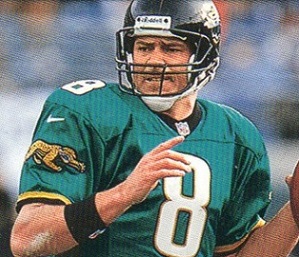
The Jacksonville Jaguars were 2-0 and coming off of their bye week as they hosted the Pittsburgh Steelers on September 22, 1997. Moreover, Head Coach Tom Coughlin’s team had won those games with two different backup quarterbacks at the helm due to a knee injury suffered by QB Mark Brunell (pictured above), who led the NFL with 4367 passing yards in 1996, and he was now returning to action. Overachievers who went all the way to the AFC title game the previous year, the third-year expansion team had won six straight regular season games dating back to the previous November.

Pittsburgh, coached by Bill Cowher, was accustomed to contending. Third-year QB Kordell Stewart was new to the starting lineup but the ground game was led by dependable RB Jerome Bettis and the defense was typically tough. The Steelers split their first two games.

There were 73,016 fans in attendance at Alltel Stadium for the Monday night game. The Jaguars had the game’s first possession and drove 68 yards in ten plays. Mark Brunell converted a third-and-10 situation with a pass to WR Keenan McCardell for 15 yards and RB Natrone Means ran for five yards on a third-and-three play. Consecutive throws by Brunell were complete to McCardell for 15 yards and to WR Jimmy Smith for 23 to reach the Pittsburgh three yard line and two plays later Means gained the final yard for a touchdown. Mike Hollis added the extra point.

Pittsburgh WR Will Blackwell returned the ensuing kickoff 99 yards, but the play was nullified by a holding penalty. However, the Steelers proceeded with an 80-yard scoring series that took six plays. The biggest was a third down throw by Kordell Stewart to WR Charles Johnson that picked up 49 yards to the Jacksonville 12 and, following a six-yard run by RB Jerome Bettis, Stewart scrambled for a six-yard TD. Norm Johnson’s kick tied the score at 7-7.

A short Jacksonville series ended with a punt but the Jaguars got the ball back three plays later when Stewart fumbled when sacked by DE Tony Brackens and LB Eddie Robinson recovered at the Pittsburgh 38. In a possession that stretched into the second quarter, Means ran for nine yards on first down and Brunell completed three passes, the last to Smith for an 11-yard TD. Hollis converted to give the home team a 14-7 lead.

The Steelers started off with the ball at their 42 following a 40-yard kickoff return by Blackwell, but after reaching the Jacksonville 39 they were forced to punt. A long series by the Jaguars started off with Brunell being sacked by LB Levon Kirkland for a loss of 11 yards but Brunell threw to Smith for 29 yards and, a few plays later and facing third-and-20, connected with RB James Stewart for 29 yards to the Pittsburgh 43. It appeared that the drive was finally thwarted when Brunell was sacked for a seven-yard loss by DT Oliver Gibson and then threw an incomplete pass when facing third-and-15 at the Pittsbugh 38. But punter Bryan Barker passed instead of kicking and it was complete to DB Dana Hall for a 22-yard gain. However, after getting to the 11, the home team came up empty when Hollis missed a 29-yard field goal attempt.

Jacksonville got the ball back two plays later when Stewart’s pass was intercepted by CB Aaron Beasley, who returned it five yards to the Pittsburgh 35 with 1:21 remaining in the first half. Brunell completed four passes and Hollis was successful on a 20-yard field goal to give the Jaguars a 17-7 halftime lead. Jacksonville had thus far dominated time of possession, holding onto the ball for 21 of the game’s first 30 minutes.


Down by ten, the Steelers started off the third quarter with a 13-play, 80-yard drive. Bettis (pictured at right) ran for 44 yards on 7 carries, with a long of 16, RB George Jones contributed an 18-yard run, and Stewart completed three passes, the last to WR Yancey Thigpen for a four-yard touchdown. Norm Johnson’s point after narrowed the score to 17-14.

The Jaguars, helped along by a pass interference penalty on the Steelers, came back with a series that resulted in Hollis kicking a 45-yard field goal. Another long Blackwell kickoff return that covered 52 yards put the Steelers at the Jacksonville 48 and, on a seven- play drive that featured a 19-yard run by Bettis and a Stewart toss to Charles Johnson for 26 yards, they scored on the first play of the fourth quarter as Stewart connected with TE Mark Bruener for a one-yard TD. Norm Johnson’s extra point put the visitors in front by 21-20.

The Jaguars again reached Pittsburgh territory as Brunell passed to Smith for a 41-yard pickup but, after the drive was stopped at the 19, Hollis failed on a 38-yard try for a go-ahead field goal. The Steelers had to punt on their next series and Jacksonville again had a long possession that ran over six minutes off the clock and was helped along by a critical unnecessary roughness penalty on DE Nolan Harrison to nullify a third down sack. Brunell completed six passes, three of them to Smith and the longest to WR Reggie Barlow for 18 yards, and this time Hollis came through with a 27-yard field goal that put the Jaguars back on top by 23-21 with 4:14 remaining to play.

Starting from their 40 following Blackwell’s 30-yard kickoff return, the Steelers kept the ball on the ground and also received help with a five-yard penalty on the Jaguars on a fourth-and-one play. Stewart threw to Thigpen for a 21-yard gain to the Jacksonville 25 and Pittsburgh was at the 22 when Norm Johnson came on to attempt a final-play field goal from 40 yards to win the game. However, the snap was low and the holder, QB Mike Tomczak, had difficulty in getting the ball set, placing it at a bad angle. Johnson’s kick was blocked by DE Clyde Simmons and safety Chris Hudson recovered and ran 58 yards for a touchdown. Hollis added the superfluous extra point and the Jaguars not only avoided a last-second defeat but won in stunning fashion by a final score of 30-21.

Jacksonville led in total yards (343 to 306), first downs (23 to 19), and time of possession (33:55 to 26:05), although Pittsburgh was much better at controlling the ball in the second half. The Jaguars were stifled on the ground as Pittsburgh outgained them, 153 to 40, but had a big lead in net passing yards (303 to 153). The Steelers turned the ball over twice, to none by Jacksonville. Pittsburgh led in sacks (three to two) but also in penalties (6 for 82 yards, against four for 35 yards against Jacksonville). The teams combined for just three punts (two by Pittsburgh, one for the Jaguars) although both clubs had trouble on field goals, with Mike Hollis missing two from under 40 yards and Norm Johnson’s lone attempt being botched at the end.

Mark Brunell completed 24 of 42 passes for 306 yards and a touchdown with none intercepted. Jimmy Smith had a big performance with 10 catches for 164 yards and a TD and Keenan McCardell contributed 6 receptions for 51 yards. Natrone Means rushed for 40 yards on 24 carries that included a score.

For the Steelers, Kordell Stewart was successful on 11 of 16 throws for 155 yards and two TDs while giving up an interception, and also ran the ball 7 times for 19 yards and a touchdown. Jerome Bettis, who came on strong in the second half, gained 114 yards on 21 rushing attempts. Yancey Thigpen caught 5 passes for 53 yards and a TD and Charles Johnson gained 88 yards on his four receptions. Will Blackwell averaged 37.8 yards on four kickoff returns. 

“This was a big win for us because it was on Monday night, it was against the Steelers, and because of the way we won,” said Mark Brunell.

“We just found a way to win,” said Coach Coughlin. “I told the team on Sunday night to never take anything for granted because a lot of teams had trouble this season with field goals.”

Jacksonville lost the following week but was at 5-1 before losing two more, including the rematch with the Steelers. The pattern of a flashy passing game and mediocre ground attack held throughout the season. The Jaguars ended up with an 11-5 record, as did Pittsburgh, and the Steelers won the AFC Central title due to the net division points tiebreaker. Jacksonville was demolished by Denver in the Wild Card playoff round while Pittsburgh reached the AFC Championship before also losing to the Broncos in a closer contest.

Mark Brunell went on to lead the AFC in passing with a 91.2 rating as he completed 60.7 percent of his passes for 3281 yards and 18 touchdowns while giving up just seven interceptions. He was selected to a second straight Pro Bowl where he was joined by Jimmy Smith, who accumulated 82 catches for 1324 yards (16.1 avg.) and four TDs.