Showing posts with label 2009 NFL season. Show all posts

March 29, 2017

Highlighted Year: Dallas Clark, 2009

Tight End, Indianapolis Colts


Age: 30
7th season in pro football & with Colts
College: Iowa
Height: 6’3”   Weight: 252

Prelude:
Clark started out as a linebacker in college before shifting to tight end where he was a consensus first-team All-American in 2002 when he caught 43 passes for 742 yards (14.3 avg.). He was chosen by the Colts in the first round of the 2003 NFL draft (24th overall) and started ten games as a rookie where he typically lined up in a double-TE set along with veteran Marcus Pollard and ended up with 29 pass receptions for 340 yards (11.7 avg.) and a TD.. An excellent receiver after the catch Clark led the club by averaging 16.9 yards on his 25 catches for 423 yards in 2004. A solid fit in an excellent passing offense Clark added 37 receptions for 488 yards (13.2 avg.) and four TDs in 2005, 30 for 367 yards (12.2 avg.) in the 2006 season that concluded with a Super Bowl victory, 58 catches for 616 yards (10.6 avg.) and 11 touchdowns in ’07, and 77 receptions for 848 yards (11.0 avg.) and 6 TDs in 2008.


2009 Season Summary
Appeared in all 16 games
[Bracketed numbers indicate league rank in Top 20]

Pass Receiving
Receptions – 100 [5, tied with Reggie Wayne]  
Most receptions, game – 14 (for 119 yds.) vs. Houston 11/8
Yards – 1106 [16]
Most yards, game – 183 (on 7 catches) at Miami 9/21
Average gain – 11.1
TDs – 10 [7, tied with Reggie Wayne & Brandon Marshall]
100-yard receiving games – 2

Rushing
Attempts – 2
Yards – 11
Average gain – 5.5
TDs – 0

Scoring
TDs – 10 [19, tied with four others]
Points – 60

Postseason: 3 G
Pass receptions – 18
Most pass receptions, game – 7 vs. Baltimore, AFC Divisional playoff; vs. New Orleans, Super Bowl
Pass receiving yards – 180
Most pass receiving yards, game – 86 vs. New Orleans, Super Bowl
Average yards per reception – 10.0
Pass Receiving TDs – 1

Awards & Honors:
1st team All-NFL: AP, PFWA, Sporting News
2nd team All-NFL: Pro Football Focus
Pro Bowl

Colts went 14-2 to finish first in the AFC  Northwhile leading the conference intouchdowns (53). Won AFC Divisional playoff over Baltimore Ravens (20-3), AFC Championship over New York Jets (30-17). Lost Super Bowl to New Orleans Saints (31-17).

Aftermath:
Clark followed up in 2010 with 37 catches for 347 yards (9.4 avg.) and three TDs in an injury plagued season when he was limited to six games. Following a 34-catch year in 2011, the Colts released Clark. He signed with Tampa Bay for 2012 and caught 47 passes for 435 yards (9.3 avg.) and four touchdowns.He moved on to the Baltimore Ravens in 2013, accumulating 31 receptions for 343 yards (11.1 avg.) and three TDs in his last year. For his career, Clark, caught 505 passes for 5665 yards (11.2 avg.) with 427 for 4887 yards occurring while with the Colts. He added another 64 receptions for 847 yards (13.2 avg.) and four TDs in the postseason, all with Indianapolis.


--

Highlighted Years features players who were consensus first-team All-League* selections or league* or conference** leaders in the following statistical categories:

Rushing: Yards, TDs (min. 10)
Passing: Yards, Completion Pct., Yards per Attempt, TDs, Rating
Receiving: Catches, Yards, TDs (min. 10)
Scoring: TDs, Points, Field Goals (min. 5)
All-Purpose: Total Yards
Defense: Interceptions, Sacks
Kickoff Returns: Average
Punt Returns: Average
Punting: Average

*Leagues include NFL (1920 to date), AFL (1926), AFL (1936-37), AAFC (1946-49), AFL (1960-69), WFL (1974-75), USFL (1983-85)

**NFC/AFC since 1970

March 20, 2017

Highlighted Year: Elvis Dumervil, 2009

Linebacker, Denver Broncos


Age: 25
4th season in pro football & with Broncos
College: Louisville
Height: 5’11” Weight: 260

Prelude:
Dumervil was credited with 151 tackles in 44 college games as well as 32 sacks and was selected as Big East Defensive Player of the Year in 2005 when he recorded 20 sacks. He was chosen by the Broncos in the fourth round of the 2006 NFL draft with the anticipation that while lacking ideal height that  his speed would make him an effective situational pass rusher. Dumervil had 8.5 sacks in that role as a rookie. He moved into the starting lineup  in 2007  and accumulated 12.5 sacks and had four takeaways while encountering problems against the run. His sack total dropped to five in 2008 with 49 tackles.Dumervil was shifted to right outside linebacker with outstanding results in 2009.


2009 Season Summary
Appeared in all 16 games
[Bracketed numbers indicate league rank in Top 20]

Sacks – 17 [1]
Most sacks, game – 4 vs. Cleveland 9/20
Multi-sack games – 6
Interceptions – 0
Fumble recoveries – 1
Forced fumbles – 4
Tackles – 42
Assists – 7

Awards & Honors:
1st team All-NFL: AP, PFWA, Sporting News
Pro Bowl

Broncos went 8-8 to finish second in the AFC West.

Aftermath:
Dumervil missed the entire 2010 season due to a torn pectoral muscle. He returned to defensive end in 2011 and regained Pro Bowl recognition with 9.5 sacks.He spent two more Pro Bowl years with Denver before signing with the Baltimore Ravens in 2013 and returning to outside linebacker. He recorded 9.5 sacks in ’13 and 17 in 2014, when he was a consensus first-team All-NFL as well as Pro Bowl choice.Following lesser seasons in 2015 and ’16 Dumervil was released by the Ravens. Overall through 2016 he has been credited with 99 sacks and some 225 tackles with 63.5 sacks coming while with the Broncos. He has received first-team All-NFL honors twice and been selected to five Pro Bowls.


--

Highlighted Years features players who were consensus first-team All-League* selections or league* or conference** leaders in the following statistical categories:

Rushing: Yards, TDs (min. 10)
Passing: Yards, Completion Pct., Yards per Attempt, TDs, Rating
Receiving: Catches, Yards, TDs (min. 10)
Scoring: TDs, Points, Field Goals (min. 5)
All-Purpose: Total Yards
Defense: Interceptions, Sacks
Kickoff Returns: Average
Punt Returns: Average
Punting: Average

*Leagues include NFL (1920 to date), AFL (1926), AFL (1936-37), AAFC (1946-49), AFL (1960-69), WFL (1974-75), USFL (1983-85)

**NFC/AFC since 1970

March 1, 2016

Highlighted Year: Jairus Byrd, 2009

Safety, Buffalo Bills


Age: 23 (Oct. 7)
1st season in pro football
College: Oregon
Height: 5’10” Weight: 200

Prelude:
Byrd, the son of former NFL cornerback Gill Byrd, was a first-team All-Pac 10 selection in 2008 and Defensive MVP of Oregon’s Holiday Bowl win over Oklahoma State. Overall, he intercepted 17 passes in college and opted to forego his final year of eligibility to enter the ’09 NFL draft. Byrd was chosen by the Bills in the second round and exceeded expectations, moving into the starting lineup at free safety. What he lacked in speed he made up for with good overall skills and keen instincts.

2009 Season Summary
Appeared in 14 of 16 games
[Bracketed numbers indicate league rank in Top 20]

Interceptions – 9 [1, tied with Asante Samuel, Darren Sharper & Charles Woodson]
Most interceptions, game – 2 at NY Jets 10/18, at Carolina 10/25, vs. Houston 11/1
Int. return yards – 118 [11]
Most int. return yards, game – 67 (on 2 int.) at Carolina 10/25
Int. TDs – 0
Fumble recoveries – 0
Tackles – 30
Assists – 12

Awards & Honors:
2nd team All-NFL:  Sporting News
Pro Bowl

Bills went 6-10 to finish fourth in the AFC East while leading the conference in interceptions (28).

Aftermath:
Having performed well as a rookie, Byrd had problems with consistency in 2010 and, together with the team playing poorly against the run, intercepted just one pass. His play improved in 2011 and he was credited with 75 tackles in addition to three interceptions, and in 2012 he topped the AFC with five interceptions and returned to the Pro Bowl for the first of two straight years. Byrd also received first-team All-NFL honors from Pro Football Focus in 2012 and second-team recognition from the Associated Press after both 2012 and ‘13. Having intercepted 22 passes with Buffalo, he moved on to the New Orleans Saints as a free agent in 2014 where he missed all but four games with a knee injury. Through 2015, Byrd has accumulated 23 interceptions, two of which were returned for touchdowns, and six fumble recoveries along with over 300 tackles. He has received at least some first-team All-NFL recognition once, second-team honors after three other seasons, and been chosen to three Pro Bowls.

--

Highlighted Years features players who were consensus first-team All-League* selections or league* or conference** leaders in the following statistical categories:

Rushing: Yards, TDs (min. 10)
Passing: Yards, Completion Pct., Yards per Attempt, TDs, Rating
Receiving: Catches, Yards, TDs (min. 10)
Scoring: TDs, Points, Field Goals (min. 5)
All-Purpose: Total Yards
Defense: Interceptions, Sacks
Kickoff Returns: Average
Punt Returns: Average
Punting: Average

*Leagues include NFL (1920 to date), AFL (1926), AFL (1936-37), AAFC (1946-49), AFL (1960-69), WFL (1974-75), USFL (1983-85)

**NFC/AFC since 1970

February 28, 2016

2009: Patriots Trade Matt Cassel to Chiefs


On February 28, 2009 the New England Patriots traded QB Matt Cassel and LB Mike Vrabel to the Kansas City Chiefs for a second-round pick in the upcoming NFL draft. Cassel, an unknown backup prior to 2008, had distinguished himself when he filled in for star QB Tom Brady, who was lost for the year with a knee injury in the season-opening contest. The trade reflected the interest that Cassel had drawn as a result but also New England Head Coach Bill Belichick’s confidence that Brady, whose injury had been further complicated by an infection following surgery, would be fully recovered and ready to resume his starting role.

Prior to 2008, Cassel had not started a game since his senior year in high school in 1999, serving as a reserve during college at USC behind Heisman Trophy winners Carson Palmer and Matt Leinart before being chosen by the Patriots in the seventh round of the 2005 NFL draft. He threw a total of just 39 passes in three seasons, for 253 yards and two touchdowns. With a strong arm, intelligence, and good leadership qualities (refined by quality coaching), Cassel steadily improved over the course of the 2008 season as he threw for 3693 yards and 21 touchdowns while giving up just 11 interceptions. The Patriots, a year removed from a 16-0 regular season that fell short of ultimate perfection in the Super Bowl, barely missed the playoffs with an 11-5 tally. They initially used the franchise tag on Cassel before dealing him. Upon being traded to Kansas City, who had a new general manager in Scott Pioli, formerly in charge of player personnel with the Patriots, and a new head coach, Todd Haley, Cassel was immediately named the starter over QB Tyler Thigpen.

“It’s very easy to root for guys like Matt Cassel, who everything the right way and flourish as a result,” said Belichick. “As much as we would have loved to continue working with Matt, we wish him nothing but the best as he takes this next step forward in his career.”

The Chiefs were coming off of two straight losing seasons under the previous head coach, Herman Edwards, including a miserable 2-14 record in 2008. The offense had been adjusted from one that was run-oriented to a spread that allowed Thigpen to operate exclusively out of the shotgun. While he showed talent, he also had limitations and the team won only one of the games he started.

Kansas City marginally improved to 4-12 with Cassel behind center in ’09. He took a pounding behind a mediocre line (he was sacked 42 times) and threw for 2924 yards with 16 TDs and 16 interceptions, resulting in a 69.9 passer rating. RB Jamaal Charles came on in the second half of the year to upgrade the ground game but it took the acquisition of WR Chris Chambers, who had been waived by the Chargers and appeared in the last nine games, to give Cassel a reliable target.

Things got much better for both Cassel and the Chiefs in 2010, albeit helped along by a weak schedule. Cassel showed better judgment and took fewer sacks while passing for 3116 yards and 27 touchdowns against just 7 interceptions, for a passer rating of 93.0. He was named to the Pro Bowl, as were Jamaal Charles, who rushed for 1467 yards and caught 45 passes for 468 more yards, and WR Dwayne Bowe, with 72 receptions for 1162 yards and 15 TDs. Kansas City topped the AFC West with a 10-6 record and lost decisively to the Ravens in the Wild Card playoff round.

The Chiefs started off the 2011 season by being blown out in their first two games by a combined score of 89-10 and, while they finished with three wins in the last five games, they ended up back under .500 with a 7-9 record. The team had problems with injuries and Coach Haley was gone before season’s end. Cassel was on injured reserve after suffering a broken hand in the ninth game and he ended up passing for 1713 yards and 10 touchdowns with nine interceptions. Charles had gone down with an ACL injury in the second week and, while Bowe was still a capable receiver, his touchdowns dropped from 15 to five with the underperforming, patchwork offense.

Cassel’s hand injury required surgery but he was back in 2012. However, he was inconsistent and turnover-prone, provoking negative fan reaction, and, following a head injury, was consigned to the bench in favor of Brady Quinn. Playing in a total of nine games, Cassel threw for 1796 yards and six touchdowns while giving up 12 interceptions. The team dropped to 2-14 and, with wholesale changes occurring afterward, Cassel was released in the offseason.

Overall, in four seasons with the Chiefs, Cassel completed 854 of 1489 passes (57.4 %) for 9549 yards and 59 TDs with 44 interceptions for an overall rating of 77.5. He was sacked 109 times and the club went 19-28 in his starts, with one winning season out of the four. An effective game manager at his best, Cassel also displayed both class and toughness with an organization that was experiencing turmoil while he was there (for instance, there was a different offensive coordinator in each of Cassel’s four seasons). He moved on to the Minnesota Vikings, where he returned to a primarily backup role.

As to the other players involved in the trade with New England, Mike Vrabel, who turned 34 prior to the 2009 season, was expected to improve the pass rush from the outside linebacker position. While he was on the downside of his career and had lost a step, he also was a savvy player with excellent instincts. He provided the leadership that was expected, although he also continued to show signs of decline and his career ended after two seasons. The second-round draft pick that the Patriots received from the Chiefs was used to take safety Patrick Chung out of Oregon, who spent four years with the club, went to Philadelphia for a year in 2013, and returned to New England in ’14.

December 25, 2015

Highlighted Year: Maurice Jones-Drew, 2009

Running Back, Jacksonville Jaguars


Age: 24
4th season in pro football & with Jaguars
College: UCLA
Height: 5’7”   Weight: 208

Prelude:
The undersized Jones-Drew displayed outstanding all-purpose skill in college, receiving consensus All-American honors for his kick returning and earning second-team Pac-10 recognition as a running back. He was chosen by the Jaguars in the second round of the 2006 NFL draft and, splitting time with veteran RB Fred Taylor, rushed for 941 yards and 13 TDs as a rookie. Jones-Drew also caught 46 passes for 436 yards and two more scores and returned 31 kickoffs for a 27.7-yard average and another touchdown, to give him a total of 16 TDs in addition to 2250 total yards. Expected to be more of a third-down back, he proved tough enough to run between the tackles and had the speed to be a breakaway threat. Jones-Drew gained another 2014 yards in much the same fashion in ’07. He saw his kick returns decrease but rushing attempts increase in 2008 and he gained 824 yards on the ground and caught a career-high 62 passes for 565 yards to total 1389 yards from scrimmage and score 14 TDs. Taylor was released and Jones-Drew, who was signed to a contract extension, became the starting running back, although there were concerns about his ability to withstand injury in an increased role.

2009 Season Summary
Appeared in all 16 games
[Bracketed numbers indicate league rank in Top 20]

Rushing
Attempts – 312 [5]
Most attempts, game – 33 (for 133 yds.) vs. St. Louis 10/18
Yards – 1391 [4]
Most yards, game – 177 yards (on 8 carries) at Tennessee 11/1
Average gain – 4.5 [18]
TDs – 15 [2, 1st in AFC]
100-yard rushing games – 5

Pass Receiving
Receptions – 53      
Most receptions, game – 5 on five occasions
Yards – 374
Most yards, game – 45 (on 5 catches) vs. St. Louis 10/18
Average gain – 7.1
TDs – 1

Kickoff Returns
Returns – 4  
Yards – 102
Average per return – 25.5
TDs – 0
Longest return – 30 yards

Punt Returns
Returns – 2
Yards – 19
Average per return – 9.5
TDs – 0
Longest return – 12 yards

All-Purpose yards – 1886 [9]

Scoring
TDs – 16 [2, tied with Chris Johnson, 1st in AFC]
Points – 96

Awards & Honors:
2nd team All-NFL: Pro Football Focus, Sporting News
Pro Bowl

Jaguars went 7-9 to finish fourth in the AFC South.

Aftermath:
“MJD” went to the Pro Bowl following each of the next two seasons. He gained 1641 yards from scrimmage in 2010 and led the NFL in rushing with 1606 yards in 2011, when he was also a consensus first-team All-NFL selection. But after three years of impressive durability in which he missed just two games due to injury, Jones-Drew was sidelined by a foot injury that cost him most of the 2012 season. He came back in 2013 to play in 15 games but averaged only 3.4 yards per carry in rushing for 803 yards and was allowed to depart to Oakland as a free agent in ’14, where he saw scant action after breaking his hand in the first week and retired in the offseason. Overall, Jones-Drew rushed for 8167 yards on 1847 attempts (4.4 avg.) and 68 touchdowns, caught 346 passes for 2944 yards (8.5 avg.) and 11 TDs, returned 79 kickoffs for a 26.0 avg. and another two TDs and averaged 8.9 on 15 punt returns. All but 167 of his yards from scrimmage came with Jacksonville, and he gained 13,277 total yards and scored 81 touchdowns, all with the Jaguars, making him the franchise’s career leader. Jones-Drew was a consensus first-team All-NFL selection once, received other first- or second-team honors after two other seasons, and was selected to the Pro Bowl three times.

--

Highlighted Years features players who were consensus first-team All-League* selections or league* or conference** leaders in the following statistical categories:

Rushing: Yards, TDs (min. 10)
Passing: Yards, Completion Pct., Yards per Attempt, TDs, Rating
Receiving: Catches, Yards, TDs (min. 10)
Scoring: TDs, Points, Field Goals (min. 5)
All-Purpose: Total Yards
Defense: Interceptions, Sacks
Kickoff Returns: Average
Punt Returns: Average
Punting: Average

*Leagues include NFL (1920 to date), AFL (1926), AFL (1936-37), AAFC (1946-49), AFL (1960-69), WFL (1974-75), USFL (1983-85)

**NFC/AFC since 1970

December 20, 2015

2009: Roethlisberger Throws for 503 Yards as Steelers Edge Packers


The Pittsburgh Steelers were defending NFL Champions but in danger of missing the postseason as they hosted the Green Bay Packers on December 20, 2009. Head Coach Mike Tomlin’s team got off to a 6-2 start but had lost its last five contests, including a miserable 13-6 game at Cleveland the previous week, and was now at 6-7 and nearly out of playoff contention.  With QB Ben Roethlisberger (pictured above) and wide receivers Hines Ward and Santonio Holmes, the passing game was productive but the defense was severely weakened by the loss of SS Troy Polamalu and DE Aaron Smith to injuries.

Green Bay was coached by Mike McCarthy and in contention for the NFC North crown with a 9-4 record. The offense was potent thanks to the passing of QB Aaron Rodgers and the running of RB Ryan Grant. The defense was especially strong at linebacker, where talented rookie Clay Matthews joined a unit that already included Nick Barnett and A.J. Hawk, while CB Charles Woodson was the key player in the backfield.   

There were 57,452 fans in attendance on a cold late afternoon at Heinz Field. The Packers had the ball first and punted. Pittsburgh set the tone for the game on the next play when Ben Roethlisberger threw deep to WR Mike Wallace for a 60-yard touchdown. Jeff Reed added the extra point to give the Steelers the early 7-0 advantage.

The teams exchanged punts before the Packers came through with a big play. Facing third-and-five at their own 17, Aaron Rodgers went long for WR Greg Jennings and the result was an 83-yard TD. Mason Crosby tied the score with the point after.

The Steelers responded with a nine-play series that covered 72 yards. Roethlisberger completed a pass to Hines Ward for nine yards in a third-and-six situation and a toss to TE Heath Miller for 14 yards was followed by a pass interference penalty on the defense that gained another 17 to the Green Bay 25. Five plays later, RB Rashard Mendenhall ran for a two-yard touchdown, Reed converted, and the home team was back in front by 14-7.

Following two short possessions that resulted in punts, the Packers were on the move as Rodgers threw to WR Donald Driver for a 49-yard gain to the Pittsburgh 24 on the last play of the opening period. However, after reaching the 16, Green Bay had to try for a field goal and Crosby missed from 34 yards.

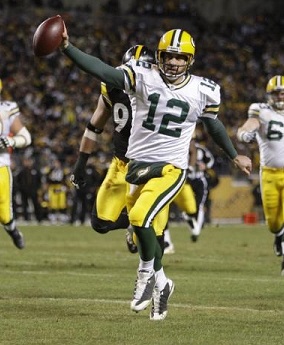
The teams returned to trading punts before the Packers advanced 52 yards in eight plays. Rodgers completed five of six passes, two of them to Jennings, and then kept the ball himself on a 14-yard run for a TD (pictured below). Crosby knotted the score once more with the extra point.


The Steelers came back with a six-play, 80-yard drive. Roethlisberger completed passes to Miller for 27 yards and Santonio Holmes for 33 and finished the series off with a 10-yard touchdown throw to RB Mewelde Moore. Reed converted and Pittsburgh was ahead by 21-14, which remained the score at the half.

The Steelers had the ball first in the third quarter and Roethlisberger connected with Mendenhall for a 25-yard gain, but the drive stalled at the Green Bay 46 and they punted. The Packers had to punt in turn and Pittsburgh put together another scoring drive. Roethlisberger completed passes to Mendenhall, again for 25 yards, and to Ward for 17 while RB Willie Parker reeled off a pair of nine-yard runs. After getting to the Green Bay 21, Rodgers was sacked for an eight-yard loss by LB Brad Jones and, while a throw to Moore gained 10 yards the Steelers had to settle for a 37-yard Reed field goal that gave them a ten-point lead.

The Packers responded with a long drive of 69 yards in 13 plays that stretched into the fourth quarter. Rodgers completed a pass to Driver for 19 yards in a third-and-16 situation, one of seven completions along the way. The last was to TE Jermichael Finley for 11 yards and a TD. Crosby added the point after and the Pittsburgh lead was cut to 24-21.

Following a 36-yard kickoff return by WR Stefan Logan, Roethlisberger threw to Ward for 29 yards to the Green Bay 34. Another Roethlisberger completion, this time to Miller, gained 12 yards to convert third-and-six but a two-yard run by Parker was followed by two incomplete passes and Reed booted a 34-yard field goal to make it a 27-21 game.

The Packers needed just four plays to advance 62 yards in response. Two throws by Rodgers to Finley totaled 11 yards before a completion to Nelson gained 27. Ryan Grant ran 24 yards for a touchdown and, with Crosby kicking the extra point, the visitors were ahead at 28-27.

On the next series, and facing second-and-18, Roethlisberger passed deep to Ward for a 54-yard gain to the Green Bay 23. The drive stalled but Reed kicked a 43-yard field goal that put the Steelers back in front by 30-28.

Pittsburgh gambled by attempting an onside kick that failed and the Packers took advantage as Rodgers threw to Nelson for nine yards and Finley for 10. Rodgers connected with WR James Jones for a 24-yard TD and then completed a pass to RB Brandon Jackson for a two-point conversion. With 2:12 left on the clock, Green Bay held a 36-30 lead.

The Steelers took possession following the ensuing kickoff at their 14. A defensive holding penalty added five yards, but Roethlisberger was sacked by LB Brady Poppinga for a four-yard loss. A throw to Miller gained seven yards but the next pass was incomplete and Pittsburgh was facing fourth-and-seven at its own 22 with the time remaining down to 1:14. Roethlisberger went deep for Holmes to pick up 32 yards and keep the drive alive. Holding on the offense backed the Steelers up 10 yards but then an interception was negated by an illegal contact call on the Packers. Two more incomplete passes and a false start had the Steelers facing third-and-15 but Roethlisberger connected with Miller for 20 yards to the Green Bay 36. A sack was nullified by defensive holding and Roethlisberger threw to Miller again, this time for 15 yards. Pittsburgh called its last timeout and Roethlisberger had two passes fall incomplete before, on the game’s last play, he found Mike Wallace in the corner of the end zone, who just managed to keep his feet inbounds for a 19-yard touchdown (pictured below). Reed added the all-important extra point and the Steelers won in dramatic fashion by a final score of 37-36.


The teams combined for 973 yards, with Pittsburgh gaining the most (537 to 436) and also leading in first downs (28 to 18) and time of possession (35:22 to 24:38). Neither team gained much on the ground, with the Steelers holding an edge of 65 yards to 60. The Packers recorded five sacks, to one by Pittsburgh, and the Steelers were also penalized 10 times, at a cost of 84 yards, to seven flags for 53 yards thrown on Green Bay. There were no turnovers by either club.

Ben Roethlisberger completed 29 of 46 passes for 503 yards, a new franchise record, with three touchdowns. Hines Ward and Heath Miller had seven catches apiece, for 126 and 118 yards, respectively. Mike Wallace had just two pass receptions, for 79 yards, but both scored TDs, including the game-decider. Rashard Mendenhall contributed 6 catches for 73 yards to go along with a team-leading 38 rushing yards on 11 attempts that included a score.

For the Packers, Aaron Rodgers was successful on 26 of 48 throws for 383 yards and three TDs and also added a scoring carry among his three runs for 22 yards. Jermichael Finley caught 9 passes for 74 yards and a touchdown and Greg Jennings gained 118 yards on his five receptions that included a long TD. Ryan Grant ran for 37 yards and a score on 8 carries.

“The guys were coming back to the huddle worn out, linemen, receivers, everybody,” said Ben Roethlisberger regarding the intensity of the winning drive. “We didn’t quit. Everybody believed we could do it.”

“You lose on a last-second play, with a spectacular throw and catch, it’s tough,” said Green Bay LB Clay Matthews. “Hindsight’s always 20-20 but we knew what we were getting ourselves into. It was a dogfight.”

The win was the first of three straight for the Steelers to close out the season, but the resulting 9-7 record placed third in the AFC North and they just missed the playoffs. The loss cost the Packers the NFC North title, clinched by the Vikings as a result, but they also won their remaining two games and their second-place 11-5 tally got them into the postseason as a Wild Card. Green Bay lost a wild 51-45 contest to Arizona in the first playoff round.

Ben Roethlisberger threw for 4328 yards and 26 touchdowns, ranking second in the AFC with a 100.5 passer rating. He exceeded the 503 yards against the Packers in a 2014 contest in which he passed for 522 yards vs. Indianapolis, becoming the first quarterback in NFL history to twice throw for over 500 yards in a game.

September 30, 2015

Highlighted Year: Matt Schaub, 2009

Quarterback, Houston Texans


Age: 28
6th season in pro football, 3rd with Texans
College: Virginia
Height: 6’5”   Weight: 234

Prelude:
Schaub set multiple school passing records in college and was the ACC Player of the Year in 2002. He was chosen by the Atlanta Falcons in the third round of the ’04 NFL draft and backed up Michael Vick for three seasons. Schaub started two games and showed enough promise to attract the attention of other teams. He was traded to the Texans in 2007 and moved into the starting lineup. With a strong and accurate arm, he played well when healthy, but injuries kept him out of ten games in his first two years with the team, and he was prone to fumbles and interceptions. Still, he completed 66.1 percent of his passes in 2008 for 3043 yards and 15 touchdowns with 10 interceptions.

2009 Season Summary
Appeared and started in all 16 games
[Bracketed numbers indicate league rank in Top 20]

Passing
Attempts – 583 [1]
Most attempts, game – 50 at Arizona 10/11
Completions – 396 [1]
Most completions, game – 35 at Arizona 10/11
Yards – 4770 [1]
Most yards, game – 392 at Cincinnati 10/18
Completion percentage – 67.9 [4]
Yards per attempt – 8.2 [4]
TD passes – 29 [5]
Most TD passes, game – 4 at Tennessee 9/20, at Cincinnati 10/18
Interceptions – 15 [9, tied with Jason Campbell]
Most interceptions, game – 2 at Buffalo 11/1, at Indianapolis 11/8, vs. Indianapolis 11/29
Passer rating – 98.6 [7]
300-yard passing games – 9
200-yard passing games – 15

Rushing
Attempts – 48
Most attempts, game – 8 (for 3 yds.) at Buffalo 11/1
Yards – 57
Most yards, game – 21 yards (on 3 carries) at Indianapolis 11/8
Average gain – 1.2
TDs – 0

Awards & Honors:
Pro Bowl

Texans went 9-7 to finish second in the AFC South, the first winning record in franchise history, while leading the NFL in passing yards (4654).

Aftermath:
Schaub again started every game in 2010 and passed for 4370 yards and 24 TDs with a passer rating of 92.0 while his interceptions dropped to 12. Both he and the team were off to a good start in ’11 before a foot injury knocked him out for the last six games of the regular season as well as the club’s first postseason appearance. Schaub returned in 2012 and had a Pro Bowl year as he passed for 4008 yards and 22 TDs and won in his first playoff appearance. However, he had a disastrous year in 2013, throwing for more interceptions (14) than touchdowns (10) and he was benched, leading to his being traded to Oakland in the offseason. He saw scant action as a backup to Derek Carr, was released, and signed with the Baltimore Ravens for 2015. Through 2014, Schaub has passed for 24,311 yards and 130 touchdowns, giving up 86 interceptions, with a 63.9 completion percentage and 89.5 passer rating. Of those totals, 23,221 yards with 124 TD passes and 78 INTs with a completion percentage of 64.6 and passer rating of 90.9 came during his seven years with Houston. He has been named to the Pro Bowl twice.   

--

Highlighted Years features players who were consensus first-team All-League* selections or league* or conference** leaders in the following statistical categories:

Rushing: Yards, TDs (min. 10)
Passing: Yards, Completion Pct., Yards per Attempt, TDs, Rating
Receiving: Catches, Yards, TDs (min. 10)
Scoring: TDs, Points, Field Goals (min. 5)
All-Purpose: Total Yards
Defense: Interceptions, Sacks
Kickoff Returns: Average
Punt Returns: Average
Punting: Average

*Leagues include NFL (1920 to date), AFL (1926), AFL (1936-37), AAFC (1946-49), AFL (1960-69), WFL (1974-75), USFL (1983-85)

**NFC/AFC since 1970

April 16, 2015

Highlighted Year: Danny Amendola, 2009

Wide Receiver, St. Louis Rams


Age: 24 (Nov. 2)
2nd season in pro football, 1st active & with Rams
College: Texas Tech
Height: 5’11” Weight: 186

Prelude:
Amendola caught 204 passes in college, including 109 for 1245 yards and six touchdowns as a senior (and adding in 6 for 68 yards and a TD in the Gator Bowl). Undrafted in 2008, he signed with the Dallas Cowboys and spent the entire regular season on the practice squad after being waived. The Eagles signed him to their practice squad for the postseason. He went to training camp with Philadelphia and started the ’09 season on the practice squad until the Rams signed him from there in September.

2009 Season Summary
Appeared in 14 of 16 games
[Bracketed numbers indicate league rank in Top 20]

Pass Receiving
Receptions – 43      
Most receptions, game – 7 (for 55 yds.) vs. Seattle 11/29
Yards – 326
Most yards, game – 61 (on 4 catches) vs. Arizona 11/22
Average gain – 7.6
TDs – 1

Rushing
Attempts – 3
Yards – -2
Average gain – -0.7
TDs – 0

Kickoff Returns
Returns – 66 [1]
Yards – 1618 [1]
Most yards, game – 217 (on 9 ret.) at Tennessee 12/13
Average per return – 24.5 [17]
TDs – 0
Longest return – 58 yards

Punt Returns
Returns – 31 [8, tied with Captain Munnerlyn]
Yards – 360 [6]
Most yards, game – 79 (on 3 ret.) at Arizona 12/27
Average per return – 11.6 [7]
TDs – 0
Longest return – 56 yards

All-purpose yards – 2302 [6, 1st in NFC]

Scoring
TDs – 1
Points – 6

Rams went 1-15 to finish fourth in the NFC West.

Aftermath:
Amendola had a bigger year in 2010, seeing more action on offense as an effective slot receiver with 85 catches for 689 yards, still returning kicks, and leading the league in all-purpose yards with 2364. However, an elbow injury suffered in the 2011 season-opening game had him spending the rest of the year on injured reserve and he missed another five games due to injury in 2012. Amendola departed for New England as a free agent in 2013, where it was anticipated that he would help fill in for departed WR Wes Welker, and he had 54 catches for 633 yards while appearing in 12 games. His production declined in 2014 but he became a significant factor in the postseason, which was capped by a touchdown reception in the Super Bowl victory over Seattle. Through 2014, he has caught 277 passes for 2559 yards (9.2 avg.) and 10 touchdowns, averaged 23.6 yards on 138 kickoff returns and 10.2 yards on 106 punt returns. Of those totals, 196 receptions for 1726 yards (8.8 avg.) and seven TDs came with the Rams, where he also averaged 23.5 yards on 118 of the kickoff returns and 10.5 yards on 89 punt returns.

--

Highlighted Years features players who were consensus first-team All-League* selections or league* or conference** leaders in the following statistical categories:

Rushing: Yards, TDs (min. 10)
Passing: Yards, Completion Pct., Yards per Attempt, TDs, Rating
Receiving: Catches, Yards, TDs (min. 10)
Scoring: TDs, Points, Field Goals (min. 5)
All-Purpose: Total Yards
Defense: Interceptions, Sacks
Kickoff Returns: Average
Punt Returns: Average
Punting: Average

*Leagues include NFL (1920 to date), AFL (1926), AFL (1936-37), AAFC (1946-49), AFL (1960-69), WFL (1974-75), USFL (1983-85)

**NFC/AFC since 1970

March 1, 2015

Highlighted Year: Miles Austin, 2009

Wide Receiver, Dallas Cowboys


Age: 25
4th season in pro football & with Cowboys
College: Monmouth
Height: 6’3”   Weight: 216

Prelude:
Austin set school records at Monmouth with 150 catches for 2867 yards (19.1 avg.) and 30 touchdowns over the course of 39 games. Coming out of a Division 1-AA program, he went undrafted in 2006 and signed with the Cowboys as a free agent. He was used exclusively as a kickoff returner as a rookie and had a 93-yard TD return in the postseason loss to Seattle. Austin continued to return kickoffs in 2007 and ’08 and caught a total of just 18 passes for 354 yards (19.7 avg.) and three TDs in a reserve role. The departure of WR Terrell Owens opened up an opportunity for Austin, who had demonstrated potential as a deep threat.

2009 Season Summary
Appeared in all 16 games
[Bracketed numbers indicate league rank in Top 20]

Pass Receiving
Receptions – 81 [15]          
Most receptions, game – 10 (for 250 yds.) at Kansas City 10/11, (for 104 yds.) at NY Giants 12/6
Yards – 1320 [3, 1st in NFC]
Most yards, game – 250 (on 10 catches) at Kansas City 10/11
Average gain – 16.3 [10]
TDs – 11 [4, tied with Roddy White & Visanthe Shiancoe]
200-yard receiving games – 1
100-yard receiving games – 5

Rushing
Attempts – 2
Yards – -2
Average gain – -1.0
TDs – 0

Kickoff Returns
Returns – 7
Yards – 157
Average per return – 22.4
TDs – 0
Longest return – 29 yards

Scoring
TDs – 11 [14, tied with four others]
Points – 66

Postseason: 2 G
Pass receptions – 11
Most pass receptions, game – 7 vs. Philadelphia, NFC Wild Card playoff
Pass receiving yards – 116
Most pass receiving yards, game – 82 vs. Philadelphia, NFC Wild Card playoff
Average yards per reception – 10.6
Pass Receiving TDs – 1

Rushing attempts – 1
Rushing yards – 8
Rushing TDs – 0

Awards & Honors:
Pro Bowl

Cowboys went 11-5 to finish first in the NFC East while ranking second in the NFL in total yards (6390). Won NFC Wild Card playoff over Philadelphia Eagles (34-14). Lost NFC Divisional playoff to Minnesota Vikings (34-3).

Aftermath:
Austin followed up with 69 catches for 1041 yards (15.1 avg.) and seven touchdowns in 2010, with the loss of QB Tony Romo six games into the season due to a broken collar bone and the addition of rookie WR Dez Bryant contributing to lowered production. He was again selected to the Pro Bowl. Hamstring problems limited Austin to ten games in 2011 but he bounced back by catching 66 passes for 943 yards (14.3 avg.) and six TDs in ’12. After being held to 11 games and 24 catches in 2013, he was released and moved on to Cleveland for 2014, where he had 47 receptions for 568 yards (12.1 avg.) before being sidelined with a lacerated kidney. Overall, over the course of nine seasons through 2014, six in a starting role, Austin has caught 348 passes for 5049 yards (14.5 avg.) and 36 TDs, with 301 of those receptions for 4481 yards and two scores coming with Dallas. He also returned 89 kickoffs for a 24.1-yard average, all with the Cowboys.

--

Highlighted Years features players who were consensus first-team All-League* selections or league* or conference** leaders in the following statistical categories:

Rushing: Yards, TDs (min. 10)
Passing: Yards, Completion Pct., Yards per Attempt, TDs, Rating
Receiving: Catches, Yards, TDs (min. 10)
Scoring: TDs, Points, Field Goals (min. 5)
All-Purpose: Total Yards
Defense: Interceptions, Sacks
Kickoff Returns: Average
Punt Returns: Average
Punting: Average

*Leagues include NFL (1920 to date), AFL (1926), AFL (1936-37), AAFC (1946-49), AFL (1960-69), WFL (1974-75), USFL (1983-85)

**NFC/AFC since 1970

February 16, 2014

MVP Profile: Peyton Manning, 2009

Quarterback, Indianapolis Colts


Age:  33
12th season in pro football & with Colts
College: Tennessee
Height: 6’5”   Weight: 230

Prelude:
Son of NFL quarterback Archie Manning and a star in college, Manning was chosen by the Colts with the first overall draft pick in 1998. It didn’t take long for him to justify the selection as he set NFL rookie records with 3739 passing yards and 26 TD passes. He led the league with 575 pass attempts, also a record for a rookie at the time, but also with 28 interceptions on a 3-13 club. The record turned around to 13-3 in ’99, the Colts qualified for the postseason, and Manning was selected to the Pro Bowl for the first time as he passed for 4135 yards and, while he again threw 26 TD passes, his interceptions dropped to 15. A classic drop-back passer, he lacked his father’s mobility but made up for it with a quick release – not to mention an excellent work ethic. Manning led the NFL with 357 completions, 4413 yards, and 33 TD passes in 2000 and again was chosen for the Pro Bowl. Following a lesser year in ’01 as the Colts dropped to 6-10, he bounced back with a third Pro Bowl season in 2002, passing for 4200 yards (his fourth straight year over 4000) and 27 touchdowns. Manning received MVP recognition in 2003 after leading the NFL in completions (379), yards (4267), and completion percentage (67.0). He again received MVP honors and was a consensus first-team All-Pro in 2004 as he set a record with 49 TD passes while leading the league in passing (121.1 rating) for the first of three straight years and also topped the NFL in TD percentage (9.9) and yards per attempt (9.2). He was consensus first-team All-Pro for the third consecutive year in 2005 and, in ’06, finally overcame years of frustration in the playoffs as the Colts won the Super Bowl. Manning led the NFL in TD passes with 31 that year, against just 9 interceptions. In 2008, he was selected to his seventh straight Pro Bowl (ninth overall) and was over 4000 passing yards for the ninth time, and again received MVP recognition (AP, PFWA, Sporting News), although the team lost to the Steelers in the AFC Championship game.

2009 Season Summary
Appeared and started in all 16 games
[Bracketed numbers indicate league rank in Top 20]

Passing
Attempts – 571 [2]
Most attempts, game – 50 vs. Houston 11/8
Completions – 393 [2]
Most completions, game – 36 at Tennessee 10/11
Yards – 4500 [2]
Most yards, game – 379 at Arizona 9/27
Completion percentage – 68.8 [2, 1st in AFC]
Yards per attempt – 7.9 [8, tied with Brett Favre & Eli Manning]
TD passes – 33 [2, tied with Brett Favre, 1st in AFC]
Most TD passes, game – 4 at Arizona 9/27, vs. New England 11/15, vs. Denver 12/13, at Jacksonville 12/17
Interceptions – 16 [7, tied with Matt Cassel]
Most interceptions, game – 3 vs. Denver 12/13
Passer rating – 99.9 [6]
300-yard passing games – 9
200-yard passing games – 14

Rushing
Attempts – 19
Most attempts, game - 3 (for -4 yds.) vs. Jacksonville 9/13, (for -3 yds.) vs. Denver 12/13, (for -3 yds.) at Jacksonville 12/17
Yards – -13
Most yards, game – 3 yards (on 1 carry) at Miami 9/21
Yards per attempt – -0.7
TDs – 0

Postseason: 3 G
Pass attempts – 128
Most attempts, game - 45 vs. New Orleans, Super Bowl
Pass completions – 87
Most completions, game - 31 vs. New Orleans, Super Bowl
Passing yardage – 956
Most yards, game - 377 vs. NY Jets, AFC Championship
TD passes – 6
Most TD passes, game - 3 vs. NY Jets, AFC Championship
Interceptions – 2
Most interceptions, game - 1 vs. Baltimore, AFC Divisional playoff, vs. New Orleans, Super Bowl

Rushing attempts – 3
Most rushing attempts, game - 2 vs. Baltimore, AFC Divisional playoff
Rushing yards – -2
Most rushing yards, game - 0 vs. NY Jets, AFC Championship
Average gain rushing – -0.7
Rushing TDs – 0

Awards & Honors:
NFL MVP: AP, PFWA, Sporting News
1st team All-NFL: AP, PFWA
2nd team All-NFL: Pro Football Focus, Sporting News
Pro Bowl

Colts went 14-2 to finish first in the AFC West with the best record in the conference while leading the AFC in touchdowns (53). Won AFC Divisional playoff over Baltimore Ravens (20-3) and AFC Championship over New York Jets (30-17). Lost Super Bowl to New Orleans Saints (31-17).

Aftermath:
Manning was again a Pro Bowl selection in 2010, but after starting 208 regular season games at quarterback, he was sidelined for all of 2011 with a neck injury. Released by the Colts and signed by the Denver Broncos for 2012, Manning made a successful comeback and led the NFL in completion percentage (68.6) while passing for 4659 yards and 37 TDs, and had an even bigger year in 2013 as he set records with 5477 passing yards and 55 TD passes, again attaining MVP honors while the Broncos won the AFC title. Through 2013, he had passed for 64,964 yards, with 13 seasons over 4000, and 491 TD passes.

--


MVP Profiles feature players who were named MVP or Player of the Year in the NFL, AAFC (1946-49), AFL (1960-69), WFL (1974), or USFL (1983-85) by a recognized organization (Associated Press, Pro Football Writers Association, Newspaper Enterprise Association, United Press International, The Sporting News, Maxwell Club – Bert Bell Award, or the league itself). 

[Updated 12/2/14]