January 28, 2013

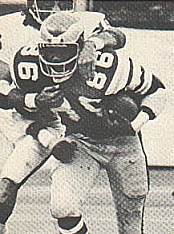
Rookie of the Year: Charle Young, 1973

Tight End, Philadelphia Eagles


Age: 22
College: Southern California
Height: 6’4”   Weight: 230

Prelude:
An All-American in college, Young was the second of two first-round draft picks (sixth overall) by the Eagles in 1973. The outspoken rookie moved directly into the starting lineup and backed up his words with production as part of the “Fire High Gang” along with tall wide receivers Harold Carmichael (6’8”) and Don Zimmerman (6’4”).

1973 Season Summary
Appeared in all 14 games
[Bracketed numbers indicate league rank in Top 20]

Pass Receiving
Receptions – 55 [4, tied with Ed Podolak]     
Most receptions, game – 8 (for 108 yds.) vs. New England 11/4
Yards – 854 [4]
Most yards, game – 113 (on 4 catches) at Dallas 11/18
Average gain – 15.5 (19)
TDs – 6 [12, tied with Jerome Barkum, Otto Stowe & Larry Brown]
100-yard receiving games - 4

Rushing
Attempts – 4
Yards – 24
Average gain – 6.0
TDs – 1

Kickoff Returns
Returns – 1
Yards – 14
TDs – 0

Scoring
TDs – 7 [18, tied with seven others]
Points – 42

Awards & Honors:
NFC Rookie of the Year: UPI
1st team All-NFL: AP, PFWA, Pro Football Weekly
2nd team All-NFL: NEA
1st team All-NFC: AP, Pro Football Weekly
2nd team All-NFC: UPI
Pro Bowl

Eagles went 5-8-1 to finish third in the NFC East while leading the NFL in passing offense (2998 yds.).

Aftermath:
Young followed up his outstanding rookie season by gathering in a NFC-leading 63 catches for 696 yards (11.0 avg.) and three touchdowns in 1974. He was again selected to the Pro Bowl in 1974 and ’75, although his production dropped with the offensively-challenged Eagles in 1975 and ’76. His first name also went through several different changes, from Charles to Charlie, Charli, and finally Charle. A contract dispute forced the trade of his rights to the Los Angeles Rams in 1977 for QB Ron Jaworski, and he dropped into obscurity behind Terry Nelson. In three seasons in LA, he caught just 36 passes. Moving on to San Francisco, Young was a better fit and, in the 1981 Super Bowl-winning season, had 37 pass receptions for 400 yards and five TDs. Following three years with the 49ers, he finished up with three seasons with the Seattle Seahawks. For his 13-season career, Young caught 418 passes for 5106 yards (12.2 avg.) and 27 touchdowns and was selected to the Pro Bowl three times.

--

Rookie of the Year Profiles feature players who were named Rookie of the Year in the NFL, AFL (1960-69), or USFL (1983-85) by a recognized organization (Associated Press – Offense or Defense, Newspaper Enterprise Association, United Press International, The Sporting News, or the league itself – Pepsi NFL Rookie of the Year). 

[Updated 2/6/14]

January 27, 2013

2002: Bledsoe Comes Off Bench to Lead Patriots Over Steelers for AFC Title


The AFC Championship game on January 27, 2002 featured the overachieving New England Patriots against the defensively-solid Pittsburgh Steelers. In their second season under Head Coach Bill Belichick, and coming off a 5-11 record in 2000, the Patriots started off 2001 at 5-5 before reeling off six straight wins to finish first in the AFC East at 11-5. A key development along the way had been an injury to QB Drew Bledsoe that resulted in unheralded backup Tom Brady moving into the lineup and remaining there even after the 29-year-old veteran had recovered. Overall, the Patriots were not an overwhelmingly talented team, but they did jell under Belichick’s coaching. They defeated the Raiders in a snowy overtime Divisional playoff game that featured a controversial reversal of an apparent fumble due to the tuck rule to advance to the conference title game.

The Steelers, in their tenth year under Head Coach Bill Cowher, came into the game as nine-point favorites. After missing the postseason in the three previous seasons, Pittsburgh went 13-3 in ’01 to top the AFC Central and gain top seed in the playoffs. Guided on offense by talented but erratic QB Kordell Stewart, the Steelers were adept at running the ball, although Pro Bowl RB Jerome Bettis had been slowed by a groin injury that had kept him out of action since Week 12. Still, they had two thousand-yard wide receivers in Hines Ward, another Pro Bowler, and Plaxico Burress. But the key to their success was the league’s top-ranked defense that featured linebackers Jason Gildon, Kendrell Bell, and Joey Porter. The Steelers had easily dispatched the defending league champions, the Ravens, in the Divisional round of the playoffs.

There was a crowd of 64,704 at Heinz Field, and they saw a quiet start to the contest as both teams traded punts back and forth. With just over four minutes remaining in the opening period, the Steelers had to punt from their own 13 and Josh Miller got off a 64-yard boot, but had to kick again when WR Troy Edwards was flagged for stepping out of bounds and returning to the field. It made a big difference as the second kick was returned 55 yards for a touchdown by WR Troy Brown to give the Patriots a lead.

In a series that extended into the second quarter, the Steelers drove into New England territory. After reaching the 11 yard line, Kris Brown kicked a 30-yard field goal to get the home team on the board. The contest again settled into a defensive battle until the Patriots took possession at their own 30 with less than three minutes remaining in the half. On the third play, Brady passed to Troy Brown for a 28-yard gain, but the quarterback was hit hard by SS Lee Flowers. Brady left the game with an injured left leg.

In to replace him was the quarterback who had been relegated to the bench, Drew Bledsoe (pictured at top). Four plays later, after hitting WR David Patten for gains of 15 and 10 yards and then running for four yards, Bledsoe threw again to Patten for an 11-yard touchdown. The Patriots were up by 14-3 at halftime.

In their second possession of the third quarter, the Steelers drove to the New England 16, but a 34-yard field goal attempt was blocked by DT Brandon Mitchell and Troy Brown picked up the loose ball, ran 11 yards, and then lateraled to DB Antwan Harris who carried it the remaining 49 yards for a TD.

Pittsburgh came back with a long 79-yard series in eight plays that featured Stewart completions to Ward for 24 yards and RB Amos Zereoue for 19 and culminated in a one-yard scoring run by Jerome Bettis. New England’s lead was cut to 21-10 with over five minutes to go in the third quarter.

The Steelers closed the gap even more following a 28-yard punt return by Troy Edwards to the New England 32. They went 32 yards, the final 11 coming on a run by Zereoue. It was a four point game heading into the fourth quarter.

A long, methodical drive by the Patriots added more points less than four minutes into the final period on a 44-yard Vinatieri field goal. The Steelers had plenty of time, but their remaining three possessions ended in a punt and two interceptions, by FS Tebucky Jones and SS Lawyer Milloy. Vinatieri missed a 50-yard field goal try in an effort to extend the lead, but it didn’t matter. The Patriots were AFC Champions by a final score of 24-17.

The Steelers had the edge in both total yards (306 to 259) and first downs (23 to 15). However, they also turned the ball over four times, to none by New England. Linebackers Willie McGinest and Ted Johnson did a great job of shutting down Pittsburgh’s running game, as the Steelers gained only 58 yards on 22 carries. Pittsburgh also recorded more sacks (four to three) and the Patriots hurt themselves with 12 penalties, at a cost of 87 yards, as opposed to three flags thrown on the home team.

In his relief effort, Drew Bledsoe completed 10 of 21 passes for 102 yards and a touchdown with no interceptions. Before exiting, Tom Brady was successful on 12 of 18 throws for 115 yards. Troy Brown (pictured below) had a big day, catching 8 passes for 121 yards, returning a punt for a TD, and contributing to the score on the blocked field goal. Antowain Smith rushed for 47 yards on 15 attempts.


For the Steelers, Kordell Stewart went to the air 42 times and completed 24 of those passes for 255 yards and no touchdowns along with three interceptions. He also led the club in rushing with 41 yards on 8 carries while the hobbled Jerome Bettis was held to 8 yards on 9 attempts that included a short TD and Amos Zeroue gained 11 yards and scored once on four carries, although he also caught 4 passes for 50 yards. Hines Ward had 6 pass receptions for 64 yards and Plaxico Burress gained 67 yards on 5 catches.

“I’ve done this for a long time and at times at a pretty high level,” said Drew Bledsoe of his performance off the bench. “I felt confident coming out. I’ve been working out and preparing for this exact scenario.”

Tom Brady was back for the Super Bowl and the upstart Patriots defeated the St. Louis Rams in a stunning upset. They missed out on the postseason in 2002 but came back to win the first of back-to-back NFL titles in ’03. Pittsburgh again reached the playoffs in ’02 and lost in the Divisional playoff round.

The relief appearance by Drew Bledsoe marked the end of his nine-year career in New England. He moved on to the division-rival Buffalo Bills for 2002. 

January 25, 2013

MVP Profile: Joe Theismann, 1983

Quarterback, Washington Redskins


Age:  34 (Sept. 9)
13th season in pro football, 10th in NFL & with Redskins
College: Notre Dame
Height: 6’0”   Weight: 198

Prelude:
Runner-up for the Heisman Trophy in 1970, Theismann was a 4th-round draft pick of the Miami Dolphins in ’71 but signed with Toronto of the CFL instead. After three years in Canada, he joined the Redskins (who had traded for his draft rights) in 1974 but was stuck behind veterans Billy Kilmer and Sonny Jurgensen. Jurgensen retired following the ’74 season, and Kilmer in ’77, at which point the cocky quarterback got his chance to start full-time. He passed for over 2500 yards in each season from 1978 thru ’81, with a high of 3568 in 1981. In the strike-shortened 1982 season, the Redskins went 8-1 and won the Super Bowl. Theismann was selected to the Pro Bowl and received the Bert Bell Trophy from the Maxwell Club. Mobile and a fiery leader, he was well-established as the starting quarterback and had a title under his belt.

1983 Season Summary
Appeared and started in all 16 games
[Bracketed numbers indicate league rank in Top 20]

Passing
Attempts – 459 [9]
Most attempts, game – 46 at San Diego 10/31
Completions – 276 [8]
Most completions, game – 28 vs. Dallas 9/5
Yards – 3714 [5]
Most yards, game – 417 vs. LA Raiders 10/2
Completion percentage – 60.1 [8]
Yards per attempt – 8.1 [4]
TD passes – 29 [2, tied with Danny White]
Most TD passes, game – 3 at Seattle 9/25, vs. LA Raiders 10/2, vs. Atlanta 12/4
Interceptions – 11
Most interceptions, game – 4 vs. NY Giants 12/17
Passer rating – 97.0 [2]
400-yard passing games – 1
300-yard passing games – 4
200-yard passing games – 9

Rushing
Attempts – 37
Most attempts, game - 5 (for 18 yds.) at Seattle 9/25
Yards – 234
Most yards, game – 36 yards (on 3 carries) vs. Dallas 9/5
Yards per attempt – 6.3
TDs – 1

Scoring
TDs – 1
Points – 6

Postseason: 3 G
Pass attempts – 84
Most attempts, game - 35 vs. LA Raiders, Super Bowl
Pass completions – 48
Most completions, game - 18 vs. LA Rams, NFC Divisional playoff
Passing yardage – 774
Most yards, game - 302 vs. LA Rams, NFC Divisional playoff
TD passes – 3
Most TD passes, game - 2 vs. LA Rams, NFC Divisional playoff
Interceptions – 3
Most interceptions, game - 2 vs. LA Raiders, Super Bowl

Rushing attempts – 5
Most rushing attempts, game - 3 vs. LA Raiders, Super Bowl
Rushing yards – 30
Most rushing yards, game - 18 vs. LA Raiders, Super Bowl
Average gain rushing – 6.0
Rushing TDs – 0

Awards & Honors:
NFL MVP: AP, PFWA, NEA, Sporting News
NFL Offensive Player of the Year: AP
1st team All-NFL: AP, PFWA, NEA, Pro Football Weekly, Sporting News
1st team All-NFC: UPI, Pro Football Weekly
Pro Bowl

Redskins went 14-2 and finish first in the NFC East while leading the league in scoring (541 points) and touchdowns (63). Won NFC Divisional Playoff over Los Angeles Rams (51-7) and NFC Championship over San Francisco 49ers (24-21). Lost Super Bowl to Los Angeles Raiders (38-9).

Aftermath:
Theismann passed for 3391 yards and 24 TDs in 1984 as the Redskins again reached the postseason. He continued to start until suffering a career-ending broken leg in a Monday Night game against the Giants during the 1985 season. Overall, he threw for a career pro total of 31,299 yards (6093 in CFL, 25,206 in NFL) and 200 touchdowns (40 in CFL, 160 in NFL).

--

MVP Profiles feature players who were named MVP or Player of the Year in the NFL, AAFC (1946-49), AFL (1960-69), WFL (1974), or USFL (1983-85) by a recognized organization (Associated Press, Pro Football Writers Association, Newspaper Enterprise Association, United Press International, The Sporting News, Maxwell Club – Bert Bell Award, or the league itself).

[Updated 2/6/14]

January 24, 2013

2010: Colts Rally Past Jets to Win AFC Title


Few teams had won as consistently over the course of a decade as the Indianapolis Colts as they entered the 2009 season. They had missed the playoffs just once in the previous ten years, winning the Super Bowl following the 2006 campaign. It was no different in ’09 as the Colts won their first 14 games and topped the AFC South with a 14-2 record. 33-year-old QB Peyton Manning (pictured above) was the one constant during the whole period, and he had another MVP year. The team had a new head coach in Jim Caldwell, replacing the highly-successful Tony Dungy, and while slashing RB Joseph Addai was still the top runner, and WR Reggie Wayne and TE Dallas Clark were offensive stalwarts, two younger wide receivers, Austin Collie and Pierre Garcon, broke in with good results. Meanwhile, the defense had stalwarts in ends Dwight Freeney and Robert Mathis. Indianapolis rolled over the Baltimore Ravens in the Divisional round of the playoffs.

The team they faced for the AFC Championship on January 24, 2010 was the New York Jets. New York also had a new head coach in Rex Ryan and a talented and aggressive defense to go along with a run-oriented offense directed by rookie QB Mark Sanchez. The brash Jets had finished strong in the regular season (including a win over the Colts, who pulled their starters in the second half) to qualify for the playoffs as a 9-7 Wild Card team and, in the process of winning five straight road games coming into the contest at Indianapolis, had beaten the Bengals in the first postseason round and Chargers at the Divisional level.

There were 67,650 fans in attendance at Lucas Oil Stadium. The Colts punted following the first series of the game and the Jets responded with a 45-yard drive into Indianapolis territory. Mark Sanchez had completions of 14 yards to WR Jerricho Cotchery and 20 yards to WR Braylon Edwards but lost five yards on running plays before Jay Feely missed a 44-yard field goal attempt.

The teams traded punts but the Colts were driving at the end of the opening period. On the first play of the second quarter, Matt Stover booted a 25-yard field goal. However, the Jets responded quickly on their next play from scrimmage when Sanchez connected with Edwards on a play-action pass for an 80-yard touchdown. With the successful extra point, it was 7-3 in favor of the visitors.

Indianapolis came back with a long sustained drive of 79 yards in 12 plays. Manning completed passes to Reggie Wayne for 25 yards to get into New York territory and then, in a third-and-two situation at the 26, to Austin Collie for 22 yards. The Jets defense held, however, and the Colts settled for Stover’s 19-yard field goal to make it a one-point game.

The Jets drove 77 yards in seven plays in their next series. RB Shonn Greene started off with three straight runs for 20 yards before WR Brad Smith, operating out of the team’s “pistol” formation, threw to Cotchery for a 45-yard gain to the Indianapolis 12. Three plays later, Sanchez passed to TE Dustin Keller for a nine-yard TD and the Jets opened up a 14-6 lead.

It got worse for the Colts when Joseph Addai fumbled on the next series and the Jets got the ball back at the Indianapolis 29 thanks to the recovery by SS Jim Leonhard. But a false start penalty on the Jets, combined with the stingy defense, moved them back and New York got three more points on a 48-yard field goal by Feely.

The Colts got the ball again with 2:11 left in the half and wasted little time in putting points on the board. Following an incomplete pass on first down, Manning connected with Collie (pictured below) three straight times, first for 18 yards, then 46, and finally 16 yards for a touchdown. The teams went into halftime with the Jets leading by 17-13.


New York had the first possession in the third quarter and drove to the Indianapolis 34, with the big play a Sanchez pass to Cotchery for 17 yards. But the Jets came up empty when Feely’s 52-yard field goal attempt was wide to the right. The Colts responded with a 57-yard series in eight plays. All were passes by Manning, the last being a four-yard toss to Pierre Garcon in the rear corner of the end zone for the go-ahead touchdown.

The teams traded punts until, in their first possession of the fourth quarter, the Colts put together another scoring drive. Manning threw to Dallas Clark for a 15-yard TD and, with Stover once again adding the extra point, Indianapolis was in front by 10 points.

The Jets went three-and-out in their next series and the Colts came back with a long scoring possession of 71 yards in 12 plays. They converted two third downs along the way, the second with a Manning completion to Garcon for 23 yards on a third-and-nine play. The drive burned 5:33 off the clock and concluded with Stover booting a 21-yard field goal.

Down by 13 points with 2:33 remaining, the Jets were finished off when a Sanchez pass was intercepted by CB Kelvin Hayden. The Colts won the AFC Championship by a score of 30-17.

Indianapolis gained more total yards (461 to 388) and accumulated more first downs (27 to 17). New York’s running game was held to 86 yards and the Jets were penalized six times, to just one flag thrown on the Colts. Each club turned the ball over once.

Peyton Manning completed 26 of 39 passes for 377 yards with three touchdowns and no interceptions. Pierre Garcon (pictured below) caught 11 of those throws for 151 yards and a TD and Austin Collie gained 123 yards on his 7 catches that included a score. Joseph Addai paced the ground game with 80 yards on 16 carries.


For the Jets, Mark Sanchez was successful on 17 of 30 throws for 257 yards and two TDs with one intercepted. Jerricho Cotchery had 5 catches for 102 yards and, thanks to the long scoring reception, Braylon Edwards gained 100 yards on his two catches. Thomas Jones rushed for 42 yards on 16 attempts and Shonn Greene added 41 yards on 10 carries.

“The guys have always been a very confident bunch and they do a great job of hanging in there,” said Jim Caldwell of his team. “Peyton had just an outstanding game. He’s one of those guys that can adjust to different situations…A real champion.”

“Today wasn’t out day,” said a humbled Rex Ryan. “There’s no question. You have to give credit to the Colts. Obviously they’re the cream of the crop right now.”

The Colts went on to lose the Super Bowl to the New Orleans Saints. They had a tougher time in 2010, but once again topped the AFC North. The Jets were again a Wild Card team at 11-5 and defeated Indianapolis in the first playoff round on the way to once more reaching the AFC title game, which they lost to the Steelers. Things would change significantly for the worse for both clubs in 2011.

January 23, 2013

2000: Rams Edge Bucs in Defensive Battle for NFC Title


After nine straight losing seasons, dating back to when the franchise was still located in Los Angeles, the St. Louis Rams rose to 13-3 in 1999 and were in the playoffs for the first time since 1989. 63-year-old Head Coach Dick Vermeil, in his third year at the helm following a lengthy hiatus from coaching, had built an offensive powerhouse, although it certainly didn’t look to be the case when newly-acquired QB Trent Green went down with a season-ending injury in the preseason. But in a stunning development, unheralded backup QB Kurt Warner stepped into the job with spectacular results. He was helped by the presence of outstanding veteran WR Isaac Bruce and rookie WR Torry Holt as well as, perhaps most significantly, RB Marshall Faulk, obtained from the Colts, who had over a thousand yards each in rushing and catching the ball. The defense was an afterthought but was also much improved. The high-powered offense had been on full display in a 49-37 Divisional round win over the Vikings.

On January 23, 2000 the Rams hosted the Tampa Bay Buccaneers for the NFC Championship. Coached by Tony Dungy, the Bucs went 11-5 in topping the NFC Central and were coming off of a one-point win over Washington in the Divisional playoff round. They featured an outstanding defense that included DT Warren Sapp, linebackers Derrick Brooks and Hardy Nickerson, and SS John Lynch, all of whom went to the Pro Bowl. The offense was conservative and ground-oriented, depending on running backs Mike Alstott and Warrick Dunn. QB Shaun King had replaced injured veteran Trent Dilfer and was attempting to become the first rookie quarterback to guide his team to a Super Bowl. Nevertheless, the Rams came into the contest as solid 14-point favorites.

There were 66,946 fans at the Trans World Dome hoping to see their team win its first conference title since moving to St. Louis. Kurt Warner received an immediate indication that he was in for a battle when his first pass was tipped and then intercepted by DE Steve White in St. Louis territory. The Bucs got a 25-yard field goal by Martin Gramatica off of the turnover to take a 3-0 lead.


St. Louis came back to score with a methodical 16-play drive that covered 74 yards and led to a Jeff Wilkins field goal from 24 yards. On the first play of the second quarter, the Rams got a break on defense when a snap to Shaun King, in shotgun formation, flew past the quarterback and into the end zone. King, seeking to prevent a possible defensive touchdown, knocked the ball through the end zone for a safety.

The Rams had a chance to score again after the free kick but a 44-yard field goal try by Wilkins was unsuccessful. The teams traded punts and the Bucs put together a promising drive that reached the St. Louis 24. However, Mike Alstott was then thrown back for a two-yard loss and King was sacked by LB Charlie Clemons to take them out of field goal range. Before the first half was over Tampa Bay threatened again, but CB Todd Lyght intercepted King’s pass at the St. Louis 33 to extinguish the drive. The Rams carried a precarious 5-3 lead into halftime.

Opening the third quarter, the Buccaneers put together a solid series that covered 66 yards in nine plays and included a pass from King to WR Jacquez Green for 32 yards in a third-and-eight situation that had more yardage attached due to a facemask penalty. Gramatica capped the drive with a 23-yard field goal that put Tampa Bay in front by 6-5.

The Rams came out throwing on their next series as Warner tossed nine passes and they moved from their 13 to the Tampa Bay 24. But the tenth pass was picked off by LB Hardy Nickerson at the Tampa Bay two to snuff out a scoring threat with just under four minutes remaining in the period.

The Buccaneers kept the ball on the ground and punted. Now in the fourth quarter, Warner again threw an interception in the Rams’ next series, this time with CB Brian Kelly giving Tampa Bay good field position at the St. Louis 42. The Bucs were unable to do anything with it and the teams again traded punts.

The Rams made a big play on defense midway through the fourth quarter when rookie CB Dre’ Bly intercepted a Shaun King pass at midfield. Six plays later, in a third-and-four situation, the Rams finally hit pay dirt.

With 4:44 left in the game, Warner threw to the team’s number four receiver, WR Ricky Proehl, who pulled the pass in along the left sideline over a leaping Brian Kelly for a 30-yard touchdown. While he juggled the ball momentarily, he came down cleanly in the end zone (pictured at top). The pass attempt for a two-point conversion failed but the Rams were back in front.

The Buccaneers had time but continued to come up short against the Rams defense. On their final drive, the Rams came through with two sacks of King, by DT Jeff Zgonina and DE Grant Wistrom. With 47 seconds left, an apparent 13-yard completion to WR Bert Emanuel to the St. Louis 23 was overturned on review. King, needing long yardage, then tossed two incomplete passes to end any hopes for the Bucs. St. Louis came away with a hard-fought 11-6 win to advance to the Super Bowl.

The Rams led in total yards (309 to 203) and first downs (17 to 12). Neither team was able to run the ball effectively, with the Bucs gaining 77 yards on 23 rushing attempts and St. Louis amassing just 51 yards on 21 carries. The Rams turned the ball over three times, to two by Tampa Bay, while the St. Louis defense stepped up with five sacks.

Kurt Warner, heavily harassed but never sacked, completed 26 of 43 passes for 258 yards with a touchdown but also three critical interceptions. The Tampa Bay defense did a good job of taking Marshall Faulk and Isaac Bruce out of the game – Faulk rushed for 44 yards on 17 carries, with six of those rushing attempts going for either no gain or a loss, and had only three catches for five yards, and Bruce gained 22 yards on three pass receptions. Instead, slow but dependable Ricky Proehl, typically an afterthought in the speed-based passing attack, gained 100 yards on 6 catches that included the game-winning TD and Torry Holt hauled in 7 receptions for 68 yards.                                                                                   

For the Buccaneers, Shaun King (pictured below) was successful on 13 of 29 throws for 163 yards with no TDs but three interceptions. Mike Alstott rushed for 39 yards on 12 carries and Warrick Dunn contributed 35 yards on 9 attempts. Dunn also was the team’s co-leader with four catches, for 37 yards, while Jacquez Green gained 59 yards on his four receptions.


“Kurt (Warner) and I talked prior to the play on a TV timeout,” explained Ricky Proehl, who had not caught a touchdown pass during the regular season, of the game-winning score. “He said if the safety comes we’re running a fade. They had good coverage. I went up to the ball and tried to screen (Brian Kelly) off. I was fortunate to make the play.”

“Kurt Warner put it (the pass) up exactly where he had to put it,” said Warren Sapp. “You take your hat off. He threw it early because we had the blitz on, but he put it in a perfect spot. That’s why he made the play.”

Speaking about the Tampa Bay defense after the game, a relieved Kurt Warner said, “they had a great scheme coming in. We never knew when they were going to blitz and when they weren’t. It seemed like everything we did, they were all over us.”

The Rams went on to win a close-fought Super Bowl over the Tennessee Titans. With Coach Vermeil stepping down into what became a brief retirement, offensive coordinator Mike Martz was promoted to head coach and St. Louis went 10-6 in 2000, losing to division-rival New Orleans in the Wild Card round. Tampa Bay came back to go 10-6 in 2000 and finish second in the NFC Central, although still grabbing a Wild Card spot in the playoffs. The Bucs fell to Philadelphia, also in the first postseason round.

January 22, 2013

1984: Raiders Overwhelm Redskins in Super Bowl XVIII


Super Bowl XVIII on January 22, 1984 featured the defending NFL Champions, the Washington Redskins, against the Los Angeles Raiders. If anything, the Redskins, coached by Joe Gibbs, appeared to be even better in ’83, at least on offense. After losing their opening game, they breezed through the rest of the schedule to again top the NFC East at 14-2. Along the way, they set a new league record for points (541) thanks to a high-powered offense directed by QB Joe Theismann and including RB John Riggins and wide receivers Charlie Brown, Art Monk, and Alvin Garrett along with an outstanding offensive line, known as “the Hogs”. If there were major concerns, they were in regard to the pass defense. 

The Raiders, coached by Tom Flores, topped the AFC West with a 12-4 record. While QB Jim Plunkett had lost his job to Marc Wilson for a time during the season, he played well down the stretch. Second-year RB Marcus Allen (pictured above) was outstanding both as a runner from scrimmage and receiver out of the backfield, TE Todd Christensen caught 92 passes, and veteran WR Cliff Branch was still productive when healthy. The veteran-laden defense was tough and aggressive.

The two teams had met during the regular season and the Redskins won an exciting back-and-forth contest in Washington. The defending champs, having thrashed the Rams and then just gotten past the 49ers in the postseason to win the NFC title, were three-point favorites coming into the game. Meanwhile, LA had soundly beaten the Steelers and Seahawks in the playoffs.

There were 72,920 fans in attendance at Tampa Stadium. Following their first possession, the Redskins were forced to punt from their 30 yard line. The kick by Jeff Hayes was blocked by TE Derrick Jensen (pictured below), who then recovered it in the end zone for a touchdown to give Los Angeles the early lead.


On Washington’s next series, it was the turn of the Raiders to suffer a miscue on a punt as the kick by Hayes hit Los Angeles CB Ted Watts in the back and was recovered by the Redskins. However, they failed to capitalize, gaining just 15 yards before Mark Moseley missed a field goal try from 44 yards out.

Both teams had difficulty generating offense in the early going. On the third play of the second quarter, it seemed as though the Redskins might benefit from a botched punt when Ray Guy had to jump for a high snap, but he one-handed it and was able to get the kick away. LA held the Redskins on the next series and, upon regaining possession, came out throwing. Jim Plunkett connected with Cliff Branch down the middle for a 50-yard gain. Two plays later, it was Plunkett to Branch again for a 12-yard touchdown and, with the successful extra point, a 14-0 lead.

Down by two touchdowns, the Redskins put together a 13-play, 73-yard series, highlighted by Theismann completing a pass to Alvin Garrett for 17 yards in a third-and-17 situation and throwing to TE Clint Didier twice, for 18 yards and then 20 yards to get inside the LA 20. However, they were unable to reach the end zone as the drive stalled at the seven. Moseley kicked a 24-yard field goal to get Washington on the board.


The Redskins got the ball back following a punt by the Raiders at their 12 yard line with 12 seconds left in the half. Theismann, with three receivers set wide to his right, tossed a swing pass to the left intended for RB Joe Washington – a play that had been a big-gainer when the clubs met in the regular season – but LB Jack Squirek stepped in front of the receiver, picked off the pass at the five, and had clear sailing for a touchdown (pictured at left) that made it 21-3 in favor of the Raiders at the half.

Washington started the second half strong with a 70-yard scoring drive. Theismann completed three passes and John Riggins ran the ball six times, the last on a one-yard plunge into the end zone for a TD. However, TE Don Hasselbeck blocked Moseley’s extra point attempt to keep the score at 21-9.

The Raiders responded with a 70-yard drive in eight plays that was helped along by a 38-yard pass interference penalty on CB Darrell Green. Los Angeles converted a third-and-four play at the Washington 11 as Plunkett threw to FB Frank Hawkins for six yards and Marcus Allen capped the series with a five-yard touchdown carry.

Trying to keep up, the Redskins were unable to convert on fourth-and-one at the LA 26 and, on the last play of the third quarter, Allen made a big play that, for all intents, finished off the defending champs. With a first down at the LA 26, Allen took a pitchout from Plunkett and began to sweep to his left. However, with SS Ken Coffey fast approaching, he reversed field and had clear sailing to a 74-yard TD. It set a new Super Bowl record for longest run, eclipsing the 58-yard carry by Tom Matte of the Colts in Super Bowl III. More importantly for the Raiders, it put Washington in a very deep hole at 35-9.

The fourth quarter was anticlimactic. The Raiders added a 21-yard field goal by Chris Bahr following an interception by CB Mike Haynes and came away with a stunning 38-9 win. It was the most points scored in a Super Bowl up to that time, as well as a record victory margin.

LA had more total yards (385 to 283) although the Redskins generated more first downs (19 to 18). But, critically, Washington was only able to gain 90 yards on the ground, averaging 2.5 yards per carry as the Raiders typically dominated the line of scrimmage.  In addition, the Los Angeles defense sacked Theismann six times and the Redskins turned the ball over three times – once directly for a score – as opposed to two turnovers by LA.

NT Reggie Kinlaw was a big part of the successful effort against the ground game while cornerbacks Mike Haynes and Lester Hayes blanketed wide receivers Charlie Brown and Art Monk.


Marcus Allen was the game’s MVP as he rushed for 191 yards on 20 carries that included two touchdowns;  the rushing total set a new Super Bowl record, breaking that of John Riggins set a year earlier. Jim Plunkett completed 16 of 25 passes for 172 yards and a TD with none intercepted. Cliff Branch (pictured at right) caught 6 passes for 94 yards and a score.

For the Redskins, the continually-harassed Joe Theismann was successful on 16 of 35 throws for 243 yards with no touchdowns and two picked off. John Riggins was held to 64 rushing yards on 26 carries and scored a TD. Clint Didier led the club with 5 pass receptions, for 65 yards, while Charlie Brown gained 93 yards on his three catches.

 “The turning point was when they scored at the start of the second half and we came right back and scored,” said Tom Flores. “That was big for us.”

“What hurt the most was the Raiders coming back right after we scored at the start of the third quarter,” echoed Charlie Brown in summing up the defeat.

“This is the first time since Joe Gibbs has been here that any team has controlled our offense the way the Raiders did,” Joe Theismann noted.

“They pressed us with tight man-to-man coverages,” explained Coach Gibbs. “When they play you like that you either get the big plays or you have problems.”

In speaking to the Raiders afterward, managing general partner Al Davis enthused, “Of all the great teams we’ve had, this team dominated so much that, in my opinion, you are the greatest Raider team of all time and you rank with the greatest teams that ever played in any sport.”

The Raiders were 11-5 in the highly-competitive AFC West in 1984, reaching the postseason as a Wild Card team and losing to the division-rival Seahawks in the first playoff round. Washington topped the NFC East again in ’84, but also fell short of a return to the Super Bowl with a loss to the Bears in the Divisional round of the playoffs. The Redskins would win another NFC title in 1987, by which time such stalwarts as Joe Theismann and John Riggins were long gone. 
January 21, 2013

Rookie of the Year: Cadillac Williams, 2005

Running Back, Tampa Bay Buccaneers


Age: 23
College: Auburn
Height: 5’11” Weight: 217

Prelude:
Following a record-setting college career in which he rushed for 3831 yards and broke Bo Jackson’s school record with 45 touchdowns, Carnell “Cadillac” Williams was taken in the first round of the 2005 NFL draft (fifth overall). He was prized for his versatility and had an immediate impact. However, after a fast start to the 2005 season in which he rushed for 434 yards in the first three games, he missed two contests due to injury, setting the tone for his career.

2005 Season Summary
Appeared in 14 of 16 games
[Bracketed numbers indicate league rank in Top 20]

Rushing
Attempts – 290 [11]
Most attempts, game - 37 (for 158 yds.) at Green Bay 9/25
Yards – 1178 [13]
Most yards, game – 158 yards (on 37 carries) at Green Bay 9/25
Average gain – 4.1
TDs – 6 [18, tied with five others]
100-yard rushing games – 6

Pass Receiving
Receptions – 20      
Most receptions, game – 3 (for 25 yds.) vs. Carolina 11/6, (for 13 yds.) at Atlanta 11/20, (for 4 yds.) at New England 12/17
Yards – 81
Most yards, game - 25 (on 3 catches) vs. Carolina 11/6
Average gain – 4.1
TDs – 0

Scoring
TDs – 6
Points – 36

Postseason: 1 G (NFC Wild Card playoff vs. Washington)
Rushing attempts – 18
Rushing yards – 49
Average gain rushing – 2.7
Rushing TDs – 0

Pass receptions – 3
Pass receiving yards - 10
Average yards per reception – 3.3
Pass Receiving TDs - 0

Awards & Honors:
NFL Rookie of the Year: League/Pepsi
NFL Offensive Rookie of the Year: AP, PFWA

Buccaneers went 11-5 to finish first in the NFC South. Lost NFC Wild Card playoff to Washington Redskins (17-10).

Aftermath:
Williams suffered a foot injury in 2006 and, with the team sinking below .500, was often not a factor in the second half of games. He rushed for 798 yards and caught 30 passes for 196 more. Williams appeared in just 10 games combined in 2007 and ’08, due to two major knee injuries, but bounced back in 2009 to run for 823 yards. Used more in third down situations in 2010, he caught a career-high 46 passes for 355 yards while gaining 437 yards on the ground. Williams moved on to the St. Louis Rams as a free agent in 2011, backing up Steven Jackson. For his injury-marred career through 2011, he rushed for 4038 yards on 1055 carries (3.8 avg.) and had 148 pass receptions for 1002 yards with a total of 25 TDs.

--

Rookie of the Year Profiles feature players who were named Rookie of the Year in the NFL, AFL (1960-69), or USFL (1983-85) by a recognized organization (Associated Press – Offense or Defense, Newspaper Enterprise Association, United Press International, The Sporting News, or the league itself – Pepsi NFL Rookie of the Year). 

[Updated 2/6/14]