January 4, 2014

2004: Harris INT Return in Overtime Gives Packers Win Over Seahawks


The NFC Wild Card playoff game on January 4, 2004 featured the Green Bay Packers, winners of the NFC North with a 10-6 record, against the visiting Seattle Seahawks, also a 10-6 team that had placed second in the NFC West.

The Packers, coached by Mike Sherman for the fourth year, had struggled through much of the season and were at 6-6 after a Thanksgiving loss at Detroit, but won their remaining games to win the division. The key to the offense was 34-year-old QB Brett Favre (pictured above), as had been the case for over a decade. Seemingly indestructible, Favre had been playing with a broken thumb on his throwing hand for the previous eleven weeks. RB Ahman Green rushed for a NFC-leading 1883 yards during the season. Second-year WR Javon Walker emerged as a fine deep threat while WR Donald Driver remained the top receiver. The midseason addition of NT Grady Jackson boosted the defense and rookie MLB Nick Barnett led the club in tackles.

Seattle was coached by Mike Holmgren, who had led the Packers to two NFC Championships and a Super Bowl win in 1996-97. Now he had the Seahawks in the playoffs for the first time in four years, but while they had been undefeated at home, they were only 2-6 on the road. QB Matt Hasselbeck, who had originally been drafted by Green Bay, directed the offense with skill and RB Shaun Alexander was productive. The pass defense was suspect, ranking 27th in the NFL during the regular season.

It was a 20-degree day with a wind chill that was far lower and there were 71,457 fans in attendance at Lambeau Field. The Packers punted following their first possession and Seattle drove 57 yards in ten plays. Matt Hasselbeck completed consecutive passes to WR Koren Robinson for 11 and 15 yards to get the series underway and with Shaun Alexander contributing runs of 8 and 17 yards along the way, the Seahawks reached the Green Bay nine. However, from there Alexander lost yardage on two carries and, after Hasselbeck’s third down pass fell incomplete, Josh Brown kicked a 30-yard field goal.

The teams traded punts for the remainder of the opening period. Early in the second quarter, the Packers took possession at midfield following a punt and moved quickly to the Seattle 21 when Brett Favre threw to FB William Henderson for a 29-yard gain. Two carries by Ahman Green (pictured below) picked up eight yards and, after an incomplete pass on third down, Ryan Longwell tied the score with a 31-yard field goal.


The Seahawks came back with an eight-play, 51-yard drive. Hasselbeck had a 28-yard completion to WR Bobby Engram to get the ball to the Green Bay 28, but after getting a first down at the 17, Hasselbeck was held to three incomplete passes and Seattle settled for a 35-yard field goal by Brown that put the visitors back in front.

Green Bay came back quickly, taking five plays to advance 80 yards. Favre immediately connected with Javon Walker for a 44-yard gain to the Seattle 36. Another pass, this time to Green, picked up another 13 yards and Favre finished the series with a throw to TE Bubba Franks for a 23-yard touchdown. Longwell kicked the extra point and the Packers had a 10-6 lead.

The Seahawks lost yardage and had to punt following their next series and the Packers got the ball back in Seattle territory with 2:18 remaining in the half. In a possession featuring a Favre pass to Donald Driver that gained 23 yards, the Packers managed to add to their lead when Longwell booted a 27-yard field goal. The score was 13-6 at halftime.

The Seahawks had the first possession in the third quarter and drove 74 yards in ten plays. Hasselbeck completed five passes along the way, starting with a throw to WR Darrell Jackson that picked up 25 yards to start things off. TE Itula Mili had two receptions that totaled 29 yards and, on fourth-and-goal at the Green Bay one, Alexander scored a touchdown. Adding Brown’s extra point, the game was tied at 13-13.

Following a punt by the Packers, Seattle again mounted a scoring drive, this time advancing 77 yards in 11 plays. Six of the plays were Hasselbeck pass completions, including one to Engram for 15 yards on third-and-four and another to Robinson that picked up 33 yards to the Green Bay 19. Once again, Alexander ran for a one-yard TD and, adding on Brown’s PAT, the visitors were up by 20-13.

Green Bay came back with a 12-play, 60-yard series that extended into the fourth quarter. Favre completed all five of his passes and Green ran for two yards on a fourth-and-one play at the Seattle three. Green followed up by gaining the last yard for a touchdown and, with Longwell adding the extra point, the game was once again tied at 20-20 with ten minutes remaining in regulation.

The Seahawks went three-and-out on their next possession and Tom Rouen’s punt was returned 21 yards by WR Antonio Chatman for good field position at the Seattle 49. Favre completed three passes and Green again converted a fourth down with a two-yard carry (although he lost the ball at the end, it was ruled that his forward progress had been stopped before the fumble, much to the consternation of Mike Holmgren), one of his six during the 12-play, 51-yard drive. He picked up a total of 21 yards, including one yard for a TD. Longwell’s extra point again made it a seven-point contest with the clock now down to less than three minutes.

The Seahawks took over at their 33 following the kickoff and Hasselbeck immediately passed to Robinson for nine yards and Jackson for another 16. Now at the Green Bay 42, on the second play after the two-minute warning Hasselbeck connected with Engram for 34 yards to the eight. Alexander ran for two yards, a five-yard penalty moved the ball to the one, and it was Alexander going the final yard for a TD. Brown’s extra point again knotted the score at 27-27.

The Packers still had 51 seconds to work with and reached the Seattle 30 after Favre threw to Walker for 27 yards. But after letting the clock run down, Longwell’s 47-yard field goal attempt was unsuccessful and the game headed into overtime.

Seattle won the toss, with Hasselbeck shouting “We want the ball, we’re going to score”. The Seahawks didn’t, however, and the teams traded punts in OT. On Seattle’s second series, and facing third-and-11 at its own 45, Hasselbeck threw a pass that was intercepted by CB Al Harris (pictured below), who cut in front of WR Alex Bannister at the last moment. With clear sailing in front of him, Harris returned it 52 yards down the sideline for a touchdown and Green Bay came away with a stunning 33-27 win. It was the first time a defensive play ended a NFL overtime playoff game.
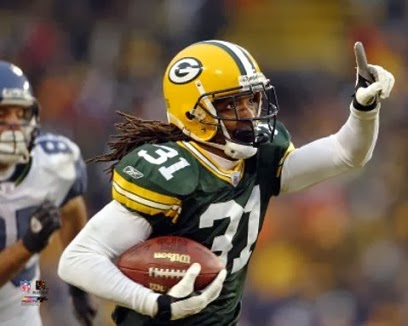


The Packers had the edge in total yards (397 to 340) while the teams were even with 22 first downs apiece. Neither club ran the ball consistently, with Green Bay compiling 78 yards on 32 carries and the Seahawks gaining 49 yards on 21 attempts. There was only one turnover in the game, and it was the game-winning play.

Brett Favre completed 26 of 38 passes for 319 yards and a touchdown with no interceptions. Donald Driver caught 6 passes for 66 yards while Javon Walker gained 111 yards on his 5 receptions. Ahman Green ran for 66 yards on 23 carries, including two TDs and the two big fourth down conversions, and contributed 5 catches for 44 more yards.


For the Seahawks, Matt Hasselbeck (pictured at right) was successful on 25 of 45 throws for 305 yards and no TDs with the one big interception. Shaun Alexander gained just 45 yards on 20 rushing attempts, but had the three short scoring carries. Koren Robinson led the club with 7 catches for 88 yards and Itula Mili had 6 receptions for 62 yards while Bobby Engram gained 83 yards on his four catches.

“This game came down to us making a play at the end,” said Coach Mike Sherman. “It could have gone either way.”

“I’m dying inside,” said Mike Holmgren from the losing side. “It hurts bad to lose this game today.”

The Packers went on to lose a close contest in overtime at Philadelphia in the Divisional round. They repeated as North Division champs in 2004 but lost in the Wild Card playoff game. Seattle had a lesser record at 9-7 but won the NFC West, also falling in the first round.

January 3, 2014

Rookie of the Year: Richmond Webb, 1990

Offensive Tackle, Miami Dolphins


Age: 23
College: Texas A & M
Height: 6’6”   Weight: 291

Prelude:
Although recruited out of high school to play defense, Webb was shifted to offensive tackle and was an All-Southwest Conference selection in 1989. He was chosen by the Dolphins in the first round (ninth overall) of the 1990 NFL draft. The team needed to retool the offensive line and Webb stepped directly into the starting lineup, not missing an offensive down during the regular season.

1990 Season Summary
Appeared in all 16 games

Postseason: 2 G

Awards & Honors:
NFL Rookie of the Year: Sporting News
AFC Rookie of the Year: UPI
2nd team All-AFC: UPI
Pro Bowl

Dolphins went 12-4 to finish second in the AFC East and qualify as a Wild Card team in the postseason while giving up the fewest sacks in the NFL (16). Won AFC Wild Card playoff over Kansas City Chiefs (17-16). Lost AFC Divisional playoff to Buffalo Bills (44-34).

Aftermath:
Webb was named to seven straight Pro Bowls and was also a consensus first-team All-NFL selection in 1992 and ’94, receiving first- or second-team recognition in two other seasons. While it was argued that he lacked the consistency of his rookie season, he was an outstanding pass blocker who protected star QB Dan Marino’s blind side from the left tackle position and had notable success against division-rival Buffalo’s star DE Bruce Smith. After missing two games due to injury in 1991, he didn’t miss another until seven years later, in 1998. With his skills declining from a Pro Bowl level, Webb still was a capable starter and played his last two seasons with the Bengals in 2001 and ’02. An abortive attempt to return to the Dolphins in 2003 ended with his eventual retirement. Overall, Webb played 13 seasons that included a total of 184 regular season games, all but one of which he started.

--


Rookie of the Year Profiles feature players who were named Rookie of the Year in the NFL (including NFC/AFC), AFL (1960-69), or USFL (1983-85) by a recognized organization (Associated Press – Offense or Defense, Newspaper Enterprise Association, United Press International, The Sporting News, or the league itself – Pepsi NFL Rookie of the Year). 

January 2, 2014

1994: Raiders Rally to Beat Broncos in OT and Secure Playoff Spot


The Los Angeles Raiders had a 9-6 record and needed a win to make the postseason as they hosted the Denver Broncos in the season finale on January 2, 1994. Coached by Art Shell, the Raiders were lightly regarded coming into the season and, indeed, were an inconsistent team, capable of beating strong clubs and falling to far weaker ones. QB Jeff Hostetler, in his first year with the team, was a fine addition to the offense and he had a good receiving corps led by WR Tim Brown (pictured above). However, the running game was mediocre and while the defense had solid performers in DE Anthony Smith, DT Chester McGlockton, and CB Terry McDaniel, the unit was prone to giving up points.

Denver, in its first year under Head Coach Wade Phillips, also had trouble running the football but had outstanding 33-year-old QB John Elway and a rising talent in TE Shannon Sharpe. The defense featured a tremendous hybrid pass rushing DE/LB in Simon Fletcher, but was vulnerable against the pass. The Broncos were also 9-6 and had lost to the Raiders in Denver.

It was a hazy but sunny day at the LA Memorial Coliseum with 66,904 fans in attendance. Following a three-and-out possession by the Raiders to start the game, Denver drove 55 yards in 12 plays. John Elway threw to WR Arthur Marshall for 23 yards in a third-and-13 situation and Jason Elam put the Broncos on the board with a 52-yard field goal.

On the Raiders’ next series, RB Randy Jordan fumbled when hit by LB Mike Croel, who recovered at the LA 31. Three plays later, Elway passed to WR Cedric Tillman for a 27-yard touchdown and, with Elam adding the extra point, a 10-0 Denver lead.

Another short Los Angeles possession ended with a punt and the Broncos were driving as the first quarter ended with Elway running for 18 yards on a third-and-10 play. The 11-play series ended with Elam kicking another field goal, this time from 24 yards.


The Raiders put together a scoring series of 82 yards in eight plays. Jeff Hostetler (pictured above) completed four passes, the last to Tim Brown for a four-yard TD. RB Tyrone Montgomery ran the ball three times for 24 yards along the way. Jeff Jaeger added the extra point that cut Denver’s lead to 13-7.

However, the Broncos responded by going 83 yards in seven plays to score once again. Elway threw to Shannon Sharpe for a 54-yard touchdown and Elam added the PAT to again put the Raiders behind by 13 points.

Hostetler completed back-to-back passes to fleet rookie WR James Jett for 22 yards and to Brown for 24 yards to the Denver 31 as Los Angeles advanced 53 yards in eight plays. The series finally stalled at the 25 and Jaeger kicked a 43-yard field goal.

There was a minute remaining in the first half but the back-and-forth nature of the game continued as RB Robert Delpino returned the ensuing kickoff 49 yards to give the Broncos good field position at the LA 43, and they made the most of it. RB Glyn Milburn ran for 13 yards, Elway threw to Sharpe for another 28 yards, and three plays later he connected with Sharpe again from a yard out for a touchdown. Elam added the extra point. The Raiders, in the last 24 seconds, benefited from three Hostetler pass completions that set up a 50-yard Jaeger field goal. Denver led by 27-13 at halftime.

The Broncos took the second half kickoff and put together a nine-play, 71-yard drive to put more points on the board. Elway threw to Sharpe for 21 yards and to WR Kitrick Taylor for another 28. The series stalled at the LA 17 and Elam booted a 27-yard field goal to give the visitors an imposing 17-point lead.

The Raiders fought back as Hostetler completed three passes to Brown that highlighted an 82-yard drive. The first was good for 26 yards to the Denver 45, the second gained 15 yards on a second-and-11 play, and the third covered 24 yards and scored a touchdown. Jaeger’s extra point made it a ten-point game at 30-20.

The Broncos reached the LA 44 before having to punt on their next series. The Raiders opened the fourth quarter with a 52-yard Jeff Gossett punt that pinned the Broncos back at their 15. Denver punted in turn and, with LA getting the better of the field position battle, the Raiders started off at their 49 and advanced 31 yards in seven plays, the biggest of which was a Hostetler to Brown completion that picked up 25 yards. Jaeger kicked a 39-yard field goal and Denver’s lead was down to seven points.

The Broncos had to punt following their next possession and Tom Rouen’s kick was blocked, but the Raiders were unable to move the ball on offense and had to punt it back. Another short series ending with a punt gave the ball to the Raiders at their 30 with just under three minutes left in regulation.

With Montgomery both running and catching the ball, the Raiders reached the Denver 40. Hostetler completed two passes of 13 yards apiece to Brown to reach the 14, and two more short throws picked up another 10 yards. Two more passes fell incomplete, but with eight seconds left Hostetler connected with WR Alexander Wright, who had gotten open when defending CB Charles Dimry fell, for a four-yard touchdown on the 13th play of the series. Jaeger successfully added the all-important extra point, and the fourth quarter ended with the teams tied at 30-30.

The Broncos had the first possession in overtime, and it appeared that they would prevail. Elway threw to Tillman twice, for 20 and 30 yards, and having reached the LA 22, Elam came in to attempt a 40-yard field goal. However, the rookie’s kick sailed wide to the left to give the Raiders a reprieve.

A short carry by Montgomery was followed by Hostetler taking off for a 19-yard gain and, after RB Napoleon McCallum ran for four yards, Hostetler completed a pass to TE Ethan Horton for 20 yards to the Denver 32. Two more runs netted three yards and, after a Hostetler pass was incomplete, Jaeger came in and kicked a 47-yard field goal to give the Raiders a 33-30 win at 7:10 into the extra period.

Denver had more total yards (471 to 398) while Los Angeles had the edge in first downs (24 to 22). The Raiders gave up the only turnover of the contest and the Broncos recorded three sacks, to none by LA.

Jeff Hostetler completed 25 of 41 passes for 310 yards and three touchdowns with none intercepted, and he also ran for 26 yards on two carries. Tim Brown had a big day with 11 catches for 173 yards and two TDs. Tyrone Montgomery (pictured below) paced the ground game with 44 yards on 13 attempts.


For the Broncos, John Elway was successful on 25 of 36 throws for 361 yards, also with three TDs and no interceptions. Shannon Sharpe caught 6 passes for 115 yards and two touchdowns and Cedric Tillman contributed 5 receptions for 91 yards and a score. Robert Delpino ran for 66 yards on 20 carries.

“There have been a lot of great comeback victories in Raider history, and I’ve been involved in a lot of them,” said Coach Art Shell. “But this one stacks up with the best.”

With the win, the Raiders finished second in the AFC West with a 10-6 record, grabbing the first Wild Card spot in the postseason. Denver, at 9-7, ended up third in the division and, thanks to advantageous tiebreakers, also qualified as a Wild Card team. Thus, the two teams met again at the same venue the following week in the Wild Card playoff round and the Raiders again won, this time by a more convincing tally of 42-24. LA lost to Buffalo at the Divisional level.

Tim Brown caught 80 passes for 1180 yards (his first of nine straight thousand-yard receiving seasons) and seven touchdowns. He was selected to the Pro Bowl.


John Elway led the NFL in pass attempts (551), completions (348), and yards (4030) and he topped the AFC in passing (92.8 rating), TD passes (25), and completion percentage (63.2). He also received Pro Bowl recognition. Shannon Sharpe (pictured at right) caught 81 passes for 995 yards and nine touchdowns, not only gaining selection to the Pro Bowl but receiving consensus first-team All-NFL honors for the first time as well.

January 1, 2014

1967: Chiefs Overcome Bills for AFL Championship


The Buffalo Bills, winners of two consecutive American Football League championships, were looking to make it three as they faced the Kansas City Chiefs on January 1, 1967. In this first season since the merger between the NFL and AFL was announced in June of 1966, a further honor would go to the game’s winner, as the champions of the two leagues were to meet for the first time in what was already being unofficially referred to as a “Super Bowl”.

The Bills had won titles in 1964 and ’65 with Lou Saban as head coach, but he had departed and been replaced by Joel Collier for 1966. QB Jack Kemp struggled with a sore arm, but was still an outstanding leader and field general, and the club ran the ball effectively with Rookie of the Year HB Bobby Burnett and FB Wray Carlton. The defense continued to be the team’s bedrock and allowed the fewest points in the AFL. Buffalo topped the Eastern Division with a 9-4-1 record, just beating out the Patriots.

Kansas City, coached by the innovative Hank Stram, had a fine veteran quarterback in Len Dawson (pictured above) and had also benefited from the addition of a talented rookie in the backfield, HB Mike Garrett, the Heisman Trophy winner out of USC. Otis Taylor emerged as an excellent flanker in his second year.  The defense contained all-league performers in DE Jerry Mays, DT Buck Buchanon, LB Bobby Bell, and FS Johnny Robinson. The Chiefs placed first in the Western Division at 11-2-1.

There were 42,080 fans in attendance at War Memorial Stadium on a cold and wet day in Buffalo. Bills DT Dudley Meredith fumbled the short opening kickoff, giving the Chiefs the ball at the Buffalo 29. Three plays later, Kansas City gained the initial advantage when Len Dawson passed to TE Fred Arbanas for a 29-yard touchdown.


Buffalo struck back quickly, however, with Jack Kemp throwing to flanker Elbert Dubenion (pictured at left) for a 69-yard TD. Booth Lusteg’s extra point tied the score at 7-7. The Bills blitzed Dawson heavily, and the KC quarterback was forced to audible often as the game settled into a defensive battle.

Early in the second quarter, Mike Garrett returned a punt to the Buffalo 45 and, following a couple of runs plus a toss to Arbanas (who was knocked out of the game with a shoulder separation on the play), Dawson fired off a pass just before being hit by LB Harry Jacobs that Otis Taylor caught for a 29-yard touchdown. Mike Mercer added his second PAT of the game and the Chiefs were back up by seven points in the second quarter.

On Kansas City’s next series, the Bills missed an opportunity when CB Tom Janik failed to intercept a poorly thrown Dawson pass with open field in front of him at the KC 21. The score remained 14-7 in favor of the visitors.

A key turn of events occurred with time running down in the half. Kemp completed two passes to Bobby Burnett that picked up 50 yards to the KC 12, and seemed to be on the verge of evening the score once again. But two plays later, Kemp’s throw into the end zone intended for split end Bobby Crockett was intercepted by Johnny Robinson, who returned it 72 yards to the Buffalo 28. Mercer kicked a 32-yard field goal with three seconds left on the clock and, instead of the game potentially being tied, the Chiefs went into halftime with a 17-7 lead.


The contest had been competitive in the first half, but the Chiefs took control in the second half, utilizing their running game effectively. Kansas City used the I-formation to good effect, with Mike Garrett (pictured at right) and FB Curtis McClinton lining up directly behind Dawson and not shifting until just before the snap. The third quarter was scoreless as both defenses asserted themselves, with the Chiefs putting particularly heavy pressure on Kemp.

Heading into the fourth quarter, the Chiefs took possession at their 37 and drove 63 yards in seven plays, the biggest one a Dawson throw to split end Chris Burford for 45 yards to the Buffalo four. Garrett plunged for the final yard and the visitors extended their lead to 24-7 with nine minutes remaining.

Buffalo mounted a drive in response but SS Bobby Hunt recovered a fumble by end Glenn Bass, who was hit hard by CB Fred “The Hammer” Williamson, and returned it to the Bills’ 21. Three plays later, Garrett took a handoff, reversed field twice, and broke away for an 18-yard touchdown that clinched the game for the Chiefs.

The Bills fought back, but continued to come up empty. Kemp’s last pass of the game was picked off by DB Emmitt Thomas and Kansas City won by a final score of 31-7.

The Chiefs had the edge in total yards (277 to 255) and first downs (14 to 9) in what was largely a defensive struggle. Buffalo recorded nine sacks, to four by Kansas City, but the Bills turned the ball over four times, to none by KC.

Len Dawson completed 16 of 24 passes for 227 yards and two touchdowns with no interceptions, and ran the ball five times for 28 yards. Otis Taylor had 5 catches for 78 yards and a TD and Chris Burford contributed 76 yards on his four receptions. Mike Garrett rushed for 39 yards on 13 carries that included the two fourth quarter touchdowns and also caught four passes for 16 yards. Curtis McClinton added 38 yards on 11 rushing attempts.


For the Bills, Jack Kemp was successful on 12 of 27 throws for 253 yards and a TD while giving up two interceptions. Wray Carlton ran for 31 yards on 9 carries and while Bobby Burnett (pictured at left) gained only six yards on three running attempts, he caught 6 passes for 127 yards. Elbert Dubenion, with the long early TD, had 79 yards on his two pass receptions.

“Our game plan was to throw first and run second, and we used 10 to 12 formations off the I,” explained Coach Hank Stram.

“Our new formation really fooled them,” added Len Dawson. “Buffalo is a great team at reading regular formations. They seem to know where every play is going and this can kill you. But today we fooled them.”

Two weeks later, the Chiefs met the NFL Champion Green Bay Packers in what was officially dubbed the AFL-NFL World Championship Game, but would retroactively be called Super Bowl I. Kansas City kept it close for a half before the Packers asserted their dominance and won by a 35-10 score. The Chiefs dropped to second place in the Western Division with a 9-5 record in 1967, but tied for first in ’68 and won the last AFL title (as well as Super Bowl IV) in 1969.

The loss in the AFL Championship game marked the end of an era for Buffalo. The Bills, despite efforts to retool the roster through trades, dropped to 4-10 in ’67. They would not post another winning record until 1973 and next appeared in a postseason game in ’74. 

December 31, 2013

1972: Griese Leads Dolphins to Win Over Steelers for AFC Championship


The Miami Dolphins had gone undefeated through the regular season and were looking to move on to the Super Bowl as they faced the Pittsburgh Steelers for the AFC Championship on December 31, 1972. The Dolphins had immediately benefited from the arrival of Don Shula as head coach in 1970, reaching the playoffs in each of his first two seasons and topping the AFC in ’71. It seemed as though they would be in trouble when star QB Bob Griese (pictured above) went down with a broken ankle in the fifth game, but 38-year-old backup Earl Morrall stepped in and the club kept winning. The ball control offense set a league record with 2960 rushing yards and bulldozing FB Larry Csonka and fleet HB Eugene “Mercury” Morris both reached the thousand-yard mark. When the Dolphins needed to go to the air, WR Paul Warfield was one of the best deep threats in the league. The “No-Name” defense in reality had plenty of outstanding players, including pass rushing ends Bill Stanfill and Vern Den Herder, MLB Nick Buoniconti, and the excellent safety tandem of Dick Anderson and Jake Scott. After going 14-0, Miami won a tough AFC Divisional battle over the Browns to reach the conference title game.

The Steelers, coached by Chuck Noll, were an up-and-coming club that was in the postseason for the first time since 1947. After going 11-3 during the regular season to top the AFC Central, Pittsburgh won a hard-fought Divisional round game over the Raiders thanks to an astonishing play – the “Immaculate Reception” – scored by FB Franco Harris. Harris had rushed for 1055 yards as a rookie while third-year QB Terry Bradshaw continued his development. The defense was especially strong, with an outstanding line anchored by DT “Mean Joe” Greene, a fine pair of outside linebackers in Jack Ham and Andy Russell, and a group of backs that included a rising star in CB Mel Blount. A source of concern coming into the game, however, was that several of the players were battling the flu, including Bradshaw.

There were over 50,000 fans in attendance at Three Rivers Stadium on a 63-degree day in Pittsburgh. The Dolphins had the first possession and it ended with SS Glen Edwards intercepting an overthrown Earl Morrall pass that he returned 28 yards to the Miami 48. Pittsburgh moved methodically in ten plays, with Franco Harris carrying on the first four and seven times overall for 35 yards. Facing third-and-two at the Miami three, Terry Bradshaw ran around left end but fumbled into the end zone when hit by Jake Scott. OT Gerry Mullins recovered for a touchdown and, with Roy Gerela adding the extra point, the Steelers had the early 7-0 lead. However, Bradshaw was shaken up on the play and Terry Hanratty came in at quarterback when Pittsburgh next had the ball.

The teams exchanged punts and, as the first quarter ended, the Dolphins had a first down at their 46 after a Morrall throw to TE Marv Fleming picked up 15 yards. The series stalled at the Pittsburgh 42, but Larry Seiple, lined up to punt, caught the Steelers napping and instead took off and ran 37 yards to the 12 (pictured below). Two plays later, Morrall threw to Larry Csonka for a nine-yard TD and Garo Yepremian added the extra point to tie the score. Neither team was able to get out of its end of the field for the remainder of the half as they traded punts and failed at connecting on long passes. The score remained 7-7 at the half.


Pittsburgh took the second half kickoff and drove into Miami territory. On third-and-13, Hanratty completed a pass to TE John McMakin for 22 yards and followed up with a throw to WR Ron Shanklin for 24 yards to the Miami 37. The Steelers got another big gain, this time on a draw play as HB John “Frenchy” Fuqua ran for another 24 yards. The series finally stalled at the seven and Gerela booted a 14-yard field goal to put Pittsburgh back in front by 10-7.

When the Miami offense came on the field, Bob Griese was at quarterback, making his first appearance since suffering the injury in Week 5. After two short running plays, Griese went to the air and connected with Paul Warfield for a 52-yard gain to the Pittsburgh 24. The Dolphins got a huge break when LB Jack Ham intercepted a pass that was nullified by an offside penalty on the Steelers. The series continued and ended after 80 yards and 11 plays with HB Jim Kiick taking a pitchout and running two yards for a touchdown. Yepremian added the PAT and Miami was on top by 14-10.

The teams exchanged punts to finish off the third quarter. Pittsburgh had good field position to start the final period at the Miami 48 following a 33-yard Seiple punt. Harris ran for seven yards but then Hanratty threw two incomplete passes and a 48-yard field goal attempt by Gerela was blocked.

Taking over at the Pittsburgh 49, the Dolphins put together another scoring drive. Griese passed just once in the 11-play possession, as Csonka, Kiick, and Mercury Morris carried the load. Kiick again finished off the drive with a three-yard touchdown carry and Yepremian’s extra point made Miami’s lead 21-10.

Terry Bradshaw was back behind center for the Steelers as they took possession at their 29 following the kickoff. He wasted no time moving the team down the field, completing a nine-yard pass to TE Larry Brown and following up with consecutive 25-yard completions to WR Al Young and Shanklin. The fourth play was a 12-yard TD pass to Young and Gerela’s conversion cut the Miami lead to four points.

The Dolphins went three-and-out on their next series and had to punt. Bradshaw was tossed for a nine-yard loss, threw an incomplete pass, and then was intercepted by Nick Buoniconti. Miami was able to run the clock down to 48 seconds, turning the ball over on downs at the Pittsburgh nine. Two plays later, LB Mike Kolen intercepted Bradshaw’s last-gasp pass and the Dolphins were winners by a score of 21-17.

Miami had the edge in total yards (314 to 250), with 193 of that total coming on 49 running plays, and first downs (19 to 13). The Dolphins also recorded the only two sacks of the game on defense. The Steelers turned the ball over twice, late in the contest, while Miami suffered the one early turnover.


Bob Griese completed three of five passes for 70 yards with no touchdowns or interceptions after relieving Earl Morrall, who was 7-of-11 for 51 yards with a TD and an interception. Mercury Morris led the ground attack with 76 yards on 16 carries while Larry Csonka contributed 68 yards on 24 attempts and also scored on his one catch. Jim Kiick (pictured above) gained just 12 yards on 8 carries, but two were good for TDs. Marv Fleming caught 5 passes for 50 yards and Paul Warfield, thanks to his one long reception on Griese’s first throw, gained 63 yards on his two catches.

For the Steelers, both Terry Bradshaw and Terry Hanratty were successful on 5 of 10 passes, with Bradshaw tossing for one TD while giving up the two late interceptions while Hanratty’s completions gained 57 yards. Franco Harris ran for 76 yards on 16 attempts. Al Young was the team’s top receiver with four catches for 54 yards and a touchdown.

Miami, with Bob Griese starting at quarterback, went on to crown its undefeated season with a win in the Super Bowl over the Washington Redskins. The Dolphins won a third consecutive AFC Championship in 1973 and again won the Super Bowl. The Steelers were a 10-4 Wild Card team in ’73, losing to Oakland in the Divisional playoff round, but would succeed Miami as the NFL’s top team with back-to-back Super Bowl victories in 1974 and ’75.

December 30, 2013

MVP Profile: Priest Holmes, 2002

Running Back, Kansas City Chiefs


Age: 29 (Oct. 7)
6th season in pro football, 2nd with Chiefs
College: Texas
Height: 5’9”   Weight: 205

Prelude:
Holmes was undrafted coming out of college and signed as a free agent with the Baltimore Ravens for 1997. He spent his rookie year on special teams but got an opportunity to move into the starting lineup during the ’98 season and gained 1008 rushing yards, including 227 in a single game, while also catching 43 passes for another 260 yards. Inconsistency and a knee injury cut into Holmes’ playing time in 1999 and there were concerns that he lacked adequate size to fit in a power-running attack. The arrival of rookie RB Jamal Lewis in 2000 relegated Holmes to a backup role and he contributed 588 rushing yards to Baltimore’s Super Bowl-winning season. Cast off by the Ravens, he moved on to the Chiefs as a free agent for 2001 and, proving to be a good fit in the offense with his skill as both a runner and receiver, rushed for a NFL-leading 1555 yards and, with another 614 yards on 62 pass receptions, also led the league with 2169 all-purpose yards. He received consensus-first team All-NFL honors as well as being selected to the Pro Bowl.

2002 Season Summary
Appeared and started in 14 of 16 games
[Bracketed numbers indicate league rank in Top 20]

Rushing
Attempts – 313 [7]
Most attempts, game - 31 (for 104 yds.) vs. Buffalo 11/17
Yards – 1615 [3]
Most yards, game – 197 yards (on 23 carries) at Seattle 11/24
Average gain – 5.2 [6]
TDs – 21 [1]
100-yard rushing games – 9

Pass Receiving
Receptions – 70      
Most receptions, game – 9 (for 81 yds.) at NY Jets 10/6
Yards – 672
Most yards, game - 110 (on 7 catches) at Seattle 11/24
Average gain – 9.6
TDs – 3
100-yard receiving games – 1

Passing
Attempts – 1
Completions – 0
Yards – 0
TD passes – 0
Interceptions – 0

All-Purpose yards – 2287 [2, 1st in AFC]

Scoring
TDs – 24 [1]
Points – 144 [1]

Awards & Honors:
NFL Offensive Player of the Year: AP
1st team All-NFL: AP, PFWA, Sporting News
1st team All-AFC: Pro Football Weekly
Pro Bowl

Chiefs went 8-8 to finish fourth in the AFC West while leading the NFL in scoring (467 points) and touchdowns (57).

Aftermath:
Holmes missed the last two games of the 2002 season with a hip injury, but following off-season surgery he had another big year in 2003. He rushed for 1420 yards, caught a career-high 74 passes for 690 yards, and broke the NFL single-season record for touchdowns with 27. He was a consensus first-team All-NFL and Pro Bowl selection for the third straight year. Holmes was off to another fine year in 2004 before a knee injury felled him halfway through – he was leading the league in rushing (892 yards) and TDs (14) before being shelved after eight games. A spinal injury limited him to seven games in ’05 and he missed all of 2006. Holmes returned during the 2007 season and appeared in four games before a neck injury forced his retirement. Overall, Holmes rushed for 8172 yards on 1780 carries (4.6 avg.) and caught 339 passes for 2962 yards, scoring a total of 94 touchdowns.

--


MVP Profiles feature players who were named MVP or Player of the Year in the NFL, AAFC (1946-49), AFL (1960-69), WFL (1974), or USFL (1983-85) by a recognized organization (Associated Press, Pro Football Writers Association, Newspaper Enterprise Association, United Press International, The Sporting News, Maxwell Club – Bert Bell Award, or the league itself). Also includes Associated Press NFL Offensive and Defensive Players of the Year.

[Updated 11/30/14]

December 29, 2013

1979: Bucs Beat Eagles for First Postseason Win


The Tampa Bay Buccaneers had been a source of derision when they debuted at 0-14 in 1976, but three years later the laughter subsided as the Bucs rode a 6-0 start to an overall record of 10-6, placing them atop the NFC Central. On December 29, 1979 they faced the Philadelphia Eagles in the first postseason game in franchise history.

Coached by John McKay, the Buccaneers featured the league’s best defense, both overall and against the pass. Utilizing a 3-4 alignment, the solid unit was anchored by formidable DE Lee Roy Selmon. The ball-control offense operated behind a good line, which was a big help to second-year QB Doug Williams as well as FB Ricky Bell (pictured above), who rushed for 1263 yards. Still, there was a perception that Tampa Bay had taken advantage of a relatively easy schedule and not much was expected in the postseason.

The Eagles were in the playoffs for the second straight year under Head Coach Dick Vermeil, having placed second in the NFC East with an 11-5 tally and securing a Wild Card spot. Ever-improving QB Ron Jaworski directed the attack that featured HB Wilbert Montgomery and WR Harold Carmichael. The defense had lost star ILB Bill Bergey to a knee injury but benefited from the arrival of rookie OLB Jerry Robinson. Philadelphia had rallied past the Bears in the first playoff round to earn the trip to Tampa for a NFC Divisional playoff game.

It was a sunny and pleasant day at Tampa Stadium with a sellout crowd of 72,126 in attendance. The Buccaneers set the tone with their first possession, driving 80 yards in 18 plays. Doug Williams completed passes to TE Jim Giles for 18 and 16 yards and Ricky Bell ran the ball effectively. It was Bell sweeping around end from four yards out for a touchdown that finished the series and, with Neil O’Donoghue’s extra point, the home team was ahead by 7-0.

The teams traded punts before the Eagles mounted a threat during a possession that extended into the second quarter. While facing a heavy pass rush, Ron Jaworski still managed to complete a throw to TE Keith Krepfle for 12 yards on a third-and-11 play, but when the series stalled and the Eagles lined up for a field goal attempt while facing fourth-and-four at the Tampa Bay 30, holder John Sciarra took off on a fake for a seven-yard gain, only to have it called back due to a delay-of-game penalty. With the ball set back five yards, Tony Franklin tried to kick a field goal for real from 52 yards and it fell short.

The Bucs followed up with a 10-play, 43-yard drive. On second-and-12, Williams threw to WR Larry Mucker for 34 yards to the Philadelphia 33. After Bell and HB Jerry Eckwood carried the ball for a total of nine yards, Bell converted a fourth-and-one with a five-yard run. Two plays later, Williams connected with WR Isaac Hagins for 26 yards. A holding penalty backed Tampa Bay up and a pass to Giles in the end zone was controversially ruled incomplete due to the receiver not having control of the ball before stepping out of bounds. O’Donoghue kicked a 40-yard field goal and the Buccaneers still increased their lead to 10-0.

The Bucs got a break when Wilbert Montgomery fumbled at his own five yard line and MG Randy Crowder recovered. It took four plays, but Bell blasted into the end zone from a yard out on fourth-and-goal and, with O’Donoghue’s kick, the score was 17-0. Philadelphia appeared in danger of being routed.

Following a short series and punt, the Eagles got a big defensive play when Jerry Robinson intercepted a Williams pass and returned it 37 yards to the Tampa Bay 11 with 1:37 left in the half. Two plays later, Jaworski threw to WR Charlie Smith for an 11-yard TD and, with Franklin adding the PAT, the score was 17-7 at halftime.

Philadelphia further narrowed the Bucs’ lead with the first possession of the third quarter. A long completion to Harold Carmichael was nullified by a clipping penalty, but with Montgomery running for 20 yards on three carries, the Eagles reached the Tampa Bay 25 and Franklin booted a 42-yard field goal that made it a seven-point game.

After an exchange of punts, the Eagles again advanced into Tampa Bay territory thanks to a Jaworski-to-Montgomery pass completion that gained 30 yards. But after reaching the 38, Lee Roy Selmon sacked Jaworski on back-to-back plays for a total loss of 20 yards and Philadelphia had to punt.


Heading into the fourth quarter, both teams went three-and-out and punted before the Bucs put together a critical scoring drive of 57 yards in nine plays. Bell had a 26-yard run on a third-and-two play and Williams converted a third-and-four situation by rolling out and keeping the ball himself for an eight-yard gain to the Philadelphia nine. From there, Williams rifled a throw to Giles (pictured above) for a touchdown and, adding on the extra point, the Buccaneers had a formidable a 14-point lead.

With seven minutes left to play, Jaworski filled the air with passes on the next series. A pass interference penalty picked up 20 yards and a fourth-and-five throw to Krepfle was good for six yards. The Eagles converted another fourth down when Jaworski connected with Smith for 13 yards and then a pass to Carmichael resulted in a 37-yard touchdown. Franklin’s conversion made it a seven-point game once more.

The Eagles attempted an onside kick that went out of bounds, but the rookie placekicker Franklin chose to try again and the second kick was recovered by the Buccaneers and gave them possession at their own 48 – much to the fury of Coach Vermeil, who had instructed Franklin to kick deep. The Bucs punted, but the Eagles had to start deep in their territory for one last opportunity with the clock down to 2:11. Jaworski threw to Carmichael for 16 yards and, on fourth-and-15, to Smith for 25 yards to the Tampa Bay 45. But that was as far as the visitors could get. Heavily pressured by the inspired defense on each play, Jaworski threw four straight incomplete passes and the Buccaneers were winners by a final score of 24-17.

Tampa Bay had the edge in total yards (318 to 227) and first downs (17 to 15). The Bucs ground out 186 yards of their total on 55 running plays, while the Eagles managed just 48 yards on 18 attempts. Each team turned the ball over once. The Tampa Bay defense was fired up and displayed uncharacteristic emotion throughout the game.


Ricky Bell rushed for 142 yards and two touchdowns, setting a NFL playoff record with 38 carries (broken by Lamar Smith of the Dolphins in 2000). Doug Williams went to the air just 15 times and, while he had only 7 completions, they were good for 132 yards and a TD, with one interception. He also ran the ball 6 times for 19 yards. Jim Giles was Tampa Bay’s top receiver with three catches for 43 yards and a touchdown. Lee Roy Selmon (pictured above, closing in on Ron Jaworski) had the two key sacks on defense and, along with DE Wally Chambers, was consistently disruptive.

For the Eagles, Ron Jaworski was successful on a mere 15 of 39 throws for 199 yards and two touchdowns with none intercepted. Wilbert Montgomery had 35 yards on 13 carries and gained another 35 yards on his team-leading four pass receptions. Harold Carmichael contributed 92 yards on his three catches that included a TD.

The Bucs hosted the NFC Championship game against the Rams, where the run ended in a 9-0 defeat. They dropped to 5-10-1 in 1980, but returned to the postseason in ’81. Philadelphia recovered to go 12-4 in 1980 and reach the Super Bowl, falling to the Raiders.