December 4, 2014

1966: Concannon Runs, Passes Eagles to Win Over Steelers


The Philadelphia Eagles were 6-5 and trying to put together their first winning season in five years as they hosted the Pittsburgh Steelers on December 4, 1966. Head Coach Joe Kuharich’s team had a fine offensive line anchored by OT Bob Brown and good group of running backs that included HB Timmy Brown and up-and-coming FB Tom Woodeshick. The passing game was a problem, however, as QB Norm Snead, typically the starter, was enduring a dreadful season. One of the other two quarterbacks, King Hill, led the team to a win at San Francisco the previous week, but now it was Jack Concannon (pictured at right) getting the call at home against Pittsburgh.

Concannon, a star at Boston College, was Philadelphia’s second-round draft choice in 1964 and had received a big contract to keep him away from the Patriots of the AFL.  Buried behind Snead and Hill on the depth chart, he saw little action but started one game against the Cowboys late in his rookie season and provided plenty of excitement with his flashy running ability, while throwing for 134 yards and two TDs in a win. That performance made him the backup most chanted for when the offense was performing badly, but being a fan favorite didn’t guarantee him playing time. He saw scant playing time in 1965 and Coach Kuharich tried him as a halfback, flanker, and punt returner during the ’66 season before finally giving him another starting shot at quarterback.

The Steelers, under the guidance of first-year Head Coach Bill Austin, were 3-7-1 and also had a change at quarterback. Bill Nelsen, having missed nine games due to a knee injury, was back behind center. But while there were good receivers, most notably flanker Gary Ballman, the line was inadequate and, other than FB Willie Asbury, the backs unimpressive. The defensive line was a strong point, and was a reason for Jack Concannon to get the starting assignment at quarterback for the Eagles because Coach Kuharich believed that his mobile, rollout style would match up well against it.

There were 54,275 fans in attendance at Franklin Field. The Steelers had first possession and punted and the Eagles, starting from their 30 yard line, drove 42 yards. Jack Concannon set the tone when, on a third-and-seven play, he took off and ran for 18 yards. He also had a five-yard carry and completed a pass to Tom Woodeshick that picked up 11 yards and set up a 35-yard field goal by Sam Baker.


Pittsburgh responded by advancing into Philadelphia territory, the big gain being a 45-yard carry to the ten yard line by Willie Asbury on a draw play. But Bill Nelsen was sacked for a loss of 14 yards by DE Gary Pettigrew (pictured at left) in between tossing two incomplete passes, and Mike Clark was unsuccessful on a 31-yard field goal attempt.

The Eagles turned the ball over on the next possession when Timmy Brown fumbled a handoff and DE Ben McGee recovered to give the Steelers the ball at the Philadelphia 19. In a series that stretched into the second quarter, Pittsburgh scored when Asbury ran seven yards for a touchdown and, adding Clark’s extra point, the visitors held a 7-3 lead.

Philadelphia again turned the ball over in its own territory when Concannon fumbled as he was hit by LB Andy Russell and safety Paul Martha recovered at the 34. The result was a 37-yard Clark field goal that extended Pittsburgh’s lead to 10-3.

The Eagles came back with an 80-yard drive in 11 plays. Concannon completed three passes and twice scrambled for sizable gains. An 11-yard completion to split end Fred Hill converted a third-and-ten situation, an 11-yard scramble led to another first down, and a 29-yard run on a third-and-six play advanced the ball to the Pittsburgh 25. Concannon threw to Brown for a 17-yard gain that converted yet another third down and set up a three-yard touchdown carry by Woodeshick. Baker converted to tie the score.

With just over two minutes to play in the first half, the Eagles took advantage of a turnover when Nelsen fumbled and LB Dave Lloyd recovered at the Pittsburgh 25. Concannon had runs of six and eight yards, but when he was finally thrown for a loss on third down, Philadelphia settled for a 22-yard Baker field goal.

There was still enough time for the Steelers, and Nelsen drove them down the field with completions of 11 yards to HB Dick Hoak, 18 yards to Gary Ballman, and 22 yards to Hoak. Clark kicked a 32-yard field goal on the last play before halftime and the score was tied at 13-13 at the intermission. Concannon had accounted for 47 passing yards and 77 by rushing.

The teams traded punts to start the third quarter until Pittsburgh put together a scoring possession. The big gain came on a Nelsen throw to Ballman for 26 yards to the Philadelphia 28 and, while the Steelers could get no further, they came away with another field goal by Clark, this time from 35 yards.

The Eagles responded by advancing 70 yards in 11 plays. Concannon completed passes to flanker Ron Goodwin for 29 yards and Hill for 11, and ran three times for 21 yards. Woodeshick ran the last yard for a TD and Baker’s PAT put the home team on top by 20-16.

Asbury fumbled on Pittsburgh’s next play from scrimmage and Pettigrew recovered at the Steelers’ 30. As the period wound down, Concannon scrambled for a 16-yard gain and completed a pass to Timmy Brown for eight more. On the fourth play of the fourth quarter, Concannon scored from a yard out on a quarterback sneak and Baker added the point after to put the Eagles up by 27-16.

The Steelers came right back as Ballman returned the ensuing kickoff 42 yards and Nelsen immediately went to the air and connected with flanker Roy Jefferson for 43 yards to the Philadelphia four. Asbury ran for a two-yard touchdown three plays later, Clark converted, and Philadelphia’s lead was narrowed to four points.

The teams exchanged punts and, with time running short for the Steelers as they took over possession on their own 47, Nelsen threw an incompletion, Asbury was stopped for no gain on a draw play, Ballman dropped a pass, and a fourth-down throw was also incomplete to turn the ball over on downs. Pittsburgh got one more shot following another Philadelphia punt, but a penalty and a sack by LB Harold Wells forced them into a deep hole from which they couldn’t escape. The Eagles won by a final score of 27-23.

Philadelphia led in total yards (304 to 250) and first downs (19 to 15). The Eagles also recorded four sacks, to one by Pittsburgh. Each team turned the ball over twice.

Jack Concannon completed 13 of 25 passes for 131 yards with no touchdowns, but also with none intercepted, but made an even bigger impression with his running as he gained 129 yards on 15 carries that included a TD. Tom Woodeshick gained 46 yards on 19 attempts with two short touchdowns and he also picked up 28 yards on three pass receptions. Timmy Brown, who ran for only five yards on nine carries, led the club with 5 catches for 43 yards.


For the Steelers, Bill Nelsen was successful on 11 of 25 throws for 195 yards, also throwing no TD passes or interceptions. Gary Ballman caught 6 passes for 93 yards and averaged 27.3 yards on four kickoff returns. Willie Asbury (pictured above) ran for 70 yards on 14 attempts that included two TDs.

“I ran a bit more today than I want to, and I hope I don’t have to do that again,” said Jack Concannon. “My timing was off from rustiness and our running attack wasn’t working the way I hoped that it would, so I ran more than a quarterback should.”

“We let Concannon go wide on us a couple of times and he hurt us each time,” said Coach Austin of the Steelers. “We didn’t get our people up quick enough to contain the rollouts.”

The Eagles won again the next week against the Browns, with Concannon again leading the way at quarterback, but it was King Hill behind center when they beat Washington in the finale to make it four straight victories to finish out the season. Philadelphia’s final record was 9-5, which was good for a second place tie with the Browns in the Eastern Conference and a spot in the Playoff Bowl, the postseason exhibition game that pitted the runners-up in each conference. They lost to the Colts with Hill and Concannon at quarterback. Pittsburgh also finished on a high note, scoring a combined 104 points behind the good play of Bill Nelsen in beating the Giants and expansion Falcons. The Steelers ended up sixth in the conference at 5-8-1.

Jack Concannon was traded to the Bears in the offseason. In three years with the Eagles, he completed just 43.7 percent of his 103 passes for 637 yards and four touchdowns against eight interceptions. However, he ran for 433 yards on 50 carries, averaging 8.7 yards per attempt and scoring two TDs. The team was 3-0 in his starts and the 129 rushing yards against the Steelers remained the single-game record for a Philadelphia quarterback until 2010, withstanding the presence of far more accomplished mobile Eagles quarterbacks over the years like Randall Cunningham and Donovan McNabb before it finally was exceeded by Michael Vick.

December 3, 2014

1989: Johnson Gains 248 Receiving Yards as Lions Defeat Saints


WR Richard Johnson (pictured above) had been a star for two seasons with the Houston Gamblers of the United States Football League, twice leading the Spring league in pass receptions, but, other than a brief stint with the Washington Redskins, drew little interest from the NFL after the USFL folded.  There were concerns about his lack of size (5’7”, 172) and speed, but the Detroit Lions finally gave him a tryout in 1989 thanks to the arrival of Darrel “Mouse” Davis as offensive coordinator, who had held the same post in Houston. Johnson made the team and, on December 3, 1989, had an especially noteworthy performance against the New Orleans Saints.

The Lions were struggling at 2-9 under Head Coach Wayne Fontes. Another, more heralded newcomer, rookie RB Barry Sanders, was outstanding, and NT Jerry Ball and LB Chris Spielman were having an impact on defense. But QB Rodney Peete was suffering through an injury-plagued season and, while journeyman Bob Gagliano was familiar with Davis’ run-and-shoot offense, but was no better than a fill-in. Johnson was the best of a receiving corps that was less than exceptional.  

New Orleans had a 6-6 record and was trying to remain in the playoff hunt. Coached by Jim Mora, the Saints had gotten off to a 1-4 start before winning five of six games, but had lost in overtime the previous week. QB Bobby Hebert was going through a rough patch, although RB Dalton Hilliard was filling in well for the injured Reuben Mayes. On defense, the corps of linebackers was outstanding and the Saints had the NFL’s number one rushing defense, but defending against the pass was problematic.

There were 38,550 fans in attendance at the Pontiac Silverdome. The teams exchanged punts until the Lions put together a nine-play, 70-yard drive. Rodney Peete completed passes to Richard Johnson for 27 yards and WR Walter Stanley for 37, and it was the quarterback keeping the ball and running six yards to score a touchdown. Ed Murray added the extra point.

On the first play following the ensuing kickoff, Bobby Hebert threw to TE Hoby Brenner, who fumbled and LB Dennis Gibson recovered for the Lions. But two plays later, a high pass by Peete was intercepted by CB Robert Massey, who returned it 22 yards to the New Orleans 47. It led to a three-and-out series followed by a punt, but the Saints again quickly regained possession when Peete fumbled a snap and LB Pat Swilling recovered at the Detroit 34. As the opening period came to an end, New Orleans was moving methodically down the field and, two plays into the second quarter Dalton Hilliard ran for a one-yard TD. Morten Andersen tied the score with the PAT.


The Lions moved swiftly down the field on their next series, advancing 82 yards in five plays as Peete completed passes to Johnson that covered 46 and 36 yards. Barry Sanders broke three tackles on the way to a three-yard touchdown and, with Murray’s conversion, Detroit was back in the lead by 14-7. But RB Bobby Morse returned the kickoff 99 yards, Andersen kicked the extra point, and once again the score was knotted at 14-14.

After the swift exchange of scores, the teams reverted to trading punts. The Saints reached the Detroit 31 with 18 seconds remaining in the first half, but Andersen was wide to the right on a 48-yard field goal attempt and the tally remained unchanged at halftime.

Peete suffered a knee injury when sacked on the second play of the third quarter and Bob Gagliano replaced him. Neither team was able to move the ball as they exchanged punts until, with the ball at their 25, the Lions came through with a big play. Gagliano threw short to Johnson at the left sideline, and he ran the distance for a 75-yard touchdown. Murray again converted and the home team was back in the lead by seven points.

There was another exchange of punts before the Saints advanced into Detroit territory. Hilliard started off with a ten-yard carry that had another 15 yards added to it due to an unnecessary roughness penalty. Hilliard continued to run well and Hebert completed two passes, New Orleans having reached the Detroit 14 as the period ended. But after getting to the seven in the early moments of the fourth quarter, Hebert had a pass batted away in the end zone by CB Jerry Holmes, who nearly picked it off, and on the next throw Holmes succeeded, just keeping his feet inbounds as he came down with the ball.

Gagliano threw to Johnson for 33 yards on the next play, but the Lions had to punt after reaching their 47. Once again the teams kicked punts back and forth. John Fourcade replaced Hebert at quarterback for the Saints, and while he completed his first two passes to Brenner for 20 yards and Hilliard for nine, the result was the same as New Orleans couldn’t get out of its end of the field.

Tommy Barnhardt’s punt gave the ball to the Lions at their 32 with 4:11 remaining in regulation. They never gave the ball up as Gagliano completed passes of 11 and 19 yards to WR Jason Phillips for first downs and, in a third-and-eight situation with still over a minute remaining, Sanders took a handoff, started to his left, changed direction, and ran 27 yards to effectively seal the 21-14 win for Detroit.      

The Lions led significantly in total yards (401 to 169) and first downs (17 to 11), although New Orleans had the longer time of possession (33:47 to 26:13). Both teams turned the ball over twice, but Detroit was penalized 10 times, at a cost of 75 yards, while just three flags were thrown on the Saints. New Orleans also recorded four sacks, to three by the Lions.

Richard Johnson had a huge performance with 8 catches for 248 yards that included the one long touchdown. Barry Sanders rushed for 72 yards on 20 carries that included a TD. Rodney Peete completed 8 of 18 passes for 177 yards and was intercepted once while Bob Gagliano was 6-of-13 for 166 yards and a touchdown while giving up no interceptions. On defense, Jerry Holmes intercepted a pass for the fourth straight game.


For the Saints, Bobby Hebert was successful on 16 of 26 throws, but for just 99 yards with no TDs and one interception. Dalton Hilliard (pictured at right) gained 67 yards on 18 rushing attempts that included a score and also caught 6 passes for 31 yards. Hoby Brenner gained 48 yards on his four pass receptions.

“It seemed like a dream,” said Richard Johnson of his performance. “I’m just so excited it happened to me. I knew I had the ability to play in this league. I just had to get the opportunity.”

The win for Detroit was the second of five straight to close out the season. The Lions ended up third in the NFC Central with a 7-9 record. For the Saints, the loss effectively ended their hopes for a Wild Card playoff spot, although with John Fourcade starting at quarterback, they won their last three games to end up at 9-7 and in third place in the NFC West.

Richard Johnson led the Lions with 70 catches for 1091 yards (15.6 avg.) and eight touchdowns. Barry Sanders received the greater acclaim for his NFC-leading 1470 yards on 280 carries (5.3 avg.) and 14 TDs. He was not only a consensus Rookie of the Year but a first-team All-NFL and Pro Bowl selection as well.

Dalton Hilliard went over a thousand yards rushing for the season with his performance against the Lions, and he finished with 1262 yards on 344 attempts (3.7 avg.) and caught 52 passes for 514 more yards (9.9 avg.). He led the NFL in touchdowns (18) and the NFC in yards from scrimmage (1776) and was named to the Pro Bowl.

December 2, 2014

1991: Eagles Dominate on Defense to Stifle Oilers in “House of Pain Game”


The NFL Monday night game on December 2, 1991 featured the team with the best defense in the league, the Philadelphia Eagles, visiting the club with the second-most-productive offense, the Houston Oilers.

Philadelphia was coached by Rich Kotite, who had replaced Buddy Ryan, the architect of the defense, the previous offseason, and the unit was now under the tutelage of defensive coordinator Bud Carson. The line, anchored by DE Reggie White and including DE Clyde Simmons and DT Jerome Brown, was the key to the defense’s success, but there was plenty of talent at linebacker and in the defensive backfield as well. The offense was far less impressive, however, in particular after losing star QB Randall Cunningham to a season-ending knee injury in the first game of the season. Backup QB Jim McMahon was talented but brittle, and when he was forced to the sidelines, the team floundered with the likes of Brad Goebel and Pat Ryan in his place. But after dropping to 3-5, the Eagles caught fire and won four straight games to come into the contest in Houston with a 7-5 record and a shot at the playoffs.

The high-flying Oilers, coached by Jack Pardee, were 9-3 and adept at rolling up offensive yards, especially at home in the Astrodome, which was thus dubbed “the House of Pain”. QB Warren Moon was a prolific passer in the team’s run-and-shoot attack and had a capable receiving corps. Philadelphia’s approach to stopping the offense was to use a 4-2-5 defense, dropping a linebacker and adding an extra defensive back on most downs.

There were 62,141 fans in attendance for the nationally televised game at the Astrodome. The Oilers had the first possession and, on the second play, turned the ball over when Warren Moon fumbled and LB Byron Evans recovered at the Houston 33. However, the Eagles were unable to capitalize as Jim McMahon threw two incomplete passes and, in between, was sacked by DE William Fuller for a loss of 11 yards. Forced to punt, they buried the Oilers deep in their own territory.

The teams exchanged punts before Houston, starting from its 20, drove into Philadelphia territory, helped along by a pass from Moon to WR Ernest Givins that gained 20 yards. However, WR Haywood Jeffires fumbled when hit hard by SS Andre Waters following a catch for a short gain. LB Seth Joyner (pictured at top) recovered and returned it to the Philadelphia 48.

The teams again traded punts, with neither offense able to move effectively. As the scoreless game headed into the second quarter, McMahon completed three passes, the longest to WR Roy Green for a pickup of 22 yards, to reach the Houston 31. But FS Bo Orlando intercepted the next throw to end the threat. Philadelphia’s aggressive defense continued to thwart Houston’s passing attack, forcing a punt and, when the Oilers, benefiting from improved field position on the exchange of kicks, reached the Philadelphia 36, the Eagles forced another turnover. Joyner jarred the ball loose from RB Allen Pinkett and DE Clyde Simmons recovered.

The exchange of punts continued until the Oilers, taking possession with 57 seconds remaining in the first half, advanced 33 yards in seven plays. Moon completed passes to Pinkett for 13 yards and Givins for 15 to set up a 42-yard field goal by Al Del Greco on the last play before halftime. Houston led by 3-0 at the intermission.


McMahon was knocked out of the game with an elbow injury during the first series of the third quarter and Jeff Kemp (pictured at left), who was claimed off waivers from Seattle in mid-October, came on at quarterback for the Eagles. Philadelphia had to punt but got the ball back on the next play when Joyner recovered a Moon fumble at the Houston eight. The visitors couldn’t reach the end zone in three plays, but they did tie the score when Roger Ruzek kicked a 23-yard field goal.

The Oilers went three-and-out on their next series, unable to gain any ground at all from their 12 yard line. The resulting punt gave Philadelphia possession at the Houston 48. RB James Joseph ran for 24 yards on first down and, after a short running play, Kemp connected with TE Keith Jackson for a 21-yard touchdown. Ruzek added the extra point and the Eagles were ahead by 10-3.

In response, the Oilers advanced 41 yards in seven plays as Moon ran for six yards and completed two passes, to WR Leonard Harris for eight yards and Jeffires for 22. The drive stalled at the Philadelphia 29 and Del Greco connected for another field goal, this time from 47 yards.

The teams traded punts once more as the game entered the fourth quarter. The Eagles then put together a long possession of 50 yards in 16 plays, converting four third downs along the way and eating up over ten minutes. Kemp completed five short passes and Ruzek finished off the series with a 29-yard field goal that extended Philadelphia’s lead to seven points.

With the clock down to 3:52 in regulation, Moon went to the air on every play but WR Drew Hill fumbled when hit by CB Otis Smith, who recovered at the Philadelphia 41. Another punt was followed by one last shot for the Oilers. Starting from his 23, Moon threw to Harris for 24 yards and had back-to-back 15-yard completions to Givins and Jeffires. But the game ended for Houston at the Philadelphia 23, where three straight passes fell incomplete. The Eagles won the hard-fought contest by a final score of 13-6.

The Oilers, who failed to score a touchdown for the first time in nearly two years, had the edge in total yards (247 to 240), which was well below their season average thus far of 392.9 yards, and in first downs (15 to 14). But Houston also turned the ball over five times, all on fumbles, to one suffered by the Eagles. Philadelphia recorded four sacks, to three for the Oilers. Further emphasizing the defensive nature of the contest, the Eagles punted nine times while Houston kicked it away on six occasions.

Seth Joyner, who had been battling the flu prior to the game, was the biggest star on defense. He recovered two fumbles, forced two more, and recorded two sacks in addition to eight solo tackles. Jim McMahon completed 12 of 20 passes for 84 yards with one interception and, in relief, Jeff Kemp also threw for 84 yards, completing 10 of 17 throws with a touchdown and none picked off. James Joseph rushed for 56 yards on 12 carries and Keith Byars, in addition to contributing 29 yards on 9 rushing attempts, led the Eagles with 7 pass receptions, although for just 19 yards. Calvin Williams had 5 receptions for 32 yards and Roy Green gained 44 yards on his three catches.

For the Oilers, Warren Moon was successful on 24 of 46 throws for 262 yards with no interceptions but also no TDs. Haywood Jeffires caught 8 passes for 82 yards and Ernest Givins gained 89 yards on 6 receptions. The team accumulated just 21 yards on the ground, and Allen Pinkett led with 10 yards on 6 carries.

The contest came to be called “the House of Pain Game” for Philadelphia’s hard-hitting defensive dominance, thus turning around the original meaning of the phrase, which was further accented by Ernest Givins suffering a broken nose and Drew Hill leaving with a concussion. As Jerome Brown said afterward, “They brought the house and we brought the pain.”

“We felt they would complete balls, and when they did complete them we wanted to hit them hard and make them pay,” said Coach Kotite of his team’s approach to dealing with Houston’s passing offense. “We played hard NFL football tonight.”

“They did a great job, no question,” summed up Warren Moon in reference to Philadelphia’s defense. “They put a lot of pressure on me and forced me to do things too fast. They punished our little guys. They are everything they’re written up to be.”

The Eagles made it six consecutive wins the following week against the Giants, but a loss to Dallas in the next contest effectively eliminated them from the postseason. They ended up with a 10-6 record, placing third in the NFC East. Houston cruised to the AFC Central title at 11-5, marking their fifth straight year of making it to the playoffs, but after defeating the Jets in the Wild Card round, they lost to Denver at the Divisional level.

While Philadelphia fell short due to the lack of offense, the defense achieved the rare feat of ranking number one not only overall, but against both the pass and the run individually. The unit also led the NFL in turnovers forced (48, tied with New Orleans), fumble recoveries (22), and sacks (55). Seth Joyner, who performed so well against Houston, was named to the Pro Bowl, as was CB Eric Allen. Reggie White, Clyde Simmons, and Jerome Brown were consensus first-team All-NFL selections in addition to being selected for the Pro Bowl. (Pictured below, L to R, are Simmons, Allen, Brown, Joyner, and White)


December 1, 2014

Highlighted Year: Red Badgro, 1934

End, New York Giants


Age:  32 (Dec. 1)
7th season in pro football, 5th with Giants
College: Southern California
Height: 6’0”   Weight: 190

Prelude:
Badgro started his NFL career with the New York Yankees in 1927 and stayed for two seasons in which he scored one touchdown. He switched over to baseball, playing as an outfielder for the St. Louis Browns and batting .257 in 143 games before returning to football, now with the Giants, in 1930. Outstanding as a blocker and on defense, he was also noteworthy as a pass receiver although the team rarely went to the air. He scored three touchdowns in ’30 and was a second-team All-NFL selection of the Green Bay Press-Gazette, and in 1931 gained first-team recognition from the NFL. Pass receiving statistics were first compiled in ’32 and Badgro had six catches for 106 yards that year and 9 receptions for 176 yards and two TDs in 1933, when he received first-team All-NFL honors from the league and the Press-Gazette and scored the first touchdown in the NFL Championship game loss to the Bears.

1934 Season Summary
Appeared in all 13 games
[Bracketed numbers indicate league rank in Top 20]

Pass Receiving
Receptions – 16 [1, tied with Joe Carter]
Yards – 206 [5]
Average gain – 12.9 [8]
TDs – 1 [14, tied with twenty-one others]

Scoring
TDs – 1
Points – 6

Postseason: 1 G (NFL Championship vs. Chicago Bears)
Pass receptions – 0

Awards & Honors:
1st team All-NFL: League, Chicago Daily News

Giants went 8-5 to finish first in the NFL Eastern Division. Won NFL Championship over Chicago Bears (30-13).

Aftermath:
Badgro played one more season with the Giants in 1935, but was limited to five games and one catch. Hired as a player/coach for the Syracuse Braves of the AFL for 1936, the team failed to last the season and Badgro finished up back in the NFL as a player with the Brooklyn Dodgers in his final year. Officially, he caught 35 passes for 560 yards (16.0 avg.) and seven touchdowns. Badgro received first-team All-NFL recognition after three seasons and, 45 years after he last played, he was inducted into the Pro Football Hall of Fame, Class of 1981.

--

Highlighted Years features players who were consensus first-team All-League* selections or league* or conference** leaders in the following statistical categories:

Rushing: Yards, TDs (min. 10)
Passing: Yards, Completion Pct., Yards per Attempt, TDs, Rating
Receiving: Catches, Yards, TDs (min. 10)
Scoring: TDs, Points, Field Goals (min. 5)
All-Purpose: Total Yards
Defense: Interceptions, Sacks
Kickoff Returns: Average
Punt Returns: Average
Punting: Average

*Leagues include NFL (1920 to date), AFL (1926), AFL (1936-37), AAFC (1946-49), AFL (1960-69), WFL (1974-75), USFL (1983-85)

**NFC/AFC since 1970

November 30, 2014

1941: Down by 17 at the Half, Packers Rally to Defeat Redskins


The Green Bay Packers were 9-1 and in a battle with the Chicago Bears in the NFL Western Division as they took on the Washington Redskins in their season finale on November 30, 1941. Head Coach Curly Lambeau’s team benefited from the passing of tailback Cecil Isbell and the pass receiving of superb end Don Hutson (Hutson, left, and Isbell pictured above). Isbell could run, too, and the stable of backs led by FB Clarke Hinkle was a good one.

Washington, coached by Ray Flaherty, had lost three straight games after starting the season at 5-1 and the Redskins were now 5-4 as they hosted the Packers. TB Sammy Baugh, who split time with Frank Filchock, was one of the NFL’s most productive passers and the team benefited from the addition of C/LB Ki Aldrich, who was obtained through a trade with the Cardinals.

It was a warm day at Griffith Stadium with 35,594 fans in attendance. The Redskins took the opening kickoff and drove 67 yards. Tailback Frank Filchock completed passes for first downs to back Roy Zimmerman and end Joe Aguirre. The series was capped by Filchock running for a 10-yard touchdown on a fake reverse. Aguirre kicked the extra point.


Green Bay managed one first down in response as Cecil Isbell threw to end Don Hutson for 15 yards, but the Packers had to punt. Washington again moved the ball on offense, with FB Bob Seymour (pictured at left) the standout, advancing 50 yards before Bob Masterson kicked a 28-yard field goal.

Heading into the second quarter, the Redskins expanded their lead. Sammy Baugh entered the game for Washington and made a big play on defense as he intercepted an Isbell pass and returned it to near midfield. Following a nine-yard run by FB Andy Farkas, Baugh threw long for Seymour and it was complete for a 41-yard TD. A bad snap from center nearly thwarted the extra point attempt, but Baugh grabbed the ball and Ki Aldrich was able to make the kick. The home team was up by a 17-0 score.

The Packers got two first downs before Isbell was twice tossed for losses and then Aldrich intercepted a pass and returned it 41 yards to the Green Bay 41. The Packers got the ball back when Farkas fumbled, gave it back up on another interception, and regained it once more on a fumble by Seymour. TB Hal Van Every threw to HB Andy Uram for a 30-yard gain with less than a minute remaining in the first half, but after TB Tony Canadeo picked up a first down, the clock ran out with the score unchanged.

Green Bay had been unable to sustain drives in the first half, but the result was very different in the third quarter. First, LB George Svendsen recovered a Farkas fumble at the Green Bay 28 and Isbell proceeded to pass the Packers down the field. Reaching the Washington 15, he then ran seven yards for a first down and the series concluded with his throw to Hutson for a touchdown from eight yards out. Hutson’s try for the extra point missed, but the visitors were on the board.

The Redskins responded by once again moving the ball effectively, but Filchock’s pass from his own 45 was intercepted by Svendsen, who returned it 45 yards to the Washington three. FB Clarke Hinkle hit the line twice without success before Isbell, facing third-and-goal, again connected with Hutson for a three-yard TD. This time Hutson successfully converted and the Packers were down by just 17-13 heading into the final period.

Following a short possession by the Redskins, Green Bay started the next series at its own 33. Isbell ran for five yards and then hit on short passes to Hutson and HB Herm Rohrig. He then went long for Hutson and the result was a 40-yard touchdown. Hutson again added the PAT and the visitors were up by 20-17.

On the ensuing kickoff, back Ray Hare fumbled at his three, recovered, and retreated into his end zone for a safety that increased the Green Bay lead to five points. Washington was unable to come back despite Baugh’s best efforts. In a series that started from the Washington 14, “Slingin’ Sammy” passed the team down the field with completions to end Al Krueger and McChesney. But after getting to the Green Bay 16, the Packers held and the Redskins turned the ball over on downs. Getting one last shot in the final minute, Baugh threw a desperation pass that Uram picked off to seal the 22-17 win for the Packers.

Green Bay led in total yards (388 to 331) while the Redskins had more first downs (18 to 14). Washington turned the ball over five times, to four suffered by the Packers, who gave up three interceptions in the first half, but none during the second half comeback. Don Hutson caught 9 passes for 135 yards and three touchdowns, all on throws from Cecil Isbell.

The Packers ended up tied with the Bears on top of the Western Division with a 10-1 record. They had split with Chicago during the regular season, but it was the Bears handily coming out on top in the playoff for the division title. Washington ended up at 6-5, placing third in the Eastern Division.

Don Hutson led the NFL in pass receiving (58), pass receiving yards (738), and TD receptions (10), as well as touchdowns overall (12, tied with George McAfee of the Bears) and scoring (95 points, a new NFL record). He was recipient of the Joe F. Carr Trophy as league MVP. Cecil Isbell topped the circuit in pass attempts (206), completions (117), yards (1479), and TD passes (15), among other categories. Both were consensus first-team All-NFL selections.

November 29, 2014

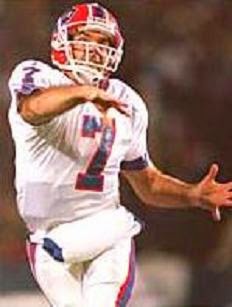
1998: Last-Play TD Gives Patriots Win Over Bills


The New England Patriots were 6-5 and fighting to stay in the playoff hunt as they hosted the division-rival Buffalo Bills on November 29, 1998. To add to New England’s concerns, QB Drew Bledsoe (pictured above) was playing with a splint on his throwing hand due to a broken finger suffered the previous week, when he had still managed to toss a late scoring pass to pull out a win. Prior to that, Head Coach Pete Carroll’s team had lost four of five games, but the offense was helped by the return from injury of WR Terry Glenn.

Buffalo, coached by Wade Phillips, was 7-4 and had beaten the Patriots at home two weeks earlier. Diminutive QB Doug Flutie, former Boston College star and CFL legend, replaced Rob Johnson, the young quarterback the team had swung a deal with Jacksonville to obtain, with good results. WR Eric Moulds was a big-play talent across from 34-year-old WR Andre Reed and, with RB Thurman Thomas entering the twilight of his great career, RB Antowain Smith emerged as a productive starter. DE Bruce Smith was still a key player on the defensive line, along with NT Ted Washington.

There were 58,304 fans in attendance at Foxboro Stadium. Buffalo had the first possession and Doug Flutie completed his first three passes, but the drive stalled at the New England 45 and the Bills punted. They got the ball back in short order when CB Thomas Smith intercepted a pass by Drew Bledsoe at the Buffalo 12. Flutie completed a throw to Eric Moulds for 33 yards and the long series finally ended at the New England 17 where the Bills came up empty when Steve Christie missed a 35-yard field goal attempt.

The teams exchanged punts as the game headed into the second quarter. The Patriots then put together a 66-yard drive in eight plays. Bledsoe threw to Terry Glenn for 15 and 33 yards and TE Ben Coates for 12 to reach the Buffalo nine. A pass interference penalty moved the ball to the one, and after two carries by RB Robert Edwards netted a loss of a yard, Bledsoe passed to him for a two-yard touchdown. Adam Vinatieri added the extra point for the 7-0 lead.

Once again the Bills had to punt following their next possession, and once again the Patriots drove to a score. This time it took them seven plays to advance 53 yards, having gotten a 30-yard punt return from CB Chris Canty to give them good starting field position. Bledsoe completed five passes, with gains of 12 yards to Glenn, 13 to Coates, and finally a 12-yard TD throw to RB Derrick Cullors. Vinatieri kicked the point after to expand the New England lead to 14-0.

 Down by two touchdowns, the Bills got a break on the next series when the Patriots were flagged for pass interference on a third-and-10 play that picked up 26 yards. Antowain Smith followed up with three runs that totaled 22 yards to the New England 38. A Flutie pass and another run by Smith picked up another ten yards, but that was it and Christie came on to kick a 34-yard field goal.

With 1:16 remaining in the first half, the Patriots responded with Bledsoe completing three straight short passes. However, a third-down sack forced a punt and the Bills, starting from their 37 with the clock now down to 18 seconds, got a 55-yard gain on a pass from Flutie to WR Kevin Williams. Christie kicked a 26-yard field goal on the last play before halftime and the score stood at 14-6 at the game’s midpoint.


Following a punt by the Patriots to finish off the first series of the third quarter, Buffalo struck quickly when Flutie (pictured at left) connected with Moulds for an 84-yard touchdown. The pass for a two-point conversion failed, but the visitors were now only two points behind.

Short Bledsoe passes and the running of Edwards moved the Patriots down the field on the next possession, and Vinatieri booted a 44-yard field goal to expand New England’s lead to 17-12. But the Bills came back with another score of their own on a series in which Flutie completed passes to Andre Reed for 23 yards and Moulds for 17. With a second-and-goal at the four, they were unable to reach the end zone, but Christie kicked a 22-yard field goal to again narrow the margin to two points at 17-15.

As the contest entered the fourth quarter, the Patriots again had to punt and Buffalo put together a long, penalty-filled drive of 67 yards. A defensive holding penalty converted a third-and-16 situation and an illegal-use-of-hands call turned a third-and-four play into a first down. Flutie completed four passes, one to Williams to convert yet another third and long that picked up 22 yards, although an apparent 23-yard completion to Reed was called back for holding. Finally, Flutie threw to Reed for a touchdown from four yards out and, while the two-point conversion attempt again failed, the Bills were in front by 21-17.

The Patriots came up empty on their next series when Vinatieri missed a 47-yard field goal attempt. After Buffalo’s next possession resulted in a punt just after the two-minute warning, New England started off at its 18 and had no remaining timeouts. Bledsoe completed four of five passes, two of them to Coates, as the Patriots advanced to the Buffalo 37. However, the drive stalled there until, on fourth-and-nine, a pass lofted toward Glenn in the end zone was incomplete but Buffalo was called for pass interference. The ball was moved to the one, much to the fury of the Bills. With no time left on the clock, Bledsoe connected with Coates for a touchdown and, with the angry Bills having already departed for the locker room, Vinatieri ran for an unopposed two-point conversion rather than kicking. The Patriots came away with a dramatic 25-21 win.

Buffalo had a sizable lead in total yards (428 to 259) and time of possession (34:01 to 24:59), although New England had the edge in first downs (24 to 23). The Bills also recorded four sacks, to one by the Patriots, and New England suffered the only turnover. But Buffalo was penalized 12 times, at a cost of 107 yards, which in the end proved fatal, while the Patriots drew 9 flags for 80 yards.


Drew Bledsoe completed 28 of 43 passes for 246 yards and three touchdowns while giving up one interception. Ben Coates (pictured at right) had 10 catches for 70 yards and the game-winning TD and Terry Glenn gained 104 yards on 8 receptions. Robert Edwards led New England in rushing with 40 yards on 13 carries.

For the Bills, Doug Flutie was successful on 21 of 39 throws for 339 yards and two TDs and no interceptions. He also ran for 30 yards on five carries. Eric Moulds caught 8 passes for 177 yards and the long touchdown. Kevin Williams contributed 74 yards on his four receptions and Andre Reed accounted for 53 yards and a TD on his four. Antowain Smith rushed for 58 yards on 21 attempts.

“We were robbed,” said SS Henry Jones, who was called for the crucial pass interference penalty at the end. “Terry Glenn jumped for the ball, but no one even grabbed him.”

“Well, [the officials] gave them the game, they might as well give them the extra point,” added Coach Phillips, also making reference to the unopposed two-point conversion at the end.

“He [Jones] wasn’t playing the ball, but he did make contact with the receiver,” countered referee Walt Coleman. “That’s pass interference.”

The win tied the Patriots with the Bills as they remained in the playoff mix, but they split their last two contests, including a loss to the division-winning Jets in the finale, to finish fourth in the AFC East at 9-7. It was still enough to make it in to the postseason with the last Wild Card spot and they lost to Jacksonville in the first round. Buffalo was third with a 10-6 record and lost to Miami, the second-place team, in the Wild Card playoff.

Drew Bledsoe, who missed the last two games and the playoff loss due to injury, ended up passing for 3633 yards and 20 touchdowns. Ben Coates led the team with 67 pass receptions, for 668 yards (10.0 avg.) and six TDs. He was named to the Pro Bowl for the fifth straight year.

Doug Flutie and Eric Moulds were also selected to the Pro Bowl. The 36-year-old Flutie threw for 2711 yards and 20 touchdowns and ran for another 248 yards while the team went 7-3 with him as the starting quarterback. Moulds (pictured below) averaged 20.4 yards on his 67 catches for an AFC-leading 1368 yards with nine TDs.


November 28, 2014

Rookie of the Year: Sammy White, 1976

Wide Receiver, Minnesota Vikings


Age: 22
College: Grambling
Height: 5’11” Weight: 189

Prelude:
White was a wingback in college who scored 43 touchdowns overall and was Southwestern Athletic Conference Co-Offensive Player of the Year in 1975. He was chosen by the Vikings in the second round of the ’76 NFL draft and he moved into the starting role vacated by John Gilliam, who had departed for the Falcons.

1976 Season Summary
Appeared in all 14 games
[Bracketed numbers indicate league rank in Top 20]

Pass Receiving
Receptions – 51 [11, tied with Ken Burrough]   
Most receptions, game – 9 (for 139 yds.) vs. LA Rams 9/19, (for 120 yds.) at Miami 12/11
Yards – 906 [5, 1st in NFC]
Most yards, game – 210 (on 7 catches) vs. Detroit 11/7
Average gain – 17.8 [15]
TDs – 10 [3, tied with Bob Chandler & Dave Casper, 1st in NFC]
200-yard receiving games – 1
100-yard receiving games – 3

Rushing
Attempts – 5
Yards – -10
Average gain – -2.0
TDs – 0

Kickoff Returns
Returns – 9
Yards – 173
Average per return – 19.2
TDs – 0
Longest return – 36 yards

Punt Returns
Returns – 3
Yards – 45
Average per return – 15.0
TDs – 0
Longest return – 31 yards

Scoring
TDs – 10 [9, tied with Bob Chandler, Dave Casper & Andy Johnson]
Points – 60

Postseason: 3 G
Pass receptions – 9
Most pass receptions, game – 5 vs. Oakland, Super Bowl
Pass receiving yards – 141
Most pass receiving yards, game – 77 vs. Oakland, Super Bowl
Average yards per reception – 15.7
Pass Receiving TDs – 3

Rushing attempts – 1
Rushing yards – 7
Rushing TDs – 0

Kickoff returns – 4
Kickoff return yards – 79
Kickoff return avg. – 19.8
Kickoff return TDs – 0

Awards & Honors:
NFL Offensive Rookie of the Year: AP, PFWA
NFC Rookie of the Year: UPI, NEA, Sporting News
1st team All-NFC: UPI, Pro Football Weekly
Pro Bowl

Vikings went 11-2-1 to finish first in the NFC Central while leading the conference in passing yards (2855). Won NFC Divisional playoff over Washington Redskins (35-20) and NFC Championship over Los Angeles Rams (24-13). Lost Super Bowl to Oakland Raiders (32-14).

Aftermath:
Fast and a potent deep receiver, and benefiting from the presence of Ahmad Rashad on the other side, White had another Pro Bowl year in 1977 as he caught 41 passes for 760 yards (18.5 avg.) and nine touchdowns. While he was not chosen to the Pro Bowl again, he remained a consistent and productive receiver, peaking with a 1981 season in which he achieved career highs in receptions (66) and yards (1001). White missed five games due to a muscle pull in 1983 and further injuries limited his effectiveness in his last two seasons of 1984 and ’85. Over the course of ten seasons that were all with the Vikings, White caught 393 passes for 6400 yards (16.3 avg.) and 50 touchdowns, and he had another 17 catches for 313 yards (18.4 avg.) and five TDs in the postseason.

--

Rookie of the Year Profiles feature players who were named Rookie of the Year in the NFL, AFL (1960-69), or USFL (1983-85) by a recognized organization (Associated Press – Offense or Defense, Newspaper Enterprise Association, United Press International, The Sporting News, or the league itself – Pepsi NFL Rookie of the Year).