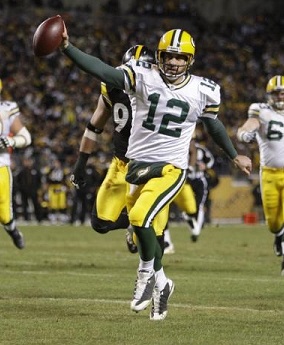
December 24, 2015

1977: Broncos Defeat Steelers in AFC Divisional Playoff


The AFC Divisional playoff game on December 24, 1977 featured the Denver Broncos, champions of the AFC West at 12-2 and newcomers to the postseason, hosting the Pittsburgh Steelers, AFC Central champs for the fourth straight year with a 9-5 record.

The Broncos, coached by Red Miller, were appearing in the postseason for the first time in a franchise history dating back to 1960 in the American Football League. They had made it with a conservative offense directed by QB Craig Morton (pictured above), who was new to Denver but a 35-year-old veteran previously with Dallas and the Giants. The key to success was the rugged “Orange Crush” defense that included DE Lyle Alzado, linebackers Randy Gradishar and Tom Jackson, CB Louis Wright, and SS Bill Thompson.

Pittsburgh had enjoyed great success under Head Coach Chuck Noll, winning back-to-back Super Bowls following the 1974 and ’75 seasons and reaching the AFC title game in 1976. However, there had been off-field turmoil heading into the 1977 season and the team was uncharacteristically turnover-prone on offense and less dominating on defense, and they lost to Denver during the regular season. Still, the nucleus of QB Terry Bradshaw, FB Franco Harris, and wide receivers Lynn Swann on offense and DT “Mean Joe” Greene, linebackers Jack Lambert and Jack Ham, and CB Mel Blount on defense was intact.

It was a sunny day at Mile High Stadium with over 75,000 fans in attendance and they saw the teams exchange punts to start the game. The Steelers had to punt again following their second possession but the kick by Rick Engles was blocked by WR John Schultz and Denver had the ball at the Pittsburgh 17. HB Rob Lytle carried four straight times, the last for a seven-yard touchdown, and Jim Turner added the extra point for a 7-0 lead.

The clubs resumed trading punts as the game moved into the second quarter. The Steelers finally mounted a scoring drive that covered 56 yards in 11 plays. Terry Bradshaw converted a third-and-nine situation with a pass to TE Bennie Cunningham that covered 19 yards and Franco Harris (pictured below) ran effectively, including a 14-yard run on a fourth-and-one play at the Denver 27. Two carries by HB Rocky Bleier and a Bradshaw throw to Lynn Swann had the visitors facing first-and-goal at the two, and while it took three plays, the Steelers got a TD when Bradshaw leaped into the end zone from just inches away. Roy Gerela converted to tie the score.


The Broncos had to punt again and the Steelers advanced to their 45 before Harris fumbled after being hit by DE Lyle Alzado and LB Tom Jackson recovered and returned it 30 yards. On the next play, HB Otis Armstrong ran 10 yards for a touchdown and, with Turner’s point after, the home team was back on top by 14-7.

The Steelers started their next series with 4:04 remaining in the first half and drove 65 yards in nine plays. Bradshaw completed four passes, the longest to John Stallworth for 21 yards, and just after the two-minute warning Harris took a handoff, started to his right, and then reversed field for a 20-yard gain to the Denver two. Two plays later, Harris ran to the right for a one-yard TD and, with Gerela’s kick, the score was once more knotted at 14-14, and that was the tally at the half. The Steelers had outgained Denver by 183 yards to 44, but the ability of the Broncos to capitalize on the blocked punt and fumble to stay even on the scoreboard.

The teams again exchanged punts to start the third quarter. Denver advanced deep into Pittsburgh territory on its second series, with the big plays passes by Craig Morton to WR Haven Moses for 27 yards and TE Jim Jensen for 29. That gave the Broncos a first-and-goal at the two, but the Steelers kept them out of the end zone as Armstrong ran for a yard, Morton had a pass batted down, and Lytle was stopped three inches short of the goal. Jensen gained nothing on a fourth down run and the Broncos turned the ball over on downs.

The Steelers were pinned back at their one and the resulting short possession led to a punt that gave the ball back to Denver at the Pittsburgh 41. Four plays later, Morton passed to TE Riley Odoms, who gathered the ball in at the six and ran the remaining distance for a 30-yard touchdown. Turner converted and the Broncos again had a seven-point lead at 21-14.

Pittsburgh had to punt on the last play of the period and Denver’s first series of the fourth quarter resulted in a punt as well. WR Jim Smith returned the kick 17 yards to the Pittsburgh 39 and, following a short run by Bleier, Bradshaw fired passes to Cunningham for 11 yards and Stallworth for 48 yards to the Denver one. From there on the next play, Bradshaw threw to Larry Brown, a tackle lined up at end, for a TD. Gerela kicked the extra point and the score again was tied.

The Broncos responded with a 39-yard drive in seven plays. Morton threw to Armstrong for a nine-yard gain and followed with a pass to Moses for 18 yards to the Pittsburgh 36. Lytle ran for three yards and a Morton bootleg picked up six. While a third-and-one pass was tipped and fell incomplete, Turner kicked a 44-yard field goal that staked Denver to a 24-21 lead.

Smith returned the ensuing kickoff 34 yards to give the Steelers good starting field position at their 40, but on their second play a Bradshaw pass was intercepted by Jackson, who returned it 32 yards to the nine yard line. The Broncos couldn’t reach the end zone from there but came away with another Turner field goal, this time from 25 yards, to extend the lead to 27-21.
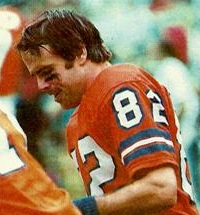


Pittsburgh took over again on offense with just over five minutes to play and Bradshaw came out throwing. He had four completions, one to Cunningham for 12 yards to convert a third down and another to Bleier for seven yards in a third-and-six situation. But his next pass was picked off at midfield by Jackson, making yet another big play on defense, and the linebacker ran it back 17 yards. Two plays later, with the defense anticipating that the Broncos would keep the ball on the ground, Morton fired long to WR Jack Dolbin (pictured at right) in the end zone for a 34-yard touchdown. While the Steelers had one more possession, the game was effectively over. Denver won by a final score of 34-21.

The Steelers had more total yards (304 to 258) and first downs (18 to 15), but also turned the ball over four times, to one by Denver. Pittsburgh also was hurt by 10 penalties, at a cost of 67 yards, to three flags for 20 yards thrown on the Broncos.

Craig Morton completed 11 of 23 passes for 164 yards and two touchdowns with no interceptions. Otis Armstrong topped the Broncos with 44 rushing yards on 11 carries that included a TD and Rob Lytle contributed 26 yards and a score on his 12 attempts. Riley Odoms had 5 catches for 43 yards and a touchdown and Haven Moses gained 45 yards on his two pass receptions. Tom Jackson (pictured below) was the defensive star with the two big interceptions plus a fumble recovery.


For the Steelers, Terry Bradshaw was successful on 19 of 37 throws for 177 yards and a TD, but gave up three interceptions. Franco Harris gained 92 yards on 28 carries that included a touchdown and also caught four passes for another 20 yards. John Stallworth also had four receptions, for a team-leading 80 yards.

Denver, having achieved its first playoff victory, went on to defeat the division-rival Oakland Raiders for the AFC Championship but was dominated in the Super Bowl by the Dallas Cowboys. The Steelers, with many commentators suggesting that they were a fading club following the disappointing 1977 season, bounced back to win the next two Super Bowls and defeated the Broncos at the Divisional level in ’78.

December 23, 2015

Highlighted Year: Lyle Blackwood, 1977

Safety, Baltimore Colts


Age: 26
5th season in pro football, 1st with Colts
College: Texas Christian
Height: 6’0”   Weight: 190

Prelude:
Blackwood was an All-Southwest Conference selection in 1971 and ’72. Chosen by the Denver Broncos in the ninth round of the 1973 NFL draft, he was waived prior to the season but signed with the Cincinnati Bengals, where he was primarily used on special teams, including returning punts. Following three seasons as a backup safety for the Bengals, Blackwood moved on to the Seattle Seahawks in the 1976 expansion draft. After an undistinguished year, he was waived prior to the ’77 season and picked up by the Colts. Thus far, he had started a total of seven games and intercepted two passes in four NFL seasons. Blackwood moved into the lineup at free safety with surprising results.

1977 Season Summary
Appeared in all 14 games
[Bracketed numbers indicate league rank in Top 20]

Interceptions – 10 [1]
Most interceptions, game – 3 vs. NY Jets 11/20
Int. return yards – 163 [2]
Most int. return yards, game – 64 (on 3 int.) vs. NY Jets 11/20
Int. TDs – 0
Fumble recoveries – 4

Kickoff Returns
Returns – 1
Yards – 24
TDs – 0

Punt Returns
Returns – 7
Yards – 22
Average per return – 3.1
TDs – 0
Longest return – 10 yards

Postseason: 1 G (AFC Divisional playoff vs. Oakland)
Interceptions – 0
Fumble recoveries – 2

Kickoff returns – 1
Kickoff return yards – 17
Punt returns – 2
Punt return yards – 6
Punt return avg. – 3.0
TDs – 0

Awards & Honors:
2nd team All-NFL:  AP

Colts went 10-4 to finish first in the AFC East while finishing second in the NFL in interceptions (30). Lost AFC Divisional playoff to Oakland Raiders (37-31).

Aftermath:
Blackwood intercepted four passes in 1978, returning two of them for touchdowns, and had another four in ’79. He lost his starting job in 1980 and moved on to the Miami Dolphins in 1981, where he teamed with his brother Glenn as part of an outstanding safety tandem and enjoyed his greatest notoriety. Blackwood spent the last six years of his career with the Dolphins, before being waived in 1986. He ended up intercepting 35 passes, two of which he returned for touchdowns, and recovering 15 fumbles. 19 of the interceptions and 11 fumble recoveries occurred while with the Colts. He also returned 69 punts for a 4.6-yard average and 20 kickoffs with a 20.2 average.

--

Highlighted Years features players who were consensus first-team All-League* selections or league* or conference** leaders in the following statistical categories:

Rushing: Yards, TDs (min. 10)
Passing: Yards, Completion Pct., Yards per Attempt, TDs, Rating
Receiving: Catches, Yards, TDs (min. 10)
Scoring: TDs, Points, Field Goals (min. 5)
All-Purpose: Total Yards
Defense: Interceptions, Sacks
Kickoff Returns: Average
Punt Returns: Average
Punting: Average

*Leagues include NFL (1920 to date), AFL (1926), AFL (1936-37), AAFC (1946-49), AFL (1960-69), WFL (1974-75), USFL (1983-85)

**NFC/AFC since 1970

December 22, 2015

1973: Vikings Defeat Redskins in NFC Divisional Playoff Game


The NFC Divisional Playoff game on December 22, 1973 featured the Minnesota Vikings, first place finishers in the NFC Central at 12-2, hosting the Washington Redskins, who placed second in the NFC East with a 10-4 record and qualified for the postseason as a Wild Card entry.

The Vikings were in their seventh season under Head Coach Bud Grant and back in the postseason after a one-year hiatus in 1972. Prior to that they had won four straight division titles, but lost their last two Divisional round games. QB Fran Tarkenton (pictured above), an original Viking, returned to the club in ’72 and was making his first postseason appearance in his 13th year as a pro. Tarkenton was talented and known for his scrambling style, but still had something to prove to critics who questioned his ability to come up a winner in big games. WR John Gilliam was a fine receiver and the addition of rookie FB Chuck Foreman helped both the running and passing attack. The tough defense remained the key to the team’s success, in particular the line with ends Carl Eller and Jim Marshall and tackles Alan Page and Gary Larsen.

The Redskins, coached by George Allen, were the defending NFC Champions and still a very strong, veteran-laden club. Gritty QB Bill Kilmer directed an offense that included the running of HB Larry Brown and a strong receiving corps with wide receivers Charley Taylor and Roy Jefferson and TE Jerry Smith. The defense was strong and adept at pressuring opposing quarterbacks. While Washington was also known for the quality of its special teams play, PK Curt Knight caused concern with his erratic tendencies. In addition, Kilmer had been hospitalized during the previous week due to a stomach disorder.

There were 45,475 fans in attendance at Metropolitan Stadium on a day with temperatures in the twenties and a seven mph wind. The field had been cleared of snow and dyed green to hide the wear. Minnesota came out throwing, but a Fran Tarkenton bomb to an open John Gilliam just grazed the receiver’s finger tips, which was the closest the Vikings came to pulling off a big play in the early going. The Redskins missed a scoring opportunity in the first quarter when they drove from their 14 into Minnesota territory but Curt Knight failed on a 17-yard field goal attempt.

Later in the period, Knight again missed a field goal attempt, coming up short from 49 yards. The Vikings were stymied on offense and didn’t register a first down until two minutes into the second quarter, but they finally came up with a big play when Tarkenton completed a pass to HB Oscar Reed for a gain of 50 yards and that set up a 19-yard field goal by Fred Cox.


With 3:30 remaining in the first half, the Redskins got a break when CB Bobby Bryant fumbled a punt and HB Bob Brunet recovered for Washington at the Minnesota 21. Three plays later, which included a pass from Bill Kilmer to Charley Taylor for 17 yards, Larry Brown (pictured at left) ran for a three-yard touchdown. Knight added the extra point for a 7-3 lead.

The Vikings advanced into field goal position as Tarkenton completed passes to WR Carroll Dale and Chuck Foreman, but an interception inside the ten yard line snuffed out the threat and the score remained unchanged at the half.

During halftime, Minnesota DE Carl Eller delivered an emotional speech to his teammates, who had played without apparent emotion during the first half, saying that they had come “too damn far” and were “embarrassing ourselves”. To accent the point, he proceeded to break apart the team’s blackboard. The tirade made an impression and the Vikings showed more fire in the second half.

Early in the third quarter, Reed, taking advantage of the defense’s keying on Chuck Foreman, broke six tackles on a 46-yard carry that set up a two-yard TD run by FB Bill Brown. Cox added the point after and the home team was ahead by 10-7.

Meanwhile, the Redskins were now without CB Pat Fischer, who suffered cracked ribs in the second quarter and was unable to continue. He was replaced by DB Speedy Duncan, also experienced but typically a kick returner who was more comfortable at safety.

Washington managed to tie the score before the period was over with Curt Knight’s 52-yard field goal that matched the then-league playoff record. Knight kicked another field goal, from 42 yards, on the first play of the fourth quarter, and the visitors held a 13-10 edge.

The Vikings proceeded to advance 71 yards in eight plays concluding with a Tarkenton pass to Gilliam, who beat Duncan for a 28-yard touchdown. Cox converted and Minnesota was back in the lead by 17-13. On Washington’s next offensive play, CB Nate Wright intercepted a Kilmer pass and returned it 26 yards to the Redskins’ eight. Two plays later, it was Tarkenton to Gilliam again for a TD, this time from six yards out and after the nimble quarterback scrambled out of trouble, running to his left and then right before finding the receiver open in the right corner of the end zone. Cox added the point after and, in the space of 1:05, the Vikings had scored twice to take a 24-13 lead.

The Redskins managed to get on the board again following DB Ken Stone’s block of a Mike Eischeid punt. Kilmer passed to WR Roy Jefferson for a 28-yard touchdown with 5:28 left to play and Knight converted to close the margin to four points.

The Vikings were able to use up four minutes on a series that concluded with Cox kicking a 30-yard field goal. Washington fought back in the remaining time as Kilmer completed three passes, but the drive came to an end at the Minnesota 42 on a fourth down incompletion. Minnesota won by a final score of 27-20.

The statistics were fairly even. The Vikings led in total yards (359 to 314) while Washington had the edge in first downs (18 to 17). Each team turned the ball over twice. The game was almost penalty-free, with Minnesota drawing the only two flags at a minimal cost of nine yards.

Fran Tarkenton completed 16 of 28 passes for 222 yards with two touchdowns and one interception, and was at his best as the Vikings took command in the second half, when he hit on eight of ten throws and both TDs. John Gilliam had just two catches for 36 yards, but they accounted for both touchdowns. Oscar Reed (pictured below) rushed for 95 yards on 17 carries and caught 5 passes for 76 more yards. Chuck Foreman contributed 40 yards on 11 attempts and had three pass receptions for 23 yards.


For the Redskins, Bill Kilmer was successful on 13 of 24 throws for 159 yards and a TD along with an interception. Larry Brown, who was playing with injured ribs, gained 115 yards on 29 rushing attempts and scored a touchdown. Roy Jefferson caught 6 passes for 84 yards and a TD and Charley Taylor contributed four receptions for 56 yards.

“Sometimes they’re not concentrating on me,” explained Oscar Reed, who received a game ball for his performance. “Since early in the season they’ve been keying on Chuck Foreman. I’m not the world’s greatest pass catcher or runner, but given a little room, I’ll use what I’ve got.”

The Vikings went on to defeat Dallas for the NFC Championship before losing to Miami in the Super Bowl. Washington came back in 1974 to again go 10-4 and reach the playoffs as a Wild Card. The Redskins lost in the Divisional round, this time to the Rams.

December 21, 2015

Highlighted Year: LeRoy Butler, 1993

Safety, Green Bay Packers


Age: 25
4th season in pro football & with Packers
College: Florida State
Height: 6’0”   Weight: 200

Prelude:
Butler overcame a childhood foot condition that had him in a wheelchair and wearing leg braces until he was eight. He first gained notoriety in college for his role in the 1988 “puntrooskie” trick play against Clemson in which he ran 76 yards out of punt formation to set up a game-winning field goal. As a senior, he moved from free safety to cornerback upon the departure of Deion Sanders and intercepted seven passes. Butler was a multiple first-team All-American and was chosen by the Packers in the second round of the 1990 NFL draft. After a rookie year as a nickel back who displayed aggressiveness if not always successful in coverage, Butler moved into the starting lineup at cornerback in ’91 and was shifted to strong safety in 1992, accounting for 74 tackles and an interception.

1993 Season Summary
Appeared in all 16 games
[Bracketed numbers indicate league rank in Top 20]

Interceptions – 6 [7, tied with six others]
Most interceptions, game – 1 on six occasions
Int. return yards – 131 [4]
Most int. return yards, game – 39 (on 1 int.) at San Diego 12/12
Int. TDs – 0
Sacks – 1
Fumble recoveries – 1
Fumble recovery TDs – 1
Forced fumbles – 2
Tackles – 90

Scoring
TDs – 1
Points – 6

Postseason: 2 G
Interceptions – 1
Sacks – 1
Fumble recoveries – 1
TDs – 0

Awards & Honors:
1st team All-NFL:  AP, PFWA, Sporting News
1st team All-NFC: UPI, Pro Football Weekly
Pro Bowl

Packers went 9-7 to finish third in the NFC Central and qualified for the postseason as a Wild Card while ranking second in the NFL in fewest yards allowed (4482). Won NFC Wild Card playoff over Detroit Lions (28-24). Lost NFC Divisional playoff to Dallas Cowboys (27-17).  

Aftermath:
Butler was weakened by a bout with pneumonia in 1994 but remained a solid performer and leader in the defensive backfield. He returned to being a consensus first-team All-NFL selection for three straight years from 1996 to ’98, as well as gaining Pro Bowl recognition. He had a 90-yard interception return and accumulated a career-high 6.5 sacks in ’96 and the Packers won NFC titles in 1996 and ’97, winning the Super Bowl following the ’96 season. Butler played until 2001 and, in a twelve-year career played entirely with Green Bay, intercepted 38 passes, registered 20.5 sacks, and accounted for over 700 tackles. He was a consensus first-team All-NFL and Pro Bowl choice four times. Butler also originated the “Lambeau Leap” touchdown celebration.

--

Highlighted Years features players who were consensus first-team All-League* selections or league* or conference** leaders in the following statistical categories:

Rushing: Yards, TDs (min. 10)
Passing: Yards, Completion Pct., Yards per Attempt, TDs, Rating
Receiving: Catches, Yards, TDs (min. 10)
Scoring: TDs, Points, Field Goals (min. 5)
All-Purpose: Total Yards
Defense: Interceptions, Sacks
Kickoff Returns: Average
Punt Returns: Average
Punting: Average

*Leagues include NFL (1920 to date), AFL (1926), AFL (1936-37), AAFC (1946-49), AFL (1960-69), WFL (1974-75), USFL (1983-85)

**NFC/AFC since 1970

December 20, 2015

2009: Roethlisberger Throws for 503 Yards as Steelers Edge Packers


The Pittsburgh Steelers were defending NFL Champions but in danger of missing the postseason as they hosted the Green Bay Packers on December 20, 2009. Head Coach Mike Tomlin’s team got off to a 6-2 start but had lost its last five contests, including a miserable 13-6 game at Cleveland the previous week, and was now at 6-7 and nearly out of playoff contention.  With QB Ben Roethlisberger (pictured above) and wide receivers Hines Ward and Santonio Holmes, the passing game was productive but the defense was severely weakened by the loss of SS Troy Polamalu and DE Aaron Smith to injuries.

Green Bay was coached by Mike McCarthy and in contention for the NFC North crown with a 9-4 record. The offense was potent thanks to the passing of QB Aaron Rodgers and the running of RB Ryan Grant. The defense was especially strong at linebacker, where talented rookie Clay Matthews joined a unit that already included Nick Barnett and A.J. Hawk, while CB Charles Woodson was the key player in the backfield.   

There were 57,452 fans in attendance on a cold late afternoon at Heinz Field. The Packers had the ball first and punted. Pittsburgh set the tone for the game on the next play when Ben Roethlisberger threw deep to WR Mike Wallace for a 60-yard touchdown. Jeff Reed added the extra point to give the Steelers the early 7-0 advantage.

The teams exchanged punts before the Packers came through with a big play. Facing third-and-five at their own 17, Aaron Rodgers went long for WR Greg Jennings and the result was an 83-yard TD. Mason Crosby tied the score with the point after.

The Steelers responded with a nine-play series that covered 72 yards. Roethlisberger completed a pass to Hines Ward for nine yards in a third-and-six situation and a toss to TE Heath Miller for 14 yards was followed by a pass interference penalty on the defense that gained another 17 to the Green Bay 25. Five plays later, RB Rashard Mendenhall ran for a two-yard touchdown, Reed converted, and the home team was back in front by 14-7.

Following two short possessions that resulted in punts, the Packers were on the move as Rodgers threw to WR Donald Driver for a 49-yard gain to the Pittsburgh 24 on the last play of the opening period. However, after reaching the 16, Green Bay had to try for a field goal and Crosby missed from 34 yards.

The teams returned to trading punts before the Packers advanced 52 yards in eight plays. Rodgers completed five of six passes, two of them to Jennings, and then kept the ball himself on a 14-yard run for a TD (pictured below). Crosby knotted the score once more with the extra point.


The Steelers came back with a six-play, 80-yard drive. Roethlisberger completed passes to Miller for 27 yards and Santonio Holmes for 33 and finished the series off with a 10-yard touchdown throw to RB Mewelde Moore. Reed converted and Pittsburgh was ahead by 21-14, which remained the score at the half.

The Steelers had the ball first in the third quarter and Roethlisberger connected with Mendenhall for a 25-yard gain, but the drive stalled at the Green Bay 46 and they punted. The Packers had to punt in turn and Pittsburgh put together another scoring drive. Roethlisberger completed passes to Mendenhall, again for 25 yards, and to Ward for 17 while RB Willie Parker reeled off a pair of nine-yard runs. After getting to the Green Bay 21, Rodgers was sacked for an eight-yard loss by LB Brad Jones and, while a throw to Moore gained 10 yards the Steelers had to settle for a 37-yard Reed field goal that gave them a ten-point lead.

The Packers responded with a long drive of 69 yards in 13 plays that stretched into the fourth quarter. Rodgers completed a pass to Driver for 19 yards in a third-and-16 situation, one of seven completions along the way. The last was to TE Jermichael Finley for 11 yards and a TD. Crosby added the point after and the Pittsburgh lead was cut to 24-21.

Following a 36-yard kickoff return by WR Stefan Logan, Roethlisberger threw to Ward for 29 yards to the Green Bay 34. Another Roethlisberger completion, this time to Miller, gained 12 yards to convert third-and-six but a two-yard run by Parker was followed by two incomplete passes and Reed booted a 34-yard field goal to make it a 27-21 game.

The Packers needed just four plays to advance 62 yards in response. Two throws by Rodgers to Finley totaled 11 yards before a completion to Nelson gained 27. Ryan Grant ran 24 yards for a touchdown and, with Crosby kicking the extra point, the visitors were ahead at 28-27.

On the next series, and facing second-and-18, Roethlisberger passed deep to Ward for a 54-yard gain to the Green Bay 23. The drive stalled but Reed kicked a 43-yard field goal that put the Steelers back in front by 30-28.

Pittsburgh gambled by attempting an onside kick that failed and the Packers took advantage as Rodgers threw to Nelson for nine yards and Finley for 10. Rodgers connected with WR James Jones for a 24-yard TD and then completed a pass to RB Brandon Jackson for a two-point conversion. With 2:12 left on the clock, Green Bay held a 36-30 lead.

The Steelers took possession following the ensuing kickoff at their 14. A defensive holding penalty added five yards, but Roethlisberger was sacked by LB Brady Poppinga for a four-yard loss. A throw to Miller gained seven yards but the next pass was incomplete and Pittsburgh was facing fourth-and-seven at its own 22 with the time remaining down to 1:14. Roethlisberger went deep for Holmes to pick up 32 yards and keep the drive alive. Holding on the offense backed the Steelers up 10 yards but then an interception was negated by an illegal contact call on the Packers. Two more incomplete passes and a false start had the Steelers facing third-and-15 but Roethlisberger connected with Miller for 20 yards to the Green Bay 36. A sack was nullified by defensive holding and Roethlisberger threw to Miller again, this time for 15 yards. Pittsburgh called its last timeout and Roethlisberger had two passes fall incomplete before, on the game’s last play, he found Mike Wallace in the corner of the end zone, who just managed to keep his feet inbounds for a 19-yard touchdown (pictured below). Reed added the all-important extra point and the Steelers won in dramatic fashion by a final score of 37-36.


The teams combined for 973 yards, with Pittsburgh gaining the most (537 to 436) and also leading in first downs (28 to 18) and time of possession (35:22 to 24:38). Neither team gained much on the ground, with the Steelers holding an edge of 65 yards to 60. The Packers recorded five sacks, to one by Pittsburgh, and the Steelers were also penalized 10 times, at a cost of 84 yards, to seven flags for 53 yards thrown on Green Bay. There were no turnovers by either club.

Ben Roethlisberger completed 29 of 46 passes for 503 yards, a new franchise record, with three touchdowns. Hines Ward and Heath Miller had seven catches apiece, for 126 and 118 yards, respectively. Mike Wallace had just two pass receptions, for 79 yards, but both scored TDs, including the game-decider. Rashard Mendenhall contributed 6 catches for 73 yards to go along with a team-leading 38 rushing yards on 11 attempts that included a score.

For the Packers, Aaron Rodgers was successful on 26 of 48 throws for 383 yards and three TDs and also added a scoring carry among his three runs for 22 yards. Jermichael Finley caught 9 passes for 74 yards and a touchdown and Greg Jennings gained 118 yards on his five receptions that included a long TD. Ryan Grant ran for 37 yards and a score on 8 carries.

“The guys were coming back to the huddle worn out, linemen, receivers, everybody,” said Ben Roethlisberger regarding the intensity of the winning drive. “We didn’t quit. Everybody believed we could do it.”

“You lose on a last-second play, with a spectacular throw and catch, it’s tough,” said Green Bay LB Clay Matthews. “Hindsight’s always 20-20 but we knew what we were getting ourselves into. It was a dogfight.”

The win was the first of three straight for the Steelers to close out the season, but the resulting 9-7 record placed third in the AFC North and they just missed the playoffs. The loss cost the Packers the NFC North title, clinched by the Vikings as a result, but they also won their remaining two games and their second-place 11-5 tally got them into the postseason as a Wild Card. Green Bay lost a wild 51-45 contest to Arizona in the first playoff round.

Ben Roethlisberger threw for 4328 yards and 26 touchdowns, ranking second in the AFC with a 100.5 passer rating. He exceeded the 503 yards against the Packers in a 2014 contest in which he passed for 522 yards vs. Indianapolis, becoming the first quarterback in NFL history to twice throw for over 500 yards in a game.

December 19, 2015

1998: Jets Defeat Bills to Clinch AFC East


The New York Jets had a 10-4 record and were looking to wrap up the AFC East title as they faced the Buffalo Bills on December 19, 1998. In their second season under Head Coach Bill Parcells, the Jets were a far cry from the 1-15 club of two years earlier. Newcomers to the offense, most notably QB Vinny Testaverde (pictured at right) and RB Curtis Martin, were having a major impact, as were wide receivers Keyshawn Johnson, a flashy third-year player, and Wayne Chrebet, a classic overachiever in his fourth season. The defense was strongest at linebacker, where Mo Lewis was joined by Bryan Cox, let go by the Bears but revitalized with the Jets.

Buffalo was coached by Wade Phillips and came into the contest at 9-5. Diminutive 36-year-old QB Doug Flutie had turned the club around in his return to the NFL from the CFL, taking over for QB Rob Johnson after a slow start. Retooling from the squad that had started the decade with four straight AFC Championships, the offense now also featured RB Antowain Smith and WR Eric Moulds while RB Thurman Thomas and WR Andre Reed had reduced roles. The tough defense was still anchored by DE Bruce Smith, who was beginning to slow down at age 36, as well as NT Ted Washington.

There were 79,056 fans in attendance at Rich Stadium on a windy Saturday. The Bills had the first possession and advanced into New York territory thanks to a pass from Doug Flutie to Eric Moulds that picked up 28 yards. Another throw to WR Quinn Early gained eight more yards to the 23, but on the next play the usually sure-handed Antowain Smith fumbled and LB Pepper Johnson recovered for the Jets.

New York drove 79 yards in eight plays. Vinny Testaverde threw to Keyshawn Johnson (pictured below) for 16 yards on first down and, after the series appeared to be stymied at the Jets’ 37, Testaverde ran for 14 yards on a third-and-10 play. Two plays later, RB Dave Meggett, who had only recently joined the team, gained 18 yards on a carry up the middle, Johnson picked up another 25 yards on an end-around, and it was Testaverde to Wayne Chrebet for a seven-yard touchdown. John Hall added the extra point and the visitors had the early 7-0 lead.


On the next possession, the Bills converted a third-and-nine situation with a Flutie pass to Moulds for 27 yards, but a 15-yard taunting penalty on the receiver at the end of the play erased most of the gain and Buffalo was ultimately forced to punt. Chris Mohr’s kick traveled 47 yards and pinned the Jets back at their one yard line, and a short series resulted in a punt in return. A 30-yard kick by John Kidd went just 30 yards and gave the Bills good starting field position at the New York 40. But after a short Flutie pass to Smith gained five yards, two more throws were incomplete and, facing fourth-and-five, another pass intended for Moulds also was unsuccessful.

The teams continued to exchange punts as the game entered the second quarter. Finally, Buffalo put together an 11-play drive that covered 79 yards. Flutie completed passes to FB Sam Gash for nine yards and WR Kevin Williams for 22 yards in a third-and-six situation. Smith ran effectively and Flutie himself had a nine-yard run. Flutie connected with Thurman Thomas for a 25-yard TD to complete the series and Steve Christie added the point after to tie the score.

Following a punt by the Jets, the Bills drove from their one to the New York 10 as Flutie completed three passes, the longest to Moulds (pictured below) for 35 yards, but they ultimately came up empty when Christie was wide to the left on a 28-yard field goal attempt in the final seconds of the half. The score remained unchanged at 7-7 although Buffalo had already accumulated 266 yards.


The Jets started off the third quarter by advancing into Buffalo territory. Testaverde completed consecutive passes to Keyshawn Johnson for 16 and six yards and Curtis Martin had a nine-yard run. Hall kicked a 48-yard field goal to put the visitors back in the lead by 10-7.

Buffalo responded with a long scoring drive. Smith carried most of the load, picking up 35 yards on eight attempts and Flutie converted two third downs, one on a pass to Williams for seven yards and another on a three-yard run. The advance finally faltered at the New York 26 and Christie tied the score once more with a 44-yard field goal into the wind. But two plays after the ensuing kickoff, Testaverde threw to WR Dedric Ward, who beat CB Donovan Greer, an injury replacement, for a 71-yard touchdown. Hall’s kick gave the visitors a seven-point lead.

The Bills had to punt following the next series and the Jets moved into Buffalo territory, helped by a defensive holding penalty in a third-and-nine situation. But they were again forced to try for a field goal and Hall’s attempt from 46 yards was no good.

Following another exchange of punts, the Bills had good starting field position at the New York 49. Keeping the ball on the ground, they reached the 21, but a Flutie pass was bobbled by Williams and barely picked off by diving CB Victor Green (television replays were inconclusive as to whether he maintained possession) with just under four minutes remaining in regulation.

The Jets went three-and-out, with Kidd’s punt sailing 57 yards. Starting from their 20, the Bills had one last chance and Flutie immediately threw to Moulds for 17 yards. But following a short run by Thomas, the next three passes fell incomplete to turn the ball over to New York on downs. There was still 1:32 left on the clock, but a Testaverde throw to Johnson for seven yards on a third-and-six play nailed down the 17-10 win for the Jets.

Buffalo had the edge in total yards (366 to 269), although the Bills gained only 100 yards in the second half. They also had more first downs (21 to 14) and ran far more plays (74 to 51). However, the home team also turned the ball over twice, to none suffered by the Jets.

Vinny Testaverde completed 14 of 23 passes for 184 yards and a touchdown while giving up no interceptions. Keyshawn Johnson had 7 catches for 66 yards while Dedric Ward gained a team-leading 71 yards on his one long scoring reception. Curtis Martin was held to 38 rushing yards on 20 attempts.

For the Bills, Doug Flutie had a rough outing, completing just 14 of 38 throws for 220 yards and a TD as well as an interception. While he was only sacked once, he faced heavy pressure and was knocked down often. Antowain Smith (pictured below) gained 82 yards while running the ball 20 times. Eric Moulds topped the receivers with four catches for 107 yards.


The Jets won the season finale to finish at 12-4 with their first division title since they were an AFL team in 1969. They reached the AFC Championship game before losing to Denver. Buffalo ended up in third place in the AFC East with a 10-6 record and qualified for the playoffs as a Wild Card. The Bills lost to Miami, the club that finished second in the division, in the first round.

Vinny Testaverde ended up with an AFC-leading 101.6 passer rating, throwing for 3256 yards and 29 TDs with just seven interceptions. He was selected to the Pro Bowl along with Keyshawn Johnson, who caught 83 passes for 1131 yards and 10 touchdowns, and Curtis Martin, who had many more productive games on his way to 1287 rushing yards.

Doug Flutie also was chosen for the Pro Bowl as he started ten games, seven of them wins, and threw for 2711 yards and 20 touchdowns against 11 interceptions. Eric Moulds led the AFC with 1368 pass receiving yards on his 67 catches with 9 TDs and was another Pro Bowl selection. Antowain Smith, in his second season, rushed for 1124 yards while averaging 3.7 yards per attempt and scored eight TDs. 

December 18, 2015

Highlighted Year: Ernie Caddel, 1935

Wingback, Detroit Lions


Age: 24
3rd season in pro football & with Spartans/Lions
College: Stanford
Height: 6’2”   Weight: 198

Prelude:
Caddel went to Stanford on a baseball scholarship but was recruited to the football team by legendary Head Coach Glenn “Pop” Warner. Noted for his spectacular running ability, he pioneered in the use of playing while wearing a flak jacket after suffering two broken ribs. Caddel signed with the Portsmouth Spartans in 1933 and “The Blond Antelope” gained 393 yards from scrimmage (282 rushing, 107 receiving) and followed up with 655 total yards in 1934, the franchise’s first season as the Detroit Lions. His 528 rushing yards ranked fifth in the NFL.

1935 Season Summary
Appeared in all 12 games
[Bracketed numbers indicate league rank in Top 20]

Rushing
Attempts – 87 [12]
Yards – 450 [2]
Yards per attempt – 5.2 [1]
TDs – 6 [1]

Pass Receiving
Receptions – 10 [11, tied with Wayland Becker & Flavio Tosi]
Yards – 171 [12]
Yards per catch – 17.1 [5]
TDs – 0

Passing
Attempts – 6
Completions – 4
Yards – 169 [16, tied with Doug Nott]
TD passes – 2 [6, tied with eleven others]
Interceptions – 1

All-Purpose yards – 621 [1]

Scoring
TDs – 6 [2, tied with Dutch Clark, Dale Burnett & Bill Karr]     
Points – 36 [3, tied with Dale Burnett & Bill Karr]

Postseason: 1 G (NFL Championship vs. NY Giants)
Rushing attempts – 16
Rushing yards – 62
Average gain rushing – 3.9
Rushing TDs – 1

Kickoff returns – 2
Kickoff return yards – 25
Average yards per reception – 12.5
Kickoff return TDs – 0
Longest return – 25 yards

Awards & Honors:
1st team All-NFL: League, Chicago Daily News
2nd team All-NFL: UPI

Lions went 7-3-2 to finish first in the NFL Western Division while ranking second in the league in rushing yards (1773), touchdowns (25), and scoring (191 points). Won NFL Championship over New York Giants (26-7).

Aftermath:
Caddel achieved career highs for rushing (580 yards), pass receptions (19), and total yards (730) in 1936. He also led the league in yards per carry (6.4) for the second straight season. Caddel received second-team All-NFL recognition from the league and the Chicago Daily News in both 1936 and ’37, a year in which he again had the NFL’s best yards per carry average (5.6) while rushing for 429 yards. He retired following an injury-plagued season in 1938. Overall, Caddel rushed for 2311 yards on 443 carries (5.2 avg.) and caught 54 passes for 641 yards (11.9 avg.), totaling 2952 combined yards and scoring 26 touchdowns.

--

Highlighted Years features players who were consensus first-team All-League* selections or league* or conference** leaders in the following statistical categories:

Rushing: Yards, TDs (min. 10)
Passing: Yards, Completion Pct., Yards per Attempt, TDs, Rating
Receiving: Catches, Yards, TDs (min. 10)
Scoring: TDs, Points, Field Goals (min. 5)
All-Purpose: Total Yards
Defense: Interceptions, Sacks
Kickoff Returns: Average
Punt Returns: Average
Punting: Average

*Leagues include NFL (1920 to date), AFL (1926), AFL (1936-37), AAFC (1946-49), AFL (1960-69), WFL (1974-75), USFL (1983-85)

**NFC/AFC since 1970