August 16, 2010

1965: Miami Awarded AFL Franchise for ’66 Season


By 1965, the American Football League was looking to expand beyond its original base of eight franchises. While there was some interest in putting a team in Philadelphia, the primary focus was on Atlanta (also rumored as a possible relocation spot for the struggling Denver Broncos). Commissioner Joe Foss went so far as to announce that the president of Cox Broadcasting Company, Leonard Reinsch, would be awarded an AFL franchise.

However, the NFL and its commissioner, Pete Rozelle, also had an interest in Atlanta and at the end of June a franchise was awarded to Rankin Smith. The loss of Atlanta to the NFL served as a major embarrassment to Commissioner Foss, and added to the groundswell that eventually led to his resignation. It also necessitated finding another suitable city (the potential ownership group in Philadelphia also withdrew its bid).

Attention soon turned to Miami. On August 16, 1965 the league awarded its ninth franchise to Joe Robbie and entertainer Danny Thomas for $7.5 million. The personable Thomas contrasted with the temperamental Robbie, an attorney from Minneapolis long acquainted with Joe Foss. The team would begin play in 1966 and would have use of the Orange Bowl as its home field. A contest that attracted nearly 20,000 entrants came up with the nickname of Dolphins for the new club.

Joe Thomas was hired away from the NFL’s Vikings to become director of player personnel, and took up the task of preparing for the team’s first draft of college talent as well as the expansion draft of unprotected players from the other AFL teams. George Wilson, the highly respected former head coach of the Detroit Lions, was hired as the first coach of the Dolphins.


The expansion draft pulled in established veterans like G Billy Neighbors from the Patriots, FB Billy Joe and flanker Bo Roberson from Buffalo, WR Frank Jackson and DE Mel Branch of the Chiefs, LB Wahoo McDaniel from the Jets, QB Dick Wood from Oakland, and TE Dave Kocurek of the Chargers. It also yielded some younger veterans who would prove valuable, such as OT Norm Evans, S Willie West, and cornerbacks Jimmy Warren and Dick Westmoreland.

In the college draft, they lost their first draft pick, FB Jim Grabowski of Illinois, to the Packers, but did sign Kentucky QB Rick Norton, Tennessee LB Frank Emanuel, and offensive end Howard Twilley, who had broken collegiate receiving records at Tulsa.

As with all expansion teams, the first season in 1966 was a hard one, and the Dolphins went 3-11 to tie Houston for last place in the Eastern Division. The team went through four starting quarterbacks - the veteran Wood threw the most passes, but only three were for touchdowns as against 13 interceptions. Rookie Norton saw action until suffering a broken jaw at midseason. It was then the turn of the coach’s son, George Wilson Jr., who led the club to two of its wins before also going down with an injury, at which point John Stofa got his shot. Stofa had played two years of minor league football before being cut by the Dolphins in the preseason and was brought back when injuries depleted the corps of available passers; his sensational performance in throwing four touchdown passes in the season-concluding win made him the front runner for the job in ’67. But overall, Miami passers combined for a dismal 39.4 % completion percentage, lowest in the AFL, while they led the league in passes intercepted with 32.

HB Joe Auer had run the opening kickoff of Miami’s very first regular season game back for a touchdown and, over the course of the year, led the club in rushing with 416 yards on 121 carries. Veteran FB Cookie Gilchrist was obtained from Denver at midseason and provided occasional power between the tackles; they had started out with the very over-the-hill former Chicago Bears star, Rick Casares, as the starting fullback. The seventh-year tight end, Kocurek, was the top receiver with 27 catches for 320 yards.


While the offense struggled, the defense was capable, especially the backfield. Willie West had an outstanding year as the free safety, intercepting eight passes, and Westmoreland and Warren were good cornerbacks. The Dolphins intercepted a total of 31 passes (led by West’s eight) and four were returned for touchdowns.

There had been concern regarding the drawing power of a pro football team in Miami, which at the time was considered more of a college football locale due to the presence of the University of Miami. The Dolphins averaged 25,551 per game at the Orange Bowl and while they weren’t yet a winning team, they could at least generate some excitement.

August 14, 2010

List of the Day: Best Rushing Seasons, 2000s AFC


Jamal Lewis

TOP 10
1- Jamal Lewis, 2003 Baltimore Ravens
2066 yards, 387 att., 5.3 avg., 14 TD

2- Chris Johnson, 2009 Tennessee Titans
2006 yards, 358 att., 5.6 avg., 14 TD

3- Ricky Williams, 2002 Miami Dolphins
1853 yards, 383 att., 4.8 avg., 16 TD

4- LaDainian Tomlinson, 2006 San Diego Chargers
1815 yards, 348 att., 5.2 avg., 28 TD

5- Larry Johnson, 2006 Kansas City Chiefs
1789 yards, 416 att., 4.3 avg., 17 TD

6- Larry Johnson, 2005 Kansas City Chiefs
1750 yards, 336 att., 5.2 avg., 20 TD

7- Edgerrin James, 2000 Indianapolis Colts
1709 yards, 387 att., 4.4 avg., 13 TD

8- Curtis Martin, 2004 New York Jets
1697 yards, 371 att., 4.6 avg., 12 TD

9- LaDainian Tomlinson, 2002 San Diego Chargers
1683 yards, 372 att., 4.5 avg., 14 TD

10-LaDainian Tomlinson, 2003 San Diego Chargers
1645 yards, 313 att., 5.3 avg., 13 TD


Chris Johnson


Ricky Williams


LaDainian Tomlinson

BEST BY FRANCHISES NOT IN TOP 10
New England Patriots: Corey Dillon, 2004
1635 yards, 345 att., 4.7 avg., 12 TD

Denver Broncos: Clinton Portis, 2003
1591 yards, 290 att., 5.5 avg., 14 TD

Jacksonville Jaguars: Fred Taylor, 2003
1572 yards, 345 att., 4.6 avg., 6 TD

Pittsburgh Steelers: Willie Parker, 2006
1494 yards, 337 att., 4.4 avg., 13 TD

Cincinnati Bengals: Rudi Johnson, 2005
1458 yards, 337 att., 4.3 avg., 12 TD

Buffalo Bills: Travis Henry, 2002
1438 yards, 325 att., 4.4 avg., 13 TD

Cleveland Browns: Jamal Lewis, 2007
1304 yards, 298 att., 4.4 avg., 9 TD

Houston Texans: Steve Slaton, 2008*
1282 yards, 268 att., 4.8 avg., 9 TD

Oakland Raiders: Tyrone Wheatley, 2000
1046 yards, 232 att., 4.5 avg., 9 TD

* Texans joined NFL in 2002


Larry Johnson


Edgerrin James


Curtis Martin


Corey Dillon

August 12, 2010

1957: Buddy Parker Abruptly Quits as Coach of Lions


On August 12, 1957 a “Meet the Lions” banquet was held at a hotel in Detroit. The team was still in training camp with the first preseason game coming up shortly and some 600 fans were in attendance. When it was time for Head Coach Buddy Parker to speak, it was assumed that he would utter the usual cliches typical of such occasions. Instead, he said “I can’t handle this team anymore. It’s the worst team I’ve ever seen in training camp. They have no life, no go, just a completely dead team. I’m leaving Detroit football. And I’m leaving tonight.”

At least one member of the audience laughed, thinking that Parker was joking. He was serious, however, and in the end simply walked off the podium and out of the building, leaving behind a stunned group of team executives, fans, and reporters.

Under Buddy Parker, the Lions had been one of the NFL’s strongest teams. Since taking over as head coach in 1951, they had gone 47-23-2 and won three conference titles and back-to-back league championships in 1952 and ’53.

The offense, directed by fiery fellow Texan Bobby Layne at quarterback (pictured at bottom with Parker), was solid and prominently included OT Lou Creekmur, guards Harley Sewell and Dick Stanfel, ends Cloyce Box and Dorne Dibble, and halfbacks Doak Walker and Bob “Hunchy” Hoernschemeyer. Parker proved adept at adjusting the offense to his personnel, effectively utilizing the power of FB Pat Harder, obtained from the Cardinals at age 29 in 1951, and then featuring the outside speed of halfbacks Hoernschemeyer and Gene Gedman while maximizing Walker’s all-around talents. With the resourceful Layne at quarterback, the Lions utilized play action passes to great effect and pioneered in the development of the two-minute offense.

As effective as the offense was, the Lions were especially renowned for their defense. Middle guard Les Bingaman had provided a 300-pound impediment to opposing runners and, when he retired, Joe Schmidt became a groundbreaking and exceptional middle linebacker. The secondary was particularly outstanding, as the Lions led the way in the art of drafting athletes for the defensive backfield. Known as “Chris’s Gang” due to the presence of safety Jack Christiansen, the unit also included fellow safety (and eventual fellow member of the Pro Football Hall of Fame) Yale Lary as well as halfbacks Jim David, Bob Smith, and Bill Stits.

In three consecutive seasons, Parker and the Lions faced off for the NFL title against Paul Brown and the Cleveland Browns; the Lions won the first two of those encounters. But Parker was shattered by the failure to win a third consecutive championship in 1954, losing badly to the Browns by a score of 56-10.

Detroit sank to 3-9 in 1955, but in ’56 the Lions recovered to post a 9-3 record and missed winning the Western Conference by a half game to the 9-2-1 Bears. In the showdown for first place, Layne had been knocked out of the game when blindsided by Chicago’s DE Ed Meadows on a very late hit, although the inability to stop Bears FB Rick Casares, who gained 190 yards rushing, was likely an even larger factor in the loss.

But by the 1957 preseason, a number of issues were rumbling beneath the surface where Buddy Parker and the Lions were concerned. While Parker never elaborated on his reason for the abrupt departure, it was known that he was frustrated with divisions among the team’s owners that had led to meddling and open second-guessing of the coach’s decisions. An hour prior to the banquet, he had been summoned to a suite at the hotel where one of the owners was throwing a cocktail party, and found several of the players there. It might well have been the last straw.

Assistant coach George Wilson was elevated to head coach and the Lions went on to win the NFL championship, once more defeating the Browns in the climactic game. Bobby Layne broke his leg late in the season, but veteran backup Tobin Rote – obtained to provide solid relief in the event of another injury to Layne – capably guided the offense the rest of the way.

Buddy Parker didn’t remain unemployed long - after rumors had him replacing Weeb Ewbank in Baltimore, he was hired by the Pittsburgh Steelers two weeks after leaving the Lions. Layne was reunited with Parker in 1958, and the perennially-losing Steelers put together a 7-4-1 record.

Parker may have been an excellent tactician who was adept at game management, but he was also temperamental and prone to outbursts. The Lions obtained his services after he had quit the Chicago Cardinals in a huff, where he had been co-coach for a year and was caught in the midst of an ownership dispute. He would abruptly quit the Steelers shortly before the 1965 season, after compiling a 51-47-6 tally through eight years, and was finished as an NFL head coach at age 51.

August 9, 2010

1975: Hawaiians Pull Out One-Point Win at Portland


The August 9, 1975 World Football League matchup between the Portland Thunder and The Hawaiians at Portland’s Civic Stadium featured two clubs that had dropped their opening games a week earlier.

The Thunder, successor to 1974’s Storm, were coached by Greg Barton, who had been one of the Portland quarterbacks in the WFL’s first season. Succeeding to the starting quarterback job was an NFL veteran, Don Horn, who had played eight largely nondescript seasons, primarily with the Packers and Broncos. The chief offensive weapon was still RB Rufus “Roadrunner” Ferguson, who ran for 1086 yards in ‘74 and caught 49 passes for 369 more with a total of nine touchdowns. They lost their first game of the ’75 season to the Southern California Sun at Anaheim by a score of 21-15.

The Hawaiians had been one of the few relatively stable WFL franchises in the first year. Coached again by Mike Giddings, they had added RB Calvin Hill from the NFL’s Cowboys, and he gained 132 yards on 32 carries in the season-opening loss at Philadelphia. Another newcomer, QB Sonny Sixkiller (pictured above), a full-blooded Cherokee who had starred in college at the University of Washington and seen limited pro action with the NFL Rams and CFL Toronto Argonauts, had played well in the loss to the Bell.

There was a modest crowd of 7709 on hand for the Thunder’s home opening game. Turnovers put the Honolulu club in front by 17-7 as Horn fumbled twice and The Hawaiians followed each with a touchdown. First, QB Rick Cassata passed 15 yards for a TD to WR Dave Atkinson. Then, it was Sixkiller entering the contest and throwing an eight-yard touchdown strike to WR Grady Richardson. Still, Portland came back later in the second quarter as Horn threw a 39-yard touchdown pass to WR Jim Krieg. For all of the mistakes the club made in the first half, Portland was only down by 17-14 at halftime.

The Hawaiians defense made another big play in the third quarter, as CB Willie Williams forced Ferguson to fumble and safety Phil Andre grabbed the loose ball and ran 43 yards for a touchdown. Sixkiller ran for the action point and The Hawaiians held a 25-14 lead.

Don Warner kicked a 25-yard field goal for the Thunder to narrow the margin to 25-17, but neither team was able to run effectively against the opposing defense. With five minutes remaining in the contest, Portland drove 35 yards to The Hawaiians’ 12 yard line. Horn connected with TE Bob Christiansen for a touchdown, but the ensuing action point attempt failed as Ferguson dropped a pass in the end zone.

The Thunder had one last shot, getting the ball back at their own 43 yard line with 11 seconds remaining. Two desperation passes fell incomplete and then Warner attempted a 64-yard field goal that fell well short. The Hawaiians came away with a closely-fought 25-24 win.

The Portland defense had keyed on Calvin Hill, who was slowed by a rib injury. Taking advantage of turnovers and gaining ground with an effective short passing game made the difference for The Hawaiians. In particular, Sonny Sixkiller had helped his cause in the competition for the starting quarterback job by completing 8 of 15 passes for 58 yards and a touchdown and converting the decisive action point.

By the time the season abruptly ended in October due to the league’s collapse, both teams had 4-7 records and were tied for fourth in the Western Division. Calvin Hill was lost to injury along the way and gained just 218 yards rushing for The Hawaiians. Both Sonny Sixkiller and Rick Cassata quit the team before the plug was pulled on the WFL, as did WR Tim Delaney, who had led the league in pass receiving in ’74 and ranked second in ‘75, and star DE Lem Burnham.

Rufus Ferguson ended up as the WFL’s third-ranked rusher with 768 yards. Don Horn finished second in completion percentage (58.1) and pass completions (158, tied with Edd Hargett of Shreveport) and third in pass attempts (272) and yards (1742).

August 8, 2010

List of the Day: Best Rushing Seasons, 2000s NFC


Ahman Green

TOP 10
1- Ahman Green, 2003 Green Bay Packers
1883 yards, 355 att., 5.3 avg., 15 TD

2- Shaun Alexander, 2005 Seattle Seahawks
1880 yards, 370 att., 5.1 avg., 27 TD

3- Tiki Barber, 2005 New York Giants
1860 yards, 357 att., 5.2 avg., 9 TD

4- Adrian Peterson, 2008 Minnesota Vikings
1760 yards, 363 att., 4.8 avg., 10 TD

5- Michael Turner, 2008 Atlanta Falcons
1699 yards, 376 att., 4.5 avg., 17 TD

6- Shaun Alexander, 2004 Seattle Seahawks
1696 yards, 353 att., 4.8 avg., 16 TD

7- Frank Gore, 2006 San Francisco 49ers
1695 yards, 312 att., 5.4 avg., 8 TD

8- Tiki Barber, 2006 New York Giants
1662 yards, 327 att., 5.1 avg., 5 TD

9- Deuce McAllister, 2003 New Orleans Saints
1641 yards, 351 att., 4.7 avg., 8 TD

10-Steven Jackson, 2006 St. Louis Rams
1528 yards, 346 att., 4.4 avg., 13 TD


Shaun Alexander


Tiki Barber


Adrian Peterson

BEST BY FRANCHISES NOT IN TOP 10
Washington Redskins: Clinton Portis, 2005
1516 yards, 352 att., 4.3 avg., 11 TD

Carolina Panthers: DeAngelo Williams, 2008
1515 yards, 273 att., 5.5 avg., 18 TD

Chicago Bears: Thomas Jones, 2005
1335 yards, 314 att., 4.3 avg., 9 TD

Philadelphia Eagles: Brian Westbrook, 2007
1333 yards, 278 att., 4.8 avg., 7 TD

Arizona Cardinals: Edgerrin James, 2007
1222 yards; 324 att., 3.8 avg., 7 TD

Dallas Cowboys: Emmitt Smith, 2000
1203 yards, 294 att., 4.1 avg., 9 TD

Detroit Lions: James Stewart, 2000
1184 yards, 339 att., 3.5 avg., 10 TD

Tampa Bay Buccaneers: Cadillac Williams, 2005
1178 yards, 290 att., 4.1 avg., 6 TD


Michael Turner


Frank Gore


Deuce McAllister


Steven Jackson

August 5, 2010

1967: Broncos Stun Lions in First Preseason Game Between AFL-NFL Teams


The merger between the NFL and AFL that was agreed to in 1966 was implemented in phases. In the first, following the ’66 season, a game was played between the champions of the two leagues (now known as Super Bowl I). For 1967, there was a common draft of college talent between the two leagues, and while they would still play separate schedules until 1970, interleague preseason games could be scheduled. While at one level the contests were mere exhibition games that counted for nothing in the standings, to the participants they meant a great deal. In particular, the AFL players were determined to prove their mettle against the clubs from the older NFL.

Such was the case as the AFL’s Denver Broncos hosted the NFL’s Detroit Lions at University of Denver Stadium on August 5, 1967. The Broncos, a club that had never produced a record above .500 in any season and had gone 4-10 in ’66, hardly seemed likely to fare well against any NFL team. Under new Head Coach Lou Saban, who had led Buffalo to back-to-back championships in 1964 and ’65 before coaching for a year at the University of Maryland, the team was in the process of being revamped. Gone were key veterans that Saban deemed unfit for taking part in a rebuilding effort like split end Lionel Taylor, safety Goose Gonsoulin, and guard Jerry Sturm. Most notable among the newcomers was the rookie first draft choice out of Syracuse, halfback Floyd Little. Denver had lost its first preseason game, against the second-year Miami Dolphins by a score of 19-2.

The Lions also had a new head coach in Joe Schmidt, at age 35 only two years removed from his Hall of Famer career as a linebacker. Detroit had gone 4-9-1 in 1966 and was also in transition. Defense had long been the team’s strong suit, and they still had a strong veteran core of defensive tackles Roger Brown and Alex Karras, linebackers Mike Lucci and Wayne Walker, and safety Dick LeBeau. Veteran QB Milt Plum was recovered after missing half of the season due to injury and was being challenged by Karl Sweetan, who had performed creditably as a rookie in his absence. The top three picks in the draft had added HB Mel Farr from UCLA, CB Lem Barney of Jackson State, and Tennessee LB Paul Naumoff.

There were 21,288 fans in attendance for the Saturday evening contest. Neither team was able to mount much offense in the first half. Playing inspired football, the Broncos defense kept the Lions offense out of the end zone; the closest Detroit penetrated was to the Denver 36 yard line. Safety Lonnie Wright made two big plays, intercepting a Sweetan pass at his own 20 and then batting down a long Detroit pass in the end zone to stop another drive.

Following a 56-yard pass play from QB Scotty Glacken to flanker Al Denson, Errol Mann kicked a 35-yard field goal that staked the Broncos to a 3-0 lead (while Mann failed to make it to the regular season with Denver, ironically, he eventually ended up kicking for the Lions for 7 ½ years).

The key play of the game occurred on a 4th and 11 situation at the Detroit 44 in the third quarter. Denver punter Bob Scarpitto (pictured at top) ran instead of kicking and picked up 28 yards and a first down at the Lions 16 yard line. Six plays later, FB Cookie Gilchrist bulled into the end zone from a yard out and the Broncos led by 10-0.

Detroit finally scored in the fourth quarter as Plum threw a 15-yard touchdown pass to WR Bill Malinchak. That was it for the Lions, and Mann’s second field goal of the game from 32 yards out capped the scoring at 13-7 in favor of Denver.

On the bus after the game, Roger Brown of the Lions moaned “The Denver Broncos…it didn’t happen!” But Coach Schmidt summed up by saying, “I want to pay tribute to the Denver team. And, if the other AFL teams show as much desire, there will be many other surprises in the preseason inter-league competition.”

While the Broncos went on to defeat the Vikings, 14-9, and the defending champion Kansas City Chiefs thrashed the Chicago Bears by an astounding score of 66-24, the NFL teams won the remaining contests and had an overall record of 13-3 in the 1967 interleague preseason games.

For all of the excitement and heightened expectations, the Broncos still ended up at the bottom of the AFL’s Western Division with a 3-11 record. Detroit finished the ’67 regular season with a 5-7-2 tally that ranked third in the Central Division of the NFL’s Western Conference.

August 3, 2010

List of the Day: Best Pass Receiving Seasons, 1990s AFC


Jimmy Smith

TOP 10 RECEPTIONS
1- Jimmy Smith, 1999 Jacksonville Jaguars
116 rec., 1636 yards, 14.1 avg., 6 TD

2- Marvin Harrison, 1999 Indianapolis Colts
115 rec., 1663 yards, 14.5 avg., 12 TD

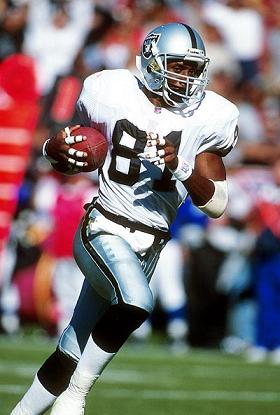
3- Tim Brown, 1997 Oakland Raiders
104 rec., 1408 yards, 13.5 avg., 5 TD

4(tied)- Haywood Jeffires, 1991 Houston Oilers
100 rec., 1181 yards, 11.8 avg., 7 TD

4(tied)- Carl Pickens, 1996 Cincinnati Bengals
100 rec., 1180 yards, 11.8 avg., 12 TD

6- Carl Pickens, 1995 Cincinnati Bengals
99 rec., 1234 yards, 12.5 avg., 17 TD

7- Ben Coates, 1994 New England Patriots
96 rec., 1174 yards, 12.2 avg., 7 TD

8(tied)- Drew Hill, 1991 Houston Oilers
90 rec., 1109 yards, 12.3 avg., 4 TD

8(tied)- Haywood Jeffires, 1992 Houston Oilers
90 rec., 913 yards, 10.1 avg., 9 TD

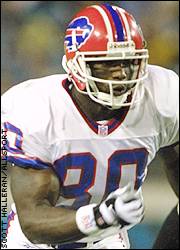
8(tied)- Andre Reed, 1994 Buffalo Bills
90 rec., 1303 yards, 14.5 avg., 8 TD

8(tied)- Tony Martin, 1995 San Diego Chargers
90 rec., 1224 yards, 13.6 avg., 6 TD

8(tied)- Terry Glenn, 1996 New England Patriots
90 rec., 1132 yards, 12.6 avg., 6 TD

8(tied)- Tim Brown, 1996 Oakland Raiders
90 rec., 1104 yards, 12.3 avg., 9 TD

8(tied)- O.J. McDuffie, 1998 Miami Dolphins
90 rec., 1050 yards, 11.7 avg., 7 TD

8(tied)- Tim Brown, 1999 Oakland Raiders
90 rec., 1344 yards, 14.9 avg., 6 TD


Haywood Jeffires


Carl Pickens

BEST BY FRANCHISES NOT IN TOP 10
New York Jets: Keyshawn Johnson, 1999
89 rec., 1170 yards, 13.1 avg., 8 TD

Denver Broncos: Shannon Sharpe, 1994
87 rec., 1010 yards, 11.6 avg., 4 TD

Pittsburgh Steelers: Yancey Thigpen, 1995
85 rec., 1307 yards, 15.4 avg., 5 TD

Seattle Seahawks: Brian Blades, 1994
81 rec., 1086 yards, 13.4 avg., 4 TD

Baltimore Ravens: Michael Jackson, 1996*
76 rec., 1201 yards, 15.8 avg., 14 TD

Kansas City Chiefs: Tony Gonzalez, 1999
76 rec., 849 yards, 11.2 avg., 11 TD

Cleveland Browns: Kevin Johnson, 1999**
66 rec., 986 yards, 14.9 avg., 8 TD

* Ravens joined NFL in 1996 from relocated Browns franchise
** Includes original Browns franchise, 1990-95, plus new Browns franchise that joined NFL in 1999


Marvin Harrison


Tim Brown

TOP 10 YARDS
1- Marvin Harrison, 1999 Indianapolis Colts
1663 yards, 115 rec., 14.5 avg., 12 TD

2- Jimmy Smith, 1999 Jacksonville Jaguars
1636 yards, 116 rec., 14.1 avg., 6 TD

3- Tim Brown, 1997 Oakland Raiders
1408 yards, 104 rec., 13.5 avg., 5 TD

4- Yancey Thigpen, 1997 Pittsburgh Steelers
1398 yards, 79 rec., 17.7 avg., 7 TD

5- Eric Moulds, 1998 Buffalo Bills
1368 yards, 67 rec., 20.4 avg., 9 TD

6- Tim Brown, 1999 Oakland Raiders
1344 yards, 90 rec., 14.9 avg., 6 TD

7- Tim Brown, 1995 Oakland Raiders
1342 yards, 89 rec., 15.1 avg., 10 TD

8- Jimmy Smith, 1997 Jacksonville Jaguars
1324 yards, 82 rec., 16.1 avg., 4 TD

9- Tim Brown, 1994 Los Angeles Raiders
1309 yards, 89 rec., 14.7 avg., 9 TD

10-Yancey Thigpen, 1995 Pittsburgh Steelers
1307 yards, 85 rec., 15.4 avg., 5 TD


Yancey Thigpen


Eric Moulds

BEST BY FRANCHISES NOT IN TOP 10
Miami Dolphins: Irving Fryar, 1994
1270 yards, 73 rec., 17.4 avg., 7 TD

Cincinnati Bengals: Carl Pickens, 1995
1234 yards, 99 rec., 12.5 avg., 17 TD

San Diego Chargers: Tony Martin, 1995
1224 yards, 90 rec., 13.6 avg., 6 TD

Denver Broncos: Rod Smith, 1998
1222 yards, 86 rec., 14.2 avg., 6 TD

Baltimore Ravens: Michael Jackson, 1996*
1201 yards, 76 rec., 15.8 avg., 14 TD

Houston/Tennessee: Haywood Jeffires, 1991
1181 yards, 100 rec., 11.8 avg., 7 TD

New England Patriots: Ben Coates, 1994
1174 yards, 96 rec., 12.2 avg., 7 TD

New York Jets: Keyshawn Johnson, 1999
1170 yards, 89 rec., 13.1 avg., 8 TD

Kansas City Chiefs: Andre Rison, 1997
1092 yards, 72 rec., 15.2 avg., 7 TD

Seattle Seahawks: Brian Blades, 1994
1086 yards, 81 rec., 13.4 avg., 4 TD

Cleveland Browns: Kevin Johnson, 1999**
986 yards, 66 rec., 14.9 avg., 8 TD

* Ravens joined NFL in 1996 from relocated Browns franchise
** Includes original Browns franchise, 1990-95, plus new Browns franchise that joined NFL in 1999


Ben Coates


Tony Martin