March 8, 2011

Past Venue: Jeppesen Stadium

Houston, TX
aka Robertson Stadium


Year opened: 1942
Capacity: 32,000, up from 20,500 when first opened. Was 36,000 at time Oilers played there.

Names:
Houston Public School Stadium, 1942-58
Jeppesen Stadium, 1958-80
Corbin J. Robertson Stadium, 1980 to date

Pro football tenants:
Houston Oilers (AFL), 1960-64

Postseason games hosted:
AFL Championship, Oilers 24 Chargers 16, Jan. 1, 1961
AFL Championship, Texans 20 Oilers 17, Dec. 23, 1962

Other tenants of note:
University of Houston, 1946-50, 98 to date
Houston Dynamo (MLS), 2006 to date

Notes: Hosted AFL All-Star Game, Jan. 16, 1965. Hosted East-West Shrine Game, 2008-09. Major renovation occurred in 1999, thanks to $6 million donation from John and Julie O’Quinn Foundation. Located on the Univ. of Houston campus and originally constructed as a joint venture of the Houston Independent School District and WPA and used as the home football field for all of the city’s high schools. Stadium was renamed Jeppesen Stadium in honor of Holger Jeppesen, a school board member who had pushed for its construction. Bought by the Univ. of Houston in 1970, it was renamed for Corbin J. Robertson, a former member of the Board of Regents who funded its renovation following the purchase. NFL Houston Texans and Dallas Cowboys scrimmaged there in 2002. Univ. of Houston football team split home games between the stadium and Astrodome from 1993-97 before moving back to Robertson Stadium full-time in ’98. Also used for track & field.

Fate: Still in use, although the Univ. of Houston announced plans in 2010 to demolish the stadium and build a new facility on the same site.

March 7, 2011

MVP Profile: Kurt Warner, 1999

Quarterback, St. Louis Rams


Age: 28
5th season in pro football, 2nd in NFL & with Rams
College: Northern Iowa
Height: 6’2” Weight: 220

Prelude:
An undrafted free agent out of Northern Iowa who failed to catch on with the Green Bay Packers in 1994, Warner played for the Iowa Barnstormers of the Arena Football League and earned another shot at the NFL with the Rams, who allocated him to the Amsterdam Admirals of NFL Europe for the spring 1998 season. He made the Rams as the third string QB in ’98 and was expected to back up new arrival Trent Green in 1999, but a season-ending injury to Green during the preseason thrust Warner into the starting lineup.

1999 Season Summary
Appeared and started in all 16 games
[Bracketed numbers indicate league rank in Top 20]

Passing
Attempts – 499 [7, tied with Elvis Grbac]
Most attempts, game – 46 at Tennessee 10/31
Completions – 325 [4]
Most completions, game – 29 at Tennessee 10/31
Yards – 4353 [2]
Most yards, game – 351 at Carolina 12/5
Completion percentage – 65.1 [1]
Yards per attempt – 8.7 [1]
TD passes – 41 [1]
Most TD passes, game – 5 vs. San Francisco 10/10
Interceptions – 13 [14, tied with Brad Johnson & Tim Couch]
Most interceptions, game – 2 vs. Baltimore 9/12, at Detroit 11/7, at Carolina 12/5, at Philadelphia 1/2/00
Passer rating – 109.2 [1]
300-yard passing games – 9
200-yard passing games – 14

Rushing
Attempts – 23
Most attempts, game - 3 (for 26 yds.) at Detroit 11/7
Yards – 92
Most yards, game – 26 yards (on 3 carries) at Detroit 11/7
Yards per attempt – 4.0
TDs – 1

Scoring
TDs – 1
Points - 6

Postseason: 3 G
Pass attempts – 121
Most attempts, game - 45 vs. Tennessee, Super Bowl
Pass completions – 77
Most completions, game - 27 vs. Minnesota, NFC Divisional playoff
Passing yardage – 1063
Most yards, game - 414 vs. Tennessee, Super Bowl
TD passes – 8
Most TD passes, game - 5 vs. Minnesota, NFC Divisional playoff
Interceptions – 4
Most interceptions, game - 3 vs. Tampa Bay, NFC Championship

Rushing attempts – 6
Most rushing attempts, game - 3 vs. Minnesota, NFC Divisional playoff
Rushing yards – 3
Most rushing yards, game - 3 vs. Minnesota, NFC Divisional playoff
Average gain rushing – 0.5
Rushing TDs – 0

Awards & Honors:
NFL MVP: AP, PFWA, NEA, Bert Bell Award, Sporting News
1st team All-NFL: AP, PFWA, Sporting News
1st team All-NFC: Pro Football Weekly
Pro Bowl

Rams went 13-3 to win NFC West and gain top playoff seed in conference while leading the NFL in points scored (526) and touchdowns (66). Won Divisional playoff over Minnesota Vikings (49-37), NFC Championship over Tampa Bay Buccaneers (11-6), and Super Bowl over Tennessee Titans (23-16).

Aftermath:
Warner led the NFL in completion percentage (67.7) and yards per attempt (9.9) in an injury-interrupted 2000, had another MVP year in 2001, when the Rams returned to the Super Bowl but were upset by the New England Patriots. However, a hand injury during the ’02 season greatly hampered his effectiveness, and he lost his starting job in 2003. After a year with the New York Giants, in which he paved the way for rookie QB Eli Manning, Warner moved on to the Arizona Cardinals and revived his career. He led the Cardinals to an NFC Championship following the 2008 season and retired after another productive, division-winning year in 2009.

--

MVP Profiles feature players who were named MVP or Player of the Year in the NFL, AAFC (1946-49), AFL (1960-69), WFL (1974), or USFL (1983-85) by a recognized organization (Associated Press, Pro Football Writers Association, Newspaper Enterprise Association, United Press International, The Sporting News, Maxwell Club – Bert Bell Award, or the league itself).

[Updated 2/15/14]

March 6, 2011

1994: Scott Mitchell Signs with Lions


On March 6, 1994 the Detroit Lions signed unrestricted free agent QB Scott Mitchell to a three-year, $11 million contract. Chosen by the Dolphins in the fourth round of the 1990 NFL draft, Mitchell had spent three quiet years as the little-used backup to durable star QB Dan Marino. But in 1993, Marino went down for the season with a torn Achilles tendon in the fifth game, and Mitchell got his chance.

Initially, the lefthander made the most of the opportunity, looking good in four starts before suffering a shoulder injury, and struggling in three starts when he returned. Miami had risen to 9-2 before losing the last five games to miss the postseason. While Mitchell had done well enough to draw interest (he ended up ranking fifth in passing in the AFC with an 84.2 rating), there were also questions regarding how well he might perform as the starting quarterback over a full season.

The Vikings were the first team to offer Mitchell a contract, and the young quarterback also met with the Saints and Rams before deciding on Detroit. “I think we were offering a crazy deal, but the Lions offered an insane deal,” said Vikings VP and chief contract negotiator Jeff Diamond (they instead obtained the proven veteran QB Warren Moon from the Oilers).

“It’s unfortunate that I’m leaving Miami, but I don’t leave behind any hard feelings, “said Mitchell. “I wanted a chance to play and be the regular guy, the starter, and I knew I wasn't going to get that here. But the Dolphins gave me a chance to become a good football player and prove myself in the league, and I'm grateful for that.”

The Lions had won the NFC Central with a 10-6 record in ’93, their second division title in three seasons. However, the offense was more centered around star RB Barry Sanders than anyone who had played quarterback during that period – indeed, Head Coach Wayne Fontes had taken much criticism for his handling of quarterbacks. Erik Kramer was the most successful, leading the Lions to the NFC Championship game following the 1991 season and spurring the run to the playoffs in ’93.

But Kramer’s hold on the starting job had been tenuous and he split time with Rodney Peete and Andre Ware, who proved to be a first-round bust. Kramer left Detroit for the Bears as a free agent, and Peete and Ware were free agents that the team was not interested in re-signing (Peete signed with Dallas to back up Troy Aikman for a year, and Ware went to the Raiders and was never activated). At the time of the signing, Chuck Long, the long-forgotten 1986 first round draft choice out of Iowa, was the only quarterback on the roster, but after looking at veteran free agents Sean Salisbury and Chris Miller, 36-year-old veteran Dave Krieg was brought in to back up Mitchell.

Mitchell had ideal size at 6’5” and 230 pounds, and proved to be tough and intelligent. He also suffered through a difficult first season in Detroit. After a good opening-game outing against the Falcons, he injured his shoulder in a rough contest the following week at Minnesota and, after developing tendinitis, struggled with his passing. Mitchell went down for good late in the second quarter of a losing game at Green Bay in Week 10 (the club’s ninth game). He ended up completing just 48.4 percent of his passes for 1456 yards (5.9 yards per attempt) and 10 touchdowns against 11 interceptions. The Lions were 4-5 after losing to the Packers, but Krieg stepped in and performed very well as the team won five of its last seven games to grab the last NFC wild card spot with a 9-7 tally (they were also helped by Barry Sanders putting together his best season yet, as he led the league with 1883 yards rushing). They lost once again to Green Bay in the first round of the playoffs.

There was no quarterback controversy going into 1995, as the Lions let Krieg move on to Arizona as a free agent. Still, they lost their first three games, and were 3-6 after nine contests, but caught fire and won seven straight to close out the regular season and once again advance into the playoffs. Mitchell passed for a team-record 4338 yards and 32 touchdowns, as opposed to just 12 interceptions. Both starting wide receivers caught over a hundred passes, with Herman Moore leading the league with a then-record 123 receptions for 1686 yards and 14 touchdowns and Brett Perriman contributing 108 for 1488 yards and nine TDs. Sanders caught 48 passes in addition to running for 1500 yards.

But it all came crashing down in a shocking 58-37 loss to the Eagles in the Wild Card playoff round – it wasn’t even that close, as Philadelphia had a 51-7 lead midway through the third quarter. Mitchell had a dreadful outing and was pulled in favor of backup Don Majkowski, who helped to make the score respectable with three touchdown passes.

The Lions were a 5-11 team in ’96, and Mitchell appeared to regress. He threw for 2917 yards with 17 TDs and 17 interceptions, but signed a contract extension to remain in Detroit. Fontes was fired as head coach and, with the coming of Head Coach Bobby Ross and offensive coordinator Sylvester Croom, it was hoped that Mitchell would again rebound. Both Mitchell and the Lions improved, with the quarterback throwing for 3484 yards and having a better touchdown-to-interception ratio (19 to 14) and the team returning to the playoffs with a 9-7 tally. But once again they came up short in the first round, this time against the Buccaneers, and Mitchell was benched in favor of rookie QB Charlie Batch in 1998. He was dealt to the Baltimore Ravens after the season, and his career continued on its descent. After a year with the Ravens and two as a backup in Cincinnati, it came to an end.

Overall in Detroit, Mitchell passed for 12,647 yards with 79 touchdowns and 57 interceptions, but he had a losing record as the starting quarterback (27-30) and played poorly in his postseason appearances. Immobile and inconsistent, in only one season did he approach the level of performance anticipated when he signed the big free agent contract in ’94.

March 5, 2011

Past Venue: Hagemeister Park

Green Bay, WI


Year opened: pre-1920
Capacity: 200

Names:
Hagemeister Park

Pro football tenants:
Acme/Green Bay Packers (APFA/NFL), 1919-23

Postseason games hosted:
None

Other tenants of note:
None

Notes: The site was a vacant lot owned by Hagemeister Brewery and adjacent to Green Bay’s East High School. Initially, it was completely open and spectators stood behind ropes along the sidelines and followed the action up and down the field. A small bleacher section of stands was constructed in 1920 and in ’21 a fence built around the exterior, thus allowing for admission to be charged. There were no locker rooms for the players, and at halftime the teams would adjourn to opposite end zones to discuss strategy – sometimes aided by spectators who wandered over from the sidelines.

Fate: Torn down in 1923 as part of construction of a new Green Bay East High School building, which still occupies the location.

March 4, 2011

1984: Bulls Lose Heartbreaker to Generals Before 73,227 in Jacksonville


One of six new United States Football League teams for 1984, the Jacksonville Bulls started their season off in a big way with a 53-14 opening win over the Washington Federals before a home crowd of 49,392. Head Coach Lindy Infante, former offensive coordinator of the NFL’s Bengals, put together a team that drew heavily on players who had played collegiately with schools in Florida and Georgia, and QB Matt Robinson, a product of the Univ. of Georgia who played for the NFL Jets and Broncos, performed well in the opener. For their second game, on March 4, a USFL-record 73,227 fans packed the Gator Bowl to see the new club take on the New Jersey Generals.

The Generals had been a disappointment in the USFL’s first season, finishing at 6-12, but were revamped during the offseason, starting with a new owner, real estate magnate Donald Trump. Walt Michaels, late of the Jets, was the new head coach and several veteran players had been signed away from the NFL – most notably ex-Cleveland Browns QB Brian Sipe to bolster the offense and linebackers Willie Harper and Bobby Leopold, DE Marshall Harris, CB Kerry Justin, and FS Gary Barbaro to improve a defense that had ranked last in the league in ‘83. They won their opening game at Birmingham. However, Sipe had to sit out the game in Jacksonville with a knee injury – backup Gene Bradley started for the Generals.

The Bulls scored first on a one-yard run by FB Michael Whiting just over four minutes into the first quarter. New Jersey responded with a drive that appeared to have stalled and come up empty when Roger Ruzek missed a 30-yard field goal attempt. However, the Bulls were penalized for roughing the kicker, and taking advantage of the break, the Generals tied the score early in the second quarter on a one-yard touchdown carry by star RB Herschel Walker.

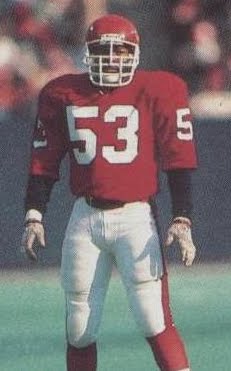
Jacksonville came back in the second quarter to retake the lead as Robinson connected on a nine-yard touchdown pass to TE Paul Bergmann, but the extra point was missed, making the score 13-7. Late in the period, Generals LB Bobby Leopold (pictured above) intercepted a Robinson pass and returned it 16 yards for a New Jersey TD. With the successful extra point, New Jersey took a 14-13 advantage into halftime.

The Generals extended their lead when Walker capped a 76-yard drive on New Jersey’s first possession of the second half with a one-yard touchdown run, making it 21-13. The Bulls chipped away, as Danny Miller kicked two field goals before the period was over to make it a two-point game.

In the fourth quarter, another interception by the Generals led to a score. LB Jim LeClair picked off Robinson at the Jacksonville 22, setting up a five-yard scoring run by Bradley four plays later. New Jersey now had a 28-19 lead with 3:26 left in the fourth quarter.

Following Bradley’s TD, the Bulls responded with an eight-play drive that resulted in a seven-yard scoring pass from Robinson to WR Gary Clark to make it once again a two-point contest with 1:45 still on the clock.

It appeared the Bulls might pull off a win for the big home crowd when they successfully recovered the ensuing onside kick at midfield and drove into field goal range. However, Miller’s attempt from 41 yards was unsuccessful as it curved over the right upright, and New Jersey escaped with a 28-26 win.

Of the missed field goal attempt, Miller said it “really looked like it might have been over the upright…The wind was swirling in there. Ordinarily the ball floats for me, and it went a little bit to the right.”


Jacksonville outgained the Generals (383 yards to 307) and had more first downs (22 to 13). However, they turned the ball over five times, to two suffered by the Generals. While Matt Robinson completed 28 of 51 passes for 329 yards and two TDs, he also threw three interceptions, in particular the two costly ones deep in his own territory that led to scores.

RB Larry Mason paced the Bulls with 69 yards on 14 carries. Paul Bergmann caught 6 passes for 86 yards and a TD, and Gary Clark also had 6 receptions, for 57 yards and a score. For Clark, the rookie out of James Madison, the touchdown was his first as a pro and, while he would end up scoring three in the USFL, he compiled 65 over the course of 11 years in the NFL, as well as catching 699 passes for 10,856 yards.

For New Jersey, Herschel Walker gained a relatively low 72 yards on 21 carries that included the two short touchdown runs. FB Maurice Carthon was right behind with 67 yards on 18 attempts. Phil Bradley completed 8 of 17 passes for 140 yards with an interception. WR Clarence Collins caught three passes for 34 yards and TE Sam Bowers gained 57 yards on two receptions. Bobby Leopold had a notable game on defense, not only scoring on the interception return, but forcing Mason to fumble the ball away near the New Jersey goal line to prevent a score.

Jacksonville maintained good fan support throughout the year (attendance averaged 46,736 per home game), but went a disappointing 6-12 to finish at the bottom of the Southern Division. The defense was weak, the running game poor, and there were many injuries. The veteran Robinson ended up splitting the quarterback job with second-year pro Robbie Mahfouz. However, Gary Clark had a good rookie season, catching 56 passes for 760 yards and two TDs.

New Jersey went on to a 14-4 record to finish second in the Atlantic Division and qualify for the postseason as a wild card. They lost in the first round to the division-rival Philadelphia Stars.

March 3, 2011

1985: Invaders and Stars Play to Only USFL Tie


Just as it has been the case in the NFL since 1974, the use of limited overtime during the regular season made ties unlikely in the United States Football League. However, one game did end in a tie during its three-year existence - on March 3, 1985 at the Oakland-Alameda County Coliseum, the Oakland Invaders and Baltimore Stars played to a deadlock.

The visiting Stars, under Head Coach Jim Mora, were the defending league champions. With the projected move to a fall schedule for 1986, the franchise moved from Philadelphia to Baltimore in order to not have to face direct competition with a NFL club. Relocating was causing difficulties for the team, which was upset by Jacksonville in the season-opening game the week before. The Stars still practiced in Philadelphia and were forced to play home games at the University of Maryland’s Byrd Stadium due to the unavailability of Memorial Stadium in Baltimore.

While the Invaders, like the Stars, were in the league for the third year, they had undergone a transformation during the preceding offseason. With the USFL consolidating some franchises, the Oakland team had been combined with the Michigan Panthers, thus creating a far stronger club. The Invaders had put together two mediocre seasons in a weak division, but Michigan had been in the playoffs both years and won the championship in 1983. As a result, key additions to the Oakland offense were QB Bobby Hebert, WR Anthony Carter (pictured above), and running backs Albert Bentley and John Williams, all stalwart performers for the Panthers. They had won their opening game against Denver after starting slowly and rallying in the fourth quarter.

There were 20,495 fans in attendance as the Stars dominated in the first half. Four minutes into the contest, Baltimore QB Chuck Fusina threw to WR Victor Harrison for a 61-yard touchdown and early 7-0 lead.

Fusina, who was nursing a thumb injury suffered during the season-opening loss, threw for an 11-yard TD to WR Herbert Harris in the second quarter. Meanwhile, the Stars were keeping Oakland’s offense in check.

It seemed as though the Stars had the game wrapped up when they extended their lead to 17-0 in the third quarter, following a 27-yard David Trout field goal. The solid defense had held the Invaders to just 101 yards and five first downs up to that point.

But on the last play of the third quarter, Hebert passed to WR Gordon Banks for a 42-yard touchdown to make it 17-7. On the first play of the fourth quarter, Harris fumbled on the kickoff return and Oakland recovered, setting up a 40-yard field goal by Novo Bojovic to make it a seven-point game.

Now it was Baltimore having trouble moving the football, and with time running out in regulation, the Invaders drove 59 yards in 31 seconds to tie the score. Hebert threw to Carter for an 18-yard touchdown with one second left on the clock and, with the successful extra point, the contest was forced into overtime.

Both teams had opportunities to win during the extra period. With 4:25 left to play, Trout missed a 49-yard field goal attempt for the Stars. Michigan’s Bojovic tried for a 48-yard field goal with 1:47 remaining, but Baltimore LB George Cooper blocked the kick. As a result, the final score was 17-17.

The Stars outgained the Invaders (374 yards to 330) and had more first downs (22 to 16). However, they also turned the ball over four times (one interception, three fumbles) to three by Oakland, and the Invaders sacked Fusina seven times, while Baltimore’s defense got to Hebert on four occasions.

Chuck Fusina completed 20 of 30 passes for 272 yards with two touchdowns and the one interception. The Stars gained 148 yards on the ground, led (as usual) by star RB Kelvin Bryant, who gained 74 yards on 18 carries. RB Allen Harvin caught 5 passes for 41 yards, while Victor Harrison had 77 yards on his two catches, including the one TD.


For Oakland, Bobby Hebert (pictured at left) went to the air 46 times and had 19 completions for 302 yards with two touchdowns and two picked off. Anthony Carter caught 6 passes for 152 yards, including the game-tying TD. The Invaders were able to rush for only 55 yards on 26 attempts, and John Williams accounted for 35 of those yards on 13 carries.

“We came back, and we should have won,” said Bobby Hebert afterward. “Our defense played great. Why we don't play well the first three quarters is something I can't answer. It s just something that's happening.”

The Invaders lost badly to Houston the following week, but rebounded with three straight wins, on the way to placing first in the Western Conference at 13-4-1.

Baltimore continued to struggle, losing at Memphis before finally beating the New Jersey Generals convincingly. They were 5-6-1 two-thirds of the way through the season, and looked unlikely to repeat as champions, but then finished strong with five wins in their last six games to end up at 10-7-1. That placed them fourth in the Eastern Conference, but also got them into the playoffs where they won twice on the road to return to the USFL Championship game – a rematch with the Invaders that they won.

March 2, 2011

1931: Portsmouth Spartans Announce Hiring of Potsy Clark as Head Coach


On March 2, 1931, owner Harry N. Snyder of the NFL’s Portsmouth Spartans returned to that Ohio city from Indianapolis and announced the hiring of George “Potsy” Clark to be the team’s head coach. He indicated that he had been in negotiations with Clark at the Severn Hotel for six hours before reaching an agreement.

“There was a difference in the salary Clark asked for and what we are able to pay and it was some time before we finally came to terms,” said Snyder. The contract was said to be in the neighborhood of $5000. Clark was also being sought by Indiana University to be an assistant, but preferred the opportunity to be a head coach.

Clark succeeded H.W. “Tubby” Griffen, who had resigned two months previously. During the 1930 season, the team’s first in the NFL, the Spartans were 5-6-3 to place eighth in the 11-team league (there were no divisions at that point). With good talent to work with, Griffen was accused of being too lax. The Spartans promised Clark complete control over personnel.

Clark, who picked up his nickname as a child in Carthage, Illinois, played college football first at William & Vashti College and then at the University of Illinois under Head Coach Bob Zuppke. Following graduation, he accepted his first coaching job, at the University of Kansas, which was followed by service in the Army during World War I (in addition to seeing combat in Europe, he also coached service football teams).

He returned from the military to his first head coaching job, at Michigan Agricultural College (now Michigan State University), which went 4-6 in 1920 and featured a wide-open offense. From there it was back to Kansas, where he was head coach for five years and the team tied for a Missouri Valley championship with Nebraska in 1923. After a year as an assistant at Minnesota, Clark became Athletic Director and head coach at Butler University. He did well in three years, but a shakeup of the athletic program forced his resignation. He sat out the 1930 football season, instead running an insurance business, but was eager to return to coaching.

Clark brought a new intensity to coaching the Spartans, and it paid off. The team went a surprising 11-3 in ’31, for a second place finish that was just a game behind the champion Green Bay Packers. In addition to Clark’s coaching, an influx of talented rookies that included tailbacks Dutch Clark and Glenn Presnell, tackle George Christensen, and guard Ox Emerson fueled the team’s rise in the standings.

The Spartans came even closer to a championship in 1932. Another impact rookie, FB Ace Gutowsky, joined the team and Portsmouth went 6-1-4 and, since ties didn’t count in determining winning percentage at that time, finished even with the 6-1-6 Chicago Bears at the top of the standings. A game was arranged between the two teams to determine the champion (while it is sometimes treated as the first NFL Championship game, it was not technically a postseason game since the result counted in the regular season standings). The contest was so hastily scheduled that the team’s best all-around player, Dutch Clark, had already left for his off-season job as basketball coach at Colorado College and couldn’t make it back in time to play against the Bears. Due to bad weather conditions, the contest was held indoors at Chicago Stadium on an 80-yard field and the Bears won, 9-0.

Dutch Clark was gone altogether in 1933, retiring for a year to coach, and while Presnell played well in his absence, the team lost two key games to the Bears. With the NFL now reorganized into divisions, the Spartans finished second in the Western Division at 6-5. It was, however, the end of the line for the franchise in Portsmouth. The team had barely made ends meet throughout its existence, and the Great Depression was adding to the burden of trying to field a pro team in a small city. It was a testament to Coach Clark’s leadership that the team remained competitive when gate receipts were low and meeting the payroll was an uncertainty (late in the ’33 season, both coaches and players were paid in stock instead of cash).

Following the 1933 season, the franchise was sold to George Richards, a radio executive who moved the club to Detroit and renamed it the Lions. Dutch Clark came out of retirement and the team started off with ten straight wins in ’34, including a record streak of seven consecutive shutouts. Two late, close losses to the Bears kept the Lions from winning the Western Division, but they firmly established themselves in their new city and were a solid 10-3.

The Lions won the NFL title in 1935, going 7-3-2 and beating the Giants in the Championship game. The team ran the ball with great effectiveness and was still formidable defensively. They dropped to third in ’36, but with an 8-4 record in the highly-competitive division. Nevertheless, in a stunning move, owner Richards fired Clark as head coach and replaced him with Dutch Clark, who acted as player-coach.

Potsy Clark didn’t stay unemployed for long, as he was quickly hired as head coach by the Brooklyn Dodgers. Brooklyn did not have the same level of talent as Clark had been used to in Portsmouth and Detroit, and had posted losing records in 1935 and ’36. They went 3-7-1 under Clark, but the addition of star tailback Ace Parker during the season had an effect as the Dodgers closed out with a convincing win over Pittsburgh and a tie against the Giants.

Following a .500 finish in 1938, the Dodgers sank back down to 4-6-1 in ’39 and Clark was gone. An ownership change in Detroit led to him being rehired by the Lions for 1940. While star tailback Byron “Whizzer” White, last with Pittsburgh in 1938, joined the team after completing a year as a Rhodes scholar at Oxford, the club no longer had the overall talent that Clark had enjoyed previously and finished at 5-5-1.

Potsy Clark left pro coaching for good after the 1940 season. His combined record of 64-42-12 produced an outstanding .603 winning percentage and included a league title. At the time, only George Halas of the Bears, Curly Lambeau of the Packers, and Steve Owen of the Giants had accumulated more wins as NFL head coaches.

Clark returned to college coaching, as well as military service during World War II, putting in stints at the University of Grand Rapids and Nebraska. His last season as a head coach was in 1948 with the Cornhuskers, and his overall record at the college level was 46-47-7. He served as athletic director at Nebraska until 1954 and at California Western until ’56, when he retired from sports altogether.

Potsy Clark was a good administrator and strong disciplinarian as a coach. He was also affable and a great storyteller, making him a much-requested after-dinner speaker at sports banquets. As a NFL head coach, he was one of the most successful of his era and made the small-city Spartans a contender, as well as winning a championship with the big-city Lions.