May 16, 2012

Rookie of the Year: Peter Boulware, 1997

Linebacker, Baltimore Ravens


Age: 23 (Dec. 18)
College: Florida State
Height: 6’4”    Weight: 255

Prelude:
A defensive end in college, where he gained notoriety for his pass rushing, Boulware was taken by the Ravens in the first round (fourth overall) of the 1997 NFL draft. Converted to outside linebacker, he moved directly into the starting lineup, joining fellow rookie Jamie Sharper and second year MLB Ray Lewis to create a young but formidable linebacking corps.

1997 Season Summary
Appeared and started in all 16 games
[Bracketed numbers indicate league rank in Top 20]

Sacks – 11.5 [9]
Most sacks, game – 2 vs. Philadelphia 11/16, vs. Seattle 12/7
Interceptions – 0
Fumble recoveries – 0
Forced fumble – 1
Tackles – 43
Assists – 15

Awards & Honors:
NFL Defensive Rookie of the Year: AP, PFWA

Ravens went 6-9-1 to finish fifth in the AFC Central.

Aftermath:
Boulware followed up on his outstanding rookie season by gaining selection to the Pro Bowl following the 1998 and ’99 seasons and was also recognized as a first-team All-AFC choice of Pro Football Weekly and second-team All-NFL pick by the Associated Press in 1999. While a shoulder injury caused his performance to level off, he was a mainstay of the defense in 2000 that fueled a late-season run culminating in victory in the Super Bowl. In 2001 he was shifted to defensive end during the season due to injury depletion and the result was a club-record 15 sacks. Boulware returned to outside linebacker and gained selection to two more Pro Bowls in 2002 and ’03. However, his string of 111 consecutive games was broken when he sat out the 2003 season finale due to injury and offseason knee surgery cost him all of 2004. He was released and re-signed to a lesser salary in ’05, playing as a reserve, and injuries forced his release and retirement prior to the 2006 season. Overall, he had 70 regular season sacks and three in the playoffs over the course of his career that included four Pro Bowl selections.

--

Rookie of the Year Profiles feature players who were named Rookie of the Year in the NFL (including NFC/AFC), AFL (1960-69), or USFL (1983-85) by a recognized organization (Associated Press – Offense or Defense, Newspaper Enterprise Association, United Press International, The Sporting News, or the league itself – Pepsi NFL Rookie of the Year). 

[Updated 2/9/14]

May 15, 2012

1983: Bandits Beat Wranglers as Anderson Scores Clinching TD in Debut


The Tampa Bay Bandits had gotten off to a good start in the United States Football League’s inaugural season. Head Coach Steve Spurrier’s team had an outstanding passing offense and was 7-3 in the highly-competitive Central Division. 

However, there was cause for concern in that veteran QB John Reaves had gone down with a broken wrist in the seventh week and his capable backup, Jimmy Jordan, suffered a shoulder separation in Week 10 at Oakland. Thus, the Bandits would have to go with an untested signal caller, Mike Kelley, in their May 15, 1983 game against the Arizona Wranglers. On the upside, rookie RB Gary Anderson (pictured above) would be making his first appearance of the season, having just signed during the previous week.

A star in college at Arkansas, Anderson was drafted in the first round by the NFL’s San Diego Chargers, but they expressed an inclination to shift him to wide receiver. Anderson thus chose to sign with Tampa Bay, where he could continue to play at running back.

As for the visiting Wranglers, they were 4-6 under Head Coach Doug Shively, which was good enough to remain competitive in the weak Pacific Division. Rookie QB Alan Risher was performing ably and WR Jackie Flowers was among the USFL’s top touchdown scorers.

There were 32,327 fans in attendance at Tampa Stadium and they saw the home team score first on a 49-yard field goal by Zenon Andrusyshyn. However, in their second possession the Bandits drove to the Arizona six but Anderson was stopped short on a fourth-and-one carry and the score remained 3-0 after one quarter.

The Wranglers took the lead in the second quarter when RB Harold Blue ran 25 yards for a touchdown, followed by a successful extra point. After Arizona’s touchdown, the Bandits drove to the Arizona 29 but were backed up by a delay of game penalty and Andrusyshyn was then wide to the left on a 51-yard field goal attempt. Later, Tampa Bay again moved the ball to the Wranglers’ 29 but Kelley was intercepted by LB Sam Norris.

Finally, CB Jeff George intercepted a Risher pass at the Arizona 49 and returned it to the 38 yard line. While he fumbled at the end, FS Glen Edwards recovered and the resulting Tampa Bay possession culminated in Kelley tossing a four-yard touchdown pass to star WR Eric Truvillion. The Bandits, despite the missed opportunities, took a 10-7 lead into halftime.

The margin was extended to 13-7 in the third quarter when Andrusyshyn booted a 46-yard field goal. Then in a pivotal play, CB Warren Hanna intercepted a pass by Risher near midfield (Hanna’s third pickoff of the day). Tampa Bay took advantage on a series that ended with Anderson taking a pitchout and running for a 12-yard TD. The additional score proved to be enough – while Risher connected with WR Neil Balholm for an eight-yard touchdown, Tampa Bay was able to hold on for a 20-14 win.

The Bandits dominated statistically, leading in total yards (340 to 197), first downs (21 to 10), and time of possession (34:56 to 25:04). Still, Tampa Bay was nearly undone by 10 penalties as well as four turnovers and Kelley was sacked seven times. But Arizona turned the ball over six times and struggled against the tough Tampa Bay defense.

Gary Anderson had an impressive debut, rushing for 99 yards on 18 carries with the one TD and catching four passes for 54 more yards. Mike Kelley, also making his first pro start, completed 21 of 39 passes for 239 yards with a touchdown and an interception. WR Danny Buggs had 6 catches for 87 yards.

For the Wranglers, Alan Risher completed 13 of 25 throws for 126 yards and a TD, but with four interceptions. TE Mark Keel topped the team with 45 yards on three receptions, and Neil Balholm also caught three passes, for 26 yards, while Jackie Flowers was limited to just two catches for 38 yards. RB Calvin Murray led the ground game with 57 yards on 16 carries.

Tampa Bay ended up going 11-7 and finishing third in the Central Division and just out of the playoffs. The Wranglers completely collapsed, never winning again the rest of the way to finish at 4-14.

In eight games, Gary Anderson continued to play impressively and gained 516 yards on 97 carries for a solid 5.3-yard average while catching 29 passes for 347 yards and a 12.0 average out of the backfield. Mike Kelley won a second straight start and ended up appearing in a total of six games, passing for 1003 yards with four touchdowns against five interceptions. 

May 13, 2012

MVP Profile: Ron Jaworski, 1980

Quarterback, Philadelphia Eagles


Age:  29
7th season in pro football, 4th with Eagles
College: Youngstown State
Height: 6’2”    Weight: 196

Prelude:
Chosen in the second round of the 1973 NFL draft by the Los Angeles Rams, Jaworski saw little action in his first three years, most notably leading LA to a playoff win over the Cardinals in 1975. Dissatisfied with the lack of playing time, he refused to accept a contract extension and was traded to the Philadelphia Eagles for the 1977 season. Installed as the starting quarterback by Head Coach Dick Vermeil, Jaworski developed along with the team, hearing plenty of boos from frustrated fans but also showing a gritty determination and vocal leadership, as well as ability. The Eagles reached the postseason in 1978 with a 9-7 record and again in ’79 at 11-5 and Jaworski threw for 2668 yards and 18 TD passes.

1980 Season Summary
Appeared and started in all 16 games
[Bracketed numbers indicate league rank in Top 20]

Passing
Attempts – 451 [12]
Most attempts, game – 36 at St. Louis 9/28
Completions – 257 [11, tied with Steve Bartkowski]
Most completions, game – 21 at New Orleans 11/9
Yards – 3529 [6, tied with Lynn Dickey]
Most yards, game – 331 at Dallas 12/21
Completion percentage – 57.0 [18]
Yards per attempt – 7.8 [5]
TD passes – 27 [6]
Most TD passes, game – 3 vs. Denver 9/7, vs. NY Giants 9/22, at New Orleans 11/9
Interceptions – 12
Most interceptions, game – 3 at St. Louis 9/28
Passer rating – 91.0 [2, 1st in NFC]
300-yard passing games – 2
200-yard passing games – 12

Rushing
Attempts – 27
Most attempts, game - 4 (for 5 yds.) vs. Dallas 10/19, (for 9 yds.) at New Orleans 11/9
Yards – 95
Most yards, game – 19 yards (on 1 carry) vs. Washington 10/5
Yards per attempt – 3.5
TDs – 1

Scoring
TDs – 1
Points - 6

Postseason: 3 G
Pass attempts – 105
Most attempts, game - 38 vs. Minnesota, NFC Divisional playoff, vs. Oakland, Super Bowl
Pass completions – 44
Most completions, game - 18 vs. Oakland, Super Bowl
Passing yardage – 572
Most yards, game – 291 vs. Oakland, Super Bowl
TD passes – 2
Most TD passes, game - 1 vs. Minnesota, NFC Divisional playoff, vs. Oakland, Super Bowl
Interceptions – 7
Most interceptions, game – 3 vs. Oakland, Super Bowl

Rushing attempts – 3
Most rushing attempts, game - 2 vs. Dallas, NFC Championship
Rushing yards – 2
Most rushing yards, game - 2 vs. Dallas, NFC Championship
Average gain rushing – 0.7
Rushing TDs – 0

Awards & Honors:
NFL Player of the Year: Bert Bell Award
1st team All-NFC: UPI, Pro Football Weekly
Pro Bowl

Eagles went 12-4 to finish first in the NFC East and with the best record in the conference. Won NFC Divisional playoff over Minnesota Vikings (31-16) and NFC Championship over Dallas Cowboys (20-7). Lost Super Bowl to Oakland Raiders (27-10).

Aftermath:
The Eagles got off to a 6-0 start in 1981 but slumped in the second half of the season and lost in the Wild Card round of the playoffs. “The Polish Rifle” threw for 3095 yards and 23 TD passes, but also saw his interception total rise from 12 to 20. The team slid into mediocrity, Vermeil departed, but Jaworski lasted in Philadelphia until 1986. His then-record string of 116 consecutive starts at quarterback came to an end when he suffered a broken leg during the 1984 season. He came back to pass for 3450 yards for the 7-9 Eagles in ’85, but with the arrival of Buddy Ryan as head coach in 1986, he began to yield playing time to Randall Cunningham. Jaworski backed up Dan Marino with the Dolphins in ’88 and started three games for Kansas City in 1989, his final season. At the time of his departure from the Eagles, he was the franchise leader in most major passing categories and, for his overall career, threw for 28,190 yards with 179 TD passes against 164 interceptions.

--

MVP Profiles feature players who were named MVP or Player of the Year in the NFL, AAFC (1946-49), AFL (1960-69), WFL (1974), or USFL (1983-85) by a recognized organization (Associated Press, Pro Football Writers Association, Newspaper Enterprise Association, United Press International, The Sporting News, Maxwell Club – Bert Bell Award, or the league itself). 

[Updated 2/9/14]
[Updated 11/28/14]

May 12, 2012

Rookie of the Year: Steve Bartkowski, 1975

Quarterback, Atlanta Falcons


Age:  23 (Nov. 12)
College: California
Height: 6’4”    Weight: 213

Prelude:
The Falcons traded star OT George Kunz to the Colts to obtain the first overall pick in the 1975 NFL draft in order to select Bartkowski, who passed for 2580 yards as a senior and was already acclaimed for having a strong throwing arm, although he was also immobile and strictly a pocket passer. He was immediately inserted into the starting lineup.

1975 Season Summary
Appeared and started in 11 of 14 games
[Bracketed numbers indicate league rank in Top 20]

Passing
Attempts – 255 [19]
Most attempts, game – 37 vs. San Francisco 12/14
Completions – 115
Most completions, game – 19 vs. San Francisco 12/14
Yards – 1662 [19]
Most yards, game – 305 vs. San Francisco 12/14
Completion percentage – 45.1
Yards per attempt – 6.5 [20]
TD passes – 13 [14, tied with Roman Gabriel]
Most TD passes, game – 3 vs. Washington 12/7
Interceptions – 15 [13, tied with James Harris]
Most interceptions, game – 3 at LA Rams 10/19, vs. Denver 11/23, vs. Washington 12/7
Passer rating – 59.3 
300-yard passing games – 1
200-yard passing games – 3

Rushing
Attempts – 14
Most attempts, game - 5 (for 5 yds.) at St. Louis 9/21
Yards – 15
Most yards, game – 7 yards (on 3 carries) at Oakland 11/30
Yards per attempt – 1.1
TDs – 2

Scoring
TDs – 2
Points – 12

Awards & Honors:
NFC Rookie of the Year: NEA, Sporting News

Falcons went 4-10 to finish third in the NFC West and ranked 20th in the league in total offense (3861 yards) and 19th in passing offense (2067 yards) and scoring (240 points).

Aftermath:
Bartkowski followed up his promising rookie year with two poor seasons in 1976 and ’77, missing much time to injury and playing badly when healthy, and seemed on his way to becoming a major first-round bust. However, he regained his starting job four weeks into the 1978 season and led the Falcons to the first postseason appearance in franchise history. He also played well in the Wild Card playoff win over the Eagles and a near-upset of the Cowboys in the Divisional round. While the team dipped in ’79, Bartkowski continued to improve and had two Pro Bowl years in 1980 and ’81. He threw for 3544 yards and a league-leading 31 TDs in ’80 and a career-high 3829 yards and 30 touchdowns in 1981. Atlanta was 12-4 and back in the postseason in 1980 although again dropped back to 7-9 in ’81. The Falcons were back in the playoffs following the strike-shortened 1982 season. Bartkowski led the NFL in passing in 1983 (97.6 rating) as he threw for 3167 yards with 22 TDs and just 5 interceptions and led the league in completion percentage (67.3) in ’84. However, the team’s performance was dropping off and the effect of taking many sacks was causing shoulder and knee injuries. After appearing in just five games in 1985, he was dealt to the Rams where he was 4-2 as a starter in ’86 before knee problems finally finished his career. Overall, he played 11 years for the Falcons, as well as the one abbreviated season in LA, and completed 55.9 % of his passes for 24,124 yards with 156 TDs and 144 interceptions. His 23,470 yards and 154 TDs with Atlanta remain franchise career records.

--

Rookie of the Year Profiles feature players who were named Rookie of the Year in the NFL (including NFC/AFC), AFL (1960-69), or USFL (1983-85) by a recognized organization (Associated Press – Offense or Defense, Newspaper Enterprise Association, United Press International, The Sporting News, or the league itself – Pepsi NFL Rookie of the Year). 

[Updated 2/9/14]

May 11, 2012

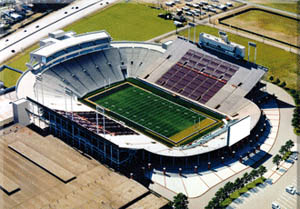
Past Venue: Independence Stadium


Shreveport, LA
aka State Fair Stadium


Year opened: 1925
Capacity: 53,000, up from 40,000

Names:
State Fair Stadium
Independence Stadium

Pro football tenants:
Shreveport Steamer (WFL), 1974-75
Shreveport Pirates (CFL), 1994-95

Postseason games hosted:
None

Other tenants of note:
Shreveport and Bossier City high schools

Notes: Hosts annual Independence Bowl, 1976 to date. Owned by City of Shreveport and located in Louisiana State Fairgrounds along with two other sports venues, Fairgrounds Field and Hirsch Coliseum. Venue is used for high school football and soccer matches. FieldTurf installed in 2010. WFL Steamer started 1974 as Houston Texans but franchise was shifted to Shreveport at midseason. 

Fate: Still in use.


May 9, 2012

MVP Profile: Jamal Lewis, 2003

Running Back, Baltimore Ravens


Age:  24
3rd season in pro football & with Ravens
College: Tennessee
Height: 5’11”  Weight: 231

Prelude:
It was anticipated that Lewis would immediately start at running back when he was taken by the Ravens in the first round (fifth overall) of the 2000 NFL draft. He did, improving as the season went along and gaining 1364 yards on the ground and 296 more on 27 pass receptions for a team that won the Super Bowl. However, he missed all of 2001 due to a knee injury suffered in training camp, but came back strong in ’02, rushing for 1327 yards. With speed as well as power, he also was a productive receiver out of the backfield and caught 47 passes for 442 yards.

2003 Season Summary
Appeared and started in all 16 games
[Bracketed numbers indicate league rank in Top 20]

Rushing
Attempts – 387 [2]
Most attempts, game - 32 (for 134 yds.) vs. Denver 10/26
Yards – 2066 [1]
Most yards, game – 295 yards (on 30 carries) vs. Cleveland 9/14
Average gain – 5.3 [4]
TDs – 14 [3, tied with Shaun Alexander & Clinton Portis]
200-yard rushing games – 2
100-yard rushing games – 12

Pass Receiving
Receptions – 26       
Most receptions, game – 6 (for 43 yds.) vs. Seattle 11/23
Yards – 205
Most yards, game - 44 (on 4 catches) vs. Kansas City 9/28
Average gain – 7.9
TDs – 0

Total yards – 2271 [3]

Scoring
TDs – 14 [6, tied with Clinton Portis]
Points – 84

Postseason: 1 G (AFC Wild Card playoff vs. Tennessee)
Rushing attempts – 14
Rushing yards – 35
Average gain rushing – 2.5
Rushing TDs – 0

Pass receptions – 2
Pass receiving yards - 4
Average yards per reception – 2.0
Pass Receiving TDs - 0

Awards & Honors:
NFL MVP: PFWA
NFL Offensive Player of the Year: AP
1st team All-NFL: AP, PFWA, Sporting News
1st team All-AFC: Pro Football Weekly
Pro Bowl

Ravens went 10-6 to finish first in the AFC North while leading the NFL in rushing yards (2674). Lost AFC Wild Card playoff to Tennessee Titans (20-17).

Aftermath:
Some luster was lost from the outstanding 2003 season when Lewis was indicted on federal drug conspiracy charges in the offseason. He was suspended for two games in 2004 after pleading guilty and then missed two more games with an ankle injury. He was thus limited to 1006 rushing yards – less then half his ’03 total – and caught only 10 passes. Lewis followed up with a poor year in 2004, running for just under a thousand yards (906) while averaging a substandard 3.4 yards per carry. After gaining 1132 yards with a low 3.6-yard average, he was dealt to Cleveland for 2007. Lewis was effective for much of the season, including a 216-yard rushing performance against the Bengals, and ended up with 1304 yards with a 4.4 average gain. He played two more years with the Browns with steadily diminishing returns, putting together his last of seven thousand-yard seasons in ’07 and finishing up with an even 500 yards in 2008. For his career, he rushed for 10,607 yards on 2542 carries for a 4.2-yard average and 58 touchdowns and caught 221 passes for 1879 yards and four more TDs.

--

MVP Profiles feature players who were named MVP or Player of the Year in the NFL, AAFC (1946-49), AFL (1960-69), WFL (1974), or USFL (1983-85) by a recognized organization (Associated Press, Pro Football Writers Association, Newspaper Enterprise Association, United Press International, The Sporting News, Maxwell Club – Bert Bell Award, or the league itself). 

[Updated 2/9/14]

May 8, 2012

1983: Stars Defeat Gold in Lowest-Scoring USFL Game


The Philadelphia Stars had the United States Football League’s best record at 8-1 and were sporting a five-game winning streak as they hosted the Denver Gold on May 8, 1983. Head Coach Jim Mora’s team utilized a conservative, ball-control offense that featured rookie RB Kelvin Bryant and had QB Chuck Fusina behind center. The “Doghouse Defense” was the new league’s best against the run and had also given up the fewest points thus far (83).

The Gold had hosted the Stars in the first week of the regular season, a low-scoring 13-7 win by Philadelphia. It had been a tough road since for Denver, coached by former Broncos Head Coach Red Miller. While the defense kept the club competitive, the offense had difficulty putting points on the board. But while the team’s record was a mediocre 4-5, it matched the other three clubs in the Pacific Division and thus placed the Gold very much in the thick of the race in the USFL’s weakest grouping.

There were 14,306 fans in attendance at Veterans Stadium, and they sat through a scoreless first quarter. It didn’t look like it would be when the Stars went 72 yards in 10 plays on their opening possession, but after reaching the six yard line they were backed up by two penalties and David Trout’s 32-yard field goal attempt hit the right upright.

Brian Speelman finally kicked a 23-yard field goal for Denver to cap a 53-yard drive with 9:39 remaining in the first half. Philadelphia, unable to move the ball effectively after the opening series, responded with a 53-yard field goal by Trout and the game was tied 3-3 at the half.

The Stars, in a third quarter possession that stretched into the first minute of the final period, drove to the Denver one. However, Fusina threw an incomplete pass intended for RB Jeff Rodenberger on third down and Trout kicked another field goal, this time from 18 yards.

Mistakes by the Gold prevented a possible tie or win during the remainder of the fourth quarter. A fumble at the Philadelphia 46 was recovered by safety Mike Lush with 7:31 remaining, snuffing out a potential threat. Denver had another chance to tie late. A drive stalled at the Philadelphia six yard line when Lush and LB Sam Mills stopped a running play on third down, but with 2:07 left a bad snap on the resulting field goal attempt flew to the right of QB Ken Johnson, also the holder on placekicks, and was recovered by the Stars to clinch the 6-3 win.

Philadelphia outgained the Gold (227 yards to 174), had more first downs (16 to 12), and held onto the ball longer (32:53 to 27:07). Both clubs suffered two turnovers and four sacks apiece. The Stars had eight penalties, at a cost of 65 yards, to just three flags thrown on Denver.


Kelvin Bryant, as usual, was the key to the Philadelphia offense, rushing for 94 yards on 23 carries and catching 6 passes for another 50 yards. Chuck Fusina completed just 15 of 29 throws for 135 yards with no TDs and one intercepted. Only four passes were completed to wide receivers, for 43 yards, while TE Steve Folsom had three receptions for 31 yards. In a game dominated by defense, Mike Lush was the standout with an interception that set up the team’s first field goal, a fumble recovery, and a hand in the big third-down stop that set up the Gold’s ill-fated three-point try.

For Denver, 32-year-old CFL veteran Ken Johnson went to the air 24 times and had 11 completions for 107 yards and was intercepted once. Tellingly, Johnson was also the team’s leading rusher with 35 yards on three carries. Harry Sydney had the most yards among the stable of running backs, with 21 on 8 attempts. Running backs Terry Miller and Larry Canada each caught four passes, for 37 and 29 yards, respectively, and two completions went to wide receivers.

The nine total points scored proved to be the lowest over the three years that the USFL existed. There were three ten-point games (two in 1984, one in ’85), with the last one also involving the Stars.

The low offensive output did not presage trouble for the Stars, who bounced back with 24 points in a convincing win at Arizona the following week on the way to topping the Atlantic Division with a 15-3 record. They advanced to the USFL Championship game, losing a close 24-22 decision to the Michigan Panthers.

Offensive problems continued to plague Denver, however, and after scoring just nine points in a loss to Boston in the next contest, Red Miller became the new league’s first coaching casualty. Owner Ron Blanding replaced him with ex-Broncos QB Craig Morton and the Gold ultimately finished third in the Pacific Division at 7-11.