August 14, 2014

Highlighted Year: Michael Bates, 1996

Wide Receiver/Kick Returner, Carolina Panthers


Age: 27 (Dec. 19)
4th season in pro football, 1st with Panthers
College: Arizona
Height: 5’10” Weight: 189

Prelude:
Bates was a track as well as football star in college and won a bronze medal in the 200-yard dash at the 1992 Olympic games. A sixth-round draft choice of the Seattle Seahawks in ’92, he delayed his pro debut until 1993 as a result of his Olympic participation. Used as a blocking fullback in college, Bates was shifted to wide receiver by the Seahawks, but he rarely saw action on offense. In two seasons with Seattle, he returned 56 kickoffs for a 19.8-yard average while catching a total of six passes, one for a touchdown. He was also good on kick coverage, but three concussions suffered in 1993 raised concerns. Waived by the Seahawks, he spent 1995 with the Browns before being dealt to Carolina.

1996 Season Summary
Appeared in 14 of 16 games
[Bracketed numbers indicate league rank in Top 20]

Kickoff Returns
Returns – 33 [17, tied with Tamarick Vanover]
Yards – 998 [12]
Most yards, game – 138 (on 4 ret.) at Philadelphia 10/27
Average per return – 30.2 [1]
TDs – 1 [2, tied with six others]
Longest return – 93 yards

Scoring
TDs – 1
Points – 6

Postseason: 2 G
Kickoff returns – 9
Kickoff return yds. – 214
Most yards, game – 155 (on 5 ret.) vs. Dallas, NFC Divisional playoff
Kickoff return avg. – 23.8
Kickoff return TDs – 0

Awards & Honors:
1st team All-NFL: AP, PFWA, Sporting News
1st team All-NFC: Pro Football Weekly
2nd team All-NFC: UPI
Pro Bowl

Panthers went 12-4 to finish first in the NFC West in just their second season while leading the NFL in kickoff return average (26.2). Won NFC Divisional playoff over Dallas Cowboys (26-17). Lost NFC Championship to Green Bay Packers (30-13).

Aftermath:
The outstanding performance in 1996 marked the first of five straight seaons in which he was selected to the Pro Bowl. Bates again led the NFL in kickoff return average in 1997 (27.3), and in his five years in Carolina returned 233 kickoffs for a 25.7-yard average and five touchdowns. Left unsigned after the 2000 season, he moved on to Washington in ’01 where he averaged 23.5 yards on 49 returns and was cut. Returning to the Panthers for 2002, Bates suffered an injury during the preseason that put him on injured reserve for the year and, after stints with the Jets and Cowboys in 2003, his career came to an end. Overall, he averaged 24.4 yards on 373 kickoff returns, was a consensus first-team All-NFL selection once, received at least some All-NFL or All-NFC consideration after four other seasons, and gained selection to the Pro Bowl five times, noted for both his kick returning and kick coverage. He was named to the 1990s All-Decade team by the Pro Football Hall of Fame.

--

Highlighted Years features players who were consensus first-team All-League* selections or league* or conference** leaders in the following statistical categories:

Rushing: Yards, TDs (min. 10)
Passing: Yards, Completion Pct., Yards per Attempt, TDs, Rating
Receiving: Catches, Yards, TDs (min. 10)
Scoring: TDs, Points, Field Goals (min. 5)
All-Purpose: Total Yards
Defense: Interceptions, Sacks
Kickoff Returns: Average
Punt Returns: Average
Punting: Average

*Leagues include NFL (1920 to date), AFL (1926), AFL (1936-37), AAFC (1946-49), AFL (1960-69), WFL (1974-75), USFL (1983-85)

**NFC/AFC since 1970

August 12, 2014

1960: Unitas to Moore TD Passes Propel Colts to Rout of College All-Stars


The 27th annual College All-Star Game on August 12, 1960 featured the Baltimore Colts, back for a second straight year after repeating as NFL champions, against an All-Star team coached by Otto Graham, former star pro quarterback and now head coach at the Coast Guard Academy.

The Colts, under Head Coach Weeb Ewbank, had a productive passing attack that featured QB Johnny Unitas, HB Lenny Moore, and end Raymond Berry. The defense was strong and had shut the All-Stars down in a 29-0 win in ’59.

Graham, who was coaching the All-Stars for the third consecutive year, had a roster that included future pro stars in Southern Methodist QB Don Meredith, fullbacks Dick Bass of the College of the Pacific and Don Perkins from New Mexico, Vanderbilt HB Tom Moore, ends Carroll Dale from Virginia Tech and Gail Cogdill of Washington State, and Georgia Tech C/LB Maxie Baughan.

There were 70,000 fans in attendance on a warm, moonlit Friday night. On their second possession of the game, the Colts rolled 69 yards in seven plays that culminated in Johnny Unitas tossing a four-yard touchdown pass to Lenny Moore. Steve Myhra added the extra point.

Down by 7-0, the All-Stars responded with an impressive series. Don Meredith connected with Dick Bass on a screen pass for 30 yards and, after Bass carried for nine more yards, a pass interference penalty put the ball on the Baltimore five yard line. However, Meredith fumbled and DE Gino Marchetti recovered for the Colts to end the threat. The Colts then proceeded to drive 95 yards to another Unitas-to-Moore TD, this time covering three yards, and Myhra’s PAT made it 14-0.

Before the half was over, Baltimore took complete control. Myhra booted a 38-yard field goal and then Unitas connected with Moore for a third touchdown of 14 yards. The pro champs had a comfortable 24-0 lead at halftime.


With the game well in hand, Unitas was relieved early in the third quarter by backup QB Ray Brown. The defense put more points on the board when Notre Dame QB George Izo was tossed for a safety by DE Don Joyce and DT Gene “Big Daddy” Lipscomb.

While Gail Cogdill made some good catches for the All-Stars, the running game was kept in check by the savvy Baltimore defense and quarterbacks Meredith, Izo, and Pete Hall of Marquette faced heavy pressure throughout the contest.

Myhra kicked a 27-yard field goal that padded the Baltimore lead to 29-0 after three quarters. Early in the fourth quarter, the All-Stars finally avoided a shutout when Meredith threw a short pass to HB Prentice Gautt of Oklahoma who took off for a 60-yard touchdown. Mississippi’s Bob Khayat added the extra point.

That was all the excitement the collegians would muster, however. Myhra kicked one more field goal, of 26 yards, and once again the Colts were comfortable winners by a final score of 32-7.

Baltimore outgained the All-Stars by 416 yards to 128. The All-Stars managed just 13 yards on the ground and turned the ball over four times, to one turnover by the Colts. Johnny Unitas completed 17 of 29 passes for 237 yards while ends Raymond Berry and Jim Mutscheller combined for nine catches and 153 yards.


Don Meredith (pictured at right) was the most productive of the All-Star quarterbacks, completing 8 of 20 throws for 156 yards and the lone TD. Gail Cogdill made five catches for 64 yards to make him the offensive star for the collegians.

The only downside for the Colts was a broken hand suffered by the All-Pro OT Jim Parker, but he was back in action by the time the regular season came around. Baltimore got off to a 6-2 start but, with a deficient running attack, faded down the stretch to end up at 6-6.

Don Meredith joined the expansion Dallas Cowboys, where he played for nine years and was chosen to the Pro Bowl three times. Gail Cogdill had a stellar rookie season for the Detroit Lions and also went to the Pro Bowl three times over the course of eleven years as a pro.

The win for the Colts put the pro champs ahead in the series by 17 to 8 with two ties, with lopsided results such as that in 1960 becoming more of the norm. 

August 10, 2014

1956: Groza Kicks 4 FGs as Browns Dominate College All-Stars


The 23rd annual College All-Star Game on August 10, 1956 featured the Cleveland Browns, defending NFL Champions for the second straight year, against a squad coached by Curly Lambeau, who had guided the All-Stars to a 30-27 upset win in the previous contest.

The Browns, coached by Paul Brown, were again without QB Otto Graham, who retired for good after the 1955 NFL title game. George Ratterman, who started at quarterback in the previous year’s defeat, was again behind center. Cleveland was better prepared than when facing the All-Stars in ’55, however, and it would show.

The All-Stars featured a lineup that included the reigning Heisman Trophy winner, HB Howard “Hopalong” Cassady from Ohio State, as well as future pro stars such as Michigan State QB Earl Morrall, halfbacks Lenny Moore of Penn State and Preston Carpenter from Arkansas (who had been drafted by the Browns), West Virginia guard Sam Huff, and SMU tackle Forrest Gregg.  

There were 75,000 fans in attendance at Soldier Field for the Friday night game. The All-Stars looked strong on offense as they took the opening kickoff and, with Earl Morrall behind center, got two first downs on an 11-yard pass completion to Navy end Ron Beagle and a ten-yard carry by the quarterback. Cassady ran for nine yards to put the All-Stars at the Cleveland 34. However, Morrall suffered an injury to his throwing hand and, on the next play, DHB Warren Lahr intercepted a pass by QB Jerry Reichow of Iowa in the end zone to snuff out the threat. It would be all downhill for the collegians, as they never again penetrated Cleveland territory for the remainder of the contest.

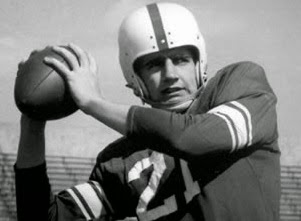
Cleveland methodically moved 80 yards in 12 plays that concluded with George Ratterman passing to HB Fred “Curly” Morrison for a 13-yard touchdown. Lou Groza (pictured at top) added the extra point and the pro champs were up by 7-0.

Early in the second quarter, the Browns reached the All-Star 25 but, after being backed up by a holding penalty, settled for a 47-yard Groza field goal (some sources show shorter distances on the field goals because, under the college rules that the game was played under, field goals were measured from the line of scrimmage rather than the spot of the kick). On the next Cleveland series, the Browns lined up for another field goal try but pulled a fake instead, with DB Tommy James carrying the ball. However, he came up two yards short of the necessary distance for a first down. James made up for it a short time later when he intercepted a pass that set up another Groza field goal, from 37 yards, just before the end of the first half. Cleveland led by 13-0 at the intermission.

Dominating on defense, Cleveland kept it very conservative on offense, making for a dull display for the crowd. Even with Morrall’s return to action for the second half, the All-Stars could not mount a threat. Midway through the third quarter, the Browns had good starting field position due to a shanked punt. A successful Groza field goal try from short range was wiped out by a holding penalty, but he then connected from 31 yards.

Shortly thereafter the collegians, trying to convert a fourth down, lost the ball when FB Don Schaefer fumbled and the Browns recovered at the All-Star 45. That led to a 34-yard field goal that made the score 19-0 heading into the final period.

Early in the fourth quarter, Lenny Moore created some excitement with a 24-yard run for the All-Stars, but the Browns once again stifled the collegians on offense. One final touchdown came at the end of a 38-yard, seven-play series, with HB Gene Filipski running the last two yards to paydirt. It was set up when Preston Carpenter fumbled a punt and DE Jim Ray Smith recovered for the Browns. Groza’s successful PAT put the cap on a convincing 26-0 win.

The Browns led in first downs (18 to 5) and ground out 191 yards on the ground. The All-Stars, who rushed for 121 yards, managed to complete only two of 10 pass attempts for 12 yards and two were intercepted. The All-Stars also fumbled the ball away three times while the Browns suffered no turnovers at all.

Lou Groza’s 14 points, thanks to his four field goals and two extra points, represented the largest individual total since Don Hutson accumulated 19 in 1940. George Ratterman was successful on 7 of 14 passes for 84 yards and a touchdown and his understudy, Babe Parilli, completed one of four throws for four yards but rushed for 39 yards on seven carries. FB Ed Modzelewski led the ground attack, rushing for 76 yards on 21 carries.


For the All-Stars, Earl Morrall (pictured above) completed one of four throws for 11 yards and Jerry Reichow managed one completion for one yard. Don Schaefer topped the collegians with 42 rushing yards on 11 carries while “Hopalong” Cassady, who was playing with an injured heel, was held to 21 yards on six attempts.

Cleveland’s win put the pro champs ahead in the series by 14 to 7, with two ties. However, it didn’t herald another big year for the Browns. They lost four of their first five games on the way to a 5-7 finish, the first losing record in franchise history.

Earl Morrall spent his rookie season with the 49ers and would play for five other teams in a pro career that lasted 21 years. He would return to the College All-Star Game as a member of the Baltimore Colts in 1971.

August 8, 2014

Rookie of the Year: A.J. Duhe, 1977

Defensive End, Miami Dolphins


Age: 22 (Nov. 27)
College: LSU
Height: 6’4”   Weight: 247

Prelude:
Duhe averaged 72 tackles a season in college and was chosen by the Dolphins in the first round of the 1977 NFL draft (13th overall). Looking to refurbish the defense, Miami took another defensive lineman, DT Bob Baumhower, in the second round. Both moved into the starting lineup with outstanding results, along with LB Kim Bokamper, CB Norris Thomas, and FS Vern Roberson, who all gained All-Rookie honors.

1977 Season Summary
Appeared in all 14 games
[Bracketed numbers indicate league rank in Top 20]

Sacks – 7 (unofficial)
Interceptions – 0
Fumble recoveries – 2
Tackles – 83

Awards & Honors:
NFL Defensive Rookie of the Year: AP, PFWA
AFC Rookie of the Year: UPI, Sporting News

Dolphins went 10-4 to finish second in the AFC East.  

Aftermath:
Duhe improved in 1978, despite a leg injury, but was shifted to inside linebacker in ‘79. An outstanding blitzer, he proved to be a good fit as a hybrid outside linebacker/pass rushing end, receiving first-team All-AFC honors from UPI in ’81, and was especially prominent as the Dolphins won the AFC Championship during the strike-shortened 1982 season, most notably with three interceptions against the Jets in the conference title game. Following the ’83 season, when he received second-team All-AFC recognition from UPI, Duhe underwent surgery for rotator cuff and knee surgery, and while he came back to achieve Pro Bowl honors for the only time in his career in 1984, further injuries that required surgery finished him. Duhe ended up playing a total of eight years for the Dolphins and was credited with 8.5 sacks, which reflected his last three seasons after the NFL began to officially compile individual sacks, while the real total was likely closer to 30. He also accumulated around 486 tackles in 108 regular season games.

--


Rookie of the Year Profiles feature players who were named Rookie of the Year in the NFL (including NFC/AFC), AFL (1960-69), or USFL (1983-85) by a recognized organization (Associated Press – Offense or Defense, Newspaper Enterprise Association, United Press International, The Sporting News, or the league itself – Pepsi NFL Rookie of the Year). 

August 6, 2014

1947: Steelers Trade Bill Dudley to Lions


On August 6, 1947 the Pittsburgh Steelers sent star HB Bill Dudley along with tackle Jack Dugger to the Detroit Lions for halfbacks Bob Cifers and Paul White plus the rights to Michigan tailback Bob Chappuis, who still had a year of college eligibility remaining, and an additional first-round draft choice for 1948 that was used to take Texas QB Bobby Layne (whose rights were traded to the Chicago Bears but who would eventually conclude his Hall of Fame career with the Steelers).

Having led the nation by scoring 134 points for Virginia in 1941, the undersized (5’10”, 180 pounds) Dudley was chosen by the Steelers with the first overall draft pick in ’42. His nickname “Bullet Bill” was rather misleading, as he was more elusive than fast. But he was a perfect fit as a tailback in Pittsburgh’s single-wing offense, allaying any concerns about his lack of size by leading the NFL in rushing with 696 yards in the eleven-game season. Dudley also passed for 438 yards (although passing with his sidearm delivery was not his best skill), returned 20 punts for a league-topping 271 yards (13.6 avg.) and led the NFL by averaging 27.1 yards on 11 kickoff returns that included a touchdown. He intercepted three passes on defense and his 1289 all-purpose yards topped the circuit. A fiery team leader, he was a consensus first-team All-NFL selection.

Dudley then spent the next three years in the Army air force during World War II, returning to Pittsburgh for the last four games of the 1945 season. In ’46, he took up where he had left off as a rookie, again leading the NFL with 604 rushing yards, a 14.3 punt return average, 10 interceptions that he returned 242 yards, and 1378 total yards. For his efforts he received the Joe F. Carr Trophy as league MVP.

However, Dudley, who took a beating due to his heavy use, expressed concern with the grind of playing pro football at his size (not helped by his difficult relationship with Head Coach Jock Sutherland, who didn’t appreciate his brashness) and indicated his desire to retire and return to the University of Virginia as an assistant backfield coach.  

Dudley turned down a $20,000 contract offer for 1947. Not surprisingly, when Dudley declared that he would no longer play for the Steelers, the team received many inquiries. The Lions persisted in negotiating the trade over the course of two weeks and Dudley agreed to terms with them for $20,000 plus a $5000 signing bonus, interrupting his honeymoon to fly to Detroit and sign the contract.

“I respect Dudley tremendously as a player,” said Coach Sutherland. “I’m sorry he didn’t see fit to come back to us. Had he decided to retire as he promised, we wouldn’t have had anybody in return. Now that he’s signed with Detroit, we get two players right away and two more next Fall.”

As for the players the Steelers received, all three came out of single-wing offenses and were thus good fits for Pittsburgh’s system. 25-year-old Bob Cifers had played collegiately at Tennessee, where he was coached by Bob Neyland, a friend of Jock Sutherland’s, and was drafted by the Lions in the second round in 1943. He was a triple-threat halfback who had also been an outstanding punter in college and led the NFL in that category with a 45.6-yard average in ’46.

Paul White was also 25 and an 11th round draft choice in 1944 who played one more season of college football for Michigan in 1946 after spending two years in the military. A left-handed halfback, he had been Michigan’s team captain.

Also from Michigan, tailback Bob Chappuis was an outstanding all-around talent who was so highly-touted after setting a Big 10 record for total offense in 1946 that the Lions drafted him in the fifth round as a future pick.

Jack Dugger, the player who was sent to the Lions along with Dudley, had been with Buffalo of the All-America Football Conference in 1946 and expressed a desire to play in Detroit, where he lived. He did so for two seasons before moving on to the Bears.

The Steelers improved from 5-5-1 to 8-4, winning a share of first place in the Eastern Division but losing a playoff to the Eagles. Detroit had been a league-worst 1-10 in ’46 and moved up to just 3-9. Dudley became a halfback in a T-formation offense, and while his rushing total dropped to 302 yards on 80 carries, he caught 27 passes for 375 yards and seven touchdowns. He also continued to return kicks and had five interceptions on defense, and in all scored 11 TDs by means of rushing, pass receiving, a punt return, and an interception return. His all-purpose yards totaled 1322 in nine games, which ranked third in the league. He was also selected team captain by his teammates, who appreciated his leadership by example.

Dudley played two more years with Detroit before moving on to the Washington Redskins, where he was named to the Pro Bowl in 1950 and ‘51. He finished up as a placekicker in 1953, making the most of his multiple talents to the end, and utilizing an odd style in which he didn’t take any steps but simply swung his leg once the ball was set. Overall, he ran the ball 765 times for 3057 yards (4.0 avg.) and 18 touchdowns, caught 123 passes for 1383 yards (11.2 avg.) and another 18 TDs, returned 124 punts for a 12.2 average and three scores, 78 kickoffs for a 22.3 average and a touchdown, and accumulated 23 interceptions that he returned for 459 yards and two more TDs. Dudley also passed for 985 yards and six TDs, punted 193 times for a 37.8-yard average, and kicked 33 field goals and 121 extra points. “Bullet Bill” was inducted into the Pro Football Hall of Fame in 1966 (he had already been selected to the College Football Hall of Fame in 1956).

The Lions never had a winning record during Dudley’s time with the team. After contending in 1947, the Steelers lost Coach Sutherland, who died suddenly in the Spring of ’48, and went 4-8 that Fall.

Bob Cifers played two seasons in Pittsburgh before moving on to Green Bay, rushing for 356 yards in 1947 and 361 in ’48. He averaged 40.4 on 130 punts over that period. Paul White played just one season as a reserve. Bob Chappuis never played for the Steelers, signing with the Brooklyn Dodgers of the AAFC in 1948 instead, and moving on to the Chicago Hornets in ’49, where he finished his brief pro career. 

August 5, 2014

Highlighted Year: Billy Atkins, 1961

Safety/Punter, Buffalo Bills


Age: 27 (Nov. 19)
4th season in pro football, 2nd in AFL & with Bills
College: Auburn
Height: 6’1”   Weight: 195

Prelude:
A star on Auburn’s 1957 national championship team, Atkins was chosen by the San Francisco 49ers in the fifth round of the ’58 NFL draft. He saw some action as a punter and in the defensive backfield in two seasons with the 49ers before moving to Buffalo of the new AFL in 1960, where he averaged 39.0 yards on a league-leading 89 punts and intercepted five passes while starting at cornerback. He was also used as a placekicker and was successful on 6 of 13 field goal attempts. Atkins was shifted to safety in 1961 as personnel was juggled in the defensive backfield.

1961 Season Summary
Appeared in all 14 games
[Bracketed numbers indicate league rank in Top 20]

Interceptions – 10 [1]
Most interceptions, game – 2 vs. NY Titans 9/17, vs. Dallas 10/15, at Dallas 11/12, at Denver 11/19
Int. return yards – 158 [2]
Most int. return yards, game – 52 (on 2 int.) at Dallas 11/12
Int. TDs – 0

Punting
Punts – 85 [1]
Most punts, game – 9 vs. Boston 9/23, at Denver 11/19
Yards – 3783 [1]
Average – 44.5 [1]
Best average, game – 54.6 (on 5 punts) at Boston 10/22
Punts blocked – 1
Longest punt – 70 yards

Kicking
Field goals – 2 [11]
Most field goals, game - 1 at Dallas 11/12, at Denver 11/19
Field goal attempts – 6 [11]
Most field goal attempts, game – 4 at Denver 11/19
Field goal percentage – 33.3
PATs – 29 [4]
PAT attempts – 31 [4]
Longest field goal – 39 yards at Denver 11/19

Rushing
Attempts – 2
Yards – 87
Average gain – 43.5
TDs – 1

Punt Returns
Returns – 2
Yards – 30
Average per return – 15.0
TDs – 0
Longest return – 15 yards

Scoring
TDs – 1
Field Goals – 2
PATs – 29
Points – 41 [20]

Awards & Honors:
1st team All-AFL: UPI, Sporting News, NY Daily News
2nd team All-AFL: League
AFL All-Star Game

Bills went 6-8 to finish fourth in the AFL Eastern Division.  

Aftermath:
Seeking an upgrade at quarterback, the Bills traded Atkins to the New York Titans for veteran QB Al Dorow prior to the 1962 season. He intercepted four passes and was leading the league with a 44.0 punting average when he went down with a knee injury at midseason. Atkins saw little action with the Jets and Buffalo in ’63 and, after a three-game stint with Denver in 1964 his career came to an end. Overall, he intercepted 20 passes (19 of them in the AFL) and averaged 41.6 yards on 221 punts. Atkins went on to become head coach at Troy State and guided the school to the NAIA national championship in 1968. He was a 2005 inductee into the Alabama Sports Hall of Fame.

--

Highlighted Years features players who were consensus first-team All-League* selections or league* or conference** leaders in the following statistical categories:

Rushing: Yards, TDs (min. 10)
Passing: Yards, Completion Pct., Yards per Attempt, TDs, Rating
Receiving: Catches, Yards, TDs (min. 10)
Scoring: TDs, Points, Field Goals (min. 5)
All-Purpose: Total Yards
Defense: Interceptions, Sacks
Kickoff Returns: Average
Punt Returns: Average
Punting: Average

*Leagues include NFL (1920 to date), AFL (1926), AFL (1936-37), AAFC (1946-49), AFL (1960-69), WFL (1974-75), USFL (1983-85)

**NFC/AFC since 1970

August 3, 2014

Rookie of the Year: Mike Ditka, 1961

Tight End, Chicago Bears


Age: 22 (Oct. 18)
College: Pittsburgh
Height: 6’3”   Weight: 230

Prelude:
Ditka was a three-sport athlete in college (baseball and basketball were the others). He led the team in pass receiving three times and was a consensus first-team All-American as a senior. Ditka also played linebacker and defensive end with distinction and punted, setting the tone for his later pro career with his competitive fury and hard-nosed style as well as being a skillful player. He was chosen by the Bears with the fifth overall pick in the first round of the 1961 NFL draft (he was chosen by the Houston Oilers of the AFL, also in the first round) and quickly became a key player on offense at tight end with his ability as a receiver as well as blocker.

1961 Season Summary
Appeared in all 14 games
[Bracketed numbers indicate league rank in Top 20]

Pass Receiving
Receptions – 56 [5, tied with Billy Howton]        
Most receptions, game – 9 (for 190 yds.) vs. Green Bay 11/12
Yards – 1076 [4]
Most yards, game – 190 (on 9 catches) vs. Green Bay 11/12
Average gain – 19.2 [4]
TDs – 12 [2, tied with Buddy Dial]
100-yard receiving games - 5

Scoring
TDs – 12 [4, tied with Buddy Dial]
Points – 72 [10, tied with Buddy Dial & Lou Michaels]

Awards & Honors:
NFL Rookie of the Year: UPI, Sporting News
1st team All-NFL: NEA, Sporting News
2nd team All-NFL: UPI, NY Daily News
Pro Bowl

Bears went 8-6 to finish in a tie for third with the Baltimore Colts in the Western Conference.  

Aftermath:
Ditka was selected to the Pro Bowl in each of the next four seasons and was a consensus first-team All-NFL selection in 1963, when the Bears won the NFL Championship, and ’64, when he caught a career-high 75 passes. He did much to define the newly-evolved position of tight end with his outstanding combination of skills. After a contract dispute fouled his relations with Chicago’s owner and head coach, George Halas, Ditka was traded to the Philadelphia Eagles in 1967, but accumulated wear-and-tear caused his production to drop off during two injury-plagued seasons. After catching 316 passes for 4503 yards and 34 TDs in six years with the Bears, he had just 39 receptions for 385 yards and four TDs in 20 games for the Eagles. Traded again to Dallas, Ditka split time in his last four seasons. He had 30 catches in 1971, a year in which he also caught a touchdown pass in a winning Super Bowl appearance. Ditka retired into coaching after the ’72 season, having caught a total of 427 passes for 5812 yards and 43 TDs. His greatest years came with the Bears, where he was a consensus first-team All-NFL selection twice, received at least second-team recognition after four other seasons, and was named to the Pro Bowl five straight times. He later became head coach of the Bears, leading them to a NFL title in 1985, and also was head coach of the Saints. Ditka’s #89 was retired by the Bears and he was inducted into the Pro Football Hall of Fame, Class of 1988.

--


Rookie of the Year Profiles feature players who were named Rookie of the Year in the NFL, AFL (1960-69), or USFL (1983-85) by a recognized organization (Associated Press – Offense or Defense, Newspaper Enterprise Association, United Press International, The Sporting News, or the league itself – Pepsi NFL Rookie of the Year).