September 5, 2015

1993: Browns Rally from First Quarter Deficit to Defeat Bengals


Two AFC Central rivals, the Cleveland Browns and Cincinnati Bengals, met in a 1993 opening week contest on September 5. Both teams were in a rebuilding mode, with the Browns having gone 7-9 in ’92 and the Bengals 5-11.

Cleveland was beginning its third year under Head Coach Bill Belichick and had been active in signing veteran free agents such as QB Vinny Testaverde, WR Mark Carrier, and G Houston Hoover on offense and DT Jerry Ball and CB Najee Mustafaa on defense. They had also drafted an offensive lineman in the first round, Michigan center Steve Everitt. Still, the starting quarterback was Bernie Kosar (pictured above), in his eighth year with the club, and there were talented veterans on the tough defense that included DT Michael Dean Perry and LB Clay Matthews.

The Bengals were a young team with 28 first- or second-year players on the roster to start the season. They had a young head coach as well in Dave Shula, son of the legendary Don Shula and back for a second season at age 34. QB David Klingler, the team’s 1992 first-round draft choice who started some late-season games, was now taking over for nine-year veteran Boomer Esiason, who had been dealt to the Jets during the offseason.

It was a sunny and mild day with 75,508 fans in attendance at Cleveland Municipal Stadium. The teams exchanged punts to start the game before the Bengals put together an 80-yard drive in six plays. David Klingler completed two passes to WR Jeff Query for gains of 25 and 51 yards. The second was a screen pass in a third-and-nine situation and set up a four-yard touchdown run by RB Ostell Miles. Doug Pelfrey added the extra point.

A short series by the Browns resulted in a punt and Cincinnati, benefiting from a 36-yard return by WR Patrick Robinson, again advanced to a score. Klingler completed a third-and-four pass to RB Derrick Fenner for 23 yards to the Cleveland 18 and, after Fenner ran for four yards, two more passes were good to Miles for nine yards and to WR Carl Pickens for a five-yard TD. Pelfrey again converted and the visitors were staked to a 14-0 lead with three minutes remaining in the opening period.

The Browns responded by driving 80 yards in 10 plays that extended into the second quarter. After a penalty on the Bengals gave Cleveland a first down at its own 31, RB Leroy Hoard ran for 12 yards and Bernie Kosar threw to Mark Carrier for 24 yards to reach the Cincinnati 33. Three consecutive completions that included a third-and-six pass to RB Eric Metcalf for 14 yards advanced the Browns to the 15 and, two plays later, Kosar connected with WR Michael Dyson (aka Jackson) for a 13-yard touchdown. Matt Stover’s point after narrowed the score to 14-7.

The teams again traded punts until the Browns put together another scoring possession, going 59 yards in 10 plays. Kosar started the series off with a throw to Carrier for 29 yards and had four more completions, setting up RB Tommy Vardell’s one-yard touchdown run with 31 seconds remaining in the first half. Stover again added the PAT and the teams went into halftime tied at 14-14.


Cleveland had the first possession in the third quarter and put together an 11-play, 64-yard drive. Vardell (pictured at left) ran effectively, picking up 35 yards on six carries, and while he was held for no gain on a third-and-one play at the Cincinnati 11, Stover put the Browns ahead by three with a 28-yard field goal.

It got worse for the Bengals on the next series as a Klingler pass was intercepted by CB Selwyn Jones, giving the ball back to the Browns at the Cincinnati 48. Kosar immediately threw to Carrier for 26 yards but the home team advanced no further and Stover booted another field goal, this time from 34 yards.

Following another exchange of punts, the Browns added to their lead early in the fourth quarter when Klingler, who was being sacked for the third straight play, fumbled and SS Stevon Moore recovered and ran 22 yards for a touchdown. Stover’s extra point put Cleveland ahead by a commanding 13 points.

Once more the teams traded punts before the Bengals, with 10:25 left to play, took over from their 17 yard line and began to move down the field. Klingler hit on five straight passes, including one to WR Tim McGee that covered 33 yards to the Cleveland 16. A pass interference penalty gave the visitors a first down at the one, but the defense held as three carries by Fenner netted a one-yard loss and on fourth down Klingler fumbled the snap. It was, in essence, the last gasp for Cincinnati.

Taking over on downs, the Browns kept the ball on the ground and were finally forced to punt from their 19 with the clock now down to 1:15. There were no last-minute heroics in store and when Klingler threw a pass that Selwyn Jones intercepted, it nailed down the 27-14 win.       

Cleveland led in total yards (263 to 227), first downs (18 to 12), and time of possession (32:38 to 27:22). The Browns recorded six sacks, to two by Cincinnati, and the Bengals turned the ball over three times, while Cleveland had none. The visitors further were hurt by nine penalties, to five flags thrown on the Browns.

Bernie Kosar completed 18 of 30 passes for 182 yards and a touchdown while giving up no interceptions. Tommy Vardell ran for 60 yards on 16 carries that included a TD while Eric Metcalf, who gained 14 yards on four rushing attempts, had 9 catches for 60 yards. Mark Carrier topped the club with 79 yards on his three pass receptions.
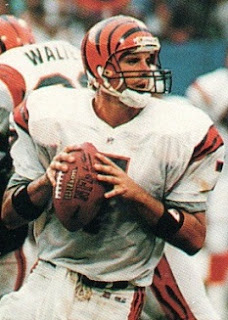

For the Bengals, David Klingler (pictured above) was successful on 20 of 28 throws for 214 yards and a TD, but gave up two interceptions and suffered from being under constant pressure in addition to the sacks. Derrick Fenner rushed for 41 yards on 13 attempts and also pulled in 9 passes for 64 yards. Jeff Query, thanks to the long reception in the first quarter, gained 80 yards on three catches.

The Browns got off to a 3-0 start and then, after a 2-3 stretch, Bernie Kosar was released in a stunning move and ultimately replaced by Vinny Testaverde. Cleveland went 2-6 the rest of the way to end up with another 7-9 record and third place finish in the AFC Central. Cincinnati was 0-10 before finally winning three of its last six contests to place last in the division at 3-13. David Klingler continued to struggle, not helped by the deficient offensive line, and ultimately failed as a starting quarterback. While the Browns would turn things around in ’94 with Testaverde behind center, Cincinnati remained in a prolonged funk, with both Coach Shula and QB Klingler falling by the wayside.

September 4, 2015

Highlighted Year: Steve Bartkowski, 1980

Quarterback, Atlanta Falcons


Age:  28 (Nov. 12)
6th season in pro football & with Falcons
College: California
Height: 6’4”   Weight: 213

Prelude:
The Falcons traded star OT George Kunz to the Colts to obtain the first overall pick in the 1975 NFL draft in order to select Bartkowski, who passed for 2580 yards as a senior and was already acclaimed for having a strong throwing arm, although he was also immobile and strictly a pocket passer. He was immediately inserted into the starting lineup and received NFC Rookie of the Year honors after passing for 1662 yards and 13 touchdowns. Bartkowski followed up his promising rookie year with two poor seasons in 1976 and ’77, missing much time to injury and playing badly when healthy, and seemed on his way to becoming a major first-round bust. However, he regained his starting job four weeks into the 1978 season and led the Falcons to the first postseason appearance in franchise history. He also played well in the Wild Card playoff win over the Eagles and a near-upset of the Cowboys in the Divisional round. While the team dipped in ’79, Bartkowski continued to improve, throwing for 2505 yards and 17 TDs, although giving up 20 interceptions.

1980 Season Summary
Appeared in all 16 games
[Bracketed numbers indicate league rank in Top 20]

Passing
Attempts – 463 [9]
Most attempts, game – 47 at St. Louis 11/9
Completions – 257 [11, tied with Ron Jaworski]
Most completions, game – 31 at St. Louis 11/9
Yards – 3544 [5]
Most yards, game – 378 at St. Louis 11/9
Completion percentage – 55.5
Yards per attempt – 7.7 [6]
TD passes – 31 [1]
Most TD passes, game – 4 at New Orleans 10/19
Interceptions – 16 [18, tied with four others]
Most interceptions, game – 3 at Buffalo 11/2
Passer rating – 88.2 [4]
300-yard passing games – 2
200-yard passing games – 10

Rushing
Attempts – 25
Most attempts, game – 4 (for 4 yds.) at Buffalo 11/2
Yards – 35
Most yards, game – 11 yards (on 2 carries) vs. Detroit 10/5
Yards per attempt – 1.4
TDs – 2

Scoring
TDs – 2
Points – 12

Postseason: 1 G (NFC Divisional playoff vs. Dallas)
Pass attempts – 33
Pass completions – 18
Passing yardage – 320
TD passes – 2
Interceptions – 1

Awards & Honors:
2nd team All-NFC: UPI
Pro Bowl

Falcons went 12-4 to finish first in the NFC West. Lost NFC Divisional playoff to Dallas Cowboys (30-27).

Aftermath:
Bartkowski had another Pro Bowl year in 1981, throwing for a career-high 3829 yards and tossing another 30 touchdowns, although the Falcons dropped back to 7-9. He led the NFL in passing in 1983 (97.6 rating) as he threw for 3167 yards with 22 TDs and just 5 interceptions and led the league in completion percentage (67.3) in ’84. However, the team’s performance was dropping off and the effect of taking many sacks (356 in all) was causing shoulder and knee injuries. After appearing in just five games in 1985, Bartkowski was dealt to the Rams where he was 4-2 as a starter in ’86 before knee problems finally finished his career. Overall, he played 11 years for the Falcons, as well as the one abbreviated season in LA, and completed 55.9 % of his passes for 24,124 yards with 156 TDs and 144 interceptions. His 23,470 yards and 154 TDs with Atlanta were franchise career records that were eventually exceeded by Matt Ryan.

--

Highlighted Years features players who were consensus first-team All-League* selections or league* or conference** leaders in the following statistical categories:

Rushing: Yards, TDs (min. 10)
Passing: Yards, Completion Pct., Yards per Attempt, TDs, Rating
Receiving: Catches, Yards, TDs (min. 10)
Scoring: TDs, Points, Field Goals (min. 5)
All-Purpose: Total Yards
Defense: Interceptions, Sacks
Kickoff Returns: Average
Punt Returns: Average
Punting: Average

*Leagues include NFL (1920 to date), AFL (1926), AFL (1936-37), AAFC (1946-49), AFL (1960-69), WFL (1974-75), USFL (1983-85)

**NFC/AFC since 1970

September 3, 2015

1978: Corral Field Goals Propel Rams to Win Over Eagles


The Los Angeles Rams traveled to Philadelphia to face the Eagles in a NFL season-opening game on September 3, 1978. LA, which went 10-4 in ’77, had a new head coach in Ray Malavasi, elevated to replace George Allen, who returned to the team for 1978 after seven years in Washington only to be fired during a tumultuous preseason, and who was in turn successor to Chuck Knox, who led the Rams to five straight division titles but no Super Bowl appearances. The offense, directed by QB Pat Haden, was deep and talented while the defense was outstanding. One newcomer was Frank Corral (pictured above), a placekicker out of UCLA who was drafted in the third round.

Philadelphia had long been a losing club, including a 5-9 record in 1977, but was looking to improve in Head Coach Dick Vermeil’s third season. The seeds were there in an emerging defense that featured a good line anchored by DE Carl Hairston and a solid corps of linebackers led by Bill Bergey. QB Ron Jaworski was still a work in progress and near the end of the ’77 season rookie HB Wilbert Montgomery, the league’s top kickoff returner, showed promise as a runner from scrimmage and claimed the starting job.

It was a sunny afternoon at Veterans Stadium with 64,721 fans in attendance. The Eagles had the game’s first possession, punted, and LA went 42 yards in 12 plays. Pat Haden completed three passes, two of them to convert third downs, and after the drive finally stalled at the Philadelphia 12, Frank Corral kicked a 29-yard field goal.

The Eagles responded with a promising series spurred by Wilbert Montgomery’s 15-yard carry on first down. Ron Jaworski completed two passes, and was fortunate when an apparent interception was wiped out by a penalty on the Rams. But the home team came up empty when Nick Mike-Mayer’s 37-yard field goal try was blocked.

The teams traded punts as the game moved into the second quarter. A poor kick by Rick Engles that traveled only 29 yards gave the Rams good field position at their own 44 and, keeping the ball primarily on the ground, they went 26 yards in eight plays that concluded with another Corral field goal, this time from 47 yards, to extend their lead to 6-0.

The clubs again exchanged punts and the Eagles squandered good field position at the LA 38 when Jaworski threw a pass that was intercepted by SS Dave Elmendorf. Neither team was able to get out of its end of the field until, in the closing seconds of the first half, Haden connected with WR Dwight Scales for a gain of 21 yards to the Philadelphia 31. However, Corral’s field goal attempt from 48 yards hit the left upright and was unsuccessful.

Both offenses remained stymied during the third quarter, although the Rams were winning the field position battle. A promising LA series that featured a Haden throw to Tyler for 16 yards reached the Philadelphia 24, but Tyler fumbled on a first down carry and Bill Bergey recovered for the Eagles.

Philadelphia kept the ball on the ground and moved effectively, although a fumble by FB Cleveland Franklin turned the ball back over to the Rams. Los Angeles had to punt once again with less than a minute remaining in the period, and as the game moved into the fourth quarter, the Eagles were forced to do the same from their own 21. This time Engles’ punt was blocked by CB Pat Thomas and the bouncing ball was recovered by safety Nolan Cromwell in the end zone for a touchdown.  Corral added the extra point and the Rams were ahead by a seemingly-comfortable 13-0.


Once more the teams traded punts, but Philadelphia finally came alive on offense with nine minutes remaining in regulation. Jaworski (pictured at left), who was the target of booing by frustrated home fans thus far, completed a third-and-six pass to WR Harold Carmichael for 32 yards, another throw drew a pass interference penalty on the defenders, and the five-play, 80-yard series concluded with Jaworski connecting with WR Ken Payne for a 24-yard TD. Mike-Mayer converted and the LA lead was cut to six points at 13-7.

The Rams couldn’t move past their own 20 on the ensuing possession and a punt was pulled in by WR Wally Henry at the Philadelphia 43, who returned it 57 yards for a touchdown. Mike-Mayer added the point after and, in sudden fashion, the Eagles were in front by 14-13 with 5:27 left on the clock.

Once more the teams traded punts following short possessions, and the Rams found themselves with the ball at their own 12 with less than two minutes remaining. Haden completed six of his next seven passes, starting off with one to WR Ron Jessie that gained 29 yards and two to WR Willie Miller that picked up ten yards apiece. The 60-yard drive concluded with Corral kicking a 46-yard field goal with seven seconds remaining, and the Rams won by a final score of 16-14.

In a contest in which neither offense excelled, Los Angeles had more total yards (220 to 208) and first downs (15 to 10). The Eagles recorded five sacks, to three by LA. They also turned the ball over twice, to one by the Rams, while the visitors were penalized 10 times at a cost of 82 yards, to three flags thrown on Philadelphia. The teams combined for 17 punts (nine by the Rams, eight by the Eagles) and the special teams for each club each accounted for a touchdown.


Pat Haden (pictured at right) completed just 14 of 33 passes for 154 yards and no touchdowns, but also gave up no interceptions and performed well in the clutch. Wendell Tyler led the Rams in rushing with 36 yards on 10 carries while Willie Miller was the top receiver with three catches for 44 yards. Frank Corral was good on three of four field goal attempts, two of them from over 40 yards that included the game-winner.

For the Eagles, Ron Jaworski was successful on 7 of 17 throws for 102 yards and a TD while being picked off once. Wilbert Montgomery ran for 46 yards on 12 attempts and caught a pass for 23 yards. Harold Carmichael’s one reception for 32 yards made him the leader in receiving yards while Mike Hogan, who ran for 37 yards on 8 carries, and TE Keith Krepfle each had two pass receptions, for 12 and 11 yards, respectively.

“I’m not going to let the fans substitute my quarterback,” said a Coach Vermeil of the booing directed toward Ron Jaworski. “I got one who can win for us; they can boo all they want. I’m not going to take him out. The only ways he matures is if he throws nine innings. They can boo for six months; he will get better.”

Vermeil did indeed stick with Jaworski, with favorable results, and Wilbert Montgomery rushed for 1220 yards. Following another defeat, the Eagles won four of their next five games on the way to a 9-7 record and Wild Card spot in the playoffs. They lost to Atlanta in the first round. The Rams reeled off seven straight wins as they topped the NFC West once again with a 12-4 tally. They made it to the NFC Championship game before falling to the Dallas Cowboys.

Frank Corral’s opening week heroics launched a season in which he led the NFL in field goals (29) and scoring (118 points). He was named to the Pro Bowl in what would prove to be the best of his four years with Los Angeles which also included doing double duty as punter in the last two.

September 2, 2015

Highlighted Year: Carl Birdsong, 1982

Punter, St. Louis Cardinals


Age: 23
2nd season in pro football & with Cardinals
College: Southwestern Oklahoma State
Height: 6’0”   Weight: 192

Prelude:
After averaging 42.3 yards in two college seasons (he transferred from West Texas State to Southwestern Oklahoma State for academic purposes), Birdsong signed with the Buffalo Bills as an undrafted free agent in 1981. Failing to make it to the regular season, he was picked up by the Cardinals and averaged 41.8 yards on 69 punts, which included a NFL-high 75-yard kick.

1982 Season Summary
Appeared in all 9 games
[Bracketed numbers indicate league rank in Top 20]

Punting
Punts – 54 [3]
Most punts, game – 10 at Washington 1/2
Yards – 2365 [3]
Average – 43.8 [3, 1st in NFC]
Best average, game – 48.0 (on 6 punts) vs. Dallas 9/19
Punts blocked – 0
Longest punt – 65 yards

Postseason: 1 G (NFC First Round playoff at Green Bay)
Punts – 0

Awards & Honors:
2nd team All-NFC: UPI

Cardinals went 5-4 in the strike-shortened season and were sixth seed in the NFC playoff tournament that replaced the usual postseason format. Lost First Round playoff to Green Bay Packers (41-16).

Aftermath:
Birdsong averaged 41.5 yards on 85 punts in 1983 and was selected to the Pro Bowl as well as receiving All-NFC honors from UPI and Pro Football Weekly. His performance dropped off in ’84 and he was released by the Cards after the 1985 season and went on to a career in pharmacology, having obtained his degree during his playing career. Overall, over five seasons Birdsong punted 360 times for a 41.4-yard average. He received first- or second-team All-NFC honors twice and was chosen to the Pro Bowl once.

--

Highlighted Years features players who were first-team All-League* selections or league* or conference** leaders in the following statistical categories:

Rushing: Yards, TDs (min. 10)
Passing: Yards, Completion Pct., Yards per Attempt, TDs, Rating
Receiving: Catches, Yards, TDs (min. 10)
Scoring: TDs, Points, Field Goals (min. 5)
All-Purpose: Total Yards
Defense: Interceptions, Sacks
Kickoff Returns: Average
Punt Returns: Average
Punting: Average

*Leagues include NFL (1920 to date), AFL (1926), AFL (1936-37), AAFC (1946-49), AFL (1960-69), WFL (1974-75), USFL (1983-85)

**NFC/AFC since 1970

September 1, 2015

1996: Ravens Defeat Raiders as NFL Returns to Baltimore


The National Football League returned to Baltimore on September 1, 1996 as the newly-relocated Ravens hosted the Oakland Raiders in the season-opening game for both teams. It was the first NFL regular season game played in Baltimore in 13 years, since the Colts vacated for Indianapolis.

The Ravens were in actuality the former Cleveland Browns franchise. As part of a deal between the NFL and Cleveland, the team renounced its history, name, and colors, to transfer to a future expansion franchise.  The club also made changes to the front office and had a new head coach in Ted Marchibroda, once coach of the Baltimore Colts, replacing Bill Belichick, under whom the team dropped to 7-9 in its final lackluster year in Cleveland (not helped by long-time owner Art Modell announcing midway through the season that the franchise would be moving in ’96). While much was new, there were still lingering problems from the previous year. There were concerns regarding the running game, and 32-year-old QB Vinny Testaverde was prone to inconsistency and throwing interceptions. The defense was in need of retooling, but there were high hopes for rookie LB Ray Lewis.

The Raiders, coached by Mike White, had returned to Oakland the previous season after a 13-year hiatus in Los Angeles. Getting off to an 8-2 start, they lost their last six games to finish at .500. An injury to QB Jeff Hostetler was a key factor in the collapse, and he was out again for the start of the ’96 season. Backup QB Billy Joe Hobert was taking his place.  WR Tim Brown was the most consistent receiver and it was hoped that rookie TE Rickey Dudley would have an impact.

There were 64,124 fans in attendance at Memorial Stadium on a pleasant and sunny day and several ex-Colts stars took part in the pre-game festivities, including Hall of Fame QB Johnny Unitas and DT Art Donovan. The teams traded punts to start the game before the Ravens drove 85 yards in eight plays. Vinny Testaverde completed three passes, including one to WR Derrick Alexander that covered 48 yards to get the ball into Oakland territory, and the veteran quarterback finished off the series by running up the middle for a nine-yard touchdown (pictured at top). Matt Stover added the extra point, and with less than a minute remaining in the first quarter the home team was ahead by 7-0.

The Raiders started off the second quarter by going 79 yards in nine plays. Billy Joe Hobert (pictured below) threw to WR James Jett for a 33-yard gain to the Baltimore 34 on the first play and Hobert converted a third-and-two situation with a pass to WR Daryl Hobbs for 15 yards to the 11. Three plays later, Tim Brown pulled in a toss from Hobert for a seven-yard TD and Cole Ford tied the score with the point after.


Oakland appeared to get a major break on the ensuing kickoff when RB Earnest Hunter fumbled and safety Dan Land recovered for the Raiders at the Baltimore 19. But on the next play, Hobert’s throw intended for Brown in the end zone was instead intercepted by Ray Lewis for a touchback.

A short possession in which Testaverde was sacked for a 19-yard loss resulted in a punt and, taking over with good field position at the Baltimore 47, the Raiders did not come up empty. After two short runs, Hobert connected with Jett for nine yards and then to Rickey Dudley for a 30-yard gain. RB Harvey Williams covered the last five yards for a touchdown and, with Ford’s PAT, the visitors were ahead by 14-7. That remained the score at the half as the teams exchanged punts for the remainder of the period.

The Raiders had the ball first in the third quarter but Hobert again was picked off, this time by CB Antonio Langham who returned it 28 yards to the Oakland 25. The Ravens were unable to move from there, and following a third-down sack, punted. But the visitors remained bottled up deep in their own territory and, after Jeff Gossett’s 43-yard punt that was returned for nine yards by WR Jermaine Lewis, Baltimore started its next series at the Oakland 45. Utilizing a no-huddle offense, Testaverde completed three passes, including one to WR Michael Jackson that picked up 21 yards, but the drive stalled inside the ten. Still, the Ravens got points on a 25-yard Stover field goal to narrow the score to 14-10.

The Raiders again had to punt following their next series and Baltimore responded by advancing 56 yards in seven plays. Testaverde completed two passes to TE Brian Kinchen, one of which gained 29 yards to the Oakland 26, and while a reverse by Alexander lost 13 yards, two more completions got the home team back into field goal range. Stover was successful from 37 yards and it was a one-point game at 14-13 after three quarters.

Another possession by the Raiders ended with a punt. Starting from their 17, the Ravens moved quickly as Testaverde connected on passes to Jackson for 27 yards and Earnest Hunter for 25 to reach the Oakland 31. FB Carwell Gardner picked up nine yards on three carries and Testaverde ran around end for 12 yards to get inside the ten. Finally, on the eighth play of the 83-yard possession, RB Earnest Byner reached the end zone from a yard out and, while the try for a two-point conversion failed, the Ravens were ahead by five points.

That proved to be all the home team needed. The Raiders had two more possessions but went three-and-out both times and Baltimore was able to control the ball for the last 4:47 of the contest to come away with a 19-14 win.

The Ravens led in total yards (314 to 238), first downs (21 to 13), and time of possession (34:38 to 25:22). Oakland turned the ball over twice, to one suffered by Baltimore, and was hurt by 12 penalties, to just two called on the Ravens. Both teams recorded three sacks apiece.

Vinny Testaverde completed 19 of 33 passes for 254 yards, with no touchdowns but also no interceptions, and he ran for a score. Earnest Byner (pictured below) rushed for 43 yards on 14 carries that included the game-winning TD and caught four passes for 32 more yards. Brian Kinchen and Carwell Gardner also co-led the team with four pass receptions apiece, for 57 and 16 yards, respectively, while Michael Jackson was the yardage leader with 60 on his three catches.


For the Raiders, Billy Joe Hobert was successful on 17 of 26 throws for 192 yards and two TDs while being intercepted twice. James Jett topped the club with 65 yards on his four pass receptions and Tim Brown scored on two of his four catches, for 31 yards. Harvey Williams gained 39 yards on 13 rushing attempts. 

While the season started on a high note for the Ravens, they lost their next two games on the way to ending up at the bottom of the AFC Central with a 4-12 record. Oakland got Jeff Hostetler back into the lineup for 13 games but went 7-9 to finish in fourth place in the AFC West.

Vinny Testaverde had a big year for a mediocre team, achieving career highs with 4177 passing yards and 33 touchdowns, both of which were still single-season records for the Ravens through 2014. He was selected to the Pro Bowl.

August 31, 2015

Highlighted Year: Kelvin Bryant, 1984

Running Back, Philadelphia Stars


Age: 23
2nd season in pro football & with Stars
College: North Carolina
Height: 6’2”   Weight: 195

Prelude:
A three-time All-Atlantic Coast Conference back in college, Bryant was chosen by the Stars in the first USFL territorial draft and went with the new league (the Washington Redskins selected him in the 7th round of the ’83 NFL draft even though he had already signed with the USFL). He moved directly into the starting lineup and quickly became the focal point of the ground-oriented offense. Bryant rushed for 1442 yards and 16 TDs, caught 53 passes for another 410 yards and a score, and received MVP honors from the league as well as consensus first-team All-USFL recognition.

1984 Season Summary
Appeared in 15 of 18 games
[Bracketed numbers indicate league rank in Top 20]

Rushing
Attempts – 297 [1, tied with Joe Cribbs]
Most attempts, game – 27 (for 114 yds.) vs. Tampa Bay 4/1
Yards – 1406 [2]
Most yards, game – 194 yards (on 24 carries) at Denver 6/8
Average gain – 4.7 [11]
TDs – 13 [6, tied with Leon Perry]
100-yard rushing games – 5

Pass Receiving
Receptions – 48      
Most receptions, game – 5 (for 34 yds.) vs. Oakland 3/18
Yards – 453
Most yards, game – 67 (on 3 catches) vs. Pittsburgh 6/4
Average gain – 9.4
TDs – 1

Scoring
TDs – 15 [5, tied with Richard Johnson & Kevin Long]
Points – 90 [5, tied with Richard Johnson & Kevin Long]

Postseason: 3 G
Rushing attempts – 80
Most rushing attempts, game – 29 vs. Arizona, USFL Championship
Rushing yards – 384
Most rushing yards, game – 152 vs. Birmingham, Eastern Conference Championship
Average gain rushing – 4.8
Rushing TDs – 5

Pass receptions – 4
Most pass receptions, game – 2 vs. New Jersey, USFL First Round playoff
Pass receiving yards – 45
Most pass receiving yards, game - 32 vs. New Jersey, USFL First Round playoff
Average yards per reception – 11.3
Pass Receiving TDs – 1

Awards & Honors:
1st team All-USFL: League, Sporting News, College & Pro Football Newsweekly, Pro Football Weekly

Stars went 16-2 to finish first in the USFL Atlantic Division with the league’s best record. Won First Round playoff over New Jersey Generals (28-7), Eastern Conference Championship over Birmingham Stallions (20-10), and USFL Championship over Arizona Wranglers (23-3).

Aftermath:
Bryant continued to be one of the league’s best runners, even though battling occasional injuries, tying for fourth in ’85 with 1207 yards. He ended up gaining 4055 yards over the course of the three USFL seasons, and the Stars won the league championship in the last two. Following the demise of the USFL, Bryant joined the Redskins where he spent four seasons from 1986 to ’90, missing all of 1989 due to a neck injury. In the NFL, he battled injuries and was utilized more for his pass receiving skills, catching over 40 passes in each of his first three years but only once compiling as many as 100 carries (108 in 1988). With Washington, he rushed for a total of 1186 yards and caught 154 passes for 1634 yards.

--

Highlighted Years features players who were consensus first-team All-League* selections or league* or conference** leaders in the following statistical categories:

Rushing: Yards, TDs (min. 10)
Passing: Yards, Completion Pct., Yards per Attempt, TDs, Rating
Receiving: Catches, Yards, TDs (min. 10)
Scoring: TDs, Points, Field Goals (min. 5)
All-Purpose: Total Yards
Defense: Interceptions, Sacks
Kickoff Returns: Average
Punt Returns: Average
Punting: Average

*Leagues include NFL (1920 to date), AFL (1926), AFL (1936-37), AAFC (1946-49), AFL (1960-69), WFL (1974-75), USFL (1983-85)

**NFC/AFC since 1970

August 30, 2015

1939: Giants Use 3 Field Goals to Defeat College All-Stars


The New York Giants represented the NFL in the sixth installment of the College All-Star Game in Chicago on August 30, 1939. They faced an All-Star squad coached by Elmer Layden, head coach of Notre Dame and a former member of that school’s famed “Four Horsemen” backfield.

The Giants were coached by Steve Owen, who had guided the club to two NFL Championships in eight years, including the 1938 season. New York had an able passer in tailback Ed Danowski and could run the ball effectively, most notably with FB Tuffy Leemans carrying. C/LB Mel Hein was coming off of a season in which he had been named MVP by the league and the team allowed few points on defense. Returning to the club was Ken Strong (pictured above), a former star fullback and placekicker who had jumped leagues after the 1935 season but was back at age 33.

The All-Stars had won the previous two contests and this year’s roster included future pro stars in center Charley Brock from Nebraska, Pitt HB Marshall Goldberg, FB Bill Osmanski of Holy Cross, and the diminutive Heisman-winning QB Davey O’Brien from TCU.  

There were 81,456 fans in attendance for the Wednesday night game at Soldier Field. The All-Stars were in trouble early when Davey O’Brien fumbled the game’s first punt and end Jim Poole recovered for New York. However, the Giants were unable to capitalize when Ward Cuff missed a field goal from 41 yards by inches.

Following an exchange of punts, the Giants again moved into scoring territory thanks to good runs by FB John “Bull” Karcis and Cuff. Cuff kicked a 34-yard field goal late in the first quarter to put the Giants in front.

In the second quarter, New York put together a 56-yard series that led to another field goal, this time by Ken Strong from 22 yards, to take a 6-0 advantage. The All-Stars responded by driving from their 28 to the New York 39, with the big play a 15-yard run by Bill Osmanski. However, a second-down pass by Michigan State back Johnny Pingel was intercepted by LB Kayo Lunday to end the threat.

The Giants attempted to add to their advantage in the third quarter with a drive to the All-Star 13, but came up empty when O’Brien intercepted a pass. The pro champs mounted another strong possession to the All-Star two, but Cuff’s try for a field goal hit the upright and bounced away.

Following more punts which included a quick-kick by the Giants that pinned the All-Stars back at their 20, New York got another field goal, again by Strong, who connected from 41 yards.

The All-Stars finally mounted a threat in the fourth quarter with Baylor QB Bill Patterson in the game, who threw the ball effectively. But drives to the New York 11 and 17 were blunted by interceptions by DB Len Barnum and LB Doug Oldershaw, respectively. The Giants came away with a 9-0 win in which they were more dominant than the score indicated.


The Giants, who controlled the line of scrimmage and kept the collegians bottled up on their side of the field for most of the game, had the edge in total yards (199 to 166) although the All-Stars had more first downs (10 to 9). However, New York intercepted five passes. Bill Osmanski (pictured at left) and QB George Faust from Minnesota drew praise as the best of the All-Star rushers.

The win for the Giants tied the series, which was far more competitive at that point than it would be in the ensuing years of its existence, at two wins apiece, with two ties.  New York again topped the Eastern Division with a 9-1-1 record during the regular season but lost in a title rematch with the Green Bay Packers.

Bill Osmanski played seven years in the NFL with the Chicago Bears and led the league in rushing as a rookie in 1939. Davey O’Brien also had a fine first year with the Philadelphia Eagles, passing for a NFL-high 1324 yards in his first of two pro seasons before leaving to join the FBI.