Showing posts with label 1948 NFL season. Show all posts

August 20, 2013

1948: Cards Shut Out College All-Stars


The 15th annual College All-Star Game on August 20, 1948 featured the Chicago Cardinals, defending NFL Champions, against a highly-regarded group of All-Stars coached by Notre Dame’s Frank Leahy. The All-Stars had won the last two games by identical 16-0 scores and the Cardinals came into the contest as underdogs, which was certainly an oddity in the history of the series.

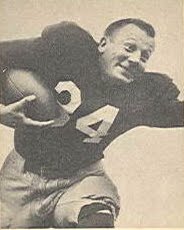
The Cardinals, playing in their home town, were coached by Jimmy Conzelman and known for their outstanding offensive backfield that featured QB Paul Christman, FB Pat Harder, and halfbacks Charlie Trippi (pictured above) and Elmer Angsman operating out of the T-formation.

The past two winning All-Star teams had utilized the T-formation but Coach Leahy made a controversial decision in deciding to split his squad into T-formation and single wing groups. There was plenty of depth for both, with four T-formation quarterbacks (most notably Bobby Layne of Texas and Notre Dame’s Johnny Lujack) and three single wing tailbacks on the roster.

There was a crowd of 101,220 in attendance at Soldier Field under a full moon for the Friday night contest. The All-Stars got the first break early in the contest when C Dick Scott of Navy recovered a fumble by Charlie Trippi in Chicago territory.  However, they were unable to move the ball as Johnny Lujack threw two incomplete passes and Charlie Conerly of Mississippi punted into the end zone for a touchback.

The Cards responded impressively by going 80 yards in 15 plays.  Only one was a pass as Chicago moved methodically down the field, with the longest gain 19 yards on a lateral from Paul Christman to Elmer Angsman. Angsman finished the series as he punched over for a touchdown from two yards out and Pat Harder added the extra point.

The All-Stars threatened in the second quarter but turned the ball over on downs at the Chicago 32 yard line. The collegians got a break shortly thereafter when HB Boris “Babe” Dimancheff fumbled and the All-Stars recovered at the Chicago 27. Shifting to the single-wing, they advanced ten yards and again came away empty.


The Cards responded with another impressive drive, going 83 yards in nine plays. Three were Christman (pictured at right) pass completions, to Angsman and ends Bill Dewell and Mal Kutner. They scored on a 14-yard run by HB Vic Schwall on a quick-opener and Harder again successfully converted.

The All-Stars recovered yet another fumble by the Cards and Michigan end Len Ford ran 55 yards for what would have been a touchdown under NFL rules. However, they were using college rules for the All-Star Game and the ball was returned to the point of recovery. The tally remained 14-0 in favor of the Cardinals at the half.

The All-Stars provided some excitement in the scoreless third quarter, putting together an 84-yard drive. Notre Dame HB Bill Gompers ran for 20 yards on a sweep and Conerly tossed a lateral to Lujack who proceeded to fire a long pass to end Dan Edwards for a 44-yard gain. Two big defensive plays by DB Marshall Goldberg kept the All-Stars out of the end zone, however, the big one a stop of FB Floyd Simmons, another Notre Dame participant, at the one foot line on fourth down.

The Cards made it a rout in the fourth quarter. First, LB Vince Banonis intercepted a pass by Illinois QB Perry Moss and returned it 31 yards for a touchdown. Then LB Bill Blackburn recovered a fumble by Bobby Layne that set up a 13-yard scoring pass from QB Ray Mallouf to Trippi four plays later. Harder kicked both extra points and that was more than enough as the Cardinals came away with a big 28-0 win.

It was the most decisive score thus far in the history of the series. Passing yardage was practically even (133 to 132 yards, in favor of Chicago) but the Cardinals had 200 rushing yards, almost twice the total amassed by the collegians. The Cards fumbled the ball away three times, all in the first half. However, they only punted three times and the defense did a fine job of keeping the All-Star attack in check.

The win for the defending NFL champs was the eighth thus far, with the All-Stars having won five and two ending in ties. Center Jay Rhodemyre of Kentucky was voted the most valuable player by his All-Star teammates.

Chicago went on to have another outstanding season, topping the Western Division with an 11-1 record. However, they lost the NFL Championship game to the Philadelphia Eagles in blizzard conditions.

February 25, 2012

MVP Profile: Pat Harder, 1948

Fullback/Linebacker, Chicago Cardinals


Age: 26
3rd season in pro football & with Cardinals
College: Wisconsin
Height: 5’11” Weight: 205

Prelude:
Chosen in the first round of the 1944 NFL draft (second overall) by the Cardinals, Harder joined the club in ’46 after completing military service. A straight-ahead power runner who also blocked well, he proved to be a good complement to halfbacks Elmer Angsman and, from ’47, Charley Trippi. He also kicked five extra points as a rookie and added field goal kicking in 1947, leading the league with 7 in 10 attempts for a 70 % success rate, which also topped the NFL, and was the top scorer with 102 points. He was a second-team All-NFL selection by Pro Football Illustrated in 1946 and a first-team choice by Pro Football Illustrated, the New York Daily News, and UPI in ’47 as the Cardinals won the NFL title.

1948 Season Summary
Appeared in all 12 games
[Bracketed numbers indicate league rank in Top 20]

Rushing
Attempts – 126 [6]
Yards – 554 [6]
Yards per attempt – 4.4 [9]
TDs – 6 [4, tied with Charley Trippi]

Pass Receiving
Receptions – 13
Yards – 93
Yards per catch – 7.2
TDs – 0

Kicking
Field goals – 7 [2]
Field goal attempts – 17 [1]
Percentage – 41.2 [3]
PATs – 53 [1]
PAT attempts – 53 [1]
Longest field goal – 35 yards at LA Rams 10/31

Scoring
TDs – 6 [16, tied with four others]
Field goals – 7
PATs - 53
Points – 110 [1]

Postseason: 1 G (at Philadelphia, NFL Championship)
Rushing attempts – 11
Rushing yards – 30
Average gain rushing – 2.7
Rushing TDs – 0

Field goals – 0
Field goal attempts – 1

Awards & Honors:
NFL MVP: UPI
1st team All-NFL: UPI, Chicago Herald-American, Pro Football Illustrated, NY Daily News
2nd team All-NFL/AAFC: Sporting News

Cardinals went 11-1 to win the Western Division while leading the NFL in total offense (4694 yards), rushing yards (2560), and scoring (395 points). Lost NFL Championship to Philadelphia Eagles (7-0).

Aftermath:
Harder again received first-team All-NFL recognition in 1949 from UPI and the New York Daily News as he rushed for a career-high 554 yards and led the league in scoring for the third straight year with 102 points. The team was going into decline, however, and after a Pro Bowl year in ’50 he threatened to retire unless traded. Harder was dealt to the Detroit Lions, a team on the rise, and continued to be a valued contributor at fullback. When HB/PK Doak Walker was lost to injury in ’52, Harder again handled the bulk of the placekicking and booted a career-high 11 field goals for the NFL Champion Lions, again gaining selection to the Pro Bowl. By 1953, however, bad knees forced his retirement. In eight years, he rushed for 3016 yards and 33 TDs, caught 92 passes for another 864 yards and 5 TDs, kicked 35 field goals and 198 extra points, and scored 531 points.

--

MVP Profiles feature players who were named MVP or Player of the Year in the NFL, AAFC (1946-49), AFL (1960-69), WFL (1974), or USFL (1983-85) by a recognized organization (Associated Press, Pro Football Writers Association, Newspaper Enterprise Association, United Press International, The Sporting News, Maxwell Club – Bert Bell Award, or the league itself).

[Updated 2/9/14]

December 19, 2009

1948: Eagles Defeat Cardinals in Blizzard for NFL Championship


The NFL championship matchup on December 19, 1948 was a repeat of the previous year, but the weather was not. The field was frozen when the Philadelphia Eagles and Chicago Cardinals met in ’47 at Comiskey Park, but in this instance a heavy winter storm dumped snow on Philadelphia all day. While a protective tarpaulin had been placed over the field, the snow had accumulated so heavily on it that the players had to assist the grounds crew in its removal a half hour before the game. Even then, the turf at Shibe Park was completely covered at the kickoff.

Eagles Head Coach Greasy Neale was in favor of postponing the contest, but Commissioner Bert Bell, citing the sellout crowd (28,864 actually showed up) and the national radio audience, suggested that the players decide. To Bell’s satisfaction, both teams wanted to play, and play they did. The Commissioner ruled that the first down chain would be used, but there would be no measurements – the referee would rule on all first downs. Ropes were tied to stakes to mark the sidelines.

The game started a half hour late, at two o’clock rather than the scheduled 1:30. Fortunately, Eagles star halfback Steve Van Buren arrived about an hour before the game – he had gone back to bed when he saw the heavy snow in the morning, thinking the contest would be postponed, but got up and made it to Shibe Park in time (some accounts claim that a nervous Coach Neale phoned him). He was the key to the Eagles offense and the NFL’s leading rusher for the third time in four seasons (945 yards). After losing the first game of the season and tying the second, Philadelphia had put together eight straight wins on the way to a 9-2-1 record. Aside from Van Buren, the offense boasted the league’s leading passer in QB Tommy Thompson, speedy halfback Bosh Pritchard, end Pete Pihos, and an excellent line.

The Cardinals, defending NFL champions, had won the Western Division with an 11-1 tally and were considered five point favorites against Philadelphia. They had an outstanding backfield of QB Paul Christman, halfbacks Charley Trippi and Elmer Angsman, and FB Pat Harder. Ends Mal Kutner and Bill Dewell were solid receivers. On this day, however, they were without the injured Christman.

The Eagles attempted a big play on their very first possession, in spite of the weather, with Thompson firing for an apparent 65-yard touchdown pass to end Jack Ferrante. However, Ferrante was penalized for being offside and the play came back. Neither team was able to mount any sort of passing attack for the rest of the contest.

Both teams turned the ball over three times in what became a battle for field position and ball control. Tough defense, and missed field goals, prevented either squad from scoring until the biggest turnover of the game late in the third quarter. Joe Muha of the Eagles had booted a punt that went out of bounds at Chicago’s 19 yard line. On the first play, a mixup in the Cardinals backfield caused backup QB Ray Mallouf to fumble the handoff to Angsman and Eagles middle guard Bucko Kilroy recovered at the 17. On the last play of the third quarter, Pritchard ran for six yards to the 11 yard line. Muha, the fullback as well as punter, plowed for three yards to start the final period and then QB Thompson gained three. Van Buren rumbled the final five yards, diving into the snowy end zone, for the only touchdown of the game (pictured). Cliff Patton’s extra point made the score 7-0, and the Eagles defense made it hold up.

The passing statistics were negligible. “One-Eyed” Tommy Thompson completed just two of 12 passes for 7 yards with two interceptions. For the Cardinals, Mallouf, Trippi, and QB Charley Eikenberg combined for three completions in 11 attempts for 35 yards and an interception. In the battle for ball control, it had been the ground game that mattered most, and the Eagles outrushed Chicago (225 yards to 96) and accumulated the most first downs (16 to 6). Van Buren picked up 98 yards on 26 carries, while Pritchard had gained 67 yards on 16 attempts and Thompson accounted for 50 yards on 11 rushes. By contrast, the leading rusher for the Cardinals was Angsman, who had decimated Philadelphia the year before, with 33 yards on 10 attempts.

The championship was the first for the Eagles, in their second try, and they would be back again the next year. For the Cardinals, however, there would be a long playoff drought that lasted until 1974, well after the team had relocated to St. Louis.