Showing posts with label 1953 NFL season. Show all posts

November 1, 2016

1953: Third Quarter Explosion Propels Rams to Win Against Lions


The Los Angeles Rams and Detroit Lions both had 4-1 records and were battling for control of the NFL’s Western Conference as they faced each other on November 1, 1953. The Lions were the reigning league champions, having topped LA in a playoff to win the conference in ’52, but more recently the Rams had beaten them in Detroit two weeks earlier.

Under Head Coach Hamp Pool, Los Angeles had a high-powered offense that featured the passing of QB Norm Van Brocklin, primarily to star end Elroy “Crazylegs” Hirsch, and the running of FB “Deacon Dan” Towler and HB Skeets Quinlan (pictured above). The Lions were coached by Buddy Parker and featured a rugged defense, with the line anchored by MG Les Bingaman and the opportunistic backfield led by safety Jack Christiansen. QB Bobby Layne provided leadership as well as passing ability to the offense and the stable of backs was a good one.

There was a then-record regular season crowd of 93,761 fans on hand at the Memorial Coliseum. The Lions had the opening possession and drove 78 yards in 11 plays, culminating in HB Doak Walker’s 38-yard field goal. The Rams responded by advancing into Detroit territory as Dan Towler had runs of 21 and 17 yards. But after reaching the 15, Jack Christiansen intercepted a throw by Norm Van Brocklin and ran it back 92 yards for a touchdown. Walker added the extra point and, in stunning fashion, the Lions were ahead by 10-0 midway through the opening period.

In the second quarter, the Rams put together a 10-play, 58-yard series. Van Brocklin completed three passes, two to Crazylegs Hirsch, and Skeets Quinlan ran effectively, finishing the drive with a five-yard run around end for a TD. Ben Agajanian’s try for the extra point was blocked, and the score remained 10-6 in favor of the visitors.

On LA’s next possession, Quinlan broke a 31-yard run to the Detroit 35, Towler carried for nine, and Van Brocklin threw to end Bob Boyd for 16 yards to set up an 18-yard field goal by Agajanian that made it a one-point game. However, HB Jug Girard took the ensuing kickoff and returned it 85 yards to the LA 15 before finally being caught from behind. Four plays later, Bobby Layne tossed a pass to end Leon Hart for a three-yard touchdown, Walker converted, and the Lions held a 17-9 lead that they took into halftime.

Los Angeles struck quickly in the early minutes of third quarter when Quinlan ran around end for a spectacular 74-yard touchdown. Agajanian’s kick again made it a one-point contest at 17-16. The Lions came right back with a 65-yard advance to the LA 6. However, Walker was stopped for a seven-yard loss and Layne, heavily pressured when attempting to pass, was intercepted by safety Herb Rich, who returned it 36 yards. While Detroit immediately got the ball back when DHB Jim David picked off Quinlan’s option pass and returned it 21 yards to the Los Angeles 43, two plays later LB Don Paul intercepted a Layne throw, returned it 15 yards, and lateraled to DHB Woodley Lewis who went the remaining 45 yards for a 60-yard TD. In dramatic fashion, the Rams were ahead by 23-17.

It got worse for the Lions on the next series when Layne was again picked off, and this time it was DHB Jack Dwyer returning it 31 yards for another touchdown. LA was in control by a score of 30-17.

Frustrations boiled over in the fourth quarter when the Lions became enraged due to an altercation between Jim David and LA’s Bob Boyd that led to David being ejected and, when players and coaches took to the field in protest, an additional 15-yard unsportsmanlike conduct penalty. Shortly thereafter, the Rams added to their lead when Van Brocklin connected with HB Vitamin T. Smith for a 54-yard TD and Agajanian converted. The Lions scored one more time late in the game with QB Tom Dublinski spelling Layne, driving 63 yards to a one-yard touchdown carry by HB Bob “Hunchy” Hoernschemeyer, but it was of no consequence as the Rams won by a final score of 37-24.

LA led in total yards (392 to 255) although the Lions had more first downs (19 to 14). The Rams ran the ball especially well, gaining 222 yards on 33 carries. Both teams turned the ball over four times apiece, with Detroit’s ultimately proving more costly.


Skeets Quinlan was the rushing star with 130 yards on 12 carries that included two touchdowns. Dan Towler (pictured at left) contributed 79 yards on 14 attempts and also had two pass receptions for 21 yards. Norm Van Brocklin completed 10 of 18 passes for 153 yards and a touchdown while being intercepted twice. Crazylegs Hirsch had four catches for 51 yards while Vitamin Smith gained 63 yards on his two receptions that included a TD.

For the Lions, Bobby Layne, who was harried by the LA defense, was successful on just five of 17 throws for 50 yards and a TD while giving up three interceptions. He also ran the ball for a team-leading 65 yards. In relief, Tom Dublinski was five of nine for 68 yards and was picked off once. Leon Hart topped the receivers with three catches for 29 yards and a touchdown.

“The turning point came in the third quarter when our defense really put the pressure on Layne and helped us make interceptions,” explained LA's Coach Pool.

The win put the Rams a game ahead of Detroit at 5-1, and seemingly in command in the Western Conference race, but they faltered, winning only one of their next four games (which included a tie). Detroit didn’t lose again and topped the conference with a 10-2 record while the Rams ended up third at 8-3-1 (the 49ers, who swept their season series with Los Angeles, placed second with a 9-3 tally). The Lions repeated as NFL Champions, defeating the Browns by a score of 17-16.

Skeets Quinlan ended up rushing for 705 yards on 97 carries, for a gaudy 7.3-yard average gain, and scored four rushing touchdowns. The yardage total ranked third in the league rushing standards, while Dan Towler was second with 879 yards on 152 attempts (5.8 avg.) and seven TDs.

January 21, 2016

Highlighted Year: Pat Brady, 1953

Punter, Pittsburgh Steelers


Age: 26 (Sept. 7)
2nd season in pro football & with Steelers
College: Nevada, Bradley
Height: 6’1”   Weight: 195

Prelude:
Following military service in World War II, Brady played quarterback and punted at Nevada, where he set an unbreakable record with a 99-yard kick. Acclaimed for his long, booming punts, he transferred to Bradley after Nevada briefly dropped football in 1951 (the program was revived the following year). The left-footed Brady was chosen by the New York Giants in the 13th round of the 1952 NFL draft but joined the Hamilton Tiger-Cats of the CFL. Released by the Tiger-Cats, he signed with the Steelers and averaged 43.2 yards on 77 punts.

1953 Season Summary
Appeared in all 12 games
[Bracketed numbers indicate league rank in Top 20]

Punting
Punts – 80 [1]
Yards – 3752 [1]
Average – 46.9 [1]
Punts blocked – 0
Longest punt – 64 yards

Passing
Attempts – 1
Completions – 0
Interceptions – 0

Steelers went 6-6 to finish fourth in the NFL Eastern Conference.

Aftermath:
Brady followed up by again leading the NFL in punting with a 43.2-yard average in 1954. However, a torn Achilles tendon injury suffered during the 1955 preseason ended his career after just three seasons. Overall, he averaged 44.5 yards on 223 punts. Brady was selected to the Steelers’ 50th anniversary all-time team chosen in 1982. He was also inducted into the Univ. of Nevada Athletic Hall of Fame and was selected to Nevada’s Team of the Century in 1998.

--

Highlighted Years features players who were first-team All-League* selections or league* or conference** leaders in the following statistical categories:

Rushing: Yards, TDs (min. 10)
Passing: Yards, Completion Pct., Yards per Attempt, TDs, Rating
Receiving: Catches, Yards, TDs (min. 10)
Scoring: TDs, Points, Field Goals (min. 5)
All-Purpose: Total Yards
Defense: Interceptions, Sacks
Kickoff Returns: Average
Punt Returns: Average
Punting: Average

*Leagues include NFL (1920 to date), AFL (1926), AFL (1936-37), AAFC (1946-49), AFL (1960-69), WFL (1974-75), USFL (1983-85)

**NFC/AFC since 1970

December 27, 2014

1953: Lions Rally to Edge Browns and Repeat as NFL Champs


The NFL Championship game on December 27, 1953 featured a rematch of the previous year’s participants, the Detroit Lions and Cleveland Browns. The Lions won that contest and were looking to repeat as champions against the Cleveland team that was now appearing in its eighth straight title game (four in the All-America Football Conference, four in the NFL).

Detroit, coached by Buddy Parker, still featured fiery QB Bobby Layne (pictured above) surrounded by a capable group on offense and a rugged defense, and had added outstanding rookies that included tackles Charlie Ane and Ollie Spencer plus G Harley Sewell on offense and LB Joe Schmidt on defense. The Lions went 10-2 in winning the Western Conference, including victories in their last six contests.

The Browns, under the guidance of the innovative Paul Brown, had new ownership but continued to win with an almost machine-like consistency. QB Otto Graham remained the key to the offense, and while star end Mac Speedie defected to Canada, end Dante Lavelli was still available and two second-year players, end Pete Brewster and HB Ray Renfro, picked up the slack. FB Harry "Chick" Jagade was the successor to the fading Marion Motley and the defense gave up the fewest points in the league (162). Star MG Bill Willis was back in action, having missed the previous month due to injury. Cleveland topped the Eastern Conference with an 11-1 record, not losing until the season finale when they had already wrapped up first place. Despite losing to the Lions the previous year, the Browns were the favorites coming into the rematch.

There were 54,577 fans in attendance at Briggs Stadium, where the field was slippery in some spots. In the first play from scrimmage, the Browns were penalized back to their 19 yard line. Following a carry by Chick Jagade, LB LaVern Torgeson forced Otto Graham to fumble and MG Les Bingaman recovered for the Lions at the Cleveland 12. Detroit kept the ball on the ground, with Bobby Layne converting a fourth-and-one situation via a quarterback sneak and, after HB Bob “Hunchy” Hoernschemeyer gained nothing, HB Doak Walker dove for a touchdown from one yard out and then kicked the extra point.

With the help of a penalty, the Browns had good field position near midfield to start their next series. However, Graham overthrew an open receiver on a third down play and Cleveland had to punt. The Lions lost star end Leon Hart with a knee injury and Jim Doran (pictured below), who normally played on defense and had caught only six passes all year, took his place. Doran made his presence known by making a catch for a gain of 27 yards, but after reaching the Cleveland 46, Detroit had to punt, as did Cleveland again in turn.


The Browns got a break on defense late in the opening period when DE Len Ford recovered a fumble by Hoernschemeyer at the Detroit six. The Lions didn’t let down on defense, but in the first play of the second quarter, the Browns came close to a TD when Dante Lavelli dropped a pass in the end zone. Lou Groza kicked a 13-yard field goal to make the score 7-3.

The Lions punted again following their next series but got the ball back when HB Dub Jones fumbled and DE Sherwin Gandee recovered at the Cleveland 25. Detroit couldn’t take advantage of the turnover, as Layne was sacked for a loss of 12 yards on third down and Walker was wide to the left on a 45-yard field goal attempt.

The teams exchanged punts and then interceptions. DHB Jim David picked off a Graham pass and returned it to the Cleveland 20, which set up the next Detroit score. The Lions came close to a touchdown on a trick play when Layne threw a lateral to Walker, who ran to his right, drawing the defense, and then passed it back to Layne for an apparent TD. However, the play was nullified by a 15-yard penalty and Walker ended up kicking a field goal from 23 yards.

With 1:15 left in the first half, QB George Ratterman came in for Graham after Jagade returned the kickoff 29 yards to the Cleveland 49. Ratterman was sacked for a 13-yard loss but also completed a screen pass to Jagade for 19 yards to the Detroit 44. As the seconds ticked away, Groza attempted a 51-yard field goal, but it missed and the score remained 10-3 in favor of the Lions at halftime.


On Cleveland’s first possession of the third quarter following an interception by safety Ken Gorgal, the Browns advanced 51 yards in eight plays. Jagade ran nine yards off tackle for a TD and Groza’s conversion tied the score at 10-10.

Such remained the situation until, in a series that extended into the fourth quarter, the Browns moved the ball effectively and Groza booted another field goal, this time from 15 yards, to put the visitors in front by 13-10.

Detroit followed up with a 14-play possession that reached the Cleveland 26. Layne completed passes to ends Dorne Dibble and Cloyce Box and ran the ball three times himself, but the Lions came up empty when Walker missed a field goal try from 33 yards. With Jagade running well, the Browns advanced from their 20 to the Detroit 33. Groza kicked a 43-yard field goal and the visitors were further ahead by 16-10.

The situation was looking dire for the Lions as they got the ball with four minutes remaining to play and down by six points. But Layne directed the home team on an 80-yard drive in which he completed three passes to Doran. The first came on the initial play of the series and picked up 17 yards, the second converted a third-and-10 situation with an 18-yard gain, and the last was on a perfect pass from Layne after the receiver had sprinted past DHB Warren Lahr into the end zone, making the catch for a 33-yard touchdown. Walker (pictured below) added the all-important extra point to put Detroit in the lead with the clock now down to 2:08. On the ensuing series, rookie DB Carl Karilivacz intercepted a hurried Graham toss to seal the 17-16 win for the Lions. Several fights broke out in the remaining time and Detroit’s Dibble was ejected.


The Lions led in total yards (293 to 191), almost completely grounding Cleveland’s vaunted passing attack (nine net yards), and had the edge in first downs also (18 to 11). Each team turned the ball over four times.

Bobby Layne completed 12 of 25 passes for 179 yards and a touchdown while being intercepted twice. He also rushed for 44 yards on 9 carries. Jim Doran had an outstanding performance as he caught four passes for 95 yards and scored the game-deciding TD (he had none during the regular season). Cloyce Box also had four catches, for 54 yards. Bob Hoernschemeyer rushed for 51 yards on 17 carries.

Otto Graham had an uncharacteristically dreadful performance in which he was successful on just two of 15 throws for 20 yards with no TDs while giving up two interceptions. George Ratterman completed his only pass for 18 yards. Chick Jagade gained 102 yards on 15 rushing attempts that included a score and also had one pass reception for 18 yards, which made him Cleveland’s most productive receiver as well as top rusher. Lou Groza was successful on three of four field goal attempts, tying the then-NFL championship game record.

Detroit’s Coach Parker praised the “terrific team effort” and singled out Jim Doran, saying “Sure, we had to have the touchdown. But that pass he leaped for and got on Cleveland’s 45 made it all possible. It was third down and gave us enough yardage for a first down to keep the ball.”

“Nobody will lose a tougher one,” said Paul Brown in the quiet Cleveland locker room. “We worked five months and lost it all in two minutes.”

As strong as the Browns were, the once-invincible team had now become the first in NFL history to lose three consecutive title games. The clubs met for a third time in the 1954 Championship game, and this time Cleveland thrashed the Lions, gaining a measure of revenge and ending Detroit’s hopes of topping the NFL for a third straight year.

October 11, 2014

1953: Steelers Overcome 21-Point Deficit to Defeat Cards


The Pittsburgh Steelers were 1-1, having come off a win the previous week against the Giants, as they hosted the Chicago Cardinals on October 11, 1953. Coached by Joe Bach for the second year, who had converted the offense to the T-formation in ’52 (the last NFL team to do so), the Steelers featured QB Jim Finks (pictured at right), who performed ably the previous year but was hindered by a knee injury suffered during the preseason. End Elbie Nickel was a favorite target and HB Lynn Chandnois was an outstanding kick returner in addition to his duties in the backfield.

The Cardinals had a new head coach in Joe Stydahar, former star lineman for the Bears who coached the Rams to the 1951 NFL Championship. However, fleet HB Ollie Matson was away in the military and QB Jim Root was not of the caliber of the quarterbacks that Stydahar had in Los Angeles (Bob Waterfield and Norm Van Brocklin). Charlie Trippi, once a star at halfback, was back in that position after a trial at quarterback. Chicago came into the contest at 0-2.

There were 25,935 fans in attendance at Forbes Field. The Steelers spent most of the first quarter bottled up on their end of the field. Chicago got the first break when LB Bill Svoboda intercepted a Jim Finks throw at the Pittsburgh 36. Two plays later, end Gern Nagler caught a pass to the two yard line and, on the third plunge into the line, FB John Olszewski scored a touchdown from a yard out. Pat Summerall added the extra point for a 7-0 lead. That was the last scoring threat until later in the opening period when Summerall attempted a field goal from 52 yards that fell far short.

Early in the second quarter, Pittsburgh finally began to move on offense, advancing 68 yards in 17 plays. FB Fran Rogel got the Steelers on the board with a one-yard carry for a TD and Nick Bolkovac converted to make it a tie game. However, turnovers began to plague the home team. HB Jim Brandt fumbled while returning a punt and LB Nick Chickillo recovered for Chicago at the Pittsburgh 34. Five plays later, Jim Root threw to Nagler in the corner of the end zone for a 34-yard touchdown and Summerall added the PAT to put the visitors back in front by 14-7.

The Steelers responded with a promising series, but Finks again was intercepted, this time by DHB Don Paul. The Cards were unable to add to their lead when Summerall tried again to kick a field goal from 52 yards and it was also short.

Pittsburgh drove quickly into Chicago territory as Finks completed a pass of 39 yards to Lynn Chandnois to the 24. But he was picked off once more and, with time running out in the first half, it was the Cardinals making a big play to move down field. Root connected with end Don Stonesifer for 46 yards and a pass interference penalty helped Chicago along further. With the clock down to 20 seconds, Root completed a six-yard touchdown pass to Nagler (pictured below) and, adding Summerall’s kick, the Cards took a 21-7 lead into halftime.


Early in the third quarter, the hole got deeper for the Steelers when Chandnois muffed a punt and Chickillo recovered at the Pittsburgh 13. Three plays later, Charlie Trippi rolled out and passed to Stonesifer for a three-yard TD. Summerall converted and Chicago had a seemingly-commanding lead of 28-7 over the error-prone Steelers.

Pittsburgh responded quickly. HB Ray Mathews returned the ensuing kickoff to the 39 and the Steelers took just four plays to cover 61 yards. Three were passes, the last from Finks to Mathews for a 19-yard touchdown. Bolkovac added the extra point to make it 28-14.

Four plays after the kickoff, the Steelers got the ball back when HB Billy Cross fumbled and LB Dick Flanagan recovered at the Chicago 36. Finks threw to end Elbie Nickel to the 16 but they failed to advance and turned the ball over on downs.

Late in the period, the Steelers commenced a drive that extended into the fourth quarter, and this time they didn’t come up empty. From the Chicago 14, Finks threw to end Ed Barker for seven yards and Rogel followed up with a three-yard run to make it first-and-goal. Rogel hit the line again, appeared to be stopped, but then broke loose for a four-yard TD. Bolkovac’s conversion further narrowed the Cards’ lead to 28-21.

Once again Pittsburgh got the ball back quickly, this time with DHB Art DeCarlo intercepting a pass that he returned to the Chicago 18. Finks completed a throw to Chandnois at the two and, after Rogel was stopped twice for losses, he fired a pass into the corner of the end zone that Barker caught for a four-yard touchdown. Bolkovac’s point after tied the score at 28-28.

Neither team was able to move effectively on its next series, but DeCarlo came through with another interception that gave the Steelers the ball at the Chicago 28. Chandnois gained eight yards on two carries, but Elter lost two on third down, and with 4:55 remaining in the contest, Bolkovac kicked a 28-yard field goal for the Steelers. It made the difference as Pittsburgh came away with a 31-28 comeback win, beating the Cardinals for the sixth straight time.

The Steelers led in total yards (354 to 233) and first downs (24 to 16). Both teams hurt themselves with turnovers, suffering five apiece (four interceptions and a fumble by the Cards, three interceptions and two fumbles given up by Pittsburgh).


Jim Finks completed 23 of 44 passes for 291 yards and Fran Rogel (pictured at right) ran for 52 yards on 17 carries to lead the Steelers. Punter Pat Brady averaged over 53 yards on eight kicks, his longest traveling 57 yards. For the Cardinals, Jim Root was successful on 9 of 27 throws for 162 yards.

The Steelers went on to a 6-6 record, rallying to win their last two games, and placed fourth in the Eastern Conference. Chicago never got on track, eking out a tie with the Rams and breaking into the victory column in the last week of the season against the crosstown-rival Bears for a 1-10-1 tally, the league’s worst.

Jim Finks had a lesser season, completing 44.9 percent of his passes for 1484 yards and eight touchdowns against 14 interceptions. Fran Rogel led the team with 527 rushing yards while Lynn Chandnois led the NFL in all-purpose yards with 1593 and was named to the Pro Bowl. Nick Bolkovac’s game-winning field goal was one of just four he kicked all year, in 12 attempts, although he was 27 for 28 in extra points. 

January 30, 2014

MVP Profile: Otto Graham, 1953

Quarterback, Cleveland Browns


Age:  32 (Dec. 6)
8th season in pro football & with Browns
College: Northwestern
Height: 6’1”   Weight: 200

Prelude:
A single-wing tailback in college, Graham chose to sign with the Browns of the new AAFC rather than the NFL Detroit Lions, who had drafted him in the first round in 1944, after coming out of the Navy. An outstanding athlete, he first played pro basketball before joining the Browns for the 1946 season. Mobile and an accurate passer, Graham threw for 1834 yards as a rookie and led the AAFC with 17 TD passes as the Browns won the league championship. He was the league’s MVP for the first time in ’47 as he led the AAFC in overall passing as well as completion percentage (60.6), yards (2753), TD passes (25), and yards per attempt (10.2). Graham was co-MVP with San Francisco’s Frankie Albert in ’48, a season in which he once more led the AAFC in passing yards (2713) while tossing another 25 TD passes and the Browns went undefeated. The Browns won the AAFC title for the fourth straight year in 1949, and Graham led the league in passing yards (2785) and yards per attempt (9.8). While no MVP was awarded by the league, he was a consensus first-team All-AAFC selection. Graham and the Browns moved to the NFL in 1950 and kept up their winning ways by achieving another championship. Graham was selected to the Pro Bowl. He was named league MVP by UPI in ’51 as the Browns went 11-1, although they lost the Championship game to the Rams. The Browns reached the NFL title game and lost again in 1952, and Graham led the league in pass attempts (364), completions (181), yards (2816), and TD passes (20), as well as interceptions (24), and was once again named to the Pro Bowl.

1953 Season Summary
Appeared in all 12 games
[Bracketed numbers indicate league rank in Top 20]

Passing
Attempts – 258 [8]
Most attempts, game – 32 at Washington 10/18
Completions – 167 [2]
Most completions, game – 20 vs. Philadelphia 10/10
Yards – 2722 [1]
Most yards, game – 328 vs. Philadelphia 10/10
Completion percentage – 64.7 [1]
Yards per attempt – 10.6 [1]
TD passes – 11 [7]
Most TD passes, game – 3 at Chi. Cardinals 10/4
Interceptions – 9 [15, tied with Adrian Burk]
Most interceptions, game – 2 vs. Pittsburgh 11/8, at Philadelphia 12/13
Passer rating – 99.7 [1]
300-yard passing games – 2
200-yard passing games – 9

Rushing
Attempts – 43
Yards – 143
Yards per attempt – 3.3
TDs – 6 [5, tied with Joe Arenas & Y.A. Tittle]

Scoring
TDs – 6         
Points – 36

Postseason: 1 G (NFL Championship at Detroit Lions)
Pass attempts – 15
Pass completions – 2
Passing yardage – 20
TD passes – 0
Interceptions – 2

Rushing attempts – 5
Rushing yards – 9
Average gain rushing – 1.8
Rushing TDs – 0

Awards & Honors:
NFL MVP: UPI
1st team All-NFL: AP, UPI, NY Daily News

Browns went 11-1 to finish first in the Eastern Conference. Lost NFL Championship to Detroit Lions (17-16).

Aftermath:
Cleveland won the Championship games following the 1954 and ’55 seasons (the latter after Graham was coaxed out of retirement to play one more year) and Graham led the league in completion percentage in each of his last three years as well as TD percentage (8.1) and yards per attempt (9.3) in ’55. Altogether, over 10 seasons (four in the AAFC, 6 in the NFL) Graham averaged 9.0 yards per attempt (a record 8.6 in the NFL alone) while throwing for 23,584 yards (10,085 in AAFC, 13,499 in NFL) with 174 TDs (86 in AAFC, 88 in NFL). He also ran for 882 yards and scored 44 TDs, with a high of 8 in 1954. He was a first-team All-league selection three times in the AAFC as well as three more times in the NFL and was chosen for the first five Pro Bowls. Perhaps most significantly of all, he quarterbacked Cleveland to a championship game in all ten years, winning seven of them. The Browns retired his #14 and he was inducted into the Pro Football Hall of Fame, Class of 1965.

--

MVP Profiles feature players who were named MVP or Player of the Year in the NFL, AAFC (1946-49), AFL (1960-69), WFL (1974), or USFL (1983-85) by a recognized organization (Associated Press, Pro Football Writers Association, Newspaper Enterprise Association, United Press International, The Sporting News, Maxwell Club – Bert Bell Award, or the league itself). 

November 8, 2012

1953: Thomason Passes for 437 Yards as Eagles Defeat Giants


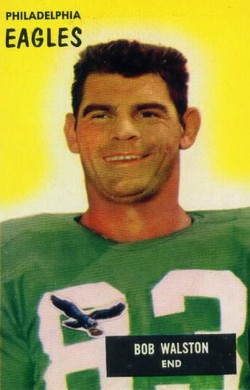
Following a slow 0-2-1 start, the Philadelphia Eagles had put together a three-game winning streak as they faced the New York Giants on November 8, 1953. Head Coach Jim Trimble’s team had an outstanding pass receiving tandem of ends Pete Pihos and Bobby Walston (who also handled the placekicking) and QB Bobby Thomason (pictured at right) had emerged over Adrian Burk as the starting quarterback. Thomason, originally drafted by the Rams and then discarded by Green Bay, started his second season with the Eagles on the bench.

The Giants, under long-time Head Coach Steve Owen, were clearly a team in trouble and had a 2-4 record. Injuries were a problem, most notably to FB Eddie Price and members of the defense, and the addition of promising younger players such as HB Frank Gifford was not yet paying off.

There was a crowd of 24,331 in attendance at Philadelphia’s Connie Mack Stadium. Two minutes into the first quarter the Eagles scored when Bobby Walston kicked a 15-yard field goal after Philadelphia’s first drive came to a halt at the New York eight yard line.

The game moved slowly from that point until the last few minutes of the half. Eleven minutes into the second quarter, Thomason threw a pass that Walston caught behind three New York defenders at the Giants’ 45 and covered a total of 62 yards for a touchdown. Two minutes later the Eagles struck again as Thomason passed to Pihos for a 26-yard TD. Philadelphia took a 17-0 lead into halftime.

The Eagles added to their margin in the third quarter, moving 80 yards with Thomason completing five passes along the way including a seven-yard toss to Pihos for a touchdown. The extra point attempt failed, but Philadelphia was now ahead by a commanding 23-0.

It became 30-0 in the fourth quarter when Thomason threw a fourth touchdown pass, this time of 13 yards to Walston. Several fights broke out in the final period and three players were ejected in all. The Giants finally scored with six minutes remaining in the game as QB Charlie Conerly tossed a 32-yard TD pass to Frank Gifford to finish off a 74-yard drive. It salvaged pride but nothing else as the Eagles coasted to a 30-7 win.

Philadelphia thoroughly dominated the Giants in total yards (514 to 92), although it was the aerial game that made the difference as neither club did particularly well on the ground (64 yards to 54 in favor of New York). The Eagles also had far more first downs (21 to 10), but were also penalized 13 times, at a cost of 123 yards, to three flags thrown on the Giants. New York turned the ball over three times, Philadelphia twice.

Bobby Thomason completed 22 of 44 passes for 437 yards and four touchdowns. Pete Pihos caught 7 passes for 145 yards and two TDs and Bobby Walston had 8 receptions for 176 yards in addition to scoring 18 points (two touchdowns, a field goal, and three extra points).


Thomason’s passing yardage total was the fourth-best in NFL history at the time as well as an Eagles club record that stood until 1989.

The Eagles won twice more before losing to the Giants at New York. They ended up second in the Eastern Conference with a 7-4-1 record. The loss was the fifth in seven games for the Giants who ended up fifth in the conference at 3-9. It marked the end of Steve Owen’s 23-year coaching tenure with the club.

Bobby Thomason had a 329-yard passing game the following week against the Colts (although he also tossed five interceptions) in what was his finest season. He led the NFL with 21 touchdown passes while ranking second in attempts (304) and yards (2462). Thomason was selected to the Pro Bowl for the first of an eventual three times, but his career was marked by inconsistency and he continued to split time with Burk during most of his six years in Philadelphia.

March 26, 2012

1953: Browns and Colts Conclude 15-Player Trade


On March 26, 1953 the Baltimore Colts and Cleveland Browns completed one of the largest trades in NFL history. It involved 15 players, most of whom were reserves or newly-drafted rookies. Cleveland was one of the league’s best teams, having appeared in its seventh straight league title game in 1952 including a string of four consecutive All-America Football Conference championships and a NFL title in 1950. The Colts were returning to the NFL after the original team of that name (also previously in the AAFC) folded following the ’50 season - they were replacing the failed Dallas Texans franchise of 1952, which in turn had taken the place of the New York Bulldogs/Yanks of 1949-51, and thus there were players passed along from both of those clubs involved in the transaction.

Of the 15 players involved, 10 were sent by the Browns to Baltimore and included:

QB Harry Agganis, first-round draft choice in 1952 out of Boston University who had not played for the Browns while pursuing a baseball career; S Bert Rechichar (pictured above), Cleveland’s other first-round pick in ’52 out of Tennessee who intercepted six passes as a rookie; HB Don Shula (pictured below), ninth-round pick in 1951 from John Carroll, who intercepted four passes in his first year and went into the military; HB Carl Taseff, 22nd-round draft choice in ’51, also out of John Carroll and just out of the military - he ran the ball 13 times for 49 yards as a rookie on offense; G Ed Sharkey, a veteran of three AAFC seasons and two in the NFL, the most recent with the Browns; G Elmer Wilhoite, 12th-round draft choice out of USC in 1953; E Art Spinney, from Boston College who played for the original Colts in 1950 and spent two years in the military; E Gern Nagler, 14th-round draft choice from Santa Clara in ’53; T Stu Sheets, co-captain at Penn State and 17th-round pick in 1952; and T Dick Batten, 18th-round choice out of College of the Pacific for 1953.


The Colts, building upon the carcass of the Texans franchise and desperate for new talent, gave up five players:

C Tom Catlin, All-American from Oklahoma drafted in the fourth-round for 1953; DT Don Colo, a three-year pro who had been with the original Colts in 1950 and moved on to the Yanks and Texans; OT Mike McCormack, third-round draft choice in 1951 by the Yanks who had played one season for them; HB John Petitbon, formerly of Notre Dame and taken by the Yanks/Texans in the seventh round for 1952, intercepting five passes in his first year; and G Herschel Forester, an eighth-round draft choice out of SMU in 1952 who was in the military.

Head Coach Paul Brown of Cleveland was especially annoyed with players who had indicated that they would play pro football only if they first failed to make it as baseball players. He said of Agganis, a star quarterback at Boston University, that, “we are not waiting to see whether or not (he) makes a baseball team. We prefer to make our plans now and can afford to do so since we do not have a quarterback problem.”

Agganis, known as “The Golden Greek”, chose to sign with baseball’s Boston Red Sox for a reported $35,000 and was forbidden to play football. Colts Coach Keith Molesworth, needing a quarterback, hoped he could be persuaded to change his mind and Agganis was a key player in the deal for Baltimore. “The Golden Greek” stuck with baseball, however, and showed the potential to become a star at the major league level. Tragically, Agganis died of a pulmonary embolism at age 26 in 1955.

Molesworth (and his successor, Weeb Ewbank) had better outcomes with some of the other players. Rechichar, Shula, and Taseff all moved into the starting lineup in the defensive backfield while Spinney started at defensive end before being shifted to guard on offense. Of that group, Rechichar had the biggest immediate impact, garnering second-team All-Pro honors in ’53 and eventually being selected to three Pro Bowls. While he was at it, he booted a league-record 56-yard field goal in the 1953 opening-game win over the Bears.

Rechichar was with the Colts, but past his prime, when they won back-to-back NFL titles in 1958 and ’59. Taseff and Spinney were still in the starting lineup, however. Shula was gone by then, but would gain far greater fame as a head coach (starting with Baltimore).

Of the others, Sharkey played one year for the Colts as a reserve before moving on to Philadelphia in 1954. None of the remaining players involved saw action with the team, although Nagler was with the Chicago Cardinals for five seasons and Pittsburgh for one before ending up back in Cleveland as a tight end.

For Cleveland’s part, Paul Brown was concentrating on strengthening his team at tackle and linebacker. While McCormack and Forester were in military service and would not be available until after 1953, Brown saw them as an investment in the future. Colo was expected to contribute right away, especially with DT Bob Gain leaving for the military, and he did, moving into the starting lineup in ’53 and staying there until 1958 while achieving selection to the Pro Bowl three times during that period.


McCormack (pictured at right) joined the club in ’54, started as a middle guard on defense that year, and then moved to right offensive tackle, where he remained a fixture for eight seasons. He garnered first- or second-team All-Pro honors in every one of those years and went to six Pro Bowls. The lineman that Paul Brown acquired as a future consideration was inducted into the Pro Football Hall of Fame in 1984. Forester, while far less accomplished, put in four seasons with the Browns.

Catlin played at linebacker in Cleveland and also stayed for four years before moving on to the Eagles. Of the five players the Browns received, Petitbon contributed the least, playing one year at safety in 1955 after spending time in the service.

Overall, the huge trade garnered benefits for both teams. Cleveland, filling in some holes on an already-sound club, topped the Eastern Conference in ’53 and added NFL titles in 1954 and ’55 (and regularly contended well beyond). The Colts, looking to build for the future, didn’t become a winner right away (they were 3-9 in 1953), but methodically developed into a championship team by the last two years of the decade.

September 27, 2010

1953: Bert Rechichar Leads Re-Formed Colts to Upset of Bears


Regular season pro football returned to Baltimore on September 27, 1953 when the re-formed Colts hosted the Chicago Bears in the season-opening contest at Memorial Stadium.

The earlier version of the Colts had replaced the Miami Seahawks in the All-America Football Conference’s second season in 1947 and had joined the Cleveland Browns and San Francisco 49ers in the NFL when the leagues merged in 1950. But after going 1-11 to finish with the league’s worst record, owner Abraham Watner sold the franchise back to the league.

Fans in Baltimore pushed to regain an NFL franchise, and after the Dallas Texans folded after one abysmal season in 1952, Commissioner Bert Bell announced that Baltimore could again have a franchise if they sold 15,000 season tickets in six weeks and suitable ownership could be found. The ticket drive reached the threshold in just a month and business executive Carroll Rosenbloom, who Bell had coached at the University of Pennsylvania, agreed to head up the new ownership group.

The new Colts started off with players from the Texans franchise that included DT Art Donovan, DE Gino Marchetti, and halfbacks Buddy Young and George Taliaferro. They also pulled off a 15-player trade with the Cleveland Browns in which they most notably obtained defensive backs Bert Rechichar, Don Shula, and Carl Taseff, and G Art Spinney.

The new Colts had different colors than the old (blue and white rather than green and silver) and the new head coach was Keith Molesworth.

There were 23,715 excited fans on hand for the opening game against the Bears, who were coming off of a subpar 5-7 record in ‘52. Chicago opened the scoring in the first quarter when HB Billy Stone, who had played with the previous edition of the Colts in 1950, ran for a 23-yard touchdown.

Bert Rechichar, the second-year defensive halfback obtained in the deal with the Browns, brought the crowd to its feet when he returned an interception 36 yards for a touchdown midway through the second quarter that tied the score.

With time running out in the first half, the Colts decided to try a long field goal attempt, but rather than use rookie Buck McPhail out of Oklahoma, who had handled all of the Colts placekicking during the preseason but had missed a 45-yard field goal attempt earlier in the contest, it was Rechichar lining up to attempt the kick from his own 44 yard line.

Many in the crowd were surprised to see Rechichar, who had never kicked a field goal as a pro. He made his first one memorable when he set a new league record by connecting from 56 yards out. The kick cleared the crossbar easily to break the previous mark of 54 yards by Detroit’s Glenn Presnell in 1934 and also gave the Colts a 10-7 lead going into halftime.

The game continued to be largely a defensive battle in the second half. In the third quarter, Colts QB Fred Enke was tackled in the end zone by DE Bob Hensley for a safety that narrowed Baltimore’s margin to 10-9. However, the regular placekicker McPhail added a 12-yard field goal in the fourth quarter and that provided the final score as the Colts won, 13-9.

The Bears outgained Baltimore with 334 total yards to 164, including the most passing (225 to 74) and rushing (109 to 90) yards, and had 20 first downs to 9 for the Colts. However, they gave up eight turnovers (four interceptions and four fumbles) and had come up empty on three possessions that took them inside Baltimore’s 20 yard line; they were stopped three times at the two yard line on one of them.

It was a good start for the re-formed Colts, who were 3-2 after five games (they beat the Bears again in Chicago, for good measure), but they lost the remaining seven contests to end up in fifth place in the Western Conference with a 3-9 tally. Just ahead of them were the Bears at 3-8-1.

Molesworth was moved to the scouting department in the offseason and replaced as head coach by Weeb Ewbank, a former assistant under Paul Brown in Cleveland. Baltimore’s fortunes would steadily improve thereafter.

Bert Rechichar (shown kicking at top) was successful on just 5 of 13 field goal attempts, although Buck McPhail hit on only two of five (he also handled all of the extra points and was good on 21 of 23 attempts). Far more proficient as a defensive halfback, Rechichar intercepted seven passes (All-Pro safety Tom Keane snagged 11). Over the course of his career, he kicked 31 field goals in 88 attempts for a 35.2 percent success rate and with a high of 10 in 1955 – when he led the league with 24 attempts. However, after being moved to safety he was named to three consecutive Pro Bowls and picked off a total of 31 passes (15 of them during that three-year period of 1955-57). His 56-yard field goal would remain the NFL record until bested by Tom Dempsey of New Orleans from 63 yards in 1970.