Showing posts with label 2004 NFL season. Show all posts

September 16, 2016

Highlighted Year: Julius Peppers, 2004

Defensive End, Carolina Panthers


Age: 24
3rd season in pro football & with Panthers
College: North Carolina
Height: 6’6”   Weight: 283

Prelude:
A college star in both football and basketball, Peppers accounted for 9.5 sacks and 63 tackles as a junior in 2001 and was a consensus All-American who also received the Rotary Lombardi Award as the nation’s best lineman and Chuck Bednarik Award as the leading overall defensive player. He chose to enter the 2002 NFL draft and was taken by the Panthers in the first round (second overall). Peppers immediately moved into the starting lineup at left end and showed off outstanding speed and pass-rushing skill, although he was weaker against the run and was lost for the final four games due to a league suspension for using prohibited dietary supplements. Still, he compiled 12 sacks and was chosen as NFL Defensive Rookie of the Year by the Associated Press and Pro Football Writers. Heavily double-teamed in 2003, Peppers’ sack total dropped to 7 but the line as a whole, which included DE Mike Rucker and DTs Brentson Buckner and Kris Jenkins, excelled as the Panthers won the NFC Championship.

2004 Season Summary
Appeared in all 16 games
[Bracketed numbers indicate league rank in Top 20]

Sacks – 11 [9, tied with Shaun Ellis, Darren Howard & Lance Johnstone]
Most sacks, game – 2 at Kansas City 9/19, vs. Oakland 11/7, at San Francisco 11/14, vs. Arizona 11/21
Multi-sack games – 4
Interceptions – 2
Int. return yards – 143 [6]
Int. TDs – 1 [5, tied with many others]
Fumble recoveries – 1
Fumble recovery TDs – 1
Forced fumbles – 4
Tackles – 52
Assists – 12

Awards & Honors:
1st team All-NFL: AP, PFWA, Sporting News
1st team All-NFC: Pro Football Weekly
Pro Bowl

Panthers went 7-9 to finish third in the NFC South.

Aftermath:
Excellent at pursuit and improving against the run, Peppers was named to the Pro Bowl again in 2005 and ’06 and again received consensus first-team All-NFL honors after the latter year. After reaching double figures in sacks for three straight seasons, Peppers dropped to 2.5 in an off-year in 2007, but came back with 14.5 sacks in 2008, the first of five consecutive Pro Bowl seasons. He signed with the Chicago Bears as a free agent in 2010 and, while his sack total dropped to 8, his presence on the line was beneficial overall and he was again a first-team All-NFL selection as well as Pro Bowler. After four years, he was released by the Bears following the 2013 season and signed by Green Bay. Shifted to outside linebacker, he had 7 sacks and two interceptions, both of which he returned for touchdowns, in 2014 and followed up with 10.5 sacks to receive Pro Bowl recognition once more in 2015. An outstanding overall talent, through 14 years Peppers has been a consensus first-team All-NFL choice on three occasions, received at least second-team honors after two other years, and achieved selection to the Pro Bowl nine times. He has accumulated 136 sacks and 11 interceptions through 2015, four of which he returned for touchdowns, and has also had two scores on fumble recoveries.

--

Highlighted Years features players who were consensus first-team All-League* selections or league* or conference** leaders in the following statistical categories:

Rushing: Yards, TDs (min. 10)
Passing: Yards, Completion Pct., Yards per Attempt, TDs, Rating
Receiving: Catches, Yards, TDs (min. 10)
Scoring: TDs, Points, Field Goals (min. 5)
All-Purpose: Total Yards
Defense: Interceptions, Sacks
Kickoff Returns: Average
Punt Returns: Average
Punting: Average

*Leagues include NFL (1920 to date), AFL (1926), AFL (1936-37), AAFC (1946-49), AFL (1960-69), WFL (1974-75), USFL (1983-85)

**NFC/AFC since 1970

August 20, 2016

Highlighted Year: Brian Griese, 2004

Quarterback, Tampa Bay Buccaneers


Age: 29
7th season in pro football, 1st with Buccaneers
College: Michigan
Height: 6’3”   Weight: 214

Prelude:
Griese, the son of Hall of Fame QB Bob Griese, was a successful walk-on in college who passed for 3663 yards and 27 touchdowns and capped his career at Michigan with a Rose Bowl victory. He was chosen by the Denver Broncos in the third round of the 1998 NFL draft and spent his rookie year backing up QB John Elway. With Elway retired, Griese took over the starting job in 1999 and, hampered by injuries (a recurring theme), threw for 3032 yards and 14 TDs, with as many interceptions. While again plagued by injuries, he showed improvement in 2000, passing for 2688 yards and 19 touchdowns, with just four interceptions, and led the NFL with a 102.9 passer rating. He was chosen to the Pro Bowl but also needed shoulder surgery for the second straight year. Griese struggled with consistency in 2001 and his interception total rose to 19. A smart and accurate, if not strong-armed, passer at his best, his leadership skills and confidence came under question, particularly in clutch situations, and after another disappointing year in 2002 he was let go and moved on to the Miami Dolphins in ’03, where he started five games and was unimpressive. Griese joined the Buccaneers in 2004 as the third-string quarterback but, when QB Chris Simms went down with an injury, he took over the starting job and performed well.

2004 Season Summary
Appeared in 11 of 16 games
[Bracketed numbers indicate league rank in Top 20]

Passing
Attempts – 336
Most attempts, game – 50 at San Diego 12/12
Completions – 233
Most completions, game – 36 at San Diego 12/12
Yards – 2632
Most yards, game – 392 at San Diego 12/12
Completion percentage – 69.3 [1]
Yards per attempt – 7.8 [8]
TD passes – 20 [14, tied with Drew Bledsoe]
Most TD passes, game – 3 at San Diego 12/12, vs. Carolina 12/26
Interceptions – 12 [15, tied with Joey Harrington & Michael Vick]
Most interceptions, game – 3 at San Diego 12/12
Passer rating – 97.5 [6]
300-yard passing games – 3
200-yard passing games – 6

Rushing
Attempts – 30
Most attempts, game – 5 (for -2 yds.) at New Orleans 10/10
Yards – 17
Most yards, game – 9 yards (on 2 carries) at Carolina 11/28
Average gain – 0.6
TDs – 0

Pass Receiving
Receptions – 1
Yards – -4
TDs – 0

Buccaneers went 5-11 to finish fourth in the NFC South.

Aftermath:
Griese started six games in 2005, five of which the Bucs won, but a knee injury cut his season short and he was let go afterward. He moved on to the Bears as a backup in 2006 and saw considerable action in ’07 in place of starting QB Rex Grossman until he again was injured. Griese was traded back to Tampa Bay in 2008 and started five games in what was his last season. Overall, he passed for 19,440 yards and 119 touchdowns, with 4841 yards and 32 TDs coming with the Bucs. Griese was chosen to one Pro Bowl in a career that was marked by injuries and inconsistency.

--

Highlighted Years features players who were consensus first-team All-League* selections or league* or conference** leaders in the following statistical categories:

Rushing: Yards, TDs (min. 10)
Passing: Yards, Completion Pct., Yards per Attempt, TDs, Rating
Receiving: Catches, Yards, TDs (min. 10)
Scoring: TDs, Points, Field Goals (min. 5)
All-Purpose: Total Yards
Defense: Interceptions, Sacks
Kickoff Returns: Average
Punt Returns: Average
Punting: Average

*Leagues include NFL (1920 to date), AFL (1926), AFL (1936-37), AAFC (1946-49), AFL (1960-69), WFL (1974-75), USFL (1983-85)

**NFC/AFC since 1970

April 19, 2016

2004: Patriots Obtain Corey Dillon from Bengals


On April 19, 2004 the New England Patriots obtained accomplished but discontented RB Corey Dillon from the Cincinnati Bengals. To do so they traded a second-round draft pick to Cincinnati that had previously been obtained from Miami (the Bengals used it to select Maryland FS Madieu Williams, who moved into the starting lineup as a rookie but had problems with injuries during his four years with the club).

The 29-year-old Dillon (he turned 30 during the 2004 season) was Cincinnati’s all-time rushing leader, having gained 8061 yards over the course of seven seasons, and was selected to the Pro Bowl three times. He further held a total of 18 franchise records at the time that included most rushing yards in a season (1435). At 6’1” and 225 pounds he had the size to be a punishing runner between the tackles while also possessing speed and elusiveness.

Dillon, who played collegiately at the Univ. of Washington, was originally chosen by the Bengals in the second round of the 1997 NFL draft and came on strong in the second half of his rookie year, gaining 933 of his 1129 rushing yards and scoring 8 of 10 TDs in the last eight games, highlighted by a 246-yard, four-touchdown performance in his fifth contest as a starter. It was the first of six consecutive seasons reaching the thousand-yard rushing threshold. Along the way Dillon had two more 200-yard single-game performances, including a then-league record 278 against the Broncos in 2000.

Dillon began sharing the rushing duties with RB Rudi Johnson in 2003 and had been pushing for a trade, complaining that he should be carrying more of the load. Following a season-ending loss to the Browns at Paul Brown Stadium, Dillon reportedly threw some of his equipment into the stands. He had further gotten into a public spat with OT Willie Anderson, calling him “a bum” on a sports radio show after the Pro Bowl tackle accused Dillon of being selfish at a point when the Bengals were still in playoff contention.

Reportedly, Coach Belichick laid down ground rules to Dillon prior to the trade being finalized. “We are very excited about Corey Dillon becoming a Patriot,” the coach said in reaction to the deal being completed. “Corey joins Kevin Faulk and our other very good backs to deepen an already competitive running back position.”

The Patriots had won two NFL Championships in the previous three years, including 2003, without a feature running back in an offense largely propelled by the passing of QB Tom Brady. Antowain Smith had been a stalwart, if plodding, ground gainer since arriving in 2001 and shared the duties with the more versatile Kevin Faulk in ’03, gaining 642 yards to Faulk’s 638, while Faulk caught 48 passes for 440 yards to Smith’s 92 yards on 14 receptions. The arrival of Dillon marked the end of the line in New England for the 32-year-old Smith.

Any concerns about Dillon and the wisdom of trading for him were resolved during an outstanding 2004 season. He started strong, with a 15-carry, 86-yard effort in an opening-week win over the Colts and followed with 158 yards on 32 attempts at Arizona the next week. He had four straight hundred-yard games as the Patriots got off to a 7-1 start and ended up with a total of nine such performances over the course of the season. Dillon ended up with a club-record 1635 rushing yards on 345 carries for an average gain of 4.7 yards and scored 12 touchdowns. He gained another 292 yards in three playoff games, with 144 coming in a Divisional-level win over the Colts and 75 yards on 18 carries in the Super Bowl victory against the Philadelphia Eagles. Dillon was chosen to the Pro Bowl for the first time in three years and, moreover, proved to be a leader who fit well in New England’s team-first approach.

Dillon spent two more seasons with the Patriots, rushing for lesser totals of 733 and 812 yards, although scoring 12 and 13 TDs, respectively, in 2005 and ’06. He was hindered by a bad ankle in ’05 and showed increased signs of wear in 2006, when he began to lose playing time to rookie Laurence Maroney. Released in the offseason, he ultimately retired.

In his three years in New England, Dillon gained 3180 yards on 753 rushing attempts (4.2 avg.) with 37 TDs. He also caught 52 passes for 431 yards and another two scores (Kevin Faulk continued to be the preferred receiver out of the backfield in addition to being a change-of-pace runner). In eight postseason games, he rushed for 508 yards and four TDs and accumulated 12 pass receptions for 74 yards.

November 28, 2015

2004: Chargers Rally to Defeat Chiefs in Back-and-Forth Game


The fortunes of the San Diego Chargers had changed dramatically since the 4-12 finish of 2003 as they met the Kansas City Chiefs on November 28, 2004. Head Coach Marty Schottenheimer’s team had won four straight games and was at 7-3 and even with Denver atop the AFC West. QB Drew Brees (pictured at right), considered a disappointment following his first three seasons, was breaking out in a big way, as was second-year TE Antonio Gates, while RB LaDainian Tomlinson continued to be a top rusher and receiver out of the backfield. The coaching of first-year defensive coordinator Wade Phillips brought about a significant improvement with the defense.  

The Chiefs were on an opposite trajectory. Having been a 13-3 playoff team in 2003, Kansas City had lost its last three games and was struggling with a 3-7 record. Under Head Coach Dick Vermeil, the offense was still productive, led by QB Trent Green and TE Tony Gonzalez, although star RB Priest Holmes was out with a knee injury. The defense was at the root of the club’s problems and ranked among the league’s least effective units.

There were 77,447 fans in attendance at Arrowhead Stadium on a 35-degree day. The Chargers had the first possession and put together a promising drive as WR Eric Parker gained 20 yards on a first-play end-around and Drew Brees completed three passes and had a 14-yard run. However, the drive stalled at the Kansas City 11 and Nate Kaeding’s 29-yard field goal attempt was unsuccessful.

The Chiefs punted following a short series and San Diego struck quickly. Brees threw to Parker for a 55-yard gain to the KC two and, two plays later, LaDainian Tomlinson scored a touchdown from a yard out. Kaeding added the extra point and the visitors were in front by 7-0.

The ensuing kickoff went out of bounds, giving the Chiefs starting field position at their 40, and they went 60 yards in six plays. Trent Green had passes to Tony Gonzalez (pictured below) for 12 and 27 yards and RB Derrick Blaylock, the stand-in for Priest Holmes, ran for a five-yard TD. Lawrence Tynes converted to tie the score at 7-7.


The Chargers punted following their next possession and a penalty on the return had the Chiefs starting from their own six yard line. As the game moved into the second quarter, consecutive carries by RB Larry Johnson picked up 18 yards and, with Green passing effectively and Johnson runs mixed in, Kansas City advanced methodically down the field. Green completed five of his passes, two of them to Gonzalez for 22 yards and the longest covering 16 yards to TE Jason Dunn. The 13-play, 94-yard drive culminated in Johnson’s six-yard touchdown run up the middle. Tynes added the point after and the home team had a 14-7 lead.

The Chargers responded with a long drive of their own that covered 70 yards in 12 plays. They converted three first downs, all on passes by Brees, including a 17-yard toss to Parker on third-and-seven that set up Tomlinson’s three-yard carry for a TD. Kaeding’s kick tied the score at 14-14.

Green passed Kansas City down the field on the next series and Tynes kicked a 28-yard field goal that put the Chiefs back in front by three. With time running out in the first half, Brees threw to WR Kassim Osgood for a 27-yard gain to the KC 43 and two short completions to Tomlinson picked up another nine yards, but Kaeding missed on a 52-yard field goal attempt and the home team took a 17-14 lead into halftime.

Kansas City WR Dante Hall started the third quarter off with a 77-yard kickoff return, but he fumbled at the end without being hit and the Chargers gained possession at their five yard line. They managed to reach their 45 before having to punt and the Chiefs punted it back following a three-and-out series. On San Diego’s first play from midfield, Parker took off for a 38-yard run to the KC 12 and, while the Chargers couldn’t reach the end zone, Kaeding tied the score with a 25-yard field goal.

The teams exchanged punts before the Chiefs began to move effectively in the closing minutes of the period. Green completed three straight passes, the first to WR Johnnie Morton for 18 yards, and a throw to Gonzalez in a third-and-nine situation gained 23 yards to the San Diego 31. On the second play of the fourth quarter, Blaylock broke away for a 22-yard touchdown. Tynes missed the extra point, but Kansas City was back in front at 23-17.

Brees passed the Chargers back down the field, completing six throws along the way. The longest was to WR Keenan McCardell for 23 yards and the last to Antonio Gates for an 18-yard TD. Kaeding added the extra point and San Diego was in the lead by a point at 24-23. It didn’t last long, however, as Hall returned the ensuing kickoff 96 yards for a touchdown, this time maintaining his grip on the football for the full distance. Green threw to WR Eddie Kennison for a two-point conversion and KC was back on top by 31-24.

The Chargers ran into problems with penalties on their next series, one of which wiped out a 51-yard pass play to Gates. However, backed up to their 19 and facing second-and-22, Brees threw to Osgood for a 65-yard pickup to the KC 16 and, three plays later, he connected with Gates for an 11-yard TD. Kaeding added the PAT and, with less than seven minutes remaining in regulation, the score was again tied at 31-31.

San Diego got the ball back when a third-and-11 pass by Green was intercepted by LB Donnie Edwards, who returned it 13 yards to the Kansas City 32. The Chargers reached the 17 before Brees was sacked by CB William Bartee and LB Scott Fujita for a loss of seven yards on third down, but Kaeding kicked a 43-yard field goal and the visitors had a three-point lead.

The Chiefs regained possession with 2:15 left on the clock, but after Green threw to Blaylock for six yards on first down, the next three passes fell incomplete. San Diego held on for a 34-31 win.

“Everybody got their money’s worth today,” summed up San Diego’s Coach Schottenheimer. “It was quite an exciting game.”

The Chargers, in ending a seven-game losing streak at Kansas City, led in total yards (498 to 310), first downs (25 to 20), and time of possession (36:46 to 23:14). The Chiefs turned the ball over twice, to none suffered by San Diego, and while the Chargers were penalized more times (9 to 5), Kansas City’s infractions came at more inopportune times.


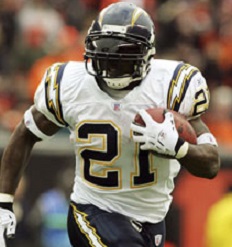
Drew Brees completed 28 of 37 passes for 378 yards and two touchdowns while giving up no interceptions. With his two long carries, Eric Parker led the Chargers with 58 rushing yards and also caught three passes for another 78 yards. LaDainian Tomlinson (pictured at left) gained just 46 yards on 21 attempts that included two TDs but also had 10 pass receptions for 57 yards. Antonio Gates gained 92 yards on his 7 catches that included two for scores and, thanks to the one long gain, Kassim Osgood matched the yardage total on his two receptions.

For the Chiefs, Trent Green was successful on 21 of 34 throws for 208 yards with no TDs and one interception. Tony Gonzalez caught 8 passes for 105 yards. Derrick Blaylock rushed for 75 yards on 8 carries that included two touchdowns and Larry Johnson ran the ball 10 times for 43 yards and a TD. Dante Hall averaged 38.8 yards on six kickoff returns, one of which resulted in a touchdown and another that came close.

The Chargers went on to win their next three games, and four of their last five, to finish first in the AFC West with a 12-4 record. They lost their Wild Card playoff contest to the New York Jets in overtime. Kansas City reeled off four wins following the loss to the Chargers but lost the season finale in the rematch at San Diego to place third in the division at 7-9.

Drew Brees ranked second in the AFC with a 104.8 passer rating, gaining 3159 yards with 27 TD passes against just seven interceptions. He was selected to the Pro Bowl, as were both LaDainian Tomlinson, who ran for 1335 yards and a league-leading 17 rushing touchdowns, and Antonio Gates, who caught 81 passes for 964 yards (11.9 avg.) and 13 TDs, and both of them also were consensus first-team All-NFL selections.

Tony Gonzalez topped the NFL with 102 pass receptions, which accounted for 1258 yards and 13 touchdowns. He was chosen to the Pro Bowl. Trent Green topped the league in pass attempts (556) and the conference in completions (369) and passing yards (4591). His 27 TD passes were a career high.

September 11, 2015

Highlighted Year: Chris Gamble, 2004

Cornerback, Carolina Panthers


Age: 21
1st season in pro football
College: Ohio State
Height: 6’1”   Weight: 181

Prelude:
Gamble played both cornerback and wide receiver in college, and was part of Ohio State’s 2002 national championship team. He was chosen by the Panthers in the first round of the 2004 NFL draft (28th overall) and, despite being a raw talent, moved directly into the starting lineup.

2004 Season Summary
Appeared in all 16 games
[Bracketed numbers indicate league rank in Top 20]

Interceptions – 6 [3, tied with four others, 1st in NFC]
Most interceptions, game – 2 at Atlanta 12/18
Int. return yards – 15
Most int. return yards, game – 13 (on 1 int.) at Kansas City 9/19
Int. TDs – 0
Fumble recoveries – 1
Forced fumbles – 1
Tackles – 68
Assists – 6

Punt Returns
Returns – 9
Yards – 69
Average per return – 7.7
TDs – 0
Longest return – 16 yards

Panthers went 7-9 to finish third in the NFC South while leading the NFL in interceptions (26).

Aftermath:
Gamble followed up in 2005 by intercepting 7 passes that he returned for 157 yards and a TD. Fast and agile, he could also be inconsistent and reckless in taking chances. Gamble’s play improved over time, as a tackler in the defensive backfield as well as a cover corner, and he was typically a solid starter, if not an elite performer. He also encountered problems with injuries but lasted for nine years with Carolina and appeared in a total of 123 games. While Gamble endured a difficult season in 2010 in which he was benched for a time and suffered a hamstring injury, costing him five games, he bounced back in 2011. He was released following an injury-plagued 2012 season and retired at age 29, having intercepted a franchise-record 27 passes, two of which he returned for touchdowns.

--

Highlighted Years features players who were consensus first-team All-League* selections or league* or conference** leaders in the following statistical categories:

Rushing: Yards, TDs (min. 10)
Passing: Yards, Completion Pct., Yards per Attempt, TDs, Rating
Receiving: Catches, Yards, TDs (min. 10)
Scoring: TDs, Points, Field Goals (min. 5)
All-Purpose: Total Yards
Defense: Interceptions, Sacks
Kickoff Returns: Average
Punt Returns: Average
Punting: Average

*Leagues include NFL (1920 to date), AFL (1926), AFL (1936-37), AAFC (1946-49), AFL (1960-69), WFL (1974-75), USFL (1983-85)

**NFC/AFC since 1970

May 18, 2015

Highlighted Year: Bertrand Berry, 2004

Defensive End, Arizona Cardinals


Age: 29
8th season in pro football, 7th in NFL & 1st with Cardinals
College: Notre Dame
Height: 6’3”   Weight: 250

Prelude:
Primarily known for his pass rushing ability in college, Berry was chosen by the Indianapolis Colts in the third round of the 1997 NFL draft. He had an undistinguished first three seasons with the Colts, starting 13 games at defensive end and also playing linebacker while recording five sacks. Berry moved on to the Rams in 2000 but was cut during training camp and saw action in the CFL with the Edmonton Eskimos. He joined the Denver Broncos in 2001 and was a reserve for two seasons before breaking into the starting lineup in ’03 and recording 11.5 sacks. A fine pass rusher who was less adept against the run, Berry signed with the Cardinals as a free agent for the 2004 season.

2004 Season Summary
Appeared in all 16 games
[Bracketed numbers indicate league rank in Top 20]

Sacks – 14.5 [2, 1st in NFC]
Most sacks, game – 4 vs. NY Giants 11/14
Multi-sack games – 3
Interceptions – 0
Fumble recoveries – 2
Fumble recovery TDs – 0
Forced fumbles – 4
Tackles – 39
Assists – 10

Awards & Honors:
2nd team All-NFL: AP
1st team All-NFC: Pro Football Weekly
Pro Bowl

Cardinals went 6-10 to finish third in the NFC West.

Aftermath:
A torn pectoral muscle limited Berry to eight games in 2005 and injuries remained an issue in ’06 and ’07 as he appeared in a combined 19 games. Still effective as a rusher from the edge who lined up more often as an outside linebacker, Berry played with the Cards until 2009, staying healthier in his last two years in which the team made it to the playoffs, after which he retired. Overall, Berry accumulated 65 sacks in the NFL, with 40 of them coming during his six years with Arizona. He had four more during the postseason.

--

Highlighted Years features players who were consensus first-team All-League* selections or league* or conference** leaders in the following statistical categories:

Rushing: Yards, TDs (min. 10)
Passing: Yards, Completion Pct., Yards per Attempt, TDs, Rating
Receiving: Catches, Yards, TDs (min. 10)
Scoring: TDs, Points, Field Goals (min. 5)
All-Purpose: Total Yards
Defense: Interceptions, Sacks
Kickoff Returns: Average
Punt Returns: Average
Punting: Average

*Leagues include NFL (1920 to date), AFL (1926), AFL (1936-37), AAFC (1946-49), AFL (1960-69), WFL (1974-75), USFL (1983-85)

**NFC/AFC since 1970

April 4, 2015

Highlighted Year: Tiki Barber, 2004

Running Back, New York Giants


Age: 29
8th season in pro football & with Giants
College: Virginia
Height: 5’10” Weight: 200

Prelude:
Barber was chosen by the Giants in the second round of the 1997 NFL draft with the expectation that he would be a third-down back and kick returner in the mold of former star RB Dave Meggett, and while he started a few games, that was largely the role he filled for his first three seasons. From 1997 to ’99, he rushed for 935 yards while catching 142 passes for 1256 yards (8.8 avg.) that included a high of 66 for 609 yards in 1999. Adding in kick returns, Barber gained 1639 all-purpose yards. He became part of an effective tandem with rookie Ron Dayne in 2000, and while Dayne wore down as the season progressed, Barber rushed for 1006 yards on 213 carries (4.7 avg.) and caught 70 passes for 719 yards (10.3 avg.). He co-led the team in ’01 with 72 pass receptions, for 577 yards, and had 865 rushing yards. The biggest concern was a tendency to fumble, but he was a surprisingly effective inside runner as well as a breakaway threat on the outside and skillful receiver. Barber shouldered more of the load in 2002 and ’03, gaining 1984 yards from scrimmage in ’02 (1387 rushing, 597 receiving) and 1677 in 2003 (1216 rushing, 461 receiving).   

2004 Season Summary
Appeared in all 16 games
[Bracketed numbers indicate league rank in Top 20]

Rushing
Attempts – 322 [8]
Most attempts, game – 24 (for 101 yds.) at Minnesota 10/31, (for 95 yds.) vs. Dallas 1/2
Yards – 1518 [5]
Most yards, game – 182 yards (on 23 carries) at Green Bay 10/3
Average gain – 4.7 [8]
TDs – 13 [4, tied with Willis McGahee, Domanick Davis & Jerome Bettis]
100-yard rushing games – 9

Pass Receiving
Receptions – 52      
Most receptions, game – 7 (for 102 yds.) vs. Detroit 10/24
Yards – 578
Most yards, game – 102 (on 7 catches) vs. Detroit 10/24
Average gain – 11.1
TDs – 2
100-yard receiving games – 1

All-Purpose yards – 2096 [2, 1st in NFC]

Scoring
TDs – 15 [4, tied with Marvin Harrison & Priest Holmes]
Points – 90

Awards & Honors:
1st team All-NFC: Pro Football Weekly
Pro Bowl

Giants went 6-10 to finish second in the NFC East.

Aftermath:
Barber led the NFL in all-purpose yards at age 30 in 2005 with 2390 and missed the league rushing title by twenty yards with 1860 on 357 carries (5.2 avg.). He received consensus first-team All-NFL as well as Pro Bowl honors. Barber followed up in 2006 with 1662 rushing yards and 58 catches for 465 yards to end up going over 2000 yards from scrimmage for the third straight year with 2127 and was named to a third consecutive Pro Bowl. He chose to retire to the broadcast booth having rushed for a franchise-record 10,449 yards on 2217 carries (4.7 avg.) and gained another 5183 yards on 586 pass receptions (8.8 avg.). Barber also returned 122 punts for a 9.7-yard average and averaged 20.1 yards on 27 kickoff returns. He scored a total of 68 touchdowns. His twin brother Ronde had a 16-year career as a cornerback for the Tampa Bay Buccaneers.

--

Highlighted Years features players who were consensus first-team All-League* selections or league* or conference** leaders in the following statistical categories:

Rushing: Yards, TDs (min. 10)
Passing: Yards, Completion Pct., Yards per Attempt, TDs, Rating
Receiving: Catches, Yards, TDs (min. 10)
Scoring: TDs, Points, Field Goals (min. 5)
All-Purpose: Total Yards
Defense: Interceptions, Sacks
Kickoff Returns: Average
Punt Returns: Average
Punting: Average

*Leagues include NFL (1920 to date), AFL (1926), AFL (1936-37), AAFC (1946-49), AFL (1960-69), WFL (1974-75), USFL (1983-85)

**NFC/AFC since 1970

December 12, 2014

Rookie of the Year: Jonathan Vilma, 2004

Linebacker, New York Jets


Age: 22
College: Miami (FL)
Height: 6’0”   Weight: 223

Prelude:
Highly rated coming into the NFL draft despite some concern about his size, Vilma was chosen by the Jets in the first round (12th overall). When starting MLB Sam Cowart was injured early in the season, Vilma took over and held onto the job thanks to his excellent speed and athleticism.

2004 Season Summary
Appeared and started in all 16 games
(Bracketed numbers indicate league rank in Top 20)

Sacks – 2
Most sacks, game – 1 vs. Buffalo 10/10, vs. New England 12/26
Interceptions – 3
Most interceptions, game – 1 vs. San Francisco 10/17, at Arizona 11/28, at St. Louis 1/2
Int. return yards – 58
Most int. return yards, game – 38 (on 1 int.) at St. Louis 1/2
Int. TDs – 1
Fumble recoveries – 1
Forced fumbles – 0
Tackles – 77
Assists – 31

Scoring
TDs – 1
Points – 6

Postseason: 2 G
Sacks – 1
Interceptions – 0
TD – 0

Awards & Honors:
NFL Defensive Rookie of the Year: AP

Jets went 10-6 to finish second in the AFC East and qualify for the playoffs as a Wild Card. Won AFC Wild Card playoff over San Diego Chargers (20-17). Lost AFC Divisional playoff to Pittsburgh Steelers (20-17).

Aftermath:
Vilma followed up his outstanding rookie season by recording 128 tackles and gaining selection to the Pro Bowl in 2005. The shift by the Jets from a 4-3 to 3-4 defense in 2006, where he was not an ideal fit, was a setback and in ’07 he went down with a season-ending knee injury in the seventh game. Vilma was traded to the New Orleans Saints where he was able to thrive again in a 4-3 scheme. He was selected to the Pro Bowl following the 2009 and ’10 seasons. However, he was initially suspended for the 2012 season for his alleged role in the Saints bounty scandal, but was reinstated by court decision and played in 11 games. A knee injury kept him off the field for virtually all of 2013 and he was not re-signed for 2014. Overall, Vilma played in 125 games and accumulated 10.5 sacks, 12 interceptions, 11 fumble recoveries, and over 600 tackles, scoring three TDs (two on interceptions, one on a fumble recovery). He was named to the Pro Bowl three times.

--

Rookie of the Year Profiles feature players who were named Rookie of the Year in the NFL (including NFC/AFC), AFL (1960-69), or USFL (1983-85) by a recognized organization (Associated Press – Offense or Defense, Newspaper Enterprise Association, United Press International, The Sporting News, or the league itself – Pepsi NFL Rookie of the Year).

October 17, 2014

Rookie of the Year: Ben Roethlisberger, 2004

Quarterback, Pittsburgh Steelers


Age:  22
College: Miami (OH)
Height: 6’5”   Weight: 242

Prelude:
Roethlisberger passed for 10,829 yards and 80 touchdowns in three collegiate seasons and Miami reached the Mid-American Conference Championship in his junior year. He entered the NFL draft and was chosen by the Steelers in the first round (11th overall, and the third quarterback) and, when QB Tommy Maddox went down with an injury in the second game, “Big Ben” moved into the lineup.

2004 Season Summary
Appeared and started in 14 of 16 games
[Bracketed numbers indicate league rank in Top 20]

Passing
Attempts – 295
Most attempts, game – 28 at NY Giants 12/18
Completions – 196
Most completions, game – 21 at Dallas 10/17
Yards – 2621
Most yards, game – 316 at NY Giants 12/18
Completion percentage – 66.4 [4]
Yards per attempt – 8.9 [2]
TD passes – 17 [19, tied with Vinny Testaverde]
Most TD passes, game – 2 on six occasions
Interceptions – 11 [18, tied with Daunte Culpepper, Kyle Boller & Patrick Ramsey]
Most interceptions, game – 2 at Baltimore 9/19, vs. NY Jets 12/12, at NY Giants 12/18
Passer rating – 98.1 [5]
300-yard passing games – 1
200-yard passing games – 4

Rushing
Attempts – 56
Most attempts, game – 9 (for 16 yds.) at Cincinnati 11/21
Yards – 144
Most yards, game – 40 yards (on 3 carries) at Jacksonville 12/5
Yards per attempt – 2.6
TDs – 1

Scoring
TDs – 1
Points – 6

Postseason: 2 G
Pass attempts – 54
Most attempts, game – 30 vs. NY Jets, AFC Divisional playoff
Pass completions – 31
Most completions, game - 17 vs. NY Jets, AFC Divisional playoff
Passing yardage – 407
Most yards, game – 226 vs. New England, AFC Championship
TD passes – 3
Most TD passes, game – 2 vs. New England, AFC Championship
Interceptions – 5
Most interceptions, game – 3 vs. New England, AFC Championship

Rushing attempts – 9
Most rushing attempts, game – 5 vs. New England, AFC Championship
Rushing yards – 75
Most rushing yards, game – 45 vs. New England, AFC Championship
Average gain rushing – 8.3
Rushing TDs – 0

Awards & Honors:
NFL Rookie of the Year: League/Pepsi, Sporting News
NFL Offensive Rookie of the Year: AP, PFWA
AFC Rookie of the Year: UPI, NEA, Sporting News

Steelers went 15-1 to place first in the AFC North with the conference’s best record while leading the AFC in rushing yards (2464). Won AFC Divisional playoff over New York Jets (20-17). Lost AFC Championship to New England Patriots (41-27).

Aftermath:
Roethlisberger missed time with a knee injury in 2005 but led the league in yards per attempt (8.9), yards per completion (14.2), and TD percentage (6.3 on his 17 TD passes), and the Steelers won the Super Bowl. In so doing, he became the youngest Super Bowl-winning quarterback. Big and mobile with a strong arm, Roethlisberger also benefited from having a solid running attack and defense as he developed his considerable skills. It was tougher going in 2006 as he was injured in an offseason motorcycle accident and also suffered from appendicitis. The result was 3513 passing yards and 18 TDs, but also a league-leading 23 interceptions and the Steelers dropped to 8-8. He bounced back with a Pro Bowl year in ’07 in which he threw for 32 touchdowns and a 104.1 rating, and showed great toughness as he also took many hits – often due to his penchant for holding the ball until the last possible moment. Roethlisberger led the Steelers to another NFL Championship in 2008 as he showed outstanding late-game clutch ability and achieved career highs (thus far) with 4328 passing yards and a 66.6 completion percentage in ’09, although off-field issues caused him to be suspended for the first four games of the 2010 season. He played well upon his return, giving up just five interceptions while once again leading the NFL in yards per completion (13.3) and the Steelers won the AFC title. Roethlisberger was chosen to the Pro Bowl for a second time in 2011 after passing for 4077 yards but a high ankle sprain limited his mobility in a losing postseason game and a shoulder injury hindered his play in 2012 as he was also asked to refine his style of play with a rebuilding team. He stayed healthy for the full year in ’13 and passed for 4261 yards and 28 TDs. Overall, through the 2013 season Roethlisberger has thrown for 34,105 yards and 219 touchdowns with a 92.6 rating. The Steelers have been 98-50 during his regular season starts and 10-4 in the playoffs, with two NFL titles.

--

Rookie of the Year Profiles feature players who were named Rookie of the Year in the NFL (including NFC/AFC), AFL (1960-69), or USFL (1983-85) by a recognized organization (Associated Press – Offense or Defense, Newspaper Enterprise Association, United Press International, The Sporting News, or the league itself – Pepsi NFL Rookie of the Year).

February 13, 2014

2005: Manning TDs Spur AFC to Win in Pro Bowl


There was a sellout crowd of 50,225 at Aloha Stadium in Honolulu for the AFC-NFC Pro Bowl on February 13, 2005, marking the 26th consecutive season that the contest had been staged in Hawaii. The coaches of the teams were Pittsburgh’s Bill Cowher for the AFC and, for the NFC, Jim Mora Jr. of the Falcons.

The AFC scored first on a 62-yard pass play from QB Peyton Manning (pictured above) to Indianapolis teammate WR Marvin Harrison. New England’s Adam Vinatieri added the extra point. LB Joey Porter of the Steelers then intercepted a pass by Eagles QB Donovan McNabb and Manning led the AFC on another scoring drive, going 69 yards in five plays and finishing with a throw to wide-open Pittsburgh WR Hines Ward for a 41-yard TD. With Vinatieri’s conversion, the score was 14-0 heading into the second quarter.

The NFC put together a long scoring series of 10 plays that covered 84 yards and concluded with RB Brian Westbrook of the Eagles running for a 12-yard touchdown. David Akers, also of Philadelphia, added the extra point. However, when the NFC attempted an onside kick, Ward leaped to grab the ball and then ran 39 yards for a TD (pictured below) – the second on a kickoff return in Pro Bowl history (Detroit’s Jack Christiansen ran won 103 yards in 1956 at the time of the old East vs. West format). Vinatieri kicked the point after and the AFC was again in front by 14 points at 21-7.


Buffalo LB Takeo Spikes intercepted a pass by QB Daunte Culpepper of the Vikings and, adding in a lateral to Porter, the AFC had the ball once again in NFC territory. They added more points, driving 38 yards in eight plays. Manning tossed his third TD pass of the game, connecting with TE Antonio Gates of the Chargers from 12 yards out.

The NFC finally got on the board again before the end of the half, driving 65 yards in 10 plays. Akers kicked a 25-yard field goal with 1:45 left on the clock and the AFC took a 28-10 lead into halftime.

The AFC defense was exceptionally aggressive during the first half, which led to grumblings by NFC players and coaches that they were blitzing – something not allowed in the Pro Bowl.

Heading into the third quarter, Atlanta QB Michael Vick rallied the NFC on three straight scoring drives. In his first possession behind center, Vick completed four of six throws, including a 27-yard touchdown pass to WR Torry Holt of the Rams. It finished off an eight-play, 73-yard series and, with Akers adding the PAT, made the score 28-17.

The next NFC series, following an interception by Philadelphia CB Lito Sheppard of a pass by QB Tom Brady of the champion Patriots, went 69 yards in nine plays. It concluded with the elusive Vick running three yards and diving into the end zone for a TD, despite his helmet being knocked off by Baltimore SS Ed Reed.

The AFC came back to add points early in the fourth quarter as Vinatieri kicked a 36-yard field goal to finish a 13-play, 54-yard possession. However, the NFC responded by driving 68 yards in 12 plays and, midway through the fourth quarter, Akers kicked a 21-yard field goal to narrow the tally to 31-27.

That was as far as the NFC got, however. On the next series, the AFC drove 71 yards in six plays to add to their lead. QB Drew Brees of the Chargers passed on a flea-flicker play to his San Diego teammate Gates for a 33-yard gain to set up a four-yard TD carry by yet another Charger, RB LaDainian Tomlinson.

There was still plenty of time, but the AFC defense stopped the next NFC series in five plays and then finished things off when Buffalo CB Nate Clements picked off a Vick throw with two minutes remaining to play. The AFC came away with a 38-27 win.

The NFC had more total yards (492 to 343) and first downs (26 to 15) but also committed three turnovers, to two by the AFC, as well as the TD on the botched onside kick.

Peyton Manning was the game’s MVP after completing 6 passes in 10 attempts for 130 yards, with three for touchdowns. Tom Brady made good on just four of nine tosses for 48 yards and gave up an interception, while Drew Brees completed both of his passes for 58 yards. RB Rudi Johnson of the Bengals was the AFC’s top rusher with 33 yards on six carries. Hines Ward had three catches for 63 yards and a TD, as well as the kickoff return for a score, and San Diego TE Antonio Gates also had three receptions, for 51 yards and a touchdown. Thanks to the long scoring catch, Marvin Harrison accumulated 66 yards on his two pass receptions.

For the NFC, Michael Vick completed 14 of 24 passes for 205 yards and a touchdown with one interception. Also rushing for 10 yards on three carries, he became the first quarterback to both throw and run for a touchdown in a Pro Bowl contest (although a running back, Marcus Allen, had done it in 1986). Daunte Culpepper was successful on 9 of 15 throws for 124 yards, with one intercepted, but Donovan McNabb was a disappointing one-of-eight for 24 yards and also had one pass picked off. RB Tiki Barber of the Giants ran the ball 9 times for 70 yards and Torry Holt pulled in 5 passes for 99 yards and a touchdown.

 “I’m not going to say I wasn’t holding my breath over there once Vick started to roll around, but our defense did a great job of stopping him,” said Manning, who was making his fifth Pro Bowl appearance. “It was good we got the game this year after we let the lead slip away last year.” He was referring to the wild 55-52 contest of the preceding year that was pulled out by the NFC.

The win was the fourth in five games for the AFC and broke a tie to give them an 18 to 17 edge over the NFC since the Pro Bowl had adopted the AFC vs. NFC format following the 1970 season.

January 8, 2014

2005: Jets Beat Chargers in Overtime of AFC Wild Card Playoff


The AFC Wild Card playoff game at San Diego on January 8, 2005 featured the San Diego Chargers hosting the New York Jets. The Chargers had won nine of their last ten games to finish atop the AFC West with a 12-4 record while New York lost three of its last four contests to end up in second place in the AFC East at 10-6 and needed help to get into the playoffs (a Buffalo loss in the final week).

San Diego, coached by Marty Schottenheimer, had turned around very quickly from a 4-12 record in 2003 and was in the postseason for the first time since 1995. QB Drew Brees had dramatically improved in his fourth year while TE Antonio Gates emerged as an outstanding receiver. RB LaDainian Tomlinson, also in his fourth season, was already established as one of the league’s best all-around backs. The defense had improved as well under the tutelage of coordinator Wade Phillips.

The Jets, coached by Herman Edwards, had the league’s leading rusher in 31-year-old RB Curtis Martin (1697 yards). QB Chad Pennington (pictured at top) was smart, efficient, and a good leader, but was troubled by a torn rotator cuff (he would have surgery in the offseason). Rookie MLB Jonathan Vilma was a good addition to the defense, but star DE John Abraham had gone down with a knee injury late in the season.

There were 67,536 fans in attendance at Qualcomm Stadium for the Saturday night game with rain falling. The Jets took the opening kickoff and drove 57 yards in 11 plays. Chad Pennington converted a third-and-nine situation with a completion to WR Santana Moss for 16 yards and, later facing third-and-eight at his own 45, threw to WR Justin McCareins, also for 16 yards. A 16-yard run by RB LaMont Jordan got the ball to the San Diego 23 and the series finally stalled at the 14. However, the visitors came up empty when Doug Brien missed a 33-yard field goal attempt.

The Chargers were unable to get anything going on offense and the teams traded punts until San Diego started a 13-play, 88-yard drive that extended into the second quarter. LaDainian Tomlinson ran for 13 yards on the first two plays, on the way to seven attempts for 39 yards for the series, and Drew Brees completed all five of his passes, the last to WR Keenan McCardell, who made an outstanding catch for a 26-yard touchdown that was initially ruled incomplete but was overturned on replay. Nate Kaeding added the extra point to give the Chargers a 7-0 lead.

The teams again exchanged punts until the Jets, helped by a 15-yard unsportsmanlike conduct penalty on Coach Schottenheimer for running onto the field to protest the lack of a roughing-the-kicker flag on the punt, put together a five-play, 52-yard possession that included a Pennington pass to McCareins that picked up 21 yards to the San Diego 15. Two plays later, Pennington connected with TE Anthony Becht for a 13-yard TD and, with Brien adding the extra point, the game was tied with less than three minutes remaining in the first half.

The Chargers again drove into New York territory as Brees completed passes of nine yards to McCardell, 16 yards to WR Eric Parker, and 15 yards to Antonio Gates. But after advancing to the 37, a Brees pass was intercepted by SS Reggie Tongue. Thus ended the last scoring opportunity of the half, and the game remained tied at the midpoint.

Following a San Diego punt that ended the first series of the third quarter, the Jets moved 75 yards in five plays to take the lead. Pennington completed passes to McCareins of 11 and 10 yards, and then connected with Moss, who outran FS Jerry Wilson and CB Quentin Jammer for a 47-yard touchdown. Brien added the PAT and New York was up by 14-7.

The Chargers reached their 43 on the ensuing series before punting, and the Jets again put together a scoring drive of eight plays and 42 yards. The highlight was a Pennington screen pass to Curtis Martin that picked up 23 yards to the San Diego 31. However, a penalty backed the Jets up and they ultimately had to settle for a 42-yard field goal by Brien, which bounced off the crossbar before going through, but they now led by a ten-point margin.

San Diego had the ball heading into the fourth quarter, on the way to a 54-yard possession in 12 plays. Most were passes by Brees, as he hit Parker twice for 14 and 12 yards, and Tomlinson for a total of 15 yards. Kaeding kicked a 35-yard field goal to make it a 17-10 game.

The Jets mounted a long drive in response, with Pennington chipping away on short passes and a five-yard penalty on the Chargers for having 12 men on the field allowing New York to convert a fourth-and-three play at the San Diego 40. The visitors reached the 34 before punting, passing up a long field goal attempt, having used up over five-and-a-half minutes.

The Chargers took over at their 20 with 4:46 remaining in regulation. It looked bad for them when Brees was sacked on the first play for a six-yard loss. However, he threw to Gates for 21 yards and a first down and then, after tossing an incomplete pass, connected with Gates again for a 44-yard gain to the New York 21. Tomlinson ran for 12 yards to give the Chargers first-and-goal at the nine. Tomlinson carried again, for a yard, and Brees went seven yards up the middle to the one. On third down, Tomlinson lost a yard and, with the clock down to 24 seconds, it was a fourth-and-two situation. Under hot pursuit, Brees faded back 20 yards before launching a pass that was knocked down in the end zone, but LB Eric Barton was penalized for roughing the passer when he hit the quarterback in the head with his right forearm. With a first down and a half-the-distance penalty on New York that moved the ball to the one, Brees then tossed to Gates for a touchdown (pictured below). Kaeding’s vital extra point was good and the game headed into overtime with the score tied at 17-17.


San Diego had the first possession but punted, and the Jets went three-and-out and kicked it back. Starting at their 30, the Chargers put together a 14-play, 48-yard drive. Brees threw to Parker for eight yards in a third-and-five situation and converted another third down near midfield with a three yard carry. A pass to Tomlinson gained 10 yards to the New York 33 and Tomlinson then ran around left end for a nine-yard gain. With the ball inside the New York 25, the Chargers played conservatively to line up for a field goal, and Kaeding came on to try from 40 yards. However, the kick was wide to the right and the game continued.

Following a four-yard carry by Martin, Pennington threw to Moss for 18 yards and, two plays later, he connected with McCareins for 11 yards to the San Diego 34. Jordan ran for 19 yards and now it was time for the visitors to maneuver for a field goal. Brien’s kick was good from 28 yards out and the Jets came away with a 20-17 win.

The Chargers had the edge in total yards (408 to 396) and first downs (24 to 20). Each team recorded two sacks apiece and there was just one turnover, which was by San Diego. The Chargers were also penalized nine times, at a cost of 75 yards, to eight penalties for 49 yards on New York.

Chad Pennington completed 23 of 33 passes for 279 yards and two touchdowns with no interceptions. Curtis Martin ran for 66 yards on 18 carries and caught four passes for 47 yards. LaMont Jordan contributed 50 yards on 7 rushing attempts. Justin McCareins had 8 pass receptions for 87 yards while Santana Moss gained an even 100 yards on his four catches that included the one long TD.


For the Chargers, Drew Brees (pictured at right) was successful on 31 of 42 throws for 319 yards and two TDs with one interception. LaDainian Tomlinson rushed for 80 yards on 26 attempts and had 9 pass receptions for another 53 yards. Eric Parker also had 9 catches, for a team-leading 93 yards, and Antonio Gates compiled 89 yards on 6 receptions that included a score.

The Jets lost to Pittsburgh in the Divisional playoff round, again in overtime and on the other end of an identical 20-17 score. Doug Brien, who kicked the winning field goal against the Chargers, was the goat against the Steelers, missing two field goal attempts in the final minutes that could have won the game. New York fell to 4-12 in ’05, leading to the dismissal of Coach Edwards, and returned to the postseason in 2006 under a new head coach, Eric Mangini.

As for San Diego, it was the fifth straight playoff loss for Coach Marty Schottenheimer, an unfortunate blot on an otherwise solid coaching career. The Chargers went 9-7 in 2005 and placed third in the AFC West, but bounced back in 2006 with a conference-best 14-2 record. They lost their first postseason contest once again, this time at the Divisional level, and Schottenheimer was let go.