Showing posts with label Frank Gifford. Show all posts

December 1, 2016

1957: 49ers Take Advantage of Fumbles to Defeat Giants


The San Francisco 49ers were trying to remain in the NFL Western Conference title hunt as they traveled to New York to face the Giants on December 1, 1957. Coached by Frankie Albert, the 49ers had a productive offense that featured the passing of QB Y.A. Tittle (pictured at right) and a formidable ground attack led by HB Hugh McElhenny and FB Joe Perry. But after getting off to a 5-1 start, the club had lost three straight games to come into New York with a 5-4 record that had them a game behind the Colts and Lions.

The Giants, under Head Coach Jim Lee Howell, were at 7-2 and trying to keep up with the resurgent Cleveland Browns in the Eastern Conference. QB Charlie Conerly was a savvy clutch passer at age 36, HB Frank Gifford an outstanding all-purpose back, and the defense was tough.

There was a big crowd of 54,121 fans at Yankee Stadium. Late in the first quarter, the 49ers took advantage of a Frank Gifford fumble recovered by LB Matt Hazeltine and drove 59 yards in nine plays. FB Gene Babb finished it off with an eight-yard touchdown run and Gordie Soltau added the extra point.

As the contest headed into the second quarter, the Giants responded with a nine-play, 80-yard possession that concluded with HB Alex Webster blasting over the middle from a yard out for a TD. Ben Agajanian kicked the game-tying point after. Following another New York fumble, this time by Conerly when hit by Hazeltine (pictured below) and recovered by DT Bill Herchman, San Francisco went 25 yards in seven plays that resulted in Joe Perry plunging three yards for a TD. Soltau’s conversion put the visitors back in front by 14-7.


The Giants continued to hurt themselves as Gifford fumbled again when hit by LB Ed Henke on a reverse and it was recovered at the New York 11. The Niners weren’t able to reach the end zone, but Soltau kicked a 42-yard field goal to stretch their advantage to ten points. On the final play of the first half, New York’s Agajanian kicked a 35-yard field goal and the San Francisco lead was trimmed to 17-10 at halftime.

The 49ers started off the third quarter by advancing 78 yards in nine plays that featured Y.A. Tittle passing to Hugh McElhenny for a 38-yard gain and to end Billy Wilson for an 11-yard touchdown. Soltau’s extra point extended the lead to 24-10. The Giants, now in a fourteen-point hole, responded with a 75-yard advance that took 11 plays. Conerly passed to Gifford for a six-yard TD and Agajanian added the point after.

As the game headed into the fourth quarter, the Giants had opportunities but were consistently thwarted by the spirited San Francisco defense. Finally, another turnover, this time an interception, set up another score for the visitors as Soltau connected on a 37-yard field goal to make it a ten-point lead. That was more than enough as the 49ers held on to win by a final score of 27-17.

San Francisco led in total yards (316 to 265), with 193 yards on the ground alone, while the Giants had more first downs (21 to 19). New York turned the ball over seven times, five of them fumbles in the first half, to four suffered by the 49ers.

Y.A. Tittle completed 11 of 16 passes for 146 yards and a touchdown, although also giving up three interceptions, and ran the ball five times for 49 yards. Joe Perry rushed for 84 yards on 19 carries that included a TD and Gene Babb contributed 59 yards on 14 attempts. Billy Wilson topped the receivers with four catches for 64 yards and a TD and Hugh McElhenny contributed three pass receptions for 42 yards.


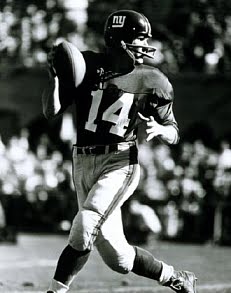
For the Giants, Charlie Conerly was successful on 17 of 25 throws for 215 yards and a TD along with an interception, but also coughed up four of the team’s fumbles. Frank Gifford (pictured at right), who was limited to 16 yards on 7 carries, caught 11 passes for 105 yards and a TD and accounted for two costly fumbles in the first half. Alex Webster topped the ground gainers with 33 yards on 9 attempts that included a score and added 38 more yards on two receptions.

“You don’t deserve to win when you lose the ball six times on fumbles,” summed up New York’s Coach Howell. “The 49ers gambled on shooting their linebackers through to get at Conerly and it paid off.”

The game proved to be a turning point heading into the final stretch for both teams.  San Francisco won its remaining two games, including a showdown with the Colts, to finish at 8-4 and tied with Detroit atop the Western Conference. In the resulting playoff game, the 49ers blew a big halftime lead to lose to the Lions. The Giants, on the other hand, lost their next two contests and placed second in the Eastern Conference at 7-5.

December 15, 2015

1956: Giants Defeat Eagles to Clinch Eastern Conference Crown


The New York Giants were looking to lock up the NFL Eastern Conference title as they faced the Philadelphia Eagles on December 15, 1956. Under the guidance of Head Coach Jim Lee Howell, the Giants had roared out to a 6-1 record and, following a 1-2-1 stretch, were now coming into the season finale at 7-3-1 and could gain a slot in the NFL Championship game with a win. New York operated a power-T offense that was the responsibility of assistant coach Vince Lombardi and emphasized a strong running game that utilized halfbacks Frank Gifford and Alex Webster (pictured above) and FB Mel Triplett. A platoon system was used at quarterback where Don Heinrich started games and the more-talented Charlie Conerly relieved when needed. Assistant coach Tom Landry handled the tough and talented defense.

The Eagles were going nowhere at 3-7-1 in their first year under Head Coach Hugh Devore.  They also used a two-quarterback platoon with Adrian Burk and Bobby Thomason and there was an able receiver in end Bobby Walston, but the ground attack was average at best. The defense was particularly sound at linebacker with All-Pro Chuck Bednarik and Wayne Robinson, but the backfield was a problem, particularly after the loss of safety Jerry Norton to injury.  

There were 15,562 fans in attendance on a foggy afternoon at Connie Mack Stadium and the contest was also nationally televised. It had rained the previous three days and the field was soft. The Giants had the first possession with Don Heinrich at quarterback and punted and, while the Eagles started off with runs by HB Ted Wegert for six yards and FB Dick Bielski for 12, they were forced to punt in turn. New York advanced into Philadelphia territory thanks primarily to the running of Mel Triplett and Frank Gifford, but the drive stalled at the 43 and Don Chandler punted into the end zone.

Following another punt by the Eagles, the Giants were driving as the game headed into the second quarter. Alex Webster started the series with a 14-yard carry and Heinrich threw to end Kyle Rote for a gain of 15 yards to the Philadelphia 30. An eight-yard run by Webster and 11-yard carry by Gifford (pictured below) got the ball inside the ten and Gifford then threw an option pass to Rote for a six-yard touchdown to complete the eight-play, 65-yard series. Ben Agajanian added the extra point.


Bobby Thomason was at quarterback for the Eagles on their next possession but a clipping penalty nullified a pass completion and Thomason was sacked for a loss of ten yards on third down to force another punt. Once again the running of Triplett and Webster advanced the ball into Philadelphia territory and Heinrich completed a pass to Gifford for nine yards to convert a third down. Following a five-yard carry by Triplett, Webster ran wide to the left for 10 yards that set up a 10-yard run by Gifford for a TD. Agajanian again converted to give the visitors a 14-0 lead.

The Eagles turned the ball over on the next series when DE Walt Yowarsky recovered an errant pitchout at the Philadelphia 35. But while the productive ground game got the Giants to the 14, Heinrich’s pass was intercepted by safety Lee Riley. The score remained unchanged at the half.

The Eagles had the ball first in the third quarter but a Thomason pass was picked off by safety Emlen Tunnell, who returned it 14 yards to the Philadelphia 27. Six plays later the Giants capitalized as Webster ran seven yards for a touchdown. Agajanian again booted the point after and New York held a comfortable 21-0 lead.

The teams exchanged punts and Riley briefly provided some excitement for the home team with a 35-yard return to midfield. But with Thomason giving way to Burk, the Eagles lost yardage from there and punted once again. Chuck Bednarik recovered a Triplett fumble on the next series at the Philadelphia 45 and the Eagles advanced into New York territory. Burk completed four passes, three of them to end Bobby Walston for gains totaling 36 yards, in the closing minutes of the period. But a run for negative yardage followed by a penalty on the offense to start the third quarter and an incomplete pass set up a fourth-and-30 situation, and Burk’s throw to Walston gained just 18 yards to turn the ball over on downs at the New York 12.

The Giants were able to put together a long series that was extended by a roughing-the-kicker call on a punt by Chandler. New York failed to extend its lead when Agajanian was wide on a 46-yard field goal attempt, but time was running out on the Eagles, who again had to punt.

Philadelphia finally put together a scoring drive of 64 yards in 14 plays that was helped along by a 26-yard pass interference penalty on the Giants. Burk completed two passes, one of which converted a fourth down, and had an 11-yard scramble in a third-and-10 situation. After an incomplete pass and 13-yard sack, the Eagles faced third-and-23 and Burk threw to end Hank Burnine for 13 yards and, on fourth down, to Walston for a 15-yard touchdown. Walston kicked the extra point, but while it averted a shutout, it was of no consequence with only 1:08 remaining in the contest. New York won by a final score of 21-7.

The Giants led significantly in total yards (332 to 174), with 291 of that total coming on the ground, and in first downs (22 to 13). Both teams turned the ball over twice. New York recorded four sacks, to none by the Eagles.

Alex Webster led the New York rushers with 132 yards on 23 carries that included a TD. Frank Gifford accumulated 81 yards and a touchdown on 16 attempts and Mel Triplett contributed 72 yards on 14 carries. With the Giants in control, Don Heinrich remained in for the full game and completed three of 10 passes for 35 yards. Gifford and Kyle Rote each caught two passes, for 20 and 21 yards, respectively, and Rote scored a touchdown on a Gifford pass.


For the Eagles, Adrian Burk was successful on 12 of 26 throws for 124 yards and a TD while Bobby Thomason was two of four for 17 yards. Bobby Walston (pictured at right) led the receivers with 5 catches for 69 yards and a touchdown. Ted Wegert rushed for 31 yards on 11 attempts.

The win allowed the Giants to finish atop the Eastern Conference with an 8-3-1 record. In their first NFL Championship game appearance in ten years, they thrashed the Chicago Bears 47-7. For Philadelphia, the loss closed out the club’s worst season since 1942, finishing at the bottom of the conference with a 3-8-1 tally.

Frank Gifford received MVP honors as he led the league in yards from scrimmage (1422, with 819 rushing and 603 receiving). Alex Webster also ranked among the Top 10 rushers with 694 yards and seven TDs and Mel Triplett added 515 yards on the ground.  

September 30, 2014

1962: Tittle’s 4 TD Passes Propel Giants Past Steelers


The New York Giants, defending champions of the NFL Eastern Conference, were 1-1 as they met the Pittsburgh Steelers, who had the same record, on September 30, 1962. In their second year under Head Coach Allie Sherman, the Giants were an outstanding passing team, with a rejuvenated QB Y.A. Tittle (pictured at right), in his 15th pro season but second in New York, throwing to split end Del Shofner and Frank Gifford, once a star halfback but, following a year missed due to injury, back as a flanker. The ground game was led by 31-year-old FB Alex Webster, operating behind a good veteran line. The defense was also experienced and a tough and cohesive unit.

Pittsburgh, coached by Buddy Parker for a sixth season, still had QB Bobby Layne, who was a worn but savvy veteran. The offense also featured FB John Henry Johnson and split end Buddy Dial while the defensive line was anchored by DT Ernie Stautner. However, Pittsburgh’s normally good corps of linebackers was depleted by injury and Parker started only two against the Giants, George Tarasovic and Tom Bettis, until Ken Kirk joined them midway through the second quarter while Gene “Big Daddy” Lipscomb, normally a defensive tackle, lined up at middle guard.

There were 40,916 fans in attendance on a sunny afternoon at Pitt Stadium. Pittsburgh had first possession and drove 84 yards in 12 plays, the highlight of which was a 36-yard carry by John Henry Johnson. HB Joe Womack ran for the last seven yards and a touchdown. Lou Michaels added the extra point and the Steelers held the early 7-0 advantage.


The Giants responded with a good drive of their own, but it stalled in Pittsburgh territory and Don Chandler kicked a 23-yard field goal. CB Brady Keys returned the ensuing kickoff 55 yards with a sensational run to give the Steelers good field position at the New York 40. A two-yard loss on an end-around was followed by a 15-yard penalty against the Giants for defensive holding. Bobby Layne (pictured at left) finished the series off with a throw to flanker Red Mack in the corner of the end zone for a 28-yard TD. Michaels again converted and the home team was up by a 14-3 lead at the end of a quarter of play.

Early in the second quarter, safety Jim Patton intercepted a Layne pass and returned it ten yards to the Pittsburgh 38. The Giants advanced to the two, but after being backed up five yards by a penalty, Y.A. Tittle threw to HB Paul Dudley for an 11-yard touchdown. Chandler added the PAT and Pittsburgh’s lead was narrowed to 14-10.

Once again Keys made an outstanding kickoff return for the Steelers, running it back 57 yards this time to the New York 39. They moved inside the ten but they lost sizable yardage to a holding penalty and sack, and settled for a 41-yard Michaels field goal.


In the final two minutes of the half, the Giants came up with a big play when Tittle connected with Alex Webster (pictured at right) on a screen pass, and he went the distance for a 58-yard touchdown. Chandler’s extra point tied the score at 17-17.

The Steelers fought back in what proved to be a wild close to the first half. End Harlon Hill dropped a pass at the New York two and Michaels attempted a 53-yard field goal that was blocked, but HB Dick Hoak recovered for Pittsburgh and ran to the New York 17. With the clock down to seven seconds, the Steelers again lined up for an apparent kick, but instead tried a fake. The resulting pass by holder and backup QB Ed Brown was intercepted in the end zone by safety Allan Webb and the score remained tied at halftime.

Early in the third quarter, Keys intercepted a Tittle pass at his own 43 and the Steelers took advantage as Michaels capped the ensuing series with a 33-yard field goal. The home team was back in front by 20-17. 

New York responded with a scoring drive of its own. Tittle passed the Giants down the field and threw to a well-covered Frank Gifford, who pulled the pass away from safety Clendon Thomas for a 27-yard TD. Chandler’s conversion put the visitors in front for the first time by a score of 21-20. The Steelers threatened again late in the period, but a Michaels field goal try from 42 yards was short.

In the early seconds of the fourth quarter, Tittle threw to split end Del Shofner for a 16-yard touchdown. The Steelers fought back, helped by penalties on New York for roughing the passer and pass interference, and Johnson leaped the last yard for a TD. Michaels was good on the extra point to put Pittsburgh four points behind.

As the time wound down in the game, and with the home crowd cheering wildly, the Steelers again drove into scoring position. But after reaching the New York 16, a Layne pass into the end zone that was intended for Buddy Dial was instead intercepted by CB Erich Barnes to seal the 31-27 win for the Giants.

New York accumulated the most total yards (427 to 317) although the Steelers held the edge in first downs (23 to 19). Pittsburgh did a good job defensively against New York’s running game, at least until the fourth quarter, holding the Giants to 95 yards on 27 attempts while gaining 175 yards themselves. However, the Steelers also turned the ball over three times, including the climactic interception in the fourth quarter, to one suffered by New York. The Giants also recorded three sacks while Pittsburgh had none.

Y.A. Tittle completed 17 of 29 passes for 332 yards and four touchdowns while giving up one interception. Alex Webster led the Giants with 77 rushing yards on nine carries and also in pass receiving with 5 catches for 101 yards and a TD. Frank Gifford gained 99 yards on four receptions that included a score. 
  
For the Steelers, Bobby Layne was successful on 12 of 23 throws for 166 yards and a TD as well as two interceptions. John Henry Johnson rushed for 113 yards on 20 attempts that included a touchdown. TE Preston Carpenter had 5 receptions for 44 yards while Buddy Dial accumulated 70 yards on his four catches. Brady Keys (pictured below) averaged 36.8 yards on five kickoff returns that included two of 55 and 57 yards.


Two weeks later, the teams met again at Yankee Stadium and Pittsburgh prevailed, but it was the only loss for the Giants the rest of the way. New York posted a 12-2 record to again top the Eastern Conference, although the Giants still came up short against Green Bay in the NFL title game. The Steelers were a mediocre 3-4 at the season’s halfway point before catching fire and winning six of their last seven games to place second in the conference at 9-5. They appeared in the Playoff Bowl, the postseason exhibition game for second place teams during that era, and lost to Detroit.

Y.A. Tittle received MVP honors from United Press International as well as consensus first-team All-NFL and Pro Bowl recognition as he passed for 3224 yards and a league-record 33 touchdown passes (Houston’s George Blanda passed for 36 in the AFL in 1961, a mark that Tittle would match in ’63). Alex Webster rushed for 743 yards on 207 carries (3.6 avg.) and caught 47 passes for another 477 yards (10.1 avg.), for 1220 yards from scrimmage and a total of nine TDs.

In his last season, Bobby Layne threw for 1686 yards and nine touchdowns and left the NFL as the career leader in several major passing categories. John Henry Johnson enjoyed a big year in his ninth season, rushing for 1141 yards and gaining selection to the Pro Bowl.

October 26, 2013

1952: Willey Has Big Sack Performance as Eagles Defeat Giants


Sacks became an officially-compiled NFL statistic in 1982, with the single-game record to date for an individual being seven by Derrick Thomas of the Chiefs in 1990. Prior to ’82, and beginning in the 1960s, team sacks were compiled (the term sack did not come into use until the ‘60s as well), and earlier, yards lost while passing were subtracted from a team’s passing yards in order to come up with a net passing yardage total, but individual records were typically a matter of conjecture (although it should be noted that some researchers are doing good work in piecing together the historical record).

On October 26, 1952, DE Norm “Wild Man” Willey of the Philadelphia Eagles (pictured above) may have set the real individual sack record, although that is by no means certain. What is known about the game on that date between the Eagles and Giants is that it was highlighted by a dominating performance by Willey and the Philadelphia defense.

The Eagles, with a 2-2 record, were 15-point underdogs coming into the contest, having lost to the Giants in Philadelphia three weeks earlier by a decisive 31-7 score. First-year Head Coach Jim Trimble had made changes heading into the season, most notably moving star offensive end Pete Pihos to defense and replacing him with Bud Grant. They lost Hall of Fame HB Steve Van Buren to a career-ending knee injury during the preseason, but had added QB Bobby Thomason, who came from Green Bay.

New York, under Head Coach Steve Owen for the 22nd year, was at 3-1 and coming off the team’s first loss the previous week. QB Charlie Conerly directed a ball control running attack led by FB Eddie Price and HB Kyle Rote, plus rookie all-purpose HB Frank Gifford, who played on defense as well. Safety Emlen Tunnell starred both on defense and as a kick returner.

There were 21,458 fans at the Polo Grounds for the rematch of the two division rivals. The Giants got the first break on the opening kickoff when it rolled free and they recovered at the Philadelphia 15. Ray Poole kicked a 30-yard field goal to start the scoring.

Late in the period, the Giants drove to the Philadelphia one yard line but the Eagles stopped them with a rugged goal line stand. The tally remained at 3-0 until, in a five-minute segment in the latter part of the second quarter, the Eagles scored twice.

First, safety Ed “Bibbles” Bawel took a Tom Landry punt and returned it 52 yards for a touchdown, regaining his footing after being hit at the New York 30. Then, getting the ball back in the closing minutes of the first half, the Eagles mounted a 72-yard scoring drive. With seven seconds left on the clock, end Bobby Walston made an impressive leaping catch in the corner of the end zone of a pass from Bobby Thomason for a 19-yard touchdown, pulling it away from defenders Harmon Rowe and Frank Gifford. Walston successfully added the extra point after each TD and the Eagles took a 14-3 lead into halftime.

The Giants started off the second half in good fashion when Gifford returned the kickoff 60 yards to the Philadelphia 32. QB Fred Benners, who took over for a battered Charlie Conerly, completed a pass to end Bob McChesney for 24 yards and a run by Kyle Rote put the ball at the two yard line. However, the Eagles defense once again pulled off a successful goal line stand and the Giants turned the ball over on downs.

The only other score of the game came a little later in the third quarter when New York LB Jon Baker blocked a punt by Adrian Burk and DE Bud Sherrod recovered in the end zone for a touchdown. Poole added the extra point to make it a four-point contest, but that was it.

The Eagles physically punished the Giants, especially on defense, with a half dozen New York players sidelined by injuries. Those injured included Charlie Conerly, Eddie Price, and Frank Gifford. While the Eagles weren’t able to mount any further offense themselves, they held on to win by a final score of 14-10.

Game accounts indicated that Willey was a one-manning wrecking crew, and sportswriter Hugh Brown of the Philadelphia Bulletin credited him with an incredible 17 sacks during the course of the contest (or “dumping Charlie Conerly…while he was attempting to pass”, although Fred Benners was clearly a victim as well), including 11 in sequence. In addition to Willey, MG Bucko Kilroy and Pete Pihos had big days. Whatever the truth of the number of sacks – Willey himself years later thought it was 15, Kilroy suggested 12, and veteran pro football writer Paul Zimmerman, who was charting the game that day, gave the Eagles credit for 14 overall and Willey a total of 8 – it is clear that the Eagles had a great day defensively.

Philadelphia outgained the Giants by 225 yards to 109, with New York managing only 54 rushing yards on 34 attempts and a net of 55 passing yards thanks to 127 yards lost due to quarterbacks Conerly and Benners being tackled while attempting to throw. Interestingly, the Eagles suffered the only turnover of the game, on a fumble. Kyle Rote carried 7 times for 12 yards and Eddie Price was held to just 7 yards on 11 rushing attempts.

“I almost felt sorry for Charlie (Conerly),” said Jim Trimble later. “I remember vividly Charlie having a heck of a time just getting up. He was just mauled by Norm (Willey).”

The Eagles lost the following week at Green Bay but then reeled off three straight wins while the Giants won their next two contests but lost three of their last five games. The clubs ended up with identical 7-5 records, tying them for second place in the American Conference, a game behind the Browns.

Norm Willey’s performance against the Giants, which has taken on something  of a legendary status, was the highlight of an eight-season NFL career, all spent with the Eagles. The 6’2”, 224-pound Willey was a 13th round draft pick out of Marshall in 1950, and with his speed off the defensive line, he regularly harassed opposing quarterbacks. He was twice named to the Pro Bowl and received at least some first-team All-NFL recognition in 1953, ‘54 and ’55. 

December 20, 2011

MVP Profile: Frank Gifford, 1956

Halfback, New York Giants


Age: 26
5th season in pro football & with Giants
College: Southern California
Height: 6’1” Weight: 205

Prelude:
Chosen by the Giants in the first round of the 1952 NFL draft, the versatile Gifford was used primarily on defense and was selected to the Pro Bowl following the ’53 season as a defensive halfback (modern cornerback). Under new Head Coach Jim Lee Howell (and offensive assistant Vince Lombardi), he was shifted to offense full-time in 1954 and again was named to the Pro Bowl. With his outside speed as a runner and pass receiver and option passing ability, Gifford proved to be a formidable weapon. In 1955, he gained 902 all-purpose yards (351 rushing, 437 on 33 receptions, 114 on kickoff returns) and not only was picked to a third Pro Bowl but was a consensus first-team All-Pro selection.

1956 Season Summary
Appeared in all 12 games
[Bracketed numbers indicate league rank in Top 20]

Rushing
Attempts – 159 [7]
Most attempts, game - 19 (for 43 yds.) vs.  Chi.Bears 11/25, (for 108 yds.) vs. Washington 12/2
Yards – 819 [5]
Most yards, game - 108 yds. (on 19 att.) vs. Washington 12/2
Average gain – 5.2 [5]
TDs – 5 [9, tied with five others]
100-yard rushing games - 1

Pass Receiving
Receptions – 51 [3]
Most receptions, game - 8 (for 85 yds.) at Chi. Cardinals 10/7
Yards – 603 [7, tied with Elroy Hirsch]
Most yards, game 116 (on 6 catches) vs.  Chi. Cardinals 11/11
Average gain – 11.8
TDs – 4 [12, tied with six others]
100-yard receiving games - 2

Passing
Pass attempts – 5
Pass completions – 2
Passing yards – 35
TD passes – 2
Interceptions – 1

Kicking
Field goals – 1 [14, tied with Sid Watson & Bud McFadin]
Field goal attempts – 2 [16]
Percentage – 50.0
PATs – 8 [14, tied with Bert Rechichar]
PAT attempts – 9 [15]
Longest field goal – 17 yards at San Francisco 9/30

All-Purpose yards – 1422 [5]

Scoring
TDs – 9 [6, tied with Lenny Moore]
FG – 1
PATs – 8
Points – 65 [10]

Postseason: 1 G (NFL Championship vs. Chicago Bears)
Rushing attempts – 5
Rushing yards – 30
Average gain rushing – 6.0
Rushing TDs – 0

Pass receptions – 4
Pass receiving yards - 131
Average yards per reception – 32.8
Pass Receiving TDs - 1

Awards & Honors:
NFL MVP: UPI, NEA, Sporting News
1st team All-NFL: AP, NEA, UPI, NY Daily News, Sporting News
Pro Bowl

Giants went 8-3-1 to finish first in the Eastern Conference and also led the conference in team rushing (2129 yards). Defeated Chicago Bears for NFL Championship (47-7).

Aftermath:
Gifford continued to excel at halfback, gaining 1116 yards from scrimmage in 1957 and 1308 in ’59. Along the way, he was again a consensus first-team All-Pro in both of those seasons and a Pro Bowl selectee in ’58 as well. A severe concussion suffered due to a tackle by Eagles LB Chuck Bednarik ended his career as a running halfback eight games into the 1960 season, but after taking a year off he returned as a flanker in ’62 and averaged 20.4 yards per catch on 39 receptions for 796 yards. He followed up with a 42-catch, 657-yard performance in 1963 when he returned to the Pro Bowl, but retired to move into a long broadcasting career after a 1964 season in which the team as a whole declined. Overall, Gifford rushed for 3609 yards on 840 carries with 34 TDs and caught 367 passes for another 5434 yards and 43 TDs, was named to 8 Pro Bowls and was a consensus first-team All-Pro four times. He also threw 14 TD passes and, on defense, had two interceptions, one that he returned for a score. The Giants retired his #16 and he was inducted into the Pro Football Hall of Fame, Class of 1977.

--

MVP Profiles feature players who were named MVP or Player of the Year in the NFL, AAFC (1946-49), AFL (1960-69), WFL (1974), or USFL (1983-85) by a recognized organization (Associated Press, Pro Football Writers Association, Newspaper Enterprise Association, United Press International, The Sporting News, Maxwell Club – Bert Bell Award, or the league itself).

[Updated 2/11/14]
[Updated 2/21/17]

December 15, 2011

1963: Giants Beat Steelers to Win Eastern Conference Title


First place in the NFL Eastern Conference and a spot in the league title game were on the line as the Pittsburgh Steelers faced the New York Giants at Yankee Stadium on December 15, 1963. The Giants came into the contest with a 10-3 record while Pittsburgh was 7-3-3. At that time, ties did not figure into a team’s won-lost percentage, so a win by the Steelers would give them the conference title by .727 to .714 despite having fewer victories than the Giants (the method for determining won-lost percentage was changed in 1972, so that a tie counts as half of a win and half of a loss).

Head Coach Allie Sherman’s Giants had won the conference the previous two seasons but started off slowly in ’63, losing two of the first five games before putting together seven wins in the next eight contests. The veteran club featured the passing of QB Y.A. Tittle (pictured above) on offense and a sound defense.

The Steelers, coached by Buddy Parker, were a franchise that had never won a division title since coming into the NFL thirty years earlier. The ball-control offense was directed by QB Ed Brown and centered on the running of FB John Henry Johnson. Flanker Gary Ballman and split end Buddy Dial were capable receivers, and DE Lou Michaels was also one of the league’s better placekickers. The Steelers had stunned the Giants by a score of 31-0 when the clubs met in Week 2 at Pitt Stadium, and they were a confident and emotionally-charged team coming into the season finale.

There was a big crowd of 63,240 on hand for the showdown on a bitterly cold day. HB Theron Sapp fumbled on Pittsburgh’s first play from scrimmage and safety Jim Patton recovered for the Giants. It led to a 34-yard field goal by Don Chandler for the first points of the game.

Shortly thereafter, it seemed as though the Steelers would score in turn. Ballman returned the kickoff 57 yards but, after Brown overthrew his receiver on a third-and-four play, Michaels missed a field goal attempt. Pittsburgh quickly regained possession on a fumble recovery and Brown went deep right away, completing a pass to Ballman, but the receiver fumbled into the end zone when hit by CB Dick Lynch just a stride short of the goal line. CB Erich Barnes, coming across the field, picked up the loose ball and returned it to the New York 34. Tittle threw to end Aaron Thomas for a first down and then went deep to split end Del Shofner for a 41-yard touchdown. While Chandler’s extra point attempt hit the goal post and was no good, the Giants were ahead by 9-0 and had blunted Pittsburgh’s early momentum.

Brown continued to have trouble hitting his receivers, throwing a pass that was intercepted by Lynch and then, on the next series, overthrowing Ballman on a potential scoring play. Facing third-and-one, Johnson was stopped cold by the Giants defense, and going for it on fourth down, Sapp was held to no gain as well. New York made the most of it as Tittle once again threw long to Shoftner for a 44-yard gain and, now into the second quarter, the Giants extended their lead when Joe Morrison, a versatile player who was covering for injured FB Alex Webster, scored on a three-yard pass from Tittle. This time the PAT was good and New York was up by 16-0. Pittsburgh finally put points on the board when Michaels kicked a 27-yard field goal, although it was after Brown had again misfired on a pass to Ballman, having beaten Lynch on a post pattern.

The star receiver Shofner suffered bruised ribs in the second quarter and left the game. Still, the Giants held a 16-3 lead at halftime.

In the third quarter, the Steelers battled back as Johnson took off on a 48-yard run and Brown connected with Ballman for a 21-yard TD that, with the extra point, put the Steelers just six points behind at 16-10. With the momentum seeming to shift, the next series proved crucial for the Giants. On a third-and-eight play from his own territory, Tittle threw a pass that, due to the onrushing Michaels, lacked the usual accuracy, but flanker Frank Gifford made a spectacular one-handed catch for a 30-yard gain to the Pittsburgh 47. Tittle hit Gifford again for 25 more yards and then found Morrison for a 22-yard touchdown that broke the game open.

On New York’s next series, now up 23-10, Tittle connected with Thomas for 31 yards and 14 yards to Gifford to set up a short scoring run of one yard by Morrison. While Brown threw to Dial for a 40-yard TD with 29 seconds remaining in the third quarter, that was it for Pittsburgh. Chandler kicked a 41-yard field goal in the final period and the Giants came away with a convincing 33-17 win.

New York outgained the Steelers (423 yards to 400) and had more first downs (21 to 17). And while the Giants turned the ball over four times, the Steelers missed five scoring opportunities as they turned the ball over five times, three on interceptions and twice on fumbles.


Y.A. Tittle completed 17 of 26 passes for 308 yards with three touchdowns and one intercepted. Joe Morrison had an outstanding performance as he rushed for 68 yards and a TD on 15 carries and caught 6 passes for 40 yards and two scores. HB Phil King also gained 68 rushing yards, on 18 attempts. Frank Gifford (pictured at left) had 5 receptions for 94 yards and Del Shofner gained 110 yards on his three catches with the one long TD before he had to leave the game.

For the Steelers, QB Ed Brown went to the air 33 times and completed just 13 for 217 yards with two TDs and three interceptions. Gary Ballman had 6 catches for 104 yards and a touchdown and Buddy Dial pulled in 5 passes for 92 yards and a score. John Henry Johnson, thanks to the one long gain, accumulated 104 yards on 14 carries.

The Giants finished at 11-3 but lost their third straight NFL Championship game, falling 14-10 to the Bears. The defeat in the season finale dropped Pittsburgh all the way to fourth place with a 7-4-3 record. The Steelers would not win a division title until 1972.

Y.A. Tittle set a new NFL record with 36 touchdown passes (Houston’s George Blanda had already done so in the AFL in 1961) while also leading the league in passing (104.8 rating by the current standard), completion percentage (60.2), and yards per attempt (8.6). In addition to receiving first-team All-Pro and Pro Bowl recognition, the 37-year-old veteran was also named MVP by the Associated Press and Newspaper Enterprise Association.


Frank Gifford, formerly an outstanding running halfback, was named to the Pro Bowl as a flanker after catching 42 passes for 657 yards (15.6 avg.) and seven touchdowns. Joe Morrison (pictured at right) rushed for 568 yards with a 4.8 average while also catching 31 passes for 284 more and a total of 10 touchdowns. It was all part of a 14-year career in which the multitalented player out of Cincinnati would often be called upon in a reserve role to fill in at halfback, flanker, and defensive back as well as fullback.

December 30, 2010

1956: Giants Dominate Bears on Frozen Field for NFL Title


Temperatures in New York City were in the 20s and the field at Yankee Stadium was frozen for the NFL Championship game on December 30, 1956. The head coach of the host Giants, Jim Lee Howell, made the decision to have the players wear sneakers – reminiscent of the 1934 title game (although the sneakers were available prior to, rather than obtained during, the game). While in this instance the Bears did likewise, the result would be similar to the earlier contest.

The Giants had won the Eastern Conference with an 8-3-1 record. The offense, directed by assistant coach Vince Lombardi and led by 35-year-old QB Charlie Conerly, was conservative but effective and contained the consensus league MVP in HB Frank Gifford, who ran for 819 yards and added another 603 yards on 51 pass receptions. Defense was the team’s strength, however, coached by assistant Tom Landry and containing All-Pros in DT Roosevelt Grier, DE Andy Robustelli, and safety Emlen Tunnell. Rookie MLB Sam Huff had an impact, as did veteran newcomers HB Ed Hughes and DT Dick Modzelewski.

As had been the case in 1934, New York’s opponent was the Chicago Bears, leaders in the Western Conference at 9-2-1. George Halas still directed the club as owner, although he had retired as head coach (he came out of retirement in 1958) in favor of longtime assistant Paddy Driscoll. Chicago had the NFL’s leading rusher in FB Rick Casares (1126 yards) and the leading passer, QB Ed Brown (9.9 yards per attempt), who split time with George Blanda. All-Pro end Harlon Hill caught 47 passes for 1128 yards and 11 touchdowns. The defense, anchored by All-Pro middle guard Bill George, was rugged. The two teams had played to a 17-17 tie during the regular season and the Bears were favored coming into the title game.

The Giants were concluding their first season as tenants at Yankee Stadium, and there were 56,836 fans present. New York got off to a quick start as HB Gene Filipski returned the opening kickoff 53 yards to the Chicago 39 yard line. Four plays later, FB Mel Triplett ran 17 yards up the middle for a touchdown (pictured above). It didn’t get any better for the Bears when, on their first possession following the ensuing kickoff, Casares fumbled on the second play and Robustelli recovered for New York at the Chicago 15. Ben Agajanian ended up kicking a 17-yard field goal. Before the first quarter was over, Agajanian kicked for another three points, from 43 yards, after safety Jim Patton intercepted a Brown pass.


It was 13-0 after the first quarter as Conerly (pictured at right) entered the contest for the Giants. In an unorthodox arrangement, backup QB Don Heinrich typically started and ran the offense for the first couple of series while Conerly studied the defense’s tendencies from the sideline. With the veteran quarterback now directing the attack, New York’s lead was extended to 20-0 three minutes into the second quarter as HB Alex Webster ran three yards for a touchdown.

The Bears finally got a break when a punt was fumbled by Tunnell at the New York 25 and DT John Mellekas recovered for Chicago. A five-play drive was capped by Casares running nine yards for a TD. However, any hopes the Bears might have had of getting back into the game were dashed when the Giants responded by driving 72 yards in five plays, including a pass from Conerly to Webster that covered 50 yards and a 20-yard run by Triplett down to the Chicago two yard line. Webster finished off the possession with another short scoring run, this time from a yard out. Less than two minutes later, Giants guard Ray Beck blocked a punt by Brown that was recovered in the end zone for a TD by DB Henry Moore. The score was 34-7 at the half.

The second half added little of note. The New York defense continued to shut down the Bears, with either Brown or Blanda behind center, and Chicago even switched from the T-formation to the double-wing in an unsuccessful effort to generate offense. The Giants put together a third quarter scoring drive of 80 yards in four plays that ended with a Conerly pass to end Kyle Rote for a nine-yard touchdown (the extra point attempt failed).

New York scored once more, in the fourth quarter, as Conerly passed to Gifford for 14 yards. Backup Bobby Clatterbuck replaced the veteran quarterback at that point and the game ended with the Giants winning by a very convincing 47-7 margin.


The Giants outgained Chicago, 348 yards to 270, and held the Bears to just 67 yards on the ground. Charlie Conerly didn’t need to go to the air often, but was efficient when he did so, completing 7 of 10 passes for 195 yards with two touchdowns and no interceptions. Mel Triplett was the leading rusher, gaining 71 yards on 13 carries with a TD, while Frank Gifford (pictured at left) had 30 yards on five attempts and also caught four passes for 131 yards and a touchdown. Alex Webster (pictured below right), who had the two short scoring runs among his 12 carries for 27 yards, added another 5 pass receptions for 76 yards.


The Bears went to the air 47 times, with Ed Brown completing just 8 of 20 passes for 97 yards with an interception and George Blanda succeeding on 12 of 27 throws for 140 yards, also having one picked off. Rick Casares gained only 43 yards on 14 carries with Chicago’s lone score, but also had the costly early fumble. Harlon Hill caught 6 passes for 87 yards, but most came after the outcome had been decided. End Jim Dooley added another 6 receptions for 66 yards.

“The frozen field was no excuse,” said Paddy Driscoll afterward. “They just ran on it and we didn’t…we just didn’t have it…the Giants played a great game.”

It was the first NFL Championship for the Giants in 18 years. While the team would make it back to the title game five times in the next seven seasons, the win in 1956 would be their last until the Super Bowl following the 1986 season.

December 29, 2009

1963: Bears Exploit Turnovers to Defeat Giants for NFL Championship


It was a frigid day at Chicago’s Wrigley Field on December 29, 1963 as the Bears hosted the New York Giants in the NFL Championship game. The temperature at game time was 11 degrees. There were 45,801 fans in attendance to see which team would prevail – the home town club with its outstanding defense, or the visitors and their vaunted passing offense.

The Bears were coached by the 68-year-old “Papa Bear”, George Halas. With a zone defense installed by assistant coach George Allen, Chicago had put together an 11-1-2 record to edge out the Green Bay Packers in the Western Conference. The defensive line was anchored by DE Doug Atkins; the linebacking corps of Joe Fortunato, Bill George, and Larry Morris was the best in pro football; and the defensive backfield, led by free safety Roosevelt Taylor, who co-led the NFL with 9 interceptions, was excellent as well. The offense, led by QB Bill Wade, played conservatively but effectively.

The Giants, 11-3 under Head Coach Allie Sherman, featured an aerial attack directed by 37-year-old veteran QB Y.A. Tittle, who had been traded to New York from the 49ers prior to the 1961 season and proceeded to set passing records while leading the Giants to three consecutive Eastern Conference titles. In 1963, Tittle had broken his own record for TD passes, set just the previous year, with 36 (George Blanda had thrown the same number in the AFL in 1961) and led the league with a 60.2 completion percentage and 8.6 yards per attempt. He had a fine receiving corps led by split end Del Shofner and flanker Frank Gifford. The defense was aging but effective.

The Bears had the first possession of the game and ran the ball well until Wade, a good running quarterback, fumbled after a 12-yard carry at his own 41 yard line. CB Erich Barnes recovered for the Giants, and a few plays later Tittle threw a 14-yard touchdown pass to Gifford. However, LB Morris rolled into Tittle’s left leg as it was planted to throw, tearing ligaments in his knee. The Giants led, 7-0, but the score would prove to be a costly one (pictured below, Tittle getting set to throw the scoring pass with #33 Morris about to roll into him; #31 is Joe Fortunato).


The teams exchanged punts, and then once again the Bears turned the ball over on a fumble, this time by HB Willie Galimore. With the ball on the Chicago 31, Tittle went for the touchdown on first down, firing to Shofner who had CB Dave Whitsell beaten by five yards in the end zone. The normally reliable All-Pro receiver jumped an instant too late and wasn’t able to make the catch. On second down, Morris intercepted a screen pass intended for HB Phil King and returned it 61 yards to the New York five yard line. Two plays later, Wade scored on a quarterback sneak, and instead of the Giants being up by two touchdowns in the first quarter, the score was tied at 7-7.

The Giants drove downfield once more, with the key play being a 36-yard pass from Tittle to TE Aaron Thomas. But with first and goal on the Bears three yard line, Chicago held and New York had to settle for a 13-yard Don Chandler field goal.

As the game continued through the second quarter, Chicago’s offense couldn’t move the ball against New York’s tenacious defense, but the Giants were unable to score again. Larry Morris once again hit Tittle and aggravated his knee injury to the point that he had to be helped off the field and didn’t immediately return. Chandler missed a field goal attempt, and the score remained 10-7 in favor of New York at the half.


The Bears defense turned another big play in the third quarter - they were on the lookout for screen passes, and DE Ed O’Bradovich cut in front of FB Joe Morrison to pick one off in Giants territory (pictured at right). Aided by a key third down pass completion to TE Mike Ditka, the Bears scored their second touchdown as Wade once again snuck over from a yard out.

After a missed field goal attempt by the Bears in the fourth quarter, Tittle and the Giants mounted one more major drive, moving from their 20 yard line deep into Chicago territory. But CB Bennie McRae intercepted a Tittle pass on third-and-five to end the threat. Still, the Bears were unable to mount a sustained drive to run out the clock and the Giants got the ball back once more at their 16 yard line with less than two minutes remaining.

Tittle connected for three passes that covered 30 yards, and in a third down situation hit Gifford for 15 yards to the Chicago 39. With 15 seconds left, Tittle threw a bomb intended for Shofner, but it was intercepted by strong safety Richie Petitbon and the Bears were league champions with a 14-10 win.

The day truly belonged to the Bears defense, as exemplified by the selection of Larry Morris as the MVP (pictured at top, stopping Joe Morrison) and the awarding of the game ball to George Allen. Of course, as Giants DE Andy Robustelli said afterward, “If Tittle hadn’t been hurt, we’d have won”. The Bears were outgained, 268 yards to 222, and their two touchdown possessions totaled 19 yards thanks to the excellent field position they were given through the interceptions by Morris and O’Bradovich. Bill Wade (pictured passing below left) completed just 10 of 28 passes for 138 yards, although to his credit he threw no interceptions. HB Ron Bull was the leading rusher for the Bears, with 42 yards on 13 carries; Wade was second, with 34 yards on 8 attempts and the two TDs. Ditka and FB Joe Marconi each caught three passes, with Marconi’s 64 yards leading the team (Ditka had 38 yards).


For the Giants, Y.A. Tittle, hampered by the injured knee, completed 11 of 29 passes for 147 yards with one TD and five interceptions. Frank Gifford topped the receivers with three receptions for 45 yards and a score. Joe Morrison also caught three passes (for 18 yards) and was the leading rusher with 18 carries for 61 yards. Most tellingly, Del Shofner caught no passes at all.

The loss was especially galling for Tittle, appearing in his last postseason game (he retired following the 1964 season), but never winning one. The Giants were on the verge of a long decline – this was their sixth championship game appearance in eight years (only the first, in 1956, resulted in a win), but they would not appear in the playoffs again until 1981. The Bears fell quickly from their perch as well, going 5-9 in 1964; they wouldn’t make the postseason again until 1977.

For Halas, it was his sixth – and final – NFL championship, stretching all the way back to 1921. On a frigid day at Wrigley Field, 42 years after leading the Bears to a title for the first time (before there even was a postseason), “the Papa Bear” and his team were back on top once more.

December 28, 2009

1958: Colts Defeat Giants in Overtime for NFL Title in “Greatest Game”


Perhaps no pro football game has received more attention than the NFL Championship game played at Yankee Stadium in New York on December 28, 1958. While it has been characteristically referred to as “the Greatest Game Ever Played”, such a statement is debatable – while it was certainly a very good game, there’s plenty of competition for that highly subjective title. But it was the most significant game in terms of fueling the rise of pro football and cementing its place on network television and in the national consciousness.

The host Giants, coached by Jim Lee Howell, had won the title two years previously and typically contended in the Eastern Conference. They had not had an easy road to the championship game, having won the last four contests of the season to end up in a tie with Cleveland. The last win had in fact been over the Browns in a nail-biting, must-win contest that came down to a late 49-yard field goal by Pat Summerall. The Giants had to then host the Browns once again in a tie-breaking playoff, and won once more, 10-0.

Baltimore was less well known nationally than the Giants, having only come into existence in 1953, and was in the postseason for the first time thanks to the coaching of Weeb Ewbank, who was in his fifth year. They boasted QB Johnny Unitas, who in his third season led the league in touchdown passes (19) and was already being referred to as one of the premier players at his position. Split end Raymond Berry tied for the NFL lead in pass receptions (56), and the Colts could run the ball formidably with FB Alan “The Horse” Ameche and halfbacks Lenny Moore (a great receiver out of the backfield as well) and L.G. Dupre.

There were 64,185 fans at Yankee Stadium and another 40 million watching on tv as the Giants took the early lead on a 36-yard Summerall field goal. But the Colts dominated play for the most part in the first half, and scored twice in the second quarter – on a two-yard run by Ameche and a 15-yard pass play from Unitas to Berry – to take a 14-3 lead into halftime.

It appeared that Unitas and the Colts were going to take decisive control of the game on their first possession of the third quarter, driving to the New York three yard line. But the Giants defense held at that point, and when the Colts went for it on fourth down, LB Cliff Livingston nailed Ameche for a four-yard loss. Momentum now shifted to the Giants, and QB Charley Conerly hit end Kyle Rote on a deep slant; he fumbled at the Baltimore 25, but HB Alex Webster, trailing the play, picked up the loose football and carried it down to the one. FB Mel Triplett scored from there to cut the Colts lead to 14-10.

On the next possession, Conerly connected on a pass to end Bob Schnelker for 46 yards, setting up the go-ahead touchdown on a 15-yard pass from Conerly to HB Frank Gifford. Less than a minute into the fourth quarter, New York led 17-14. The solid Giants defense stopped the next two Baltimore drives. With the clock dipping under three minutes, the Giants faced a third-and-four situation at their own 40 yard line; a first down would all but nail down the win. Conerly handed off to Gifford, who was hit hard by DE Gino Marchetti (who broke his leg on the play) and seemed very close to the necessary yardage; the officials placed the ball just short, and Coach Howell elected to punt.

Don Chandler’s punt was a good one that the Colts were forced to fair catch at their 14 yard line. Now it was Unitas driving the Colts down the field. On a third-and-ten play, he hit Moore for a first down at the 25. With the Giants double-teaming the multi-talented Moore, Unitas found Berry for a diving catch at the 35. Unitas kept going to Berry, who caught three passes for 62 yards on the drive to the New York 13. With the clock ticking down to 30 seconds, Steve Myhra kicked a 20-yard field goal (pictured below) to tie the game at 17-17 and set the stage for the first “sudden death” overtime in NFL history.


The Giants won the toss and received, but came up short on a third down Conerly bootleg and had to punt. Baltimore got the ball on their 20 yard line, and from there Unitas directed one of the most famous drives in pro football history. First, L.G. Dupre swept for 11 yards. After a pass intended for Moore was batted away by Giants defensive halfback Lindon Crow, Ameche gained two yards on a draw play. On third-and-eight, Unitas passed to Ameche who just made enough yardage for the first down.

Dupre ran again, but then Unitas was sacked by DT Dick Modzelewski. With a third-and-15 situation, Unitas found Berry on a 20-yard pass play to keep the drive going. Another big gain followed as Ameche rumbled for 23 yards on a trap play to the New York 21 yard line. After a short gain by Dupre, it was Unitas to Berry once again for 12 yards and a first down at the Giants 8. Ameche ran for a yard, and then Unitas surprised the Giants with a six-yard pass to end Jim Mutscheller that put the ball on the one. From there, Ameche ran in for the score (pictured at bottom) and the Colts had a 23-17 win and the championship.

Johnny Unitas completed 26 of 40 passes for 349 yards with a TD and an interception. Berry was the top receiver with 12 catches for 178 yards and a score, and Lenny Moore had 101 yards on 6 receptions (he had a 60-yard catch in the first half). Alan Ameche led the runners with 65 yards on 14 carries, including the two touchdowns.

For New York, Charley Conerly had a solid performance in completing 10 of 14 passes for 187 yards and a touchdown. Frank Gifford ran for a team-high 60 yards on 12 carries and also led the Giants with three pass receptions, for 14 yards and a TD, although he also fumbled the ball away three times. Kyle Rote accumulated the most pass receiving yards with 76 on two catches, and Bob Schnelker was right behind with 63 yards on his two receptions.

There was plenty of room for second-guessing with a game that was so close and turned on a few key plays. The decision to play for the touchdown rather than a field goal at the end particularly drew speculation, but the fact was that the pass to Mutscheller was a second down play and, with the team on a roll and Myhra not a sure bet to make the kick (the Giants blocked an attempt in the first half), Unitas was not inclined to be too conservative; in this instance, it proved to be a successful strategy and helped to confirm the lanky quarterback’s reputation as a daring field general and skillful clutch performer.

The close calls and second guesses have provided fuel for discussion over the years, but the outstanding performances – especially by Unitas – and the “sudden death” overtime element have long given the game an iconic status. And it surely generated interest in the sport at a time when television was ready to provide more exposure. Maybe, when you put all of the elements together, it truly was “the Greatest Game”.