Showing posts with label Los Angeles Dons. Show all posts

October 22, 2017

Highlighted Year: Bob Reinhard, 1947

Tackle/Fullback/Punter, Los Angeles Dons


 Age: 27 (Oct. 17)
2nd season in pro football & with Dons
College: California
Height: 6’4”    Weight: 230

Prelude:
A stellar tackle and punter in college, Reinhard was chosen by the Chicago Cardinals in the fifth round of the 1942 NFL draft. He went into the military for the duration of World War II and in 1946 joined the Dons of the new AAFC. Reinhard started all 14 games and received consensus second-team All-AAFC honors.

1947 Season Summary
Appeared in all 14 games
[Bracketed numbers indicate league rank in Top 20]

Punting
Punts – 28 [9]
Yards – 1279 [9]
Average – 45.7 [1]
Punts blocked – 1 [7, tied with four others]

Rushing
Attempts – 41
Yards – 150
Yards per attempt – 3.7
TDs – 0

Pass Receiving
Receptions – 3
Yards – 34
Yards per catch – 11.3
TDs – 1

Passing
Attempts – 4
Completions – 2
Yards – 21
TD passes – 0
Interceptions – 0

Interceptions
Interceptions – 1
Return yards – 0
TDs – 0

Kickoff Returns
Returns – 3
Yards – 42
Average per return – 14.0
TDs – 0

Scoring
TDs – 1         
Points – 6

Dons went 7-7 to finish third in the AAFC Western Division.

Aftermath:
Reinhard remained with the Dons for the next two seasons and continued to excel as a tackle, if no longer handling punting duties, receiving consensus first-team All-AAFC recognition in 1948 and second-team honors in ’49. With the demise of the AAFC he moved on to the Los Angeles Rams of the NFL in 1950, his last season, in which he received second-team All-NFL recognition. For his three years as a punter with the Dons, Reinhard averaged 44.6 yards on 78 punts. Reinhard’s brother Bill also played for the Dons.


--

Highlighted Years features players who were consensus first-team All-League* selections or league* or conference** leaders in the following statistical categories:

Rushing: Yards, TDs (min. 10)
Passing: Yards, Completion Pct., Yards per Attempt, TDs, Rating
Receiving: Catches, Yards, TDs (min. 10)
Scoring: TDs, Points, Field Goals (min. 5)
All-Purpose: Total Yards
Defense: Interceptions, Sacks
Kickoff Returns: Average
Punt Returns: Average
Punting: Average

*Leagues include NFL (1920 to date), AFL (1926), AFL (1936-37), AAFC (1946-49), AFL (1960-69), WFL (1974-75), USFL (1983-85)


**NFC/AFC since 1970

October 20, 2016

1946: Browns Surge in Second Half to Defeat Dons


The undefeated Cleveland Browns faced a major test in the inaugural All-America Football Conference season as they hosted the Los Angeles Dons on October 20, 1946. The Browns were off to a sensational start under innovative Head Coach Paul Brown and had a 6-0 record. Brown had assembled a team that included many players that he was familiar with from coaching in the college and service ranks, such as QB Otto Graham, ends Dante Lavelli and Mac Speedie, FB Marion Motley (pictured at right), G Bill Willis, and OT/PK Lou Groza, and they were all excelling.

The Dons were at 3-1-1 under Head Coach Dudley DeGroot. Viewed as the more glamorous team coming into the AAFC season, LA had several established pro veterans. They also had QB Angelo Bertelli, the Heisman Trophy winner out of Notre Dame, although Charlie O’Rourke had done the better job thus far behind center.

There were 71,134 fans in attendance, which was the largest crowd in pro football history at the time. The Browns threatened first as they reached Los Angeles territory thanks to a pass from Otto Graham to Dante Lavelli that gained 46 yards, but they came up empty when a fake field goal attempt failed. The Dons then drove 67 yards, resulting in QB Charlie O’Rourke throwing to end Bob Nowaskey for an 18-yard touchdown. Joe Aguirre added the extra point to make it 7-0.

Los Angeles was able to keep the Browns in check on offense for the remainder of the first half, but was also unable to add more points. In the second quarter, Cleveland stopped another advance by the Dons when Graham, showing his skill on defense, intercepted an O’Rourke pass at his 31 and returned it to the LA 45. HB Don Greenwood ran for two yards and two passes were incomplete but the Browns scored on a 48-yard Lou Groza field goal. The score remained 7-3 at halftime.

In the third quarter Cleveland’s offense came to life and put together an 85-yard drive. Key plays were runs by HB Edgar “Special Delivery” Jones for 15 yards and FB Gaylon Smith for 16 before a pass from Graham to Lavelli gained 36 yards and set up Graham’s two-yard carry for a TD. Groza added the point after and the Browns were in front by 10-7.

As the fourth quarter started, Joe Aguirre of the Dons attempted a 34-yard field goal that was blocked by tackle Chet Adams. Three plays later, Graham connected with Mac Speedie for a 47-yard touchdown, Groza again converted, and the home team’s lead was up to 17-7.

LA responded with a 50-yard series but, after reaching the Cleveland 26, had to turn the ball over on downs. Two running plays, the longest for 17 yards by Greenwood, got the ball past midfield and then, with the Dons looking for a pass, Marion Motley broke away for a 48-yard TD. Groza added the extra point to make it 24-7.

The Dons again drove into Cleveland territory, going 62 yards. Following an O’Rourke throw to Nowaskey to make it first-and-goal on the six, O’Rourke kept the ball himself on the next play, running around end for a touchdown. Aguirre’s PAT made it a ten-point game, but it didn’t take long for the Browns to respond. On their first play from scrimmage after the ensuing kickoff, Motley struck again, running 68 yards for a touchdown. Groza converted, thus sealing the 31-14 Cleveland win.

The Dons had the edge in total yards (395 to 353) and first downs (21 to 10), outrushing Cleveland by 274 yards to 224, but the Browns made the bigger plays in the second half that overcame LA’s statistical edge. Each team turned the ball over three times.

With the two long touchdowns, Marion Motley rushed for 143 yards on just eight carries. Otto Graham completed four of 10 passes for 129 yards with a touchdown and an interception. For the Dons, Charlie O’Rourke and Angelo Bertelli combined for 10 pass completions out of 20 attempts for 121 yards and a touchdown along with an interception.

The Browns finally lost the next week to another Western Division rival, the San Francisco 49ers. They were defeated again in the rematch with the Dons but didn’t lose another game on the way to a 12-2 record and a title game victory over the New York Yankees. Los Angeles placed third in the Western Division at 7-5-2.

Otto Graham went on to lead the AAFC in touchdown passes (17) and yards per attempt (10.5) and placed second in passing yards (1834) and completion percentage (54.6). He received first-team All-AAFC honors. Marion Motley rushed for 601 yards on just 73 carries for an 8.2 average and five touchdowns.

September 2, 2016

Highlighted Year: Charlie O’Rourke, 1946

Quarterback/Defensive Back, Los Angeles Dons


Age: 29
2nd season in pro football, 1st in AAFC & with Dons
College: Boston College
Height: 5’11” Weight: 175

Prelude:
“Chuckin’ Charlie” O’Rourke starred at Boston College, where he passed for 1108 yards and 14 touchdowns and led the 1940 team to an undefeated record and victory in the Sugar Bowl. He was chosen by the Chicago Bears in the fifth round of the 1941 NFL draft and joined the club in ’42, backing up QB Sid Luckman and throwing for 951 yards and 11 TDs. O’Rourke then entered the US Navy for the remainder of World War II and signed with the Dons of the new AAFC in 1946.

1946 Season Summary
Appeared in all 14 games
[Bracketed numbers indicate league rank in Top 20]

Passing
Attempts – 182 [4]
Completions – 105 [2]
Yards – 1250 [5]
Completion percentage – 57.7 [1]
Yards per attempt – 6.9 [4]
TD passes – 12 [5]
Most TD passes, game – 3 vs. Miami 9/20, vs. Buffalo 12/1
Interceptions – 14 [2, tied with four others]
Passer rating – 68.7 [3]

Rushing
Attempts – 47
Yards – 50
Yards per attempt – 1.1
TDs – 1

Kickoff Returns
Returns – 1
Yards – 28
TDs – 0

Punting
Punts – 8 [17, tied with Fred Evans]
Yards – 312 [17]
Average – 39.0
Punts blocked – 0

Scoring
TDs – 1
Points – 6

Dons went 7-5-2 to finish third in the AAFC Western Division.

Aftermath:
O’Rourke found himself in competition with QB Glenn Dobbs, who was obtained from Brooklyn a week into the 1947 season, but proved the better fit in the T-formation offense and passed for a career-high 1449 yards with 13 touchdowns. With the shift to a spread formation geared to Dobbs in 1948, O’Rouke was sold to the Baltimore Colts where he acted as a player/coach backing up QB Y.A. Tittle for the last two seasons of his career, ending with the dissolution of the AAFC in ’49. Overall in the AAFC, O’Rourke passed for 3088 yards and 28 touchdowns. Of that, 2699 passing yards and 25 TDs came with the Dons.

--

Highlighted Years features players who were consensus first-team All-League* selections or league* or conference** leaders in the following statistical categories:

Rushing: Yards, TDs (min. 10)
Passing: Yards, Completion Pct., Yards per Attempt, TDs, Rating
Receiving: Catches, Yards, TDs (min. 10)
Scoring: TDs, Points, Field Goals (min. 5)
All-Purpose: Total Yards
Defense: Interceptions, Sacks
Kickoff Returns: Average
Punt Returns: Average
Punting: Average

*Leagues include NFL (1920 to date), AFL (1926), AFL (1936-37), AAFC (1946-49), AFL (1960-69), WFL (1974-75), USFL (1983-85)

**NFC/AFC since 1970

August 29, 2016

1947: Dons Edge Out Rockets in Season-Opening AAFC Game


The second All-America Football Conference season commenced with the Los Angeles Dons traveling to Chicago to face the Rockets on August 29, 1947.

The Dons were coached by Dudley DeGroot, formerly of the NFL Redskins, and were coming off of a 7-5-2 record in 1946, although in the tough Western Division that put them behind the Cleveland Browns and San Francisco 49ers. There was plenty of veteran talent on the roster and QB Charlie O’Rourke (pictured above) led the AAFC in completion percentage and outperformed Angelo Bertelli, the highly-touted Heisman Trophy winner out of Notre Dame.

Jim Crowley, once one of Notre Dame’s “Four Horsemen” and more recently the commissioner of the AAFC, was making his debut as head coach of the Rockets. It was hoped he could stabilize a club that went through multiple coaches in ’46 on the way to a 5-6-3 tally. There was promising young talent on the team, including all-purpose tailback Bob “Hunchy” Hoernschemeyer and HB Elroy “Crazy Legs” Hirsch.

There were 41,182 fans in attendance for the Friday night game at Soldier Field. Five minutes into the first quarter, LA scored first on a long pass from Charlie O’Rourke to end Joe Aguirre that covered 31 yards. Ben Agajanian kicked the extra point for a 7-0 lead. The Rockets responded with an 85-yard series that featured a 39-yard run by QB Al Dekdebrun and concluded with Dekdebrun tossing a four-yard TD throw to “Hunchy” Hoernschemeyer in the end zone. John Rokisky converted to tie the score.

In the second quarter, the Dons struck back with an eight-play, 52-yard possession. FB John Kimbrough finished it off with a two-yard touchdown carry around left end and Agajanian again booted the point after. Chicago once more came back with a score. Hoernschemeyer threw to end Max Morris to reach the LA 22 and, from there, FB Bill Daley blasted up the middle for a TD. Rokisky’s extra point tied the game at 14-14, which remained the tally at the half.

The Rockets moved ahead in the third quarter thanks to a razzle-dazzle play that involved Dekdebrun tossing 12 yards to “Crazy Legs” Hirsch, and he lateraled to HB Ray Ramsey who went the rest of the way for a 24-yard touchdown. Rokisky again booted the point after and the home team held a 21-14 edge. Later in the period, Agajanian kicked a 40-yard field goal for the Dons to narrow the margin to 21-17.

The game’s pivotal play came on the last play of the quarter when DHB Bob Kelly went high to intercept a Dekdebrun pass and returned it 22 yards to give the Dons the ball at the Chicago 46. O’Rourke completed a 19-yard pass to end Dale Gentry and Kimbrough and HB Bert Pigott ran the ball effectively to reach the three yard line, from where Kimbrough ran over left tackle for a touchdown. Agajanian added the extra point and Los Angeles held on to win by a final score of 24-21.


Chicago led in total yards (304 to 279) while the Dons had the edge in first downs (13 to 12). Each team turned the ball over twice. Charlie O’Rourke was the passing star for the Dons, setting up all three of the team’s TDs with his throws. Bill Daley (pictured at left) ran the ball effectively for the Rockets, who gained 129 yards on the ground, and scored once.

The next week the Dons swung a huge three-team trade involving the Rockets to obtain tailback Glenn Dobbs from the Brooklyn Dodgers, the AAFC’s reigning MVP. Chicago parted with Hoernschemeyer, who ended up in Brooklyn, and LA jettisoned Bertelli, who went to the Rockets. Dobbs struggled in his transition from the single-wing to T-formation and O’Rourke continued to see most of the action at quarterback. The Dons struggled as well, losing three of their next four games on the way to a disappointing 7-7 record that was once again well behind the Browns and 49ers. Coach DeGroot was forced to resign after the eleventh game. Jim Crowley also failed to last the year in Chicago as the Rockets collapsed to a dismal 1-13.

January 26, 2015

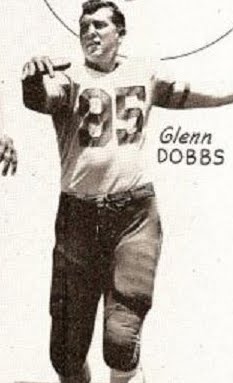
Highlighted Year: Glenn Dobbs, 1948

Tailback/Defensive Back, Los Angeles Dons


Age:  28
3rd season in pro football, 2nd with Dons
College: Tulsa
Height: 6’4”   Weight: 210

Prelude:
A star tailback and punter in college, Dobbs was chosen by the Chicago Cardinals in the first round of the 1943 NFL draft, but went into the military instead. After starring in service football, he joined the Dodgers of the new AAFC in 1946, a club that utilized a single-wing attack. Brooklyn went only 3-10-1, but Dobbs led the circuit in passing yards (1886) as well as punting (47.8 avg.) and was named MVP by the league. In a major trade early in the 1947 season, Dobbs was dealt to the Los Angeles Dons. Playing quarterback in the T-formation, his performance suffered, but in ’48 a new head coach, Jimmy Phelan, created a new offense (the Phelan spread) in order to more fully utilize Dobbs’ talents.

1948 Season Summary
Appeared in all 14 games
[Bracketed numbers indicate league rank in Top 20]

Passing
Attempts – 369 [1]
Completions – 185 [1]
Yards – 2403 [4]
Completion percentage – 50.1 [5]
Yards per attempt – 6.5 [7]
TD passes – 21 [3]
Most TD passes, game – 4 vs. Chicago 10/8
Interceptions – 20 [2]
Passer rating – 67.4 [5]

Rushing
Attempts – 91 [14]
Yards – 539 [11]
Yards per attempt – 5.9 [5]
TDs – 4 [13, tied with four others]

Pass Receiving
Receptions – 2
Yards – 11
Yards per catch – 5.5
TDs - 0

Punting
Punts – 68 [1]
Yards – 3336 [1]
Average – 49.1 [1]
Punts blocked – 3 [1]

Interceptions
Interceptions – 1
Return yards – 32
TDs – 0

Kickoff Returns
Returns – 2  
Yards – 38
Average per return – 19.0
TDs – 0

Scoring
TDs – 4         
Points – 24

Awards & Honors:
2nd team All-NFL/AAFC: Sporting News
2nd team All-AAFC: League, UPI, NY Daily News

Dons went 7-7 to finish third in the AAFC Western Division.

Aftermath:
Injuries significantly diminished Dobbs’ performance in 1949, and with the demise of the AAFC following that season, he retired from pro football. After an absence of a year, in which he was a sportscaster in Tulsa, Dobbs joined the Saskatchewan Roughriders in Canada, playing three more seasons (and winning MVP honors in the Western league, the WIFU, in ’51) before further injuries set in, and serving as a player/coach. Overall, in the AAFC he passed for 5876 yards and 45 TDs, rushed for 1039 yards and 12 TDs, and had a 46.4 punting average. In Canada, Dobbs passed for 5196 yards and 51 TDs, rushed for 241 yards and 7 TDs, and had a 44.7 punting average. He returned to his alma mater, Tulsa, where he was athletic director and head football coach. 

--

Highlighted Years features players who were consensus first-team All-League* selections or league* or conference** leaders in the following statistical categories:

Rushing: Yards, TDs (min. 10)
Passing: Yards, Completion Pct., Yards per Attempt, TDs, Rating
Receiving: Catches, Yards, TDs (min. 10)
Scoring: TDs, Points, Field Goals (min. 5)
All-Purpose: Total Yards
Defense: Interceptions, Sacks
Kickoff Returns: Average
Punt Returns: Average
Punting: Average

*Leagues include NFL (1920 to date), AFL (1926), AFL (1936-37), AAFC (1946-49), AFL (1960-69), WFL (1974-75), USFL (1983-85)

**NFC/AFC since 1970

June 29, 2014

Highlighted Year: Ben Agajanian, 1947

Placekicker, Los Angeles Dons


Age: 28
6th season in pro football, 1st in AAFC & with Dons
College: New Mexico
Height: 6’1”   Weight: 210

Prelude:
Agajanian suffered the loss of four toes on his right (kicking) foot in a workplace accident while in college, but went on to have a long career as a pioneering placekicking specialist. After gaining honorable mention All-American honors as a college senior, he played minor league pro football with the Hollywood Bears of the Pacific Coast Professional Football League in 1942 and, while enlisted in the military, was stationed in California and thus able to play with teams in the PCPFL and (minor-league) AFL in 1943 and ’44. He also played end during this time in addition to kicking. In 1945 he joined the Philadelphia Eagles of the NFL who in turn dealt him to the Steelers after two games and, while still considered an end, he suffered a broken arm with Pittsburgh that caused him to become a placekicker exclusively. He was successful in all four of his field goal attempts in ’45 but returned to the PCPFL in 1946.

1947 Season Summary
Appeared in 13 of 14 games
[Bracketed numbers indicate league rank in Top 20]

Kicking
Field goals – 15 [1]
Most field goals, game – 3 at Brooklyn 11/23
Field goal attempts – 24 [1]
Field goal percentage – 62.5 [1]
PATs – 39 [2, tied with Lou Groza]
PAT attempts – 40 [4]
Longest field goal – 53 yards at Baltimore 10/19

Scoring
Field Goals – 15
PATs – 39
Points – 84 [2]

Dons went 7-7 to finish third in the AAFC Western Division.

Aftermath:
Agajanian had a lesser year with the Dons in 1948, succeeding on just 5 of 15 field goal tries, but then returned to the NFL and the New York Giants in ’49, where he was good on 8 of 13 attempts for a league-leading percentage of 61.5. He retired to tend to his business interests but came back with the Los Angeles Rams in 1953 and then to the Giants for four seasons (1954 to ’57) where he kicked 38 field goals in 71 attempts (53.5 %) and was part of the 1956 NFL Championship team. Sitting out the next two seasons, he again returned to pro football with the Los Angeles Chargers of the new AFL in 1960 and booted 13 field goals in 24 attempts. He moved on to the Dallas Texans for three games in 1961 and finished out the year back in the NFL with the Packers. Stints with the Raiders in 1962 and Chargers in ’64 closed out his career at age 45, having been one of two players to see action in the AAFC, NFL, and AFL (the other was LB Hardy Brown). Overall in those three leagues, Agajanian kicked 104 field goals in 204 attempts (51.0 %) and converted 343 of 351 extra point tries to compile 655 points . He went on to become kicking coach for the Dallas Cowboys and also mentored many placekickers at all levels over the ensuing years.

--

Highlighted Years features players who were consensus first-team All-League* selections or league* or conference** leaders in the following statistical categories:

Rushing: Yards, TDs (min. 10)
Passing: Yards, Completion Pct., Yards per Attempt, TDs, Rating
Receiving: Catches, Yards, TDs (min. 10)
Scoring: TDs, Points, Field Goals (min. 5)
All-Purpose: Total Yards
Defense: Interceptions, Sacks
Kickoff Returns: Average
Punt Returns: Average
Punting: Average

*Leagues include NFL (1920 to date), AFL (1926), AFL (1936-37), AAFC (1946-49), AFL (1960-69), WFL (1974-75), USFL (1983-85)

**NFC/AFC since 1970

November 3, 2012

1946: Dons Upset Browns with Late FG


The Cleveland Browns had quickly asserted themselves in the first year of the All-America Football Conference, winning their first seven games of the 1946 season and most by lopsided scores. Head Coach Paul Brown’s team was strong on both sides of the ball. But they had finally been tripped up by the San Francisco 49ers and, on November 3 they faced another tough Western Division opponent – although one they had beaten two weeks earlier.

The Los Angeles Dons had solid financing and a well-known name in entertainer Don Ameche as the club president. Head Coach Dudley DeGroot had led the NFL Redskins to the league title game the previous year. There was much veteran talent and the Dons were adept at scoring points, but the defense had shown a tendency to give up too many points in turn. After starting off at 3-0-1, they had lost three straight to come into the game against the Browns at 3-3-1.

There was a crowd of 24,800 at the Memorial Coliseum, which was the largest of the season thus far for Los Angeles. On the first play from scrimmage, HB Chuck Fenenbock (pictured above) ran for a 75-yard touchdown to give the Dons the early lead. Lou Groza got the Browns on the board later in the first quarter with a 25-yard field goal.

In the second quarter, Cleveland went ahead after DB Tom Colella recovered a fumble at the LA 16. The Browns scored four plays later with HB Bill Lund sweeping around right end from five yards out and Groza added the extra point to make the score 10-7.

The Dons drove to another field goal attempt, but the try by Bob Nelson from 26 yards was wide. The Browns scored again when QB Otto Graham passed to end Mac Speedie for a 79-yard touchdown. However, Groza missed the extra point, snapping a string of 22 consecutive successful conversions, and while Cleveland carried a 16-7 lead into halftime, it would have repercussions in the end.

Los Angeles came out strong in the third quarter and drove to the Cleveland 22 before turning the ball over on downs. Shortly thereafter, tackle Bob Reinhard recovered a Cleveland fumble and returned it 43 yards to the Browns’ 14, but again the Dons ran out of downs at the seven.

LA’s defense played inspired football in the second half and the ground game on offense wore Cleveland down. Early in the fourth quarter, the Browns gambled by faking a punt on fourth-and-nine at their own 21. Colella gained just two yards, giving the ball back to LA in excellent field position. Five plays later, end Dale Gentry ran for an eight-yard touchdown. Joe Aguirre kicked the extra point and Cleveland’s lead was narrowed to 16-14.

Another Cleveland fumble set up the winning score for LA. Taking over at the Cleveland 43, the Dons battled for 15 plays to reach the three yard line, from where Aguirre kicked the game-winning 11-yard field goal on fourth down with 20 seconds left to play.

The Browns made a last-gasp effort to pull out the win with Graham completing two passes, but he was sacked on the last play and time ran out. The Dons came away with a stunning 17-16 upset win.


The Dons outgained the Browns by 291 yards to 284 and significantly outperformed them on the ground with 220 yards to just 43. Cleveland had the edge in first downs (13 to 12) and both teams turned the ball over three times. Mac Speedie (pictured at left) had the biggest individual performance, catching 4 passes for 134 yards and the one long TD.

It was the second straight loss for the Browns but they righted the ship in a rematch with the 49ers the next week that they won 14-7, and they didn’t lose again. Cleveland topped the Western Division with a 12-2 record and defeated the New York Yankees for the first AAFC title.

The Dons, meanwhile, ended a three-game losing streak with the upset of the Browns. They won three of their next four contests and finished third in the division at 7-5-2.

November 24, 2011

1949: Blocked Extra Point Preserves Win for Yankees Over Dons


The Los Angeles Dons still held out the faint hope of securing a postseason berth as they hosted the New York Yankees in an All-America Football Conference game on November 24, 1949. With the league down to seven teams, the divisions had been discarded in favor of a format in which the top four would qualify for the playoffs.

The Dons were known for their explosive offense and, under Head Coach Jimmy Phelan, the attack had been geared to the passing of star tailback Glenn Dobbs. However, Dobbs was suffering through an injury-plagued season and much of the time it was George Taliaferro at tailback, who was an outstanding runner but mediocre passer. As a result, and despite having good receivers, the Dons were a ground-oriented team with an inconsistent defense and were sporting a lackluster 4-7 record going into the season finale.

The Yankees, coached by Red Strader, were in a far better situation. After a down year in 1948, they had benefited from being combined with the Brooklyn Dodgers for the ’49 season and also picked up some outstanding rookie talent, including DHB Tom Landry. Having converted to the T-formation, New York was lacking at quarterback, and lost star tailback Spec Sanders to injury, but still had a good stable of running backs that included halfbacks Buddy Young and Sherman Howard and FB Bob Kennedy. The Yankees were 8-3 and certain of a playoff berth, and had beaten the Dons in a 10-7 defensive battle in New York.

There were 20,096 fans in attendance for the Thanksgiving Day game at the LA Memorial Coliseum. As had been the case in the first meeting, the first three quarters were again dominated by the defenses.

In the first quarter, Landry punted to the LA 11 and it was fielded by HB Tom McWilliams, who lateraled to C/LB “Big John” Brown, who in turn made it to the New York 49 for an overall 40-yard return. FB Hosea Rodgers gained five yards and then Taliaferro put the Dons ahead with a bolting 44-yard run off tackle for a touchdown. The 7-0 score stood up until the fourth quarter, but the last quarter was an exciting one.

45 seconds into the final period, Bob Kennedy plowed into the end zone from a yard out to conclude a 12-play, 52-yard drive for the Yankees. Harvey Johnson kicked the extra point to tie the contest. On the ensuing kickoff, HB Billy Grimes fumbled the ball and DB Otto Schnellbacher recovered at the LA 28. QB Don Panciera threw to Buddy Young for a 20-yard gain. Three runs into the line gained five yards to the three yard line and Johnson put New York ahead by 10-7 with a 16-yard field goal.

The Dons regained possession at their 29. With Taliaferro running and end Len Ford making an outstanding one-handed catch, they made it to the New York 19. The drive stalled and Bob Nelson kicked a 26-yard field goal to again tie the score at 10-10.

LA tried an onside kick but it failed disastrously when end Bruce Alford recovered for the Yankees and returned it to the Dons’ 47. Highlighted by a 27-yard gain on a pass from Kennedy to Alford that put the ball on the three yard line, New York drove down the field to another one-yard TD carry by Kennedy. Johnson’s 100th consecutive successful conversion made it 17-10.

The next Los Angeles possession ended with an interception, but New York had to punt as the clock ticked down to 30 seconds. On a spectacular play, Taliaferro ran the kick back 52 yards for a touchdown, but instead of salvaging a tie, the all-important extra point attempt by Nelson was blocked by New York end Jack Russell. There were just 13 seconds left and the Yankees came away with a hard-fought 17-16 win.

The statistics were as evenly matched as the final score. The Dons edged New York in total yardage by just a single yard, 246 to 245. LA outrushed the Yankees (151 to 138) while New York had more passing yards (107 to 95) and first downs (13 to 10). George Taliaferro accounted for 112 rushing yards on 14 carries.

While it was the season finale for the Dons, who ended up tied for fifth with the Chicago Hornets at 4-8, the Yankees had one more game to play. They headed up the coast to San Francisco, where they lost to the 49ers three days later to finish in third place with an 8-4 record. They fell again to the 49ers in the first playoff round.

With the merger with the NFL, the AAFC ceased to exist, and that included the Dons and Yankees. However, many of the players on both teams moved on to NFL clubs. 19 of the Yankees made the roster of the New York Yanks (a separate franchise from the AAFC club, they had played as the New York Bulldogs in ‘49), including Buddy Young, Bruce Alford, Bob Kennedy, Harvey Johnson, and Jack Russell. The Yanks also hired Red Strader to be head coach. Several other ex-Yankees went to the Giants, most notably Tom Landry, Otto Schnellbacher, and DT Arnie Weinmeister. Don Panciera played for the Detroit Lions.

Of the ex-Dons, George Taliaferro joined several of his former antagonists on the Yanks and Billy Grimes went to Green Bay. Len Ford joined the Browns, one of three AAFC clubs (along with the 49ers and Colts) that were taken in by the NFL, and moved on with his Hall of Fame career as a defensive end. Glenn Dobbs took his passing arm to Canada instead.

October 15, 2011

1948: Colts Score 15 Points in 4th Quarter to Pull Away from Dons


The Los Angeles Dons were two-touchdown favorites coming into their All-America Football Conference game against the Baltimore Colts on October 15, 1948. Jimmy Phelan, who was in his first year as head coach of the Dons, had developed an offensive formation, the Phelan Spread, in an effort to better utilize star passing tailback Glenn Dobbs. Dobbs, the AAFC’s MVP in 1946 with Brooklyn, had come to Los Angeles in a celebrated trade early in the ’47 season and was a disappointment. Further efforts had been made to revamp the team, which was caught in a struggle with the NFL’s Rams for fan support and revenue, and new players included rookies Herm Wedemeyer, a halfback out of St. Mary’s of California, and end Len Ford from Michigan. LA had a 4-2 record coming into the game, having won their previous two contests.

The visiting Colts, coached by Cecil Isbell, had been 2-11-1 in ’47 but were improved, most notably thanks to the performance of rookie QB Y.A. Tittle out of LSU. They routed the New York Yankees, who had dominated the Eastern Division in each of the AAFC’s first two seasons, in the opening game in which Tittle threw four scoring passes and beat them again two games later, but were 3-3 following a 56-14 loss to the 49ers the previous week.

There was a crowd of 40,019 in attendance on a Friday night at the LA Memorial Coliseum. HB Bill Reinhard scored first by intercepting a deflected Tittle pass and running it back for a 10-yard touchdown.

In the second quarter, and with the ball on the one foot line on a drive helped along by a pass interference penalty, Dobbs surprised the Colts by throwing for a touchdown to end Joe Aguirre, who was all alone in the end zone. Down 14-0, Tittle threw a touchdown pass of 40 yards to end Lamar Davis to make the score 14-7 at halftime. LA’s defensive line, featuring Ford and tackle Butch Levy, dominated for much of the first half – but the tables would turn in the second half.

Wedemeyer and FB John Kimbrough both were injured early, hurting LA’s offense, but then the Colts suffered a blow when Tittle was lost to an injury in the third quarter. Charley O’Rourke, formerly a quarterback for the Dons, entered the game for Baltimore.

O’Rourke engineered a drive that led to a 26-yard TD pass to end Windell Williams that tied the game at 14-14 going into the final period. From there, the Colts proceeded to dominate the fourth quarter.

HB Billy Hillenbrand put Baltimore ahead with a one-yard run and Rex Grossman (grandfather of the modern NFL quarterback of the same name) extended the lead to 24-14 with a 23-yard field goal. The defense added a safety when Dobbs was tackled in his end zone. Grossman kicked his second field goal, from 20 yards, and the Colts came away with a convincing 29-14 win.

Baltimore rolled up 438 total yards and 19 first downs, to 235 yards and 9 first downs for the Dons. FB Buzz Mertes, another ex-Don, led a running game for the Colts that accounted for 169 of that yardage total. Tittle and O’Rourke combined for 269 net passing yards.


The Colts defensive line put heavy pressure on Dobbs, already hurting from an injured hip, who was sacked for a total of 91 yards in losses, including the safety. Dobbs completed just 10 of 28 passes for 173 yards.

Baltimore lost its next three games, all on the road, but won three of the last four and, while that meant finishing with a 7-7 record, it was enough to put the Colts in a tie atop the mediocre Eastern Division with the Buffalo Bills; they lost the resulting playoff. The Dons remained an inconsistent team and also ended up at 7-7 which, in the tough Western Division, meant third place.

Y.A. Tittle ended up as the third-ranked passer in the AAFC and was also third with 2522 passing yards. His 16 TD passes tied for fourth with Buffalo’s George Ratterman, and he also ranked fourth in attempts (289) and completions (161). He threw just nine interceptions. It was a promising start to a Hall of Fame career.

Glenn Dobbs led the league in pass attempts (369) and completions (185), was third in touchdown passes (21), and fourth in passing yards (2403). However, his 20 interceptions placed second. The versatile Dobbs also led the team in rushing with 539 yards on 91 carries (5.9 avg.) and was the AAFC’s top punter with a 49.1 average.

Rex Grossman led the league in field goals with 10, out of 18 attempts. Billy Hillenbrand, who put the Colts ahead to stay against the Dons, accumulated 2067 all-purpose yards, including 510 by rushing and an AAFC-leading 970 yards on his 50 pass receptions. LA’s Len Ford was outstanding on both sides of the ball and caught 31 passes for 598 yards (19.3 avg.) and seven touchdowns. While he performed well again on offense in 1949, with the demise of the league he joined the Cleveland Browns in the NFL and was used exclusively on defense in an outstanding career that was honored, like Tittle’s, with enshrinement in the Pro Football Hall of Fame.

May 11, 2011

Past Venue: Memorial Coliseum

Los Angeles, CA


Year opened: 1923
Capacity: 93,607, up from 75,144 at opening but down from high of 105,000 at time of 1932 Olympics

Names:
Los Angeles Memorial Coliseum, 1923 to date

Pro football tenants:
Los Angeles Dons (AAFC), 1946-49
Los Angeles Rams (NFL), 1946-79
Los Angeles Chargers (AFL), 1960
Los Angeles Raiders (NFL), 1982-94
Los Angeles Express (USFL), 1983-85
Los Angeles Xtreme (XFL), 2001

Postseason games hosted:
NFL Championship, Eagles 14 Rams 0, Dec. 18, 1949
NFL National Conf. playoff, Rams 24 Bears 14, Dec. 17, 1950
NFL Championship, Rams 24 Browns 17, Dec. 23, 1951
NFL Championship, Browns 38 Rams 14, Dec. 26, 1955
Super Bowl I, Packers 35 Chiefs 10, Jan. 15, 1967
Super Bowl VII, Dolphins 14 Redskins 7, Jan. 14, 1973
NFC Divisional playoff, Rams 19 Redskins 10, Dec. 22, 1974
NFC Divisional playoff, Rams 35 Cardinals 23, Dec. 27, 1975
NFC Championship, Cowboys 37 Rams 7, Jan. 4, 1976
NFC Divisional playoff, Vikings 14 Rams 7, Dec. 26, 1977
NFC Divisional playoff, Rams 34 Vikings 10, Dec. 31, 1978
NFC Championship, Cowboys 28 Rams 0, Jan. 7, 1979
AFC First Round playoff, Raiders 27 Browns 10, Jan. 8, 1983
AFC Divisional playoff, Jets 17 Raiders 14, Jan. 15, 1983
AFC Divisional playoff, Raiders 38 Steelers 10, Jan. 1, 1984
AFC Championship, Raiders 30 Seahawks 14, Jan. 8, 1984
USFL First Round playoff, Express 27 Panthers 21, June 30, 1984
AFC Divisional playoff, Patriots 27 Raiders 20, Jan. 5, 1986
AFC Divisional playoff, Raiders 20 Bengals 10, Jan. 13, 1991
AFC Wild Card playoff, Raiders 42 Broncos 24, Jan. 9, 1994
XFL Semifinal playoff, Xtreme 33 Enforcers 16, April 15, 2001
XFL Championship, Xtreme 38 Demons 6, April 21, 2001

Other tenants of note:
Univ. of Southern California (college football), 1923 to date
UCLA (college football), 1928-81
Los Angeles Dodgers (MLB – NL), 1958-61
Los Angeles Wolves (soccer), 1967
Los Angeles Aztecs (NASL), 1974-81

Notes: Hosted annual NFL Pro Bowl, 1951-72, and 1979. Hosted Summer Olympics, 1932 & 1984. The Olympic Cauldron/Torch is still lit during the fourth quarter of USC football games and on special occasions. Hosted Mercy Bowl, 1961 & ’71. Hosted one home game of the Los Angeles Dragons of the short-lived Spring Football League (SFL) in 2000. Was originally constructed and named as a memorial to World War I veterans (re-dedicated to veterans of all wars in 1968). First football game was a college contest between USC and Pomona College, Oct. 6, 1923. Stadium is owned by the State of California but leased to and managed by the Los Angeles Memorial Coliseum Commission. Running track removed as part of major renovation in 1993 in order to create additional seating closer to the football field. Renovations, use of temporary end zone seating, and occasional closing off of sections have caused fluctuations in stadium capacity over the years. Highest pro football game attendance was 102,368 for an NFL contest between the Rams and San Francisco 49ers in 1957.

Fate: Still in use.