Showing posts with label Mike Rozier. Show all posts

March 4, 2016

1985: Showboats Come from Behind to Defeat Bulls


The Jacksonville Bulls and Memphis Showboats were both coming off of opening-week wins to start off the 1985 United States Football League season as they faced off on March 4.

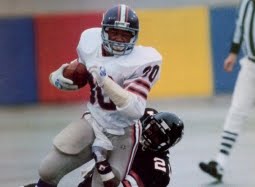
The visiting Showboats were coached by Pepper Rodgers, who guided the club to a respectable 7-11 record in its first season. QB Walter Lewis (pictured above) augmented his passing with impressive mobility and had tossed three touchdown passes in the first-week win over San Antonio. RB Leonard Williams, who had seen scant action in his 1984 rookie year, rushed for 136 yards in that contest as well. The defense was anchored by second-year DE Reggie White.

Jacksonville, under Head Coach Lindy Infante, was coming off of a 6-12 first-year record but upset the defending-champion Baltimore Stars the previous week. However, injuries were a significant concern, especially at quarterback. Veteran Brian Sipe, obtained from New Jersey, went down with a shoulder separation against the Stars and while backup Robbie Mahfouz performed well in relief, he had suffered from a bout of the flu and missed practice during the intervening week. While ex-San Diego QB Ed Luther had just been signed, it would be Buck Belue making his first pro start. Belue had come out of the Univ. of Georgia and, after two years playing minor league baseball, spent ’84 on Jacksonville’s developmental squad.

There were 40,112 fans in attendance for the nationally-televised Monday night game at Jacksonville’s Gator Bowl. The teams traded punts to start the contest before Walter Lewis, who failed to complete a pass in the first quarter, fumbled in the process of running for first down yardage and the Bulls recovered at their 40. But after driving to the Memphis 22, Brian Franco missed a 39-yard field goal attempt.

As the game headed into the second quarter, and following another exchange of punts, the Bulls were able to pin the Showboats at their one yard line. The result was a Memphis punt that gave the home team good starting field position and the Bulls capitalized, advancing 46 yards in six plays. RB Mike Rozier broke several tackles as he spun up the middle on the way to an 11-yard touchdown. Franco added the extra point and Jacksonville had a 7-0 lead.

The score remained unchanged at the half. Alan Duncan missed a 48-yard field goal try for the Showboats on the next series after the Jacksonville score and DB Henry “Gizmo” Williams had a 47-yard punt return for the Showboats that they were unable to capitalize on.

Memphis had the ball first in the third quarter and drove 81 yards in five plays. Leonard Williams broke away for a 37-yard run and Walter Lewis capped the series with a pass to WR Greg Moser for a 22-yard touchdown on the next play. Duncan converted to tie the game at 7-7.

Another exchange of punts ensued, with an apparent return for a TD by Jacksonville WR Reggie Butts nullified by a roughing-the-kicker penalty, and while the Showboats gained ground following the reprieve, a holding penalty and sack on third down forced them to punt in return.

A 62-yard pass completion by the Bulls was called back due to another untimely penalty, this time for holding, and with the ball deep in their own territory, Belue fumbled and NT Paul Hanna recovered at the Jacksonville four. On the next play, Lewis ran around end for another Memphis TD. Duncan added the point after for a seven-point Memphis advantage.

It got worse for the Bulls on the ensuing kickoff when Butts fumbled and DB Doran Major of the Showboats fell on the loose ball at the Jacksonville 25. Five plays later, Lewis bulled to another touchdown, barely breaking the plane of the goal line. Duncan’s extra point put the visitors ahead by 21-7.

Early in the fourth quarter, the Bulls finally got on the board again when Belue tossed a two-yard scoring pass to WR Aubrey Matthews on a fourth down play. It capped a 10-play, 66-yard series highlighted by three key Belue scrambles. With Franco converting it was again a seven-point contest with 13:21 remaining in regulation.

On the next possession, Lewis, throwing on the run, completed a pass to TE Mark Raugh for a gain of 50 yards to the Jacksonville 13, and, while the Showboats were unable to reach the end zone, that set up a 24-yard Duncan field goal and a ten-point cushion.

Jacksonville had three more possessions, but the next two resulted in punts and the last ended when DB Leonard Coleman intercepted a Belue pass in the end zone with less than two minutes remaining to seal the 24-14 win for Memphis.

The Showboats had the edge in total yards (328 to 251) while each team generated 15 first downs. Jacksonville turned the ball over three times, with the two in the third quarter especially damaging, to one suffered by Memphis. The Bulls compiled four sacks, to three by the Showboats.

Walter Lewis, who completed just one pass in the first half, ended up hitting on 9 of 18 throws for 117 yards and a touchdown while giving up no interceptions. He also ran the ball 11 times for 76 yards and two TDs. Leonard Williams led the Showboats in rushing with 93 yards on 14 carries. Greg Moser had 5 catches for 72 yards and a touchdown.

For the Bulls, Buck Belue completed 16 of 31 passes for 118 yards and a TD while giving up one interception, and he ran for 47 yards on 6 carries. Mike Rozier led the rushers with 81 yards on 8 attempts that included a touchdown. Wide receivers Perry Kemp and Alton Alexis caught four passes apiece, for 42 and 39 yards, respectively.

Memphis won again the next week and went on to an 11-7 record that placed third in the Eastern Conference. The Showboats thrashed Denver in the Quarterfinal playoff round before falling to the Oakland Invaders in their Semifinal game. The Bulls struggled to a 9-9 tally, finally hitting stride with four straight midseason wins after having gotten off to a 2-5 start, placing sixth in the conference.

While Buck Belue performed capably in his first start, he eventually gave way to the veterans Brian Sipe and Ed Luther. For the season, he completed 37 of 68 passes for 299 yards and three touchdowns as well as three interceptions.

June 10, 2014

1985: Walker Passes Dickerson as Generals Defeat Bulls


RB Herschel Walker had become one of the most notable players in the United States Football League from the moment he passed up his senior year at Georgia to sign with the New Jersey Generals of the new Spring league in 1983. Walker had been a Heisman Trophy contender from his freshman year, winning the award as a junior, and thus expectations were high – and despite his achievements, the criticism often was sharp as well. He started slowly in ’83 but went on to win the USFL’s first rushing title with 1812 yards. Playing with a sore shoulder, he had a lesser year in ’84, but in his third season he was rolling up yards at a pace that not only put him at the top of his league’s rushing standings but also in competition with the NFL record of 2105 yards that Eric Dickerson of the Rams had set just the previous Fall. That record had been set over the course of 16 games and, coming into New Jersey’s 16th game on June 10, Walker had a string of nine straight 100-yard rushing games and was just 138 yards behind.

New Jersey, coached by Walt Michaels, was without injured QB Doug Flutie, who had suffered a broken collar bone the previous week. With backup Ron Reeves starting in his place, Walker could be expected to carry more of the load, along with FB Maurice Carthon.

The opposing Jacksonville Bulls, under the direction of offensive-minded Head Coach Lindy Infante, were also without their starting quarterback as Brian Sipe had suffered a separated shoulder, although backup Ed Luther had NFL experience. RB Mike Rozier, Walker’s successor as Heisman Trophy winner in 1983, was the third-ranking rusher in the USFL (he would finish second) and the defense was benefiting from the play of rookie DE Keith Millard and second-year LB Vaughan Johnson.

The Generals, with a 10-5 record, needed a win to clinch a playoff spot while the Bulls, at 8-7, were struggling to remain in contention, although they had beaten New Jersey in their previous meeting in Jacksonville.

There were 36,465 fans on hand for the Monday night game at Giants Stadium in the New Jersey Meadowlands. The Generals scored first when Roger Ruzek capped a long initial possession with a 27-yard field goal.

Following a short series by the Bulls, another long and methodical New Jersey drive ended when Reeves threw to TE Sam Bowers for a five-yard touchdown. Ruzek added the extra point that made it 10-0. It got worse for the Bulls when they fumbled away the ensuing kickoff and early in the second quarter, Walker ran four yards for another TD.

Thus far, the home team had dominated the game, but two turnovers by the Generals allowed the Bulls to get back into the contest. First, Jacksonville had to punt following the next series but it was New Jersey’s turn to muff the kick and the Bulls recovered at the Generals’ 43. The visitors drove to the 15 before the series stalled and Brian Franco kicked a 28-yard field goal.

The next New Jersey series ended when a third down pass by Reeves was intercepted by safety Van Jakes. Luther passed the Bulls down the field and Mike Rozier ran the last five yards for a TD. Franco successfully converted to make it a seven-point game. However, the Generals had time for one more possession in the half and drove to another score, with Maurice Carthon running in for a touchdown from 15 yards out. The tally was 24-10 at the half.

Midway through the third quarter, and on the first play following a Jacksonville punt, Walker ran up the middle and broke two tackles on the way to a 55-yard touchdown that put him ahead of Dickerson. It also gave the Generals a 31-10 lead.

Behind by three touchdowns, the Bulls fought back in the fourth quarter. A blocked punt late in the third period gave Jacksonville the ball in New Jersey territory, and early in the final period it paid off when Luther threw to TE Robert Young for a seven-yard touchdown. Franco successfully added the extra point.

The Generals appeared to have the game in hand when the Bulls failed to convert a fourth down with 6:32 remaining on the clock, but a fumble by Walker’s backup, RB Rod Pegues, gave the visitors the ball again at the New Jersey 45. The Bulls made the most of the opportunity, driving to another Luther-to-Young TD connection, this time covering nine yards. Franco again added the PAT and it was a seven-point contest.

The Generals were unable to handle the ensuing pooched kickoff and Jacksonville DB Rodney McMillan recovered the ball at the New Jersey three with 3:10 left on the clock, giving the Bulls a good shot at potentially tying the score. But in dramatic fashion, the Generals kept them out of the end zone on four straight plays to hold on for the 31-24 win.

New Jersey led in total yards (313 to 267) and first downs (18 to 17). Of that yardage total, the Generals generated 230 on the ground. However, they also hurt themselves with four turnovers, to two suffered by the Bulls.

Herschel Walker rushed for 162 yards on 28 carries that included two touchdowns, bringing his season total to 2129 yards. Maurice Carthon contributed another 49 yards on 9 attempts that included a score. Ron Reeves threw just 13 passes and completed 7 for 83 yards with a TD and an interception. Walker was one of three Generals that caught two passes apiece and Sam Bowers led the club with 37 yards on his pair.

For the Bulls, Ed Luther completed 24 of 44 throws for 209 yards and the two late touchdowns as well as giving up one interception.  Mike Rozier ran for 51 yards on 16 carries and led the club with 8 catches, for 45 yards. WR Alton Alexis gained 58 yards on his four receptions.

“Records are very important, no doubt, but then again, a win is just as important,” said Herschel Walker. “If we had lost the game, I don’t think the record would have meant as much.”

The win clinched a postseason spot for New Jersey while the Bulls were eliminated from contention. The Generals finished at 11-7 and in second place in the Eastern Conference. They lost to the Baltimore Stars in the Quarterfinal playoff round. Jacksonville placed sixth in the conference with a 9-9 record.

Herschel Walker finished up with 2411 yards on 438 carries (5.5 avg.) and also led the USFL with 22 touchdowns (21 rushing). He received unanimous Player of the Year as well as All-league honors and, with the demise of the league, moved on to the Dallas Cowboys of the NFL.

May 20, 2012

1985: Sipe Rallies Bulls Past Gamblers


The 1985 United States Football League season had been a rough one for Jacksonville Bulls QB Brian Sipe as he prepared to take the field on May 20 against the Houston Gamblers. Sipe, once the NFL’s Most Valuable Player with the Cleveland Browns in 1980, had been signed to the USFL by the New Jersey Generals in ’84, and was unceremoniously dumped off to the Bulls after Heisman Trophy-winner Doug Flutie signed with the Generals for 1985. Taking over as starting quarterback for Jacksonville, he had suffered a severe shoulder separation in the season-opening game and Ed Luther had been behind center as the team got off to a 6-6 start.

Head Coach Lindy Infante’s team had a fine tandem of wide receivers in Alton Alexis and Perry Kemp and also benefited from the presence of RB Mike Rozier, who had spent his rookie season in ’84 with the Pittsburgh Maulers. The defense was improved due to the play of DE Keith Millard and LB Vaughan Johnson.

The Week 13 opponents, the Gamblers, were coached by Jack Pardee and boasted the USFL’s most explosive offense, led by second-year QB Jim Kelly. However, after being well-supported by the Houston fans in their inaugural ’84 season, the announced move to the fall for 1986 significantly dampened attendance during 1985.

For the Monday night game, there were just 17,127 in attendance at the Astrodome – the crowd was especially disappointing since there was a promotion in which, if there were at least 40,000 present, a selected fan would win a $1 million annuity ($10,000 if there were at least 35,000).

Houston nevertheless started off the scoring in electrifying fashion as WR Gerald McNeil returned a punt 49 yards down the middle of the field for a TD. The Bulls drove to the Houston one yard line but two penalties and a sack of Sipe forced them to settle for a field goal. Brian Franco was successful from 29 yards and the score was 7-3 after a quarter of play.

Toni Fritsch added a 44-yard field goal for the Gamblers at just over five minutes into the second quarter and Kelly connected with slotback Richard Johnson for a 15-yard touchdown. Late in the first half, the Bulls drove to the Houston 23, helped along by two pass interference penalties, but SS Luther Bradley intercepted a Sipe pass to end the threat with 10 seconds remaining.

Houston was ahead by 17-3 at the half, but the Bulls took control in the third quarter. The defense allowed the high-powered Gamblers to gain just four net yards while holding the ball for a total of 4:35 during the entire period.

Meanwhile, Sipe threw two TD passes during the period. The first covered 22 yards to Alexis and the second came just over two minutes later on a five-yard toss to RB Larry Mason. With 40 seconds left in the quarter, Franco kicked a 27-yard field goal and it proved to be the winning margin.

Houston did threaten once more during the fourth quarter, driving to the Jacksonville 30, but RB Todd Fowler fumbled the ball away with just under six minutes remaining in the contest, LB Terry Beeson recovering for the Bulls. Jacksonville hung on for the 20-17 win.

The Bulls had more first downs (19 to 15) although Houston had more total yards (331 to 309), but only 19 yards on 12 carries came on the ground. Jacksonville had a better-balanced attack and led significantly in time of possession (36:27 to 23:33). The Gamblers turned the ball over three times and were penalized on nine occasions while the Bulls turned the ball over just once.

Brian Sipe completed 14 of 32 passes for 191 yards with two TDs and an interception. Mike Rozier led the Bulls with 86 yards on 20 carries, putting him over a thousand yards for the year (he ended up second in the USFL with 1361). Perry Kemp caught 4 passes for 82 yards.

Jim Kelly had a rough outing against Jacksonville’s defense, completing 23 of 39 passes for 312 yards while being twice intercepted and sacked five times. Gerald McNeil had 5 pass receptions for 65 yards, WR Scott McGhee added 5 for 65 yards, and Richard Johnson contributed 63 yards on his four catches. Todd Fowler was Houston’s leading ground gainer with just 14 yards on 5 attempts, and had the costly fumble late in the contest.

 “This is my first game back and I am still getting fully integrated into the offense,” said Sipe. “But they pay me to put wins in the win column, so I’m going to just sneak out of here and grin all the way back to Jacksonville.”

“They had a real good defensive line,” said Jack Pardee about the Bulls. “They came with four men for the most part and put a lot of heat on our passer.”

Jacksonville ended up with a 9-9 record that placed sixth in the Eastern Conference. Houston made the playoffs by finishing third in the Western Conference at 10-8, although the Gamblers lost in the first round of the postseason for the second straight year.

The come-from-behind win proved to be a last hurrah for Brian Sipe, who suffered another injury and ended up completing just 55 of 89 passes for 685 yards with four touchdowns and two interceptions in what ended up being his final pro season. 

March 11, 2012

1984: Cribbs Rushes for 191 Yards as Stallions Defeat Maulers


The Pittsburgh Maulers, one of six new teams in the United States Football League’s second season, had lost their first two games on the road. Owned by Edward J. DeBartolo Sr. (father of the owner of the NFL’s 49ers), Coach Joe Pendry’s team had the reigning Heisman Trophy winner, RB Mike Rozier, but little else. QB Glenn Carano was a former backup for the Cowboys and the defense was mediocre. Still, the Maulers lost their first two contests by a combined total of just seven points. On March 11, 1984 they debuted at home against the Birmingham Stallions.

There were 53,771 fans in attendance at Three Rivers Stadium, the first sellout in league history, fueled by the fact that Birmingham’s new starting quarterback was ex-Steeler Cliff Stoudt. He had been less-than-popular as the replacement for the injured Terry Bradshaw in ’83, and had made the jump to the USFL. Stoudt was joined in the backfield by RB Joe Cribbs, who had been selected to the Pro Bowl in three of four seasons with the Buffalo Bills. The one element of the Birmingham offense that had played well in 1983 was the line, not surprising under Head Coach Rollie Dotsch, who had been offensive line coach of the Steelers during their last two championship years. Adding experienced veteran talent in the backfield could only help, and the club had gotten off to a 1-1 start.

It was a cold and windy day with temperatures in the 20s. A deafening chorus of boos greeted Stoudt’s pregame introduction and a regular barrage of snowballs were tossed toward the quarterback and his teammates during the contest (drawing angry criticism from Coach Dotsch afterward). However, the Maulers proved mistake-prone on both sides of the ball and put themselves in a hole early.

In the opening period, Birmingham CB Chuck Clanton intercepted Carano’s second pass and returned it 53 yards for a touchdown. Before the first quarter was over, Scott Norwood kicked a 35-yard field goal that was set up thanks to a roughing-the-passer penalty on Pittsburgh on a third-down play in which Stoudt threw an incompletion. A run by Cribbs put the ball in field goal range.

It got worse for the Maulers as a fumble by Rozier after catching a swing pass was recovered by Birmingham DT Joe Cugliari. It initially seemed that Pittsburgh had dodged a bullet when, following a 23-yard pass completion from Stoudt to another ex-Steeler, WR Jim Smith, the defense held and Norwood’s field goal attempt was wide to the right. But Norwood was hit by LB Ron Crosby, who was called for roughing-the-kicker. Five plays later, and just into the second quarter, Cribbs scored on a four-yard touchdown carry.

Norwood suffered a knee injury on the play that resulted in the penalty and was forced to sit out the remainder of the contest. Following the Cribbs touchdown, Stoudt ran for a two-point conversion (waving the football triumphantly over his head in response to the Pittsburgh fans) and the score was 18-0 in favor of the visitors.

Tony Lee kicked field goals of 28 and 42 yards for the Maulers in the second quarter to narrow Birmingham’s margin to 18-6 at halftime. In the second half, another penalty snuffed out a successful fake punt for the Maulers. From their 45, punter Larry Swider, after dropping the snap, threw to CB Bill Yancy (a receiver in this instance). However, the play was called back because of an illegal receiver downfield.


Stoudt (pictured at left) was having a poor day throwing but, with Cribbs running effectively and the Maulers beating themselves, it hardly mattered. He also added another six points in the third quarter on a ten-yard run, although the attempt to pass for a two-point conversion failed.

Pittsburgh finally scored a touchdown two minutes into the fourth quarter as Carano tossed a four-yard pass to WR Shawn Potts. Ten minutes later, Cribbs rushed for a 13-yard TD and the Maulers followed with one last score as FB Walt Easley plowed over from a yard out. Both teams attempted two-point conversions after each of their touchdowns, failing in each instance. Pittsburgh came close to one final, meaningless TD but Rozier was stopped inches short of the goal line on the last play of the game. Birmingham comfortably came away as the winner by a final score of 30-18.

The yardage totals were deceivingly close as the Stallions outgained Pittsburgh by just five yards (263 to 258). However, the breakdown showed Birmingham with 242 yards on 52 rushing plays to just 46 on 20 attempts for the Maulers. The Stallions had only 21 net passing yards to Pittsburgh’s 212 that were accumulated in a vain attempt to come from behind. Birmingham led in first downs (19 to 15) and dominated the time of possession (37:07 to 22:53). There weren’t many turnovers, but both of Pittsburgh’s led to Birmingham scores while the Stallions turned the ball over once, and the Maulers were penalized 8 times to 4 flags thrown on the visitors, often in key situations.

Joe Cribbs was the offensive star for the Stallions with 191 yards on 33 carries and two touchdowns. Cliff Stoudt was successful on only two of 17 passes for 29 yards and had one intercepted. Jim Smith’s 23-yard catch was the longest of the game for Birmingham and RB Leon Perry had the only other reception, for six yards. The Stallions went for two-point conversions after their remaining touchdowns but were only successful on one.

For the Maulers, Mike Rozier was held to 52 yards on 16 rushing attempts but caught 7 passes for 68 more, although with the one costly fumble. Glenn Carano went to the air 33 times and had 18 completions for 221 yards and a TD with one intercepted. WR Greg Anderson gained 96 yards on his 4 receptions.

“Cliff did the things that he had to do, and we won,” said Coach Dotsch in response to the comfortable win despite Stoudt’s miniscule passing performance.

“All I have to do is please my teammates, my fans, and my coaches,” added Stoudt, who also said, “the crowd really fired me up. I was just excited out there. I was having fun and I wanted them to know it.”

“The interception didn’t set things back as much as the second turnover,” said Joe Pendry regarding the early plays that put Pittsburgh in a deep hole. “That forced us to throw the ball more than we wanted.”

Pendry, whose team fell to 0-3, added “They’re (Birmingham) an excellent football team, too good for us to make mistakes against. If they didn’t stop us, we had a penalty to stop ourselves.”

The Maulers won their first game the following week, against the equally-hapless Washington Federals, but it was hardly a case of turning a corner. They and Washington ended up the season at 3-15 and at the bottom of the Atlantic Division. Coach Pendry was gone after ten weeks.

Birmingham, on the other hand, went on to win nine straight games and topped the Southern Division at 14-4. They easily defeated the division-rival Tampa Bay Bandits in the First Round playoff game but lost to the Philadelphia Stars, who had also ended their season winning streak, in the Eastern Conference Championship game.

Joe Cribbs led the USFL in rushing with 1467 yards on 297 carries (4.9 avg.) and 8 touchdowns. Cliff Stoudt had far better passing days than he did against the Maulers and ended up ranking second in the league with a 101.6 rating that included 3121 yards and 26 TDs to just 7 interceptions.

May 5, 2011

1985: Bulls Score Two TDs in 4th Quarter to Beat Generals


The second-year Jacksonville Bulls were 5-5, and had won their last three United States Football League contests, as they hosted the New Jersey Generals on May 5, 1985. Coached by Lindy Infante, they had benefited from the play of QB Ed Luther, formerly of the NFL Chargers, who had joined the team early in the season and took over for the injured Brian Sipe. They also had second-year RB Mike Rozier (pictured at right), a former Heisman Trophy winner out of Nebraska who played for the Pittsburgh Maulers in ’84, a franchise that folded after one season. The defense had improved since the previous year, benefiting from the presence of rookie DE Keith Millard to go along with second-year LB Vaughan Johnson.

The Generals, coming into the contest at 7-3 and tied for the lead in the USFL’s Eastern Conference, were coached by Walt Michaels and had two ex-Heisman Trophy winners of their own – star RB Herschel Walker and rookie QB Doug Flutie – to go along with an array of veteran talent.

Typically drawing well, there were 60,100 in attendance at the Gator Bowl. The fans saw the Generals control the game early, scoring the first two times they had the ball. Four minutes into the contest, Roger Ruzek kicked a 49-yard field goal. Just three minutes later, following a bad punt by the Bulls, Flutie threw to TE Sam Bowers for a 30-yard touchdown. The possession lasted two plays and New Jersey was ahead by 10-0.

Jacksonville got back into the game by putting together a 72-yard drive over nine plays that ended when Rozier ran 23 yards up the middle with less than two minutes remaining in the first quarter. New Jersey held a three-point lead after one period.

The teams traded field goals in the second quarter. Jacksonville’s Brian Franco (pictured below) kicked two, of 23 and 38 yards, and Ruzek booted a 46-yarder with 2:09 left in the first half, knotting the score at 13-13 at halftime.


The Bulls got a break in the third quarter on a fake field goal attempt by the Generals that went awry. Holder Rick Partridge attempted a pass that was intercepted by DB Joe Johnson and returned 16 yards to the New Jersey 49. Franco capped the possession with a 36-yard field goal and the Bulls were ahead by 16-13.

New Jersey opened the fourth quarter in the midst of an 11-play, 77-yard drive with Walker taking off on runs of 18 and 13 yards along the way. FB Maurice Carthon rushed for a 10-yard touchdown, and the Generals were back in front by 20-16 with 10:45 to go.

New Jersey’s lead didn’t last long, however. On the ensuing kickoff, Jacksonville TE Norris Brown, who had been waived by the Generals in the preseason, gathered in the ball at his 18 yard line and ran down the right sideline 82 yards for a touchdown. It was not only the biggest play of the game, giving the Bulls a 23-20 lead, but was the only kickoff return for a TD in franchise history.

Any hopes that the Generals had of coming back were crushed by a 72-yard Jacksonville possession that ran more than six minutes off the clock and ended with Rozier scoring a second touchdown, going around end from a yard out to cushion the lead with 2:17 remaining in the contest and providing the final score of 30-20.

The Bulls had more first downs (21 to 19), and while New Jersey far outrushed Jacksonville (209 yards to 98), the Bulls had more passing yards (195 to 119).

Ed Luther completed 20 of 31 passes for 200 yards with none intercepted. Mike Rozier ran for 87 yards on 22 carries, two of them for scores, and caught three passes for 41 more. WR Perry Kemp and TE Mark Keel each caught four passes, with Kemp gaining 45 yards to Keel’s 33.

For New Jersey, Herschel Walker had a typically strong showing, running for 169 yards on 29 attempts, his fifth consecutive hundred-yard performance. Doug Flutie completed 9 of 17 passes for 148 yards and a TD with one intercepted. Sam Bowers caught two passes for 43 yards and a touchdown. WR Walter Broughton was right behind with 42 yards on his two receptions.

“Norris Brown's run could not have come at a better time,” said Bulls coach Lindy Infante afterward. “It was a great spark.”

“New Jersey waived me so I wanted to do whatever I could to help the Bulls,” said Brown. “I just popped the opening and all I had was field in front of me. I couldn't believe there was all that ground out there with nobody in front of me. I was so wide open, I thought I was going to pull a muscle or something.”

Ultimately, the Generals remained ahead of the Bulls in the final standings. New Jersey finished at 11-7, in second place in the Eastern Conference. They lost to the Baltimore Stars in the Quarterfinal round of the playoffs. Jacksonville had a 9-9 record, placing them sixth in the same conference.

Herschel Walker went on to lead the USFL with a phenomenal 2411 rushing yards. Mike Rozier placed second with 1361. Ed Luther ended up ninth among the league’s passers, throwing for 2792 yards and completing an even 60 percent of his passes, while tossing 15 touchdowns against 21 interceptions. Brian Franco was named All-USFL placekicker by the league, succeeding on 24 of 29 field goal attempts and scoring 117 points.

February 26, 2011

1984: Outlaws Defeat Maulers in USFL Debut Game for Each


The United States Football League added six new franchises for its second season, and two of those teams were matched up on February 26, 1984 at Tulsa’s Skelly Stadium to open their regular season.

The host Oklahoma Outlaws, coached by the former defensive coordinator of the NFL Steelers, Woody Widenhofer, featured a veteran quarterback in Doug Williams (pictured above). Williams, dissatisfied with his contract with the Tampa Bay Buccaneers, was lured to the Outlaws and provided instant credibility at the key position on offense.

The visiting Pittsburgh Maulers, under Head Coach Joe Pendry, also had a marquee name on the roster, although it was a rookie rather than veteran player. RB Mike Rozier won the 1983 Heisman Trophy at Nebraska and would be starting his first pro game. The team’s quarterback was Glenn Carano, a veteran backup with the Cowboys.

The weather conditions were far from ideal, as the contest was played in a steady downpour with gusty winds and a wind chill that dipped into the 20s. It certainly dampened the turnout, as 11,638 attended the game; there were 4300 reported no-shows.

The bad weather induced sloppy play. Three first half drives by the Outlaws ended in fumbles, but the Maulers were unable to capitalize on the turnovers despite making it inside the Oklahoma 30 on two occasions. The first ended with Mickey Barilla missing a 40-yard field goal attempt, and the second came up empty when Rozier was thrown for a two-yard loss in a fourth-and-one situation at the Oklahoma 29.

Pittsburgh finally scored on a Barilla field goal from 32 yards out with eight seconds left in the half, finishing a drive that was highlighted by a 20-yard Carano scramble to the Outlaws’ 28 yard line. Meanwhile, Oklahoma’s offense was unable to advance at all into Pittsburgh territory during the first half, and the Maulers held a 3-0 lead at the intermission.

Oklahoma finally put together a scoring drive in the second half, going 80 yards for the only touchdown of the game. In a key play, former Steelers RB Sidney Thornton ran 34 yards on a trap to the Pittsburgh 8. At just over a minute into the fourth quarter, Williams threw a swing pass to FB Derek Hughes that covered 12 yards for the TD.

Pittsburgh responded by driving to the Oklahoma 19 yard line as Carano completed a 13-yard pass to WR Greg Anderson on a fourth-and-six play along the way, but the Maulers were stopped when Carano threw incomplete on a fourth-and-12 pass intended for WR Reggie Butts.

With 2:56 remaining, Pittsburgh’s last shot came up short when Carano was intercepted by LB Terry Beeson at the Oklahoma 37. The Outlaws came away the winners of the sloppy contest by a final score of 7-3.

Neither team mounted much offense, with the Maulers outgaining Oklahoma (219 yards to 172) and accumulating the most first downs (11 to 9). The Outlaws also turned the ball over four times, to three by Pittsburgh.

Doug Williams completed just 9 of 22 passes for 62 yards with a touchdown and an interception. Sidney Thornton paced the running game for the Outlaws with 66 yards on 12 carries. WR Lonnie Turner led the team with a mere 17 yards on two catches.

For the Maulers, Glenn Carano was successful on 10 of 21 passes for 101 yards, and was picked off twice. Greg Anderson led all receivers with three catches for 45 yards. Carano also was the team’s leading rusher with 29 yards on 10 carries. Mike Rozier (pictured below) had a rough debut, running for only 27 yards on 16 attempts - he had just two carries for four yards in the second half. Having joined the team late, his lack of familiarity with the offense’s plays proved a hindrance.


“This is the first time we've won and if feels great,” Woody Widenhofer said. “We needed to win the first game to get the feeling of what it's like.”

Widenhofer stated further, “They are an excellent football team defensively, but our offense broke open their defense in the second half. We made adjustments after halftime. We ran the ball very well in the second half against their five defensive backs.”

“I sure can't complain about how it turned out,” summed up Doug Williams. “I can't complain at all. I wanted to win this game as bad as I've ever wanted to win a game.”

“I thought our defense did extremely well,” said Coach Pendry of the Maulers. “With a good passing game like Oklahoma has with Doug Williams, sometimes you're .going to break a draw or a trap and that's exactly what happened.”

However, Pendry wasn't happy with the offense. “We have to go back to Pittsburgh and look at the films and see what happened,” he said. “We made lots of first-game mistakes out there.”

Pendry failed to last the entire season as the Maulers compiled a 3-15 record, tying the Washington Federals not only at the bottom of the Atlantic Division, but for the USFL's worst record. Mike Rozier ultimately rushed for 792 yards on 223 carries (3.6 avg.).

Oklahoma got off to a promising 6-2 start, but lost the remaining 10 games to end up at 6-12 and in fourth place in the Central Divison. The lack of an effective running attack, combined with the collapse of the defense and late-season loss of Doug Williams to a knee injury, ultimately did the Outlaws in.

April 14, 2010

1984: Gold Overcomes 3-TD Deficit to Defeat Maulers


The Pittsburgh Maulers were one of six new teams in the United States Football League’s second season, and were experiencing plenty of difficulties as they got off to a 2-5 start. Coached by Joe Pendry, the offense was directed by former Cowboys backup QB Glenn Carano and featured rookie Heisman Trophy-winning RB Mike Rozier. However, the defense was mediocre, Rozier got off to a slow start, and Carano struggled (at least, prior to a 388-yard passing performance the week before in a losing effort at New Orleans).

Pittsburgh’s opponent at Three Rivers Stadium on April 14, 1984 was the Denver Gold. Under Head Coach Craig Morton, the Gold had gotten off to a 6-1 start and sat atop the Pacific Division. It hardly seemed likely that the Maulers would mount a strong challenge.

However, at halftime the score was 21-0 in favor of Pittsburgh. Carano had thrown touchdown passes of 21 and 24 yards to WR Greg Anderson and, in between, connected for a 65-yard TD to WR Jackie Flowers.

Denver finally got on the board in the third quarter as QB Craig Penrose threw a 34-yard touchdown pass to WR Kevin Williams. Shortly thereafter, Penrose went down with torn knee ligaments, but reserve QB Bob Gagliano stepped in and narrowed the margin to 21-13 with a 25-yard TD throw to WR Leonard Harris (the extra point attempt failed).

In the fourth quarter, Gagliano connected with Harris for another score, this one from five yards out, and the quarterback ran for a successful two-point conversion to tie the contest. The Gold pulled ahead thanks to an 18-yard touchdown run by Williams on an end-around, and Brian Speelman’s 20-yard field goal with under two minutes to play sealed the 31-21 Denver victory.


The game had been all Pittsburgh in the first half, all Denver in the second. The Maulers outrushed the Gold, 176 yards to 97, and controlled the ball for almost 34 minutes to Denver’s 26. However, Carano (pictured at left) threw three interceptions and was sacked six times (three times apiece by defensive ends Dave Stalls and Bruce Thornton), as opposed to Denver suffering one sack and neither quarterback having a pass picked off. Pittsburgh also committed 12 penalties, adding up to 100 yards, to Denver’s four for 26 yards.

A bright spot for the Maulers was the performance of Rozier, who had his first pro hundred-yard game with 137 yards on 24 carries. Carano’s numbers reflected his inconsistency as he threw three touchdowns, three interceptions, and completed just 14 of 34 passes. Greg Anderson caught 6 passes (for 96 yards) while Jackie Flowers led the team in receiving yards with 125 on three catches.

For Denver, Bob Gagliano’s solid relief performance was summed up by his completing 8 of 9 passes for 90 yards and the two TDs. Prior to that, Craig Penrose was successful on 7 of 16 passes for 106 yards and a score. Leonard Harris was the top receiver with 5 catches for 76 yards and two touchdowns. RB Harry Sydney led the runners with 60 yards on 15 carries.

The win marked the high point of the season for the Gold – they lost their next five contests and won only two more games the rest of the way to finish at 9-9 and in third place in the Pacific Division. Pittsburgh never got on track, ending up at the bottom of the Atlantic Division (along with the Washington Federals) with a 3-15 record. The Maulers folded following the season while the Gold changed ownership and Morton was replaced as coach by Darrell “Mouse” Davis, who had popularized the “run-and-shoot” offense.