May 3, 2011

1977: Cowboys Trade Up to Pick Tony Dorsett with 2nd Overall Draft Choice


Leading up to the first round of the NFL draft on May 3, 1977, the two ’76 expansion teams, the Tampa Bay Buccaneers and Seattle Seahawks, held the first two overall picks. The Bucs, who suffered through an 0-14 inaugural season, made clear well ahead of time that they would take RB Ricky Bell of USC – the team that Head Coach John McKay had guided prior to crossing over to the NFL.

The logical choice for the next pick, which was property of the 2-12 Seahawks, was Heisman Trophy-winning RB Tony Dorsett from the University of Pittsburgh. However, the front office found itself awash in trade offers from teams that wanted the record-setting running back, and the fact that Dorsett made clear his aversion to playing for Seattle made those offers all the more enticing.

In the end, it was the Dallas Cowboys swinging the deal that allowed them to choose Dorsett second overall. The Seahawks were looking to stockpile draft choices, and Dallas had extra picks to trade. Seattle came away with a first round choice that had come to the Cowboys by way of San Diego in the deal for QB Clint Longley (14th overall) as well as three second-round draft choices.

With the picks from Dallas, the Seahawks took G Steve August from Tulsa in the first round and offensive lineman Tom Lynch of Boston College with the second pick in the second round. They also came away with LB Terry Beeson from Kansas with their next second-round choice, eleven slots down the line. Yet another of the second round choices was traded back to the Cowboys for WR Duke Fergerson, who had been on injured reserve in 1976. Seattle also obtained LB Pete Cronan from Boston College in a trade with the Rams that sent one of the second round picks to LA for C Geoff Reece and that club’s second round pick.

The Cowboys, who were widely credited with having pulled off the steal of the draft, were hardly bereft of talent, having won the NFC East in 1976 with an 11-3 record and gone to the postseason in ten of the previous 11 seasons. However, the running game had been beset by injuries in ’76; RB Doug Dennison was the club’s leading rusher with 542 yards.

“We were willing to sacrifice numbers (the draft choices) for one good football player,” explained Dallas President/GM Tex Schramm. “We did not disturb our current team, which also was one of our major objectives.”

The Cowboys may have sacrificed draft picks, but they still had enough to take WR Tony Hill from Stanford in the third round who, following a quiet rookie season, became a mainstay of the offense for the next nine years. They also took QB Glenn Carano of Nevada-Las Vegas, a backup for the next several seasons until moving on to the USFL. Tenth-round selection Steve DeBerg, a quarterback from San Jose State, failed to make the team but went on to a 17-year NFL career with six clubs.

Dallas got off to an 8-0 start and Dorsett was eased into the lineup, although he scored two touchdowns in the season’s second game and had a 14-carry, 141-yard performance against the Cardinals in Week 4. HB Preston Pearson, in tandem with FB Robert Newhouse, continued to start until midseason. Despite the relatively light use, the prize rookie made the most of his opportunities and still gained a thousand yards on the ground (1007 on 208 attempts), including 206 yards on 23 carries in a game against Philadelphia. The Cowboys again won the NFC East, with a 12-2 record, and went on to win the Super Bowl over the Denver Broncos – Dorsett scored the game’s first touchdown and ran for 66 yards.

It was the start of a career in which the 5’11”, 192-pound Dorsett crossed the thousand-yard threshold in eight of his first nine seasons (the players’ strike that limited the schedule to nine games in 1982 was the only exception), was a consensus first-team All-Pro in ’81 and was selected to four Pro Bowls. Ending up his 12-season career with a year in Denver, he rushed for a total of 12,739 yards and 77 touchdowns while also catching 398 passes for another 3554 yards and 13 more TDs. The Cowboys went to one more Super Bowl and four NFC Championship games during that period. Dorsett was inducted into the Pro Football Hall of Fame in 1994.

As for the players that Seattle obtained as a result of dealing the second overall draft pick, Steve August was injured in a motorcycle accident before the 1977 season that limited his playing time, but went on to appear in 102 games for the Seahawks, 91 of them as the starting right tackle, until 1984. Tom Lynch made it into the starting lineup as a rookie and stayed for four seasons before departing for Buffalo, where he played another four years. He was a second-team All-AFC selection by UPI in ’78.

Terry Beeson became the starting middle linebacker, was an All-Rookie selection in ’77, and stayed with the Seahawks for five years. Pete Cronan was mostly used on special teams in his 3 ½ years in Seattle before moving on to Washington during the 1981 season. He played for the Redskins through ’85. Duke Fergerson caught 19 passes for 374 yards (19.7 avg.) and two touchdowns in 1977, but only 16 more over the course of the remaining three years of his NFL career. Geoff Reece, the young veteran obtained from the Rams, accomplished the least, appearing in just three games with Seattle in ’77.

The Seahawks improved to 5-9 in ’77 and posted their first winning record (9-7) in 1978. However, Tampa Bay beat them to the postseason, going all the way to the NFC Championship game in 1979 thanks to an outstanding defense and Ricky Bell’s 1263 rushing yards.

May 2, 2011

MVP Profile: Joe Theismann, 1982

Quarterback, Washington Redskins


Age: 33 (Sept. 9)
12th season in pro football, 9th in NFL & with Redskins
College: Notre Dame
Height: 6’0” Weight: 195

Prelude:
Runner-up for the Heisman Trophy in 1970, Theismann was a 4th-round draft pick of the Miami Dolphins in ’71 but signed with Toronto of the CFL instead. After three years in Canada, he joined the Redskins (who had traded for his draft rights) in 1974 but was stuck behind veterans Billy Kilmer and Sonny Jurgensen. Jurgensen retired following the ’74 season, and Kilmer in ’77, at which point the cocky quarterback got his chance to start full-time. He passed for over 2500 yards in each season from 1978 thru ’81, with a high of 3568 in 1981. Mobile and a fiery leader, he was well-established as the starting quarterback after four years.

1982 Season Summary
Appeared and started in all 9 games
[Bracketed numbers indicate league rank in Top 20]

Passing
Attempts – 252 [12]
Most attempts, game – 39 at Philadelphia 9/12
Completions – 161 [8, tied with Scott Brunner]
Most completions, game – 28 at Philadelphia 9/12
Yards – 2033 [9]
Most yards, game – 382 at Philadelphia 9/12
Completion percentage – 63.9 [2, 1st in NFC]
Yards per attempt – 8.1 [4]
TD passes – 13 [8]
Most TD passes, game – 3 at Philadelphia 9/12, vs. St. Louis 1/2/83
Interceptions – 9 [16, tied with Ken Anderson, Vince Ferragamo & Scott Brunner]
Most interceptions, game – 4 vs. NY Giants 12/19
Passer rating – 91.3 [3, 1st in NFC]
300-yard passing games – 1
200-yard passing games – 5

Rushing
Attempts – 31
Most attempts, game - 7 (for 1 yd.) vs. Philadelphia 11/28
Yards – 150
Most yards, game – 58 yards (on 5 carries) at New Orleans 12/26
Yards per attempt – 4.8
TDs – 0

Postseason: 4 G
Pass attempts – 85
Most attempts, game - 23 vs. Minnesota, NFC Second Round playoff, vs. Miami, Super Bowl
Pass completions – 58
Most completions, game - 17 vs. Minnesota, NFC Second Round playoff
Passing yardage – 716
Most yards, game - 213 vs. Minnesota, NFC Second Round playoff
TD passes – 8
Most TD passes, game - 3 vs. Detroit, NFC First Round playoff
Interceptions – 3
Most interceptions, game - 2 vs. Miami, Super Bowl

Rushing attempts – 9
Most rushing attempts, game - 3 vs. Minnesota, NFC Second Round playoff, vs. Miami, Super Bowl
Rushing yards – 27
Most rushing yards, game - 20 vs. Miami, Super Bowl
Average gain rushing – 3.0
Rushing TDs – 0

Awards & Honors:
NFL Player of the Year: Bert Bell Award
2nd team All-NFL: UPI
1st team All-NFC: UPI
Pro Bowl

Redskins went 8-1 in strike-shortened season and were top seed in the NFC playoff tournament that replaced the usual postseason format. Defeated the Detroit Lions in the First Round playoff (31-7), Minnesota Vikings in the Second Round playoff (21-7), Dallas Cowboys in the NFC Championship (31-17), and Miami Dolphins in the Super Bowl (27-17).

Aftermath:
Following up the NFL title season, Theismann had a consensus MVP season in 1983 as the Redskins repeated as NFC champions, setting records for scoring along the way. Theismann had career highs in passing yards (3714) and TD passes (29), but the Redskins were upset by the Los Angeles Raiders in the Super Bowl. Theismann continued to start until suffering a career-ending broken leg in a Monday Night game against the Giants during the 1985 season. Overall, he threw for a career pro total of 31,299 yards (6093 in CFL, 25,206 in NFL) and 200 touchdowns (40 in CFL, 160 in NFL).

--

MVP Profiles feature players who were named MVP or Player of the Year in the NFL, AAFC (1946-49), AFL (1960-69), WFL (1974), or USFL (1983-85) by a recognized organization (Associated Press, Pro Football Writers Association, Newspaper Enterprise Association, United Press International, The Sporting News, Maxwell Club – Bert Bell Award, or the league itself).

[Updated 2/15/14]
[Updated 11/28/14]

May 1, 2011

1983: Walker Crosses 1000-Yard Threshold as Generals Defeat Gold


RB Herschel Walker, whose signing by the New Jersey Generals had been the most celebrated event in the lead-up to the inaugural United States Football League season, entered the pro football world with extremely high expectations, having contended for the Heisman Trophy since his freshman year at Georgia and finally winning it as a junior. A slow start stoked the critics, but after eight games of the 1983 spring season, Walker had 852 yards rushing, including a streak of four straight 100-yard games.

The Generals, despite Walker’s efforts, had been a disappointment as they faced the Denver Gold at Mile High Stadium on May 1. Their record was 2-6, putting them in third place in the Atlantic Division, well behind the leaders, the Philadelphia Stars and Boston Breakers. While New Jersey had an experienced head coach in Chuck Fairbanks, injuries decimated the offensive line and QB Bobby Scott, who had backed up Archie Manning for several years with the NFL Saints, led a largely ineffectual passing game.

The Gold, coached by former Broncos mentor Red Miller, had a 4-4 record coming into the game, but in the mediocre Pacific Division, that was good enough to be in a three-way tie for first.

There was a season-high crowd of 47,940 on hand, no doubt bolstered by the presence of Walker, the USFL’s leading gate attraction. The home team dominated early. After the Generals were forced to punt on their first possession, Denver then went 60 yards in 16 plays capped by RB Harry Sydney scoring on a one-yard run. Sydney was the workhorse during the drive, carrying the ball 11 times.

New Jersey tied the game with 5:26 remaining in the second quarter as FB Maurice Carthon blasted over for a touchdown from a yard out to finish off a 76-yard drive. Denver came right back, however, as punter Steve Gortz faked a punt and passed to RB Glenn Ford, who made a spectacular run for a 75-yard touchdown. The Gold then again resorted to trickery as they faked the extra point attempt as well, with the holder, backup QB Jeff Knapple, throwing into the end zone to RB Larry Canada (an ex-Bronco).

On the final play of the first half, and with no time remaining, Scott passed to WR Tom McConnaughey for a two-yard New Jersey touchdown. An attempted two-point conversion failed, however, and the score was 15-13 in favor of Denver at the intermission.

In the third quarter, a pass completion from Scott to TE Sam Bowers that covered 49 yards set up a one-yard plunge by Carthon, who then added two points on a pass from Scott to put the Generals in front by a score of 21-15. Again Denver drove into Generals territory, but Canada fumbled after losing eight yards, and DB Eric Johnson recovered for New Jersey and ran 43 yards for a touchdown, making it 27-15.

The Gold fought back to narrow the margin in the fourth quarter. In a crucial third-and-eight situation, the Generals were called for pass interference and two plays later, Canada ran around right end for an 11-yard touchdown.

The Generals were ahead by just 27-22 as they got the ball back. However, Walker broke a tackle at the line of scrimmage and burst through the secondary on the way to an 80-yard touchdown that essentially clinched the game with 6:41 left to play.

Denver responded with a 65-yard scoring drive that ended with the quarterback, Johnson, plunging over for a touchdown, but it was too-little, too-late as New Jersey controlled the ball for the remaining four minutes of play. The Generals won by a final score of 34-29.

New Jersey outgained the Gold on the ground (209 yards to 117) and through the air (272 to 213) and had more first downs (25 to 20). There was only one turnover in the game (the fumble by Denver’s Canada) although the Generals were penalized 11 times, at a cost of 82 yards, and Denver was flagged eight times (87 yards).

Herschel Walker, thanks to his long touchdown run, gained 172 yards on 29 carries. Bobby Scott had a particularly good day as he completed 13 straight passes at one point and ended up being successful on 20 of 28 throws for 283 yards with a TD and no interceptions. Sam Bowers caught 7 passes for 138 yards.

For Denver, Ken Johnson went to the air 26 times with 13 completions for 138 yards and a touchdown. Harry Sydney led the club with 55 rushing yards on 14 attempts while Larry Canada contributed 31 yards on 8 carries that included a touchdown. Six receivers caught two passes apiece for the Gold, but Glenn Ford had the most receiving yards on his one 75-yard TD reception on the fake punt.

Walker’s performance made him the USFL’s first thousand-yard rusher, giving him 1023 yards thus far on the season (221 carries). He ended up leading the league with 1812 yards for the year. The Generals remained in third place with a 6-12 final tally.

Having lost the week prior to the game against the Generals, the Gold proceeded to lose a total of four straight contests, costing the popular Miller his job. Owner Ron Blanding sought to mollify the Denver faithful by hiring another ex-Broncos star, Craig Morton, as Miller’s successor. The Gold also finished as a third-place team with a record of 7-11.

April 29, 2011

Past Venue: Balboa Stadium

San Diego, CA


Year opened: 1914
Capacity: 34,000 after expansion to accommodate Chargers, up from 15,000 at opening.

Names:
City Stadium
Balboa Stadium

Pro football tenants:
San Diego Chargers (AFL), 1961-66

Postseason games hosted:
AFL Championship, Oilers 10 Chargers 3, Dec. 24, 1961
AFL Championship, Chargers 51 Patriots 10, Jan. 5, 1964
AFL Championship, Bills 23 Chargers 0, Dec. 26, 1965

Other tenants of note:
San Diego Toros (NASL), 1968
San Diego High School, 1914 to date

Notes: Hosted AFL All-Star Games, Jan. 7, 1962; Jan. 13, 1963; Jan. 19, 1964. Hosted San Diego East-West Christmas Classic, 1921-22. Hosted Harbor Bowl, 1947-49. Hosted home games of PCPFL San Diego Bombers, 1940-46, and San Diego Clippers, 1948 Used for auto racing, 1937-61, but that ended with arrival of the Chargers. Stadium was also used on occasion by St. Augustine High School and San Diego City College for football and track & field. Originally constructed as part of 1915 Panama-California Exposition.

Fate: Demolished in 1978, although field is still in use. Concrete bleachers replaced the original structure, dramatically reducing seating capacity (3000).


(Modern view below, since demolition and rebuild to smaller facility)

April 28, 2011

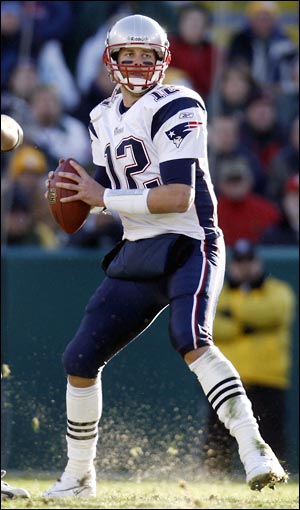
MVP Profile: Tom Brady, 2007

Quarterback, New England Patriots


Age: 30
8th season in pro football & with Patriots
College: Michigan
Height: 6’4” Weight: 225

Prelude:
A lightly-regarded sixth-round draft choice by New England in 2000, Brady got his chance when starting QB Drew Bledsoe was injured in the second game of the ’01 season. With the young quarterback showing surprising poise and leadership ability, the team surged in the second half and ended up with a stunning win over the St. Louis Rams in the Super Bowl. Brady was selected to the Pro Bowl, as he also would be in 2004 and ‘05. The Patriots won two more championships over the next three seasons, and he led the NFL with 28 TD passes in 2002. Brady also led the league with 4110 yards passing in 2005.

2007 Season Summary
Appeared and started in all 16 games
[Bracketed numbers indicate league rank in Top 20]

Passing
Attempts – 578 [2]
Most attempts, game – 54 vs. Philadelphia 11/25
Completions – 398 [2]
Most completions, game – 34 vs. Philadelphia 11/25
Yards – 4806 [1]
Most yards, game – 399 vs. Pittsburgh 12/9
Completion percentage – 68.9 [1]
Yards per attempt – 8.3 [1]
TD passes – 50 [1]
Most TD passes, game – 6 at Miami 10/21
Interceptions – 8
Most interceptions, game – 2 at Indianapolis 11/4, vs. Miami 12/23
Passer rating – 117.2 [1]
300-yard passing games – 8
200-yard passing games – 15

Rushing
Attempts – 37
Most attempts, game - 5 (for 14 yds.) at Indianapolis 11/4
Yards – 98
Most yards, game – 16 yards (on 3 carries) vs. Philadelphia 11/25
Yards per attempt – 2.6
TDs – 2

Scoring
TDs – 2
Points - 12

Postseason: 3 G
Pass attempts – 109
Most attempts, game - 48 vs. NY Giants, Super Bowl
Pass completions – 77
Most completions, game - 29 vs. NY Giants, Super Bowl
Passing yardage – 737
Most yards, game - 266 vs. NY Giants, Super Bowl
TD passes – 6
Most TD passes, game - 3 vs. Jacksonville, AFC Divisional playoff
Interceptions – 3
Most interceptions, game - 3 vs. San Diego, AFC Championship

Rushing attempts – 4
Most rushing attempts, game – 2 (for 1 yd.) vs. Jacksonville, AFC Divisional playoff, (for -2 yds.) vs. San Diego, AFC Championship
Rushing yards – -1
Most rushing yards, game - 1 vs. Jacksonville, AFC Divisional playoff
Average gain rushing – -0.3
Rushing TDs – 0

Awards & Honors:
NFL MVP: AP, PFWA, NEA, Bert Bell Award, Sporting News
NFL Offensive Player of the Year: AP
1st team All-NFL: AP, PFWA, Sporting News
Pro Bowl

Patriots went 16-0 to win the AFC East and complete the first undefeated regular season in the NFL since 1972. The team also paced the NFL in points (589), touchdowns (75), total yards (6580), and passing yards (4731). Won Divisional playoff over Jacksonville Jaguars (31-20) and AFC Championship over San Diego Chargers (21-12). Lost Super Bowl to New York Giants (17-14).

Aftermath:
Brady’s 2008 season ended prematurely due to a knee injury in the opening game. He came back to throw for 4398 yards and 28 TDs in 2009 and had another MVP season in 2010, in which he led the NFL in passing (111.0 rating) and TD passes (36). Brady was selected to the Pro Bowl in both 2009 and ’10.

--

MVP Profiles feature players who were named MVP or Player of the Year in the NFL, AAFC (1946-49), AFL (1960-69), WFL (1974), or USFL (1983-85) by a recognized organization (Associated Press, Pro Football Writers Association, Newspaper Enterprise Association, United Press International, The Sporting News, Maxwell Club – Bert Bell Award, or the league itself).

[Updated 2/15/14]

April 27, 2011

1982: Forced to Settle, Eagles Draft Mike Quick in First Round


With the 20th pick in the first round of the NFL draft on April 27, 1982, the Philadelphia Eagles were looking to take a wide receiver. There were a few who were considered likely first round choices, and the Eagles were most interested in Perry Tuttle out of Clemson.

The Kansas City Chiefs snagged WR Anthony Hancock of Tennessee with the 11th pick. New Orleans took Georgia WR Lindsay Scott two choices later. It appeared that Tuttle would be available, but the Broncos, just ahead of Philadelphia in the 19th spot, traded the choice to Buffalo, and the Bills used it to take Tuttle.

Head Coach Dick Vermeil and the Eagles staff, disappointed at losing out on Tuttle, settled on WR Mike Quick from North Carolina State. To be sure, Quick had size (6’2”, 185 pounds) and was known as a good blocker, but was considered too slow.

“We actually were ready to pick Tuttle, but Denver made that trade and Buffalo got him,”
Vermeil said. “We are satisfied. We rated him (Quick) the third best wide receiver in the draft.”

“He's a big kid, very tough, and mature,” Vermeil added. “I think he can come in the first year and make a contribution.”

The contribution did not come quite so soon as Quick had a quiet rookie year in the strike-shortened ’82 season, catching 10 passes for 156 yards and a touchdown while playing behind the 33-year-old veteran Harold Carmichael and Ron Smith. The Eagles, who had gone to the Super Bowl two years before, suffered through a difficult 3-6 campaign and Vermeil resigned afterward.

It was a very different story for Quick in 1983, as he moved into the starting lineup across from Carmichael. He caught 69 passes for a league-leading 1409 yards and 13 touchdowns, and was a consensus first-team All-Pro as well as Pro Bowl selection. He had six 100-yard receiving games, including four straight early in the season. What he lacked in speed, Quick made up for in his ability to catch in traffic and run well after getting the ball. The young wide receiver’s performance was a highlight for a team that lost nine of its last 10 games to finish at 5-11 while also embroiled in front office instability.

Better things were hoped for in 1984, especially with the aging Carmichael let go to make room for another first round wide receiver, Kenny Jackson of Penn State. However, both receivers encountered injury problems, although Quick recovered to grab 61 passes for 1052 yards and nine touchdowns. Jackson, who failed to live up to expectations, had just 26 catches for 398 yards and a TD.

The Eagles were a losing team from 1983 to ‘87, but Quick continued to perform well. During that period, he scored more touchdowns (53) than any other NFL receiver and had the third-most receiving yards (5437). He went to five consecutive Pro Bowls and was again a consensus first-team All-NFL selection in 1985. The league-leading yardage total of ’83 remained his career high, but was the first of three straight thousand-yard receiving totals for Quick, who caught a career-high 73 passes in ’85. His 99-yard touchdown on a slant pass from QB Ron Jaworski in 1985 tied the unbreakable NFL record and won a game against the Falcons in overtime.

Unfortunately, at the point that the Eagles were beginning to develop into a winning team again under Head Coach Buddy Ryan, Quick suffered injuries that greatly hindered his performance and ultimately forced his retirement following the 1990 season.

Five weeks into the ’88 season, in the process of making a difficult catch against the Houston Oilers, Quick suffered a broken leg that sidelined him for eight weeks. In 1989, a knee injury in the sixth game finished him for the year. In his last season, he appeared in just four games and caught 9 passes for 135 yards and one last touchdown.

Over the course of his career, Quick easily justified his first round selection in 1982. He caught a total of 363 passes for 6464 yards (17.8 avg.) and 61 TDs.

As for the receivers chosen ahead of Quick in ’82, Anthony Hancock lasted five years, returned kicks, and caught a total of 73 passes for 1266 yards and five touchdowns. Lindsay Scott stayed with the Saints for four seasons and ended up with 69 receptions for 864 yards and a score. Perry Tuttle, the receiver the Eagles had really wanted, played for three years and had 25 catches for 375 yards and three TDs.

The player that the Eagles had settled on in the first round proved far better than those rated higher at his position – one of many examples of the surprises that regularly occur in the NFL draft process.

April 25, 2011

Past Venue: Forbes Field

Pittsburgh, PA


Year opened: 1909
Capacity: 41,000, up from 23,000 at opening

Names:
Forbes Field, 1909-71

Pro football tenants:
Pittsburgh Pirates/Steelers (NFL), 1933-63
Pittsburgh Americans (AFL), 1936-37

Postseason games hosted:
NFL Eastern Division playoff, Eagles 21 Steelers 0, Dec. 21, 1947

Other tenants of note:
Pittsburgh Pirates (MLB – NL), 1909-70
University of Pittsburgh (college football), 1909-24
Homestead Grays (baseball Negro Leagues), 1922-39
Pittsburgh Phantoms (NPSL), 1967

Notes: Hosted some home games of combined Phil-Pitt team (“Steagles”, 1943) and Card-Pitt team (1944). The Steelers began splitting home games between Forbes Field and the Univ. of Pittsburgh’s Pitt Stadium in 1958 before moving to Pitt Stadium exclusively in 1964. Stadium was bought by Univ. of Pittsburgh in 1958, with university agreeing to lease to the Pirates until a new stadium was built.

Fate: Demolished in 1971, the site contains the Forbes Quadrangle, a library and dormitories for the Univ. of Pittsburgh. Home plate remains on display in its exact location in what is now first floor walkway of Forbes Quadrangle and a portion of the left field wall still stands.