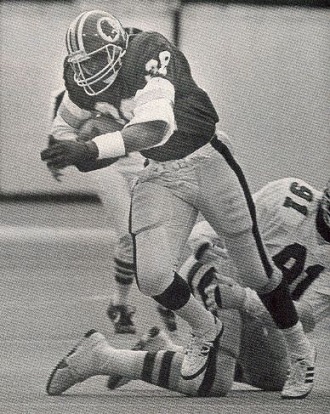
Showing posts with label Washington Redskins. Show all posts

September 16, 2017

Highlighted Year: Gary Clark, 1986

Wide Receiver, Washington Redskins


Age: 24
4th season in pro football, 2nd in NFL & with Redskins
College: James Madison
Height: 5’9”    Weight: 173

Prelude:
Clark caught 155 passes for 2863 yards and 16 touchdowns in college and was chosen by the Jacksonville Bulls in the first round of the 1984 USFL draft. He had 56 catches for 760 yards and two TDs as a rookie and also returned kicks. He had a lesser season in ’85 and caught only 10 passes. Following the demise of the USFL, he joined the Redskins in the Fall, who had taken him in the second round of the 1984 NFL Supplemental Draft. He had a big first year with Washington in ’85 with 72 receptions for 926 yards and 5 TDs. He proved to be an explosive receiver with great toughness.

1986 Season Summary
Appeared in 15 of 16 games
[Bracketed numbers indicate league rank in Top 20]

Pass Receiving
Receptions – 74 [10]           
Most receptions, game – 11 (for 241 yds.) at NY Giants 10/27
Yards – 1265 [4]
Most yards, game – 241 (on 11 catches) at NY Giants 10/27
Average gain – 17.1
TDs – 7 [15, tied with four others]
200-yard receiving games – 1
100-yard receiving games – 5

Punt Returns
Returns – 1
Yards – 14
TDs – 0

Scoring
TDs – 7
Points – 42

Postseason: 3 G
Pass receptions – 6
Most pass receptions, game – 5 at Chicago, NFC Divisional playoff
Pass receiving yards – 45
Most pass receiving yards, game – 37 at Chicago, NFC Divisional playoff
Average yards per reception – 7.5
Pass Receiving TDs – 0

Awards & Honors:
2nd team All-NFL: AP
1st team All-NFC: UPI, Pro Football Weekly
Pro Bowl

Redskins went 12-4 to finish second in the NFC East to qualify as a wild card playoff entry. Won NFC Wild Card playoff over Los Angeles Rams (19-7) & NFC Divisional playoff over Chicago Bears (27-13). Lost NFC Championship to New York Giants (17-0).

Aftermath:
Clark followed up with another All-Pro season in 1987, catching 56 passes for 1066 yards and 7 TDs in Washington’s Super Bowl-winning campaign, that was strike-interrupted. An off year in 1988 with a 79-catch year in ’89 for 1229 yards and 9 touchdowns. Clark garnered Pro Bowl recognition in 1990 and ’91 (75 receptions for 112 yards and 8 TDs followed by 70 catches for 1340 yards and 10 TDs). Following a 64-catch, 912-yard season in 1992, Clark moved on to the Phoenix Cardinals as a free agent in ’93. He spent two years with the Cards and finished his stellar career with Miami in 1995. Overall in the NFL he caught 699 passes for 10,856 yards and 65 touchdowns. Of those totals, 549 receptions for 8742 yards and 58 TDs came with the Redskins. Clark received at least some first-team All-NFL honors twice and was selected to four Pro Bowls.


--

Highlighted Years features players who were consensus first-team All-League* selections or league* or conference** leaders in the following statistical categories:

Rushing: Yards, TDs (min. 10)
Passing: Yards, Completion Pct., Yards per Attempt, TDs, Rating
Receiving: Catches, Yards, TDs (min. 10)
Scoring: TDs, Points, Field Goals (min. 5)
All-Purpose: Total Yards
Defense: Interceptions, Sacks
Kickoff Returns: Average
Punt Returns: Average
Punting: Average

*Leagues include NFL (1920 to date), AFL (1926), AFL (1936-37), AAFC (1946-49), AFL (1960-69), WFL (1974-75), USFL (1983-85)


**NFC/AFC since 1970

November 17, 2016

Highlighted Year: Larry Brown, 1970

Halfback, Washington Redskins


Age: 23 (Sept. 19)
2nd season in pro football & with Redskins
College: Kansas State
Height: 5’11” Weight: 195

Prelude:
Brown played two seasons at Kansas State after transferring from Dodge City Junior College and had an undistinguished career, rushing for 684 yards and catching 13 passes. An eighth round pick by the Redskins in the 1969 NFL draft, Brown led the team in rushing as a rookie with 888 yards on 202 carries (4.4 avg.) and caught 34 passes for another 302 yards. He was selected to the Pro Bowl.

1970 Season Summary
Appeared in 13 of 14 games
[Bracketed numbers indicate league rank in Top 20]

Rushing
Attempts – 237 [2]
Most attempts, game – 27 (for 110 yds.) at Philadelphia 10/4
Yards – 1125 [1]
Most yards, game – 139 yards (on 17 carries) vs. NY Giants 11/29
Average gain – 4.7 [3]
TDs – 5 [13, tied with eleven others]
100-yard rushing games – 6

Pass Receiving
Receptions – 37      
Most receptions, game – 9 (for 76 yds.) at Oakland 10/19
Yards – 341
Most yards, game – 76 (on 9 catches) at Oakland 10/19
Average gain – 9.2
TDs – 2

Scoring
TDs – 7 [18, tied with nine others]
Points – 42

Awards & Honors:
1st team All-NFL: AP, PFWA, NEA, Pro Football Weekly
1st team All-NFC: AP, UPI, Pro Football Weekly, Sporting News
Pro Bowl

Redskins went 6-8 to finish fourth in the NFC East.

Aftermath:
Brown’s production dropped off to 948 yards in 1971 as defenses keyed on him, but he was selected to a third Pro Bowl and received consensus first-team All-NFC recognition. He was the consensus league MVP in ’72 as he led the NFC in rushing with 1216 yards and the Redskins reached the Super Bowl. Brown ran for 860 yards and caught 40 passes in 1973, but the workhorse runner began to show signs of wear in ’74 and totaled just 838 yards over the last three seasons of a career spent entirely with Washington that ended in 1976. Overall, he rushed for 5875 yards on 1530 attempts (3.8 avg.) and caught 238 passes for 2485 yards (10.4 avg.) while scoring a total of 55 touchdowns. Brown was a consensus first-team All-NFL selection twice, received first-team All-NFC honors after one other season, and was selected to four Pro Bowls.

--

Highlighted Years features players who were consensus first-team All-League* selections or league* or conference** leaders in the following statistical categories:

Rushing: Yards, TDs (min. 10)
Passing: Yards, Completion Pct., Yards per Attempt, TDs, Rating
Receiving: Catches, Yards, TDs (min. 10)
Scoring: TDs, Points, Field Goals (min. 5)
All-Purpose: Total Yards
Defense: Interceptions, Sacks
Kickoff Returns: Average
Punt Returns: Average
Punting: Average

*Leagues include NFL (1920 to date), AFL (1926), AFL (1936-37), AAFC (1946-49), AFL (1960-69), WFL (1974-75), USFL (1983-85)

**NFC/AFC since 1970

October 8, 2016

1950: Giants Prevail Against Redskins in Back-and-Forth Contest


The New York Giants were 2-0 as they traveled to Washington to face the Redskins on October 8, 1950. The Giants were coming off of three straight mediocre seasons since last topping the NFL’s Eastern Division, but an infusion of talent that was mainly due to the demise of the All-America Football Conference was making a difference for the better. It was especially true on defense, and long-time Head Coach Steve Owen’s “umbrella defense” had shut down the powerful Cleveland Browns, newcomers from the AAFC, the previous week.

Washington, coached by Herman Ball, was at 1-2 and didn’t appear to offer much of a challenge. HB Bill Dudley was a fine all-around player and end Hugh Taylor a quality receiver, but aging star QB Sammy Baugh was injured and inconsistent Harry Gilmer was starting in his place. After defeating the lowly Colts in the opener, they had lost badly to the Packers and Steelers.

It was a rainy day with a light crowd of 19,288 fans in attendance at Griffith Stadium.  In the first quarter, the Redskins drove 80 yards, keeping the ball on the ground, and Gilmer finished it off with a quarterback sneak from less than a yard out for a touchdown. Bill Dudley added the extra point for the early 7-0 lead. The Giants responded with a 70-yard possession that ended with HB Forrest Griffith, who ran effectively along the way with gains of six and seven yards, scoring on a two-yard plunge. Ray Poole tied the game with the point after.

In the second quarter, the Redskins got a break when HB Jim Ostendarp fumbled a punt and DT Paul Lipscomb recovered, giving Washington the ball at the New York nine. Two plays later, Gilmer threw to Dudley (pictured below) for a four-yard TD and Dudley also added the extra point to make it 14-7, which remained the score at halftime.


In the third quarter, New York QB Charlie Conerly (pictured at top) passed to end Bob McChesney to reach the Washington 13 and the Giants pounded away on the ground from there until HB Gene Roberts blasted over from two yards out for a touchdown. Poole again added the extra point and it was a 14-14 contest.

The Redskins had an opportunity to regain the lead when Dudley kicked a 22-yard field goal, but they chose to take the points off the board due to an offside penalty on the Giants that gave them a first down at the New York 11. However, they were unable to reach the end zone and, once again calling upon Dudley to try for three, came up empty when he missed.

Dudley didn’t miss early in the fourth quarter when he kicked a 19-yard field goal to make it 17-14 in favor of Washington. Down by three, and with less than six minutes to play, the Giants advanced 92 yards. Conerly threw twice to HB Randall Clay, for 37 and 20 yards, and finally it was Conerly tossing a short pass to Roberts, who ran the remaining distance untouched for a 39-yard touchdown. Poole converted once more to put the visitors ahead by four points.

There was still time for the Redskins and HB Frank Spaniel returned the ensuing kickoff 40 yards to the New York 49. But after advancing to the 35, FB Chuck Drazenovich fumbled and the Giants recovered to seal the 21-17 win.

The statistics reflected the closeness of the contest. New York had the edge in total yards (288 to 260) while the Redskins led in first downs (18 to 15). Both teams completed seven passes apiece, with the Giants having a 168 to 105 edge in yards, and Washington outgained New York on the ground by 155 yards to 120. However, the Redskins turned the ball over three times, to one by the Giants.

New York lost two of its next three games but didn’t lose another on the way to a 10-2 record that tied with the Browns atop the American Conference (the re-named Eastern Division). But after sweeping Cleveland in the season series, the Giants lost a tight 8-3 playoff to the Browns. As for the Redskins, the loss to New York was the third of eight straight (including the rematch between the teams). Washington ended up 3-9 and at the bottom of the conference.

September 17, 2016

1989: Cunningham Throws for 447 Yards & 5 TDs as Eagles Stun Redskins


The Philadelphia Eagles were 1-0 as they faced the Washington Redskins, rivals in the NFC East, on September 17, 1989. Entering their fourth season under brash Head Coach Buddy Ryan, the Eagles had surged in the second half of the ’88 season to a 10-6 record and the NFC East title for their first postseason appearance in seven years. Central to the offense was QB Randall Cunningham (pictured above), who passed for 3808 yards and ran for 624. Beyond the fleet-footed quarterback, the running game was ordinary, with RB Keith Byars proving to be more effective as a receiver out of the backfield than a runner from scrimmage. The attacking defense was led by DE Reggie White and, while prone to giving up big plays on passes, improvement was anticipated. The Eagles defeated Seattle with ease in the first week.

Washington was coached by Joe Gibbs, who had enjoyed much success since taking over the team in 1981 but was coming off of a disappointing 7-9 record in 1988. QB Mark Rypien was taking over for the hobbled Doug Williams and it was hoped that the running game would improve with the addition of RB Gerald Riggs from the Falcons. It was also anticipated that the defense would recover from an injury-riddled year. The Redskins suffered a tough opening loss against the Giants the previous Monday night.

There were 53,493 fans in attendance at RFK Stadium. The Redskins struck quickly when, on their first play from scrimmage, Mark Rypien threw to WR Gary Clark for an 80-yard touchdown. The extra point attempt was aborted due to a bad snap but Washington held the early 6-0 advantage.

That lead got larger when DE Charles Mann recovered a fumble by FB Anthony Toney at the Philadelphia 41 and, on the next play, Gerald Riggs broke away for another TD. This time Chip Lohmiller added the point after and, having run just two offensive plays, the Redskins were up by 13-0.

It got worse for the Eagles when a Randall Cunningham pass was intercepted by CB Brian Davis, who returned it 13 yards to the Philadelphia 12. Two plays later, Rypien tossed a scoring throw to RB Earnest Byner from 11 yards out and, following another Lohmiller conversion, the home team was ahead by 20-0.

The Eagles responded with a nine-play, 80-yard series that included an unsportsmanlike conduct penalty on the defense and a pass from Cunningham to Keith Byars that picked up 28 yards. Cunningham connected with TE Keith Jackson for a 17-yard touchdown and, following the extra point by Luis Zendejas, the score stood at 20-7 after an eventful first quarter of play.

As the game headed into the second quarter, the Redskins came back with an 80-yard possession in eight plays. Riggs (pictured below) carried for a 46-yard gain and Rypien threw to Clark for 21 yards before the series ended with another Rypien-to-Clark TD, this time covering five yards. Lohmiller’s conversion put Washington ahead by a formidable 27-7.


The Eagles got a break on defense when DB William Frizzell picked off a Rypien pass and returned it 23 yards to the Washington three. From there, Toney ran for a touchdown and, with Zendejas adding the PAT, Philadelphia was down by 13 points at 27-14. However, before the first half was over, the Redskins put together a long drive of 63 yards in 12 plays. Rypien completed a pass to WR Art Monk for 17 yards and two to WR Ricky Sanders for 13 and 14 yards to set up a 25-yard Lohmiller field goal. Washington took a 30-14 lead into halftime.

The third quarter was relatively quiet, with the Eagles mounting a 92-yard drive in 12 plays for the only score. Cunningham connected with Byars for 31 yards, WR Mike Quick for 21, and Byars again for 12 along the way before tossing a touchdown pass to Jackson that covered five yards. Zendejas converted and it was a 30-21 game heading into the final period.

Philadelphia narrowed the margin even further in the early minutes of the fourth quarter after SS Andre Waters recovered a Rypien fumble and returned it 16 yards. In a drive that covered 42 yards in seven plays, Cunningham passed to Byars for 20 yards and connected with WR Cris Carter for a five-yard TD. Zendejas booted the extra point and suddenly the Eagles were only two points down at 30-28.

The visitors regained possession on a fumble and appeared primed to take the lead, but Zendejas missed on a 33-yard field goal attempt. Having gained a reprieve, and following an exchange of punts, the Redskins finally got on the board again following a six-play, 71-yard series that concluded with Rypien going long to Monk for a 43-yard touchdown. Lohmiller added the point after that put Washington ahead by a seemingly comfortable 37-28 with 3:06 remaining on the clock.

Philadelphia responded with a drive that covered 69 yards in eight plays. Cunningham completed five straight passes that included one to Jackson for 17 yards and two to WR Gregg Garrity that covered 29 and 12 yards. Finally, it was Cunningham to Quick, who made a leaping grab for a two-yard TD and, with Zendejas adding the extra point, the Eagles were down by just 37-35.

It looked as though the two-point margin would hold for the Redskins, however, as Riggs took off for a 58-yard gain on first down to the Philadelphia 22. But two plays later, and with 1:16 left on the clock, LB Al Harris recovered a Riggs fumble and, before he could be pulled down by OT Jim Lachey, he handed off to FS Wes Hopkins who proceeded to charge 77 yards down the sideline to the Washington four (While Coach Gibbs complained that the Hopkins runback was due to a forward lateral, the replay official indicated that it was inconclusive).

On the next play, Cunningham threw to Jackson (pictured below), who was open in the end zone for a touchdown and Zendejas tacked on the point after. Any remaining chance for the Redskins ended when Rypien fumbled while being sacked by DT Jerome Brown and Reggie White recovered at the Washington 15 with 43 seconds to go. The Eagles, trailing for almost the entire game and twice by as many as 20 points, came away winners by a final score of 42-37.


The Redskins had the edge in total yards (492 to 474) although Philadelphia had far more first downs (32 to 16). Washington turned the ball over a critical six times, to three by the Eagles. The Redskins recorded four sacks to two by Philadelphia.

Randall Cunningham, who just received a five-year contract extension, had a huge performance as he completed 34 of 46 passes for 447 yards (breaking a team record that had been set in 1953) with five touchdowns while giving up one interception. Keith Jackson had 12 catches for 126 yards and three TDs and Keith Byars gained 130 yards on his 8 pass receptions. Anthony Toney rushed for 24 yards on 9 attempts that included a score. On defense, Jerome Brown had a notable performance with nine tackles and two sacks.

For the Redskins, Gerald Riggs gained a club-record 221 yards on 29 rushing attempts with one touchdown, but the outstanding performance was tarnished by the late fumble. Mark Rypien was successful on 12 of 23 throws for 288 yards and four TDs while being picked off twice. Gary Clark caught four passes for 153 yards and two touchdowns and Art Monk also had four receptions, for 87 yards and a TD.

“I told them I’ve been to Super Bowls and all that, but I’ve never been associated with a game like that,” said Buddy Ryan. “It was a knock-down, drag-out.”

“It is probably one of the low points since I’ve been here,” said Joe Gibbs in defeat. “It was one of the toughest losses I’ve ever been part of.”

The Eagles, who were 2-0 for the first time since 1981, lost their next two games but reeled off four straight wins before briefly slumping. They lost the rematch with the Redskins at home in a far more low-scoring contest (10-3) and went on to place second in the NFC East with an 11-5 record, securing a playoff spot and losing to the Rams in the Wild Card round. Washington recovered to win three of its next four games and, after slumping to 5-6, finished the season with five consecutive victories to end up third in the division at 10-6, although out of the playoffs.

The fortunes of the game’s major statistical performers varied over the course of the season. Randall Cunningham passed for 3400 yards and 21 touchdowns, with 15 interceptions, and again led the club in rushing with 621 yards. While he was chosen to the Pro Bowl for a second straight year, his performance was uneven as injuries to receivers, in particular Mike Quick and Keith Jackson, took their toll. Jackson still managed to gain selection to the Pro Bowl as well, although his numbers were reduced to 63 catches for 648 yards (10.3 avg.) and the three touchdowns scored against Washington were his total for the year.

Gerald Riggs also failed to sustain a strong start, not reaching the hundred-yard mark in the remainder of an injury-plagued season (although he did gain 99 yards in Week 7 against Tampa Bay). He finished with 834 yards on 201 carries (4.1 avg.) with four TDs.

September 3, 2016

1978: Dusek Fumble Return Lifts Redskins Past Patriots


The Washington Redskins were under new leadership and facing long odds (they were 9.5-point underdogs) as they faced the New England Patriots in a season-opening game on September 3, 1978.

Jack Pardee was making his debut as head coach of the Redskins, the successor to George Allen and his seven straight winning records, including 9-5 in ‘77. Allen had dealt away draft picks to stockpile veterans, and there were concerns about retooling at certain positions. Foremost was at quarterback, where Bill Kilmer was almost 39 years old and being pressed by Joe Theismann, who was named the starter just prior to the opener. HB Mike Thomas was capable and it was hoped that FB John Riggins would rebound from an injury-plagued year. The defense was tough but old and there were concerns in particular about the backfield.

New England, coached by Chuck Fairbanks, had also been 9-5 the previous year but was considered to be a contender in the highly competitive AFC East. Steve Grogan brought grit and mobility to the quarterback position and there was a promising group of runners led by FB Sam Cunningham. WR Darryl Stingley’s career was cut short by a spinal cord injury suffered during the preseason and WR Harold Jackson was obtained from the Rams to take his place. The defense was fifth overall in 1977 and especially strong against the run.

There were 55,037 fans in attendance at Schaeffer Stadium in Foxboro, MA. The Redskins came through with a big gain on their first play from scrimmage as Joe Theismann fired a pass to WR Danny Buggs that picked up 63 yards to the New England 17. From there, the visitors made it to the eight before Mark Moseley came on to kick a 26-yard field goal for the early 3-0 lead.

That lead held up through the first half as both quarterbacks were erratic and the Patriots failed to take advantage of several opportunities. Drives to the Washington 23 and 26 both came up empty, the last when CB Lamar Parrish picked off a Grogan pass at his 18 with 20 seconds remaining in the second quarter.

Three minutes into the third quarter, the Patriots finally got on the board as the result of an 80-yard drive in seven plays when QB Steve Grogan passed to WR Stanley Morgan for a 33-yard touchdown. John Smith added the extra point for a 7-3 advantage.

The Redskins responded later in the period thanks to 18-year veteran DE Ron McDole’s interception of a Grogan pass that he batted into the air at the line of scrimmage and that resulted in an 11-play, 55-yard advance. Mike Thomas converted one third down with a six-yard run and then another in which he made a diving catch for 14 yards to the New England 22. After reaching the 10, a fumbled snap lost five yards and Theismann’s throw to WR Frank Grant in the end zone was dropped. Once more it was Thomas, circling out of the backfield and getting open for a 15-yard TD toss from Theismann. Moseley’s extra point attempt hit the goal post and was unsuccessful but the visitors were in front by 9-7.


As the game headed into the fourth quarter, the Patriots put together an 80-yard drive as two reserves, HB Horace Ivory and TE Don Hasselbeck, made key plays and Grogan went long to Harold Jackson for a 45-yard touchdown. Smith’s conversion put New England back on top by 14-9.

Up by five points, the Patriots were attempting to run out the clock as they took possession in the last three minutes. But on a second down play Ivory, attempting to sweep around right end, was hit hard by DT Dave Butz, causing a fumble. LB Brad Dusek, a former member of the Patriots, grabbed the ball on one bounce and raced down the left sideline along with a convoy of teammates for a 31-yard touchdown. Moseley this time made good on the PAT and the visitors clung to a two-point lead with 2:40 left to play.

The Patriots still had time and a brisk wind at their backs. They got a break on the next series as Grogan fumbled when sacked by DE Diron Talbert and the Redskins recovered, but the play was nullified by an illegal bump on Parrish. That gave the Patriots a first down at their 32, but a handoff to HB Andy Johnson was botched, DE Coy Bacon sacked Grogan for a 13-yard loss, and a third down pass was dropped by WR Don Westbrook to force a punt. Washington then put the game away when John Riggins broke away for a 31-yard gain to the New England 16 in the last minute, allowing the Redskins to run out the clock and win by a final score of 16-14.

Total yards were nearly even, with the Patriots having a slight edge (326 to 324) although New England more decisively led in first downs (21 to 14). However, the Patriots also turned the ball over three times, to two suffered by Washington, and the Redskins recorded three sacks, to one by New England.


Joe Theismann completed 10 of 24 passes for 184 yards and a touchdown while giving up an interception. Mike Thomas ran for 70 yards on 11 carries and also led the Redskins with four catches, for 46 yards and a TD. With the long gain to start the game, Danny Buggs gained 89 yards on two pass receptions. John Riggins contributed 60 rushing yards on 16 attempts.

For the Patriots, Steve Grogan was successful on just 12 of 31 throws for 199 yards and two TDs with two interceptions. Despite the late fumble, Horace Ivory had a fine overall performance with 89 yards on 16 carries. Harold Jackson caught 7 passes for 124 yards and a touchdown.

The opening win was the first of six straight for the Redskins, but they slipped badly during the second half of the season to finish at 8-8 and third in the NFC East. New England recovered to win eight of the next nine games, and topped the AFC East with an 11-5 record. However, the announcement by Coach Fairbanks that he was resigning to take over at the University of Colorado just prior to the season finale, and his immediate dismissal by owner William H. Sullivan effectively pulled the plug on the season. The Patriots lost decisively to Houston in the AFC Divisional playoff round.

Brad Dusek, who was originally drafted by the Patriots, was in his fifth season with Washington and well established as the starting left linebacker. His game-winning fumble recovery was one of two for the year and 16 over the course of his career, three of which he returned for touchdowns.

August 24, 2016

Highlighted Year: Charlie Brown, 1983

Wide Receiver, Washington Redskins


Age: 25 (Oct. 29)
3rd season in pro football (2nd active) & with Redskins
College: South Carolina State
Height: 5’10” Weight: 179

Prelude:
An outstanding receiver on a run-oriented college team, Brown was chosen by the Redskins in the eighth round of the 1981 NFL draft but spent his first year on injured reserve due to a knee injury suffered in the third preseason game. He made an impact in the 1982 season opening game by scoring on a 78-yard touchdown catch, the first of eight TDs in the strike-shortened campaign that saw him pull in 32 receptions for 690 yards (21.6 avg.). Brown caught another 17 passes for 242 yards and two TDs in the postseason as the Redskins won the NFL Championship and he received second-team All-NFL recognition from the NEA and was selected to the Pro Bowl. He became part of a group of capable receivers known as “the Fun Bunch” that were a component of the NFL’s most potent offense.

1983 Season Summary
Appeared in 15 of 16 games
[Bracketed numbers indicate league rank in Top 20]

Pass Receiving
Receptions – 78 [6, tied with Earnest Gray & Roy Green, 1st in NFC]           
Most receptions, game – 11 (for 180 yds.) vs. LA Raiders 10/2
Yards – 1225 [6]
Most yards, game – 180 (on 11 catches) vs. LA Raiders 10/2
Average gain – 15.7
TDs – 8 [7, tied with five others]
100-yard receiving games – 4

Rushing
Attempts – 4
Yards – 53
Average gain – 13.3
TDs – 0

Scoring
TDs – 8
Points – 48

Postseason: 3 G
Pass receptions – 14
Most pass receptions, game – 6 vs. LA Rams, NFC Divisional playoff
Pass receiving yards – 401
Most pass receiving yards, game – 171 vs. LA Rams, NFC Divisional playoff
Average yards per reception – 28.6
Pass Receiving TDs – 1
100-yard receiving games – 2

Awards & Honors:
2nd team All-NFC: UPI
Pro Bowl

Redskins went 14-2 and finished first in the NFC East while leading the NFL in scoring (541 points) and touchdowns (63). Won NFC Divisional playoff over Los Angeles Rams (51-7) and NFC Championship over San Francisco 49ers (24-21). Lost Super Bowl to Los Angeles Raiders (38-9).

Aftermath:
Brown suffered through an injury-plagued season in 1984, catching just 18 passes for 200 yards (11.1 avg.), and was traded to the Atlanta Falcons. Following a mediocre 24-catch season in ’85, Brown rebounded in 1986 with 63 pass receptions for 918 yards (14.6 avg.) and four touchdowns. It was his last hurrah as he caught just five more passes in 1986 and his NFL career came to an end with his release by the Colts in 1988. Brown played arena football in 1990 with the a Washington Commandos and caught 11 passes for 129 yards and two TDs. Overall in the NFL, Brown had 220 receptions for 3548 yards (16.1 avg.) and 25 touchdowns, with 128 of those catches for 2115 yards and 19 TDs coming with Washington. He added another 31 catches for 643 yards (20.7 avg.) and three TDs in eight postseason games. Brown received second-team All-NFL honors once, second-team All-NFC recognition twice, and was chosen to two Pro Bowls.

--

Highlighted Years features players who were consensus first-team All-League* selections or league* or conference** leaders in the following statistical categories:

Rushing: Yards, TDs (min. 10)
Passing: Yards, Completion Pct., Yards per Attempt, TDs, Rating
Receiving: Catches, Yards, TDs (min. 10)
Scoring: TDs, Points, Field Goals (min. 5)
All-Purpose: Total Yards
Defense: Interceptions, Sacks
Kickoff Returns: Average
Punt Returns: Average
Punting: Average

*Leagues include NFL (1920 to date), AFL (1926), AFL (1936-37), AAFC (1946-49), AFL (1960-69), WFL (1974-75), USFL (1983-85)

**NFC/AFC since 1970

May 16, 2016

Highlighted Year: Sammy Baugh, 1937

Tailback/Defensive Back, Washington Redskins


Age: 23
1st season in pro football
College: Texas Christian
Height: 6’2”   Weight: 185

Prelude:
The multi-talented Baugh was a two-time All-American at TCU, where he passed for 3439 yards and 39 touchdowns and was also an outstanding punter. While a baseball prospect as well, “Slingin’ Sammy” signed with the Redskins, newly relocated from Boston to Washington, who chose him in the first round of the 1937 NFL draft (sixth overall). A passing tailback in the single-wing offense, he improved as the season progressed and impressed with his poise as well as precision throwing ability.

1937 Season Summary
Appeared in all 11 games
[Bracketed numbers indicate league rank in Top 20]

Passing
Attempts – 171 [1]
Completions – 81 [1]
Yards – 1127 [1]
Completion percentage – 47.4 [2]
Yards per attempt – 6.6 [2]
TD passes – 8 [2, tied with Bob Monnett & Ed Danowski]
Most TD passes, game – 2 vs. Chi. Cardinals 9/24
Interceptions – 14 [1, tied with Dave Smukler]
Passer rating – 50.5 [2]

Rushing
Attempts – 86 [19]
Yards – 240
Yards per attempt – 2.8
TDs – 1 [17, tied with many others]

Scoring
TDs – 1
Points – 6

Postseason: 1 G (NFL Championship at Chicago Bears)
Pass attempts – 33
Pass completions – 18
Passing yardage – 335
TD passes – 3
Interceptions – 1

Rushing attempts – 4
Rushing yards – 6
Average gain rushing – 1.5
Rushing TDs – 0

Punts – 5
Punting yards – 132
Punting average – 26.4
Longest punt – 43 yards

Awards & Honors:
1st team All-NFL: League, INS, UPI, NY Daily News

Redskins went 8-3 to finish first in the NFL Eastern Division. Won NFL Championship over Chicago Bears (28-21).

Aftermath:
Baugh went on to play 16 seasons in the NFL, all with the Redskins. Along the way, utilizing his sidearm passing motion to excellent effect he led the league in numerous statistical categories, including passing yards four times, touchdown passes twice, and overall passing on six occasions. Baugh also excelled on defense and as a punter and in 1943 led the NFL in passing, punting (45.9 avg.), and interceptions (11). The Redskins benefited from his wide-open style and won five Eastern Division titles and two league championships in Baugh’s first nine seasons. After a difficult year of transition to the T-formation in 1944, Baugh came back to set a completion percentage record of 70.3 (that lasted until 1982) as the Redskins topped the Eastern Division, and he continued to excel even as the team went into decline thereafter, up until his retirement in 1952. Overall, he passed for 21,886 yards and 187 TDs with a 56.5 percent completion percentage on 1693 completions in 2995 attempts, all of which were NFL records at the time. Baugh, masterful at the art of the quick-kick, also set league records with a 51.4-yard average in 1940 and a career average of 45.1 yards, leading the league five times. On defense, he intercepted 31 passes. Baugh received first-team All-NFL recognition after seven seasons and second-team honors following two other years. His #33 was retired by the Redskins (the only retired number thus far in franchise history) and he was inducted into the Pro Football Hall of Fame as a Charter Member in 1963. He went on to become a head coach in the AFL with the New York Titans and Houston Oilers.

--

Highlighted Years features players who were consensus first-team All-League* selections or league* or conference** leaders in the following statistical categories:

Rushing: Yards, TDs (min. 10)
Passing: Yards, Completion Pct., Yards per Attempt, TDs, Rating
Receiving: Catches, Yards, TDs (min. 10)
Scoring: TDs, Points, Field Goals (min. 5)
All-Purpose: Total Yards
Defense: Interceptions, Sacks
Kickoff Returns: Average
Punt Returns: Average
Punting: Average

*Leagues include NFL (1920 to date), AFL (1926), AFL (1936-37), AAFC (1946-49), AFL (1960-69), WFL (1974-75), USFL (1983-85)

**NFC/AFC since 1970

April 26, 2016

1985: Redskins Obtain George Rogers from Saints


A trade that had been widely rumored was finalized on the afternoon of April 26, 1985 as the Washington Redskins dealt their first pick in the upcoming NFL draft to New Orleans for RB George Rogers plus the Saints’ fifth, tenth, and eleventh-round draft choices.

The 26-year-old, power-running Rogers had won the 1980 Heisman Trophy while at South Carolina. Chosen in the first round of the ’81 NFL draft by the Saints, he had a big rookie season, rushing for a league-leading 1674 yards with 13 touchdowns. The 6’2”, 225-pound Rogers was a consensus first-team All-NFL choice and was named to the Pro Bowl, an honor he received again in the strike-shortened 1982 season when he rushed for 535 yards in six games and the Saints contended for a playoff spot.  

However, there were off-field drug problems and Rogers was further hampered by a knee injury in ’83. He still ran for 1144 yards in 13 games but, in 1984, found competition from newly-acquired RB Earl Campbell, who was obtained from the Houston Oilers and reunited with Bum Phillips, once head coach in Houston and now in New Orleans. Rogers’ rushing total fell to 914 yards and he scored only two touchdowns. After four seasons and 4267 rushing yards, the Saints were willing to swing the trade with Washington (and would find that the once-great Campbell was at the end of his Hall of Fame career).

The Redskins were still a fundamentally sound team under Head Coach Joe Gibbs, having won back-to-back NFC Championships in 1982 and ’83, with the former resulting in a Super Bowl victory, and topped the NFC East with an 11-5 record in 1984 before succumbing to the Bears in the Divisional playoff round.

However, Washington’s once-formidable ground game had become a source of concern due to uncertainty surrounding star RB John Riggins, who rushed for 1239 yards but was 35 years old and hindered by a back injury, and Joe Washington, who was 31 and missed nine games with a knee injury (and was separately traded to Atlanta for draft choices).

Riggins returned to the club for the 1985 season, but it was Rogers carrying most of the rushing load. He accumulated four hundred-yard performances, capping the year with 206 yards on 34 attempts in a win against the Cardinals. Overall, he gained 1093 yards on 231 carries, for a career-best 4.7-yard average, and scored seven touchdowns. Riggins contributed 677 yards and Keith Griffin, handling the third-down role that had been Joe Washington’s specialty, gained 473 rushing yards and caught 37 passes for 285 more (Rogers and Riggins had ten catches between them). The team went 10-6, but while the Cowboys and Giants did likewise, tiebreakers put Washington third in the NFC East and out of the playoffs.

With Riggins retired in 1986, Rogers carried 303 times for 1203 yards (4.0 avg.) and a league-leading 18 touchdowns. The Redskins grabbed a Wild Card slot with their 12-4 record and, in his first opportunity to appear in the postseason, Rogers added another 202 yards on the ground, but while that included 115 yards on 29 carries in a first round win over the Rams, he was held to 15 yards on nine attempts in the NFC Championship loss to the Giants.

Rogers spent an injury-plagued 1987 season running for 613 yards in 11 games and saw limited action in the Super Bowl victory over Denver in which RB Timmy Smith, a little-used reserve during the regular season, gained 204 yards on 22 carries. It was the end of the line for Rogers at age 29. He retired, citing nagging injuries. Overall for his three seasons with the Redskins, he ran the ball 697 times for 2909 yards (4.2 avg.) and scored 31 touchdowns. Rarely used as a pass receiver, he had 11 catches for 76 yards.

As for the rest of the transaction involving Rogers, the 1985 draft choices that Washington received were used to take RB Raphael Cherry from Hawaii in the fifth round, Texas RB Terry Orr in the tenth, and G Raleigh McKenzie of Tennessee in the eleventh. Cherry was converted to strong safety, started five games as a rookie when veteran Tony Peters was injured, and intercepted two passes in his only season with the Redskins. Orr was on injured reserve and thus saw no action in ’85 but, utilized at tight end, spent most of the next eight years with Washington and caught 52 passes. McKenzie didn’t contribute much in his first year but he ended up staying with the Redskins until 1994 and started a total of 113 games at both left and right guard as well as center. He moved on to the Eagles in ’95 and finished his career with Green Bay in 2000.

With the first round pick obtained from Washington, which was 24th overall, the Saints selected Tennessee LB Alvin Toles. He spent four seasons with the club, primarily as a reserve among a strong corps of linebackers, and his career was cut short by a serious knee injury during the 1988 season.

February 11, 2016

Highlighted Year: Cliff Battles, 1932

Tailback/Defensive Back, Boston Braves


Age: 22
1st season in pro football
College: West Virginia Wesleyan
Height: 6’1”   Weight: 198

Prelude:
A multi-sport star in college who was also a Phi Beta Kappa student, Battles put up significant numbers playing football for a small school. In 1930, he rushed for 354 yards, totaled 469 all-purpose yards, and scored seven touchdowns in a game against Salem College, and in another contest had three scoring runs of over 80 yards. While the team didn’t do so well when taking on stronger competition, Battles drew interest from several NFL teams and signed with the first-year Braves.

1932 Season Summary
Appeared in 8 of 10 games
[Bracketed numbers indicate league rank in Top 20]

Rushing
Attempts – 148 [1]
Yards – 576 [1]
Yards per attempt – 3.9 [5]
TDs – 3 [2, tied with five others]

Pass Receiving
Receptions – 4
Yards – 60
Yards per catch – 15.0
TDs – 1 [10, tied with fourteen others]

Passing
Attempts – 20 [16, tied with Bob Campiglio & Hap Moran]
Completions – 2
Yards – 42
Completion percentage – 10.0
TD passes – 0
Interceptions – 2 [13, tied with eight others]

All-Purpose yards – 636 [1]

Scoring
TDs – 4 [5, tied with five others]   
Points – 24 [6, tied with four others]

Awards & Honors:
1st team All-NFL: Collyers Eye

Braves went 4-4-2 to finish fourth in the NFL.

Aftermath:
Battles ranked second in rushing to teammate FB Jim Musick with the re-named Redskins in 1933, gaining 737 yards that included 215 in a single game, making him the first NFL player to reach the 200-yard rushing threshold in a single contest. He was a consensus first-team All-NFL selection for his efforts. Running with a long stride, Battles had excellent cutting ability as well as speed, and was adept at returning kicks. He received primarily second-team All-NFL honors in 1934 and ’35 but was a consensus first-team selection in 1936 as he rushed for 614 yards and the Redskins finished first in the Eastern Division, although he was injured early in the NFL Championship loss to Green Bay. The franchise was shifted to Washington for 1937 and Battles set a league rushing record with 874 yards. The Redskins won the NFL title but, when owner George Preston Marshall refused to give his star runner a raise, Battles retired. Overall, he rushed for 3511 yards on 839 carries (4.2 avg.), caught 38 passes for 546 yards (14.4 avg.), and scored a total of 31 touchdowns. He received consensus first-team All-NFL honors three times and at least some first-team or second-team recognition after three other seasons. Battles, who initially became an assistant coach at Columbia, was later head coach of the AAFC’s Brooklyn Dodgers. He was inducted into the Pro Football Hall of Fame, Class of 1968.

--

Highlighted Years features players who were consensus first-team All-League* selections or league* or conference** leaders in the following statistical categories:

Rushing: Yards, TDs (min. 10)
Passing: Yards, Completion Pct., Yards per Attempt, TDs, Rating
Receiving: Catches, Yards, TDs (min. 10)
Scoring: TDs, Points, Field Goals (min. 5)
All-Purpose: Total Yards
Defense: Interceptions, Sacks
Kickoff Returns: Average
Punt Returns: Average
Punting: Average

*Leagues include NFL (1920 to date), AFL (1926), AFL (1936-37), AAFC (1946-49), AFL (1960-69), WFL (1974-75), USFL (1983-85)

**NFC/AFC since 1970

December 22, 2015

1973: Vikings Defeat Redskins in NFC Divisional Playoff Game


The NFC Divisional Playoff game on December 22, 1973 featured the Minnesota Vikings, first place finishers in the NFC Central at 12-2, hosting the Washington Redskins, who placed second in the NFC East with a 10-4 record and qualified for the postseason as a Wild Card entry.

The Vikings were in their seventh season under Head Coach Bud Grant and back in the postseason after a one-year hiatus in 1972. Prior to that they had won four straight division titles, but lost their last two Divisional round games. QB Fran Tarkenton (pictured above), an original Viking, returned to the club in ’72 and was making his first postseason appearance in his 13th year as a pro. Tarkenton was talented and known for his scrambling style, but still had something to prove to critics who questioned his ability to come up a winner in big games. WR John Gilliam was a fine receiver and the addition of rookie FB Chuck Foreman helped both the running and passing attack. The tough defense remained the key to the team’s success, in particular the line with ends Carl Eller and Jim Marshall and tackles Alan Page and Gary Larsen.

The Redskins, coached by George Allen, were the defending NFC Champions and still a very strong, veteran-laden club. Gritty QB Bill Kilmer directed an offense that included the running of HB Larry Brown and a strong receiving corps with wide receivers Charley Taylor and Roy Jefferson and TE Jerry Smith. The defense was strong and adept at pressuring opposing quarterbacks. While Washington was also known for the quality of its special teams play, PK Curt Knight caused concern with his erratic tendencies. In addition, Kilmer had been hospitalized during the previous week due to a stomach disorder.

There were 45,475 fans in attendance at Metropolitan Stadium on a day with temperatures in the twenties and a seven mph wind. The field had been cleared of snow and dyed green to hide the wear. Minnesota came out throwing, but a Fran Tarkenton bomb to an open John Gilliam just grazed the receiver’s finger tips, which was the closest the Vikings came to pulling off a big play in the early going. The Redskins missed a scoring opportunity in the first quarter when they drove from their 14 into Minnesota territory but Curt Knight failed on a 17-yard field goal attempt.

Later in the period, Knight again missed a field goal attempt, coming up short from 49 yards. The Vikings were stymied on offense and didn’t register a first down until two minutes into the second quarter, but they finally came up with a big play when Tarkenton completed a pass to HB Oscar Reed for a gain of 50 yards and that set up a 19-yard field goal by Fred Cox.


With 3:30 remaining in the first half, the Redskins got a break when CB Bobby Bryant fumbled a punt and HB Bob Brunet recovered for Washington at the Minnesota 21. Three plays later, which included a pass from Bill Kilmer to Charley Taylor for 17 yards, Larry Brown (pictured at left) ran for a three-yard touchdown. Knight added the extra point for a 7-3 lead.

The Vikings advanced into field goal position as Tarkenton completed passes to WR Carroll Dale and Chuck Foreman, but an interception inside the ten yard line snuffed out the threat and the score remained unchanged at the half.

During halftime, Minnesota DE Carl Eller delivered an emotional speech to his teammates, who had played without apparent emotion during the first half, saying that they had come “too damn far” and were “embarrassing ourselves”. To accent the point, he proceeded to break apart the team’s blackboard. The tirade made an impression and the Vikings showed more fire in the second half.

Early in the third quarter, Reed, taking advantage of the defense’s keying on Chuck Foreman, broke six tackles on a 46-yard carry that set up a two-yard TD run by FB Bill Brown. Cox added the point after and the home team was ahead by 10-7.

Meanwhile, the Redskins were now without CB Pat Fischer, who suffered cracked ribs in the second quarter and was unable to continue. He was replaced by DB Speedy Duncan, also experienced but typically a kick returner who was more comfortable at safety.

Washington managed to tie the score before the period was over with Curt Knight’s 52-yard field goal that matched the then-league playoff record. Knight kicked another field goal, from 42 yards, on the first play of the fourth quarter, and the visitors held a 13-10 edge.

The Vikings proceeded to advance 71 yards in eight plays concluding with a Tarkenton pass to Gilliam, who beat Duncan for a 28-yard touchdown. Cox converted and Minnesota was back in the lead by 17-13. On Washington’s next offensive play, CB Nate Wright intercepted a Kilmer pass and returned it 26 yards to the Redskins’ eight. Two plays later, it was Tarkenton to Gilliam again for a TD, this time from six yards out and after the nimble quarterback scrambled out of trouble, running to his left and then right before finding the receiver open in the right corner of the end zone. Cox added the point after and, in the space of 1:05, the Vikings had scored twice to take a 24-13 lead.

The Redskins managed to get on the board again following DB Ken Stone’s block of a Mike Eischeid punt. Kilmer passed to WR Roy Jefferson for a 28-yard touchdown with 5:28 left to play and Knight converted to close the margin to four points.

The Vikings were able to use up four minutes on a series that concluded with Cox kicking a 30-yard field goal. Washington fought back in the remaining time as Kilmer completed three passes, but the drive came to an end at the Minnesota 42 on a fourth down incompletion. Minnesota won by a final score of 27-20.

The statistics were fairly even. The Vikings led in total yards (359 to 314) while Washington had the edge in first downs (18 to 17). Each team turned the ball over twice. The game was almost penalty-free, with Minnesota drawing the only two flags at a minimal cost of nine yards.

Fran Tarkenton completed 16 of 28 passes for 222 yards with two touchdowns and one interception, and was at his best as the Vikings took command in the second half, when he hit on eight of ten throws and both TDs. John Gilliam had just two catches for 36 yards, but they accounted for both touchdowns. Oscar Reed (pictured below) rushed for 95 yards on 17 carries and caught 5 passes for 76 more yards. Chuck Foreman contributed 40 yards on 11 attempts and had three pass receptions for 23 yards.


For the Redskins, Bill Kilmer was successful on 13 of 24 throws for 159 yards and a TD along with an interception. Larry Brown, who was playing with injured ribs, gained 115 yards on 29 rushing attempts and scored a touchdown. Roy Jefferson caught 6 passes for 84 yards and a TD and Charley Taylor contributed four receptions for 56 yards.

“Sometimes they’re not concentrating on me,” explained Oscar Reed, who received a game ball for his performance. “Since early in the season they’ve been keying on Chuck Foreman. I’m not the world’s greatest pass catcher or runner, but given a little room, I’ll use what I’ve got.”

The Vikings went on to defeat Dallas for the NFC Championship before losing to Miami in the Super Bowl. Washington came back in 1974 to again go 10-4 and reach the playoffs as a Wild Card. The Redskins lost in the Divisional round, this time to the Rams.