Showing posts with label New Orleans Saints. Show all posts

April 26, 2017

Highlighted Year: Mel Gray, 1987

Running Back/Kick Returner, New Orleans Saints


Age: 26
4th season in pro football, 2nd in NFL & with Saints
College: Purdue
Height: 5’9”   Weight: 166

Prelude:
As a Purdue running back Gray rushed for 1765 yards and 15 touchdowns and caught 53 passes for another 437 yards and a TD. Chosen by the Chicago Blitz in the seventh round of the 1984 USFL draft, Gray alternated with Kevin Nelson and Kevin Mack and ran for 625 yards on 133 attempts as a rookie (4.7 avg.),added 27 pass receptions for another 288 yards (10.7 avg.), and returned 20 kickoffs for a 16.6-yard average.   Gray scored the winning TD in the third overtime period in a playoff game against the Michigan Panthers and sufferered a broken arm on the play. He followed up with 526 rushing yards in 1985 along with 20 catches for 101 yards and an 18.5 average on 11 kickoff returns. With the demise of the USFL, where he compiled1151 yards on 258 carries (4.5 avg.), 389 yards on 47 pass receptions, and a 17.3-yard average on 31 kickoff returns, he moved on to the Saints, who chose him in the second round of the 1984 NFL supplemental draft.   Used almost exclusively as a kick returner, Gray averaged 27.9 yards on 31 kickoff returns in 1986 that included a touchdown.


1987 Season Summary
Appeared in 12 of 15 games
[Bracketed numbers indicate league rank in Top 20]

Kickoff Returns
Returns – 30 [6]
Yards – 636 [6]
Most yards, game – 108 (on 5 ret.) vs. Cleveland 9/13
Average per return – 21.2 [16]
TDs – 0
Longest return – 43 yards

Punt Returns
Returns – 24 [11, tied with Scott Schwedes, Bobby Futrell & Kenny Johnson]
Yards – 352 [7]
Most yards, game – 130 (on 2 ret.) vs. Tampa Bay 12/6
Average per return – 14.7 [1]
TDs – 0
Longest return – 80 yards

Pass Receiving
Receptions – 6        
Yards – 30
Average gain – 5.0
TDs – 0

Rushing
Attempts – 8
Yards – 37
Average gain – 4.6
TDs – 1

Scoring
TDs – 1
Points – 6

Postseason: 1 G (NFC Wild Card playoff vs. Minnesota)
Kickoff returns – 1
Kickoff return yds. – 16
Kickoff return TDs – 0

Punt returns – 1
Punt return yds. – 0
Punt return TDs – 0

Awards & Honors:
1st team All-NFL: PFWA, Pro Football Weekly, Sporting News
1st team All-NFC: Pro Football Weekly

Saints went 12-3 to finish second in the NFC West in thestrike-shortened season (three games were played with replacement players) to finish second in the NFC West and qualified for the postseason as a wild card. Lost AFC Wild Card playoff to Minnesota Vikings (44-10).

Aftermath:
Gray spent one more season with New Orleans before signing with the Detroit Lions in 1989. He continued to excel as a kick returner leading the NFL with a 15.4-yard punt return average and 25.8-yard kickoff return average in1991 and a 28.4-yard kickoff return average in 1994. He moved on to the Houston Oilers in 1995 and split his last season in 1997 between the Oilers and Philadelphia Eagles.Overall in the NFL, Gray returned 421 kickoffs for an average of 24.3 yards with six touchdowns and 252 punts for a 10.9-yard average and another three TDs. He received consensus first-team All-NFL recognition three times, at least some All-NFL honors following five other seasons and was named to four Pro Bowls.

--

Highlighted Years features players who were consensus first-team All-League* selections or league* or conference** leaders in the following statistical categories:

Rushing: Yards, TDs (min. 10)
Passing: Yards, Completion Pct., Yards per Attempt, TDs, Rating
Receiving: Catches, Yards, TDs (min. 10)
Scoring: TDs, Points, Field Goals (min. 5)
All-Purpose: Total Yards
Defense: Interceptions, Sacks
Kickoff Returns: Average
Punt Returns: Average
Punting: Average

*Leagues include NFL (1920 to date), AFL (1926), AFL (1936-37), AAFC (1946-49), AFL (1960-69), WFL (1974-75), USFL (1983-85)

**NFC/AFC since 1970

October 19, 2016

Highlighted Year: La’Roi Glover, 2000

Defensive Tackle, New Orleans Saints


Age: 26
5th season in pro football, 4th with Saints
College: San Diego State
Height: 6’2”   Weight: 285

Prelude:
Glover was credited with 18.5 sacks in college and was selected by the Oakland Raiders in the fifth round of the 1996 NFL draft. He saw action in only two games as a rookie and played with the Barcelona Dragons of the WLAF in the Spring of 1997. Waived by the Raiders during the preseason in ’97, the Saints picked Glover up and he recorded 6.5 sacks as a backup before moving into the starting lineup and compiling 10 sacks in 1998 and 8.5 in ’99. The arrival of DT Norman Hand allowed the Saints to take better advantage of Glover’s speed and strength as a pass rusher.

2000 Season Summary
Appeared in all 16 games
[Bracketed numbers indicate league rank in Top 20]

Sacks – 17 [1]
Most sacks, game – 3 at Chicago 10/8, vs. Carolina 10/15, at St. Louis 11/26
Multi-sack games – 5
Interceptions – 0
Fumble recoveries – 1
Forced fumbles – 3
Tackles – 54
Assists – 13

Postseason: 2 G
Sacks – 0
Interceptions – 0
Fumble recoveries – 1
TDs – 0

Awards & Honors:
1st team All-NFL: AP, PFWA, Sporting News
1st team All-NFC: Pro Football Weekly
Pro Bowl

Saints went 10-6 to finish first in the NFC West while leading the NFL in sacks (66). Won NFC Wild Card playoff over St. Louis Rams (31-28). Lost NFC Divisional playoff to Minnesota Vikings (34-16).

Aftermath:
Glover followed up with 8 sacks and another Pro Bowl selection in 2001 before departing for Dallas as a free agent. A disruptive player with surprising speed who was also good against the run, he received first-team All-NFL honors from the Pro Football Writers and Sporting News in 2002 and was a second-team choice of the Associated Press in both 2002 and ’03. Glover was a Pro Bowl pick in each of his four seasons with the Cowboys, although he was less effective as a nose tackle with the shift to a 3-4 defense in 2005. Released by Dallas, he spent the last three years of his career with the St. Louis Rams, through 2008, before retiring. In all, Glover compiled 83.5 sacks, 50 while he was with New Orleans. He was a consensus first-team All-NFL selection twice and was selected to six Pro Bowls.

--

Highlighted Years features players who were consensus first-team All-League* selections or league* or conference** leaders in the following statistical categories:

Rushing: Yards, TDs (min. 10)
Passing: Yards, Completion Pct., Yards per Attempt, TDs, Rating
Receiving: Catches, Yards, TDs (min. 10)
Scoring: TDs, Points, Field Goals (min. 5)
All-Purpose: Total Yards
Defense: Interceptions, Sacks
Kickoff Returns: Average
Punt Returns: Average
Punting: Average

*Leagues include NFL (1920 to date), AFL (1926), AFL (1936-37), AAFC (1946-49), AFL (1960-69), WFL (1974-75), USFL (1983-85)

**NFC/AFC since 1970

July 18, 2016

Highlighted Year: Julian Fagan, 1970

Punter, New Orleans Saints


Age: 22
1st season in pro football
College: Mississippi
Height: 6’3”   Weight: 205

Prelude:
Fagan averaged 41.5 yards on 199 punts in college and was chosen by the Houston Oilers in the 17th round of the 1970 NFL draft. Failing to make the club, he was picked up by the Saints.

1970 Season Summary
Appeared in all 14 games
[Bracketed numbers indicate league rank in Top 20]

Punting
Punts – 77 [9]
Most punts, game – 8 at Minnesota 9/27, vs. Chicago 12/20
Yards – 3269 [9]
Average – 42.5 [8, 1st in NFC]
Best average, game – 49.6 (on 5 punts) at Miami 11/15
Punts blocked – 2
Longest punt – 64 yards

Rushing
Attempts – 1
Yards – -6
TDs – 0

Awards & Honors:
1st team All-NFC: AP, Sporting News

Saints went 2-11-1 to finish fourth in the NFC West.

Aftermath:
Fagan spent two more seasons with the Saints, averaging 41.4 yards on 77 punts in 1971 and 40.8 yards on 71 punts in ’72. Traded to the New York Jets as part of a four-player deal that involved another punter, Steve O’Neal, in 1973, Fagan had a poor year, averaging just 37.1 yards in his last pro season. Overall, over the course of four years he punted 299 times for an average of 40.5 yards, with 225 of those punts for a 41.6-yard average coming with the Saints. Fagan went on to practice law in his native Mississippi.

--

Highlighted Years features players who were first-team All-League* selections or league* or conference** leaders in the following statistical categories:

Rushing: Yards, TDs (min. 10)
Passing: Yards, Completion Pct., Yards per Attempt, TDs, Rating
Receiving: Catches, Yards, TDs (min. 10)
Scoring: TDs, Points, Field Goals (min. 5)
All-Purpose: Total Yards
Defense: Interceptions, Sacks
Kickoff Returns: Average
Punt Returns: Average
Punting: Average

*Leagues include NFL (1920 to date), AFL (1926), AFL (1936-37), AAFC (1946-49), AFL (1960-69), WFL (1974-75), USFL (1983-85)

**NFC/AFC since 1970

April 26, 2016

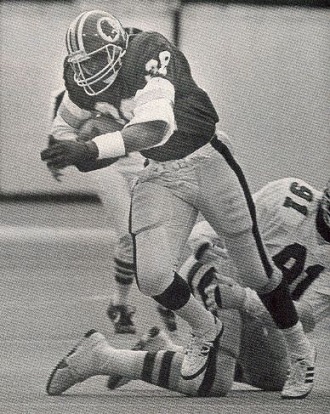
1985: Redskins Obtain George Rogers from Saints


A trade that had been widely rumored was finalized on the afternoon of April 26, 1985 as the Washington Redskins dealt their first pick in the upcoming NFL draft to New Orleans for RB George Rogers plus the Saints’ fifth, tenth, and eleventh-round draft choices.

The 26-year-old, power-running Rogers had won the 1980 Heisman Trophy while at South Carolina. Chosen in the first round of the ’81 NFL draft by the Saints, he had a big rookie season, rushing for a league-leading 1674 yards with 13 touchdowns. The 6’2”, 225-pound Rogers was a consensus first-team All-NFL choice and was named to the Pro Bowl, an honor he received again in the strike-shortened 1982 season when he rushed for 535 yards in six games and the Saints contended for a playoff spot.  

However, there were off-field drug problems and Rogers was further hampered by a knee injury in ’83. He still ran for 1144 yards in 13 games but, in 1984, found competition from newly-acquired RB Earl Campbell, who was obtained from the Houston Oilers and reunited with Bum Phillips, once head coach in Houston and now in New Orleans. Rogers’ rushing total fell to 914 yards and he scored only two touchdowns. After four seasons and 4267 rushing yards, the Saints were willing to swing the trade with Washington (and would find that the once-great Campbell was at the end of his Hall of Fame career).

The Redskins were still a fundamentally sound team under Head Coach Joe Gibbs, having won back-to-back NFC Championships in 1982 and ’83, with the former resulting in a Super Bowl victory, and topped the NFC East with an 11-5 record in 1984 before succumbing to the Bears in the Divisional playoff round.

However, Washington’s once-formidable ground game had become a source of concern due to uncertainty surrounding star RB John Riggins, who rushed for 1239 yards but was 35 years old and hindered by a back injury, and Joe Washington, who was 31 and missed nine games with a knee injury (and was separately traded to Atlanta for draft choices).

Riggins returned to the club for the 1985 season, but it was Rogers carrying most of the rushing load. He accumulated four hundred-yard performances, capping the year with 206 yards on 34 attempts in a win against the Cardinals. Overall, he gained 1093 yards on 231 carries, for a career-best 4.7-yard average, and scored seven touchdowns. Riggins contributed 677 yards and Keith Griffin, handling the third-down role that had been Joe Washington’s specialty, gained 473 rushing yards and caught 37 passes for 285 more (Rogers and Riggins had ten catches between them). The team went 10-6, but while the Cowboys and Giants did likewise, tiebreakers put Washington third in the NFC East and out of the playoffs.

With Riggins retired in 1986, Rogers carried 303 times for 1203 yards (4.0 avg.) and a league-leading 18 touchdowns. The Redskins grabbed a Wild Card slot with their 12-4 record and, in his first opportunity to appear in the postseason, Rogers added another 202 yards on the ground, but while that included 115 yards on 29 carries in a first round win over the Rams, he was held to 15 yards on nine attempts in the NFC Championship loss to the Giants.

Rogers spent an injury-plagued 1987 season running for 613 yards in 11 games and saw limited action in the Super Bowl victory over Denver in which RB Timmy Smith, a little-used reserve during the regular season, gained 204 yards on 22 carries. It was the end of the line for Rogers at age 29. He retired, citing nagging injuries. Overall for his three seasons with the Redskins, he ran the ball 697 times for 2909 yards (4.2 avg.) and scored 31 touchdowns. Rarely used as a pass receiver, he had 11 catches for 76 yards.

As for the rest of the transaction involving Rogers, the 1985 draft choices that Washington received were used to take RB Raphael Cherry from Hawaii in the fifth round, Texas RB Terry Orr in the tenth, and G Raleigh McKenzie of Tennessee in the eleventh. Cherry was converted to strong safety, started five games as a rookie when veteran Tony Peters was injured, and intercepted two passes in his only season with the Redskins. Orr was on injured reserve and thus saw no action in ’85 but, utilized at tight end, spent most of the next eight years with Washington and caught 52 passes. McKenzie didn’t contribute much in his first year but he ended up staying with the Redskins until 1994 and started a total of 113 games at both left and right guard as well as center. He moved on to the Eagles in ’95 and finished his career with Green Bay in 2000.

With the first round pick obtained from Washington, which was 24th overall, the Saints selected Tennessee LB Alvin Toles. He spent four seasons with the club, primarily as a reserve among a strong corps of linebackers, and his career was cut short by a serious knee injury during the 1988 season.

April 12, 2016

Highlighted Year: Tom Dempsey, 1969

Placekicker, New Orleans Saints


Age: 22
3rd season in pro football (2nd active), 1st in NFL & with Saints
College: Palomar Junior College
Height: 6’1”   Weight: 264

Prelude:
Born without a right hand and with no toes on his right (kicking) foot, Dempsey seemed an unlikely football player. Still, he played offensive tackle in high school and defensive end, in addition to placekicking, at California’s Palomar Junior College. Dempsey spent 1967 in the Atlantic Coast Football League with the Lowell Giants where he booted just two field goals but a league-leading 42 extra points and joined San Diego’s taxi squad in ’68, where a special kicking shoe was designed for him that would, in time, generate controversy. While capable of kicking for distance with his size and leg strength, accuracy was a chronic problem.

1969 Season Summary
Appeared in all 14 games
[Bracketed numbers indicate league rank in Top 20]

Kicking
Field goals – 22 [3, tied with Bruce Gossett]
Most field goals, game – 4 at NY Giants 11/16, vs. Philadelphia 11/30
Field goal attempts – 41 [1]
Most field goal attempts, game – 7 vs. Philadelphia 11/30
Field goal percentage – 53.7 [6]
PATs – 33 [7, tied with Pete Gogolak, Bob Etter & Lou Michaels]
PAT attempts – 35 [7]
Longest field goal – 55 yards at LA Rams 10/5

Scoring
Field Goals – 22
PATs – 33
Points – 99 [5]

Awards & Honors:
1st team All-NFL: AP
Pro Bowl

Saints went 5-9 to finish third in the NFL Capitol Division.   

Aftermath:
Dempsey gained notoriety during a 1970 season in which he kicked a 63-yard game-winning field goal against Detroit, which exceeded the previous NFL record by seven yards. He hit on 18 of 34 field goal attempts overall, with three of 50 yards or more but with three misses inside the 30 and just one of five good between 30 and 39 yards. Dempsey lost out to Skip Butler in the 1971 preseason but caught on with the Philadelphia Eagles and, active for the last five games, led the NFL in field goal percentage (70.6) while connecting on 12 of 17 three-pointers, including a then-club record 54-yard kick. He spent three more seasons with the Eagles and had a six-field goal game in ’72. His most productive year in Philadelphia was in 1973 when he made good on 24 of 40 field goal attempts (60.0 %) and 34 extra points with no misses. However, with the goal posts moved to the back of the end zone in 1974 Dempsey attempted just 16 field goals, was successful on 10 of them, and missed four of his 30 extra point attempts. He was traded to the Los Angeles Rams in 1975 and, while his field goal percentage rose to 80.8 as he succeeded on 21 of 26 attempts, he continued to struggle with extra points. Dempsey’s performance slipped in ’76, his last with the Rams, and he spent time with the Houston Oilers and Buffalo Bills before his career ended in 1979. Overall in the NFL, he kicked 159 field goals out of 258 attempts (61.6 %) and added 252 extra points, with 30 misses, for a total of 729 points. With the Saints, he was 40 of 75 on field goals (53.3 %) and 49 of 52 on PATs for 169 points. He received his lone Pro Bowl selection with New Orleans, as well as his greatest fame with the 63-yard field goal that remained the NFL record until 2013.

--

Highlighted Years features players who were consensus first-team All-League* selections or league* or conference** leaders in the following statistical categories:

Rushing: Yards, TDs (min. 10)
Passing: Yards, Completion Pct., Yards per Attempt, TDs, Rating
Receiving: Catches, Yards, TDs (min. 10)
Scoring: TDs, Points, Field Goals (min. 5)
All-Purpose: Total Yards
Defense: Interceptions, Sacks
Kickoff Returns: Average
Punt Returns: Average
Punting: Average

*Leagues include NFL (1920 to date), AFL (1926), AFL (1936-37), AAFC (1946-49), AFL (1960-69), WFL (1974-75), USFL (1983-85)

**NFC/AFC since 1970

January 8, 2016

Highlighted Year: Aaron Brooks, 2002

Quarterback, New Orleans Saints


Age: 26
4th season in pro football, 3rd active & with Saints
College: Virginia
Height: 6’4”   Weight: 205

Prelude:
Brooks passed for 5118 yards and 33 touchdowns in college and was chosen by the Green Bay Packers in the fourth round of the 1999 NFL draft. He made the team but, as a backup to Brett Favre and Matt Hasselbeck, was never activated during the ’99 season. Brooks was traded to New Orleans in 2000 to back up Jeff Blake, but when the veteran went down with a broken foot, he got his opportunity to start and played well, completing 58.2 percent of his passes for 1514 yards and 9 TDs and leading the Saints to a Wild Card playoff win, the franchise’s first ever in the postseason. With his strong passing arm and excellent mobility, he followed up in 2001 by throwing for 3832 yards and 26 touchdowns (although with a completion percentage of just 55.9 and 22 interceptions) and rushing for 358 yards. While consistency was an issue, Brooks was a fine athlete with the ability to make big plays.

2002 Season Summary
Appeared in all 16 games
[Bracketed numbers indicate league rank in Top 20]

Passing
Attempts – 528 [9, tied with Jeff Garcia]
Most attempts, game – 48 at Detroit 9/29
Completions – 283 [15]
Most completions, game – 27 at Detroit 9/29
Yards – 3572 [9]
Most yards, game – 318 vs. Cleveland 11/24
Completion percentage – 53.6
Yards per attempt – 6.8 [19]
TD passes – 27 [2, tied with Peyton Manning & Brett Favre, 1st in NFC]
Most TD passes, game – 3 at Chicago 9/22, at Washington 10/13, vs. San Francisco 10/20
Interceptions – 15 [10, tied with four others]
Most interceptions, game – 3 vs. Cleveland 11/24
Passer rating – 80.1
300-yard passing games – 1
200-yard passing games – 12

Rushing
Attempts – 62
Most attempts, game – 7 (for 28 yds.) at Chicago 9/22
Yards – 253
Most yards, game – 49 yards (on 4 carries) at Detroit 9/29
Yards per attempt – 4.1
TDs – 2

Scoring
TDs – 2
2-pt conversions – 2 [2, tied with four others]
Points – 16

Saints went 9-7 to finish third in the NFC South while leading the conference in touchdowns (49) and scoring (432 points).

Aftermath:
Brooks achieved career highs in 2003 by completing 59.1 percent of his passes with a rating of 88.8, giving up just eight interceptions while throwing for 24 TDs. His performance dropped somewhat in ’04 and after a dismal year both for him and the team in 2005, Brooks moved on to the Oakland Raiders. All eight of his starts were losses as he threw for just three TDs with eight interceptions in his last season. Overall, Brooks passed for 20,261 yards and 123 touchdowns and rushed for 1534 yards with 13 TDs. His 120 TD passes with the Saints made him the franchise’s career leader at the time of his departure (long since passed by Drew Brees) and, while his career was ultimately disappointing, he was elected to the Saints Hall of Fame in 2014. Another NFL quarterback, Michael Vick, is a cousin to Brooks.

--

Highlighted Years features players who were consensus first-team All-League* selections or league* or conference** leaders in the following statistical categories:

Rushing: Yards, TDs (min. 10)
Passing: Yards, Completion Pct., Yards per Attempt, TDs, Rating
Receiving: Catches, Yards, TDs (min. 10)
Scoring: TDs, Points, Field Goals (min. 5)
All-Purpose: Total Yards
Defense: Interceptions, Sacks
Kickoff Returns: Average
Punt Returns: Average
Punting: Average

*Leagues include NFL (1920 to date), AFL (1926), AFL (1936-37), AAFC (1946-49), AFL (1960-69), WFL (1974-75), USFL (1983-85)

**NFC/AFC since 1970

November 24, 2015

1985: Campbell Runs for 160 Yards as Saints Defeat Vikings


RB Earl Campbell (pictured at right) was nearing the end of his Hall of Fame NFL career as the New Orleans Saints played the Minnesota Vikings on November 24, 1985. Once the league’s premier running back with the Houston Oilers, he had been dealt to New Orleans midway through the 1984 season, which reunited him with Head Coach O.A. “Bum” Phillips, who had coached Campbell during his best years with the Oilers. It had not brought a turnaround for the worn-down 30-year-old power runner who had last run for a hundred yards in a game during the ’83 season, which was also the last time he reached a thousand yards and gained Pro Bowl recognition.

The Saints were having plenty of other difficulties. After starting out at 3-2, they were in the midst of a six-game-losing streak that had them at 3-8. Ex-USFL star QB Bobby Hebert started for the first time in the previous week’s loss at Green Bay, replacing the mediocre Dave Wilson. The defense, which had been an asset during most of Phillips’ coaching reign, was performing badly.

Minnesota had a 5-6 record, attempting to bounce back after a disastrous 3-13 campaign with Les Steckel as head coach in ’84. His predecessor, Bud Grant, had come out of retirement to try and right the ship.   

There were 54,117 fans in attendance at the Hubert H. Humphrey Metrodome. The Vikings had the first possession, went three-and-out, and punted. Earl Campbell carried on each of New Orleans’ first four plays, gaining a total of 29 yards. Faking a pitch to Campbell on the fifth play, Bobby Hebert instead handed off to FB Wayne Wilson, who ran 41 yards down the right sideline for a touchdown. Morten Anderson added the extra point.

WR Buster Rhymes returned the ensuing kickoff 38 yards to the Minnesota 42 and the Vikings struck quickly as, two plays later, QB Tommy Kramer threw to RB Arthur Anderson for a 54-yard TD. Jan Stenerud converted to tie the score at 7-7.

The Saints got good starting field position for their next series thanks to a 45-yard kickoff return by CB Willie Tullis to the Minnesota 46. It was Campbell running three times for 25 yards to start it off. Wilson netted a one-yard loss on two carries and, facing third-and-11, Hebert tossed his first pass of the game to WR Eugene Goodlow for a pickup of 17 yards to the five yard line. Two plays later, Campbell ran for a four-yard touchdown and, adding Andersen’s conversion, the visitors were on top by 14-7.

The Vikings responded strongly as Kramer connected with TE Steve Jordan for 18 yards and RB Ted Brown broke loose for a 21-yard run. But another running play lost yardage and Kramer’s next pass was intercepted by LB Glen Redd, who returned it 25 yards to the Minnesota 38. It was Campbell again carrying the load as the Saints reached the nine yard line at the end of the period and, two plays into the second quarter, Andersen booted a 26-yard field goal to extend the lead to 17-7.

A short Minnesota possession resulted in a punt and the Saints advanced 48 yards in seven plays to score again. Campbell continued to run effectively and a pass interference penalty on CB Carl Lee picked up 34 yards. The drive stalled but Andersen kicked another field goal, this time from 47 yards, to make it a 20-7 game with less than eight minutes to go in the first half.

The teams exchanged punts until, just after the two-minute warning, New Orleans TE Hoby Brenner fumbled when hit by CB Willie Teal after catching a pass for 26 yards to midfield, and Teal recovered. Kramer completed three straight passes, the longest to Rhymes for 27 yards to the New Orleans five. The Vikings couldn’t penetrate the end zone, but Stenerud kicked a 22-yard field goal to narrow the margin to 20-10 at halftime.

The Saints had the ball first in the third quarter and advanced 33 yards in eight plays that culminated in a 45-yard Andersen field goal. New Orleans was up by 23-10. The Vikings punted following their possession and it looked promising for the Saints as Campbell ran the ball four times for 25 yards and Hebert completed a pass to Brenner for 14. However, after reaching the Minnesota 30, Lee intercepted an Hebert pass and returned it 33 yards to the New Orleans 39. Kramer completed four consecutive throws, the longest to WR Mike Jones for 17 yards, but after achieving a first-and-goal at the 10, the home team once again couldn’t score a touchdown and settled for a 22-yard Stenerud field goal. The spread was once again ten points as the game headed into the fourth quarter.

Following a punt by the Saints early in the period, the Vikings again drove into New Orleans territory. Facing third-and-ten at the 43, Minnesota got a break when the Saints were called for defensive holding, giving them another first down, and Kramer immediately passed to WR Anthony Carter for a pickup of 19 yards. The drive bogged down at the 20, but Stenerud chipped away further at the New Orleans lead with a 37-yard field goal that made the tally 23-16.

WR Eric Martin returned the kickoff 48 yards and the Saints started their next series off at the Minnesota 49, but Wilson fumbled on a third-down carry and DE Keith Millard recovered for the Vikings at the 38. Kramer had completions to Carter for 25 yards and RB Allen Rice for six as Minnesota advanced to the New Orleans 26, but a long pass by Kramer was picked off by CB Dave Waymer and returned 15 yards to the 18.

The Saints managed to reach their 42 before having to punt. Minnesota was quickly back in business when a first down pass intended for Carter drew a pass interference call on Waymer that picked up 45 yards to the New Orleans 30. This time the Vikings didn’t come up empty as a third-down pass from Kramer to Jones was good for a six-yard touchdown. Stenerud added the extra point to tie the score at 23-23 with 1:47 left in regulation.

The ensuing kickoff went out of bounds and the next, squibbed kick was returned 23 yards by RB Bobby Fowler to the 50. Campbell carried twice for 11 yards before Hebert threw to TE John Tice for a 39-yard TD. Andersen added the point after and New Orleans held on to win by a final score of 30-23.

The Saints had the edge in total yards (371 to 284) and first downs (19 to 17). Of the yardage total for New Orleans, 234 came on the ground. Each team turned the ball over three times.


Earl Campbell rushed for 160 yards on a team-record 35 carries that included one touchdown.  Wayne Wilson (pictured at left) contributed 65 yards and a TD on his 12 attempts. Bobby Hebert completed 10 of 14 passes for 147 yards and a touchdown, his first in the NFL, while being intercepted once. Hoby Brenner topped the Saints with three pass receptions for 51 yards.

For the Vikings, Tommy Kramer was successful on 19 of 45 throws for 240 yards and two TDs with three interceptions. Ted Brown ran for 40 yards on 8 attempts and also topped the club with 8 catches for 54 yards. Alfred Anderson also gained 54 yards on his one long scoring reception. Greg Coleman averaged 51.6 yards on his five punts.

The 160-yard outing against the Vikings was Earl Campbell’s fortieth, and last, career hundred-yard performance. He ended up with 643 yards on 158 carries (4.1 avg.) and his TD at Minnesota was the only one he scored in what was his last season.  

The game against the Vikings was also the last for Coach Phillips, who resigned and was replaced by his son, Wade, the defensive coordinator. The Saints won again the next week but lost their last three contests to end up with a 5-11 record and placed third in the NFC West. Minnesota bounced back to split the remaining four games and finished at 7-9, which ranked third in the NFC Central and was considered a respectable outcome after the debacle of ‘84. Bud Grant retired for good and offensive coordinator Jerry Burns was elevated to head coach.

October 27, 2015

2002: Falcons Prevail Over Saints in Back-and-Forth Game


The Atlanta Falcons, with a 3-3 record, traveled to New Orleans to take on their rivals, the Saints, on October 27, 2002. Coached by Dan Reeves, the Falcons featured flashy second-year QB Michael Vick directing the offense. RB Warrick Dunn (pictured at right), formerly of the Buccaneers, was off to a slow start but WR Brian Finneran was having a breakout year. Moreover, after getting off to a 1-3 start, the team was coming off of two wins, including a 30-0 thrashing of the Panthers the previous week.

The Saints were coached by Jim Haslett and had started off impressively at 6-1. The offense was especially productive with QB Aaron Brooks, who also happened to be Vick’s cousin, behind center. RB Deuce McAllister was an outstanding runner and the receiving corps, led by WR Joe Horn, was a good one.

There were 67,883 fans in attendance at the Louisiana Superdome. Following a punt by the Falcons, the Saints had the ball at the Atlanta 43 to begin their first series and, with Aaron Brooks running for 19 yards and Deuce McAllister picking up another 15 on two carries, they scored first on a 40-yard John Carney field goal.

Once again the Falcons were forced to punt, thanks to back-to-back sacks, and New Orleans advanced 65 yards in nine plays. McAllister started the series off with a 28-yard run to the Atlanta 37 and a roughing-the-passer penalty on a third down play kept the drive alive. McAllister finished it off with a one-yard touchdown carry and Carney added the extra point to extend the home team’s lead to 10-0.

The Falcons were helped along on their next possession by a 32-yard pass interference penalty in a second-and-14 situation and, on the first play of the second quarter, Vick ran for 27 yards to the New Orleans 24 on a second-and-25 play. Three carries by Warrick Dunn picked up 18 yards and, after another defensive penalty, Vick gained the last three yards for a TD. Jay Feely’s point after narrowed the score to 10-7.

The Saints responded with a drive that featured completions by Brooks to Joe Horn for 16 and  25 yards, but McAllister fumbled at the end of a nine-yard run and LB Sam Rogers recovered at the Atlanta 30. Vick completed a pass to TE Alge Crumpler for 33 yards and, following two runs by Dunn that picked up nine yards, converted on third-and-one with a two yard carry. Two plays later, Vick connected with WR Willie Jackson for 18 yards and on the next play Dunn ran for a three-yard touchdown. Feely converted and the visitors were ahead by 14-10.

Atlanta got the ball back when LB Chris Draft intercepted a Brooks pass at midfield and returned it nine yards, but after reaching the New Orleans 17, Dunn fumbled after making a catch and the Saints recovered at their five. The score remained unchanged at halftime.


The Saints had the ball first in the third quarter but a Brooks throw was picked off by FS Keion Carpenter to give the Falcons excellent field position at the New Orleans 31. This time they did not fail to cash in as Vick (pictured at left) threw to Brian Finneran for 28 yards and FB Bob Christian ran for an eight-yard touchdown. Feely’s point after put the visitors ahead by 11 points at 21-10.

WR Michael Lewis returned the ensuing kickoff 41 yards and the Saints moved quickly to score. McAllister ran for six yards after which Brooks threw to Horn for 17 and had another 15 yards tacked on thanks to an unnecessary roughness penalty. Brooks threw to McAllister for a 19-yard TD and then to TE Boo Williams for a two-point conversion and the Atlanta lead was trimmed to 21-18.

CB Allen Rossum gave the Falcons a good kickoff return of 41 yards and Vick threw four straight passes, three of them complete. The third, to Finneran, was good for 14 yards to convert a third-and-seven situation and runs by Dunn and Christian got the ball to the New Orleans 13. Feely kicked a 31-yard field goal and the visitors were up by 24-18.

Lewis responded with a 65-yard kickoff return to the Atlanta 38 and Brooks immediately threw to McAllister for a 16-yard gain. Three more running plays set up a Brooks completion to Horn for a six-yard touchdown and, with Carney adding the extra point, the Saints were on top by 25-24.

The Falcons had the ball as the game headed into the fourth quarter. Dunn had a 56-yard run to the New Orleans 18 and, while the visitors couldn’t reach the end zone, Feely booted a 32-yard field goal to re-take the lead at 27-25.

The Saints punted on their next series and Atlanta used 10 plays to drive 92 yards. Dunn started things off with an 18-yard run and Vick had a 10-yard carry on a third-and-nine play. A roughing-the-passer call moved the Falcons past midfield and Vick completed a pass to Finneran for 10 yards. It was the nimble quarterback running the final 32 yards for a touchdown and, adding Feely’s PAT, Atlanta was now ahead by 34-25 with 5:57 remaining in regulation.

New Orleans fought back with a series that nearly ended with an apparent interception that was overturned on replay review. With that reprieve, Brooks threw to WR Jake Reed for 15 yards and to McAllister for 15, but an offensive pass interference penalty blunted the drive and Carney kicked a 40-yard field goal to at least narrow the score to 34-28 with the clock now down to 3:38.

Disaster struck for the Falcons on their next play from scrimmage when Dunn fumbled when hit by FS Jay Bellamy at the end of an eight-yard run and CB Fred Thomas recovered at the Atlanta 28. Carries by McAllister and Brooks gained six yards apiece and, following an incomplete pass, McAllister ran off tackle for a 16-yard TD. Carney’s extra point again put the home team back on top by 35-34.

There was 2:12 to play as the Falcons started their next series at their own 11 after an offensive holding penalty on the kickoff return moved them back. Vick fired off passes to TE Brian Kozlowski for 11 yards, Dunn for 12, and Crumpler for five yards to reach the 39. Vick took off on an eight-yard run, threw to WR Shawn Jefferson for 14 yards, and ran for six yards to the New Orleans 33. A defensive holding penalty added four more yards but the Falcons could advance no further as a run by Dunn gained nothing and a pass was incomplete. Finally, Feely came on to kick a 47-yard field goal on the game’s last play and Atlanta won in dramatic fashion by a final score of 37-35.

The Falcons had the edge in total yards (446 to 351) and first downs (28 to 22). They gained 260 of their yards on the ground, to 159 for New Orleans. The Saints turned the ball over three times, to two suffered by Atlanta, and both clubs were heavily penalized, with the Falcons getting flagged 10 times at a cost of 95 yards and New Orleans 9 times for 96 yards. The teams combined for just three punts, two by Atlanta.

Michael Vick, who became ill on the climactic drive and had to remove himself from the game, completed 16 of 24 passes for 195 yards and, while there were no touchdowns he also gave up no interceptions. Vick also rushed for 91 yards on 10 carries and scored two TDs. Warrick Dunn gained 142 yards on 23 rushing attempts that included a touchdown and also caught five passes for 28 more yards. Alge Crumpler and Brian Finneran each gained 62 receiving yards on an identical four pass receptions.


For the Saints, Aaron Brooks was successful on 16 of 35 throws for 192 yards and two TDs while giving up two interceptions. Deuce McAllister (pictured above) ran for 115 yards and two touchdowns on 17 carries and had five catches for 56 yards and another TD. Joe Horn also had five receptions, for a team-leading 61 yards and a score. Michael Lewis averaged 33.5 yards on six kickoff returns.

The Falcons followed up on their dramatic win by going 4-0-1 over the next five weeks, which included another victory over New Orleans at home, and while they lost three of their last four games, they finished at 9-6-1 to place second in the NFC South and secure a Wild Card playoff spot. Atlanta stunned the Packers in Green Bay in the first round before falling to the Eagles at the Divisional level. The Saints won the following week but only twice more after that as they faltered down the stretch. They ended up third in the division with a 9-7 record and out of the postseason.      

October 16, 2015

Highlighted Year: Drew Brees, 2006

Quarterback, New Orleans Saints


Age:  27
6th season in pro football, 1st with Saints
College: Purdue
Height: 6’0”   Weight: 209

Prelude:
Chosen by the San Diego Chargers in the second round of the 2001 NFL draft, Brees spent a year as backup to veteran Doug Flutie before taking over as starting quarterback in ’02. A good first year as starter was followed by a season in which he had difficulties, and the Chargers swung the deal that brought rookie Philip Rivers to San Diego in 2004. Brees bounced back that year with a Pro Bowl season in which his passer rating was 104.8, but he badly injured his shoulder in the last game of the ’05 season, the final year of his contract, and with the team committing to Rivers, he signed with the New Orleans Saints.

2006 Season Summary
Appeared in all 16 games
[Bracketed numbers indicate league rank in Top 20]

Passing
Attempts – 554 [5]
Most attempts, game – 52 vs. Cincinnati 11/19
Completions – 356 [4]
Most completions, game – 37 vs. Cincinnati 11/19
Yards – 4418 [1]
Most yards, game – 510 vs. Cincinnati 11/19
Completion percentage – 64.3 [5]
Yards per attempt – 8.0 [4]
TD passes – 26 [3, 1st in NFC]
Most TD passes, game – 5 at Dallas 12/10
Interceptions – 11
Most interceptions, game – 3 vs. Baltimore 10/29, vs. Cincinnati 11/19
Passer rating – 96.2 [3, 1st in NFC]
500-yard passing games – 1
300-yard passing games – 8
200-yard passing games – 10

Rushing
Attempts – 42
Most attempts, game – 6 (for 9 yds.) at Tampa Bay 11/5
Yards – 32
Most yards, game – 14 yards (on 4 carries) at Pittsburgh 11/12, (on 3 carries) vs. San Francisco 12/3
Yards per attempt – 0.8
TDs – 0

Postseason: 2 G
Pass attempts – 81
Most attempts, game – 49 at Chicago, NFC Championship
Pass completions – 47
Most completions, game – 27 at Chicago, NFC Championship
Passing yardage – 597
Most yards, game – 354 at Chicago, NFC Championship
TD passes – 3
Most TD passes, game – 2 at Chicago, NFC Championship
Interceptions – 1

Rushing attempts – 4
Most rushing attempts, game – 3 (for -2 yds.) vs. Philadelphia, NFC Divisional playoff
Rushing yards – 6
Most rushing yards, game – 8 at Chicago, NFC Championship
Average gain rushing – 1.5
Rushing TDs – 0

Awards & Honors:
1st team All-NFL: AP, PFWA, Sporting News
Pro Bowl

Saints went 10-6 to finish first in the NFC South while leading the NFL in total yards (6264) and passing yards (4503). Won NFC Divisional playoff over Philadelphia Eagles (27-24). Lost NFC Championship to Chicago Bears (39-14).

Aftermath:
Brees started poorly and the team didn’t do as well in 2007, but he recovered to lead the league in pass attempts (652) and completions (440) while throwing for another 4423 yards. He had another Pro Bowl year in ’08 in which he led the NFL in passing yards (5069), TD passes (34), pass attempts (635) and completions (413). Brees went to the Pro Bowl for the third straight year, and fifth overall, in 2010 after throwing for 4620 yards and 33 touchdowns and leading the NFL in completion percentage (68.1). However, he also threw a career-high 22 interceptions and, while the team qualified for the postseason as a wild card with an 11-5 record, the Saints were upset in the first round of the playoffs by Seattle. Brees set a new NFL record with 5476 passing yards in 2011 and topped the league in completions (468), completion percentage (71.2), and TD passes (46). He broke the record long held by Johnny Unitas for consecutive games with a touchdown pass in 2012, which finally ended with 54 straight, on his way to recording a third 5000-yard passing season (5177) and again topping the NFL in TD passes (43) although also in interceptions (19) in a difficult year for the club both on and off the field. New Orleans rebounded in 2013 and Brees led the NFC with 5162 passing yards and 39 TD passes. He topped the NFL in passing yards for the fifth time in 2014 (4952) and tossed over 30 TD passes for the seventh consecutive year (33). Overall through 2014, Brees has completed 66.2 percent of his passes for 57,337 yards and 402 touchdowns and has been selected to nine Pro Bowls, including a string of seven straight.   

--

Highlighted Years features players who were consensus first-team All-League* selections or league* or conference** leaders in the following statistical categories:

Rushing: Yards, TDs (min. 10)
Passing: Yards, Completion Pct., Yards per Attempt, TDs, Rating
Receiving: Catches, Yards, TDs (min. 10)
Scoring: TDs, Points, Field Goals (min. 5)
All-Purpose: Total Yards
Defense: Interceptions, Sacks
Kickoff Returns: Average
Punt Returns: Average
Punting: Average

*Leagues include NFL (1920 to date), AFL (1926), AFL (1936-37), AAFC (1946-49), AFL (1960-69), WFL (1974-75), USFL (1983-85)

**NFC/AFC since 1970

July 11, 2015

Highlighted Year: Tom Blanchard, 1974

Punter, New Orleans Saints


Age: 26
4th season in pro football, 1st with Saints
College: Oregon
Height: 6’0”   Weight: 190

Prelude:
A quarterback in college, Blanchard had problems with an injured knee as a senior and split time with sophomore Dan Fouts, who would go on to a Hall of Fame career as a pro. He was chosen by the New York Giants in the 12th round of the 1971 NFL draft and caught on as the punter. In three years with the Giants, Jennings punted 169 times for a 41.6-yard average, with a high of 42.7 in 1972. He was beaten out by Dave Jennings in the 1974 preseason, but when the Saints cut P Donnie Gibbs following the first game, Blanchard took his place.

1974 Season Summary
Appeared in 13 of 14 games
[Bracketed numbers indicate league rank in Top 20]

Punting
Punts – 88 [4]
Most punts, game – 10 at Atlanta 10/20
Yards – 3704 [2]
Average – 42.1 [2, 1st in NFC]
Best average, game – 47.5 (on 6 punts) vs. LA Rams 11/17
Punts blocked – 0
Longest punt – 71 yards

Saints went 5-9 to finish third in the NFC West.

Aftermath:
Blanchard spent another four seasons with the Saints and averaged 41.3 yards on 447 punts. He again led the NFC with a 42.4-yard average in 1977 and proved adept at dropping punts inside the 20. The arrival of kicker Russell Erxleben, a first-round draft choice in 1979, caused the Saints to trade Blanchard to the Tampa Bay Buccaneers, where he remained for the last three years of his career. An injury finished his ’81 season in the third week and he was released afterward. Overall, he averaged 41.3 yards on 819 punts for his career. Blanchard returned to his hometown of Grants Pass, Oregon and coached high school football for 18 years, as well as softball.

--

Highlighted Years features players who were first-team All-League* selections or league* or conference** leaders in the following statistical categories:

Rushing: Yards, TDs (min. 10)
Passing: Yards, Completion Pct., Yards per Attempt, TDs, Rating
Receiving: Catches, Yards, TDs (min. 10)
Scoring: TDs, Points, Field Goals (min. 5)
All-Purpose: Total Yards
Defense: Interceptions, Sacks
Kickoff Returns: Average
Punt Returns: Average
Punting: Average

*Leagues include NFL (1920 to date), AFL (1926), AFL (1936-37), AAFC (1946-49), AFL (1960-69), WFL (1974-75), USFL (1983-85)

**NFC/AFC since 1970