June 9, 2011

1985: Gold Beat Gamblers to Clinch Playoff Spot


The teams that met on June 9, 1985 at Denver’s Mile High Stadium were battling for postseason berths in the United States Football League’s third season. The host Gold had missed out in the USFL’s first two years and came into this contest at 10-5 while the visiting Houston Gamblers, who had joined the league in 1984, were 9-6. Both clubs were in the Western Conference of the restructured league.

The announced move from spring to fall for 1986 had a devastating impact on the Gold, despite the success on the field. After averaging a league-high 41,736 fans per home game in 1983 and 33,953 in ’84, Denver averaged just 14,446 in 1985 and, for the finale at Mile High Stadium with a playoff spot on the line, there was a paltry crowd of 12,553.

Former Gamblers’ offensive coordinator Darrel “Mouse” Davis (pictured above) was now the head coach in Denver, and had brought his exciting run-and-shoot offense with him. Houston, coached by Jack Pardee, also continued to utilize the quick-striking scheme. However, star QB Jim Kelly was injured and backup Todd Dillon started against the Gold.

The Gold opened the scoring in spectacular fashion in the first quarter as QB Bob Gagliano connected on a bomb to WR Leonard Harris that resulted in a 63-yard touchdown. Houston responded with two Toni Fritsch field goals, of 46 yards later in the first quarter and 31 yards less than five minutes into the second quarter, to cut Denver’s lead to 7-6.

The nationally-televised game was delayed in the second quarter for 19 minutes due to lightning and torrential rain. The stadium lights briefly went out and parts of the field were flooded with over an inch of rain while the officials sent the teams back to the locker room until the storm passed.

Play resumed, but Denver’s offense, while moving the ball effectively, squandered four second quarter scoring opportunities and one in the third period as well. Gagliano was intercepted in the end zone three times and PK Jim Asmus missed field goal attempts of 19 and 30 yards. The Gold clung to a one-point lead at halftime.

Asmus was finally successful on a 40-yard field goal attempt midway through the third quarter and also connected from 47 yards early in the final period, putting the Gold ahead by a 13-6 score. However, Houston came back with a five-play, 73-yard drive that culminated in RB Todd Fowler running for a six-yard touchdown with just over eight minutes remaining in regulation. Fritsch was successful on the extra point conversion, and the score was tied at 13-13.

The teams traded punts, and then the Gold, taking over at their own 27 yard line, drove to the Houston one. Along the way, Gagliano completed passes of 27 yards to WR Marc Lewis and 20 yards to WR Lonnie Turner. Asmus booted the game-winning kick from 18 yards with one second left on the clock, atoning for the two earlier misses, and Denver clinched a playoff spot by a score of 16-13.

Considering that both teams had explosive offenses, the game was remarkably low-scoring (the 13 points were the fewest ever scored by the Gamblers). Denver significantly outgained the Gamblers (462 yards to 291) and also led in first downs (20 to 16), but had difficulty putting points on the board. The Gold gained just 47 yards on 21 rushing attempts and the Gamblers sacked Bob Gagliano five times (to three by Denver).

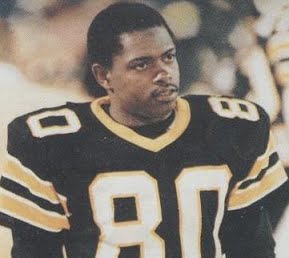
Gagliano nevertheless piled up plenty of passing yards as he set a Denver club record with 445 while completing 24 of 45 throws, including the one long TD but also the three costly interceptions. Marc Lewis caught 9 passes for 130 yards while Leonard Harris (pictured below), with the long scoring reception, had 177 yards on his four catches. RB Bill Johnson led the ground game with 38 yards on 15 carries.


For Houston, QB Todd Dillon was successful on 21 of 36 passes for 233 yards with no touchdowns and one picked off. Wide receivers Ricky Sanders and Scott McGhee and RB Sam Harrell all caught four passes apiece, with Sanders gaining the most yards (56). Harrell and Todd Fowler had identical rushing statistics - 25 yards on six carries.

“I could hear Coach Davis swearing at me as I walked off the field after the first half,” Jim Asmus said afterward. “But then he told me to go out in the second half and kick it through the uprights. I was glad I was able to come back and score points when we need them. I owed it to the guys.”

“Yes, it's true we had a difficult time getting into the end zone,” added Mouse Davis, “and yes, it's true we had a tough time making those field goals. But we won and it gets us in the playoffs.”

In the other locker room, Houston’s Pardee could only shake his head and mutter, “Two run-and-shoot teams in a defensive battle.”

While the loss put Houston’s playoff hopes in jeopardy, in the end both clubs made it to the postseason. Denver was second in the conference at 11-7 but was crushed by the Memphis Showboats in the first round (48-7). The Gamblers, who came in third at 10-8, also lost in the Quarterfinal playoff round, but to the Birmingham Stallions by the much closer score of 22-20.

With fan support dwindling, Denver owner Doug Spedding was considering moving the franchise for the ’86 fall season, but the USFL folded before the shift ever happened. Meanwhile, the Gamblers (who also suffered at the gate as a result of the announced move to the fall) merged with the New Jersey Generals, and while it created what could have been a dominating club, the end of the league rendered such speculation moot.

June 8, 2011

Past Venue: Soldier Field

Chicago, IL
(original structure)


Year opened: 1924
Capacity: 74,000 at opening, could be increased to 100,000 with additional seating. Reduced to 57,000 as result of renovation to accommodate the Bears, but capacity increased to 66,944 by 1994.

Names:
Municipal Grant Park Stadium, 1924-25
Soldier Field, 1925-2002

Pro football tenants:
Chicago Rockets/Hornets (AAFC), 1946-49
Chicago Cardinals (NFL), 1959
Chicago Owls (ContFL), 1968-69
Chicago Bears (NFL), 1971-2001
Chicago Fire/Winds (WFL), 1974-75
Chicago Blitz (USFL), 1983-84
Chicago Enforcers (XFL), 2001

Postseason games hosted:
NFC Divisional playoff, Bears 21 Giants 0, Jan. 5, 1986
NFC Championship, Bears 24 Rams 0, Jan. 12, 1986
NFC Divisional playoff, Redskins 27 Bears 13, Jan. 3, 1987
NFC Divisional playoff, Redskins 21 Bears 17, Jan. 10, 1988
NFC Divisional playoff, Bears 20 Eagles 12, Dec. 31, 1988
NFC Championship, 49ers 28 Bears 3, Jan. 8, 1989
NFC Wild Card playoff, Bears 16 Saints 6, Jan. 6, 1991
NFC Wild Card playoff, Cowboys 17 Bears 13, Dec. 29, 1991
NFC Divisional playoff, Eagles 33 Bears 19, Jan. 19, 2002

Other tenants of note:
Chicago Spurs (NPSL), 1967
Chicago Sting (NASL), 1975-76
Chicago Fire (MLS), 1998-2001

Notes: Hosted annual College All-Star game, 1934-42, 1945-73, 1975-76. In addition to years indicated above, hosted two home games of NFL Chicago Bears in 1926 and one in 1933. In addition to 1959 season, hosted one home game of NFL Chicago Cardinals in 1926 and two in 1927. Name changed on Nov. 11, 1925. First football game at stadium was between Louisville Male High School vs. Austin High School, Oct. 4, 1924. Hosted Army vs. Navy football game, 1926. Used as venue for FIFA World Cup, including the opening ceremony, 1994. Hosted boxing Heavyweight title fight between Jack Dempsey and Gene Tunney, famous as “Long Count” fight, Sept. 22, 1927. Hosted stock car racing between 1935 and ’68. AstroTurf replaced grass field in 1971 but was in turn replaced by grass in 1988.

Fate: Demolished in 2002 and rebuilt into modernized facility bearing same name. Only the distinctive outer colonnade remains from the original structure.


[Updated 2/3/14]

June 7, 2011

MVP Profile: Roger Staubach, 1971

Quarterback, Dallas Cowboys


Age: 29
3rd season in pro football & with Cowboys
College: Navy
Height: 6’3” Weight: 197

Prelude:
After starring at Navy, where he won the Heisman Trophy as a junior in 1963, Staubach didn’t arrive in the NFL until completing his five-year military commitment in 1969. The Cowboys had drafted him in the 10th round of the ’64 draft, as a future consideration (he was also picked by the Kansas City Chiefs in the 16th round of the AFL draft), and Staubach joined them in ’69. After backing up Craig Morton for two years, he alternated with the veteran in ’71 before winning the starting job outright.

1971 Season Summary
Appeared in 13 of 14 games, started 10 of them
[Bracketed numbers indicate league rank in Top 20]

Passing
Attempts – 211 [20]
Most attempts, game – 31 at St. Louis 11/7
Completions – 126 [17]
Most completions, game – 20 at St. Louis 11/7
Yards – 1882 [14]
Most yards, game – 232 at NY Giants 12/12
Completion percentage – 59.7 [3]
Yards per attempt – 8.9 [1]
TD passes – 15 [8, tied with Len Dawson]
Most TD passes, game – 3 vs. NY Jets 12/4, at NY Giants 12/12
Interceptions – 4
Most interceptions, game – 1 on four occasions
Passer rating – 104.8 [1]
200-yard passing games – 1

Rushing
Attempts – 41
Most attempts, game - 7 (for 60 yds.) at St. Louis 11/7
Yards – 343
Most yards, game – 90 yards (on 6 carries) vs. Philadelphia 11/14
Yards per attempt – 8.4
TDs – 2

Scoring
TDs – 2
Points - 12

Postseason: 3 G
Pass attempts – 51
Most attempts, game - 19 vs. Miami, Super Bowl
Pass completions – 31
Most completions, game - 12 vs. Miami, Super Bowl
Passing yardage – 321
Most yards, game - 119 vs. Miami, Super Bowl
TD passes – 3
Most TD passes, game - 2 vs. Miami, Super Bowl
Interceptions – 0

Rushing attempts – 15
Most rushing attempts, game - 8 vs. San Francisco, NFC Championship
Rushing yards – 75
Most rushing yards, game - 55 vs. San Francisco, NFC Championship
Average gain rushing – 5.0
Rushing TDs – 0

Awards & Honors:
NFL Player of the Year: Bert Bell Award
NFC Player of the Year: Sporting News
2nd team All-NFL: PFWA, NEA
1st team All-NFC: AP, Pro Football Weekly, Sporting News
Pro Bowl

Cowboys went 11-3 to win the NFC East and led league in total offense (5035 yards), points scored (406), and touchdowns (50) and NFC in passing yards (2786). Won NFC Divisional playoff over Minnesota Vikings (20-12), NFC Championship over San Francisco 49ers (14-3), and Super Bowl over Miami Dolphins (24-3).

Aftermath:
Injured early in the 1972 season, Staubach saw only limited action, but returned to the starting job in ’73 and led the NFL in passing (94.6 rating) and TD passes (23, tied with Roman Gabriel of the Eagles). From 1975 through the end of his career in ’79, he was named to the Pro Bowl five straight times and led the league in passing in each of his last two seasons (1978 and ’79). The Cowboys went to the Super Bowl three more times with Staubach at quarterback, winning once. He retired as the top-ranked passer in NFL history at the time (83.4 rating). Highly mobile, he also rushed for 2264 yards. Staubach was inducted into the Pro Football Hall of Fame, Class of 1985.

--

MVP Profiles feature players who were named MVP or Player of the Year in the NFL, AAFC (1946-49), AFL (1960-69), WFL (1974), or USFL (1983-85) by a recognized organization (Associated Press, Pro Football Writers Association, Newspaper Enterprise Association, United Press International, The Sporting News, Maxwell Club – Bert Bell Award, or the league itself).

[Updated 2/15/14]

June 5, 2011

Past Venue: Municipal Stadium

Baltimore, MD
aka Babe Ruth Stadium


Year opened: 1922
Capacity: 40,000 at opening, increased to 78,000 within two years, but eventually reduced to 58,917

Names:
Venable Stadium, 1922-24
Municipal Stadium, 1924-49
Babe Ruth Stadium, 1949-50

Pro football tenants:
Baltimore Colts (AAFC), 1947-49

Postseason games hosted:
AAFC Eastern Division playoff, Bills 28 Colts 17, Dec. 12, 1948

Other tenants of note:
Baltimore Orioles (minor league baseball), 1944-49
Baltimore Elite Giants (baseball Negro leagues), 1944-49

Notes: Hosted Army vs. Navy football games, 1924 and 1944. Stadium opened with a football game between teams fielded by the US Army Third Corps and Marines from Quantico, VA on Dec. 3, 1922. Regularly hosted Navy home games against significant opponents. Primarily a football stadium, the minor league baseball Orioles moved in during 1944 season after their home park was destroyed by fire. Briefly renamed for Baltimore native Babe Ruth following the baseball star’s death in 1948.

Fate: Gradually demolished between 1949 and ‘50 and rebuilt into Memorial Stadium.

June 4, 2011

1974: Seattle Awarded NFL Franchise for ’76 Season


On June 4, 1974 the commissioner of the NFL, Pete Rozelle, announced that the owners had awarded a franchise to Seattle for the 1976 season. With the approval of a team for Tampa the previous month, the league would be expanding from 26 to 28 clubs – the first adding of teams since the merger with the American Football League in 1970 (it had been rumored that the league might expand by four clubs, but in the end settled for two).

The only issue of concern had been the rental agreement for use of the new domed stadium being built in Seattle, but Commissioner Rozelle indicated that this had been resolved satisfactorily. The construction of the facility (later known as the Kingdome) had been the key to Seattle’s bid.

Other cities in the running were Phoenix, Memphis, and Honolulu (the latter two fielded World Football League teams that fall). Of the applicants, only Seattle received the recommendation for an immediate franchise by the NFL Expansion Committee. The vote had not been unanimous (acceptance by 20 of the 26 existing franchises was necessary). Both new franchises paid a fee of $16 million to enter the NFL. While Rozelle indicated that Tampa was very interested in moving the timetable up to 1975, it remained at ’76.

Heading the Seattle ownership group was majority owner Lloyd Nordstrom (who died before the team ever took the field), joined by Herman Sarkowsky (principal owner of the NBA’s Portland Trail Blazers), Ned Skinner, Lynn Himmelman, Howard Wright, and M. Lamont Bean. John Thompson, who had been the NFL Management Council’s executive director, was named general manager early in 1975, and Jack Patera, an assistant coach with the Vikings, was hired to be the team’s first head coach. A contest to name the club drew over 20,000 responses and came up with Seahawks for the fledgling franchise.

As was typical with expansion teams, an allocation draft of unprotected NFL veterans was held to stock the Seahawks and Tampa Bay Buccaneers. Seattle selected 39 players in that draft and, in the league draft of college talent, took another 25 rookies headed by first draft choice Steve Niehaus, a defensive tackle from Notre Dame.

As the team arrived at Eastern Washington University for its first training camp, there were plenty of personnel questions, beginning with who would start at quarterback. The two veteran quarterbacks taken in the allocation draft, Neil Graff from New England and Gary Keithley of the Cardinals, were nondescript career backups. A rookie free agent, Jim Zorn out of Cal Poly – Pomona (pictured above), who had failed to make the Cowboys the previous year (he was the final preseason cut after Dallas acquired RB Preston Pearson) won the job and provided plenty of excitement. A mobile lefthander who threw well – if not always accurately – on the run, Zorn set a rookie record with 2571 passing yards, but also led the NFL by tossing 27 interceptions as opposed to 12 TD passes.

During training camp, the Seahawks swung a trade with the Oilers for rookie WR Steve Largent out of Tulsa (pictured below), and it proved to be another fortuitous acquisition. The 5’11”, 184-pound receiver lacked speed, but proved to be sure-handed and able to get open with regularity. He led the club with 54 catches for 705 yards and four touchdowns, and would last 14 years in Seattle on his way to the Pro Football Hall of Fame.


Yet another rookie, RB Sherman Smith, who was drafted by the Seahawks in the second round out of Miami of Ohio, made an impact. At 6’4” and 217 pounds, he had played quarterback in college but was projected to be a pro running back. He became the best of a mediocre crop of runners, topping the team with 537 yards on 119 carries as well as catching 36 passes for another 384 yards.

As for the remainder of the offense, while Smith showed promise, the running game as a whole ranked at the bottom of the NFL (1416 yards). Zorn placed second on the team in rushing with 246 yards, tied with FB Don Testerman, a rookie who had been drafted by the Dolphins but ended up starting eight games with Seattle.

A solid veteran wide receiver (although coming off of a knee injury), Ahmad Rashad, had been signed away from Buffalo, where he had played out his option, but he was in turn dealt to Minnesota just before the start of the regular season. Largent took his spot in the lineup, and across from him was WR Sam McCullum, a third-year player who was picked up in the expansion draft from the Vikings. He caught 32 passes for 506 yards and four TDs. While fifth-year veteran John McMakin was expected to start at tight end, he instead backed up Ron Howard, who hadn’t caught a pass in two seasons with Dallas but contributed 37 receptions for 422 yards with the ’76 Seahawks.

The offensive line was mediocre, containing two NFL veterans, 34-year-old ex-Dolphin OT Norm Evans and C Fred Hoaglin, in his 11th (and last) season. Only left tackle Nick Bebout, a fifth-year ex-Falcon, started every game on the line in 1976.

Defensively, Niehaus had a solid rookie season at the one tackle position. The other tackle, Richard Harris, had been a star rookie with the Eagles in 1971 but had not progressed in the ensuing five years. The ends were Dave Tipton and another 34-year-old veteran, Bob Lurtsema. 33-year-old Mike Curtis, once an outstanding middle linebacker for the Colts, played on the outside while ex-Steeler Ed Bradley started at MLB. Ken Geddes, formerly with the Rams, started nine games at the other outside position.

FS Dave Brown intercepted four passes, as did CB Rolly Woolsey. Another ex-Ram, Eddie McMillan, started at the other cornerback spot and Al Matthews was the strong safety. The unit gave up 27 touchdown passes but was also the most stable part of the defense throughout the season.

As for the specialists, John Leypoldt attempted only 12 field goals, but was successful on 8 of them. Rick Engles averaged a mediocre 38.3 yards on 80 punts.

In the end, the ’76 Seahawks went 2-12 to finish at the bottom of the NFC Western Division (they were shifted to the AFC West in ’77 and remained there until returning to the NFC as part of the 2002 restructuring). Their first win came in the sixth week of the season and was over the other expansion club, the Buccaneers (who ended up going 0-14).

The Seahawks improved rapidly, posting their first winning record in 1978, the franchise’s third year. Progress was not so smooth thereafter, however. They would not reach the postseason until 1983, under a new head coach, Chuck Knox, and with a different starting quarterback, Dave Krieg.

June 3, 2011

MVP Profile: Larry Brown, 1972

Running Back, Washington Redskins


Age: 25 (Sept. 19)
4th season in pro football & with Redskins
College: Kansas State
Height: 5’11” Weight: 195

Prelude:
An 8th round pick by the Redskins in the 1969 NFL draft, Brown led the team in rushing as a rookie (888 yards) and won the league rushing title in ’70 (1125 yards). His production dropped off to 948 yards in 1971 as defenses keyed on him, but he was selected to the Pro Bowl in each of his first three years and was a consensus first-team All-Pro in 1971.

1972 Season Summary
Appeared in 12 of 14 games
[Bracketed numbers indicate league rank in Top 20]

Rushing
Attempts – 285 [3]
Most attempts, game - 30 (for 106 yds.) vs. NY Giants 11/12
Yards – 1216 [2, 1st in NFC]
Most yards, game – 191 yards (on 29 carries) at NY Giants 10/29
Average gain – 4.3 [18]
TDs – 8 [7, tied with four others]
100-yard rushing games - 6

Pass Receiving
Receptions – 32
Most receptions, game – 7 (for 100 yds.) vs. Dallas 10/22
Yards – 473
Most yards, game - 100 (on 7 catches) vs. Dallas 10/22
Average gain – 14.8
TDs – 4

Scoring
TDs – 12 [4, tied with Mercury Morris & Gene Washington]
Points – 72

Led NFL with 1689 yards from scrimmage

Postseason: 3 G
Rushing attempts – 77
Most rushing attempts, game - 30 vs. Dallas, NFC Championship
Rushing yards – 261
Most rushing yards, game - 101 vs. Green Bay, NFC Divisional playoff
Average gain rushing – 3.4
Rushing TDs – 0

Pass receptions – 7
Most pass receptions, game - 5 vs. Miami, Super Bowl
Pass receiving yards - 42
Most pass receiving yards, game - 26 vs. Miami, Super Bowl
Average yards per reception – 6.0
Pass Receiving TDs - 0

Awards & Honors:
NFL MVP: AP, NEA, Bert Bell Award
NFL Offensive Player of the Year: AP
NFC Player of the Year: Sporting News
1st team All-NFL: AP, PFWA, NEA, Pro Football Weekly
1st team All-NFC: AP, UPI, Pro Football Weekly, Sporting News
Pro Bowl

Redskins went 11-3 to finish first in NFC East with best record in conference. Won NFC Divisional playoff over Green Bay Packers (16-3) and NFC Championship over Dallas Cowboys (26-3). Lost Super Bowl to Miami Dolphins (14-7).

Aftermath:
Brown ran for 860 yards and caught 40 passes in 1973, but the workhorse runner began to show signs of wear in ’74 and totaled just 838 over his last three seasons (1974-76). For his career, he ran for 5875 yards (3.8 avg.) and caught 238 passes for 2485 yards (10.4 avg.) while scoring a total of 55 touchdowns.

--

MVP Profiles feature players who were named MVP or Player of the Year in the NFL, AAFC (1946-49), AFL (1960-69), WFL (1974), or USFL (1983-85) by a recognized organization (Associated Press, Pro Football Writers Association, Newspaper Enterprise Association, United Press International, The Sporting News, Maxwell Club – Bert Bell Award, or the league itself).

[Updated 2/15/14]
[Updated 11/28/14]

June 1, 2011

1984: Panthers Rally Behind Backup QB to Beat Gunslingers in Overtime


The Michigan Panthers, defending champions of the United States Football League, looked likely to repeat when they started off at a 6-0 pace in 1984. However, losing star WR Anthony Carter to a season-ending injury sent Head Coach Jim Stanley’s team into a downward spiral. By the time they took on the expansion San Antonio Gunslingers on June 1, they were 7-7 and in danger of falling out of contention.

The Gunslingers, coached by Gil Steinke and one of six new teams in the USFL for ’84, came into the contest with a 5-9 record. The offense had a rookie starting at quarterback, Rick Neuheisel out of UCLA, and had difficulty scoring either through the air or on the ground. The defense, which came to be known as The Bounty Hunters, was better and kept the team competitive.

There were 16,384 fans in attendance at Alamo Stadium for the Friday night game. They witnessed a first half that was almost scoreless. The only points came very late in the opening period as San Antonio’s Nick Mike-Mayer booted a 26-yard field goal to give the Gunslingers a 3-0 lead, capping a 60-yard drive that ended at the Michigan three yard line.

The Panthers’ Novo Bojovic had a chance to tie the game midway threw the second quarter, but he missed a 22-yard field goal attempt, and that was the closest the defending champions came to scoring before halftime. It was the first time during the 1984 season, and the second time ever, that Michigan was shut out in the first half.

San Antonio extended its lead on the club’s first possession of the second half that culminated in Neuheisel passing to WR Jerry Gordon for a 22-yard touchdown. Michigan’s quarterback, Bobby Hebert, left the game due to injury after completing just two of his eight passes for 35 yards, and backup QB Whit Taylor (pictured at top) came into the game. With just under four minutes left in the third quarter, Bojovic was successful with a 28-yard field goal that narrowed San Antonio’s lead to 10-3.

Less than a minute into the fourth quarter, the Panthers tied the game when Taylor threw to TE Mike Cobb for a three-yard touchdown. However, San Antonio went back ahead at 17-10 with 6:28 remaining in regulation as RB George Works dove into the end zone for a TD on a fourth-and-one play.

The Panthers responded with a 14-play, 80-yard drive that resulted in a four-yard scoring pass from Taylor to WR Anthony Allen with 51 seconds left in the fourth quarter, and with Bojovic’s successful PAT, the contest was again tied at 17-17.

The Gunslingers had a chance to win on the last play of the fourth quarter, but Mike-Mayer’s 58-yard field goal attempt hit the crossbar and was no good. The game proceeded into overtime.

With a strong wind blowing, Michigan won the toss and elected to kick off to start the OT period. It didn’t take long for the gamble to pay off. CB Oliver Davis intercepted a Neuheisel pass and returned it for a 27-yard touchdown just 22 seconds into the extra period to win the game for the Panthers by a final score of 23-17.

The Gunslingers outgained Michigan (311 yards to 251) and had a slight edge in first downs (19 to 18), although they also turned the ball over three times, to the Panthers’ one, the last time fatally.

Coming off the bench in the second half, Whit Taylor completed 13 of 23 passes for 139 yards with two touchdowns and none intercepted. Anthony Allen caught 7 passes for 98 yards and a TD. RB Ken Lacy led the running attack with 32 yards on 12 carries, while RB Albert Bentley was right behind at 31 yards on his 10 attempts.


For San Antonio, Rick Neuheisel was successful on 16 of 32 passes for 213 yards that included one TD but also two interceptions. TE Joey Hackett was the top receiver with 4 receptions for 89 yards. RB Mike Hagen rushed for 44 yards on 14 carries.

“We were in double rotation nickel coverage, and I had a short area of responsibility,” said Davis of the play that resulted in the decisive score. “I made a hell of a break for the ball and got to walk it in. My main thing was to make sure I had the ball. I think he (Neuheisel) never really saw me. We disguised the defense to make him think it was a man-to-man.”

“We were in the nickel defense with an extra back,” added Coach Stanley. “This is one of the real good victories for this team. We showed class in the game. I'm proud of this team more than any other.”

The Panthers lost the next week but went on to finish up with two wins in the last four games, just qualifying for the postseason as a wild card with a 10-8 record. They lost to the Los Angeles Express in an epic triple-overtime First Round playoff game. San Antonio ended up at 7-11 and in third place, behind the Panthers, in the Central Division.

The relief performance by Whit Taylor was a highlight of his two seasons with Michigan (ironically, he played for San Antonio in 1985). Overall, he completed 47 of 96 passes for 790 yards with five touchdowns and two interceptions.