January 23, 2014

2000: Third Quarter Surge Propels Titans Past Jaguars for AFC Title


The AFC Championship game on January 23, 2000 featured two teams that had already met twice during the 1999 regular season, the Jacksonville Jaguars and the Tennessee Titans. But while the Titans finished second to the Jaguars in the AFC Central, they swept the season series between the two clubs – the only two defeats Jacksonville sustained all year.

Tennessee had a new nickname (they had been the Tennessee Oilers for two years after moving from Houston) and a new stadium in 1999. Head Coach Jeff Fisher was in his fifth season with the team, and despite the distractions pertaining to the franchise’s relocation, had built a solid team. The conservative offense was directed by highly-mobile QB Steve McNair (pictured above), who missed the early part of the season due to a back injury but stepped up as a game manager and leader. Pro Bowl RB Eddie George ran for 1304 yards and TE Frank Wycheck was a fine clutch receiver. Rookie DE Jevon Kearse set a rookie record for sacks (14.5) and behind a good group of linebackers was a defensive backfield anchored by safeties Marcus Robertson and Blaine Bishop. At 13-3, the Titans sported the best record of any club that had ever finished as a Wild Card in the NFL and while they had narrowly gotten by Buffalo in the Wild Card round (thanks to “The Music City Miracle”) and the Colts at the Divisional level, the defense had stepped up.

Jacksonville, at 14-2, was the top seed in the AFC. Head Coach Tom Coughlin’s team had a fine quarterback in Mark Brunell, a mobile lefthander, and he had outstanding targets in wide receivers Jimmy Smith and Keenan McCardell. Second-year RB Fred Taylor missed time with a nagging hamstring injury, but when healthy he was very productive. DE Tony Brackens anchored the tough defensive line and LB Kevin Hardy topped a good group of linebackers. Veteran FS Carnell Lake brought a savvy veteran presence to the defensive backfield. The Jaguars had hit on all cylinders in defeating Miami by an overwhelming score of 62-7 in the Divisional playoff round.

There were 75,206 fans in attendance at Jacksonville’s Alltel Stadium. Tennessee had the first possession and punted. The Jaguars then scored first thanks to a five-play, 62-yard drive. Along the way, Mark Brunell passed to Jimmy Smith for an 18-yard gain to the Tennessee 44 and Fred Taylor broke away for a 31-yard run. Three plays later, Brunell completed a seven-yard touchdown pass to TE Kyle Brady and, adding the extra point by Mike Hollis, the home team held a 7-0 lead.

The Titans responded by advancing 51 yards in nine plays. A pass interference penalty on Carnell Lake allowed the visitors to convert a third-and-seven play and Steve McNair had a completion to TE Jackie Harris for 10 yards and a carry for eight yards to the Jacksonville 18. Runs by Eddie George and McNair picked up nine yards and the possession ended with McNair throwing to WR Yancey Thigpen for a nine-yard TD. Al Del Greco’s extra point tied the score at 7-7.

Following a punt by the Jaguars, the Titans mounted another drive that reached Jacksonville territory. McNair ran for 19 yards on a third-and-ten play at the end of the opening period and George started off the second quarter with a 20-yard run to the Jacksonville 30. However, the possession stalled there and McNair’s third down pass was intercepted by CB Fernando Bryant to snuff out the threat.

Now it was the turn of the Jaguars to mount a promising drive. On a third-and-nine play, Brunell connected with Smith for 37 yards to the Tennessee 39 and, when Brunell fumbled while being sacked by SS Blaine Bishop, TE Damon Jones recovered and picked up eight yards. Taylor took off on a 19-yard run and, two plays later, caught a pass for nine more yards to the five. But a Brunell pass into the end zone was picked off by FS Marcus Robertson.

The Titans went three-and-out on the ensuing series and the Jaguars moved ahead this time thanks to a four-play series that covered 65 yards. Brunell threw to Smith for an 11-yard gain and, two plays later, a pass interference penalty advanced the ball to the Tennessee 42. Taylor ran for nine yards before RB James Stewart carried for 33 yards and a touchdown. Hollis added the PAT and Jacksonville led by 14-7.

With the clock having ticked down to under three minutes remaining in the half, the Titans again had to punt but got a break when WR Reggie Barlow fumbled Craig Hentrich’s kick and DB Steve Jackson recovered at the Jacksonville 19. Del Greco booted a 34-yard field goal with 20 seconds left before halftime and the score was 14-10 at the intermission.

The Jaguars got the ball first in the third quarter and had to punt. On their second play, the Titans picked up 11 yards on a pass from McNair to WR Isaac Byrd. McNair followed up with a completion to George for 15 yards to midfield and another 15 yards was tacked on when Tony Brackens was flagged for roughing the passer. Two plays later, a pass interference call on Bryant moved the ball all the way to the Jacksonville six. George went five yards up the middle to get to the one, and from there McNair went over for a touchdown. Del Greco added the extra point and the Titans had the lead at 17-14.

It looked good for Tennessee when Brady fumbled after catching a short pass from Brunell on the next series and DT Jason Fisk recovered at the Jacksonville 35. A five-yard run by George was followed by McNair completions to Byrd for eight yards and Harris for 15. The Jaguars stopped George for a two-yard loss on the next play and it seemed as though the home team had dodged a bullet when McNair passed to Frank Wycheck, but the star tight end fumbled when hit by LB Kevin Hardy and Lonnie Marts recovered at the one.

However, on second down Brunell was sacked in the end zone for a safety by DT Josh Evans and Fisk. The free kick was then returned by WR Derrick Mason (pictured below) for an 80-yard touchdown and, with the extra point added on, the Titans suddenly held an expanded lead of 26-14.


The Jaguars responded by advancing to the Tennessee 36, but they failed to convert a fourth-and-two situation and the Titans had the ball heading into the fourth quarter. The teams exchanged punts before McNair, at the end of a nine-yard run, fumbled and Brackens recovered at the Jacksonville 33. The Jaguars backed themselves up with consecutive penalties and then Brunell was sacked by Jevon Kearse. Brunell followed up with two completions to WR Keenan McCardell for 18 and 12 yards, and Taylor ran for seven yards to just short of midfield, but another pass was intercepted by CB Donald Mitchell at the Tennessee 39.

After two runs by George gained nine yards, McNair took off for a 51-yard carry to the Jacksonville one. McNair ran for the final yard to extinguish any lingering hopes for the Jaguars with seven minutes left to play. Jacksonville had the ball two more times, to no effect, and Tennessee won by a final score of 33-14.

The Jaguars had more total yards (355 to 289) and first downs (20 to 18). However, they also turned the ball over six times, to four flags thrown on the Titans, and allowed three sacks that included a safety that was followed up by the kick return touchdown. Jacksonville was also penalized 9 times, at a cost of 100 yards, to five flags thrown on the visitors.

Steve McNair completed 14 of 23 passes for 112 yards with a touchdown and an interception, but was especially effective running the ball as he gained 91 yards on 9 attempts and scored twice. Eddie George rushed for 86 yards on 25 carries and caught three passes for another 19 yards. Jackie Harris also had three catches, for a team-leading 33 yards.


For the Jaguars, Mark Brunell was successful on 19 of 38 throws for 226 yards and a TD, but tossed two interceptions. Fred Taylor (pictured at right) ran for 110 yards on 19 attempts, most of which came in the first half, while Keenan McCardell caught 6 passes for 67 yards and Jimmy Smith gained 92 yards on his five pass receptions – again, getting most of those yards during the first half.

The win was costly as the Titans lost two starters to injuries during the course of the game, with Yancey Thigpen suffering a broken left foot during the first half and Marcus Robertson broke an ankle.

“They said we couldn’t beat Jacksonville three times in a season and the players didn’t blink an eye,” said Jeff Fisher. “Our players believed, believed and believed, and now we’re going to the Super Bowl.”
 
“For whatever reason, we didn’t play as well as we anticipated we would,” said a disappointed Tom Coughlin from the losing side. “The turnovers, the missed opportunities were too much to overcome. It’s a bitter pill to swallow.”

The Titans went on to a closely-fought Super Bowl loss to the St. Louis Rams. They came back to win the AFC Central in 2000, again with a 13-3 record, but fell short in the postseason by losing in the Divisional round. Jacksonville, after having been in the postseason for four straight years, dropped to 7-9 and fourth place in the division.

January 22, 2014

MVP Profile: Chris Johnson, 2009

Running Back, Tennessee Titans


Age: 24 (Sept. 23)
2nd season in pro football & with Titans
College: East Carolina
Height: 5’11” Weight: 200

Prelude:
Taken by the Titans in the first round of the 2008 NFL draft (24th overall), Johnson had an outstanding rookie season. He rushed for 1228 yards on 251 carries (4.9 avg.), caught 43 passes for 260 more yards, and scored a total of 10 touchdowns. His great speed made him especially effective in the open field, and he teamed well with power-running RB LenDale White. It all resulted in his being selected to the Pro Bowl.

2009 Season Summary
Appeared in all 16 games
[Bracketed numbers indicate league rank in Top 20]

Rushing
Attempts – 358 [1]
Most attempts, game - 36 (for 134 yds.) at Seattle 1/3
Yards – 2006 [1]
Most yards, game – 228 yards (on 24 carries) vs. Jacksonville 11/1
Average gain – 5.6 [3]
TDs – 14 [3, tied with Thomas Jones]
200-yard rushing games – 1
100-yard rushing games – 12

Pass Receiving
Receptions – 50      
Most receptions, game – 9 (for 87 yds.) vs. Houston 9/20, (for 100 yds.) vs. Buffalo 11/15
Yards – 503
Most yards, game - 100 (on 9 catches) vs. Buffalo 11/15
Average gain – 10.1
TDs – 2

Passing
Attempts – 1
Completions – 0
Yards – 0
TDs – 0
Interceptions – 0

Total Yards – 2509 [3]

Scoring
TDs – 16 [2, tied with Maurice Jones-Drew, 1st in AFC]
2-point PAT – 1
Points – 98 [18]

Awards & Honors:
NFL Offensive Player of the Year: AP
1st team All-NFL: AP, PFWA, Pro Football Focus, Sporting News
Pro Bowl

Titans went 8-8 to finish third in the AFC South while ranking second in the NFL in rushing (2592 yards).

Aftermath:
While defenses keyed on Johnson, he followed up in 2010 by rushing for 1364 yards and 11 TDs and, with another 245 yards on 44 pass receptions, accumulating 1609 yards from scrimmage. He was a Pro Bowl selection for the third straight year. A lengthy preseason holdout in 2011 led to reduced performance, particularly over the first half of the schedule, although he still rushed for 1047 yards and caught a career-high 57 passes. He bounced back in 2012, running for 1243 yards while averaging 4.5 yards per attempt (his best since 2009) and despite injuries that decimated the offensive line over the course of the season. With 1077 rushing yards and 345 yards on 42 catches in 2013, Johnson’s totals over six seasons are 7965 yards on 1742 rushing attempts (4.6 avg.) and 272 pass receptions for 2003 yards. He has scored a total of 58 touchdowns.

--


MVP Profiles feature players who were named MVP or Player of the Year in the NFL, AAFC (1946-49), AFL (1960-69), WFL (1974), or USFL (1983-85) by a recognized organization (Associated Press, Pro Football Writers Association, Newspaper Enterprise Association, United Press International, The Sporting News, Maxwell Club – Bert Bell Award, or the league itself). Also includes Associated Press NFL Offensive and Defensive Players of the Year.

[Updated 12/2/14]

January 20, 2014

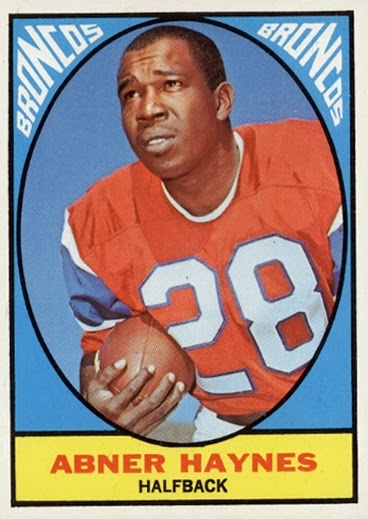
1965: Broncos Obtain Abner Haynes from the Chiefs


On January 20, 1965 the Kansas City Chiefs traded HB Abner Haynes straight-up to the Denver Broncos for LB/P Jim Fraser.

Haynes was considered the American Football League’s first home-grown star. A native Texan, he had played college football at North Texas State, where he was an outstanding performer. The Dallas Texans of the new league won a bidding war with the NFL’s Pittsburgh Steelers and Winnipeg of the CFL to get him for the 1960 season, and were rewarded when Haynes led the AFL in rushing (875 yards), punt returns (15.4 avg.), and all-purpose yards (2100). At 6’0” and 185 pounds, he was fairly small and lacked power, but was fast and shifty with excellent running instincts. He was a fine receiver out of the backfield (55 catches, 576 yards) and kick returner as well as runner from scrimmage. With his tendency to hold the ball away from his body when running, he was also prone to fumbling, but he made up for it with his exciting all-around play and quickly became a favorite of the fans. Haynes was named AFL Player of the Year as well as Rookie of the Year for ’60.

He continued to be an outstanding performer in 1961 and ’62, the latter being his greatest season. He rushed for over a thousand yards (1049) and led the league in yards from scrimmage (1622) and touchdowns (19). The Texans won the AFL Championship in a game that featured Haynes starting off at flanker before moving back to halfback and scoring a touchdown on a pass play. Dallas won in overtime, although Haynes nearly was the goat when, after winning the coin toss for OT, as a captain for the team he mistakenly elected to kick rather than choose an end of the field to defend, as instructed by Coach Hank Stram due to the windy weather conditions. Fortunately, it didn’t cost the Texans the game and Haynes crowned an outstanding three years in Dallas with being member of a Championship team.

The franchise may have achieved the pinnacle of success in Dallas, but had lost money in competition with the NFL’s Cowboys. Owner Lamar Hunt moved it to Kansas City, where the team was rechristened the Chiefs. However, during the preseason, a tragedy occurred which profoundly affected the team, and in particular Haynes. HB Stone Johnson, a sprinter with tremendous speed, was drafted by the Chiefs and suffered a fatal neck injury while attempting a tackle on a preseason kickoff return. Haynes had befriended the younger player and Johnson’s death had a profound effect on him. His style of play was more restrained and, in what became a lesser season for the entire club, Haynes rushed for just 352 yards on 99 carries (3.6 avg.) and his overall total of 1196 yards was well below his prior standards.

Haynes bounced back somewhat from the bad year in 1963 with 697 rushing yards on 139 attempts, 562 more yards on 38 catches, and a total of 1548 all-purpose yards in ’64. He was shifted to split end at the beginning of the year, when veteran Chris Burford was injured, but moved back to halfback with good results.

However, Haynes felt he was not being used properly by the Chiefs and welcomed the trade, saying “I think it will be better for me and for Kansas City.” The Chiefs were looking for depth at linebacker, especially after star MLB E.J. Holub underwent knee surgery. In addition, rookie FB Mack Lee Hill had played well, in addition to HB Bert Coan, which factored in the decision to deal Haynes.


As for the 28-year-old Jim Fraser (pictured at left), he had led the AFL in punting average for two straight years while also starting at outside linebacker. In Kansas City he was strictly a backup at linebacker and unneeded as a punter, with Jerrel Wilson ably handling that department. After one season, he was traded once again, this time to the Patriots.

The Broncos had been a perennially lackluster team and the trade for Haynes, along with a deal that brought in the temperamental but highly talented FB Cookie Gilchrist from Buffalo, was part of an effort to revive the franchise. Haynes was expected to compete with HB Charley Mitchell, who was coming off a good year in ’64, gaining 815 yards from scrimmage (590 rushing, 225 pass receiving). But it was HB Wendell Hayes who had an outstanding rookie year in ’65 and relegated Haynes to a backup role (Mitchell missed virtually the entire season with a thigh injury). Haynes ran the ball just 41 times for 166 yards (4.0 avg.) and caught 26 passes for 216 yards. He had a bigger impact as a kick returner, running back 34 kickoffs for 901 yards and a league-leading 26.5 average and also averaging 8.6 yards on 14 punt returns that included a touchdown.

Haynes moved back into the starting lineup in 1966 when Hayes was shifted to fullback. His rushing numbers were unimpressive as he gained just 304 yards on 129 carries for a 2.4-yard average. However, as a receiver out of the backfield he led the club with 46 pass receptions, gaining 480 yards. He was used less often as a kick returner, but still averaged 11.9 yards on 10 punt returns and had a total of 1132 all-purpose yards. On the downside, he also led the AFL by fumbling 11 times.

With the arrival of HB Floyd Little, the All-American out of Syracuse who was taken by the Broncos in the first round of the ’67 combined AFL/NFL draft, Haynes was dealt to the second-year Miami Dolphins. He had a big day in the season-opening game, which happened to be against Denver, and ran for 151 yards on 12 carries (his only hundred-yard rushing performance after leaving the Chiefs). However, he was used sparingly thereafter and was waived 11 games into the season. The Jets picked him up to shore up an injury-depleted backfield, but he saw little action and, at age 30, retired following the season.

An electrifying performer in his early years, Haynes showed flashes of that form in his two years in Denver. But with a poor team (the Broncos went 4-10 in each season), and no longer able to produce with the same consistency, his time in Denver was largely undistinguished. He left the AFL after having gained a career total of 12,065 all-purpose yards, 2536 of which were generated with the Broncos.

January 19, 2014

Rookie of the Year: Alan Ameche, 1955

Fullback, Baltimore Colts


Age: 22
College: Wisconsin
Height: 6’0”   Weight: 217

Prelude:
“The Horse” rushed for 3212 yards with a 4.8-yard average in college while also playing linebacker on defense in his junior and senior years. He capped his last season by winning the 1954 Heisman Trophy and was taken by the Colts in the first round of the 1955 NFL draft (third overall). Ameche moved directly into the starting lineup and made an immediate impression by running for a 79-yard touchdown on his first regular season carry.

1955 Season Summary
Appeared in all 12 games
[Bracketed numbers indicate league rank in Top 20]

Rushing
Attempts – 213 [1]
Most attempts, game - 22 (for 117 yds.) vs. Green Bay 1029, (for 73 yds.) vs. LA Rams 11/20 
Yards – 961 [1]
Most yards, game – 194 yards (on 21 carries) vs. Chi. Bears 9/25
Average gain – 4.5 [8, tied with Howie Ferguson & Joe Perry]
TDs – 9 [1]

Pass Receiving
Receptions – 27      
Yards – 141
Average gain – 5.2
TDs – 0

Kickoff Returns
Returns – 4
Yards – 60
Average per return – 15.0
TDs – 0

All-Purpose yards – 1162 [3]

Scoring
TDs – 9 [1, tied with Harlon Hill]
Points – 54 [10, tied with Harlon Hill]

Awards & Honors:
NFL Rookie of the Year: UPI, Sporting News
1st team All-NFL: AP, UPI, NY Daily News, Sporting News
2nd team All-NFL: NEA
Pro Bowl

Colts went 5-6-1 to finish fourth in the NFL Western Conference.

Aftermath:
Ameche followed up with 858 rushing yards in 1956, averaging 4.8 yards per carry, and caught 26 passes as he again was chosen for the Pro Bowl. Adding to his effectiveness as a runner between the tackles was the improvement in his blocking, which was a concern during his rookie year. He was a Pro Bowl selection in each of his first four years as well as the key to Baltimore’s ground game as the club steadily improved. Ameche ran for 791 yards in 1958 and scored the winning touchdown in overtime against the Giants to win the NFL title. He began to show wear during the 1960 season, and an Achilles injury ended his career. Overall, he rushed for 4045 yards on 964 carries (4.2 avg.) and caught 101 passes for 733 yards, scoring a total of 44 TDs.

--


Rookie of the Year Profiles feature players who were named Rookie of the Year in the NFL, AFL (1960-69), or USFL (1983-85) by a recognized organization (Associated Press – Offense or Defense, Newspaper Enterprise Association, United Press International, The Sporting News, or the league itself – Pepsi NFL Rookie of the Year). 

[Updated 2/21/17

January 18, 2014

2009: Cards Overcome Rally & Defeat Eagles for NFC Championship


The NFC Championship game on January 18, 2009 featured two teams that had won fewer than ten games during the regular season and were hardly expected to get so far. The Arizona Cardinals, winners of the mediocre NFC West with a 9-7 record, which made them the fourth-seeded team in the conference, hosted the Philadelphia Eagles, who were the sixth-seeded team after finishing second in the NFC East and qualifying as a Wild Card at 9-6-1.

Under Head Coach Ken Whisenhunt, the Cardinals were a pass-oriented team on offense with QB Kurt Warner (pictured above) throwing to wide receivers Larry Fitzgerald, Anquan Boldin, and Steve Breaston, all three of whom reached a thousand receiving yards. RB Edgerrin James, once an outstanding runner with the Colts, was on the downside at age 30. The defense was suspect and ranked 28th in points allowed. The Cards had been long-time underachievers and, after getting off to a 7-3 start, seemed to revert to form as they lost four of their last six games. Some of those defeats had been by lopsided scores, including a 48-20 blowout at the hands of the Eagles when they met on Thanksgiving night in Philadelphia. However, with expectations low as the postseason commenced, Arizona defeated the Falcons in the Wild Card round and then dominated the 12-4 Panthers on the road at the Divisional level to advance to the NFC title game.

The Eagles, under Head Coach Andy Reid, had been inconsistent and were 5-5-1 after being routed by the Ravens before winning four of five to make it into the playoffs. QB Donovan McNabb passed for a career-high 3916 yards, but was benched during the second half of the loss to Baltimore and not as much the running threat he had been in his early years. RB Brian Westbrook was an outstanding all-purpose back and rookie WR DeSean Jackson was developing into a big-play receiver. The heart of the defense was still FS Brian Dawkins, who had been joined in the backfield by Pro Bowl CB Asante Samuel. Philadelphia defeated the Vikings in the Wild Card round and then the top-seeded Giants at the Meadowlands and was back in the conference championship game for the fifth time under Coach Reid.


There were 70,650 fans present at University of Phoenix Stadium in Glendale, AZ. While the weather was pleasant, the stadium’s retractable roof was closed in order to amplify the sound of the partisan crowd. The Cardinals took the opening kickoff and drove 79 yards in nine plays. Kurt Warner completed his first three passes, two of them to Anquan Boldin for a total of 16 yards and one to Larry Fitzgerald (pictured at right) for 19. Edgerrin James then ran three straight times, the last two for 16 and 12 yards to the Philadelphia 12 yard line. A short gain by RB Tim Hightower was followed by a Warner throw to Fitzgerald for a nine-yard touchdown. Neil Rackers added the extra point and Arizona had the early 7-0 lead.

The Eagles came right back with a long drive of their own that covered 33 yards in eight plays. Starting at their own 40 after Rackers kicked off out of bounds, Donovan McNabb scrambled for 21 yards to the Arizona 39. Short passes by McNabb interspersed with carries by Brian Westbrook got the ball to the 22, but with the crowd roaring, a five-yard penalty for a false start backed the Eagles up five yards to force third-and-nine and, after McNabb threw an incomplete pass, David Akers kicked a 45-yard field goal.

The Cards went three-and-out on their next series and the Eagles, following the punt, regained possession at their 33. Facing third-and-10 after two incomplete passes, McNabb’s next throw was intercepted by FS Aaron Francisco, but he fumbled at the end of a 27-yard return and OT Jon Runyan recovered for Philadelphia. Given a reprieve, the Eagles moved into Arizona territory as McNabb threw to WR Hank Baskett for 14 yards, Westbrook had a 14-yard run, and RB Correll Buckhalter carried twice for 12 yards to the Arizona 35. Now into the second quarter, the drive finally stalled at the 29, but this time Akers was wide on a 47-yard field goal try and the visitors came up empty.

On the next play, Warner went long for Fitzgerald on a flea-flicker and it was good for a 62-yard touchdown.  Rackers added the extra point for a 14-3 lead. Philadelphia came back with a seven-play, 65-yard series. A third down sack was negated by defensive holding and McNabb then threw to WR Kevin Curtis for a 47-yard gain to the Arizona 19. Once again, the visitors couldn’t reach the end zone, but this time Akers was successful on a field goal attempt from 33 yards.

The Cardinals started off their next drive with James running for 22 yards up the middle to his own 49. Warner completed passes to RB J.J. Arrington for 16 yards, TE Leonard Pope for 12, and Steve Breaston for 10 yards, with running plays interspersed, to reach the Philadelphia four. Warner connected with Fitzgerald for a third TD, this time from a yard out as the wide receiver outmaneuvered CB Sheldon Brown in the corner of the end zone. Arizona was ahead by 21-6.

The Eagles had to punt following their next series and the Cards again drove to a score, going 80 yards in nine plays. A Warner pass to Boldin that was initially ruled complete for a 32-yard gain was overturned following a challenge, but the Cardinals managed to overcome a third-and-15 situation as Warner threw complete to WR Jerheme Urban for 18 yards to the Arizona 49. A pass to Fitzgerald picked up 14 yards but DE Trent Cole sacked Warner two plays later and the Cards settled for a 49-yard Rackers field goal. Still, they went into halftime with a commanding 24-6 lead.

Philadelphia came out throwing to start the third quarter. McNabb had completions of 20 yards to FB Dan Klecko, 14 yards to WR Jason Avant, and 8 to DeSean Jackson to reach the Arizona 49. But on third down, McNabb fumbled the ball away when sacked and DE Bertrand Berry recovered at the Philadelphia 43. The Cards were unable to move, however, and punted, seemingly pinning the visitors down at their 10 yard line.

The Eagles drove 90 yards in 13 plays, converting three third downs along the way. Short passes interspersed with runs by Westbrook got the ball to the Philadelphia 39, but after SS Adrian Wilson sacked McNabb for an eight-yard loss, the Eagles faced a third-and-18 situation. McNabb went deep for Curtis, who made the catch for a 50-yard gain to the Arizona 19. The possession ended with McNabb connecting with TE Brent Celek for a six-yard touchdown and, with Akers adding the PAT, Arizona’s lead was narrowed to 24-13.

The Cardinals went three-and-out on their next series, and following the punt the Eagles drove to another score. McNabb threw to Curtis for 14 yards and, on a third-and-six play, tossed to Jackson for nine yards to the Arizona 34. McNabb completed another touchdown pass to Celek, this time covering 31 yards, and while Akers missed the extra point, the Eagles were down by just five points heading into the fourth quarter.


Arizona’s seemingly unstoppable offense of the first half was unable to move effectively thus far in the second, and the Cards punted the ball back to the Eagles early in the final period. It took Philadelphia just four plays to score again. Starting at their 14, McNabb threw to Buckhalter for 12 yards and Avant for nine before Westbrook carried for three yards up the middle. McNabb then went long for Jackson, who was covered by CB Dominique Rodgers-Cromartie. The cornerback tipped the ball as he fell down, but Jackson was able to make the catch and proceed to the end zone for a 62-yard TD (pictured above). The Eagles tried for two points, but McNabb’s pass failed. Still, the Eagles were ahead by a score of 25-24 with just under eleven minutes remaining on the clock.

Breaston returned the ensuing kickoff 29 yards to his 28 yard line. Warner threw to Fitzgerald for 15 yards and Pope for nine before James lost a yard on a running play. Hightower gained the yard back, but the Cards now faced fourth-and-one at the Philadelphia 49. They converted when Hightower ran for six yards around right end. After a short carry by James, Warner connected with Fitzgerald for 18 yards to the 23. A three-yard run by James was followed by Fitzgerald catching a pass for six yards and, on third-and-one, Hightower came through again with a five-yard carry. Runs by James and Hightower netted a yard and it was third-and-goal at the eight. With his receivers spread out, Warner threw to Hightower out of the backfield for a touchdown. The Cards went for two and converted as Warner connected with TE Ben Patrick, putting Arizona back in front by seven points.

Taking over at their 20 with 2:53 remaining, the Eagles drove to the Arizona 47 as McNabb completed three straight passes, the longest to Westbrook for 19 yards. But that was as far as they got. The next four passes fell incomplete and the Cardinals took over on downs, effectively ending the game. Arizona was the winner by a final score of 32-25.

The Eagles had the edge in total yards (454 to 369) and first downs (22 to 21). However, Philadelphia also turned the ball over three times, to one suffered by the Cardinals. The Eagles also were penalized seven times, at a cost of 64 yards, to just three flags thrown on Arizona, for 15 yards.

Kurt Warner completed 21 of 28 passes for 279 yards and four touchdowns with no interceptions. Larry Fitzgerald had 9 catches for 152 yards and three TDs. Edgerrin James ran for 73 yards on 16 carries and Tim Hightower (pictured below) contributed 33 yards on 11 attempts as well as the game-winning touchdown on his lone pass reception. Defensively, Adrian Wilson recorded both of Arizona’s sacks.


For the Eagles, Donovan McNabb came on strong in the second half comeback and was successful on 28 of 47 throws for 375 yards and three TDs with one interception. Brent Celek had 10 pass receptions for 83 yards and two touchdowns while Kevin Curtis gained 122 yards on four catches and DeSean Jackson added 6 receptions for 92 yards and a score. Brian Westbrook was the team’s top rusher with 45 yards on 12 carries.

The Cardinals went on to lose to the Pittsburgh Steelers in a close Super Bowl battle. They had a 10-6 record in 2009, again topping the NFC West but losing to the Saints in the Divisional playoff round. Philadelphia also had a better record in ’09, going 11-5 and qualifying as a Wild Card after placing second in the NFC East. The Eagles lost to Dallas in the first round. 

January 16, 2014

MVP Profile: Y.A. Tittle, 1963

Quarterback, New York Giants


Age:  37 (Oct. 24)
16th season in pro football, 14th in NFL and 3rd with Giants
College: LSU
Height: 6’0”   Weight: 195

Prelude:
While drafted by the NFL’s Detroit Lions in 1948, Tittle instead signed with the Baltimore Colts of the AAFC. He had an immediate impact, leading the league in yards per attempt (8.7) and throwing for 16 TDs against 9 interceptions. After another year in the AAFC, Tittle and the Colts joined the NFL in 1950, and he led the league in pass completions (161) although the team went a dismal 1-11 and folded. Picked up by the 49ers in ’51, he gradually took over from Frankie Albert as the starting quarterback and was selected to the Pro Bowl following the 1953, ’54, and ‘57 seasons. In 1957 the 49ers tied for first in the Western Conference and Tittle also received MVP consideration. He suffered through an injury-plagued season in 1958 and, and while he bounced back with a Pro Bowl year in ’59, by ’60 found himself in competition with the up-and-coming John Brodie. With Head Coach Red Hickey committing to a shotgun offense for 1961, Tittle was dealt to the New York Giants in the preseason and revived his career as he threw for 2272 yards and 17 TDs. The Giants topped the Eastern Conference and Tittle was selected for the Pro Bowl and received MVP recognition from the Newspaper Enterprise Association. He followed up with a bigger year in 1962, throwing for 3224 yards and a league-leading 33 touchdowns and receiving consensus first-team All-NFL and Pro Bowl honors, plus being selected league MVP by UPI. The Giants again finished first in the Eastern Conference, although they fell short in the NFL title game.

1963 Season Summary
Appeared in 13 of 14 games
[Bracketed numbers indicate league rank in Top 20]

Passing
Attempts – 367 [3]
Most attempts, game – 38 vs. St. Louis 11/24
Completions – 221 [3]
Most completions, game – 22 vs. St. Louis 11/24
Yards – 3145 [3]
Most yards, game – 324 at Washington 10/6
Completion percentage – 60.2 [1]
Yards per attempt – 8.6 [1]
TD passes – 36 [1]
Most TD passes, game – 4 vs. Dallas 10/20, at St. Louis 11/3, vs. San Francisco 11/17
Interceptions – 14 [7, tied with Earl Morrall]
Most interceptions, game – 4 vs. Washington 12/8
Passer rating – 104.8 [1]
300-yard passing games – 2
200-yard passing games – 10

Rushing
Attempts – 18
Most attempts, game – 5 (for 24 yds.) at Baltimore 9/15
Yards – 99
Most yards, game – 45 (on 4 att.) vs. St. Louis 11/24
Yards per attempt – 5.5
TDs – 2

Scoring
TDs - 2
Points – 12

Postseason: 1 G (NFL Championship at Chicago)
Pass attempts – 29
Pass completions – 11
Passing yards – 147
TD passes – 1
Interceptions – 5

Rushing attempts – 1
Rushing yards – 2
Rushing TDs – 0

Awards & Honors:
NFL MVP: AP, NEA, Sporting News
1st team All-NFL: AP, UPI, NEA, NY Daily News
1st team All-Eastern Conference: Sporting News
Pro Bowl

Giants went 11-3 to finish first in the Eastern Conference while leading the NFL in total yards (5024), scoring (448 points), and touchdowns (57). Lost NFL Championship to Chicago Bears (14-10).

Aftermath:
The team collapsed in 1964, Tittle’s last season, and he threw for just 1798 yards with 10 TDs and 22 interceptions while splitting time with rookie Gary Wood. He retired as NFL career leader in pass attempts (3817), completions (2118), and yards (28,339). The Giants retired his #14, and Tittle was inducted into the Pro Football Hall of Fame, Class of 1971.

--


MVP Profiles feature players who were named MVP or Player of the Year in the NFL, AAFC (1946-49), AFL (1960-69), WFL (1974), or USFL (1983-85) by a recognized organization (Associated Press, Pro Football Writers Association, Newspaper Enterprise Association, United Press International, The Sporting News, Maxwell Club – Bert Bell Award, or the league itself). 

January 15, 2014

1995: 49ers Defeat Cowboys for NFC Championship


Following the 1992 and ’93 NFL seasons, the Dallas Cowboys and San Francisco 49ers had met for the NFC Championship, with Dallas winning both times on the way to victories in the Super Bowl. On January 15, 1995 the two clubs faced off for a third time with the conference title on the line.

The 49ers, coached by George Seifert, had put together a league-best 13-3 record to top the NFC West for the eighth time in nine years. QB Steve Young (pictured at right), mobile and highly accurate with his lefthanded passing, led the league with a 112.8 passer rating plus 35 touchdowns, 8.6 yards per attempt, and a 70.3 completion percentage. Star WR Jerry Rice topped the NFL in receiving yards (1499) on his 112 catches. RB Ricky Watters was productive both running the ball and catching it out of the backfield. The defense benefited from the presence of CB Deion Sanders and had other Pro Bowl talent in DT Dana Stubblefield, FS Merton Hanks, and SS Tim McDonald.

Dallas had a new head coach for 1994 in Barry Switzer, who replaced the departed Jimmy Johnson, architect of the club’s previous success. The core of the offense was back in the persons of QB Troy Aikman, RB Emmitt Smith, and WR Michael Irvin. DE Charles Haley anchored the defensive line while SS Darren Woodson was also an All-Pro in the backfield. The Cowboys were nicked up on the offensive line, however, and while Smith had rushed for 1484 yards and 21 touchdowns, he had been hampered by hamstring problems.

Both clubs had handily won their NFC Divisional playoff games, with the 49ers defeating Chicago by a score of 44-15 and Dallas whipping the Packers 35-9.

There were 69,125 fans in attendance at Candlestick Park. The field was in poor condition after a week of heavy rain in the Bay Area leading up to game day. On the third play from scrimmage, San Francisco CB Eric Davis (pictured below) intercepted a Troy Aikman pass and returned it 44 yards for a touchdown. Doug Brien added the extra point and the 49ers were in front by 7-0 with barely over a minute of time elapsed.


The next Dallas possession again resulted in a turnover, and it was once again Davis making the play as he forced Michael Irvin to fumble after gaining 16 yards on a pass from Aikman. Tim McDonald recovered at the Dallas 39 and, five plays later, Young threw a short pass to Ricky Watters, who went the distance for a 29-yard TD. Brien’s kick put the Niners up by 14-0.

Things continued to go wrong for the Cowboys as, on the ensuing kickoff, WR Kevin Williams was stripped of the ball by RB Adam Walker after a 22-yard return and Brien recovered for the 49ers at the Dallas 35. Runs by Watters and FB William Floyd picked up nine yards and Steve Young gave the home team a first down with a two-yard sneak up the middle. Two plays later, Young threw to WR John Taylor for 14 yards and followed that up with a quarterback draw that gained nine yards to the one yard line. From there, on the seventh play of the series, Floyd bulled over for a touchdown. Brien again added the PAT and, with the opening period not quite halfway over, the 49ers held a 21-0 lead.

Now in a deep hole, the Cowboys put together an eight-play, 62-yard scoring drive. FB Daryl “Moose” Johnston converted a third-and-one with a carry for four yards, Williams gained eight yards on an end-around, and a sack of Aikman was negated by a defensive holding penalty. Finally, facing third-and-23 at the San Francisco 44, Aikman threw deep for Irvin and connected for a touchdown. Chris Boniol added the PAT and the score was 21-7 after a period of play.

The Cowboys had the ball again heading into the second quarter and reached the San Francisco 10, but Boniol was wide on a 27-yard field goal attempt. The 49ers drove 64 yards in 11 plays in response, helped along by a 33-yard pass interference penalty on CB Larry Brown. Watters had an 11-yard run, Young carried for six, and Young converted a fourth-and-three play with a completion to TE Brent Jones for ten yards to the Dallas 17. After the usually-reliable Jerry Rice dropped a pass in the end zone, Brien finished off the series with a 34-yard field goal to extend the home team’s lead.

With just under six minutes remaining in the half, the Cowboys came back with a 63-yard drive in eight plays. Aikman had two completions to TE Jay Novacek, covering 15 and 19 yards, and Emmitt Smith ran for a four-yard touchdown. Boniol’s extra point narrowed the San Francisco lead to ten points.

The teams traded punts until the 49ers, taking advantage of a 23-yard kick by John Jett, took over at the Dallas 39 with thirty seconds left on the clock. Two carries by Floyd picked up 11 yards before Young fired for Rice in the end zone for a 28-yard touchdown. It was a huge boost for the 49ers, and they took a 31-14 lead into halftime.

The Cowboys got a break on the second half kickoff when Adam Walker muffed the kick and CB Dave Thomas recovered for Dallas at the San Francisco 25. Seven plays later, and helped along by a penalty on LB Rickey Jackson for a blow to Aikman’s head on a third down play, Smith ran one yard for a TD and, with Boniol’s conversion, it was a ten-point game once again.

However, the 49ers came right back with a drive of 70 yards in ten plays. Young completed three passes, including one of 17 yards to Taylor to reach the Dallas 38 and another to Jones of 12 yards in a third-and-five situation. Young ran for the final three yards, just reaching the end zone for a touchdown that, adding the extra point, made the score 38-21.

The Cowboys came back throwing, with Aikman hitting Williams for 18 yards and Irvin for 20 before being picked off by Deion Sanders. The 49ers put together a methodical possession that carried into the fourth quarter and ended with a Klaus Wilmsmeyer punt that had the visitors starting at their own 11.

Still, Dallas battled back and drove 89 yards in 14 plays. Smith ran effectively and Aikman completed six passes, the last to Irvin for a 10-yard touchdown. But that was it for the defending champs. Dallas got the ball twice more and turned the ball over on downs both times. At one point Coach Switzer, furious that Sanders was not called for pass interference, bumped an official, which resulted in a 15-yard penalty against the Cowboys which was followed by Aikman being sacked by DE Tim Harris on fourth down. The 49ers won by a final score of 38-28.

Dallas had more total yards (451 to 294) and first downs (29 to 19) as they played catch-up throughout the contest. However, they also turned the ball over five times, three in the first quarter to put themselves in a hole, to one turnover by the 49ers. San Francisco also recorded four sacks and Aikman was knocked down on 14 other plays.

Steve Young completed 13 of 29 passes for 155 yards and two touchdowns, with none intercepted, and also ran the ball 10 times for 47 yards and a TD. Ricky Watters rushed for 72 yards on 14 carries and scored a 29-yard touchdown on his lone pass reception. William Floyd contributed 20 yards on 7 rushing attempts that included a score and had three catches for 16 yards. Brent Jones also had three receptions, for a team-leading 37 yards, while Jerry Rice was right behind with 36 yards on his two catches that included a TD. Defensively, DT Rhett Hall and Tim Harris had two sacks apiece and Eric Davis intercepted two passes, one of which was returned for a touchdown.

For the Cowboys, Troy Aikman went to the air 53 times and had 30 completions for 380 yards and two TDs, but gave up three interceptions. Michael Irvin (pictured below), with 12 catches, tied the record for pass receptions in a NFL/NFC Championship game set by Raymond Berry of the Colts in 1958 and set a new standard with 192 receiving yards while scoring twice. Kevin Williams added 6 pass receptions for 78 yards and Jay Novacek contributed 72 yards on his five catches. Emmitt Smith ran for 74 yards and two TDs on 20 carried before leaving the game with nine minutes remaining due to a pulled hamstring.


“We’re all disappointed,” said Troy Aikman. “We came out thinking we were going to run the ball, but when you get down 21-0, we were forced to put the ball in the air. It’s hard enough to pass block when you’re behind, but it makes it tougher when your players are banged up.”

The 49ers went on to win the Super Bowl with ease over the San Diego Chargers. They again topped the NFC West in 1995 but lost in the Divisional playoff round. Dallas came back strong to post a 12-4 record in winning the NFC East and, this time defeating the Packers for the conference title, returned to the Super Bowl where they defeated the Steelers. While coming up short on achieving three consecutive NFL Championships, the Cowboys still managed to win three in a four-year span.