October 17, 2011

1976: Seahawks Defeat Bucs in Battle of Expansion Teams


The NFL game on October 17, 1976 at Tampa Stadium was derisively referred to as “Expansion Bowl I”. Both the host Buccaneers and visiting Seattle Seahawks were first-year expansion teams and their records were each equally imperfect at 0-5.

Tampa Bay was coached by John McKay, who had been highly successful in the college ranks at Southern California. A veteran quarterback, ex-49er Steve Spurrier, had been obtained but was operating behind a substandard line and supported by a nondescript group of running backs. Brothers Lee Roy and Dewey Selmon, the top two draft choices, would both pay future dividends at defensive end and linebacker, respectively, but were battling injuries as rookies. As a result, the defense was poor, especially against the pass. The Bucs had been shut out three times already, and only reached double figures in points scored in one of the five games (they lost to the Colts by a score of 42-17).

The Seahawks, under Head Coach Jack Patera, were dealing with expansion-team woes but seemed the more promising of the clubs. Three unheralded rookies - QB Jim Zorn, WR Steve Largent, and RB Sherman Smith - had emerged as capable starting players on offense. However, the defense gave up far too many points – in fact, more than Tampa Bay at that point (153 points vs. 120), but two of their losses, to the Cardinals and Packers, had been by seven points or less.

There were 43,812 fans present for the showdown between the NFL’s newcomers. Eleven penalties were called in the first quarter, setting the tone for the game. Dave Green kicked a 38-yard field goal, and the Buccaneers were in front by 3-0 after a period of play.

In the second quarter, the Seahawks drove 86 yards in eight plays in a drive kept alive by a fake punt by Rick Engles, who ran 13 yards for a first down in a fourth-and-four situation at his own 48. The possession culminated in a Zorn pass to WR Sam McCullum for a 15-yard touchdown after an apparent scoring pass to Largent was nullified by a penalty.

Later, it appeared that Seattle had a second touchdown when Smith ran into the end zone from two yards out, but it was called back due to yet another penalty and the Seahawks had to settle for a 25-yard field goal by John Leypoldt. Leypoldt kicked another field goal from 39 yards before the first half was over. Meanwhile, Green’s 35-yard field goal attempt for Tampa Bay was blocked by Seattle safety Lyle Blackwood and the Seahawks took a 13-3 lead into halftime.

Late in the third quarter, the Buccaneers put together a scoring drive after LB Richard Wood recovered a fumble at the Tampa Bay 46. Penalties, plus runs of 12 and 9 yards by HB Essex Johnson, led to a first-and-goal at the Seattle one. After two plunges into the line failed to penetrate into the end zone, HB Lewis Carter took the handoff on third down, was pushed back, and flipped the ball to an unsuspecting WR Morris Owens, who caught it and scored. With the successful extra point, it was a three-point game after three quarters – and would remain so.

In the final minutes, Tampa Bay drove to the Seattle 18 but 33-year-old LB Mike Curtis broke through the line to block a 36-yard field goal attempt by Green with 40 seconds left to preserve the 13-10 win for the Seahawks.

A total of 35 penalties were called (20 on the Bucs, 15 on Seattle), adding up to 310 yards, in the sloppily-played game that took some 3 ½ hours (there were actually four more flags thrown, but two of the penalties were declined and two offset). Even Coach McKay drew a 15-yard unsportsmanlike conduct penalty for comments made to the officials from the sideline (when asked afterward what he said, his only reply was “you can’t print it in a family newspaper.”). It was the most penalties in a NFL game since 1951.

The Buccaneers outgained the Seahawks (285 yards to 253) and had more first downs (18 to 14). But while John Leypoldt missed on one of his three field goal attempts, the two blocked three-point attempts by Dave Green proved to be crucial.

Jim Zorn completed just 11 of 27 passes for 167 yards with a TD and an interception. Sam McCullum was the receiving star as he caught 5 passes for 64 yards and a touchdown while Steve Largent contributed three receptions for 49 yards. Sherman Smith gained 45 yards on 10 carries to pace what there was of a ground game.


For Tampa Bay, Steve Spurrier was successful on 18 of his 30 passes for 170 yards with no scores but also none intercepted. Louis Carter (pictured at left), in addition to his improvised scoring pass, rushed for 66 yards on 15 carries and caught three passes for 28 more. Ex-Bengal Essex Johnson had 12 rushes for 54 yards, caught a pass for nine, and ran a kickoff back for 32 yards. Morris Owens had 5 receptions for 24 yards and a TD while FB Ed Williams was the pass receiving yardage leader with 42 yards on his four catches.

“Nobody touched me,” said Mike Curtis, the ex-Baltimore Colts star, about the fourth quarter blocked field goal attempt. “They broke down on their blocking assignment on the final field-goal attempt. The up-back blocked out, trying to get defensive back Lyle Blackwood, and I got through and hit the ball shoulder high.”

“It was perfect,” said the grim-faced Dave Green of the ill-fated attempt. “It was a fast play. Nobody touched the guy. I can't block them myself.”

Said Jack Patera afterward, “I don't know if he'll win any this year, but I think John McKay is a fine coach. In fact I'd say he's done a heck of a job because I compare his team to ours.”

The normally quote-worthy McKay was unusually low-key after the game, perhaps realizing that his team’s best chance of winning a game in ’76 had passed. The Buccaneers came within three points of upsetting Miami the next week, but that was as close as they came to being victorious in a contest as they finished up at 0-14 and on the bottom of the AFC West (they moved to the NFC Central the following year). They would lose a record 26 straight before winning their last two games of the 1977 season, but would be the first of the two expansion teams to make it to the postseason (in 1979, when Tampa Bay advanced to the NFC Championship game).

Seattle won once more to end its inaugural season with a 2-12 record for last place in the NFC West (like the Buccaneers, the Seahawks were transferred to a different division in ’77, the AFC West, where they remained until returning to the NFC as a result of the 2002 league realignment).

October 16, 2011

1974: Steamer Defeats Bell Before 750 Fans at JFK Stadium


It was a rainy Wednesday night in Philadelphia on October 16, 1974 as the host Bell took on the Shreveport Steamer in a World Football League contest at JFK Stadium. Adding to the gloom was a miniscule estimated turnout of 750 at the 100,000-seat venue, a bitter pill for a team that had drawn big crowds in its first two home games – and created a scandal when it was later revealed that the vast majority of those fans were using free or heavily-discounted tickets.

The Bell, under Head Coach Ron Waller, was a colorful club with an exciting offense led by eccentric QB Jim “King” Corcoran. The passing game was productive, and there were good running backs in John Land and Claude Watts. Still, Philadelphia had a losing 6-9 record coming into the contest with Shreveport.

The Steamer had started the season as the Houston Texans and moved to Shreveport in late September. At the time of the relocation, they sported a 3-7-1 tally and things had not gotten better for the veteran team, which was 1-3 in its new city for a combined record of 4-10-1. There had been plenty of turmoil with the move, as many players were opposed to it and Head Coach Jim Garrett was suspended when he actively urged them to not report to Shreveport. Garrett was replaced by Marshall Taylor, and despite the misgivings, the club received a warm welcome from the fans in the new locale. FB Jim Nance (pictured above), an ex-AFL star with the Patriots, was a standout running the ball. Another former AFL player, LB Garland Boyette, was the leader of the well-seasoned defense. Veteran QB Mike Taliaferro quit the team, and two rookie quarterbacks, D.C. Nobles and Dave Mays, ran the option offense.

Philadelphia fumbled less then four minutes into the game and Nobles started off the scoring with a 27-yard touchdown pass to Eber that was followed by a successful pass for the action point. After Bell DB Ron Mabra intercepted a Nobles pass, Land and Watts proceeded to grind out a drive. Watts scored for Philadelphia, but the action point attempt failed and the Steamer held an 8-7 lead after a period of play (touchdowns counted for seven points in the WFL, followed by an action point that could not be kicked).

In the second quarter, Mays came in at quarterback for Shreveport after Nobles strained his shoulder and connected with TE Willie Frazier for a 29-yard TD. The pass attempt for the action point was unsuccessful and Shreveport took a 15-7 lead into halftime.

The Bell started off the second half scoring when Jerry Warren kicked a 32-yard field goal to cut the margin to 15-10. Nobles came back into the game for Shreveport and the Steamer responded with a drive that concluded with Nance scoring on a two-yard run. Nobles ran for the action point, making the score 23-10.

“King” Corcoran passed to WR Ron Holliday for a nine-yard touchdown, capping an eight-play, 64-yard drive by the Bell, but the action point was again missed and the score stood at 23-17. It didn’t stay that way for long. Safety Richmond Flowers returned the ensuing kickoff 36 yards. On the next play, Nobles threw his second scoring pass to Eber, this time covering 39 yards, extending the Steamer lead to 30-17 as the action point attempt failed.

The Bell scored once more in the fourth quarter when Corcoran threw an eight-yard TD pass to WR Vince Papale, and Land ran for the action point. The Steamer missed a chance to extend the lead when a 20-yard field goal attempt by Charlie Durkee hit the upright and was no good. But Boyette intercepted a Corcoran pass and Shreveport was able to run out the last four minutes to win 30-25.

The statistics were very even, with Shreveport barely outgaining the Bell (323 yards to 321) and having the edge in first downs (17 to 15). Philadelphia had more rushing yards (180 to 164) while the Steamer gained more net passing yards (159 to 141). However, the Bell lost three fumbles, to none given up by Shreveport. Jim Nance ran for 104 yards for the Steamer, and John Land gained 105 yards on 13 attempts for Philadelphia.

The biggest story from the game was the paltry attendance, which was the smallest for any WFL game.

“I don’t know if it was the World Series, the weather or what, but that’s the smallest crowd that I can ever remember playing in front of,” said Land.

“Hell, I wrestled before bigger crowds than that at Indiana (Pa.) High School,” added Jim Nance.

With the win, the Steamer was now 2-2 under Coach Taylor. They went 1-2 the rest of the way and finished at 7-12-1 and tied for third in the Western Division. Philadelphia won by a surprisingly big margin of 45-7 over the Southern California Sun the next week and, with a win by forfeit to conclude the season, ended up with a 9-11 record and a playoff spot. The Bell lost to the Florida Blazers in the first round.

Jim Nance ranked third in the WFL with 1240 yards on 300 carries (4.1 avg.) and eight touchdowns. John Land wasn’t far behind as he carried the ball 243 times for 1136 yards (4.7 avg.) and eight TDs. Land was a far more productive pass receiver out of the backfield than Nance (who caught just 14 passes) with 54 catches for 621 yards and another four touchdowns.

After averaging 60,127 fans in the first two home games (inflated by the free and discounted tickets), the Bell averaged just 9328 in the remaining eight, including the 750 against the Steamer. The team survived to return for the aborted 1975 season, but moved to the less-spacious Franklin Field at the University of Pennsylvania.

October 15, 2011

1948: Colts Score 15 Points in 4th Quarter to Pull Away from Dons


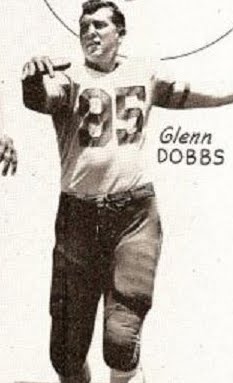
The Los Angeles Dons were two-touchdown favorites coming into their All-America Football Conference game against the Baltimore Colts on October 15, 1948. Jimmy Phelan, who was in his first year as head coach of the Dons, had developed an offensive formation, the Phelan Spread, in an effort to better utilize star passing tailback Glenn Dobbs. Dobbs, the AAFC’s MVP in 1946 with Brooklyn, had come to Los Angeles in a celebrated trade early in the ’47 season and was a disappointment. Further efforts had been made to revamp the team, which was caught in a struggle with the NFL’s Rams for fan support and revenue, and new players included rookies Herm Wedemeyer, a halfback out of St. Mary’s of California, and end Len Ford from Michigan. LA had a 4-2 record coming into the game, having won their previous two contests.

The visiting Colts, coached by Cecil Isbell, had been 2-11-1 in ’47 but were improved, most notably thanks to the performance of rookie QB Y.A. Tittle out of LSU. They routed the New York Yankees, who had dominated the Eastern Division in each of the AAFC’s first two seasons, in the opening game in which Tittle threw four scoring passes and beat them again two games later, but were 3-3 following a 56-14 loss to the 49ers the previous week.

There was a crowd of 40,019 in attendance on a Friday night at the LA Memorial Coliseum. HB Bill Reinhard scored first by intercepting a deflected Tittle pass and running it back for a 10-yard touchdown.

In the second quarter, and with the ball on the one foot line on a drive helped along by a pass interference penalty, Dobbs surprised the Colts by throwing for a touchdown to end Joe Aguirre, who was all alone in the end zone. Down 14-0, Tittle threw a touchdown pass of 40 yards to end Lamar Davis to make the score 14-7 at halftime. LA’s defensive line, featuring Ford and tackle Butch Levy, dominated for much of the first half – but the tables would turn in the second half.

Wedemeyer and FB John Kimbrough both were injured early, hurting LA’s offense, but then the Colts suffered a blow when Tittle was lost to an injury in the third quarter. Charley O’Rourke, formerly a quarterback for the Dons, entered the game for Baltimore.

O’Rourke engineered a drive that led to a 26-yard TD pass to end Windell Williams that tied the game at 14-14 going into the final period. From there, the Colts proceeded to dominate the fourth quarter.

HB Billy Hillenbrand put Baltimore ahead with a one-yard run and Rex Grossman (grandfather of the modern NFL quarterback of the same name) extended the lead to 24-14 with a 23-yard field goal. The defense added a safety when Dobbs was tackled in his end zone. Grossman kicked his second field goal, from 20 yards, and the Colts came away with a convincing 29-14 win.

Baltimore rolled up 438 total yards and 19 first downs, to 235 yards and 9 first downs for the Dons. FB Buzz Mertes, another ex-Don, led a running game for the Colts that accounted for 169 of that yardage total. Tittle and O’Rourke combined for 269 net passing yards.


The Colts defensive line put heavy pressure on Dobbs, already hurting from an injured hip, who was sacked for a total of 91 yards in losses, including the safety. Dobbs completed just 10 of 28 passes for 173 yards.

Baltimore lost its next three games, all on the road, but won three of the last four and, while that meant finishing with a 7-7 record, it was enough to put the Colts in a tie atop the mediocre Eastern Division with the Buffalo Bills; they lost the resulting playoff. The Dons remained an inconsistent team and also ended up at 7-7 which, in the tough Western Division, meant third place.

Y.A. Tittle ended up as the third-ranked passer in the AAFC and was also third with 2522 passing yards. His 16 TD passes tied for fourth with Buffalo’s George Ratterman, and he also ranked fourth in attempts (289) and completions (161). He threw just nine interceptions. It was a promising start to a Hall of Fame career.

Glenn Dobbs led the league in pass attempts (369) and completions (185), was third in touchdown passes (21), and fourth in passing yards (2403). However, his 20 interceptions placed second. The versatile Dobbs also led the team in rushing with 539 yards on 91 carries (5.9 avg.) and was the AAFC’s top punter with a 49.1 average.

Rex Grossman led the league in field goals with 10, out of 18 attempts. Billy Hillenbrand, who put the Colts ahead to stay against the Dons, accumulated 2067 all-purpose yards, including 510 by rushing and an AAFC-leading 970 yards on his 50 pass receptions. LA’s Len Ford was outstanding on both sides of the ball and caught 31 passes for 598 yards (19.3 avg.) and seven touchdowns. While he performed well again on offense in 1949, with the demise of the league he joined the Cleveland Browns in the NFL and was used exclusively on defense in an outstanding career that was honored, like Tittle’s, with enshrinement in the Pro Football Hall of Fame.

October 14, 2011

MVP Profile: Pete Retzlaff, 1965

Tight End, Philadelphia Eagles


Age: 34
10th season in pro football & with Eagles
College: South Dakota State
Height: 6’1” Weight: 214

Prelude:
A star small-college running back, Retzlaff was taken by the Detroit Lions in the 22nd round of the 1953 draft. He never saw regular season action with the Lions, as he served in the military for the next two years and then was cut during the 1956 preseason and signed by the Eagles. Buried on the depth chart at halfback for the next two seasons, he was converted into a receiver at the suggestion of QB Norm Van Brocklin and quickly blossomed, co-leading the NFL (along with Baltimore’s Raymond Berry) with 56 catches in 1958 and being selected to the Pro Bowl. “Pistol Pete” was named to the Pro Bowl following the Eagles’ championship season in 1960 as well. After missing much of 1962 with a broken arm, he was converted to tight end and made the Pro Bowl at that position in 1963 and ’64, catching 57 passes for 895 yards and 51 for 855 yards, respectively, with a total of 12 touchdowns.

1965 Season Summary
Appeared in all 14 games
[Bracketed numbers indicate league rank in Top 20]

Pass Receiving
Receptions – 66 [3]
Most receptions, game – 9 (for 148 yds.) at St. Louis 11/28
Yards – 1190 [2]
Most yards, game - 204 (on 7 catches) vs. Washington 11/14
Average gain – 18.0 [8]
TDs – 10 [3, tied with Jimmy Orr & Gary Collins]
200-yard receiving games - 1
100-yard receiving games - 5

Scoring
TDs – 10 [6, tied with Jimmy Orr & Gary Collins]
Points – 60 [16, tied with Jimmy Orr & Gary Collins]

Awards & Honors:
NFL Player of the Year: Bert Bell Award
1st team All-NFL: AP, NEA, UPI, NY Daily News
1st team All-Eastern Conference: Sporting News
Pro Bowl

Eagles went 5-9 to tie for fifth place with Washington in the NFL Eastern Conference, although they scored more points (363) than they surrendered (359) and ranked second in the league in total yards (5012) and passing offense (3188 yards).

Aftermath:
Retzlaff played one more season, catching 40 passes for 653 yards and six TDs in 1966, before retiring. Overall, he had 452 catches for 7412 yards (16.4 avg.) and 47 touchdowns. His #44 was retired by the Eagles, and he later became the team’s General Manager.

--

MVP Profiles feature players who were named MVP or Player of the Year in the NFL, AAFC (1946-49), AFL (1960-69), WFL (1974), or USFL (1983-85) by a recognized organization (Associated Press, Pro Football Writers Association, Newspaper Enterprise Association, United Press International, The Sporting News, Maxwell Club – Bert Bell Award, or the league itself).

[Updated 2/13/14]

October 13, 2011

1929: Benny Friedman Throws First Two of 20 TD Passes for Season


On October 13, 1929 Benny Friedman, tailback for the New York Giants, threw his first two touchdown passes of the season against the Staten Island Stapletons in a 19-9 win. The Giants’ record improved to 2-0-1 as a result, but it was also the beginning of an extraordinary achievement for the player who was the first great passer in pro football history.

In an era when the football was less sleak than it is today and the rules tended to discourage passing (which most teams did only out of necessity), Friedman was a revolutionary figure. He played college football at Michigan under Head Coach Fielding Yost, who called him “one of the greatest passers [and] smartest quarterbacks in history”. His contemporary, Red Grange, called him the best field general among the opponents he played against at Illinois, and Friedman honed his talent as a passer and was also a good runner.

The 5’10”, 172-pound passing tailback entered the NFL with the Cleveland Bulldogs to great fanfare in 1927 and set a league record with 11 touchdown passes. The Bulldogs folded and Friedman moved on to the Detroit Wolverines, and once again paced the NFL with nine scoring passes (he also tied for the league lead in rushing touchdowns with six). However, the Wolverines weren’t doing well financially despite a 7-2-1 record, and were purchased by owner Tim Mara of the Giants – primarily so he could obtain Friedman for his club (six other Detroit players also started for the 1929 Giants).

The Giants played the Orange Tornadoes to a scoreless tie in their opening game and then defeated the Providence Steam Roller prior to the contest against the Stapletons. It was New York’s first home game and there were some 30,000 fans at the Polo Grounds. In the second quarter, Friedman threw to back Led Sedbrook for a 15-yard touchdown. The second was tossed to wingback Hap Moran and covered 20 yards in the fourth quarter to pace the Giants’ ten-point win.

The next week against the Frankford Yellow Jackets, again at home, Friedman threw three touchdown passes (all in the second quarter) to give him five for the season. It became six two weeks later at Chicago against the Bears. He had eight after seven games with two TD passes in a rout of the Buffalo Bisons.

Following a win in New York’s rematch with the Tornadoes, Friedman had nine scoring passes and the next week at home against the Bears he threw for a season-high four touchdowns in a game. The Giants had remained undefeated through nine contests, but lost to Green Bay in a game that would prove critical to their title hopes. While Friedman threw to FB Tony Plansky for New York’s only points, he was also intercepted twice and the Packers won by a 20-6 score.

The star passer threw two touchdown passes in each of the next two games, a second win over Staten Island and then as part of a 24-21 thriller over the Chicago Cardinals that came down to a drop kick field goal on the last play of the game. His 19th TD pass came in the 14th game, against Frankford, and in the season finale Friedman beat the Bears with his 20th, a 27-yard throw to Sedbrook.

The Giants finished with a 13-1-1 record, which put them second to the one team that defeated them along the way – the 12-0-1 Green Bay Packers. They were easily the highest-scoring team in the NFL with 312 points as the runner-up Packers scored 198. Defensively, New York gave up only 86 points as only three of their opponents reached double figures against them and eight of the games were shutouts.

Friedman’s 20 touchdown passes broke his own record by nine and lasted for 13 years – it was finally broken by Green Bay’s Cecil Isbell, who tossed 24 in 1942 and whose 15 TD passes in ’41 was the closest that anyone came to Friedman’s mark in the intervening seasons. He received consensus first-team All-Pro recognition for the third straight year, and would do so once more the next season, when he led the NFL for the fourth consecutive time with 13 TD tosses.

Friedman initially retired to take an assistant coaching position at Yale in 1931, but returned to the Giants for the second half of the season. He played two more years with Brooklyn (after his wife, not wanting to leave New York, reportedly vetoed a deal that would have sent him to the Bears), plus one last game with the Dodgers in 1934, and finished up with 66 touchdown passes. Not surprisingly, that was the career record and would last until surpassed by Sammy Baugh in 1943.

Statistics from the 1920s and early 30s are too spotty to fully measure Benny Friedman’s performance, but there is no question from the touchdown pass totals alone that he was the most effective passer of his era by far, and likely the most accurate. A student of the game who trained himself to be outstanding at throwing the ball, Friedman went into college coaching and was athletic director at Brandeis University. He also tirelessly (some might say shamelessly) promoted himself for the Pro Football Hall of Fame, an honor that he finally received in 2005 – 23 years after his death in 1982.

Friedman wasn’t particularly well-liked by his peers (he was prone to being arrogant and aloof), but he set the stage for the pass-oriented game that pro football has become and thus is one of the game’s pioneers. The record 20 touchdown passes in 1929 was the crowning achievement of his career.

October 12, 2011

2008: Cardinals Beat Cowboys with Blocked Punt in Overtime


The matchup at University of Phoenix Stadium in Glendale, Arizona on October 12, 2008 featured the host Arizona Cardinals (3-2) against the Dallas Cowboys (4-1), the more highly-regarded team.

Arizona was coming off an encouraging 8-8 season in ‘07 under Head Coach Ken Whisenhunt. Veteran QB Kurt Warner had resurrected his career with the Cardinals and had an outstanding receiving corps to throw to in wide receivers Larry Fitzgerald, Anquan Boldin, and Steve Breaston. The defense, however, was a source of concern, especially after having surrendered 56 points to the New York Jets two weeks before.

Much more was expected of the Cowboys, under Head Coach Wade Phillips. They had won the NFC East with a 13-3 record in 2007, only to be upset at home in the Divisional round by the Giants. The team had stars in QB Tony Romo, RB Marion Barber, WR Terrell Owens, and TE Jason Witten on offense and LB DeMarcus Ware on defense. They won their first three games, lost a close contest to Washington, and bounced back to beat the Bengals the previous week.

The home crowd got an immediate treat when RB J.J. Arrington ran the opening kickoff back 93 yards for a touchdown and quick 7-0 lead for the Cardinals. That was it for the first quarter scoring, but the Cowboys put together a 91-yard drive in the second quarter, highlighted by two Romo passes to WR Patrick Crayton, one for a 24-yard gain and the other for a 55-yard touchdown. The score remained tied at 7-7 at halftime.

Dallas started off the second half with a long drive that covered 77 yards in 12 plays. Romo completed five passes along the way, including three to Owens that covered 27 yards and one to WR Miles Austin for a 14-yard TD. Arizona came right back with an 11-play possession that was kept alive when, on a third-and-seventeen play, a tipped pass by Warner was still caught by RB Tim Hightower, who gained the necessary 17 yards before being pushed out of bounds at the 50. Another third down was converted thanks to a pass to Breaston that gained 22 yards to the Dallas 24. The drive culminated in a two-yard scoring pass from Warner to Fitzgerald, and the game was once again tied at 14-14.

Following a Dallas punt, the Cardinals put together another scoring drive that extended into the fourth quarter. Warner completed a pass to a leaping Fitzgerald for a 39-yard gain to the Cowboys’ 38 along the way, and an 11-yard touchdown throw to Breaston finished off the 89-yard possession and put Arizona back in front at 21-14.

Dallas went three-and-out and punted, and the Cardinals scored again as they drove 43 yards in nine plays, with Neil Rackers giving them a ten-point lead thanks to a 41-yard field goal. The Cowboys got the ball back with 3:12 remaining in regulation but struck quickly when Romo completed two short passes before connecting with Marion Barber for a 70-yard TD.

Arizona had to punt following a short possession and, down by three, the Cowboys took over at their 32 yard line. A holding penalty set them back further, and following two incomplete passes and a short throw for a four-yard gain, Dallas faced a third-and-16 situation. An offside penalty on the defense gained five yards, and Romo then threw to Crayton for a 30-yard gain and a first down. Another offside call, on an injured Arizona linebacker who couldn’t get down the field quickly enough, proved critical as Folk booted a 52-yard field goal that was just long enough to clear the crossbar with no time left to tie the game at 24-24 and send it into overtime.

Dallas got the ball first in the extra period, but after a sack and two incomplete passes, the Cowboys had a fourth-and-17 situation and were forced to punt from their own 15. WR Sean Morey blocked Mat McBriar’s kick (pictured at top) and LB Monty Beisel grabbed the ball for the Cardinals at the three and ran it in for a stunning 30-24 win. It was the first time since the NFL had instituted sudden death play for the regular season in 1974 that a game was decided by a touchdown on a blocked punt.

The Cowboys outgained Arizona (374 yards to 276) and had the edge in first downs (15 to 14). Neither team ran the ball with much effectiveness, with Dallas gaining 73 yards on 22 running plays and the Cardinals just 50 on 19 attempts. Dallas had fewer turnovers, with one to three suffered by the Cardinals. There were plenty of flags flown, as both teams were penalized 12 times, for a total of 163 yards.


Kurt Warner completed 22 of 30 passes for 236 yards with two touchdowns and one interception. Steve Breaston (pictured above) led the receivers with 8 catches for 102 yards and a TD while Larry Fitzgerald contributed 5 receptions for 79 yards and a score. 30-year-old veteran RB Edgerrin James was the top rusher with 29 yards on 9 attempts; Tim Hightower gained 20 yards on 7 carries.

For the Cowboys, Tony Romo went to the air 38 times and had 24 completions for 321 yards with three touchdowns and none picked off. Marion Barber (pictured below) caught 11 passes out of the backfield for 128 yards and the one long TD, and also was the team’s leading rusher with 45 yards on 17 carries. Patrick Crayton gained 84 yards on his three catches that included a touchdown.


“It didn't seem like the bounces or the calls were going our way and sometimes you have to overcome those things,” said Arizona’s Coach Whisenhunt afterward. “I think our team did that. That's part of growing up and getting mentally tougher.”

“Today I got hit blindside for the first time in awhile,” said Tony Romo, who dealt with a great deal of pressure from the Arizona defense. “But they're good. Their D-line played an outstanding football game. You've got to give them credit. That was, I thought, the difference of the game.”

The Cardinals won three of their next four games before losing four of five (and looking especially bad in losses on the East Coast) to finish at 9-7, which was good enough to win the mediocre NFC West. Lightly regarded going into the postseason, they defeated the Falcons, Panthers, and Eagles on the way to winning the NFC Championship and narrowly lost the Super Bowl to the Pittsburgh Steelers. Dallas also ended up with a 9-7 record, but was eliminated from the playoffs in the final week and placed third in the NFC East.

October 11, 2011

1981: LeRoy Irvin’s Punt Returns Help Rams to Win Over Falcons


The Week 6 matchup at Atlanta-Fulton County Stadium on October 11, 1981 featured two NFC West rivals, the host Falcons and the visiting Los Angeles Rams. The Rams, under Head Coach Ray Malavasi, had won their previous three games after losing the first two. Coming off an 11-5 season in ’80, they lost starting QB Vince Ferragamo to Montreal of the CFL and LB Jack “Hacksaw” Reynolds was released following a contract dispute and went to San Francisco. Still, they had veteran QB Pat Haden, who had plenty of experience and savvy, even if not as powerful an arm as the departed Ferragamo, and there was still plenty of experience remaining in the defense.

The Falcons, coached by Leeman Bennett, were coming off a 12-4 division-winning year and had won their first three games in ’81. However, they lost their last two, including a hard-fought 16-13 Monday night decision to the Eagles the previous week. With QB Steve Bartkowski throwing to WR Alfred Jenkins and TE Junior Miller, the passing game was still healthy, and running backs William Andrews and Lynn Cain were talented both at running the ball and catching it out of the backfield. However, the defense was proving to be vulnerable, in particular the inexperienced secondary.

The Rams got on the board first, and in exciting fashion, as second-year CB LeRoy Irvin returned a punt for a 75-yard touchdown at 3:32 into the first quarter. Turnovers by the Falcons allowed LA to extend the lead. First, CB Rod Perry intercepted a Bartkowski pass and the Rams capitalized when Haden threw to WR Preston Dennard for a 29-yard gain and Frank Corral kicked a 25-yard field goal. Shortly thereafter, DT Mike Fanning recovered a fumble that resulted in a 37-yard Corral field goal four plays later. The Rams led by 13-0 after one quarter.

However, following the poor beginning, the Falcons came back with three touchdowns in an eight-minute segment of the second quarter. The first was dramatic as William Andrews took the handoff on a sweep around end on a fourth-and-one play and ran 25 yards for a touchdown to finish off an 80-yard drive.

The second score came following a fumbled snap on a Rams punt that led to an incomplete pass, giving the Falcons good field position at the LA 21. It took just four plays for Atlanta to score again as Bartkowski passed to Miller from 11 yards out. Mick Luckhurst’s extra point put the Falcons in front at 14-13. Atlanta then went 46 yards in seven plays while Bartkowski completed passes covering 16 yards to Andrews, 12 to WR Alfred Jackson, and 23 to Jenkins for a TD.

With the score now at 21-13 in favor of Atlanta, the next possession for LA started off with a 50-yard kickoff return by WR Drew Hill. Haden suffered a leg injury when hit by DE Wilson Faumuina after scrambling and completing a pass to Dennard for a 35-yard gain to the Atlanta 15, and backup QB Jeff Rutledge came into the game and completed the drive with a one-yard scoring pass to TE Henry Childs. Atlanta’s lead was narrowed to 21-20 at halftime.

In the third quarter, Rutledge connected with Hill for a 36-yard TD that put the Rams back in front at 27-21. The 63-yard drive was kept alive when RB Cullen Bryant ran for three yards in a fourth-and-one situation.

Atlanta came back on a possession that started with a 38-yard punt return by DB Scott Woerner. Andrews ran for a 26-yard gain and Bartkowski threw to Jackson for an eight-yard touchdown with 5:37 remaining in the third quarter. With the successful PAT, it was again a one-point game.

The Falcons extended their lead as they drove 65 yards, highlighted by a 19-yard Andrews run to set up his two-yard scoring carry early in the fourth quarter, making the tally 35-27. Irvin struck again with 8:23 to play by taking a punt and racing 84 yards down the right sideline for a touchdown that pulled the Rams to a point behind Atlanta at 35-34.

Getting the ball back, the Rams started their climactic drive at their 20 with 4:35 on the clock. Rutledge completed five passes, including 12 and 6 yards to Childs and 20 and 9 yards to Dennard to move the team down the field. After Bryant ran to the Falcons’ eight yard line and positioned the ball directly in front of the goal post, Corral’s 25-yard field goal with 24 seconds left put the Rams over the top. There was still time for the Falcons to come back, but FS Nolan Cromwell intercepted a Bartkowski pass to nail down the 37-35 win for the Rams.

Atlanta outgained the Rams (349 yards to 252), with 152 of those yards coming on the ground, and also had the edge in first downs (19 to 14). However, the Falcons turned the ball over three times, twice leading to LA field goals in the first quarter and once at the end of the game to finish off their hopes, while the Rams suffered two turnovers.

In relief of Pat Haden, Jeff Rutledge completed 11 of 20 passes for 130 yards with two touchdowns and one intercepted. Preston Dennard caught 4 passes for 84 yards and Henry Childs added 4 receptions for 26 yards and a TD. RB Wendell Tyler led the ground game with 48 yards on 14 carries and Cullen Bryant contributed 31 yards on his 10 attempts.

The return game was significant for the Rams, and while Drew Hill averaged 30 yards per return on his five kickoffs, it was LeRoy Irvin who starred, scoring two touchdowns while also setting a league record with 207 yards on his six punt returns.

For the Falcons, Steve Bartkowski was successful on 17 of his 38 throws for 214 yards that included three touchdowns as well as two interceptions. William Andrews (pictured below) rushed for 119 yards on 21 carries and scored twice and also caught 4 passes for another 35 yards. Alfred Jackson had 4 receptions as well, for 47 yards, while Wallace Francis gained 59 yards on his three catches.


Initially, Pat Haden’s leg was thought to be broken, but it proved to be strained ankle ligaments. Still, many on the LA side were angry about the play that knocked Haden out of the game.

“That play incited our team. It looked like the hit was late and low,” GM Don Klosterman said.

“It was a late hit. The whistle was late all day,” Coach Ray Malavasi added. “It is the officials’ responsibility to keep the game under control and they did a poor job of it.”

Haden suffered from injury problems the rest of the year (his last), as did many of the Rams, and the team’s performance suffered accordingly. While the win moved LA ahead of the Falcons in the NFC West, the Rams lost their next two games and won just twice more to finish a disappointing 6-10 and third in the division – their first losing record since 1972, which was also the last time they missed the playoffs. Just ahead of them was Atlanta at 7-9; the Falcons were in contention with three games left in the season, but lost them all, including one at Los Angeles.

The two touchdown returns against the Falcons gave LeRoy Irvin three on the season. He ended up running back 46 punts for a NFL-leading 615 yards and 13.4 average and was a consensus first-team All-Pro selection. Irvin developed into a star cornerback during his 11-year career, intercepting a total of 35 passes and gaining consensus first-team All-Pro consideration once more at that position as well as earning two Pro Bowl selections.