March 31, 2014

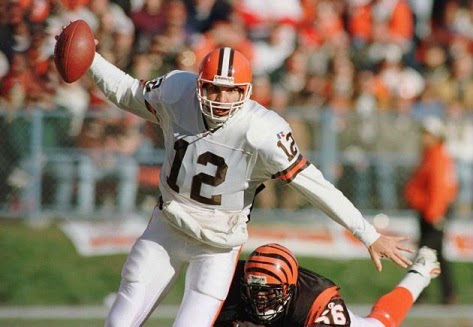
1993: Vinny Testaverde Signs with Browns


On March 31, 1993 free agent QB Vinny Testaverde, previously with the Tampa Bay Buccaneers, signed a one-year contract with the Cleveland Browns. He was to back up Bernie Kosar, a quarterback he had understudied at the University of Miami nearly a decade before. At 29, Testaverde and Kosar were the same age (in fact, their birthdays were just 12 days apart – the studious Kosar graduated from college a year early and Testaverde entered late).

“Cleveland wanted me, Tampa would have settled for me,” said Testaverde in discussing his decision. The Bucs had reportedly offered a deal to Pittsburgh QB Neil O’Donnell prior to Testaverde choosing to go with Cleveland (O’Donnell remained with the Steelers and Tampa Bay ended up going with Craig Erickson, a rookie backup in ’92 who was also a product of Miami).

“Being back on the same team, playing the role I did in college, I feel comfortable with it,” Testaverde added. “We have a good relationship, Bernie and I do, and I think that will make it more fun than it has been for me in the past few years.”

Cleveland Head Coach Bill Belichick welcomed the depth that his new quarterback brought to the position. The Browns ran into trouble in ’92 when Kosar and backup Todd Philcox were both injured. Former Bears QB Mike Tomczak had been signed to fill in, but the team lost six of its last nine games to finish with a 7-9 record.

Testaverde had won the 1986 Heisman Trophy and Tampa Bay made him the first overall pick in the ’87 NFL draft. With his outstanding physical tools, at 6’5” and 235 pounds and including a strong arm, expectations were high for him, but his six seasons were filled with adversity. He took over as the starting quarterback late in the strike-interrupted 1987 season and proceeded to lead the league in interceptions thrown over the course of the next two years, including 35 in 1988, still the second-highest total in NFL/AFL history.

While he could be a precise passer and was fairly mobile, Testaverde also tended to deal poorly with adversity and could make bad plays as a result. He left the Buccaneers as the team’s all-time leader with 14,820 passing yards. However, Tampa Bay went 24-48 with him as the starting quarterback. While mediocre coaching and lack of a strong supporting cast certainly played a role, Testaverde drew criticism regarding his work ethic and toughness under pressure. In many ways, he was the exact opposite of Kosar, who overachieved with less impressive skills and had great intelligence and leadership ability.

As anticipated, Kosar started the ‘93 season but struggled and Testaverde performed ably in relief outings. The Browns had a 5-3 record when Coach Belichick, in a stunning decision, released Kosar – all the more surprising because Testaverde was injured and Philcox had to step into the lineup for four games (three of them losses on the way to another 7-9 record).

When Testaverde returned, he continued to play well and had his best pro season to date, throwing more touchdowns (14) than interceptions (9) for the first time and compiling an 85.7 passer rating. His 91.3 completion percentage on a 21-of-23 performance against the Rams was a NFL record at the time. He was rewarded with a contract extension and the starting job for ’94.

In 1994, the gamble appeared to pay off when the Browns went 11-5 and reached the playoffs. Still, operating behind an offensive line that allowed only 14 sacks, Testaverde reverted to form with a negative TD pass-to-interception ratio of 16 to 18 and was especially unimpressive in fourth quarter pressure situations. But he was a winning quarterback in his first postseason game and drew praise for development as a leader.

Hopes for further improvement in 1995 were dashed when the team fell to 5-11 after getting off to a 3-1 start. The announced move of the franchise to Baltimore for ’96 was a significant distraction, but Testaverde continued to have difficulty with consistency. While he gave up only 10 interceptions, tossing 17 touchdown passes, he was also benched for three games in favor of backup Eric Zeier.

The team, now called the Baltimore Ravens, had a new offensive-minded head coach in Ted Marchibroda for 1996 and Testaverde put up big numbers, including 4177 yards and 33 TD passes, and was named to the Pro Bowl for the first time. But the record was only 4-12 and, after a lesser performance in ’97, Testaverde was let go.

In five seasons with the Browns and Ravens, Testaverde threw for 14,403 yards and 98 touchdowns while giving up 71 interceptions. It was improvement, to be sure, but the inconsistency remained and only once during that period did the team finish with a winning record.

Testaverde went on to have an outstanding year with the New York Jets in 1998, followed by a season in which he went down for the year in the opening week and then a 2000 campaign where he led the NFL in interceptions for the fourth time. His career would ultimately come to an end in 2007 at age 44, and while there were many accomplishments, there was also the up-and-down pattern of performance that caused Testaverde’s failure to achieve the heights that were anticipated when he came into the league in 1987.

March 30, 2014

MVP Profile: Terrell Suggs, 2011

Linebacker, Baltimore Ravens


Age:  29 (Oct. 11)
9th season in pro football & with Ravens
College: Arizona State
Height: 6’3”   Weight: 260

Prelude:
A star defensive end in college, registering 24 sacks in 2002, Suggs entered the NFL draft following his junior year and was chosen by the Ravens in the first round (10th overall) in anticipation of converting him into a pass rushing outside linebacker. He received Rookie of the Year honors in 2003 and had 10 sacks and was selected to the Pro Bowl in 2004, but with a change in the defensive scheme Suggs was shifted to end in ’05. He received Pro Bowl recognition again in 2006 as he garnered 9.5 sacks as a hybrid DE/OLB. Always a fine pass rusher, he showed improvement in coverage and against the run. Following an off-year in 2007 in which he again was returned to outside linebacker, he regained Pro Bowl form in ’08. A knee injury hindered Suggs in 2009 but he came back with an 11-sack Pro Bowl season in 2010.

2011 Season Summary
Appeared in all 16 games
[Bracketed numbers indicate league rank in Top 20]

Sacks – 14 [5, tied with Aldon Smith]
Most sacks, game – 3 vs. Pittsburgh 9/11, vs. San Francisco 11/24, vs. Indianapolis 12/11
Multi-sack games – 3
Interceptions – 2
Most interceptions, game – 1 at Tennessee 9/18, at Pittsburgh 11/6
Int. yards – 9
Most int. yards, game – 9 at Pittsburgh 11/6
Int. TDs – 0
Fumble recoveries – 0
Forced fumbles – 7
Tackles – 52
Assists – 23

Postseason: 2 G
Sacks – 0
Interceptions – 0
TD – 0

Awards & Honors:
NFL Defensive Player of the Year: AP
1st team All-NFL: AP, PFWA, Pro Football Focus, Sporting News
Pro Bowl

Ravens went 12-4 to finish first in the AFC North while leading the conference in sacks (48) and fewest rushing yards allowed (1482). Won AFC Divisional playoff over Houston Texans (20-13). Lost AFC Championship to New England Patriots (23-20).

Aftermath:
An offseason Achilles injury sidelined Suggs for the first six games of the 2012 season, although he returned for the second half of the year and the playoff run to the Super Bowl, if at reduced effectiveness. In 2013, he played in every game and reached double digits in sacks for the fifth time with 10, and was rewarded with a sixth Pro Bowl selection. Through the first 11 years of his career, Suggs accumulated 94.5 sacks and seven interceptions.

--


MVP Profiles feature players who were named MVP or Player of the Year in the NFL, AAFC (1946-49), AFL (1960-69), WFL (1974), or USFL (1983-85) by a recognized organization (Associated Press, Pro Football Writers Association, Newspaper Enterprise Association, United Press International, The Sporting News, Maxwell Club – Bert Bell Award, or the league itself). Also includes Associated Press NFL Offensive and Defensive Players of the Year.

March 28, 2014

Rookie of the Year: Eddie George, 1996

Running Back, Houston Oilers


Age:  23 (Sept. 24)
College: Ohio State
Height: 6’3”   Weight: 232

Prelude:
George won the 1995 Heisman Trophy after a year in which he rushed for 1927 yards, gained 2344 yards from scrimmage overall, and scored 25 touchdowns. He was chosen by the Oilers in the first round of the ’96 NFL draft (14th overall) and moved directly into the starting lineup.

1996 Season Summary
Appeared in all 16 games
[Bracketed numbers indicate league rank in Top 20]

Rushing
Attempts – 335 [4]
Most attempts, game - 28 (for 141 yds.) at NY Jets 12/1
Yards – 1368 [5]
Most yards, game – 152 yards (on 26 carries) at Cincinnati 10/6
Average gain – 4.1 [16]
TDs – 8 [10, tied with four others]
100-yard rushing games – 4

Pass Receiving
Receptions – 23      
Most receptions, game – 3 (for 22 yds.) at Cincinnati 10/6, (for 22 yds.) vs. Pittsburgh 10/20, (for 34 yds.) vs. Miami 11/17, (for 32 yds.) vs. Cincinnati 12/15
Yards – 182
Most yards, game - 34 (on 3 catches) vs. Miami 11/17
Average gain – 7.9
TDs – 0

Scoring
TDs – 8
Points – 48

Awards & Honors:
NFL Rookie of the Year: Sporting News
NFL Offensive Rookie of the Year: AP, PFWA
2nd team All-AFC: UPI

Oilers went 8-8 to finish fourth in the AFC Central.

Aftermath:
With the team shifting to Tennessee in 1997, George rushed for 1399 yards and was selected to the Pro Bowl for the first of four straight seasons. A power runner with outstanding agility and speed enough for breakaway runs, he didn’t catch many passes in his first two years but became more involved as a receiver out of the backfield thereafter. George rushed for 1304 yards and caught 47 passes for 458 more as the team, now called the Titans, won the AFC title in 1999 and was a consensus first-team All-NFL selection in 2000 as he achieved career highs with 1509 yards, on a league-leading 403 carries, and 50 catches. However, after five years of never missing a game, foot surgery cut into his offseason conditioning regimen and he had an off-year in 2001, running for 939 yards while averaging just 3.0 yards per carry. While he came back to run for 1165 yards and score a total of 14 TDs in ’02, he was clearly in decline and, after one more season with the Titans, moved on to the Dallas Cowboys for his last year in 2004. Overall, George rushed for 10,441 yards (10,009 with the Oilers/Titans) on 2865 carries (3.6 avg.) and caught 268 passes for 2227 yards, scoring a total of 78 touchdowns.

--


Rookie of the Year Profiles feature players who were named Rookie of the Year in the NFL, AFL (1960-69), or USFL (1983-85) by a recognized organization (Associated Press – Offense or Defense, Newspaper Enterprise Association, United Press International, The Sporting News, or the league itself – Pepsi NFL Rookie of the Year). 

March 27, 2014

1983: Federals Defeat Panthers for First Win


The Washington Federals had endured tough going in the first three weeks of the inaugural United States Football League season, losing all three of their games, including the most recent thanks to a late field goal. On March 27, 1983 they hosted the Michigan Panthers, who came into the contest at 1-2.

The Federals, coached by Ray Jauch, had a good rookie running back in Craig James, but he was already sidelined with an injury. WR Joey Walters was a dependable receiver, but quarterback was unsettled with another promising first-year play, Mike Hohensee, injured and veteran NFL backup Kim McQuilken taking his place.

Michigan had a big-name rookie of its own, WR Anthony Carter, who was off to a slow start and a less-heralded first-year quarterback in Bobby Hebert. LB John Corker already had five sacks, but Head Coach Jim Stanley’s team was still coming together and, following a low-scoring opening win, was struggling.

There was an extremely disappointing crowd of 11,414 fans in attendance on a rainy day at RFK Stadium. The Federals got on the board first, just three minutes into the contest, with a 32-yard field goal by Obed Ariri.

That was it until midway through the second quarter when Washington extended its lead on a pass from Kim McQuilken to WR Mike Holmes that was good for a 40-yard touchdown. The Panthers responded by driving 81 yards in 12 plays, culminating in a TD pass from Bobby Hebert to Anthony Carter that covered 33 yards. It was Carter’s first pro touchdown and, with Novo Bojovic adding the extra point, Washington’s lead was narrowed to 10-7.

In the waning seconds of the first half, the Federals scored another touchdown on an eight-yard McQuilken toss to Joey Walters. Ariri missed the extra point, but the home team took a 16-7 lead into halftime.

Late in the third quarter, the Panthers came through with a big play to once again cut into Washington’s lead. Hebert connected with WR Derek Holloway for a 69-yard TD, although Bojovic also failed to convert the extra point. Still, it was a three-point contest heading into the fourth quarter. It was almost enough for the Federals, but Bojovic tied the game with a 43-yard field goal as time expired in regulation.

The Federals had the first possession in overtime and drove 72 yards in six plays, the last of which was a pass from McQuilken to Walters, who outdistanced the coverage on a down-and-in pattern for a game-winning 23-yard touchdown at 2:43 into the extra period. Washington finally broke into the win column by a final score of 22-16.

The Panthers had the edge in total yards (326 to 314) and each team recorded 20 first downs. Most of the yards came through the air as neither club mounted much of a ground attack (the Federals had the edge at 48 yards to 42). Michigan recorded six sacks (five of them by John Corker, on his way to leading the USFL in that category) but also turned the ball over seven times (six on fumbles) to just one turnover suffered by Washington.

Kim McQuilken had a big day as he completed 24 of 48 passes for 324 yards and three touchdowns with one interception. Mike Holmes caught 6 passes for 124 yards and a TD while Joey Walters also contributed 6 receptions, gaining 99 yards and scoring twice. RB James Mayberry was Washington’s leading ground gainer with 25 yards on 10 carries while RB Eric Robinson was held to just 22 yards on 17 attempts, although he caught 5 passes for 37 yards.

For the Panthers, Bobby Hebert was successful on 22 of 44 throws for 292 yards and two TDs, tossing one interception. WR Frank McClain led the receivers with 6 catches for 76 yards and Anthony Carter added three receptions and 51 yards, including a touchdown. RB Ken Lacy ran for 35 yards on 7 attempts.

The win for the Federals did not signal a turnaround. They were thrashed by the powerful Philadelphia Stars the next week and went on to finish at the bottom of the Atlantic Division with a 4-14 record. Michigan’s fortunes did improve dramatically, however. The Panthers lost again to drop into a 1-4 hole before reeling off six straight wins on the way to a 12-6 tally, best in the Central Division. They went on to win the first USFL Championship.

Kim McQuilken saw most of the action at quarterback for the Federals, throwing for 1912 yards with seven touchdowns against 14 interceptions in what would be his last pro season. Joey Walters remained productive as he caught 63 passes for 959 yards (15.2 avg.) and six TDs. 

March 25, 2014

1984: Gold Defeat Showboats in Back-and-Forth Contest


The Denver Gold had a 3-1 record heading into Memphis to face the Showboats in a United States Football League game on March 25, 1984. Coached by Craig Morton, the Gold had a strong fan base that was being rewarded with improved offensive play. QB Craig Penrose, a former teammate of Morton’s with the NFL Broncos, was behind center and had promising rookie WR Leonard Harris, who also returned kicks, as a target while productive RB Harry Sydney was the best of the backs.

The first-year Showboats, coached by the colorful Pepper Rodgers, were struggling at 1-3. Rookie QB Walter Lewis was more noted for his running than passing, but the defense was anchored by DE Reggie White, a first-year player out of Tennessee who was showing off the abilities that would make him an all-time great.

There was a crowd of 21,213 in attendance at the Liberty Bowl. The Gold jumped out to a 14-0 lead thanks to two Memphis turnovers. The first was a fumble, which led to a nine-yard touchdown carry by RB Vincent White, and then a pass interception that set up a Craig Penrose TD pass to TE Bob Niziolek that covered 36 yards. Brian Speelman added the extra point after each. Early in the second quarter, Alan Duncan kicked a 48-yard field goal to finally get the Showboats on the board and the score remained 14-3 at the half.

Memphis narrowed the margin in the third quarter, this time benefiting from a Denver turnover as SS Terry Love intercepted a Penrose pass and returned it 79 yards for a TD. Just before the end of the period, the Showboats took the lead when Walter Lewis scored on a one-yard touchdown carry. Duncan successfully converted after each score and the tally was 17-14.

Denver responded on the next series by scoring on a Penrose pass to WR John Arnold that covered 34 yards. The Showboats put together a 16-play, 72-yard drive that culminated in RB Alan Reid running for a one-yard touchdown and, with the successful extra point, they led by 24-21 with under three minutes to go in the contest.

There was still enough time for the Gold, and they went 66 yards on their next series. Penrose threw to Leonard Harris for a 27-yard gain to the Memphis 25 and, with 57 seconds remaining, Vincent White scored from 16 yards out. Speelman added the PAT and Denver came away with a hard-earned 28-24 win.

Memphis led in total yards (323 to 277) and first downs (19 to 11). The Showboats were hurt by the two early turnovers that put them in a hole, while Denver turned the ball over once. There were many penalties, with the Gold being flagged 9 times at a cost of 50 yards to 8 penalties for 63 yards on Memphis.


Craig Penrose completed 12 of 20 passes for 177 yards and two touchdowns while giving up one interception. Harry Sydney ran for 54 yards on 12 carries and Vincent White was right behind with 52 yards on 7 attempts that included two TDs. Bob Niziolek had three catches for 45 yards and a touchdown and John Arnold gained 49 yards on his two receptions that also included a score.

For the Showboats, Walter Lewis was successful on 17 of 25 throws for 175 yards and a TD as well as one that was picked off. He also ran the ball five times for 37 yards and a score. Alan Reid had 22 carries for 71 yards and a touchdown and added another 34 yards on four catches. WR Derrick Crawford led the club with 5 pass receptions, for 31 yards, while WR Cormac Carney gained 52 yards on his three catches. On defense, Reggie White accounted for both of his team’s sacks.

Denver’s promising start failed to hold up over the long haul. The Gold won their next three games to reach 7-1 before the bottom fell out and they lost eight of their last ten contests to finish at a disappointing 9-9 and third in the USFL's Pacific Division. Memphis won the next week but continued to struggle and ended up fourth in the Southern Division at 7-11.

Craig Penrose ended up being one of five quarterbacks utilized by the Gold, but was the most productive as he completed 60.3 percent of his passes for 1984 yards and 12 touchdowns along with 14 interceptions. 

March 24, 2014

MVP Profile: Walter Payton, 1976

Running Back, Chicago Bears


Age: 23
2nd season in pro football & with Bears
College: Jackson State
Height: 5’10” Weight: 203

Prelude:
Payton was a two-time All-American in college, rushing for 3563 yards and 66 touchdowns, and his 464 points set a NCAA record. Chosen by the Bears in the first round of the 1975 NFL draft, he played hurt during his rookie season (and missed the only game of his career) as he accumulated 679 rushing yards.

1976 Season Summary
Appeared and started in all 14 games
[Bracketed numbers indicate league rank in Top 20]

Rushing
Attempts – 311 [1]
Most attempts, game - 36 (for 97 yds.) vs. Oakland 11/7
Yards – 1390 [2, 1st in NFC]
Most yards, game – 183 yards (on 27 carries) at Seattle 12/5
Average gain – 4.5 [13]
TDs – 13 [2, tied with Chuck Foreman, 1st in NFC]
100-yard rushing games – 7

Pass Receiving
Receptions – 15      
Most receptions, game – 4 (for 42 yds.) at Minnesota 10/10
Yards – 149
Most yards, game - 42 (on 4 catches) at Minnesota 10/10
Average gain – 9.9
TDs – 0

Kickoff Returns
Returns – 1  
Yards – 0
TDs – 0

All-Purpose Yards – 1539 [4]

Scoring
TDs – 13 [3, tied with Steve Grogan]
Points – 78

Awards & Honors:
NFC Player of the Year: Sporting News
1st team All-NFL: AP, PFWA, Pro Football Weekly
2nd team All-NFL: NEA
1st team All-NFC: AP, UPI, Sporting News, Pro Football Weekly
Pro Bowl

Bears went 7-7 to finish second in the NFC Central, their best record since 1968.

Aftermath:
Payton followed up his breakout 1976 season by rushing for a league-leading 1852 yards, including a then-record 275 in a single game in ’77. He garnered MVP honors as well as being a consensus first-team All-NFL selection for the second year. Payton continued to be not only a highly productive rusher for a total of 13 seasons in the NFL, but was also an outstanding blocker and receiver out of the backfield, as well as an accomplished passer on option plays (he was even the club’s emergency quarterback). He led the NFC in rushing for five straight years, despite being part of a lackluster offense that had opposing teams keying on him, and totaled 10 thousand-yard rushing seasons. Payton was a consensus first-team All-Pro five times and was chosen to nine Pro Bowls. The even-tempered player known as “Sweetness” was also an unselfish team leader and hard worker, and was popular not only with Bears fans, but throughout the league. He retired as the NFL’s all-time leading rusher with 16,726 yards and also topped the list in carries (3838) and rushing TDs (110); his total of 125 touchdowns ranked second. Payton also caught 492 passes for 4538 yards and exceeded 2000 yards from scrimmage in four seasons. The Bears retired his #34 and he was inducted into the Pro Football Hall of Fame, Class of 1993. 

--


MVP Profiles feature players who were named MVP or Player of the Year in the NFL, AAFC (1946-49), AFL (1960-69), WFL (1974), or USFL (1983-85) by a recognized organization (Associated Press, Pro Football Writers Association, Newspaper Enterprise Association, United Press International, The Sporting News, Maxwell Club – Bert Bell Award, or the league itself). 

March 22, 2014

Rookie of the Year: Marshall Faulk, 1994

Running Back, Indianapolis Colts


Age: 21
College: San Diego State
Height: 5’10” Weight: 200

Prelude:
Faulk was a three-time consensus first-team All-American, the first in San Diego State history, as he rushed for a total of 4589 yards, including 386 in a single game, and scored 62 touchdowns. Choosing to turn pro after his junior year, Faulk was taken in the first round of the 1994 NFL draft (second overall) by the Colts and quickly established himself as an outstanding combination runner/receiver.

1994 Season Summary
Appeared and started in all 16 games
[Bracketed numbers indicate league rank in Top 20]

Rushing
Attempts – 314 [7]
Most attempts, game - 27 (for 129 yds.) at Seattle 12/4
Yards – 1282 [5]
Most yards, game – 143 yards (on 23 carries) vs. Houston 9/4
Average gain – 4.1 [9]
TDs – 11 [3]
100-yard rushing games – 4

Pass Receiving
Receptions – 52      
Most receptions, game – 8 (for 127 yds.) vs. Washington 10/23
Yards – 522
Most yards, game - 127 (on 8 catches) vs. Washington 10/23
Average gain – 10.0
TDs – 1
100-yard receiving games – 1

All-Purpose Yards – 1804 [6]

Scoring
TDs – 12 [4, tied with Natrone Means, 1st in AFC]
Points – 72

Awards & Honors:
NFL Rookie of the Year: Sporting News
NFL Offensive Rookie of the Year: AP, PFWA
AFC Rookie of the Year: UPI
1st team All-NFL: AP, PFWA, Sporting News
1st team All-NFC: Pro Football Weekly
Pro Bowl

Colts went 8-8 to finish third in the AFC East.

Aftermath:
Faulk was selected to the Pro Bowl again following a 1995 performance in which he rushed for 1078 yards and had 56 catches. Injuries, and a subpar offensive line, reduced his production significantly in 1996 and he ran for 1054 yards and caught 47 passes for a 3-13 team in ’97. Faulk returned to Pro Bowl form in 1998 as he rushed for 1319 yards and gained 908 yards on 86 pass receptions to lead the NFL with 2227 yards from scrimmage. Traded to the Rams in the offseason for two draft picks, he was a key (along with unsung QB Kurt Warner) in lifting St. Louis to a NFL title as he again led the league in yards from scrimmage (2429), rushing for 1381 and catching 87 passes for 1048 more yards. He was a consensus first-team All-NFL selection and also received MVP honors for the first time. Faulk followed up with another strong season in 2000, again receiving MVP consideration while setting a new record for touchdowns (26) and gaining 1359 rushing yards plus 830 more on 81 catches for a total of 2189 yards from scrimmage. In 2001 he received MVP recognition for the third straight year as he gained 2147 yards overall, with 1382 rushing and 765 on 83 catches. He scored 21 touchdowns to lead the NFL in scoring for a second consecutive season with 128 points. Faulk was a consensus first-team All-Pro for a third straight year and was selected to the Pro Bowl for the fourth consecutive time. He had one last Pro Bowl season in 2002 (his 7th overall), but injuries and accumulated wear-and-tear were reducing his production. While he played until 2005, he never again gained over a thousand yards rushing or two thousand yards from scrimmage. For his career, he rushed for 12,279 yards and 100 touchdowns and caught 767 passes for 6875 yards and another 36 TDs. At the time, his 19,190 total yards ranked sixth all-time and 136 TDs placed fourth. Faulk was inducted into the Pro Football Hall of Fame, Class of 2011.

--


Rookie of the Year Profiles feature players who were named Rookie of the Year in the NFL (including NFC/AFC), AFL (1960-69), or USFL (1983-85) by a recognized organization (Associated Press – Offense or Defense, Newspaper Enterprise Association, United Press International, The Sporting News, or the league itself – Pepsi NFL Rookie of the Year). 

[Updated 12/2/14]