Showing posts with label Washington Federals. Show all posts

June 20, 2016

1983: Last-Minute Field Goal Propels Panthers Past Federals


The Michigan Panthers were fighting for a playoff spot in the inaugural United States Football League season as they hosted the Washington Federals on June 20, 1983. The Federals had defeated Michigan early in the season, but the Panthers had undergone changes that improved their fortunes since then.

Coached by Jim Stanley, Michigan got off to a 1-4 start (including the loss at Washington) before veteran additions to the offensive line helped fuel a turnaround that had the club at 9-6 and a game behind Chicago and Tampa Bay in the USFL’s Central Division. Unheralded rookie QB Bobby Hebert was fast developing into a star and WR Anthony Carter (pictured above), the high-priced first year player out of Michigan, had overcome a slow start to become a potent deep threat. The running game was sound and the defense formidable.

The Federals, under Head Coach Ray Jauch, were far less successful and had won only one other contest thus far to linger at the bottom of the Atlantic Division with a league-worst 2-13 record. There was an outstanding rookie in RB Craig James and first-year QB Mike Hohensee was able when healthy, but he was out for the rematch with the Panthers and veteran NFL backup Kim McQuilken was filling in. 

There were 26,418 fans in attendance for the Monday night game at the Pontiac Silverdome. Early in the first quarter, the Panthers advanced into Washington territory and Bobby Hebert threw to Anthony Carter, who split two defenders on the way to a 37-yard touchdown. Novo Bojovic added the extra point.

On their next possession, the Panthers again moved well. Hebert completed passes to Carter for 20 and 10 yards, but after gaining a first down inside the Washington 10, the Federals were able to keep them out of the end zone thanks to good plays by LB Joe Harris and CB Jeff Brown. Michigan had to settle for a 19-yard Bojovic field goal.

Down 10-0, the Federals put together a good drive. McQuilken tossed passes to WR Mike Harris, Craig James, and RB Billy Taylor and, facing third-and-one at the Michigan four, he faked a handoff and threw to a wide-open Taylor in the end zone for a TD. Sandro Vitiello missed the point after but the score was narrowed to 10-6.

Washington’s next series resulted in a punt from deep in its own territory. DE Ronnie Paggett partially blocked the kick and Carter returned it to the Federals’ 14. A pass interference call and throw from Hebert to Carter that covered 10 yards set up a one-yard touchdown carry by RB John Williams. Bojovic converted and the Panthers were ahead by 17-6 with 1:12 remaining in the half. The second quarter scoring was not yet over, however, as the Federals were able to get past midfield and, on the final play before halftime, Vitiello booted a field goal from 51 yards that made it 17-9.

Early in the third quarter, Washington got a break on defense when TE Mike Cobb fumbled after catching a pass from Hebert and SS Doug Greene recovered the loose ball and ran 35 unmolested yards for a TD. A try for a two-point conversion that would have tied the score failed, but Michigan’s lead was narrowed to 17-15.

The Federals pulled off a successful onside kick but turned the ball over on a Taylor fumble three plays later. Michigan took advantage, driving to a one-yard run for a TD by RB Ken Lacy, and Bojovic added the extra point. Washington responded with a 74-yard possession that featured the running of James and RB Curtis Bledsoe and resulted in a one-yard scoring carry by James with 6:48 to go in the period. This time Vitiello made good on the point after to again make it a two-point contest at 24-22.

That was it for the scoring until the fourth quarter when Vitiello came through on a 45-yard field goal that gave the visitors a narrow 25-24 advantage. But with their backs to the wall, the Panthers put together a 73-yard drive. With 18 seconds left on the clock, Bojovic kicked an 18-yard field goal that provided the final margin in Michigan’s 27-25 win.

The Panthers led in total yards (335 to 285) while Washington had the edge in first downs (17 to 16) and time of possession (31:13 to 28:47). Each team turned the ball over twice while Michigan recorded four sacks, to none by the Federals.

Bobby Hebert completed 13 of 21 passes for 195 yards and a touchdown as well as an interception. Anthony Carter had 5 catches for 94 yards and a TD. Ken Lacy rushed for 81 yards on 22 carries that included a touchdown and John Williams added 59 yards on 16 attempts that also included a score.


For the Federals, Kim McQuilken was successful on 19 of 27 throws for 158 yards and a TD without giving up an interception. Craig James (pictured above) gained 89 yards on 13 rushing attempts and also had 7 pass receptions for 63 yards.

The win kept the Panthers even with the Bandits, who lost, and they ultimately finished atop the Central Division at 12-6 (Chicago ended up with the lone Wild Card spot and Tampa Bay finished third and missed the postseason). Michigan handily defeated the Oakland Invaders in the Semifinal playoff round and then edged the Philadelphia Stars to win the initial USFL Championship. The hard-luck Federals managed to win twice more and were 4-14.

April 17, 2015

1983: Walker & Generals Hold Off Late Rally to Defeat Gilliam & Federals


The New Jersey Generals had made the biggest player signing heading into the inaugural United States Football League season, but were struggling at 1-6 as they hosted the Washington Federals on April 17, 1983. RB Herschel Walker (pictured above), who left Georgia after a Heisman-winning junior year in ’82 to sign with the new Spring league, overcame a slow start to rank among the top rushers, but Head Coach Chuck Fairbanks’ team as a whole was lacking. QB Bobby Scott, longtime NFL backup to Archie Manning in New Orleans, was mediocre and the defense was no better.

The Federals also came into the game with a 1-6 record. Coached by Ray Jauch, the club had some talent but suffered many injuries and was prone to losing close contests. Two rookies on offense, QB Mike Hohensee and RB Craig James, showed promise when healthy. The defense was woeful and the effort to find a reliable placekicker was not going well.

There were 35,381 fans in attendance at Giants Stadium in the New Jersey Meadowlands. The only score of the first quarter came as a result of a safety on New Jersey’s opening possession when punter Dave Jacobs ran out of his end zone. Washington was ahead by a 2-0 margin.

The Generals took control in the second quarter. A 40-yard pass play from Bobby Scott to TE Victor Hicks was good for a touchdown although an attempted two-point conversion was unsuccessful. Midway through the period, a 46-yard New Jersey possession was capped by a two-yard Herschel Walker touchdown carry. This time Scott threw to FB Maurice Carthon to add two points and make the score 14-2.

With the Federals down by twelve points, Joe Gilliam entered the game at quarterback. The 32-year-old Gilliam had experience as a starting quarterback with the NFL Steelers, but had fallen on hard times in the intervening years due to off-field problems. He had started in place of Hohensee the previous week and now guided the visitors to their first offensive score, tossing an 18-yard TD pass to WR Mike Holmes. The the extra point attempt was missed, however, and New Jersey later added a 32-yard Jacobs field goal to take a 17-8 lead into halftime.

The third quarter was scoreless, but on the first play of the fourth quarter, Walker breezed into the end zone from eight yards out for a touchdown. The try for extra point failed, but the home team’s 23-8 lead appeared to be secure.

At this point, Washington began to mount a comeback. On a drive highlighted by two pass interference calls on Generals SS Dana Noel, Gilliam connected with WR Joey Walters for a nine-yard touchdown. Gilliam again threw to Walters for two points and New Jersey’s lead was narrowed to 23-16.

The Federals scored once more on a spectacular play when Gilliam passed to Craig James, who caught it at the New Jersey 35, was spun around at the 28, regained his balance, and sped the rest of the way for a 52-yard touchdown. However, down by a point and trying to take the lead, Washington attempted a two-point conversion that failed when Gilliam’s pass was knocked down by FS Keith Moody.

Still, there were eight minutes remaining. In the final minute, Gilliam drove the Federals down the field, starting at their own 13 and reaching the New Jersey 16 with a 26-yard completion to WR Vince Kinney highlighting the series. The Federals lined up for a field goal attempt with eight seconds left, but Ken Olson missed from 33 yards and New Jersey came away with a 23-22 win.

The Generals had the edge in total yards (389 to 312) and first downs (24 to 18). However, New Jersey also turned the ball over three times, to one by the Federals, and Washington accumulated three sacks, to two by the Generals. The Federals punted seven times, to two by New Jersey, while also drawing eight penalties to six flags thrown on the Generals.

Herschel Walker rushed for 143 yards on 28 carries that included two touchdowns, and his longest gain was for 38 yards. Maurice Carthon contributed 57 yards on 18 rushing attempts. Bobby Scott completed 13 of 25 passes for 206 yards with one TD but also three interceptions. Victor Hicks had four catches for 72 yards and a score.

For the Federals, Joe Gilliam was successful on 10 of 22 throws for 199 yards and three touchdowns, giving up one interception, in relief of Mike Hohensee, who was three-of-seven for 21 yards. RB Billy Taylor gained 85 yards on 17 carries and added four pass receptions for 26 yards while Craig James rushed for 28 yards on 10 attempts and gained 77 yards on his three catches that included a TD.

New Jersey lost a close game in overtime the next week on the way to a 6-12 finish, which placed a distant third in the Atlantic Division. Washington ended up in the cellar at 4-14.

Herschel Walker was in a virtual dead heat with another rookie, RB Kelvin Bryant of the Philadelphia Stars, in the USFL rushing standings following the win over the Federals and ultimately came out on top with 1812 yards. He also topped the new league with 17 rushing touchdowns and 18 overall. He received consensus All-League recognition.

Joe Gilliam continued to split time with Mike Hohensee and ended up completing 40 of 102 passes (39.2 %) for 673 yards and five TDs while giving up 12 interceptions.  

The missed field goal try at the end was Ken Olson’s first official attempt for the Federals. He had not had any attempts in his debut the previous week and an earlier miss from 37 yards against the Generals was nullified by a roughing-the-kicker penalty. Olson was gone by the next week.

April 14, 2014

1984: Late Williams TD Pass Gives Outlaws Win Over Federals


The Oklahoma Outlaws were coming off of two straight closely-fought wins as they took on the Washington Federals in a United States Football League game on April 14, 1984. One of six expansion franchises for the USFL’s second season, the Outlaws were 5-2 and a game behind the defending-champion Michigan Panthers in the Central Division. Coached by Woody Widenhofer, the offense was directed by QB Doug Williams (pictured at right), formerly of the NFL Buccaneers, and had capable receivers in WR Alphonso Williams and TE Ron Wheeler, but the running game was lacking.

Washington, just as had been in the case in 1983, was a poor team and poorly supported. The Federals were a miserable 0-7 and had undergone a coaching change from Ray Jauch to Dick Bielski after a first-week blowout. There was talent in WR Joey Walters and RB Curtis Bledsoe, and second-year QB Mike Hohensee showed potential, but overall the team had little going for it.

There were just 6075 fans in attendance at RFK Stadium. The Federals scored on their first possession, with Jeff Brockhaus kicking a 40-yard field goal that was set up by Mike Hohensee throwing to WR Greg Taylor for 12 yards on a third-and-17 play that moved the home team into range. It was the first successful field goal of the year for the Federals, with the newly-acquired Brockhaus the team’s third placekicker.

Brockhaus got another field goal before the opening period was over, this time from 25 yards that was set up by a Hohensee pass to WR Mike Fisher that picked up 54 yards to the Oklahoma 11. At just under five minutes into the second quarter, the Outlaws finally got on the board when Efren Herrera booted a 24-yard field goal and the score of 6-3 held up until halftime.

Washington put together another scoring drive in the third quarter as Hohensee completed passes to Joey Walters and RB Eric Robinson, and Curtis Bledsoe had an 18-yard carry. The series culminated in a third straight Brockhaus field goal, from 43 yards.

The Outlaws took advantage of a turnover midway through the period when Hohensee fumbled after being blindsided by blitzing DB Kelvin Middleton. The ensuing possession resulted in another Herrera field goal of 28 yards that cut Washington’s lead to 9-6.

Hohensee left the game due to a head injury and Reggie Collier came in at quarterback. The Federals extended their lead to 16-6 near the end of the third quarter when Collier ran for a two-yard touchdown and Brockhaus added the extra point.

The Outlaws came back with the help of an interception by Middleton, who returned it seven yards to give Oklahoma possession at the Washington 43. Two plays later, Doug Williams threw long to Alphonso Williams for a 43-yard touchdown. Herrera kicked the extra point to make it a three-point game.

Oklahoma had a chance to tie the score with seven minutes remaining on the clock, but a bad snap doomed a 38-yard field goal try by Herrera.

Getting the ball back with four minutes to go, the Outlaws drove 93 yards in 10 plays. Doug Williams completed six of nine passes for 71 yards along the way and, with 57 seconds to play, he connected with Ron Wheeler, who was open in the corner of the end zone, for an eight-yard touchdown. It was Oklahoma’s first lead of the game, and proved decisive as the Outlaws won by a final score of 20-16.

Oklahoma led in total yards (393 to 336) and first downs (19 to 18) while the Federals had the edge in time of possession (32:56 to 27:04) in the closely-fought contest. As usual, and especially since they were playing from behind for most of the game, the Outlaws gained far more yards through the air (333) than on the ground (60). Meanwhile, the Federals turned the ball over three times, to two by the Outlaws, and also hurt themselves with nine penalties, to six flags thrown on the visitors.

Doug Williams completed 24 of 45 passes for 333 yards and the two big fourth quarter touchdowns, as opposed to one interception. Ron Wheeler had 6 catches for 87 yards and the game-winning TD while Alphonso Williams gained 105 yards on his five receptions that also included a score. RB Sidney Thornton also caught 6 passes, for 54 yards, to go along with his 7 rushing attempts for 14 yards. RB Ted Sample led the Outlaws with 33 rushing yards on five carries.


For the Federals, Mike Hohensee was successful on 7 of 19 throws for 134 yards with no TDs and one interception before giving way to Reggie Collier, who completed 12 of 23 for 117 yards and also tossed an interception. WR Ricky Simmons pulled in 6 pass receptions for 68 yards and Mike Fisher gained 89 yards on his four catches. RB Billy Taylor led the club with 44 rushing yards on 16 carries and Curtis Bledsoe was right behind with 42 yards on 10 attempts. Jeff Brockhaus (pictured at left) was successful on all three of his field goal attempts, the first of the year for Washington.

The win for the Outlaws put them in a first-place tie with Michigan at 6-2, but it proved to be the high water mark of their season. The bottom fell out as they lost their remaining games, with the defense collapsing and Doug Williams eventually going out with an injury. They ended up with a 6-12 record and placed fourth in the Central Division. Washington eventually did break into the win column, but only three times as the Federals finished up tied with Pittsburgh in the basement of the Atlantic Division at 3-15.

March 27, 2014

1983: Federals Defeat Panthers for First Win


The Washington Federals had endured tough going in the first three weeks of the inaugural United States Football League season, losing all three of their games, including the most recent thanks to a late field goal. On March 27, 1983 they hosted the Michigan Panthers, who came into the contest at 1-2.

The Federals, coached by Ray Jauch, had a good rookie running back in Craig James, but he was already sidelined with an injury. WR Joey Walters was a dependable receiver, but quarterback was unsettled with another promising first-year play, Mike Hohensee, injured and veteran NFL backup Kim McQuilken taking his place.

Michigan had a big-name rookie of its own, WR Anthony Carter, who was off to a slow start and a less-heralded first-year quarterback in Bobby Hebert. LB John Corker already had five sacks, but Head Coach Jim Stanley’s team was still coming together and, following a low-scoring opening win, was struggling.

There was an extremely disappointing crowd of 11,414 fans in attendance on a rainy day at RFK Stadium. The Federals got on the board first, just three minutes into the contest, with a 32-yard field goal by Obed Ariri.

That was it until midway through the second quarter when Washington extended its lead on a pass from Kim McQuilken to WR Mike Holmes that was good for a 40-yard touchdown. The Panthers responded by driving 81 yards in 12 plays, culminating in a TD pass from Bobby Hebert to Anthony Carter that covered 33 yards. It was Carter’s first pro touchdown and, with Novo Bojovic adding the extra point, Washington’s lead was narrowed to 10-7.

In the waning seconds of the first half, the Federals scored another touchdown on an eight-yard McQuilken toss to Joey Walters. Ariri missed the extra point, but the home team took a 16-7 lead into halftime.

Late in the third quarter, the Panthers came through with a big play to once again cut into Washington’s lead. Hebert connected with WR Derek Holloway for a 69-yard TD, although Bojovic also failed to convert the extra point. Still, it was a three-point contest heading into the fourth quarter. It was almost enough for the Federals, but Bojovic tied the game with a 43-yard field goal as time expired in regulation.

The Federals had the first possession in overtime and drove 72 yards in six plays, the last of which was a pass from McQuilken to Walters, who outdistanced the coverage on a down-and-in pattern for a game-winning 23-yard touchdown at 2:43 into the extra period. Washington finally broke into the win column by a final score of 22-16.

The Panthers had the edge in total yards (326 to 314) and each team recorded 20 first downs. Most of the yards came through the air as neither club mounted much of a ground attack (the Federals had the edge at 48 yards to 42). Michigan recorded six sacks (five of them by John Corker, on his way to leading the USFL in that category) but also turned the ball over seven times (six on fumbles) to just one turnover suffered by Washington.

Kim McQuilken had a big day as he completed 24 of 48 passes for 324 yards and three touchdowns with one interception. Mike Holmes caught 6 passes for 124 yards and a TD while Joey Walters also contributed 6 receptions, gaining 99 yards and scoring twice. RB James Mayberry was Washington’s leading ground gainer with 25 yards on 10 carries while RB Eric Robinson was held to just 22 yards on 17 attempts, although he caught 5 passes for 37 yards.

For the Panthers, Bobby Hebert was successful on 22 of 44 throws for 292 yards and two TDs, tossing one interception. WR Frank McClain led the receivers with 6 catches for 76 yards and Anthony Carter added three receptions and 51 yards, including a touchdown. RB Ken Lacy ran for 35 yards on 7 attempts.

The win for the Federals did not signal a turnaround. They were thrashed by the powerful Philadelphia Stars the next week and went on to finish at the bottom of the Atlantic Division with a 4-14 record. Michigan’s fortunes did improve dramatically, however. The Panthers lost again to drop into a 1-4 hole before reeling off six straight wins on the way to a 12-6 tally, best in the Central Division. They went on to win the first USFL Championship.

Kim McQuilken saw most of the action at quarterback for the Federals, throwing for 1912 yards with seven touchdowns against 14 interceptions in what would be his last pro season. Joey Walters remained productive as he caught 63 passes for 959 yards (15.2 avg.) and six TDs. 

August 12, 2011

Past Venue: RFK Stadium

Washington, DC
aka DC Stadium


Year opened: 1961
Capacity: 46,000, down from 56,692 when Redskins played there

Names:
District of Columbia Stadium, 1961-68
Robert F. Kennedy Memorial Stadium, 1969 to date

Pro football tenants:
Washington Redskins (NFL), 1961-96
Washington Federals (USFL), 1983-84

Postseason games hosted:
NFC Divisional playoff, Redskins 16 Packers 3, Dec. 24, 1972
NFC Championship, Redskins 26 Cowboys 3, Dec. 31, 1972
NFC First Round playoff, Redskins 31 Lions 7, Jan. 8, 1983
NFC Divisional playoff, Redskins 21 Vikings 7, Jan. 15, 1983
NFC Championship, Redskins 31 Cowboys 17, Jan. 22, 1983
NFC Divisional playoff, Redskins 51 Rams 7, Jan. 1, 1984
NFC Championship, Redskins 24 49ers 21, Jan. 8, 1984
NFC Divisional playoff, Bears 23 Redskins 19, Dec. 30, 1984
NFC Wild Card playoff, Redskins 19 Rams 7, Dec. 28, 1986
NFC Championship, Redskins 17 Vikings 10, Jan. 17, 1988
NFC Divisional playoff, Redskins 24 Falcons 7, Jan. 4, 1992
NFC Championship, Redskins 41 Lions 10, Jan. 12, 1992

Other tenants of note:
Washington Senators (MLB – AL), 1962-71
George Washington Univ., 1961-66
Washington Whips (USA/NASL), 1967-68
Washington Darts (NASL), 1971
Washington Diplomats (NASL), 1974-81
D.C. United (MSL), 1996 to date
Washington Freedom (WUSA), 2001-03
Washington Nationals (MLB – NL), 2005-07
Washington Freedom (WPS), 2009 to date

Notes: First major league stadium to be specifically designed for both football and baseball. Used as venue for FIFA World Cup, 1994. Also hosted soccer matches for 1996 Summer Olympics and 2003 Women’s World Cup.

Fate: Still in use.


May 29, 2011

1983: Generals Defeat Federals as Offenses Pile Up Yards


It had been a difficult first season in the United States Football League for the two teams that met at Washington’s RFK Stadium on May 29, 1983. The host Washington Federals, under Head Coach Ray Jauch, had gone 1-11 through the first twelve weeks, and suffered through bad weather, low turnouts, and injuries to key players, such as QB Mike Hohensee, RB Craig James, and WR Joey Walters.

The visiting New Jersey Generals had caused the biggest splash in the preseason by signing Heisman Trophy-winning RB Herschel Walker out of Georgia, a controversial move at the time since he still had a year of college eligibility left. After a slow start, Walker proved his worth, but the rest of the team, under Head Coach Chuck Fairbanks, was a big disappointment. Veteran QB Bobby Scott was mediocre and had been traded to the Chicago Blitz the week before (the Blitz had lost their more successful veteran quarterback, Greg Landry, to a broken ankle). Earlier, they obtained QB Jeff Knapple from the Denver Gold, and he would now handle the starting job, but the team had a 3-9 record and was well out of the running.

It was a typically rainy Sunday afternoon at RFK Stadium, and only 11,264 fans attended (there were 12,437 no-shows). The Generals had the first possession, and on the first play from scrimmage, Walker ran 83 yards for a touchdown (his 14th of the season).

Washington got on the board twice in the first quarter as Sandro Vitiello kicked field goals of 42 and 45 yards, narrowing New Jersey’s margin to 7-6 after one period. However, in the second quarter Knapple extended the Generals’ lead with a 27-yard touchdown pass to WR Mike Friede.

The two teams traded field goals for the remainder of the period. The new placekicker for the Generals, Dave Betz, kicked a 28-yard field goal and Vitiello booted one that made it 17-9 at halftime. Betz was appearing in his first game after replacing Dave Jacobs, who had missed a key extra point attempt the previous week and was released.

In Washington’s first possession of the third quarter, ex-Giants RB Billy Taylor scored a 32-yard TD on a sweep that cut New Jersey’s lead to 17-16. The Federals went ahead when Hohensee threw to James for an 11-yard touchdown with 5:22 remaining in the period. Betz was successful on a 45-yard field goal attempt before the quarter ended and the score stood at 23-20.

Midway through the fourth quarter, Hohensee tossed a 19-yard TD pass to WR Mike Harris, but the ensuing extra point attempt was missed, although they still led by 29-23. New Jersey came back and with 3:40 left in regulation, Knapple threw a 28-yard touchdown pass to TE Sam Bowers to draw even. However, Betz failed on his extra point attempt as well, maintaining the tie at 29-29.

With overtime looming, New Jersey got the ball back and drove 33 yards in seven plays in just under a minute to set up a long field goal attempt. Betz, making up for the missed PAT, was successful from 50 yards out as time expired and the Generals came away with a 32-29 win.

Altogether, the two teams gained 945 yards, with 496 accumulated by the Federals and 449 accounted for by New Jersey. Of the Generals’ total, 211 came on the ground while Washington had 317 net passing yards. The Federals also led in first downs (29 to 20) while New Jersey had a slight edge in time of possession (30:43 to 29:17).

The main cog in the Generals’ running game was, of course, Herschel Walker, who set a new USFL single-game record with 194 yards on 23 carries that included the long, game-opening touchdown dash. Jeff Knapple completed 17 of 31 passes for 249 yards with two touchdowns and an interception. Mike Friede was the top receiver with four catches for 65 yards and a TD.


As for Washington, the offensive stars that had missed time with injuries were back and in good form. Mike Hohensee was successful on 23 of 43 throws for 326 yards and two touchdowns. He gave up no interceptions. Joey Walters had 12 pass receptions for 193 yards. And while Billy Taylor led the rushing attack with 73 yards on 13 attempts, Craig James was right behind with 70 yards on 14 carries.

New Jersey went 2-3 the rest of the way and finished the season at 6-12 and third in the Atlantic Division. The loss to the Generals was the ninth in a row for Washington, but the Federals played hard, with many of their defeats coming in close contests, and finished the season on a high note by winning three of the last four games. Still, the final record was a dismal 4-14, putting them two games behind New Jersey in the standings.

Herschel Walker was the league’s top rusher, with 1812 yards on 412 carries; he also scored 18 touchdowns (17 rushing, one on a reception). However, Dave Betz lasted just three games, missing two of his six extra point attempts, and gave way to John Roveto.

In nine games, rookie Mike Hohensee threw for 1297 yards with nine touchdowns and seven interceptions. Craig James, who missed four contests and was also in his first year, led the Federals in rushing with 823 yards on 202 attempts. Joey Walters, who had played six seasons in the Canadian Football League prior to coming to the USFL, missed two games but caught 63 passes for 959 yards and six touchdowns.

April 4, 2011

1985: Late Collier TD Clinches Orlando Win Over Memphis


After two unsuccessful seasons as the Washington Federals (a combined 7-29 record and average attendance in 1984 of 7694 fans per home game), the franchise moved south to Florida and became the Orlando Renegades for the 1985 United States Football League season. They had a new owner (Donald Dizney) and head coach (Lee Corso) in addition to a new name and surroundings. However, they still yielded the same results, losing their first six games. To be sure, the club was becoming more competitive, losing one game in overtime and, in the sixth contest, led the Gold by 17-0 at halftime before succumbing by a final score of 21-17.

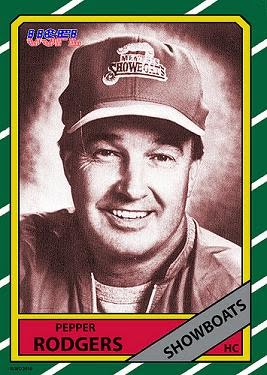
On April 4, 1985 the Renegades hosted the Memphis Showboats at Orlando Stadium. The Showboats, in their second USFL season under colorful Head Coach Pepper Rodgers, had started strong with three wins, but then lost the next three games prior to the contest in Orlando.

There were 21,223 fans in attendance for the Thursday night game and they saw it get off to a rousing start as WR Jerry Parrish took the opening kickoff for the Renegades, found a hole up the middle of the field and then broke for the right sideline on his way to an 87-yard touchdown.

Midway through the first quarter, the Showboats responded as QB Walter Lewis completed a 10-yard TD pass to TE Mark Raugh to cap an eight-play, 64-yard drive. Just under two minutes later, Orlando culminated an eight-play possession that covered 70 yards, including three straight pass completions that moved the ball from the Memphis 38 to the one. QB Reggie Collier, starting his second game in place of injured veteran Jerry Golsteyn, sneaked for a one-yard TD to put the Renegades back in front at 14-7 after one period.

That was all the scoring until the fourth quarter as neither team was able to generate much offense. Collier ran for his second TD, this time from two yards out on the second play of the final period. At that point, with a 21-7 lead, it seemed as though Orlando had the game in hand, but the Showboats mounted a comeback.

RB Harry Sydney ran for a 13-yard touchdown to culminate a quick possession by Memphis in which QB Mike Kelley, who took over for Lewis, completed two passes that covered 49 yards, including a 30-yard throw to Raugh.

Kelley passed the Showboats into scoring position again with a crucial completion to RB Ricky Porter that covered 34 yards on a third-and-23 play. When Chuck Bushbeck kicked a 26-yard field goal with 4:25 left on the clock, Orlando’s margin shrank to 21-17.

The Showboats again threatened, and it seemed as though another late defeat was in the offing for the Renegades. But Kelley then missed on four straight passes, including a fourth-and-ten play at the Orlando 30 with the clock running down to 58 seconds in which his throw was just beyond the outstretched fingertips of RB Anthony Parker. Three plays later, Collier dropped back to pass, couldn’t find an open receiver, eluded two Memphis linemen in the backfield, and took off down the right sideline on an electrifying 63-yard run for a touchdown to nail down the win with 33 seconds remaining. The final score was 28-17.

Memphis had more first downs (24 to 15) and led in both rushing (185 yards on 33 attempts) and passing yards (216). The Renegades had 147 rushing yards on 29 carries and 136 passing yards. In addition, Memphis missed two costly field goals, to one by Orlando.

Reggie Collier ran for a team-leading 70 yards on 6 carries and completed 12 of 19 passes for 136 yards with none intercepted. RB Curtis Bledsoe ran for 45 yards on 12 attempts and caught three passes for 25 yards. FB Rickey Claitt had 29 yards on three catches.

For Memphis, Walter Lewis, who entered the game as the USFL’s top-rated passer, completed 6 of 13 throws for 64 yards with a TD and had none picked off before being benched, while Mike Kelley was successful on 7 of 15 passes for 152 yards with one intercepted in relief. Harry Sydney rushed for 95 yards on 16 attempts. Mark Raugh caught 5 passes for 97 yards.

“I said all along that we were becoming a better team each week,” Coach Lee Corso commented afterward. “Our philosophy this week was that if we could win this week we could wipe out all the other games and get respect.”


While there was jubilation among the Renegades and their fans, an angry Coach Pepper Rodgers and GM Steve Ehrhart of the Showboats locked the locker room door, refusing to admit reporters after the game in violation of USFL rules. The club’s PR director appeared with a statement from Rodgers that read, “To say that I'm disappointed is the understatement of the year. This is undoubtedly one of the low points of the season for the.Showboats.”

It was the fourth straight loss for Memphis after a 3-0 start. They recovered to end up at 11-7 for third place in the Eastern Conference and qualified for the postseason – after dismantling the Denver Gold by a score of 48-7 in the Quarterfinal round, they lost to the Oakland Invaders in the Semifinal game. Orlando continued to improve, at least offensively (the defense gave up a league-high 481 points), and went 5-7 after the 0-6 start, which still left them in the Eastern Conference basement with a record of 5-13.

Third-year QB Reggie Collier, as he did decisively against Memphis, continued to make the most of his mobility by running for 606 yards on 92 carries (6.6 avg.) with 12 touchdowns. His passing statistics were less impressive as he was successful on 53.6 percent of his passes for 2578 yards with 13 touchdowns and 16 interceptions.

March 20, 2011

1983: Mazzetti Field Goals Lift Breakers Past Federals


The Boston Breakers had split their first two games on the road in the United States Football League’s inaugural season. On March 20, 1983 they played their first home game, drawing 18,430 to the 20,535-seat Nickerson Field at Boston University. Under Head Coach Dick Coury and offensive coordinator Roman Gabriel, they had 35-year-old John Walton at quarterback, a veteran of four different pro football leagues (Continental, Midwest, NFL, and WFL) who had come out of retirement as head coach at Elizabeth City State to lend his strong passing arm to a fifth league.

Their opponents, the Washington Federals, had lost both games thus far under Head Coach Ray Jauch. They were further handicapped coming into the contest at Boston by the loss to injury of starting QB Mike Hohensee and RB Craig James, two prize rookies.

Veteran NFL backup QB Kim McQuilken took over for Hohensee, and the Federals started off the scoring when Obed Ariri kicked a 38-yard field goal 5:43 into the first quarter. The Breakers responded when Tim Mazzetti, the former bartender-turned-NFL placekicker who spent three seasons with the Atlanta Falcons, booted a 20-yard field goal. The score stood at 3-3 after one quarter.

Mazzetti kicked a 47-yard field goal in the second quarter to put Boston ahead by 6-3, but Washington regained the lead by scoring the first touchdown of the game on a 17-yard pass from McQuilken to WR Joey Walters. A third Mazzetti field goal, from 21 yards, made it 10-9 in favor of the Federals at the half.

Washington extended its lead to 16-9 in the third quarter when DB Mike Guess returned a punt 43 yards, setting up a two-yard touchdown carry by RB James Mayberry. The extra point attempt was missed.

It seemed as though the underdog Federals would pull out the win on the road, especially since Boston’s offense was missing scoring opportunities. On four occasions, the Breakers made it inside the Washington ten yard line without scoring a TD - Walton had turned the ball over on two of those occasions, with a fumble and an interception. But turnovers on special teams by the Federals in the last five minutes of the game ultimately determined the outcome.

With the ball deep in their own territory, an attempted punt by Steve Coffman was botched due to a bad snap, forcing the punter to fall on the ball on the one yard line. With 4:37 remaining on the clock, Boston RB Richard Crump ran for the one-yard touchdown. The successful PAT tied the score at 16-16.

Then, with time running down, Washington got another chance to retake the lead, lining up for a 42-yard field goal attempt. However, the snap passed over Ariri’s head, and traveled all the way to the Federals’ 35 yard line, where Ariri finally fell on it, resulting in a 40-yard change of possession.

Walton completed passes of 13 yards to WR Dwayne Strozier and 9 yards to Crump to set up Mazzetti’s fourth field goal of the game, which was successful from 29 yards out with 27 seconds left on the clock. The Breakers came away with a 19-16 win.

Obed Ariri kicked a field goal for the Federals, but also missed an extra point and had a 33-yard field goal attempt blocked. C Dave Pacella was handling the long-snapping in place of another injured player, Bruce Byrom, with disastrous results. Breakers NT Jeff Gaylord disrupted Pacella, causing the bad snaps that ultimately cost the Federals the game.

Boston outgained Washington (390 yards to 335) and had the edge in first downs (19 to 18), although the Federals held onto the ball longer (31:42 to 28:18). As would prove typical throughout the season, the Breakers gave up no sacks as the line gave Walton good protection.

The veteran Walton had a relatively ordinary day, completing 21 of 42 passes for 247 yards with no TDs and two interceptions. Richard Crump (pictured below) had an outstanding game, rushing for 130 yards on 15 carries, including the short touchdown, and caught 5 passes for another 50 yards. WR Nolan Franz had 5 receptions for a team-leading 73 yards and ex-Patriots RB Andy Johnson also grabbed 5 passes for 55 yards.


For the Federals, Kim McQuilken went to the air 47 times, with 25 completions for 322 yards, but also gave up four interceptions. RB Eric Robinson caught 9 passes for 98 yards and Joey Walters gained 112 yards on 7 catches. However, the running game was ineffective, with a total of 27 yards on 27 attempts – Robinson led the club by gaining 32 yards on 20 carries.

The narrow win would come to characterize the Breakers throughout the ’83 season. 11 of their 18 games were decided by fewer than nine points, and the outcome of 10 weren’t determined until the fourth quarter. Overall, Boston went 11-7 to finish second in the Atlantic Division, just missing a chance at the playoffs. Washington ended up at the bottom with a 4-14 record.

John Walton suffered a knee injury late in the season, but still managed to lead the USFL with 589 pass attempts, of which he completed 56 percent for 3772 yards with 20 touchdowns against 18 interceptions. Richard Crump ran for 990 yards on 190 carries for a good 5.2-yard average and 8 touchdowns – he scored another four TDs among his 44 pass receptions. Tim Mazzetti was the league’s second-leading scorer with 119 points that included 27 field goals and 38 extra points.

April 24, 2010

1983: Eric Truvillion’s 3 TD Receptions Help Bandits Defeat Federals


The Tampa Bay Bandits had won their first four games in the United States Football League’s inaugural season, but had stumbled in losing two of the next three contests. The loss of veteran QB John Reaves with a broken wrist didn’t help matters.

On April 24, 1983 the Bandits traveled to Washington to take on the lowly (1-6) Federals at RFK Stadium before a sparse crowd of 9070. Jimmy Jordan, a former star at Florida State, had taken over at quarterback. Like Reaves, Jordan wasn’t very mobile and also suffered from a sore shoulder, but he proved to be effective in this, his first start.

It looked like it would be an easy win for the Bandits as they broke out to a 20-6 halftime lead. Jordan hit WR Eric Truvillion with three touchdown passes, of 28, 15, and six yards (the extra point attempt was blocked after the first one). Washington only got on the board thanks to a 94-yard kickoff return by RB Eric Robinson after the first Tampa Bay score (the Bandits blocked the ensuing PAT attempt in turn).

However, sloppy play by the Bandits - they turned the ball over seven times in all - allowed the Federals to nearly pull the game out. First, RB Craig James ran for a 19-yard touchdown to cut the margin to 20-13 in the third quarter. Then in the fourth quarter, QB Mike Hohensee passed to WR Mike Holmes for a 10-yard TD that tied the score. The Federals gained the lead at 23-20 with a 23-yard Dale Castro field goal, but it didn’t last long.

Jordan took the Bandits to the Washington 15 yard line on the next possession, which culminated in Zenon Andrusyshyn re-tying the game at 23-23 with a 31-yard field goal. CB Leon Williams intercepted a pass to regain possession for Tampa Bay, and with under three minutes remaining RB Carl Franks dashed 18 yards through the middle for the winning touchdown. The final score was 30-23 in favor of the Bandits.

Jimmy Jordan completed 30 of 45 passes for 345 yards with the three touchdowns, but tossed three interceptions as well. Eric Truvillion caught 9 passes for 113 yards with the three scores, while WR Danny Buggs also exceeded a hundred receiving yards with 103 on 7 catches. RB Sam Platt led the club in rushing with 71 yards on 22 carries; he also contributed a further 49 yards on 7 pass receptions.


The two Washington quarterbacks, rookie Mike Hohensee and veteran Joe Gilliam, combined to complete 16 of 37 passes for 213 yards with a TD and four interceptions (Hohensee tossed the TD while Gilliam had three of his passes picked off). Craig James rushed for 60 yards on 15 attempts. WR Joey Walters was the Federals’ top receiver with 7 catches for 85 yards.

Tampa Bay gave up more turnovers than Washington thanks to four fumbles and the three passes picked off, but also won the total yardage battle (452 to 267) and dominated in first downs (31 to 16) and time of possession (35:28 to 24:32). The Federals recorded the only sacks of the contest, however, with three; 1.5 were credited to 15-year veteran DE Coy Bacon.

The Bandits encountered rough going the rest of the way, finishing with an 11-7 record that put them in third place in the Central Division and out of the playoffs. Washington went 4-14 to end up at the bottom of the Atlantic Division, tied with Arizona for the worst record in the league.

Jordan performed well overall, placing fourth among the USFL’s passers (Reaves was 12th) as he completed 60.9 % of his 238 throws for 1831 yards with 14 TDs and 14 interceptions. Eric Truvillion was an All-League selection both by the USFL and The Sporting News as he caught 66 passes for 1080 yards and 15 touchdowns (Danny Buggs grabbed 76 passes for 1146 yards, but with just 5 TDs). Prize rookie Craig James was one of the few bright spots for the Federals as he rushed for 823 yards on 202 carries.

March 6, 2010

1983: Blitz Wins USFL Debut as George Allen Returns to Washington


March 6, 1983 marked opening day for the new United States Football League (USFL), and the Washington Federals hosted the Chicago Blitz at RFK Stadium. It was something of a homecoming for Blitz Head Coach George Allen, who had coached the NFL Redskins from 1971-77.

Allen was the most prestigious of the new league’s head coaches, and thus he and the Blitz received a fair amount of attention prior to the USFL commencing its first spring season. After initially gaining notoriety as the defensive assistant for the Bears under George Halas when they won the 1963 NFL title, Allen had gone on to his first head coaching job with the Rams. Taking over a franchise that had posted six consecutive losing seasons prior to 1966, he immediately turned the team’s fortunes around and ended up with a 49-19-4 record before departing following the 1970 season. From there it was to Washington and a 69-35-1 tally that included a NFC championship in 1972. Hard-working and intense, he also was an outstanding motivator whose teams typically played with great spirit and enthusiasm.

Allen left Washington to return to the Rams for the ’78 season, but never made it through the preseason as he was replaced by Ray Malavasi. He retreated to the broadcast booth until taking on the challenge of coaching a new team in a start-up league. His arrival in Chicago heralded great expectations and, as Allen had done with the Rams and Redskins, a strong nucleus of veteran players was assembled.

QB Greg Landry (pictured below left), a 14-year NFL veteran, guided an offense that included the team’s two most significant rookie signings, WR Trumaine Johnson and RB Tim Spencer. The defense was filled with experienced players, most notably defensive ends Karl Lorch (WFL and Redskins) and Junior Ah You (CFL), DT Joe Ehrmann (Colts and Lions), LB Stan White (Colts and Lions), CB Virgil Livers (Bears), and safety Luther Bradley (Lions). Even punter/placekicker Frank Corral (Rams) was an experienced pro.


Chicago met expectations in the opener, easily defeating the Federals, 28-7. Landry directed the typically conservative but effective offense (a signature of Allen’s teams), completing 19 of 27 passes for 251 yards with two TDs and no interceptions. The rookie WR Johnson made an immediate impression, catching 11 of those passes for 158 yards and a score. Spencer led the running attack with 69 yards on 17 carries. On defense, Bradley picked off two passes and Ah You and Ehrmann each recorded a sack.

The Blitz outrushed the Federals, 143 yards to 36 (rookie RB Craig James gained 34 of those yards on 14 carries), and outpassed them 213 to 172. Washington had only three first downs in the first three quarters, didn’t score until the fourth quarter, and was forced to punt nine times.

Speculation that Chicago was the USFL’s dominant team grew to a fever pitch, although Allen attempted to calm the inflated expectations. “I don’t feel that we’ll dominate the league in any manner,” was his response, and it was proven so the following week when the Blitz gave up 18 points in the fourth quarter to blow a 29-12 lead over the Arizona Wrangers, who won 30-29.

At the end of the year, Chicago had a 12-6 record and the wild card spot in the playoffs (their record matched that of the Michigan Panthers in the Central Division, but the eventual-champion Panthers won the division title by sweeping the season series between the teams). They lost to the Philadelphia Stars in the Semifinal round. Washington, by contrast, went 4-14 and ended up at the bottom of the Atlantic Division.

The Blitz scored the most points (456) and had the third-ranked offense as well as top-ranked defense in the USFL. Trumaine Johnson topped the league with 81 catches for 1322 yards and Luther Bradley led in interceptions with 12. Allen was criticized for his offense’s predictability, and for sitting on late leads that made them vulnerable to opponents staging comebacks. However, the team suffered key injuries, losing Landry to a foot injury twelve weeks into the campaign as well as some key offensive linemen. But for the outsized expectations (and monetary losses that led the franchise to exchange locations with the Wranglers for 1984), it was a respectable showing and did nothing to damage a coaching career that landed Allen in the Pro Football Hall of Fame.

February 26, 2010

1984: Jacksonville Bulls Score 53 Points in USFL Debut


The Jacksonville Bulls were one of six new teams in the USFL for the 1984 season. Owned by Fred Bullard (hence the Bulls nickname) and coached by Lindy Infante, they took the field for their first game on February 26 before 49,392 fans at the Gator Bowl. They didn’t disappoint, rolling up 53 points as they obliterated the visiting Washington Federals.

The first points came on a safety as Washington punter Dana Moore fell on a fumble in his end zone. The first touchdown occurred on a 74-yard pass play from QB Matt Robinson to WR Aubrey Matthews. It was 16-0 at the end of the first quarter after RB Larry Mason scored from a yard out.

By the end of the first half, the Bulls had a 29-0 lead as Mason scored a second TD on an eight-yard run (the PAT failed) and Robinson connected on another long pass play, this one covering 54 yards to WR Wyatt Henderson. Washington finally got on the board in the third quarter on a one-yard run by QB Mike Hohensee, but it was Jacksonville accumulating the next 17 points as the Bulls cruised to the 53-14 victory.


Robinson (pictured at right), who had played in the NFL with the Jets, Broncos, and Bills, completed 15 of 25 passes for 299 yards with three touchdowns against two interceptions. Rookie WR Gary Clark led the team with 4 pass receptions (for 65 yards), although Matthews had the most receiving yards with 74 on his lone catch, the long TD. Larry Mason led the team’s runners with 36 yards on 11 carries with the two scores.

WR Joey Walters had an outstanding statistical day in a losing effort for the Federals as he gained 205 yards on 8 receptions that included a 51-yard TD on a pass from relief QB Reggie Collier.

It was a great start for the franchise both on the field and in terms of attendance. But while the Bulls would set a USFL single-game attendance record in their next game with 73,227 on hand to witness a heartbreaking loss to the New Jersey Generals, and would go on to lead the league in attendance over the course of the season, they went 6-12 on the way to a last place finish in the Southern Division. The Federals also finished last with a 3-15 record, tied with the Pittsburgh Maulers in the Atlantic Division.

Matt Robinson ended up splitting time at quarterback with Robbie Mahfouz. Gary Clark was the top receiver, with 56 catches for 760 yards. However, the team finished next to last in the USFL in rushing with 1729 yards; Mason’s 495 yards led the club.

Defense was a problem as the team failed to consistently put pressure on opposing quarterbacks and ended up surrendering 455 points. They were good at picking off passes, with 28 interceptions (led by safety Don Bessillieu’s seven), but defensive lineman Bob Clasby was the team’s leader with just five sacks.

The franchise’s enduring legacy was the fan support that it generated. Long after the Bulls disappeared with the rest of the USFL, the NFL awarded Jacksonville an expansion franchise for the 1995 season. The enthusiasm generated for the Bulls apparently played a role in that decision.