August 10, 2014

1956: Groza Kicks 4 FGs as Browns Dominate College All-Stars


The 23rd annual College All-Star Game on August 10, 1956 featured the Cleveland Browns, defending NFL Champions for the second straight year, against a squad coached by Curly Lambeau, who had guided the All-Stars to a 30-27 upset win in the previous contest.

The Browns, coached by Paul Brown, were again without QB Otto Graham, who retired for good after the 1955 NFL title game. George Ratterman, who started at quarterback in the previous year’s defeat, was again behind center. Cleveland was better prepared than when facing the All-Stars in ’55, however, and it would show.

The All-Stars featured a lineup that included the reigning Heisman Trophy winner, HB Howard “Hopalong” Cassady from Ohio State, as well as future pro stars such as Michigan State QB Earl Morrall, halfbacks Lenny Moore of Penn State and Preston Carpenter from Arkansas (who had been drafted by the Browns), West Virginia guard Sam Huff, and SMU tackle Forrest Gregg.  

There were 75,000 fans in attendance at Soldier Field for the Friday night game. The All-Stars looked strong on offense as they took the opening kickoff and, with Earl Morrall behind center, got two first downs on an 11-yard pass completion to Navy end Ron Beagle and a ten-yard carry by the quarterback. Cassady ran for nine yards to put the All-Stars at the Cleveland 34. However, Morrall suffered an injury to his throwing hand and, on the next play, DHB Warren Lahr intercepted a pass by QB Jerry Reichow of Iowa in the end zone to snuff out the threat. It would be all downhill for the collegians, as they never again penetrated Cleveland territory for the remainder of the contest.

Cleveland methodically moved 80 yards in 12 plays that concluded with George Ratterman passing to HB Fred “Curly” Morrison for a 13-yard touchdown. Lou Groza (pictured at top) added the extra point and the pro champs were up by 7-0.

Early in the second quarter, the Browns reached the All-Star 25 but, after being backed up by a holding penalty, settled for a 47-yard Groza field goal (some sources show shorter distances on the field goals because, under the college rules that the game was played under, field goals were measured from the line of scrimmage rather than the spot of the kick). On the next Cleveland series, the Browns lined up for another field goal try but pulled a fake instead, with DB Tommy James carrying the ball. However, he came up two yards short of the necessary distance for a first down. James made up for it a short time later when he intercepted a pass that set up another Groza field goal, from 37 yards, just before the end of the first half. Cleveland led by 13-0 at the intermission.

Dominating on defense, Cleveland kept it very conservative on offense, making for a dull display for the crowd. Even with Morrall’s return to action for the second half, the All-Stars could not mount a threat. Midway through the third quarter, the Browns had good starting field position due to a shanked punt. A successful Groza field goal try from short range was wiped out by a holding penalty, but he then connected from 31 yards.

Shortly thereafter the collegians, trying to convert a fourth down, lost the ball when FB Don Schaefer fumbled and the Browns recovered at the All-Star 45. That led to a 34-yard field goal that made the score 19-0 heading into the final period.

Early in the fourth quarter, Lenny Moore created some excitement with a 24-yard run for the All-Stars, but the Browns once again stifled the collegians on offense. One final touchdown came at the end of a 38-yard, seven-play series, with HB Gene Filipski running the last two yards to paydirt. It was set up when Preston Carpenter fumbled a punt and DE Jim Ray Smith recovered for the Browns. Groza’s successful PAT put the cap on a convincing 26-0 win.

The Browns led in first downs (18 to 5) and ground out 191 yards on the ground. The All-Stars, who rushed for 121 yards, managed to complete only two of 10 pass attempts for 12 yards and two were intercepted. The All-Stars also fumbled the ball away three times while the Browns suffered no turnovers at all.

Lou Groza’s 14 points, thanks to his four field goals and two extra points, represented the largest individual total since Don Hutson accumulated 19 in 1940. George Ratterman was successful on 7 of 14 passes for 84 yards and a touchdown and his understudy, Babe Parilli, completed one of four throws for four yards but rushed for 39 yards on seven carries. FB Ed Modzelewski led the ground attack, rushing for 76 yards on 21 carries.
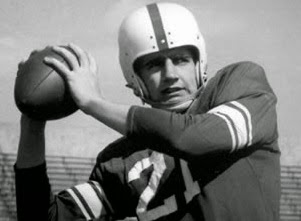


For the All-Stars, Earl Morrall (pictured above) completed one of four throws for 11 yards and Jerry Reichow managed one completion for one yard. Don Schaefer topped the collegians with 42 rushing yards on 11 carries while “Hopalong” Cassady, who was playing with an injured heel, was held to 21 yards on six attempts.

Cleveland’s win put the pro champs ahead in the series by 14 to 7, with two ties. However, it didn’t herald another big year for the Browns. They lost four of their first five games on the way to a 5-7 finish, the first losing record in franchise history.

Earl Morrall spent his rookie season with the 49ers and would play for five other teams in a pro career that lasted 21 years. He would return to the College All-Star Game as a member of the Baltimore Colts in 1971.

August 8, 2014

Rookie of the Year: A.J. Duhe, 1977

Defensive End, Miami Dolphins


Age: 22 (Nov. 27)
College: LSU
Height: 6’4”   Weight: 247

Prelude:
Duhe averaged 72 tackles a season in college and was chosen by the Dolphins in the first round of the 1977 NFL draft (13th overall). Looking to refurbish the defense, Miami took another defensive lineman, DT Bob Baumhower, in the second round. Both moved into the starting lineup with outstanding results, along with LB Kim Bokamper, CB Norris Thomas, and FS Vern Roberson, who all gained All-Rookie honors.

1977 Season Summary
Appeared in all 14 games
[Bracketed numbers indicate league rank in Top 20]

Sacks – 7 (unofficial)
Interceptions – 0
Fumble recoveries – 2
Tackles – 83

Awards & Honors:
NFL Defensive Rookie of the Year: AP, PFWA
AFC Rookie of the Year: UPI, Sporting News

Dolphins went 10-4 to finish second in the AFC East.  

Aftermath:
Duhe improved in 1978, despite a leg injury, but was shifted to inside linebacker in ‘79. An outstanding blitzer, he proved to be a good fit as a hybrid outside linebacker/pass rushing end, receiving first-team All-AFC honors from UPI in ’81, and was especially prominent as the Dolphins won the AFC Championship during the strike-shortened 1982 season, most notably with three interceptions against the Jets in the conference title game. Following the ’83 season, when he received second-team All-AFC recognition from UPI, Duhe underwent surgery for rotator cuff and knee surgery, and while he came back to achieve Pro Bowl honors for the only time in his career in 1984, further injuries that required surgery finished him. Duhe ended up playing a total of eight years for the Dolphins and was credited with 8.5 sacks, which reflected his last three seasons after the NFL began to officially compile individual sacks, while the real total was likely closer to 30. He also accumulated around 486 tackles in 108 regular season games.

--


Rookie of the Year Profiles feature players who were named Rookie of the Year in the NFL (including NFC/AFC), AFL (1960-69), or USFL (1983-85) by a recognized organization (Associated Press – Offense or Defense, Newspaper Enterprise Association, United Press International, The Sporting News, or the league itself – Pepsi NFL Rookie of the Year). 

August 6, 2014

1947: Steelers Trade Bill Dudley to Lions


On August 6, 1947 the Pittsburgh Steelers sent star HB Bill Dudley along with tackle Jack Dugger to the Detroit Lions for halfbacks Bob Cifers and Paul White plus the rights to Michigan tailback Bob Chappuis, who still had a year of college eligibility remaining, and an additional first-round draft choice for 1948 that was used to take Texas QB Bobby Layne (whose rights were traded to the Chicago Bears but who would eventually conclude his Hall of Fame career with the Steelers).

Having led the nation by scoring 134 points for Virginia in 1941, the undersized (5’10”, 180 pounds) Dudley was chosen by the Steelers with the first overall draft pick in ’42. His nickname “Bullet Bill” was rather misleading, as he was more elusive than fast. But he was a perfect fit as a tailback in Pittsburgh’s single-wing offense, allaying any concerns about his lack of size by leading the NFL in rushing with 696 yards in the eleven-game season. Dudley also passed for 438 yards (although passing with his sidearm delivery was not his best skill), returned 20 punts for a league-topping 271 yards (13.6 avg.) and led the NFL by averaging 27.1 yards on 11 kickoff returns that included a touchdown. He intercepted three passes on defense and his 1289 all-purpose yards topped the circuit. A fiery team leader, he was a consensus first-team All-NFL selection.

Dudley then spent the next three years in the Army air force during World War II, returning to Pittsburgh for the last four games of the 1945 season. In ’46, he took up where he had left off as a rookie, again leading the NFL with 604 rushing yards, a 14.3 punt return average, 10 interceptions that he returned 242 yards, and 1378 total yards. For his efforts he received the Joe F. Carr Trophy as league MVP.

However, Dudley, who took a beating due to his heavy use, expressed concern with the grind of playing pro football at his size (not helped by his difficult relationship with Head Coach Jock Sutherland, who didn’t appreciate his brashness) and indicated his desire to retire and return to the University of Virginia as an assistant backfield coach.  

Dudley turned down a $20,000 contract offer for 1947. Not surprisingly, when Dudley declared that he would no longer play for the Steelers, the team received many inquiries. The Lions persisted in negotiating the trade over the course of two weeks and Dudley agreed to terms with them for $20,000 plus a $5000 signing bonus, interrupting his honeymoon to fly to Detroit and sign the contract.

“I respect Dudley tremendously as a player,” said Coach Sutherland. “I’m sorry he didn’t see fit to come back to us. Had he decided to retire as he promised, we wouldn’t have had anybody in return. Now that he’s signed with Detroit, we get two players right away and two more next Fall.”

As for the players the Steelers received, all three came out of single-wing offenses and were thus good fits for Pittsburgh’s system. 25-year-old Bob Cifers had played collegiately at Tennessee, where he was coached by Bob Neyland, a friend of Jock Sutherland’s, and was drafted by the Lions in the second round in 1943. He was a triple-threat halfback who had also been an outstanding punter in college and led the NFL in that category with a 45.6-yard average in ’46.

Paul White was also 25 and an 11th round draft choice in 1944 who played one more season of college football for Michigan in 1946 after spending two years in the military. A left-handed halfback, he had been Michigan’s team captain.

Also from Michigan, tailback Bob Chappuis was an outstanding all-around talent who was so highly-touted after setting a Big 10 record for total offense in 1946 that the Lions drafted him in the fifth round as a future pick.

Jack Dugger, the player who was sent to the Lions along with Dudley, had been with Buffalo of the All-America Football Conference in 1946 and expressed a desire to play in Detroit, where he lived. He did so for two seasons before moving on to the Bears.

The Steelers improved from 5-5-1 to 8-4, winning a share of first place in the Eastern Division but losing a playoff to the Eagles. Detroit had been a league-worst 1-10 in ’46 and moved up to just 3-9. Dudley became a halfback in a T-formation offense, and while his rushing total dropped to 302 yards on 80 carries, he caught 27 passes for 375 yards and seven touchdowns. He also continued to return kicks and had five interceptions on defense, and in all scored 11 TDs by means of rushing, pass receiving, a punt return, and an interception return. His all-purpose yards totaled 1322 in nine games, which ranked third in the league. He was also selected team captain by his teammates, who appreciated his leadership by example.

Dudley played two more years with Detroit before moving on to the Washington Redskins, where he was named to the Pro Bowl in 1950 and ‘51. He finished up as a placekicker in 1953, making the most of his multiple talents to the end, and utilizing an odd style in which he didn’t take any steps but simply swung his leg once the ball was set. Overall, he ran the ball 765 times for 3057 yards (4.0 avg.) and 18 touchdowns, caught 123 passes for 1383 yards (11.2 avg.) and another 18 TDs, returned 124 punts for a 12.2 average and three scores, 78 kickoffs for a 22.3 average and a touchdown, and accumulated 23 interceptions that he returned for 459 yards and two more TDs. Dudley also passed for 985 yards and six TDs, punted 193 times for a 37.8-yard average, and kicked 33 field goals and 121 extra points. “Bullet Bill” was inducted into the Pro Football Hall of Fame in 1966 (he had already been selected to the College Football Hall of Fame in 1956).

The Lions never had a winning record during Dudley’s time with the team. After contending in 1947, the Steelers lost Coach Sutherland, who died suddenly in the Spring of ’48, and went 4-8 that Fall.

Bob Cifers played two seasons in Pittsburgh before moving on to Green Bay, rushing for 356 yards in 1947 and 361 in ’48. He averaged 40.4 on 130 punts over that period. Paul White played just one season as a reserve. Bob Chappuis never played for the Steelers, signing with the Brooklyn Dodgers of the AAFC in 1948 instead, and moving on to the Chicago Hornets in ’49, where he finished his brief pro career. 

August 5, 2014

Highlighted Year: Billy Atkins, 1961

Safety/Punter, Buffalo Bills


Age: 27 (Nov. 19)
4th season in pro football, 2nd in AFL & with Bills
College: Auburn
Height: 6’1”   Weight: 195

Prelude:
A star on Auburn’s 1957 national championship team, Atkins was chosen by the San Francisco 49ers in the fifth round of the ’58 NFL draft. He saw some action as a punter and in the defensive backfield in two seasons with the 49ers before moving to Buffalo of the new AFL in 1960, where he averaged 39.0 yards on a league-leading 89 punts and intercepted five passes while starting at cornerback. He was also used as a placekicker and was successful on 6 of 13 field goal attempts. Atkins was shifted to safety in 1961 as personnel was juggled in the defensive backfield.

1961 Season Summary
Appeared in all 14 games
[Bracketed numbers indicate league rank in Top 20]

Interceptions – 10 [1]
Most interceptions, game – 2 vs. NY Titans 9/17, vs. Dallas 10/15, at Dallas 11/12, at Denver 11/19
Int. return yards – 158 [2]
Most int. return yards, game – 52 (on 2 int.) at Dallas 11/12
Int. TDs – 0

Punting
Punts – 85 [1]
Most punts, game – 9 vs. Boston 9/23, at Denver 11/19
Yards – 3783 [1]
Average – 44.5 [1]
Best average, game – 54.6 (on 5 punts) at Boston 10/22
Punts blocked – 1
Longest punt – 70 yards

Kicking
Field goals – 2 [11]
Most field goals, game - 1 at Dallas 11/12, at Denver 11/19
Field goal attempts – 6 [11]
Most field goal attempts, game – 4 at Denver 11/19
Field goal percentage – 33.3
PATs – 29 [4]
PAT attempts – 31 [4]
Longest field goal – 39 yards at Denver 11/19

Rushing
Attempts – 2
Yards – 87
Average gain – 43.5
TDs – 1

Punt Returns
Returns – 2
Yards – 30
Average per return – 15.0
TDs – 0
Longest return – 15 yards

Scoring
TDs – 1
Field Goals – 2
PATs – 29
Points – 41 [20]

Awards & Honors:
1st team All-AFL: UPI, Sporting News, NY Daily News
2nd team All-AFL: League
AFL All-Star Game

Bills went 6-8 to finish fourth in the AFL Eastern Division.  

Aftermath:
Seeking an upgrade at quarterback, the Bills traded Atkins to the New York Titans for veteran QB Al Dorow prior to the 1962 season. He intercepted four passes and was leading the league with a 44.0 punting average when he went down with a knee injury at midseason. Atkins saw little action with the Jets and Buffalo in ’63 and, after a three-game stint with Denver in 1964 his career came to an end. Overall, he intercepted 20 passes (19 of them in the AFL) and averaged 41.6 yards on 221 punts. Atkins went on to become head coach at Troy State and guided the school to the NAIA national championship in 1968. He was a 2005 inductee into the Alabama Sports Hall of Fame.

--

Highlighted Years features players who were consensus first-team All-League* selections or league* or conference** leaders in the following statistical categories:

Rushing: Yards, TDs (min. 10)
Passing: Yards, Completion Pct., Yards per Attempt, TDs, Rating
Receiving: Catches, Yards, TDs (min. 10)
Scoring: TDs, Points, Field Goals (min. 5)
All-Purpose: Total Yards
Defense: Interceptions, Sacks
Kickoff Returns: Average
Punt Returns: Average
Punting: Average

*Leagues include NFL (1920 to date), AFL (1926), AFL (1936-37), AAFC (1946-49), AFL (1960-69), WFL (1974-75), USFL (1983-85)

**NFC/AFC since 1970

August 3, 2014

Rookie of the Year: Mike Ditka, 1961

Tight End, Chicago Bears


Age: 22 (Oct. 18)
College: Pittsburgh
Height: 6’3”   Weight: 230

Prelude:
Ditka was a three-sport athlete in college (baseball and basketball were the others). He led the team in pass receiving three times and was a consensus first-team All-American as a senior. Ditka also played linebacker and defensive end with distinction and punted, setting the tone for his later pro career with his competitive fury and hard-nosed style as well as being a skillful player. He was chosen by the Bears with the fifth overall pick in the first round of the 1961 NFL draft (he was chosen by the Houston Oilers of the AFL, also in the first round) and quickly became a key player on offense at tight end with his ability as a receiver as well as blocker.

1961 Season Summary
Appeared in all 14 games
[Bracketed numbers indicate league rank in Top 20]

Pass Receiving
Receptions – 56 [5, tied with Billy Howton]        
Most receptions, game – 9 (for 190 yds.) vs. Green Bay 11/12
Yards – 1076 [4]
Most yards, game – 190 (on 9 catches) vs. Green Bay 11/12
Average gain – 19.2 [4]
TDs – 12 [2, tied with Buddy Dial]
100-yard receiving games - 5

Scoring
TDs – 12 [4, tied with Buddy Dial]
Points – 72 [10, tied with Buddy Dial & Lou Michaels]

Awards & Honors:
NFL Rookie of the Year: UPI, Sporting News
1st team All-NFL: NEA, Sporting News
2nd team All-NFL: UPI, NY Daily News
Pro Bowl

Bears went 8-6 to finish in a tie for third with the Baltimore Colts in the Western Conference.  

Aftermath:
Ditka was selected to the Pro Bowl in each of the next four seasons and was a consensus first-team All-NFL selection in 1963, when the Bears won the NFL Championship, and ’64, when he caught a career-high 75 passes. He did much to define the newly-evolved position of tight end with his outstanding combination of skills. After a contract dispute fouled his relations with Chicago’s owner and head coach, George Halas, Ditka was traded to the Philadelphia Eagles in 1967, but accumulated wear-and-tear caused his production to drop off during two injury-plagued seasons. After catching 316 passes for 4503 yards and 34 TDs in six years with the Bears, he had just 39 receptions for 385 yards and four TDs in 20 games for the Eagles. Traded again to Dallas, Ditka split time in his last four seasons. He had 30 catches in 1971, a year in which he also caught a touchdown pass in a winning Super Bowl appearance. Ditka retired into coaching after the ’72 season, having caught a total of 427 passes for 5812 yards and 43 TDs. His greatest years came with the Bears, where he was a consensus first-team All-NFL selection twice, received at least second-team recognition after four other seasons, and was named to the Pro Bowl five straight times. He later became head coach of the Bears, leading them to a NFL title in 1985, and also was head coach of the Saints. Ditka’s #89 was retired by the Bears and he was inducted into the Pro Football Hall of Fame, Class of 1988.

--


Rookie of the Year Profiles feature players who were named Rookie of the Year in the NFL, AFL (1960-69), or USFL (1983-85) by a recognized organization (Associated Press – Offense or Defense, Newspaper Enterprise Association, United Press International, The Sporting News, or the league itself – Pepsi NFL Rookie of the Year). 

August 1, 2014

1975: Gilliam Rallies Steelers to Win Over College All-Stars


After a delay of one year due to the NFL preseason players’ strike in 1974, the 41st College All-Star Game was held on August 1, 1975. The Pittsburgh Steelers, having won the first championship in franchise history the preceding season, represented the professionals while John McKay of USC coached a group of All-Stars that included 22 first round draft choices.

Pittsburgh, under Head Coach Chuck Noll, featured an outstanding defense and an offense that also had plenty of talent, with FB Franco Harris, the Super Bowl MVP, leading the ground attack and a good group of receivers. QB Terry Bradshaw had regained the starting job that Joe Gilliam (pictured above) had held for the first six games in ‘74, and displayed savvy as the team reached the top.

The All-Stars included California QB Steve Bartkowski, HB Walter Payton from Jackson State, and Oregon TE Russ Francis on offense and, on defense, DT Randy White from Maryland, Jackson State LB Robert Brazile, and Ohio State CB Neal Colzie. John McKay was coaching the collegians for the second time (he had also been designated as head coach for the game that was cancelled the previous year).

There were 54,562 fans in attendance on a Friday night at Soldier Field. The field was wet after a shower doused it two hours before kickoff, and it rained throughout the contest.

The All-Stars scored on their first possession, going 80 yards in just four plays. Steve Bartkowski threw to Northwestern WR Larry Burton for a 48-yard gain and then to WR Pat McInally from Harvard for a 28-yard touchdown and the successful conversion by Maryland PK Steve Mike-Mayer made it 7-0. However, the receiver suffered a broken leg on the play

The fired-up All-Star defense forced the pro champs to punt on the next series, but when the Steelers regained possession, they drove 87 yards in 17 plays and tied the score when Bradshaw tossed a two-yard TD pass to TE Randy Grossman at five minutes into the second quarter, Roy Gerela adding the PAT. Along the way, Pittsburgh overcame a second-and-24 hole as Bradshaw passed to WR Ron Shanklin and HB Rocky Bleier to set up a fourth-and-one situation that the quarterback converted with a plunge into the line. Bradshaw also completed passes of 20 yards to TE Larry Brown, 11 yards to Bleier, and nine to FB Reggie Harrison.

On the next Pittsburgh possession, Coach Noll chose to put many backups into the game, although Bradshaw remained at quarterback. The Steelers went three-and-out and punted, but on the next play FS Glen Edwards intercepted a Bartkowski pass. Pittsburgh got a first down on the ensuing series but ended up having to punt again and, in the most exciting play of the game, DB Virgil Livers of Western Kentucky returned Bobby Walden’s kick 88 yards. The return set an All-Star Game record, and, with Mike-Mayer’s conversion, the collegians took a 14-7 lead into halftime.

The pro champs were further damaged when Franco Harris and CB Mel Blount left the game with minor injuries during the first half. Still, Pittsburgh’s other starters were back for the third quarter, although they continued to have difficulty moving the ball against the tough All-Star defense. The Steelers managed to pin the All-Stars back inside their one yard line after a punt, and Neil Clabo had to kick from his end zone after the collegians went nowhere. The punt was a good one to midfield and the defense again came through, sacking Bradshaw twice to squelch any threat.

The Steelers were passing more than usual, especially with Harris sidelined. With three minutes remaining in the period, Pittsburgh got the ball on a turnover when LB Jack Lambert recovered a Bartkowski fumble. On a series highlighted by two runs and a pass reception by HB John “Frenchy” Fuqua, the Steelers advanced to the All-Star 15, but then Florida LB Ralph Ortega came up with an interception that he returned to his 35.

The All-Stars had difficulty on offense themselves in the second half, managing just two first downs in the third quarter and none in the fourth. Bartkowski (pictured below) stayed in the game but was victimized by dropped passes and untimely holding penalties.


Joe Gilliam relieved Terry Bradshaw in the fourth quarter and the Steelers came alive on offense. Finishing off a 42-yard series, Gilliam threw to HB Rocky Bleier for a six-yard TD at less than five minutes into the final period. Then, with 4:16 left on the clock, Gilliam put the Steelers ahead with a touchdown pass to WR Frank Lewis that covered 21 yards and capped a 45-yard drive that was set up by a shanked punt. Gerela successfully added the extra points after each and, after much difficulty, Pittsburgh came away with a 21-14 win.

For all of the trouble that the Steelers had on offense, they still significantly outgained the All-Stars (287 yards to 123) and had far more first downs (17 to 4). The All-Stars recorded six sacks of Pittsburgh quarterbacks to just two of the collegians by the Steelers.

Terry Bradshaw completed 14 of 24 passes for 145 yards with one touchdown and one interception and Joe Gilliam was successful on five of his six throws for 50 yards and two TDs while giving up no interceptions. Rocky Bleier paced Pittsburgh’s ground game with 41 yards on 11 carries and also led the club with five pass receptions, for 41 yards and a touchdown. Larry Brown gained 45 yards on his three catches.

For the All-Stars, Steve Bartkowski was successful on 7 of 18 passes for 126 yards and a TD. Russ Francis was the best of the receivers with two catches for 46 yards and Walter Payton was the leading rusher, although with only 16 yards on 7 carries.

“Physically, we got the hell kicked out of us,” said an irritated Chuck Noll afterward, disappointed at his team’s effort. “That’s what happens when you underestimate somebody.”

The Steelers went on to repeat as NFL Champions, putting together a 12-2 record in the regular season. While Joe Gilliam played well in relief of Terry Bradshaw against the College All-Stars, it was Bradshaw guiding the offense all the way and receiving Pro Bowl recognition for the first time.

Steve Bartkowski went on to play for the Atlanta Falcons, who had taken him in the first round of the draft, and became a two-time All-Pro. Walter Payton had a great career with the Chicago Bears that ended with his topping the NFL career rushing list and gaining enshrinement in the Pro Football Hall of Fame. Pat McInally, who suffered the broken leg while scoring the game’s first touchdown, spent ten years with the Cincinnati Bengals, although he was more productive as a punter than as a pass receiver. Virgil Livers, who had the long punt return for a score, joined Walter Payton with the Bears, where he played cornerback and returned kicks for five seasons.

There were concerns about the future of the All-Star Game, and only one more was played before the series that had started in 1934 came to an end. The win by the Steelers was the 30th for the pro champs, as against nine for the All-Stars and two ties (Pittsburgh also won the final contest in ’76). 

July 29, 2014

Highlighted Year: Peter Boulware, 2001

Linebacker/Defensive End, Baltimore Ravens


Age: 27 (Dec. 18)
5th season in pro football & with Ravens
College: Florida State
Height: 6’4”   Weight: 255

Prelude:
A defensive end in college, where he gained notoriety for his pass rushing, Boulware was taken by the Ravens in the first round (fourth overall) of the 1997 NFL draft. Converted to outside linebacker, he moved directly into the starting lineup, joining fellow rookie Jamie Sharper and second year MLB Ray Lewis to create a young but formidable linebacking corps. He received NFL Defensive Player of the Year honors from the AP and Pro Football Writers. Boulware followed up on his outstanding rookie season by gaining selection to the Pro Bowl following the 1998 and ’99 seasons and was also recognized as a first-team All-AFC choice of Pro Football Weekly and second-team All-NFL pick by the Associated Press in 1999. While a shoulder injury caused his performance to level off, he was a mainstay of the defense in 2000 that fueled a late-season run culminating in victory in the Super Bowl. Due to injury depletion, Boulware was shifted to defensive end during the 2001 season.

2001 Season Summary
Appeared in all 16 games
[Bracketed numbers indicate league rank in Top 20]

Sacks – 15 [2, 1st in AFC]
Most sacks, game – 4 vs. Minnesota 1/7
Multi-sack games – 3
Interceptions – 0
Fumble recoveries – 1
Forced fumbles – 4
Tackles – 45
Assists – 21

Postseason: 2 G
Sacks – 1
Interceptions – 0
Fumble recoveries – 1
TDs – 0

Ravens went 10-6 to finish second in the AFC Central and qualify for the playoffs as a Wild Card. Won AFC Wild Card playoff over Miami Dolphins (20-3). Lost AFC Divisional playoff to Pittsburgh Steelers (27-10). 

Aftermath:
Boulware returned to outside linebacker and gained selection to two more Pro Bowls in 2002 and ’03. However, his string of 111 consecutive games was broken when he sat out the 2003 season finale due to injury and offseason knee surgery cost him all of 2004. He was released and re-signed to a lesser salary in ’05, playing as a reserve, and injuries forced his release and retirement prior to the 2006 season. Overall, he had 70 regular season sacks and three in the playoffs over the course of his career that included four Pro Bowl selections.

--

Highlighted Years features players who were consensus first-team All-League* selections or league* or conference** leaders in the following statistical categories:

Rushing: Yards, TDs (min. 10)
Passing: Yards, Completion Pct., Yards per Attempt, TDs, Rating
Receiving: Catches, Yards, TDs (min. 10)
Scoring: TDs, Points, Field Goals (min. 5)
All-Purpose: Total Yards
Defense: Interceptions, Sacks
Kickoff Returns: Average
Punt Returns: Average
Punting: Average

*Leagues include NFL (1920 to date), AFL (1926), AFL (1936-37), AAFC (1946-49), AFL (1960-69), WFL (1974-75), USFL (1983-85)

**NFC/AFC since 1970