Showing posts with label 2001 NFL season. Show all posts

December 7, 2016

Highlighted Year: Todd Sauerbrun, 2001

Punter, Carolina Panthers


Age: 28
7th season in pro football, 1st with Panthers
College: West Virginia
Height: 5’10” Weight: 211

Prelude:
Sauerbrun averaged 46.2 yards on 177 punts in college, including a NCAA-record 48.4-yard average in 1994 when he was a consensus first-team All-American. He was chosen by the Chicago Bears in the second round of the 1995 NFL draft and spent five years with them, although he was limited to three games in ’98 due to a knee injury, and averaged 42.2 yards on 328 punts. Sauerbrun was a second-team All-NFC choice by UPI in 1996. He spent a season with Kansas City in 2000, where he averaged 44.6 yards on 82 punts, before signing with the Panthers in 2001.

2001 Season Summary
Appeared in all 16 games
[Bracketed numbers indicate league rank in Top 20]

Punting
Punts – 93 [3]
Most punts, game – 10 vs. NY Jets 10/28
Yards – 4419 [1]
Average – 47.5 [1]
Best average, game – 55.8 (on 6 punts) at Washington 10/21
Punts blocked – 1 [3, tied with five others]
Longest punt – 73 yards

Rushing
Attempts – 1
Yards – 0
Average gain – 0.0
TDs – 0

Awards & Honors:
1st team All-NFL: AP, PFWA, Sporting News
1st team All-NFC: Pro Football Weekly
Pro Bowl

Panthers went 1-15 to finish fifth in the NFC West.

Aftermath:
Sauerbrun followed up by again leading the NFL with a 45.5-yard average in 2002 and topped the NFC for a third straight time in 2003 by averaging 44.6 yards. With exceptional leg strength, he improved on his directional punting and also in not out-kicking the coverage. However, off-field issues led the Panthers to trade him to Denver in 2005, where he averaged 43.8 yards on 72 punts. Sauerbrun received a four-game suspension in ’06 for use of illegal supplements and was cut upon his return. He spent two games with the Patriots in 2006 and returned to the Broncos in ’07, his last year in the NFL. Sauerbrun finished his pro career with the Florida Tuskers of the UFL in 2009, punting 16 times for a 36.7-yard average. Overall, he punted 889 times in the NFL for an average of 44.1 yards. His greatest success came with the Panthers, where he averaged 45.5 yards on 350 punts. In a career that came to be overshadowed by controversy, he received consensus first-team All-NFL honors twice, some first- or second-team recognition after another season, and was selected to three Pro Bowls.

--

Highlighted Years features players who were first-team All-League* selections or league* or conference** leaders in the following statistical categories:

Rushing: Yards, TDs (min. 10)
Passing: Yards, Completion Pct., Yards per Attempt, TDs, Rating
Receiving: Catches, Yards, TDs (min. 10)
Scoring: TDs, Points, Field Goals (min. 5)
All-Purpose: Total Yards
Defense: Interceptions, Sacks
Kickoff Returns: Average
Punt Returns: Average
Punting: Average

*Leagues include NFL (1920 to date), AFL (1926), AFL (1936-37), AAFC (1946-49), AFL (1960-69), WFL (1974-75), USFL (1983-85)

**NFC/AFC since 1970

November 30, 2016

Highlighted Year: Jay Feely, 2001

Placekicker, Atlanta Falcons


Age: 25
3rd season in pro football, 1st in NFL & with Falcons
College: Michigan
Height: 5’10” Weight: 206

Prelude:
Feely was Michigan’s regular placekicker as a senior in 1998 and was successful on 16 of 20 field goal attempts and 34 of 35 PATs for a total of 82 points. Undrafted by the NFL out of college, Feely spent two seasons playing arena football, with the Florida Bobcats in 1999 and Tampa Bay Storm in 2000. He joined the Falcons in 2001 and beat out Jake Arians for the placekicking job previously held by Morten Andersen.

2001 Season Summary
Appeared in all 16 games
[Bracketed numbers indicate league rank in Top 20]

Kicking
Field goals – 29 [4, 1st in NFC]
Most field goals, game – 4 vs. Buffalo 12/23
Field goal attempts – 37 [2]
Most field goal attempts, game – 4 vs. St. Louis 12/2, vs. Buffalo 12/23
Field goal percentage – 78.4 [18]
PATs – 28 [20, tied with Martin Gramatica]
PAT attempts – 28 [20, tied with Martin Gramatica & Todd Peterson]
Longest field goal – 55 yards at Arizona 9/30

Scoring
Field Goals – 29
PATs – 28
Points – 115 [6, tied with David Akers & Matt Stover]

Falcons went 7-9 to finish fourth in the NFC West.

Aftermath:
Feely followed up with a bigger season in 2002, leading the NFL with 32 field goals out of 40 attempts and scoring a total of 138 points. He spent two more lesser seasons with the Falcons before moving on to the New York Giants in 2005, where he kicked a career-high 35 field goals out of 42 attempts and, a perfect 43-for-43 in extra points, also had his top scoring total with 148 points. Feely was with the Giants for another year in 2006, one with Miami in ‘07, two as a member of the New York Jets, and four in Arizona before finishing up with the Chicago Bears in 2014 at age 38. Consistent if not spectacular, Feely was successful on 332 of 402 field goal attempts (82.6 %) and, adding 449 PATs (with just three misses), scored a total of 1451 points. Of that, 98 field goals, 142 PATs, and 436 points came with Atlanta.

--

Highlighted Years features players who were consensus first-team All-League* selections or league* or conference** leaders in the following statistical categories:

Rushing: Yards, TDs (min. 10)
Passing: Yards, Completion Percentage, Yards per Attempt, TDs, Rating
Receiving: Catches, Yards, TDs (min. 10)
Scoring: TDs, Points, Field Goals (min. 5)
All-Purpose: Total Yards
Defense: Interceptions, Sacks
Kickoff Returns: Average
Punt Returns: Average
Punting: Average

*Leagues include NFL (1920 to date), AFL (1926), AFL (1936-37), AAFC (1946-49), AFL (1960-69), WFL (1974-75), USFL (1983-85)

**NFC/AFC since 1970

November 13, 2016

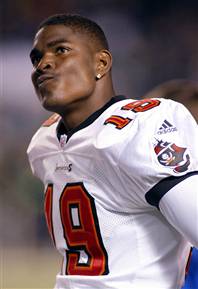
Highlighted Year: Keyshawn Johnson, 2001

Wide Receiver, Tampa Bay Buccaneers


Age: 29
6th season in pro football, 2nd with Buccaneers
College: Southern California
Height: 6’4”   Weight: 212

Prelude:
In two seasons at USC after transferring from West Los Angeles College, Johnson caught 168 passes for 2796 yards (16.6 avg.) and 16 touchdowns, including 102 for 1434 yards and 7 TDs in 1995. He received consensus first-team All-America recognition and was chosen by the New York Jets as the top overall selection in the 1996 NFL draft. Johnson showed off his potential, with 63 receptions for 844 yards and 8 TDs as a rookie, but also a distracting brashness. Big and physical, if not particularly fast, he followed up with another solid season in ’97 and, with the club improving dramatically overall, had consecutive Pro Bowl seasons in 1998 and ’99 as he caught over 80 passes and gained a thousand yards in each, scoring a combined 18 touchdowns. Johnson was traded to Tampa Bay in 2000 and had a lesser year, catching 71 passes for 874 yards and 8 TDs.

2001 Season Summary
Appeared in 15 of 16 games
[Bracketed numbers indicate league rank in Top 20]

Pass Receiving
Receptions – 106 [4, 1st in NFC]  
Most receptions, game – 12 (for 89 yds.) vs. Chicago 11/18
Yards – 1266 [7]
Most yards, game – 159 (on 10 catches) vs. Pittsburgh 10/21
Average gain – 11.9
TDs – 1
100-yard receiving games – 4

Scoring
TDs – 1
Points – 6

Postseason: 1 G (NFC Wild Card playoff at Philadelphia)
Pass receptions – 3
Pass receiving yards – 75
Average yards per reception – 25.0
Pass Receiving TDs – 0

Awards & Honors:
Pro Bowl

Buccaneers went 9-7 to finish third in the NFC Central and qualified for a Wild Card playoff spot. Lost NFC Wild Card playoff to Philadelphia Eagles (31-9).

Aftermath:
Johnson followed up with 76 catches for 1088 yards (14.3 avg.) and five touchdowns in 2002 as the Buccaneers won the NFL title, but as his relationship with the coaching staff deteriorated, he was deactivated for the last seven games of the ’03 season. Dealt to the Dallas Cowboys in 2004, Johnson continued to be a productive possession receiver for two seasons and finished up by catching 70 passes for 815 yards with Carolina in 2006. For his career, Johnson had 814 pass receptions for 10,571 yards (13.0 avg.) and 64 TDs. Of those totals, 298 for 3828 yards and 17 TDs were with Tampa Bay. He was selected to three Pro Bowls.

--

Highlighted Years features players who were consensus first-team All-League* selections or league* or conference** leaders in the following statistical categories:

Rushing: Yards, TDs (min. 10)
Passing: Yards, Completion Pct., Yards per Attempt, TDs, Rating
Receiving: Catches, Yards, TDs (min. 10)
Scoring: TDs, Points, Field Goals (min. 5)
All-Purpose: Total Yards
Defense: Interceptions, Sacks
Kickoff Returns: Average
Punt Returns: Average
Punting: Average

*Leagues include NFL (1920 to date), AFL (1926), AFL (1936-37), AAFC (1946-49), AFL (1960-69), WFL (1974-75), USFL (1983-85)

**NFC/AFC since 1970

November 25, 2015

Highlighted Year: David Boston, 2001

Wide Receiver, Arizona Cardinals


Age: 23
3rd season in pro football & with Cardinals
College: Ohio State
Height: 6’2”   Weight: 210

Prelude:
Boston caught a school-record 191 passes for 2855 yards (14.9 avg.) and 34 touchdowns in college, including 85 for 1455 yards and 13 TDs in ’98, his last season. He chose to enter the 1999 NFL draft with a year of eligibility remaining and was chosen by the Cardinals in the first round (eighth overall). Boston caught 40 passes for 473 yards (11.8 avg.) and two touchdowns in a mediocre rookie season but moved into the starting lineup full-time in 2000 and had 71 receptions for 1156 yards (16.3 avg.) and 7 TDs. Big, fast, and able to run effectively after catching the ball, Boston also drew criticism for his attitude and off-field problems, although he showed greater maturity and dedication coming into 2001.

2001 Season Summary
Appeared in all 16 games
[Bracketed numbers indicate league rank in Top 20]

Pass Receiving
Receptions – 98 [7] 
Most receptions, game – 9 (for 108 yds.) at Dallas 10/28, (for 137 yds.) vs. NY Giants 11/11
Yards – 1598 [1]
Most yards, game – 145 (on 8 catches) vs. Denver 9/23
Average gain – 16.3 [6]
TDs – 8 [13, tied with five others]
100-yard receiving games – 9

Rushing
Attempts – 5
Yards – 35
Average gain – 7.0
TDs – 0

Scoring
TDs – 8
Points – 48

Awards & Honors:
1st team All-NFL: AP, PFWA, Sporting News
1st team All-NFC: Pro Football Weekly
Pro Bowl

Cardinals went 7-9 to finish fourth in the NFC East.

Aftermath:
Boston’s 2002 season was cut short halfway through by a knee injury and he ended up with 32 catches for 512 yards (16.0 avg.) and one TD. He signed a big free agent contract with San Diego in ’03 and caught 70 passes for 880 yards (12.6 avg.) and 7 TDs but clashed with his coaches and was traded to Miami in 2004. Boston received a four-game suspension for steroid use but ended up missing the entire season with a knee injury. He appeared in just five games in ’05 before reinjuring his knee. Boston signed with the Buccaneers in 2006 and was released following further off-field problems. He attempted a comeback with the Toronto Argonauts of the CFL in ’08 and appeared in one game, catching 2 passes for 16 yards, before a foot injury that required surgery forced him to the sidelines for good. Overall, Boston caught 315 passes for 4699 yards (14.9 avg.) and 25 touchdowns in the NFL. Of those totals, 241 receptions for 3739 yards (15.5 avg.) and 18 TDs came with the Cardinals.

--

Highlighted Years features players who were consensus first-team All-League* selections or league* or conference** leaders in the following statistical categories:

Rushing: Yards, TDs (min. 10)
Passing: Yards, Completion Pct., Yards per Attempt, TDs, Rating
Receiving: Catches, Yards, TDs (min. 10)
Scoring: TDs, Points, Field Goals (min. 5)
All-Purpose: Total Yards
Defense: Interceptions, Sacks
Kickoff Returns: Average
Punt Returns: Average
Punting: Average

*Leagues include NFL (1920 to date), AFL (1926), AFL (1936-37), AAFC (1946-49), AFL (1960-69), WFL (1974-75), USFL (1983-85)

**NFC/AFC since 1970
September 7, 2015

Highlighted Year: Ray Lewis, 2001

Linebacker, Baltimore Ravens


Age: 26
6th season in pro football & with Ravens
College: Miami (FL)
Height: 6’1”   Weight: 245

Prelude:
Lewis was chosen by the Ravens in the first round of the 1996 NFL draft and inserted into the starting lineup at middle linebacker as a rookie, and had an immediate impact. He was chosen to the Pro Bowl for the first time in ’97 and was a consensus first-team All-NFL selection in 1999. With outstanding instincts, intensity, and speed that allowed him to cover a large area and make plays, Lewis was well-established as one of the premier linebackers in the NFL. The only concerns about him following the ’99 season pertained to off-field issues surrounding an altercation outside an Atlanta nightclub that ended in two stabbing deaths, but following a plea bargain that included his testimony against two associates, he was back in action in 2000 (and was also heavily fined by the NFL) and received NFL Defensive Player of the Year honors from the Associated Press as the Ravens went all the way to a Super Bowl victory.

2001 Season Summary
Appeared in all 16 games
[Bracketed numbers indicate league rank in Top 20]

Sacks – 3.5
Most sacks, game – 1 at Denver 9/30, vs. Indianapolis 12/2, vs. Pittsburgh 12/16
Interceptions – 3
Most interceptions, game – 2 vs. Cincinnati 12/23
Int. yards – 115 [10, tied with Deltha O’Neal]
Most int. return yards, game – 94 (on 2 int.) vs. Cincinnati 12/23
Int. TDs – 0
Fumble recoveries – 1
Fumble recovery TDs – 0
Forced fumbles – 1
Tackles – 112
Assists – 49

Postseason: 2 G
Sacks – 0
Interceptions – 0
TD – 0

Awards & Honors:
1st team All-NFL: AP, Sporting News
1st team All-AFC: Pro Football Weekly
Pro Bowl

Ravens went 10-6 to finish second in the AFC Central and qualify for the postseason as a Wild Card entry. Won AFC Wild Card playoff over Miami Dolphins (20-3). Lost AFC Divisional playoff to Pittsburgh Steelers (27-10).

Aftermath:
Lewis adjusted well to a shift to inside linebacker as the Ravens switched to a 3-4 defense in 2002 but he was limited to five games due to a shoulder injury. He bounced back to again be named NFL Defensive Player of the Year in 2003 and, other than a hamstring injury that cost him time in ’05, remained a regular Pro Bowl choice through 2011, his next-to-last season at age 36. Overall, Lewis played for 17 years, all with Baltimore, and recorded 41.5 sacks, intercepted 31 passes, and was credited with over 1500 tackles. He was a consensus first-team All-NFL selection seven times, received at least some second-team recognition after four other seasons, and was chosen to the Pro Bowl on 13 occasions. Lewis capped his career in 2012 by playing in another Super Bowl, also won by the Ravens.

--

Highlighted Years features players who were consensus first-team All-League* selections or league* or conference** leaders in the following statistical categories:

Rushing: Yards, TDs (min. 10)
Passing: Yards, Completion Pct., Yards per Attempt, TDs, Rating
Receiving: Catches, Yards, TDs (min. 10)
Scoring: TDs, Points, Field Goals (min. 5)
All-Purpose: Total Yards
Defense: Interceptions, Sacks
Kickoff Returns: Average
Punt Returns: Average
Punting: Average

*Leagues include NFL (1920 to date), AFL (1926), AFL (1936-37), AAFC (1946-49), AFL (1960-69), WFL (1974-75), USFL (1983-85)

**NFC/AFC since 1970

August 15, 2015

Highlighted Year: Ronde Barber, 2001

Cornerback, Tampa Bay Buccaneers


Age: 26
5th season in pro football & with Buccaneers
College: Virginia
Height: 5’10” Weight: 184

Prelude:
Barber intercepted 15 passes in college and was a first-team All-Atlantic Coast Conference selection three times before declaring for the NFL draft after his junior year. He was chosen by the Buccaneers in the third round in 1997 and saw action in only one game as a rookie. Barber broke out in ’98, developing quickly and moving into the starting lineup. He played well in combination with Brian Kelly across from CB Donnie Abraham and made up in instincts what he lacked in speed, intercepting a total of six passes in three seasons, one of which he returned for a touchdown.

2001 Season Summary
Appeared in all 16 games
[Bracketed numbers indicate league rank in Top 20]

Interceptions – 10 [1, tied with Anthony Henry]
Most interceptions, game – 3 vs. New Orleans 12/23
Int. return yards – 86 [18]
Most int. return yards, game – 56 (on 3 int.) vs. New Orleans 12/23
Int. TDs – 1 [12, tied with many others]
Sacks – 1
Fumble recoveries – 2
Forced fumbles – 1
Tackles – 58
Assists – 13

Scoring
TDs – 1
Points – 6

Postseason: 1 G (NFC Wild Card playoff at Philadelphia)
Interceptions – 0
TDs – 0

Awards & Honors:
1st team All-NFL: AP, PFWA
Pro Bowl

Buccaneers went 9-7 to finish third in the NFC Central and qualify for the postseason as a Wild Card entry while leading the conference in interceptions (28). Lost NFC Wild Card playoff to Philadelphia Eagles (31-9).

Aftermath:
Barber spent another 11 seasons with Tampa Bay. He was a second-team All-NFL selection by the Associated Press in 2002 and his 92-yard interception return for a touchdown against Philadelphia nailed down a win in the NFC Championship game on the way to a NFL title. Barber received first-team All-NFL honors following the 2004 and ’05 seasons and was chosen to a total of five Pro Bowls. He appeared in 240 consecutive regular season games, starting 215 of them, and ending up as a free safety starting all 16 games at age 37 in 2012. Unwilling to come back in a reserve role, Barber retired, having intercepted a franchise-record 47 passes and also accounting for 28 sacks and over a thousand tackles. He was named to the All-2000s team by the Pro Football Hall of Fame. His twin brother Tiki had a 10-year career as a running back for the New York Giants.

--

Highlighted Years features players who were consensus first-team All-League* selections or league* or conference** leaders in the following statistical categories:

Rushing: Yards, TDs (min. 10)
Passing: Yards, Completion Pct., Yards per Attempt, TDs, Rating
Receiving: Catches, Yards, TDs (min. 10)
Scoring: TDs, Points, Field Goals (min. 5)
All-Purpose: Total Yards
Defense: Interceptions, Sacks
Kickoff Returns: Average
Punt Returns: Average
Punting: Average

*Leagues include NFL (1920 to date), AFL (1926), AFL (1936-37), AAFC (1946-49), AFL (1960-69), WFL (1974-75), USFL (1983-85)

**NFC/AFC since 1970

June 7, 2015

2001: Antowain Smith Signs with Patriots


On June 7, 2001 the New England Patriots took a step toward improving their running game by signing RB Antowain Smith to a one-year contract. The 29-year old, who started college late and was thus a comparative latecomer to the NFL, had spent the previous four years with the Buffalo Bills.

Smith didn’t play football until he was a high school senior, but excelled when he did, achieving both all-district and all-conference honors. After working for two years to support the grandparents who raised him, he moved on to Eastern Mississippi and then the University of Houston, where he ran for 1847 yards and 19 touchdowns in two seasons.

Smith was chosen by the Bills in the first round of the 1997 NFL draft and backed up RB Thurman Thomas as a rookie but still managed to rush for 840 yards. He followed up with 1124 yards in ’98 as he became the starting tailback. However, injuries, which would become a recurring problem, dropped Smith’s production to 614 yards in 1999, although he performed well in the postseason loss at Tennessee (14 carries for 79 yards and two TDs). In 2000 he appeared in 11 games, starting only three of them, as he found himself out of favor with offensive coordinator Joe Pendry.

With a new front office and coaching staff taking over, the Bills released Smith. He joined a New England squad that had yet to suitably replace star RB Curtis Martin, who departed for the Jets following the 1997 season. J.R. Redmond, a third-round draft choice in 2000, had been the latest disappointment. He started five games and ran for 406 yards in an injury-plagued year while Kevin Faulk, better suited to a part-time role, led the club with 570 yards on the ground. The team as a whole dropped to 5-11 in the first season under Head Coach Bill Belichick and was seeking to retool. Smith was the sort of player that New England was rebuilding with – another club’s misfit who nevertheless was also a highly-motivated, team-oriented type and played with passion.

Smith moved into the lineup and became part of a surprising turnaround by the Patriots that culminated in a NFL Championship. While the biggest story was the injury to QB Drew Bledsoe that opened the door for the unsung Tom Brady, Smith helped by having his best season. A slow start gave way to a 94-yard, two-TD performance against the Colts in the third contest and he had three hundred-yard performances in four weeks at midseason. He reached a high of 156 yards on 26 carries against Miami in the next-to-last game and ended up with 287 rushes for 1157 yards (4.0 avg.) and 12 touchdowns. In the playoffs, Smith gained another 204 yards that included 92 on 18 attempts in the Super Bowl upset of the Rams.

Smith spent two more seasons with the Patriots, rushing for 982 yards in 2002 and catching a career-high 31 passes for 243 yards, although he scored only six touchdowns on the ground and, at age 31, appeared to be wearing down. While New England again reached the top in ’03, Smith was less productive and was released in the offseason. His last hundred-yard game for the Patriots was an even 100 on 22 carries against the Colts in the AFC Championship game, and he rushed for 83 yards on 26 attempts in the Super Bowl vs. Carolina, his final game with the club.

Smith played another two years, with Tennessee in 2004 and New Orleans in ’05, and finished up with 6881 rushing yards on 1784 carries (3.9 avg.) and 54 TDs. Never much of a receiver out of the backfield, he had 136 pass receptions for 982 yards (7.2 avg.) and three TDs. Not a breakaway threat, he was a solid power runner who was at his best carrying the ball between the tackles and wearing defenses down. In 2001, most notably, his performance helped to take pressure off of a promising young quarterback, who could typically stick to a conservative passing game, with excellent results.

January 9, 2015

Highlighted Year: Shaun Alexander, 2001

Running Back, Seattle Seahawks


Age: 24
2nd season in pro football & with Seahawks
College: Alabama
Height: 5’11” Weight: 218

Prelude:
After rushing for 3565 yards in college, including 1383 as a senior when he was SEC Player of the Year, Alexander was chosen by the Seahawks in the 1st round of the 2000 NFL Draft. He backed up starting RB Ricky Watters as a rookie, rushing for 313 yards on 64 carries (4.9 avg.). Alexander started the ’01 season behind Watters but, when the veteran was injured, broke into the starting lineup.

2001 Season Summary
Appeared in all 16 games
[Bracketed numbers indicate league rank in Top 20]

Rushing
Attempts – 309 [9]
Most attempts, game – 35 (for 266 yds.) vs. Oakland 11/11
Yards – 1318 [6]
Most yards, game – 266 yards (on 35 carries) vs. Oakland 11/11
Average gain – 4.3 [17]
TDs – 14 [1]
200-yard rushing games – 1
100-yard rushing games – 4

Pass Receiving
Receptions – 44      
Most receptions, game – 7 (for 66 yds.) at Oakland 9/30
Yards – 343
Most yards, game – 66 (on 7 catches) at Oakland 9/30
Average gain – 7.8
TDs – 2

Scoring
TDs – 16 [2, tied with Terrell Owens; 1st in AFC]
Points – 96 [20, tied with Terrell Owens & Olindo Mare]

Seahawks went 9-7 to finish second in the AFC West (their last year in that division before being realigned into the NFC West).

Aftermath:
The thousand-yard, double-digit touchdown season in 2001 was the first of five straight for Alexander. He also improved on his pass receiving and blocking. He was named to the Pro Bowl following the 2003 thru ‘05 seasons, rushing for 1435 and 1696 yards in ’03 and ’04 before leading the NFL with a career-high 1880 yards in 2005. He also scored a then-record 28 touchdowns that year as the Seahawks won the NFC Championship and he received consensus MVP honors.Alexander signed an 8-year contract extension but broke his foot three weeks into the 2006 season and was limited to just 10 games, gaining 896 yards rushing, including 201 on 40 carries against Green Bay. After a less productive year in ’07, in which he suffered a series of nagging injuries, he was released. Alexander joined the Redskins during the 2008 season, to provide depth following the loss of backup RB Ladell Betts, and ran the ball just 11 times in four games in his final year at age 31. Overall, Alexander rushed for 9453 yards on 2187 carries (4.3 avg.), caught 215 passes for 1520 more yards (7.1 avg.), and scored a total of 112 touchdowns (100 rushing, 12 receiving).  9429 of his rushing yards, and all of the TDs, came with the Seahawks, making him the franchise’s career leader in both categories.

--

Highlighted Years features players who were consensus first-team All-League* selections or league* or conference** leaders in the following statistical categories:

Rushing: Yards, TDs (min. 10)
Passing: Yards, Completion Pct., Yards per Attempt, TDs, Rating
Receiving: Catches, Yards, TDs (min. 10)
Scoring: TDs, Points, Field Goals (min. 5)
All-Purpose: Total Yards
Defense: Interceptions, Sacks
Kickoff Returns: Average
Punt Returns: Average
Punting: Average

*Leagues include NFL (1920 to date), AFL (1926), AFL (1936-37), AAFC (1946-49), AFL (1960-69), WFL (1974-75), USFL (1983-85)

**NFC/AFC since 1970

December 22, 2014

Highlighted Year: David Akers, 2001

Placekicker, Philadelphia Eagles


Age:  27 (Dec. 9)
4th season in pro football, 3rd with Eagles
College: Louisville
Height: 5’10” Weight: 200

Prelude:
Akers signed with the Carolina Panthers as an undrafted free agent in 1997 but was cut in the preseason. He also failed in a preseason trial with Atlanta in ’98, but was added to Washington’s practice squad and activated for one game in which he kicked his first two NFL extra points but missed both of his field goal attempts and was released. Signed by the Eagles after the season, Akers played for the Berlin Thunder of NFL Europe in the Spring of 1999 and for Philadelphia in the Fall, used for kickoffs and long-distance field goals while Norm Johnson handled the regular placekicking duties. He connected on three of six field goal tries, with a long of 53 yards at Miami. Akers took over as full-time placekicker in 2000 and was successful on 29 of 33 field goal attempts and set a team record with 121 points.

2001 Season Summary
Appeared in all 16 games
[Bracketed numbers indicate league rank in Top 20]

Kicking
Field goals – 26 [8, tied with Paul Edinger & Brett Conway]
Most field goals, game – 5 at Dallas 11/18
Field goal attempts – 31 [10, tied with four others]
Most field goal attempts, game – 5 at Dallas 11/18
Field goal percentage – 83.9 [6, tied with Paul Edinger]
PATs – 37 [8]
PAT attempts – 38 [8]
Longest field goal – 50 yards vs. St. Louis 9/9, at Washington 12/16

Scoring
Field Goals – 26
PATs – 37
Points – 115 [6, tied with Jay Feely & Matt Stover]

Postseason: 3 G
Field goals – 6
Most field goals, game – 4 at Chicago, NFC Divisional playoff
Field goal attempts – 6
Most field goal attempts, game – 4 at Chicago, NFC Divisional playoff
PATs – 10
Most PATs, game – 4 vs. Tampa Bay, NFC Wild Card playoff
PAT attempts – 10
Longest field goal – 46 yards at Chicago, NFC Divisional playoff; at St. Louis, NFC Championship

Awards & Honors:
1st team All-NFL: AP, PFWA, Sporting News
1st team All-NFC: Pro Football Weekly
Pro Bowl

Eagles went 11-5 to finish first in NFC East. Won NFC Wild Card playoff over Tampa Bay Buccaneers (31-9) and NFC Divisional playoff over Chicago Bears (33-19). Lost NFC Championship to St. Louis Rams (29-24).  

Aftermath:
Akers remained with the Eagles for another nine years. During that stretch, he led the NFC in scoring four times and the entire NFL once, topped the NFC in field goals twice, and was named to the Pro Bowl five times. With a strong left leg, he was known for his long kickoffs as well as field goal kicking. He missed four games with a severe hamstring injury in 2005 and his field goal accuracy dipped under 80 percent for the first of three straight years. However, Akers bounced back to kick a club-record 33 field goals in 2008 and was named to the Pro Bowl in each of his last two years in Philadelphia. By the end of the 2010 season, his last with the Eagles, he owned most of the major franchise career placekicking records, including field goals (294) and scoring (1323 points). He signed with the 49ers in 2011 and set NFL records with 44 field goals in 52 attempts and a total of 166 points, the most in league history with no touchdowns included. However, Akers connected on only 69 percent of his field goal attempts in 2012, although one of them tied the then-league record of 63 yards. Released by the 49ers, he last kicked for Detroit in 2013. Overall, Akers was successful on 386 field goals in 477 attempts (80.9 %) and added 563 extra points for a total of 1721 points. In the postseason, he added another 39 field goals in 47 tries (83 %) and twice appeared in the Super Bowl.

--

Highlighted Years features players who were consensus first-team All-League* selections or league* or conference** leaders in the following statistical categories:

Rushing: Yards, TDs (min. 10)
Passing: Yards, Completion Pct., Yards per Attempt, TDs, Rating
Receiving: Catches, Yards, TDs (min. 10)
Scoring: TDs, Points, Field Goals (min. 5)
All-Purpose: Total Yards
Defense: Interceptions, Sacks
Kickoff Returns: Average
Punt Returns: Average
Punting: Average

*Leagues include NFL (1920 to date), AFL (1926), AFL (1936-37), AAFC (1946-49), AFL (1960-69), WFL (1974-75), USFL (1983-85)

**NFC/AFC since 1970

December 8, 2014

Highlighted Year: John Abraham, 2001

Defensive End, New York Jets


Age:  23
2nd season in pro football & with Jets
College: South Carolina
Height: 6’3”   Weight: 265

Prelude:
Abraham totaled 23.5 sacks in college and was a first-team All-Southeastern Conference selection in 1999. He was chosen by the Jets in the first round of the 2000 NFL draft (13th overall) and was used effectively as a pass-rushing outside linebacker as a rookie, garnering 4.5 sacks in six games until a hernia injury that required surgery ended his season. With the Jets shifting to a 3-4 defense for 2001, Abraham was moved to right defensive end.

2001 Season Summary
Appeared in 16 games
[Bracketed numbers indicate league rank in Top 20]

Sacks – 13 [6, tied with Jamir Miller & Marcellus Wiley]
Most sacks, game – 4 at New Orleans 11/4
Multi-sack games – 1
Interceptions – 0
Fumble recoveries – 3
Fumble recovery TDs – 1
Forced fumbles – 6
Tackles – 58
Assists – 8

Postseason: 1 G (AFC Wild Card playoff at Oakland)
Sacks – 0
Interceptions – 0
TD – 0

Awards & Honors:
1st team All-NFL: AP, PFWA, Sporting News
1st team All-AFC: Pro Football Weekly
Pro Bowl

Jets went 10-6 to finish third in the AFC East and qualify for the postseason as a Wild Card. Lost AFC Wild Card playoff to Oakland Raiders (38-24).

Aftermath:
With his great speed and ability to pursue plays, Abraham had another Pro Bowl season in 2002 with 10 sacks, although he was regularly double-teamed. A groin injury limited him to seven games in ’03, but he still recorded six sacks, and bounced back in 2004, despite missing four more games to injury, with 9.5 sacks and selection to the Pro Bowl for the third time. Following a 10.5-sack season in 2005, the Jets traded Abraham to the Atlanta Falcons. He endured another injury-plagued year before coming back to record 10 sacks in 2007 and a career-high 16.5 in ’08 while appearing in all 32 games. A relative down year in 2009 was followed by a 2010 season in which Abraham had 13 sacks and achieved consensus first-team All-NFL as well as Pro Bowl recognition. He played two more years with the Falcons, recording a franchise-high 68.5 sacks over seven years, and moved on to the Arizona Cardinals in 2013, where he played outside linebacker, recorded 11.5 sacks, and returned to the Pro Bowl. He was placed on injured reserve following the first game of the 2014 season due to a concussion. Overall, through 2013, he had appeared in 192 games and accumulated 133.5 sacks, ranking ninth all-time in NFL history. He has twice been a consensus first-team All-NFL selection, received at least some all-league recognition in one other season, and has been chosen to the Pro Bowl five times.

--

Highlighted Years features players who were consensus first-team All-League* selections or league* or conference** leaders in the following statistical categories:

Rushing: Yards, TDs (min. 10)
Passing: Yards, Completion Pct., Yards per Attempt, TDs, Rating
Receiving: Catches, Yards, TDs (min. 10)
Scoring: TDs, Points, Field Goals (min. 5)
All-Purpose: Total Yards
Defense: Interceptions, Sacks
Kickoff Returns: Average
Punt Returns: Average
Punting: Average

*Leagues include NFL (1920 to date), AFL (1926), AFL (1936-37), AAFC (1946-49), AFL (1960-69), WFL (1974-75), USFL (1983-85)

**NFC/AFC since 1970

November 25, 2014

2001: Surging Bears Shut Down Vikings


The Chicago Bears were 7-2 as they took on the Minnesota Vikings on November 25, 2001 but had benefited from some good fortune in close games along the way. The Bears, who had not had a winning season in six years, were coached by Dick Jauron for the third season. Workmanlike QB Jim Miller directed a conservative offense that benefited from the presence of rookie RB Anthony Thomas. The tough defense was buttressed by the arrival of veteran newcomers on the line in DTs Ted Washington and Keith Traylor, plus the continued development of second-year MLB Brian Urlacher. However, they were without Thomas due to a hamstring injury and RB James Allen (pictured above) was starting in his place against the Vikings.

Minnesota reached the playoffs in each of the five previous seasons, but was stumbling along at 4-5 thus far in ’01 (including an earlier loss at Chicago), although the Vikings were coming off of an impressive win over the Giants the previous Monday night. Head Coach Dennis Green produced consistently strong offensive teams, and there was plenty of talent with QB Daunte Culpepper and wide receivers Cris Carter and Randy Moss. But the retirement of RB Robert Smith hurt and so did the tragic training camp death of OT Korey Stringer. Defense was a chronic problem.  

There were 64,214 fans in attendance for the Sunday night game at the Metrodome. The Vikings had the game’s first possession and moved into Chicago territory but were forced to punt, and that set the stage for the rest of the first quarter. Neither offense was able to move effectively. A 23-yard punt return by WR Nate Jacquet gave the Vikings good starting field position at the Chicago 44 at one point, but they came up empty when LB Rosevelt Colvin intercepted a Daunte Culpepper pass.

Finally, in the second quarter the Bears put together an 80-yard drive in seven plays. Jim Miller completed a pass to WR Dez White for 17 yards and RB Leon Johnson gained 34 yards on a carry to the Minnesota four. Two plays later, Johnson ran for a two-yard touchdown and, with Paul Edinger adding the extra point, Chicago was in front by 7-0.

Following more exchanges of punts, the Bears got favorable field position at the Minnesota 34 and, starting with a 15-yard run by James Allen, came away with a 30-yard Edinger field goal to lead by 10-0 at the half.

The Vikings finally got on the board on their first possession of the third quarter. Culpepper completed six passes to get from his 31 to the Chicago 26 and Gary Anderson booted a 44-yard field goal to narrow the Bears’ margin to 10-3.

That was it until, in a series that extended into the fourth quarter, the Bears moved 55 yards in eight plays. Miller completed passes to WR David Terrell that picked up 26 and 25 yards to reach the Minnesota 26 and, while the drive stalled, Edinger kicked a 43-yard field goal to again make it a ten-point contest.

After another exchange of punts, the Vikings put together a long series, the key play being a pass from Culpepper to TE Byron Chamberlain in a third-and-five situation that gained 23 yards to the Chicago 12. However, after getting another first down at the one, Minnesota couldn’t punch the ball in and had to settle for a 21-yard Anderson field goal.

That was effectively the last gasp for the Vikings. Taking over on offense with 3:10 on the clock, the Bears managed to maintain possession until the final seconds before having to punt, and pinned back in their own territory, time ran out on the Vikings. Chicago won the low-scoring affair by the final score of 13-6.

Minnesota failed to score a touchdown for the first time in 98 games but led in total yards (316 to 235), first downs (15 to 11), and time of possession (34:13 to 25:47). However, the Vikings also were called for 11 penalties, at a cost of 75 yards, to just two flags thrown on Chicago. Each team turned the ball over once and punted eight times apiece.


Jim Miller (pictured at left) completed just 10 of 21 passes for 97 yards, but gave up no interceptions. James Allen rushed for 107 yards on 27 carries while Leon Johnson ran the ball twice for 35 yards that included a TD and did well returning kicks, averaging 10.8 yards on four punt returns and running back one kickoff for 33 yards. Dez White had four catches for 32 yards and David Terrell gained 51 yards on his two receptions.

For the Vikings, Daunte Culpepper was successful on 26 of 46 throws for 209 yards, but failed to throw a TD pass for the first time all season and gave up one interception. He also rushed for 43 yards on seven carries. Rookie RB Michael Bennett gained 75 yards on 12 rushing attempts. Byron Chamberlain caught 7 passes for 56 yards and Cris Carter contributed 45 yards on five receptions, while Randy Moss was a negligible presence with four receptions for 25 yards and some dropped passes.

The Bears lost only one more game the rest of the way, finishing the regular season with a 13-3 record that put them on top of the NFC Cental. They lost to the Eagles in the Divisional playoff round. Minnesota collapsed, winning only one more time and ending up at 5-11 and fourth in the division. Coach Green was replaced by Mike Tice before the end, and Tice continued on as head coach for the next four seasons.

The defensive performance by the Bears was typical as they led the NFL in fewest points allowed (203). Ted Washington and Brian Urlacher were both consensus first-team All-NFL selections in addition to being named to the Pro Bowl.