Showing posts with label Keyshawn Johnson. Show all posts

November 13, 2016

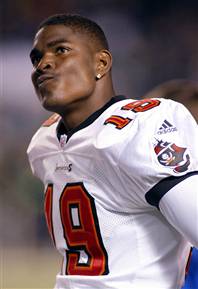
Highlighted Year: Keyshawn Johnson, 2001

Wide Receiver, Tampa Bay Buccaneers


Age: 29
6th season in pro football, 2nd with Buccaneers
College: Southern California
Height: 6’4”   Weight: 212

Prelude:
In two seasons at USC after transferring from West Los Angeles College, Johnson caught 168 passes for 2796 yards (16.6 avg.) and 16 touchdowns, including 102 for 1434 yards and 7 TDs in 1995. He received consensus first-team All-America recognition and was chosen by the New York Jets as the top overall selection in the 1996 NFL draft. Johnson showed off his potential, with 63 receptions for 844 yards and 8 TDs as a rookie, but also a distracting brashness. Big and physical, if not particularly fast, he followed up with another solid season in ’97 and, with the club improving dramatically overall, had consecutive Pro Bowl seasons in 1998 and ’99 as he caught over 80 passes and gained a thousand yards in each, scoring a combined 18 touchdowns. Johnson was traded to Tampa Bay in 2000 and had a lesser year, catching 71 passes for 874 yards and 8 TDs.

2001 Season Summary
Appeared in 15 of 16 games
[Bracketed numbers indicate league rank in Top 20]

Pass Receiving
Receptions – 106 [4, 1st in NFC]  
Most receptions, game – 12 (for 89 yds.) vs. Chicago 11/18
Yards – 1266 [7]
Most yards, game – 159 (on 10 catches) vs. Pittsburgh 10/21
Average gain – 11.9
TDs – 1
100-yard receiving games – 4

Scoring
TDs – 1
Points – 6

Postseason: 1 G (NFC Wild Card playoff at Philadelphia)
Pass receptions – 3
Pass receiving yards – 75
Average yards per reception – 25.0
Pass Receiving TDs – 0

Awards & Honors:
Pro Bowl

Buccaneers went 9-7 to finish third in the NFC Central and qualified for a Wild Card playoff spot. Lost NFC Wild Card playoff to Philadelphia Eagles (31-9).

Aftermath:
Johnson followed up with 76 catches for 1088 yards (14.3 avg.) and five touchdowns in 2002 as the Buccaneers won the NFL title, but as his relationship with the coaching staff deteriorated, he was deactivated for the last seven games of the ’03 season. Dealt to the Dallas Cowboys in 2004, Johnson continued to be a productive possession receiver for two seasons and finished up by catching 70 passes for 815 yards with Carolina in 2006. For his career, Johnson had 814 pass receptions for 10,571 yards (13.0 avg.) and 64 TDs. Of those totals, 298 for 3828 yards and 17 TDs were with Tampa Bay. He was selected to three Pro Bowls.

--

Highlighted Years features players who were consensus first-team All-League* selections or league* or conference** leaders in the following statistical categories:

Rushing: Yards, TDs (min. 10)
Passing: Yards, Completion Pct., Yards per Attempt, TDs, Rating
Receiving: Catches, Yards, TDs (min. 10)
Scoring: TDs, Points, Field Goals (min. 5)
All-Purpose: Total Yards
Defense: Interceptions, Sacks
Kickoff Returns: Average
Punt Returns: Average
Punting: Average

*Leagues include NFL (1920 to date), AFL (1926), AFL (1936-37), AAFC (1946-49), AFL (1960-69), WFL (1974-75), USFL (1983-85)

**NFC/AFC since 1970

September 6, 2016

1998: Hearst’s 96-Yard Run in OT Propels 49ers Over Jets


The season-opening NFL game in San Francisco on September 6, 1998 featured the 49ers, a perennial contender, hosting the New York Jets, a team that was on the rise.

The 49ers were a savvy veteran club that was used to winning, having been to the postseason in each of the previous six seasons and 16 of the past 18 years. Steve Mariucci had taken over as head coach in 1997 and the result was a conference-best 13-3 record and an appearance in the NFC Championship game. 36-year-old QB Steve Young routinely won passing titles, and while there were concerns that he could no longer deliver the long ball, the return of star WR Jerry Rice, who was lost for the year in the first week of ‘97, was expected to help, even coming off of two knee surgeries.

New York was just two years removed from a dreadful 1-15 campaign in 1996 but had perked up considerably to 9-7 in the first year under Head Coach Bill Parcells. QB Glenn Foley, taking over for the departed Neil O’Donnell, brought a gunslinger attitude to the offense but was also inexperienced, and underachieving veteran QB Vinny Testaverde was signed during the offseason. RB Curtis Martin was obtained from New England, where he had previously played with distinction under Parcells, and there was a young pass receiving corps led by brash WR Keyshawn Johnson. The team was in rebuilding mode but appeared poised to move up.


There were 64,419 fans in attendance on an unseasonably warm day at 3Com Park. The 49ers had the game’s first possession but turned the ball over when a pass by Steve Young was intercepted by FS Kevin Williams, who returned it 34 yards to the San Francisco 27. Glenn Foley (pictured at right) completed two passes to Keyshawn Johnson and John Hall kicked a 24-yard field goal to give the Jets the early lead.

The teams exchanged punts before San Francisco put together an 84-yard drive in eight plays. Young completed four passes along the way, with the longest to WR Terrell Owens for 23 yards, and RB Garrison Hearst (pictured at top) capped the series with a five-yard touchdown run up the middle. Wade Richey kicked the extra point and the home team was ahead by 7-3.

The Jets had the ball for the remainder of the opening period, but on the first play of the second quarter CB Antonio Langham picked off a Foley pass to give the 49ers possession at the New York 48. Hearst burst up the middle for 19 yards on first down, but three consecutive incomplete passes forced a long field goal try by Richey, and his 47-yard attempt missed the mark. Seven plays later, Foley connected with Johnson for a 41-yard TD and, with Hall’s point after, the visitors were back on top by 10-7.

The teams again traded punts before the 49ers put together a seven-play, 63-yard scoring drive. Young threw to WR J.J. Stokes for 25 yards and followed up with a completion to FB Marc Edwards for 16 yards to reach the New York 17. The drive bogged down but a defensive holding penalty on a third-and-six play gave the Niners a first down at the eight and, two plays later, it was Young to Stokes for a six-yard touchdown. Richey’s conversion had San Francisco ahead by 14-10.

There were still two minutes remaining in the first half following RB Leon Johnson’s 33-yard kickoff return, and Foley fired passes to WR Dedric Ward for 19 yards and Keyshawn Johnson for nine to reach the San Francisco 32. The Jets got a break when an interception was nullified by a penalty on the 49ers and, three plays later, Foley tossed a pass to WR Wayne Chrebet for a six-yard TD with 37 seconds left on the clock. Hall booted the extra point and, in see-saw fashion, the Jets took a 17-14 lead into halftime.

Following a possession by the Jets that concluded with a punt to start the third quarter, the 49ers tied the score with a 38-yard drive in seven plays that ended with a Richey field goal from 22 yards. However, New York came right back when, on the first play of the next series, Foley threw to Chrebet for a 48-yard gain to the San Francisco 30. Three plays later, with a roughing-the-passer penalty mixed in to move the Jets closer, Foley connected with Keyshawn Johnson for a 21-yard touchdown and, with Hall providing the extra point, the visitors were up by 24-17.

The 49ers responded with a 68-yard series in seven plays that featured Young completing consecutive passes to Owens for 19 yards and WR Jerry Rice for 21. Facing fourth-and-one at the New York 14, it was Young to Rice for a TD but the extra point attempt was blocked by DT Jason Ferguson and New York remained in the lead by a point.

The Jets had the ball in a possession that extended into the fourth quarter. Foley threw to Curtis Martin for 18 yards and to Chrebet twice, once for eight yards in a third-and-seven situation and then for 22 to get the ball to the San Francisco 29. But New York came up empty when the drive stalled and Hall missed a 45-yard field goal attempt.

The teams exchanged punts before the Jets advanced to another score. Foley completed passes to Martin for 22 yards, Keyshawn Johnson for 14, and Chrebet for 22 and, after Martin ran twice to get to the San Francisco 14, Hall booted a 32-yard field goal to make the score 27-23.


After the ensuing kickoff, the 49ers took possession with 3:38 remaining in regulation. On first down, Young passed to Hearst for a 35-yard gain to the New York 41. Four plays later, it was Young to Stokes (pictured at left), who out-jumped Kevin Williams and dove into the end zone for a 31-yard touchdown and, with Richey making the extra point, the Niners were in the lead by three points at 30-27 with the clock down to 1:32.

There was still time for the Jets, and they drove 60 yards in 12 plays. Foley converted a third-and-ten play with a throw to Chrebet for 19 yards and a fourth-and-ten situation with a toss to Ward for 22 to the San Francisco 32. Another pass to Ward on third down picked up 19 yards and, as time expired, Hall booted a 31-yard field goal to make it 30-30 and send the contest into overtime.

The Jets had the ball first in the extra period but went three-and-out. CB R.W. McQuarters returned Nick Gallery’s punt 16 yards to give San Francisco good field position at the New York 43, but the 49ers were unable to move and punted in return.

The visitors, helped by a face mask penalty, drove to their 47 before having to punt again, and Gallery’s 49-yard kick had the 49ers taking possession at their four yard line. But on the next play, Hearst broke away off right tackle, stiff-armed Williams at the 20, and was off to the races for a 96-yard touchdown run, reaching the end zone just ahead of LB Mo Lewis’ desperation tackle. In stunning fashion, San Francisco came away the winner by a final score of 36-30.

The teams combined for 1003 yards, with the 49ers having the edge (557 to 465) as well as in first downs (26 to 25). New York, whose yardage total was its most in eight years, led in time of possession (34:43 to 29:25). Each club turned the ball over once.

Steve Young completed 26 of 46 passes for 363 yards and three touchdowns while giving up one interception. Boosted by the game-winning run that was the longest in franchise history, Garrison Hearst accumulated 187 yards on 20 carries that included two TDs. J.J. Stokes had 7 catches for 111 yards and two touchdowns and Jerry Rice pulled in 6 passes for 86 yards and a score.


For the Jets, Glenn Foley had a career day as he succeeded on 30 of 58 throws for 415 yards and three TDs with one interception. There were two receivers with over a hundred yards led by Keyshawn Johnson, who caught 9 passes for 126 yards and two touchdowns, along with Wayne Chrebet (pictured at right) with 6 receptions for 125 yards and a TD. Dedric Ward was four yards short of the century mark as he gained 96 yards on five catches. Curtis Martin had a fairly quiet rushing day, gaining 58 yards on 22 attempts, but also had four pass receptions for 41 yards. 

“It’s disappointing to fight that hard and lose,” said a drained Coach Parcells. “You just put players in a position to make plays and you’ve got to make them. Hearst was right there. We missed some tackles there.”

San Francisco went on to a 12-4 record that placed second in the NFC West and qualified for a Wild Card playoff spot. The 49ers defeated Green Bay in the first round before falling to Atlanta at the Divisional level. The Jets were a bigger surprise in also going 12-4 and topping the AFC East. They reached the AFC Championship game before finally succumbing to the Denver Broncos.

Steve Young had another stellar year, passing for a career-high 4170 yards and a league-leading 36 touchdowns. He was chosen to a seventh straight Pro Bowl, his last. Garrison Hearst went on to gain 1570 yards on 310 carries with seven TDs and was also a Pro Bowl selection for the first time. J.J. Stokes achieved career bests with 63 pass receptions for 770 yards and eight touchdowns and Jerry Rice returned to Pro Bowl form as he caught 82 passes for 1157 yards and nine TDs.

For Glenn Foley, the big opening performance against the 49ers proved to be the highlight of his season. Two lackluster starts while also being sidelined with a rib injury in between caused him to be relegated to the bench in favor of Vinny Testaverde, who put together a Pro Bowl year in quarterbacking the Jets to the postseason.
December 19, 2015

1998: Jets Defeat Bills to Clinch AFC East


The New York Jets had a 10-4 record and were looking to wrap up the AFC East title as they faced the Buffalo Bills on December 19, 1998. In their second season under Head Coach Bill Parcells, the Jets were a far cry from the 1-15 club of two years earlier. Newcomers to the offense, most notably QB Vinny Testaverde (pictured at right) and RB Curtis Martin, were having a major impact, as were wide receivers Keyshawn Johnson, a flashy third-year player, and Wayne Chrebet, a classic overachiever in his fourth season. The defense was strongest at linebacker, where Mo Lewis was joined by Bryan Cox, let go by the Bears but revitalized with the Jets.

Buffalo was coached by Wade Phillips and came into the contest at 9-5. Diminutive 36-year-old QB Doug Flutie had turned the club around in his return to the NFL from the CFL, taking over for QB Rob Johnson after a slow start. Retooling from the squad that had started the decade with four straight AFC Championships, the offense now also featured RB Antowain Smith and WR Eric Moulds while RB Thurman Thomas and WR Andre Reed had reduced roles. The tough defense was still anchored by DE Bruce Smith, who was beginning to slow down at age 36, as well as NT Ted Washington.

There were 79,056 fans in attendance at Rich Stadium on a windy Saturday. The Bills had the first possession and advanced into New York territory thanks to a pass from Doug Flutie to Eric Moulds that picked up 28 yards. Another throw to WR Quinn Early gained eight more yards to the 23, but on the next play the usually sure-handed Antowain Smith fumbled and LB Pepper Johnson recovered for the Jets.

New York drove 79 yards in eight plays. Vinny Testaverde threw to Keyshawn Johnson (pictured below) for 16 yards on first down and, after the series appeared to be stymied at the Jets’ 37, Testaverde ran for 14 yards on a third-and-10 play. Two plays later, RB Dave Meggett, who had only recently joined the team, gained 18 yards on a carry up the middle, Johnson picked up another 25 yards on an end-around, and it was Testaverde to Wayne Chrebet for a seven-yard touchdown. John Hall added the extra point and the visitors had the early 7-0 lead.


On the next possession, the Bills converted a third-and-nine situation with a Flutie pass to Moulds for 27 yards, but a 15-yard taunting penalty on the receiver at the end of the play erased most of the gain and Buffalo was ultimately forced to punt. Chris Mohr’s kick traveled 47 yards and pinned the Jets back at their one yard line, and a short series resulted in a punt in return. A 30-yard kick by John Kidd went just 30 yards and gave the Bills good starting field position at the New York 40. But after a short Flutie pass to Smith gained five yards, two more throws were incomplete and, facing fourth-and-five, another pass intended for Moulds also was unsuccessful.

The teams continued to exchange punts as the game entered the second quarter. Finally, Buffalo put together an 11-play drive that covered 79 yards. Flutie completed passes to FB Sam Gash for nine yards and WR Kevin Williams for 22 yards in a third-and-six situation. Smith ran effectively and Flutie himself had a nine-yard run. Flutie connected with Thurman Thomas for a 25-yard TD to complete the series and Steve Christie added the point after to tie the score.

Following a punt by the Jets, the Bills drove from their one to the New York 10 as Flutie completed three passes, the longest to Moulds (pictured below) for 35 yards, but they ultimately came up empty when Christie was wide to the left on a 28-yard field goal attempt in the final seconds of the half. The score remained unchanged at 7-7 although Buffalo had already accumulated 266 yards.


The Jets started off the third quarter by advancing into Buffalo territory. Testaverde completed consecutive passes to Keyshawn Johnson for 16 and six yards and Curtis Martin had a nine-yard run. Hall kicked a 48-yard field goal to put the visitors back in the lead by 10-7.

Buffalo responded with a long scoring drive. Smith carried most of the load, picking up 35 yards on eight attempts and Flutie converted two third downs, one on a pass to Williams for seven yards and another on a three-yard run. The advance finally faltered at the New York 26 and Christie tied the score once more with a 44-yard field goal into the wind. But two plays after the ensuing kickoff, Testaverde threw to WR Dedric Ward, who beat CB Donovan Greer, an injury replacement, for a 71-yard touchdown. Hall’s kick gave the visitors a seven-point lead.

The Bills had to punt following the next series and the Jets moved into Buffalo territory, helped by a defensive holding penalty in a third-and-nine situation. But they were again forced to try for a field goal and Hall’s attempt from 46 yards was no good.

Following another exchange of punts, the Bills had good starting field position at the New York 49. Keeping the ball on the ground, they reached the 21, but a Flutie pass was bobbled by Williams and barely picked off by diving CB Victor Green (television replays were inconclusive as to whether he maintained possession) with just under four minutes remaining in regulation.

The Jets went three-and-out, with Kidd’s punt sailing 57 yards. Starting from their 20, the Bills had one last chance and Flutie immediately threw to Moulds for 17 yards. But following a short run by Thomas, the next three passes fell incomplete to turn the ball over to New York on downs. There was still 1:32 left on the clock, but a Testaverde throw to Johnson for seven yards on a third-and-six play nailed down the 17-10 win for the Jets.

Buffalo had the edge in total yards (366 to 269), although the Bills gained only 100 yards in the second half. They also had more first downs (21 to 14) and ran far more plays (74 to 51). However, the home team also turned the ball over twice, to none suffered by the Jets.

Vinny Testaverde completed 14 of 23 passes for 184 yards and a touchdown while giving up no interceptions. Keyshawn Johnson had 7 catches for 66 yards while Dedric Ward gained a team-leading 71 yards on his one long scoring reception. Curtis Martin was held to 38 rushing yards on 20 attempts.

For the Bills, Doug Flutie had a rough outing, completing just 14 of 38 throws for 220 yards and a TD as well as an interception. While he was only sacked once, he faced heavy pressure and was knocked down often. Antowain Smith (pictured below) gained 82 yards while running the ball 20 times. Eric Moulds topped the receivers with four catches for 107 yards.


The Jets won the season finale to finish at 12-4 with their first division title since they were an AFL team in 1969. They reached the AFC Championship game before losing to Denver. Buffalo ended up in third place in the AFC East with a 10-6 record and qualified for the playoffs as a Wild Card. The Bills lost to Miami, the club that finished second in the division, in the first round.

Vinny Testaverde ended up with an AFC-leading 101.6 passer rating, throwing for 3256 yards and 29 TDs with just seven interceptions. He was selected to the Pro Bowl along with Keyshawn Johnson, who caught 83 passes for 1131 yards and 10 touchdowns, and Curtis Martin, who had many more productive games on his way to 1287 rushing yards.

Doug Flutie also was chosen for the Pro Bowl as he started ten games, seven of them wins, and threw for 2711 yards and 20 touchdowns against 11 interceptions. Eric Moulds led the AFC with 1368 pass receiving yards on his 67 catches with 9 TDs and was another Pro Bowl selection. Antowain Smith, in his second season, rushed for 1124 yards while averaging 3.7 yards per attempt and scored eight TDs. 

January 10, 2015

1999: Jets Beat Error-Prone Jaguars in Divisional Playoff Game


The New York Jets were in the postseason for the first time in seven years as they hosted the Jacksonville Jaguars in an AFC Divisional Playoff game on January 10, 1999. Head Coach Bill Parcells, formerly of the Giants and Patriots, had guided the Jets to a remarkable turnaround, just two seasons removed from a dreadful 1-15 record. Newcomers had made a difference in ’98, with QB Vinny Testaverde (pictured above), a career underachiever, putting together a Pro Bowl season and RB Curtis Martin, formerly with Parcells in New England, rushing for 1287 yards and also gaining a Pro Bowl spot. Another Pro Bowler was WR Keyshawn Johnson, stepping up his game in his third season in New York (83 catches, 1131 yards, 10 TDs). The defense was especially strong at linebacker, where yet another newcomer, Bryan Cox, performed well in a unit that already included All-Pro OLB Mo Lewis. The Jets won their last six regular season games on the way to a 12-4 record that topped the NFC East.

The Jaguars, only a fourth-year franchise coached by Tom Coughlin, were nevertheless in the playoffs for the third consecutive season, having topped the AFC Central at 11-5. The offense was potent, led by QB Mark Brunell, who missed three weeks late in the season with an ankle injury. Wide receivers Jimmy Smith and Keenan McCardell made for a productive tandem and rookie RB Fred Taylor rushed for 1223 yards and 14 touchdowns. The defense was far less impressive, however, ranking a mediocre 25th in the league and particularly lacking a pass rush. Jacksonville defeated the Patriots, who were without their starting quarterback, in the Wild Card playoff round to advance to the Divisional game against the Jets.

There were 78,817 fans in attendance at Giants Stadium in the New Jersey Meadowlands. The Jets had the first possession and drove 70 yards in seven plays. Curtis Martin started it off with a 17-yard gain on a pass play and rushed for 11 yards while Vinny Testaverde had three more completions, the last two to RB Dave Meggett for 14 yards and Keyshawn Johnson (pictured below) for a 21-yard touchdown. John Hall added the extra point.


The teams exchanged punts, with the Jaguars advancing to the New York 42 on their second possession. Mark Brunell completed three passes, two of them to Keenan McCardell, but his last two fell incomplete, forcing another punt. The Jets took over at their seven and, in a series that extended into the second quarter, drove into Jacksonville territory. Testaverde was successful on four of his throws, one of which had 15 yards tacked on for an unsportsmanlike conduct penalty, and after the drive stalled at the 34, Hall kicked a 52-yard field goal to open up a 10-0 lead for New York.

The Jaguars no sooner got the ball back following the kickoff when Brunell threw a pass that was intercepted by CB Otis Smith at the New York 40. A long possession with an odd play in the midst of it ensued. With the Jets at the Jacksonville 18, Martin fumbled and FS Chris Hudson recovered and raced 47 yards down the sideline. However, an attempt to lateral to CB Dave Thomas failed and Keyshawn Johnson recovered the loose ball. Given a reprieve, the Jets drove 65 yards back into Jacksonville territory and, on an end-around, Johnson ran around left end for a ten-yard TD. With Hall’s point after, the New York lead was up to 17-0 with 40 seconds remaining in the first half.


It was enough time for the Jaguars, following a 28-yard kickoff return by WR Reggie Barlow. Three plays later, Brunell threw long to Jimmy Smith (pictured at left), who took advantage of a lapse in coverage for a 52-yard touchdown. Mike Hollis converted and the score stood at 17-7 at halftime.

Jacksonville appeared to maintain the momentum heading into the first series of the third quarter, but facing a third-and-inches situation at their 49, Brunell threw a long pass that was picked off by FS Corwin Brown, who returned it 40 yards to the Jacksonville 40. Testaverde completed passes to Martin for 16 yards and Johnson for 23 to reach the one yard line, and three plays later Martin scored a TD that, followed by Hall’s PAT, again gave the Jets a 17-point lead at 24-7.

The Jaguars weren’t finished yet, and Barlow returned the ensuing kickoff 88 yards to the New York four. The Jets held for three downs, but on fourth-and-three, Brunell completed a pass to McCardell for a touchdown. Hollis added the extra point to reduce the New York lead to 24-14.

The Jets responded with a series in which Testaverde completed all five of his passes. WR Wayne Chrebet hauled in the first for 16 yards, Martin had catches for nine and ten yards, and in between WR Dedric Ward had an 18-yard reception. TE Kyle Brady’s catch for 17 yards put the ball at the Jacksonville four, and two carries by Martin yielded a one-yard TD. Hall kicked the point after and the home team took a 31-14 lead into the fourth quarter.

Following a punt by the Jets early in the final period, Fred Taylor took off on a 29-yard run that launched a 64-yard drive. Brunell threw to Jimmy Smith for a 19-yard TD and Hollis converted to make the score 31-21.

On the third play of their next possession, the Jets turned the ball over when Chrebet fumbled when hit by LB Kevin Hardy and Dave Thomas recovered for the Jaguars at the New York 41. It appeared that the break would come to nothing when the visitors couldn’t move the ball and a fourth-and-nine pass fell incomplete, but the Jets were called for pass interference. Jacksonville still couldn’t get a first down, reaching the New York 19, but Hall kicked a 37-yard field goal to make it a seven-point game with 6:38 to play in regulation.

The Jets fought back, converting a third-and 14 situation at their own 30 with Testaverde connecting with Johnson for a 20-yard gain. Martin ran effectively, but after advancing to the Jacksonville 14, Testaverde’s pass was intercepted by SS Donovin Darius. Darius, who slid down in the end zone after making the catch, was slow to get to his feet and, rather than taking a touchback, tried to run and barely made it out of the end zone before being tackled. The Jaguars thus were forced to start from their one yard line. Brunell had a seven-yard run on second down, but his three passes fell incomplete, including the last on fourth-and-three at his eight at the two minute mark. Hall kicked a 30-yard field goal to effectively seal the 34-24 win for New York, with the home crowd erupting loudly at the end.

The win was New York’s first in 12 years in the postseason. The Jets significantly led in total yards (429 to 251) and first downs (29 to 14). Jacksonville turned the ball over four times, to three suffered by New York, but the Jaguars had the game’s only two sacks.

Vinny Testaverde completed 24 of 36 passes for 284 yards and a touchdown while giving up one interception. Curtis Martin (pictured below) rushed for 124 yards on 36 carries that included two TDs and also caught 6 passes for another 58 yards. Keyshawn Johnson had 9 catches for 121 yards and a touchdown, ran the ball twice for 28 yards and another score, and also recovered a fumble and, inserted as an extra defender, intercepted a desperation pass at the end of the game. The overall performance made him the second player in NFL postseason history to score on both a catch and a run, recover a fumble, and intercept a pass in the same playoff game (Jack Manders of the Bears did the same thing in the 1937 NFL Championship game).


For the Jaguars, Mark Brunell was successful on 12 of 31 throws for 156 yards and three TDs, but also was intercepted three times. Fred Taylor gained 86 yards on 20 rushing attempts. Jimmy Smith caught 5 passes for 104 yards and two touchdowns and Keenan McCardell contributed four receptions for 32 yards and a TD. On defense, Kevin Hardy had a noteworthy performance, compiling 19 tackles, 14 of them solo.

 “It wasn’t an aesthetic performance in a lot of ways, but this is a good win for this franchise,” said Coach Parcells of the Jets.

“We made foolish, foolish plays, foolish throws, foolish decisions,” summed up Mark Brunell of his team’s performance.

The Jets moved on to the AFC Championship game at Denver and lost convincingly to the powerful Broncos. Jacksonville came back in 1999 with a NFL-best 14-2 record and reached the AFC title game before losing to Tennessee.

November 3, 2010

2002: Brad Johnson Throws for 5 TDs as Bucs Beat Vikings


Under the leadership of defensive-minded Head Coach Tony Dungy, the Tampa Bay Buccaneers had gone from being perennial bottom feeders to contenders. However, while they made it to the postseason in four of the five seasons prior to 2002, they got as far as the NFC Championship game once and, in 2000 and ’01, had not gotten beyond the Wild Card playoff round. The problem had been that, while the defense was solid, the offense, directed by a series of coordinators, was conservative and tended to have difficulty scoring points – especially in the postseason. As a result, Dungy was fired following the 2001 season (and of course resurfaced in Indianapolis, where he enjoyed greater success) and was replaced by the more offense-minded Jon Gruden, late of the Oakland Raiders (and after being turned down by Bill Parcells).

Key to the offense was QB Brad Johnson (pictured above), a nine-year NFL veteran in his second season with Tampa Bay. While immobile and not much of a deep passer, he was very accurate on short passes, which made him a good fit in Gruden’s version of the West Coast offense. He also had good leadership skills and toughness. His abilities in the revamped offense were especially evident in a Week 9 matchup against Minnesota.

The Buccaneers were 6-2 as they hosted the Vikings on November 3, 2002 at Raymond James Stadium, but the defense was still largely carrying the club (they had scored just 11 offensive TDs in the eight games) and Johnson had missed the previous contest due to a rib injury. Minnesota, under Head Coach Mike Tice, lost its first four games and was 2-5 coming into the contest, although coming off a good win against Chicago.

Things got off to a good start for Tampa Bay very quickly as safety Jermaine Phillips recovered a fumble by Minnesota WR Nick Davis on the opening kickoff at the Vikings’ 21 yard line. Three plays later, Johnson tossed a 15-yard touchdown pass to WR Karl Williams for a quick 7-0 lead.

The Bucs went on to score on each of their first four possessions. A 12-play, 86-yard drive ended with Johnson completing a two-yard TD pass to TE Rickey Dudley and the score stood at 14-0 after one quarter. Early in the second quarter, Martin Gramatica kicked a 36-yard field goal, and Johnson threw another short touchdown pass of two yards to WR Keyshawn Johnson.

Down 24-0 and still in the second period, the Vikings finally got on the board thanks to a big play as RB Michael Bennett ran for an 85-yard touchdown. 43-year-old Gary Anderson kicked a 26-yard field goal before the quarter was over to cut Tampa Bay’s lead to 24-10 at halftime (Gramatica missed a 40-yard field goal attempt that would have added to the lead).

Brad Johnson tossed a third quarter touchdown pass to Keyshawn Johnson of 19 yards and FB Mike Alstott scored in the fourth quarter on a five-yard reception. The Vikings had two one-yard runs by RB Moe Williams, but Minnesota was never able to mount a credible comeback in the second half – even a successful onside kick led to failure when QB Daunte Culpepper was intercepted by DT Warren Sapp. The Buccaneers won convincingly, 38-24.

For a team that had been considered offensively-challenged, it was an impressive showing. Tampa Bay rolled up 446 yards, to 387 for the Vikings, and only punted once. They gave up no turnovers and Johnson wasn’t sacked (pass protection had been an issue in prior weeks). In addition, Minnesota was hurt by a total of 12 penalties.


Brad Johnson completed 24 of 31 passes for 313 yards and a club-record tying five touchdowns while not being intercepted. Keyshawn Johnson (pictured at left) caught 9 passes for 133 yards and two of the TDs (of his career-high 106 receptions in 2001, only one had been for a score). RB Aaron Stecker carried the ball just once, but it was for a 59-yard gain to lead the team in rushing. Mike Alstott ran for 55 yards on 26 carries and caught three passes for 16 yards, including a TD.

Daunte Culpepper went to the air 29 times for the Vikings, with 18 completions for 225 yards, but had no touchdown passes and surrendered two interceptions. Thanks to the long scoring run, Michael Bennett gained 114 yards on just 10 carries. Moe Williams had the two short rushing touchdowns while gaining 43 yards on 7 attempts, and also led Minnesota with 5 pass receptions, for 24 yards. TE Jim Kleinsasser gained 64 yards on three catches.

Tampa Bay lost only twice more the rest of the way and finished atop the NFC South with a 12-4 record. They finally broke through in the postseason, beating the Eagles in Philadelphia for the NFC Championship (the site of their losses in the preceding two playoff appearances) and defeating Oakland in the Super Bowl. Minnesota went 6-10 for second place in the NFC North.

Brad Johnson led the NFC in passing (92.9 rating) and was among the league leaders in completion percentage (62.3) and touchdown passes (22). He threw for 3049 yards and was intercepted only six times, for a league-low 1.3 INT percentage. Johnson was named to the Pro Bowl for the second time in his career (and only time in Tampa Bay).

While the Tampa Bay offense ranked 18th in the league, that was higher than at any time during the Dungy years. Combined with the NFL’s top-ranked defense, it was enough to win a championship.