December 18, 2011

1976: Raiders Come From Behind to Beat Patriots in Penalty-Filled Playoff Game


The AFC Divisional playoff game at the Oakland-Alameda County Coliseum on December 18, 1976 featured a team that had regularly contended but not yet reached the top against a club that had risen from 3-11 to 11-3 in one year.

The Raiders, coached by John Madden, were the regular contenders. They won the AFC West for the fifth straight time and sixth in seven years since the NFL/AFL merger with a league-best 13-1 record. However, for all of their success, they had consistently come up short in the postseason. QB Ken “The Snake” Stabler had an outstanding season in ’76 and had excellent wide receivers in Cliff Branch and Fred Biletnikoff (pictured above), as well as talented TE Dave Casper. Running behind a superb offensive line, FB Mark van Eeghen rushed for 1012 yards. The defense had been switched to a 3-4 alignment with good results.

New England was the 11-3 Cinderella team, having posted their first winning record since they were still the Boston Patriots of the AFL in 1966. Coached by Chuck Fairbanks for the fourth year, they had benefited from the fine play of QB Steve Grogan in his first full season as the starter, a good group of running backs led by FB Sam “Bam” Cunningham, and the performance of second-year TE Russ Francis. The opportunistic defense that featured the NFL’s Defensive Rookie of the Year, CB Mike Haynes, and another first-year star in FS Tim Fox led the league in takeaways with 50. Moreover, the Patriots had inflicted the only defeat on Oakland during the regular season – a 48-17 thrashing in Week 4 – on the way to a second place finish in the AFC East and wild card spot in the playoffs.

New England started off the scoring with an 87-yard drive highlighted by a spectacular one-handed catch by Francis for a 48-yard gain on a third-and-seven play from the Patriots’ 33 yard line. Grogan threw to WR Darryl Stingley for 24 yards on a third-down play to the Oakland one and HB Andy Johnson capped the series with a one-yard scoring run at 3:41 into the first quarter.

The Raiders responded with a scoring drive of their own as Stabler completed his first two passes of the day, of 22 yards to Biletnikoff and 18 to Branch, to set up a 40-yard field goal by Errol Mann just before the end of the opening period.

There were no more points during the first half until just before halftime when CB Skip Thomas intercepted a pass to give the Raiders the ball on their 24. Oakland moved into New England territory and Stabler threw a 31-yard touchdown pass to Biletnikoff. So while the Patriots had dominated the first thirty minutes of play, holding the ball for 42 plays to 25 by Oakland, the Raiders led by 10-7.

New England, playing ball-control football, scored twice in the third quarter to nearly take control of the game. The first score came on a drive helped along by a questionable holding call on the Raiders on the punt return that opened the series. New England went 80 yards and QB Steve Grogan finished it off with a 26-yard TD pass to Francis.

Five minutes later, the Patriots punted but retained possession following another penalty on Oakland (an offside call on LB Ted Hendricks). Keeping the ball on the ground, New England drove 55 yards with ex-Raider FB Jess Phillips running in for the touchdown from three yards out. At the end of three quarters, the Patriots held a 21-10 lead and it seemed as though the Raiders might once again fall short of reaching the Super Bowl.


Oakland came right back, however, as Stabler (pictured at left), who had been having problems with his passing, hit on five straight throws in a 70-yard possession into the fourth quarter that ended with van Eeghen running in over left tackle for a TD. With just over 11 minutes to play, New England’s margin was narrowed to 21-17.

The Raiders were stopped the next time they had the ball and then a potential New England scoring drive faltered due to a penalty. Grogan appeared to have successfully sneaked for a crucial first down at the Oakland 28, but the play was nullified by an offside call and Cunningham was then stopped on a draw play. Forced to try for a long field goal, John Smith was short on a 50-yard attempt. With 4:12 left on the clock, the Raiders took over at their 32.

Stabler threw to Biletnikoff for 12 yards and 21 yards to Casper, but “The Snake” was then sacked by DE Mel Lunsford. With the ball at the New England 28, Stabler threw two incompletions, but on the second NT Ray Hamilton was flagged for roughing the passer, giving the Raiders a first down at the 13 with 57 seconds remaining.

Stabler threw to Casper for five yards, and the tight end got out of bounds to stop the clock. HB Clarence Davis ran for four yards on a draw play. The Patriots were penalized for a personal foul on SS Prentice McCray, who kept moving the ball back after it had been spotted.

With a first down and over a yard to go, Coach Madden called for Stabler to run a bootleg option. He chose to send RB Pete Banaszak into the line with 37 seconds left, and the Patriots stopped him short. Stabler, not known for his running ability, went with the rollout on the next play. Scrambling to his left and following G Gene Upshaw, he dove into the end zone with 10 seconds left for the winning touchdown as the Raiders advanced by a final score of 24-21.

New England outgained the Raiders (331 yards to 282) and had more first downs (23 to 20). The Patriots were more effective on the ground, outgaining Oakland by 164 yards to 81, and sacked Stabler four times while Grogan was not sacked at all. However, they turned the ball over three times, to one by the Raiders.

Ken Stabler had problems with his passing accuracy during the first three quarters, not helped by the New England secondary’s success at shutting down the speedy Cliff Branch (3 catches for 32 yards), although it opened up opportunities to throw to Fred Biletnikoff. The result was that Biletnikoff had a big day, pulling in 9 passes for 137 yards and a TD. Stabler was successful on 19 of 32 throws for 233 yards with a touchdown and none intercepted. Mark van Eeghen led Oakland in rushing with 39 yards on 11 carries that included a touchdown.


For the Patriots, Steve Grogan completed 12 of 23 passes for 167 yards with a TD and one picked off. Russ Francis (pictured at right) caught 4 of those throws for 96 yards and a score. Sam Cunningham gained 68 yards on 20 rushing attempts.

Penalties had played a big role throughout the game, especially in some key situations. The Raiders were flagged 11 times at a cost of 93 yards while the Patriots were penalized 10 times for 83 yards. While it seemed that both teams had benefited from the calls, New England’s players and coaches were more vociferous as they complained about the officiating – not to mention alleged dirty play by the Raiders – throughout the contest, and there was plenty of bitterness expressed afterward.

“That was one of the worst-called games I have ever seen in my life,” said an angry Patriots DE Julius Adams.

Chuck Fairbanks kept quiet regarding the officiating in general, but with regard to the controversial call on Ray Hamilton said, “I just hope they were right. It looked to me like Ray Hamilton hit the ball first. If he did deflect the ball, it was an incorrect call.”

More composed later, Fairbanks added, “I’m proud of my team and the way we played today. We’re going home knowing we played our hearts out.”

“That's what YOU say,” said Coach John Madden when the Pats' complaints were brought to his attention by a writer. “If you could sit there for 60 minutes and say the officials turned that game around with penalties at the end, you were wasting your time. You were eating a hot dog somewhere instead of watching what was going on. There was some great football out there.”

For the Raiders, the close call against New England proved to be the biggest scare they suffered on the way to a championship. They defeated the Steelers more easily in the AFC Championship game and dominated the Minnesota Vikings in the Super Bowl. As for the Patriots, they started slowly in 1977 and, while posting a respectable 9-5 record, missed the playoffs in what was ultimately a disappointing campaign.

December 17, 2011

1933: Bears Edge Giants in First NFL Championship Game


For the first thirteen years of its existence, the National Football League (American Professional Football Association originally) had no designated game to determine the annual champion. While season record was the determining factor, this occasionally led to controversy, especially when the teams didn’t play fixed schedules. In 1932, the clubs tied with the top winning percentage, the Chicago Bears and Portsmouth Spartans, arranged a game to determine the league champion – while this is sometimes referred to as the first NFL title game, it was not in fact a postseason contest, since the result figured in the season won-lost records (the Bears won).

Several innovations were put into effect for the 1933 season, including rules changes to promote scoring such as using hashmarks, allowing forward passes to be thrown from anywhere behind the line of scrimmage (as opposed to five yards behind), and moving the goal posts up to the goal line (where they would remain until moved back in 1974). There were also structural innovations that included breaking the league up into Eastern and Western divisions and creating a designated postseason championship game to be held between the division winners.

On December 17, 1933 the first official NFL Championship game occurred between the New York Giants, champions of the Eastern Division, and their hosts, the Western Division-champion Chicago Bears.


The Bears, defending league champs, were once again coached by team owner George Halas, who had stepped away from the sideline after the 1929 season for three years in favor of Ralph Jones. They won their first six games, briefly slumped during a midseason road trip to the East with two losses and a tie, and then finished up with four more victories to easily top the Western Division with a 10-2-1 record. Chicago was strong in all facets of the game, with FB Bronko Nagurski (pictured at right) providing the power running, QB Keith Molesworth leading the league by averaging 8.7 yards per pass, and end Bill Hewitt playing well both offensively and defensively.

New York was coached by Steve Owen and had dominated the Eastern Division with an 11-3 tally. Rookie tailback Harry Newman proved to be a top passer and FB Ken Strong, obtained after the Staten Island Stapletons folded, was a good runner and placekicker. Ends Red Badgro and Ray Flaherty and wingback Dale Burnett made for a capable receiving corps. The line was anchored by center Mel Hein and the Giants had proven their defensive prowess already in a shutout win over the Bears during the season.

There were some 26,000 fans in attendance at Wrigley Field on a foggy day with some light rain during the first half. The Giants drove to the Chicago 15 yard line and came up empty. With Nagurski running effectively, the Bears responded by driving into New York territory and scored the first points of the game on a 16-yard field goal by their outstanding placekicker, Jack Manders. Early in the second quarter, Manders booted a second field goal, from 40 yards, and the hosts were ahead by 6-0.

Late in the first half, FB Kink Richards broke off a 30-yard gain for the Giants and Newman threw to Badgro for a 29-yard touchdown. Strong was successful on the extra point attempt, and New York took a narrow 7-6 lead into halftime.

Manders put the Bears back in front in the third quarter with a 28-yard field goal, but the Giants came right back behind Newman’s passing on a 73-yard drive that ended with blocking back Max Krause plowing over from a yard out for a touchdown.

With the score 14-9, it was the turn of Chicago to make a big play. Facing a third-and-long situation, the Bears were set to punt but passed instead of kicking. HB George Corbett threw to QB Carl Brumbaugh for a 67-yard gain to the New York eight yard line (Brumbaugh shown running at top during the title game). From there, Nagurski took the handoff and headed for the line but held up and tossed a jump pass into the end zone. End Bill Karr hauled it in and Chicago regained the lead at 16-14.

Moving into the fourth quarter, once more Newman moved the Giants as he completed all four of his passes. At the Chicago eight, Strong took a handoff on a reverse and, seeing no running room, he lateraled back to Newman. Running to his right and hemmed in for a possible loss of yardage, the tailback saw that Strong had kept on going uncovered into the end zone and completed a TD pass to him. In the back-and-forth rhythm that the contest had settled into, New York was once more on top by a 21-16 tally.

It seemed as though that would be enough, but with time running down a shanked punt by the Giants that traveled only eight yards gave Chicago the ball in good field position at the New York 47. Molesworth passed to Brumbaugh for nine yards and then Nagurski ran for four. The Bears once again resorted to Nagurski on a jump pass (one of their most effective plays). This time the throw was to Hewitt for 14 yards, but when Dale Burnett closed in to make the tackle, he tossed the ball to Karr who ran the rest of the way for a 33-yard touchdown.

The outcome was still in doubt right down to the final play as Newman threw to Burnett in the open field, but DHB Red Grange, once a great running halfback but now better as a defensive back, was able to hold him up (and prevent a possible lateral) and the Bears won the NFL Championship by a score of 23-21.

The first postseason title game had been exciting, containing six lead changes, and highlighted the greater emphasis on passing in the pro game as opposed to college football at the time. As the report by the Associated Press put it, “The struggle was a revelation to college coaches who advocate no changes in the rules. It was strictly an offensive battle and the professional rule of allowing passes to be thrown from any point behind the line of scrimmage was responsible for most of the thrills.”

Total yards were almost even, with the Bears holding a slight edge of 311 to 307. Chicago gained most of its yardage on the ground (161 to 99) while the Giants went more often to the air (208 to 150). New York had the edge in first downs, 13 to 12. Notable individual performances were turned in by Bronko Nagurski, who ran for 65 yards on 14 carries, and Harry Newman (pictured below), who completed 12 of 17 passes for 201 yards and two touchdowns.

The Bears and Giants were still the best clubs in their respective divisions in 1934 and met again for the NFL title, this time at the Polo Grounds in New York and with a decidedly different result.

December 16, 2011

MVP Profile: Merlin Olsen, 1974

Defensive Tackle, Los Angeles Rams


Age: 34 (Sept. 15)
13th season in pro football & with Rams
College: Utah State
Height: 6’5” Weight: 270

Prelude:
Winner of the Outland Trophy as the best college lineman, Olsen was chosen in the first round of the 1962 NFL draft by the Rams (third overall) and moved into the starting lineup by the third game of his rookie season. With his size complemented by speed, agility, and intelligence, he became an immediate impact player and was named to the first of a record 14 consecutive Pro Bowls. He was a consensus first-team All-Pro selection as well for five consecutive years (1966 to ’70) and was particularly dominant during the George Allen head coaching era as part of the “Fearsome Foursome” that included ends Deacon Jones and Lamar Lundy and, first, Rosey Grier and then Roger Brown at tackle.

1974 Season Summary
Appeared and started in all 14 games
(Bracketed numbers indicate league rank in Top 20)

Sacks – N/A
Interceptions – 0
Fumble recoveries – 0

Postseason: 2 G
Sacks – 0.5 (unofficial)
Most sacks, game – 0.5 vs. Washington, NFC Divisional playoff
Interceptions – 0
TD – 0

Awards & Honors:
NFL Player of the Year: Bert Bell Award
2nd team All-NFL: PFWA
2nd team All-NFC: UPI
Pro Bowl

Rams went 10-4 to finish first in the NFC West while leading the NFL in defense against the run (1302 yards / 93.0 per game / 4 TDs) and giving up the fewest points (181) and the NFC in sacks (44). Won NFC Divisional playoff over Washington Redskins (19-10). Lost NFC Championship to Minnesota Vikings (14-10).

Aftermath:
Olsen played another two years, for a total of 15, and only missed the Pro Bowl in his final season of 1976 before retiring to a career as a broadcaster and actor. His #74 was retired by the Rams and he was inducted into the Pro Football Hall of Fame, Class of 1982.

--

MVP Profiles feature players who were named MVP or Player of the Year in the NFL, AAFC (1946-49), AFL (1960-69), WFL (1974), or USFL (1983-85) by a recognized organization (Associated Press, Pro Football Writers Association, Newspaper Enterprise Association, United Press International, The Sporting News, Maxwell Club – Bert Bell Award, or the league itself).

December 15, 2011

1963: Giants Beat Steelers to Win Eastern Conference Title


First place in the NFL Eastern Conference and a spot in the league title game were on the line as the Pittsburgh Steelers faced the New York Giants at Yankee Stadium on December 15, 1963. The Giants came into the contest with a 10-3 record while Pittsburgh was 7-3-3. At that time, ties did not figure into a team’s won-lost percentage, so a win by the Steelers would give them the conference title by .727 to .714 despite having fewer victories than the Giants (the method for determining won-lost percentage was changed in 1972, so that a tie counts as half of a win and half of a loss).

Head Coach Allie Sherman’s Giants had won the conference the previous two seasons but started off slowly in ’63, losing two of the first five games before putting together seven wins in the next eight contests. The veteran club featured the passing of QB Y.A. Tittle (pictured above) on offense and a sound defense.

The Steelers, coached by Buddy Parker, were a franchise that had never won a division title since coming into the NFL thirty years earlier. The ball-control offense was directed by QB Ed Brown and centered on the running of FB John Henry Johnson. Flanker Gary Ballman and split end Buddy Dial were capable receivers, and DE Lou Michaels was also one of the league’s better placekickers. The Steelers had stunned the Giants by a score of 31-0 when the clubs met in Week 2 at Pitt Stadium, and they were a confident and emotionally-charged team coming into the season finale.

There was a big crowd of 63,240 on hand for the showdown on a bitterly cold day. HB Theron Sapp fumbled on Pittsburgh’s first play from scrimmage and safety Jim Patton recovered for the Giants. It led to a 34-yard field goal by Don Chandler for the first points of the game.

Shortly thereafter, it seemed as though the Steelers would score in turn. Ballman returned the kickoff 57 yards but, after Brown overthrew his receiver on a third-and-four play, Michaels missed a field goal attempt. Pittsburgh quickly regained possession on a fumble recovery and Brown went deep right away, completing a pass to Ballman, but the receiver fumbled into the end zone when hit by CB Dick Lynch just a stride short of the goal line. CB Erich Barnes, coming across the field, picked up the loose ball and returned it to the New York 34. Tittle threw to end Aaron Thomas for a first down and then went deep to split end Del Shofner for a 41-yard touchdown. While Chandler’s extra point attempt hit the goal post and was no good, the Giants were ahead by 9-0 and had blunted Pittsburgh’s early momentum.

Brown continued to have trouble hitting his receivers, throwing a pass that was intercepted by Lynch and then, on the next series, overthrowing Ballman on a potential scoring play. Facing third-and-one, Johnson was stopped cold by the Giants defense, and going for it on fourth down, Sapp was held to no gain as well. New York made the most of it as Tittle once again threw long to Shoftner for a 44-yard gain and, now into the second quarter, the Giants extended their lead when Joe Morrison, a versatile player who was covering for injured FB Alex Webster, scored on a three-yard pass from Tittle. This time the PAT was good and New York was up by 16-0. Pittsburgh finally put points on the board when Michaels kicked a 27-yard field goal, although it was after Brown had again misfired on a pass to Ballman, having beaten Lynch on a post pattern.

The star receiver Shofner suffered bruised ribs in the second quarter and left the game. Still, the Giants held a 16-3 lead at halftime.

In the third quarter, the Steelers battled back as Johnson took off on a 48-yard run and Brown connected with Ballman for a 21-yard TD that, with the extra point, put the Steelers just six points behind at 16-10. With the momentum seeming to shift, the next series proved crucial for the Giants. On a third-and-eight play from his own territory, Tittle threw a pass that, due to the onrushing Michaels, lacked the usual accuracy, but flanker Frank Gifford made a spectacular one-handed catch for a 30-yard gain to the Pittsburgh 47. Tittle hit Gifford again for 25 more yards and then found Morrison for a 22-yard touchdown that broke the game open.

On New York’s next series, now up 23-10, Tittle connected with Thomas for 31 yards and 14 yards to Gifford to set up a short scoring run of one yard by Morrison. While Brown threw to Dial for a 40-yard TD with 29 seconds remaining in the third quarter, that was it for Pittsburgh. Chandler kicked a 41-yard field goal in the final period and the Giants came away with a convincing 33-17 win.

New York outgained the Steelers (423 yards to 400) and had more first downs (21 to 17). And while the Giants turned the ball over four times, the Steelers missed five scoring opportunities as they turned the ball over five times, three on interceptions and twice on fumbles.


Y.A. Tittle completed 17 of 26 passes for 308 yards with three touchdowns and one intercepted. Joe Morrison had an outstanding performance as he rushed for 68 yards and a TD on 15 carries and caught 6 passes for 40 yards and two scores. HB Phil King also gained 68 rushing yards, on 18 attempts. Frank Gifford (pictured at left) had 5 receptions for 94 yards and Del Shofner gained 110 yards on his three catches with the one long TD before he had to leave the game.

For the Steelers, QB Ed Brown went to the air 33 times and completed just 13 for 217 yards with two TDs and three interceptions. Gary Ballman had 6 catches for 104 yards and a touchdown and Buddy Dial pulled in 5 passes for 92 yards and a score. John Henry Johnson, thanks to the one long gain, accumulated 104 yards on 14 carries.

The Giants finished at 11-3 but lost their third straight NFL Championship game, falling 14-10 to the Bears. The defeat in the season finale dropped Pittsburgh all the way to fourth place with a 7-4-3 record. The Steelers would not win a division title until 1972.

Y.A. Tittle set a new NFL record with 36 touchdown passes (Houston’s George Blanda had already done so in the AFL in 1961) while also leading the league in passing (104.8 rating by the current standard), completion percentage (60.2), and yards per attempt (8.6). In addition to receiving first-team All-Pro and Pro Bowl recognition, the 37-year-old veteran was also named MVP by the Associated Press and Newspaper Enterprise Association.


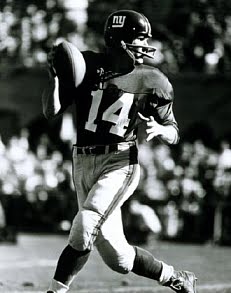
Frank Gifford, formerly an outstanding running halfback, was named to the Pro Bowl as a flanker after catching 42 passes for 657 yards (15.6 avg.) and seven touchdowns. Joe Morrison (pictured at right) rushed for 568 yards with a 4.8 average while also catching 31 passes for 284 more and a total of 10 touchdowns. It was all part of a 14-year career in which the multitalented player out of Cincinnati would often be called upon in a reserve role to fill in at halfback, flanker, and defensive back as well as fullback.

December 14, 2011

2003: Panthers Defeat Cardinals to Clinch Division Title


In their first eight years after coming into the NFL as an expansion franchise in 1995, the Carolina Panthers achieved both a winning record and division title on one occasion, in 1996. Since that time, they had reached .500 once and, in 2001, suffered through a dreadful 1-15 season. On December 14, 2003 the Panthers faced the Arizona Cardinals sporting an 8-5 tally and with an opportunity to once again reach the playoffs.

In the second year under Head Coach John Fox, Carolina was better offensively thanks to the addition of veteran RB Stephen Davis, who had been obtained from the Redskins. QB Jake Delhomme, in his first year starting behind center, was improving as the weeks went by in operating the conservative attack and had a good target when he passed in up-and-coming WR Steve Smith (pictured above). The defense was the key to the team’s turnaround, however, and the strength of that unit was the outstanding line that featured ends Mike Rucker and Julius Peppers and tackles Kris Jenkins and Brentson Buckner. However, after starting off 8-2, Carolina had lost its previous three games and needed to get back into the win column.

As for the Cardinals, coached by Dave McGinnis, the season was already yet another lost cause in what had been the franchise’s long-time pattern. They were 3-10 coming into the contest with Carolina and had lost five straight.

There were just 23,217 in attendance at Sun Devil Stadium and the game started off with a rash of turnovers. The Cardinals got a 35-yard return of the opening kickoff by RB Josh Scobey to provide them with good initial field position at their own 46 yard line, but two plays later RB Marcel Shipp fumbled and CB Dante Wesley recovered for Carolina. Delhomme’s first pass of the day was intercepted by safety Dexter Jackson. Arizona QB Josh McCown, making his first start in his second year with the club, was in turn picked off by SS Mike Minter, who returned it 35 yards for a touchdown to put the Panthers ahead by 7-0.

The teams traded punts before the Cardinals put together a scoring drive of 80 yards in 10 plays. McCown completed all four of his passes and ran for 15 yards on a quarterback draw in a third-and-twelve situation. He rolled out and ran again for a 16-yard touchdown and the score was tied at 7-7 following one quarter of action.

Carolina started off the second quarter by driving to the Arizona 32, but Delhomme fumbled when hit by DE Fred Wakefield and the Cards recovered. They again mounted a 10-play scoring drive that went 59 yards. McCown was successful once more on all four of his passes, including a 15-yard completion to WR Anquan Boldin on a third-and-nine play to the Panthers’ four. On the next play, aging all-time great RB Emmitt Smith ran the remaining distance for a TD to put the Cardinals ahead.

The Panthers once more drove into Arizona territory with Delhomme completing a pass to Davis for 17 yards and RB DeShaun Foster running for a 16-yard gain, but had to punt. Arizona maintained the 14-7 lead at halftime.

The clubs again traded punts to start off the third quarter before Delhomme connected with Steve Smith for 36 yards to the Arizona 34. The drive finally ended at the three yard line and John Kasay kicked a 21-yard field goal that narrowed the Cards’ lead to 14-10.

Following an Arizona series that ended with a punt, Carolina put together a 93-yard drive in nine plays that extended into the fourth quarter and put the Panthers ahead. Delhomme completed five passes, including two to Smith for 14 yards, one to TE Kris Mangum that gained 19, and a 31-yard scoring throw to Foster. With Kasay’s extra point, the Panthers had a 17-14 lead.

The Cardinals came back with a series that featured runs of 11 yards by Emmitt Smith and 21 by Shipp. They reached the Carolina 17, but a 35-yard field goal attempt by Neil Rackers was unsuccessful. The Panthers went three-and-out in their next possession and Arizona again mounted a drive from its own 30. McCown completed a pass to Boldin for a 24-yard gain in a third-and-20 situation and the series reached the Carolina 12 before penalties backed the Cardinals up. Rackers booted a 44-yard field goal and the score was tied at 17-17 with just over a minute remaining in regulation.

The Panthers came out throwing and the combination of Delhomme to Steve Smith was good for five pass completions that covered 41 yards. With time running out, Kasay was successful on a 49-yard field goal attempt and the Panthers came away with a 20-17 win and the NFC South title. It was the seventh time over the course of the season that they had won by three points or less.

The Cardinals outgained Carolina (317 yards to 298) and had more first downs (23 to 17). Each team turned the ball over twice, but the Panthers sacked McCown five times while Delhomme was dumped for a loss just once.

Steve Smith had a big performance as he caught 9 passes for 99 yards and was especially significant during the game-winning drive; he also had a 21-yard punt return. Jake Delhomme completed 20 of 32 passes for 236 yards with a touchdown and an interception. Stephen Davis led the ground game with 48 yards on 13 carries.


For the Cardinals, Josh McCown showed poise as he was successful on 14 of 25 throws for 172 yards with one picked off - he also ran six times for 48 yards and a TD. Marcel Shipp rushed for 89 yards on 23 carries while Emmitt Smith (pictured at right) contributed 23 yards and a touchdown on his 9 attempts. Anquan Boldin led the receivers with 7 catches for 73 yards.

“Are we playing our best football right now? Probably not,” said Delhomme. “But we still got the win, and that's an encouraging sign.”

They might not have been playing their best football, but the win over Arizona was the first of six straight – three to conclude the regular season with an 11-5 record and three more in the playoffs to win the NFC Championship. They lost a closely-fought Super Bowl to the Patriots. The Cardinals ended up 4-12 and at the bottom of the NFC West in what proved to be the last year for Coach McGinnis.

Steve Smith, who had caught a total of 64 passes in his first two seasons and had been better known for his outstanding kick returning, had 88 receptions for 1110 yards (12.6 avg.) and seven touchdowns. Jake Delhomme did not put up big passing numbers in a ball control offense but did crack the league’s Top 10 in yards per attempt (7.2) and yards per completion (12.1).

December 13, 2011

1942: Redskins Upset Undefeated Bears for NFL Championship


Coming into the NFL Championship game on December 13, 1942, it appeared that the contest would be a mismatch. Even though the Eastern Division-champion Washington Redskins were 10-1, they were 22-point underdogs facing the Western Division’s Chicago Bears. The team known as “The Monsters of the Midway” had won the last two NFL Championships, was 11-0 during the regular season, and was the winner in 39 of its last 40 games. Not lost on anyone in attendance was the 73-0 thrashing Chicago had put on the Redskins in the title game two years earlier.

The Bears kept winning even as World War II military duty pulled several key players off of the roster. Stars such as HB George McAfee, fullbacks Norm Standlee and Bill Osmanski, ends Ken Kavanaugh and Dick Plasman, and tackle Joe Stydahar missed all or part of the season (Osmanski and Stydahar received furloughs that allowed them to participate in the title game). Even the owner and head coach, George Halas, had departed for the navy on November 1. While the “Papa Bear” was on leave and present for the game, assistants Hunk Anderson and Luke Johnsos co-coached the club in his absence.

Washington, coached by Ray Flaherty, still had the league’s best passer to direct its double-wing attack in tailback Sammy Baugh. The receiving corps was strong and FB Andy Farkas was the top ground-gainer. The defense, anchored by tackle “Wee Willie” Wilkin, had played well all year and was particularly impressive down the stretch. The Redskins allowed just one touchdown in their final four games.(Pictured at top, left to right, are #44 Farkas, #33 Baugh, & #41 Dick Todd)

There were 36,006 fans in attendance at Washington’s Griffith Stadium, site of the 73-0 contest of 1940. It was very different this time as they witnessed a scoreless first quarter, with the Bears twice getting inside the Washington 30 but coming up empty. In the first instance, Lee Artoe missed on a 46-yard field goal attempt and the second time they fumbled the ball away.

In the second quarter, the Redskins had possession at midfield following a nine-yard run by blocking back Cecil Hare and a Baugh pass to wingback Dick Todd. However, an apparent mixup between Todd and Farkas on which was to receive the direct snap caused a fumble - Artoe picked the ball up on the bounce and the 230-pound tackle rumbled 50 yards for a touchdown. However, he missed the extra point attempt and the score remained 6-0.

The Redskins responded some two minutes later as Baugh passed to wingback Wilbur Moore for a 38-yard touchdown. Bob Masterson’s extra point attempt was successful and the Redskins took a 7-6 lead into halftime.

Washington put together a long scoring drive in the third quarter that proved to be decisive. Farkas returned a punt 30 yards to give the Redskins good field position at their 44 yard line and he then keyed the drive with his running and capped it with a one-yard TD against the massed Bears defense. Meanwhile, Baugh made a key defensive play after Chicago drove to the Washington 12 yard line as he intercepted a pass in the end zone.

In the fourth quarter, the Bears came close to scoring thanks to a 79-yard drive that took them to the Redskins’ one. An apparent touchdown by HB Hugh Gallarneau was nullified by a backfield-in-motion penalty. Chicago proceeded to turn the ball over on downs and in the end it was Washington running out the clock and coming away with the NFL Championship by a score of 14-6.

In a game dominated by defense, the Bears had more total yards (188 to 170) and first downs (10 to 9). Chicago was only able to gain 69 of that total on the ground, on 41 carries, and also turned the ball over four times, to two by Washington. The line play, both offensive and defensive, was outstanding throughout the game for the Redskins.


Washington’s passing game was largely kept in check as Sammy Baugh completed 5 of 13 passes for 66 yards, but one was good for a touchdown while two were intercepted. He also contributed the one big interception and was effective with his punting. Wilbur Moore (pictured at right), who caught the scoring pass, was the team’s leading receiver with two receptions for 41 yards. Andy Farkas ran for 46 yards on 13 carries that included a TD while FB Bob Seymour contributed 34 yards on 14 attempts.

Sid Luckman had a poor day throwing against the Redskins defense as he went to the air 11 times and completed 5 for just nine yards and had two picked off. QB Charlie O’Rourke, who relieved in the fourth quarter, was good on 4 of 6 throws for 110 yards. HB Ray “Scooter” McLean caught 3 passes for 26 yards while HB Frank Maznicki had one catch for 39 yards to go along with his 14 yards on 5 rushing attempts. Bill Osmanski was the team’s top ground gainer with 36 yards on 13 carries.

The loss put an end to Chicago’s hopes of posting an undefeated season all the way to the championship as well as three consecutive titles. The win not only brought the Redskins their second NFL title but provided some measure of payback for the big defeat of two years earlier. As Sammy Baugh said afterward in his Texas drawl, “I guess this kinda makes up for that thing in 1940, don’t it?”

The two teams met again for the title in 1943, with the Redskins tying the Giants atop the Eastern Division at 6-3-1 and winning the resulting playoff and Chicago going 8-1-1 to beat the Packers out in the Western Division by a game. The Bears won easily this time by a 41-21 score for their third NFL Championship in four years.

December 12, 2011

1965: Hornung’s 5 TDs Spur Packers to Win Over Colts


For Paul Hornung (pictured at right), the Green Bay halfback known as the Golden Boy, the best days of his career appeared to be far behind as the Packers traveled to Baltimore to take on the Colts in a key Western Conference showdown on December 12, 1965. Once a key point producer for Head Coach Vince Lombardi’s team as a runner and placekicker, injuries and a one-year suspension that cost him the 1963 season had rendered him an afterthought.

Hornung had lost his placekicking job after a mediocre 1964 season and, in the three weeks before the game in Baltimore, had been benched in favor of HB Elijah Pitts. He had scored three TDs all season and there was speculation that he would be exposed to the Atlanta Falcons in the expansion draft for the ’66 season. However, early in the week of the game Lombardi told him he would be back in the starting lineup.

Green Bay came into the contest with a 9-3 record, a half-game behind the 9-2-1 Colts. The Packers won the first encounter between the two clubs at home in Week 2 on the way to breaking out to a 6-0 start, but had faltered with back-to-back losses to the Bears and Lions and then were ambushed by the Rams in Los Angeles two weeks earlier.

The Colts, under Head Coach Don Shula and the defending Western Conference champions, had won eight straight games since the loss in Green Bay, even weathering an injury to their star quarterback, Johnny Unitas, that caused him to sit out for a game. However, following a tie against the Lions, Unitas suffered a knee injury against the Bears that knocked him out for good. Chicago shut the Colts out and now the quarterback who was considered to be the best in the game would be watching this contest while propped on crutches. Backup Gary Cuozzo drew the start at quarterback, and he had already led the club to a win over the Vikings when called upon earlier in the year in which he tossed five TD passes.

There were 60,238 fans in attendance at Memorial Stadium, as well as a national television audience, on a foggy day that made it difficult for fans both at the stadium and watching on tv to follow the ball. The Colts scored first on a 14-yard field goal by Lou Michaels following an intercepted pass by CB Lenny Lyles that was returned to the Green Bay 11.

The Packers scored the next two times they had the ball, both on Hornung touchdowns. The first came on a two-yard run over right guard that capped a six-play, 80-yard drive and the second on a 50-yard pass play. Green Bay was ahead by 14-3 after one period of play.

The Colts fought back in the second quarter. First, Michaels kicked another field goal, this time from 45 yards. Then Pitts fumbled when hit hard returning the ensuing kickoff and the Colts recovered. HB Lenny Moore scored on a three-yard touchdown run that, with the extra point, put Baltimore just a point behind at 14-13.

In the final minute of the first half, the Colts seemed to have all the momentum and appeared ready to take the lead. They had first-and-goal on the Green Bay four yard line after Packers FB Jim Taylor fumbled and CB Bob Boyd recovered and ran 17 yards. On second down at the two, Cuozzo dropped back and threw toward FB Jerry Hill but LB Dave Robinson (pictured below), reading the play correctly, reached up, intercepted the pass, and proceeded to run 87 yards to the Baltimore 10. QB Bart Starr threw to flanker Boyd Dowler for a touchdown on the next play. It was the turning point of the game - instead of the Colts being in front at halftime, it was Green Bay holding an increased lead of 21-13.


In the third quarter, Hornung scored twice more, on a nine-yard sweep to the left and a three-yard carry. Meanwhile, Cuozzo, who had been struggling throughout the game, suffered a shoulder injury in the third quarter and had to briefly come out, with HB Tom Matte, the team’s emergency quarterback, taking his place and tossing an interception along with two incomplete passes.

Cuozzo returned to the contest and nearly brought the Colts from behind in the fourth quarter. Down 35-13, Hill scored on a one-yard touchdown carry and then Cuozzo tossed a five-yard TD pass to split end Raymond Berry that narrowed Green Bay’s margin to 35-27. However, Starr threw to Hornung out of the backfield on a play that covered 65 yards, 50 of it by the halfback running down the field through the fog for a touchdown. It was Hornung’s fifth TD of the game and finished off the Colts. The Packers won by a final score of 42-27 and moved a half-game ahead in the conference race.

Hornung’s five touchdowns set a club record, and on a day of superlative performances that included Gale Sayers scoring six TDs for the Bears.

Green Bay outgained the Colts (366 yards to 264) although Baltimore led in first downs (21 to 18). The Packers had the better-balanced attack, with 222 passing and 144 rushing yards, while Baltimore, thanks to suffering losses on four sacks (to none given up by Green Bay), had 190 through the air and 74 on 24 running plays. Both teams turned the ball over three times.

Paul Hornung rushed for 61 yards on 15 carries that included three touchdowns and had the two big catches that covered 115 yards and resulted in a pair of TDs. Jim Taylor led the Packers in rushing with 17 attempts for 66 yards. Bart Starr completed 10 of 17 passes for 222 yards with three TDs and one interception. Boyd Dowler caught 4 passes for 40 yards and a touchdown.

For the Colts, Gary Cuozzo went to the air 38 times and completed 20 for 212 yards with a TD and two interceptions. Raymond Berry had an outstanding game in defeat as he hauled in 10 catches for 125 yards and a score. Lenny Moore paced the ground game with 42 yards on 15 carries with a TD.

Said Vince Lombardi of his decision to start Hornung, “It was a hunch – but Hornung’s a pressure player.” The hunch paid off well on this occasion.

Of the key interception in the second quarter, Don Shula called it “a bad decision on Gary’s part. He should have just rammed in there with two yards to go and plenty of time.”

“It wasn’t that bad a call, it was bad execution,” responded Cuozzo.

“It was one of those things,” said Hornung of Robinson’s interception. “A half inch and he's a hero. If Robinson had gone with the flow of the play it would have worked. But Robinson was there waiting.”

Green Bay’s win over the Colts did not prove to be quite as decisive as it appeared to be at the time, and the two clubs were not yet done with each other. Needing a win in the season finale to clinch the Western Conference, the Packers were tied by the 49ers. The Colts, with Cuozzo as well as Unitas finished for the year, went with Tom Matte at quarterback in their final game and beat the Rams, 20-17. Both clubs thus completed the regular season at 10-3-1, necessitating a playoff game. In a defensive battle that went into overtime at Lambeau Field, Green Bay won by a 13-10 score and went on to defeat the Cleveland Browns in the NFL Championship game.

Hornung also played well in the title game and was back with the Packers in 1966. In a reserve role, he rushed for 200 yards and caught 14 passes, but nagging injuries became more of an issue. Exposed in the 1967 expansion draft, he was taken by the New Orleans Saints but retired during training camp. For all intents and purposes, the late-season heroics in 1965 provided the capstone on the Golden Boy’s Hall of Fame career.