January 9, 2014

1983: Vikings Overcome Falcons in First Round Playoff Game


Following a strike-interrupted regular season, two teams with 5-4 records met in a NFC First Round playoff game in Minneapolis on January 9, 1983. The 57-day work stoppage had limited the 1982 NFL season to nine games, resulting in the league eliminating divisions and having the top eight clubs in each conference make the playoffs. Minnesota was the fourth seeded team and Atlanta ranked fifth.

While the Vikings were coached by Bud Grant for the 16th season, there was a significant change in terms of venue. Rather than being a rugged outdoor team that made the most of cold conditions at old Metropolitan Stadium, especially in the postseason, Minnesota had moved into the domed confines of the Hubert H. Humphrey Metrodome, which took the elements out of the equation. Still, they had won four of their five games at the new stadium. QB Tommy Kramer provided emotional leadership as well as passing ability and FB Ted Brown (pictured above) paced the ground attack. Star DE Doug Martin had been joined by NT Charlie Johnson, who was obtained from the Eagles, and LB Matt Blair had a Pro Bowl year. 

The Falcons, under Head Coach Leeman Bennett, seemed to be going in the wrong direction. They were an inconsistent team that had been badly beaten in each of their last two regular season games with the offense struggling in particular, having managed just one touchdown in those two contests. QB Steve Bartkowski was a classic dropback passer with a strong and accurate arm, but the deep passing game was lacking. However, RB William Andrews was outstanding at both running the ball and catching out of the backfield. The linebacking corps was the strength of the defense, but ILB Buddy Curry was out for the playoff game with a knee injury.

There were 60,560 fans in attendance for the first postseason game at the Metrodome. The Falcons scored at just over a minute into the game when the Vikings were forced to punt following their first series. Punter Greg Coleman fumbled the snap and, while he got the kick off, it was blocked by LB Paul Davis. DE Doug Rogers recovered the ball in the end zone for an Atlanta touchdown. Mick Luckhurst kicked the extra point and the visitors had an early 7-0 lead.

Late in the first period, the Vikings benefited from a 25-yard pass interference call on FS Tom Pridemore. It set up a 33-yard field goal by Rick Danmeier that finished off a 33-yard drive in six plays and the score was 7-3 at the end of the first quarter.

In the second quarter, the Vikings drove 82 yards in seven plays to put more points on the board. HB Darrin Nelson had a 14-yard run and Tommy Kramer connected with WR Sammy White for a 25-yard gain. The series ended with Kramer again throwing to White for an 11-yard touchdown. Danmeier’s extra point put Minnesota ahead by three.

Down by 10-7, a promising drive by the Falcons came up empty when FS John Turner intercepted a Bartkowski pass at the Minnesota two and returned it 17 yards.

Minnesota added to its lead with a 30-yard Danmeier field goal in the last 30 seconds before the end of the half that capped a four-play series and made the score 13-7. It was set up by a 20-yard punt return by DB Rufus Bess and helped along by Ted Brown’s 14-yard run.

It had been a rough first half for both clubs. Bartkowski had only three pass completion against the tough Minnesota defense, which pressured him relentlessly. Meanwhile, the Vikings had injury problems as Ted Brown missed time with a sore shoulder and John Turner hurt his ankle to the extent that he was carried off the field and taken to a hospital for x-rays, although both returned to make big plays in the second half.

In the third quarter, Atlanta finally put together a solid drive, with Bartkowski completing three passes, including one for 25 yards to WR Floyd Hodge and another to WR Alfred Jenkins that picked up 22 yards. The series reached the Minnesota 17 before stalling and the Falcons lined up for a field goal attempt. However, QB Mike Moroski, the holder, took the snap and sprinted around right end, lateraling to PK Mick Luckhurst (pictured below), who ran the last 17 yards for a touchdown. It was the Englishman’s only career rushing attempt and capped an eight-play, 71-yard possession.


Two minutes later, SS Bob Glazebrook intercepted a Kramer pass at the Minnesota 35 and returned it for a touchdown. Despite their woes on offense, the Falcons were ahead by eight points at 21-13.

Minnesota drove to another score before the third quarter was over, going 70 yards in 13 plays, ending with a 39-yard Danmeier field goal. Along the way, an offside penalty in a third-and-four situation gave the Vikings a first down and Kramer completed a pass to TE Joe Senser for 18 yards.

The Falcons had to punt on their next series and, as the contest entered the fourth quarter, Minnesota responded with a ten-play possession that advanced 61 yards. Brown converted a fourth-and-inches situation with a three-yard run and Kramer completed a pass to WR Sam McCullum for 15 yards. The drive ended with Kramer throwing to WR Sam McCullum for an 11-yard TD and Danmeier again added the PAT to put the Vikings up by two at 23-21.

The Falcons moved back in front thanks to a 50-yard, seven-play drive that concluded with a 41-yard Luckhurst field goal with 6:45 left in regulation to make it 24-23. The big play was a Bartkowski pass to Jenkins that picked up 30 yards.

The Vikings, taking over with six minutes left in the game, put together a 72-yard drive. Ted Brown was the key player, running for gains of 11 and 10 yards along the way. In addition, Kramer threw to WR Terry LeCount for 19 yards. Brown finished off the series with a five-yard carry that was helped along by a block thrown by HB Rickey Young. The TD put the Vikings in front once more with 1:44 remaining.

There was still time for the Falcons to respond, but after advancing to the Minnesota 45, a pass by Bartkowski was intercepted by Turner to seal the win with 57 seconds left on the clock. The Vikings came out on top by a final score of 30-24.

Atlanta’s offense failed to score a touchdown, and the Vikings easily outgained the Falcons by 378 yards to 235. Minnesota also had an edge of 30 to 24 in first downs. The Vikings registered the game’s only three sacks and forced two Atlanta turnovers, to one for Minnesota. There were a total of 17 penalties, with the Vikings flagged 10 times at a cost of 84 yards.


Tommy Kramer completed 20 of 34 passes for 253 yards and a touchdown, also giving up an interception. Ted Brown ran for 81 yards and a TD on 23 carries. Joe Senser had 6 catches for 81 yards to lead the team’s receivers. Defensively, John Turner contributed two interceptions, with a trip to the hospital in between.

For the Falcons, Steve Bartkowski was successful on only 9 of 23 throws for 134 yards and no TDs while tossing two interceptions. William Andrews had 48 yards on 11 attempts and rookie RB Gerald Riggs added 38 yards on 9 carries and was one of three Atlanta receivers who led the club with two catches apiece, gaining 16 yards. Alfred Jenkins had 52 yards on his two receptions and Floyd Hodge gained 29 on his.

“It shows what we can do, but I sure don’t like to have to do it every week,” said Tommy Kramer. “We gave them 14 points. They really shouldn’t have been in the game.”

“We got beat today by a defensive football team that I thought whipped our offensive football team,” said Atlanta’s Coach Bennett. “I thought our offense left a lot to be desired.”

The Vikings went on to play Washington in the second round and lost 21-7. They dropped to 8-8 in 1983 and went into a period of decline, not returning to the postseason again until 1987. As for the Falcons, the loss to Minnesota proved to be the end for Leeman Bennett, who was fired and replaced by Dan Henning. They had an even longer period in the doldrums, not reaching the playoffs again until 1991.

January 8, 2014

2005: Jets Beat Chargers in Overtime of AFC Wild Card Playoff


The AFC Wild Card playoff game at San Diego on January 8, 2005 featured the San Diego Chargers hosting the New York Jets. The Chargers had won nine of their last ten games to finish atop the AFC West with a 12-4 record while New York lost three of its last four contests to end up in second place in the AFC East at 10-6 and needed help to get into the playoffs (a Buffalo loss in the final week).

San Diego, coached by Marty Schottenheimer, had turned around very quickly from a 4-12 record in 2003 and was in the postseason for the first time since 1995. QB Drew Brees had dramatically improved in his fourth year while TE Antonio Gates emerged as an outstanding receiver. RB LaDainian Tomlinson, also in his fourth season, was already established as one of the league’s best all-around backs. The defense had improved as well under the tutelage of coordinator Wade Phillips.

The Jets, coached by Herman Edwards, had the league’s leading rusher in 31-year-old RB Curtis Martin (1697 yards). QB Chad Pennington (pictured at top) was smart, efficient, and a good leader, but was troubled by a torn rotator cuff (he would have surgery in the offseason). Rookie MLB Jonathan Vilma was a good addition to the defense, but star DE John Abraham had gone down with a knee injury late in the season.

There were 67,536 fans in attendance at Qualcomm Stadium for the Saturday night game with rain falling. The Jets took the opening kickoff and drove 57 yards in 11 plays. Chad Pennington converted a third-and-nine situation with a completion to WR Santana Moss for 16 yards and, later facing third-and-eight at his own 45, threw to WR Justin McCareins, also for 16 yards. A 16-yard run by RB LaMont Jordan got the ball to the San Diego 23 and the series finally stalled at the 14. However, the visitors came up empty when Doug Brien missed a 33-yard field goal attempt.

The Chargers were unable to get anything going on offense and the teams traded punts until San Diego started a 13-play, 88-yard drive that extended into the second quarter. LaDainian Tomlinson ran for 13 yards on the first two plays, on the way to seven attempts for 39 yards for the series, and Drew Brees completed all five of his passes, the last to WR Keenan McCardell, who made an outstanding catch for a 26-yard touchdown that was initially ruled incomplete but was overturned on replay. Nate Kaeding added the extra point to give the Chargers a 7-0 lead.

The teams again exchanged punts until the Jets, helped by a 15-yard unsportsmanlike conduct penalty on Coach Schottenheimer for running onto the field to protest the lack of a roughing-the-kicker flag on the punt, put together a five-play, 52-yard possession that included a Pennington pass to McCareins that picked up 21 yards to the San Diego 15. Two plays later, Pennington connected with TE Anthony Becht for a 13-yard TD and, with Brien adding the extra point, the game was tied with less than three minutes remaining in the first half.

The Chargers again drove into New York territory as Brees completed passes of nine yards to McCardell, 16 yards to WR Eric Parker, and 15 yards to Antonio Gates. But after advancing to the 37, a Brees pass was intercepted by SS Reggie Tongue. Thus ended the last scoring opportunity of the half, and the game remained tied at the midpoint.

Following a San Diego punt that ended the first series of the third quarter, the Jets moved 75 yards in five plays to take the lead. Pennington completed passes to McCareins of 11 and 10 yards, and then connected with Moss, who outran FS Jerry Wilson and CB Quentin Jammer for a 47-yard touchdown. Brien added the PAT and New York was up by 14-7.

The Chargers reached their 43 on the ensuing series before punting, and the Jets again put together a scoring drive of eight plays and 42 yards. The highlight was a Pennington screen pass to Curtis Martin that picked up 23 yards to the San Diego 31. However, a penalty backed the Jets up and they ultimately had to settle for a 42-yard field goal by Brien, which bounced off the crossbar before going through, but they now led by a ten-point margin.

San Diego had the ball heading into the fourth quarter, on the way to a 54-yard possession in 12 plays. Most were passes by Brees, as he hit Parker twice for 14 and 12 yards, and Tomlinson for a total of 15 yards. Kaeding kicked a 35-yard field goal to make it a 17-10 game.

The Jets mounted a long drive in response, with Pennington chipping away on short passes and a five-yard penalty on the Chargers for having 12 men on the field allowing New York to convert a fourth-and-three play at the San Diego 40. The visitors reached the 34 before punting, passing up a long field goal attempt, having used up over five-and-a-half minutes.

The Chargers took over at their 20 with 4:46 remaining in regulation. It looked bad for them when Brees was sacked on the first play for a six-yard loss. However, he threw to Gates for 21 yards and a first down and then, after tossing an incomplete pass, connected with Gates again for a 44-yard gain to the New York 21. Tomlinson ran for 12 yards to give the Chargers first-and-goal at the nine. Tomlinson carried again, for a yard, and Brees went seven yards up the middle to the one. On third down, Tomlinson lost a yard and, with the clock down to 24 seconds, it was a fourth-and-two situation. Under hot pursuit, Brees faded back 20 yards before launching a pass that was knocked down in the end zone, but LB Eric Barton was penalized for roughing the passer when he hit the quarterback in the head with his right forearm. With a first down and a half-the-distance penalty on New York that moved the ball to the one, Brees then tossed to Gates for a touchdown (pictured below). Kaeding’s vital extra point was good and the game headed into overtime with the score tied at 17-17.


San Diego had the first possession but punted, and the Jets went three-and-out and kicked it back. Starting at their 30, the Chargers put together a 14-play, 48-yard drive. Brees threw to Parker for eight yards in a third-and-five situation and converted another third down near midfield with a three yard carry. A pass to Tomlinson gained 10 yards to the New York 33 and Tomlinson then ran around left end for a nine-yard gain. With the ball inside the New York 25, the Chargers played conservatively to line up for a field goal, and Kaeding came on to try from 40 yards. However, the kick was wide to the right and the game continued.

Following a four-yard carry by Martin, Pennington threw to Moss for 18 yards and, two plays later, he connected with McCareins for 11 yards to the San Diego 34. Jordan ran for 19 yards and now it was time for the visitors to maneuver for a field goal. Brien’s kick was good from 28 yards out and the Jets came away with a 20-17 win.

The Chargers had the edge in total yards (408 to 396) and first downs (24 to 20). Each team recorded two sacks apiece and there was just one turnover, which was by San Diego. The Chargers were also penalized nine times, at a cost of 75 yards, to eight penalties for 49 yards on New York.

Chad Pennington completed 23 of 33 passes for 279 yards and two touchdowns with no interceptions. Curtis Martin ran for 66 yards on 18 carries and caught four passes for 47 yards. LaMont Jordan contributed 50 yards on 7 rushing attempts. Justin McCareins had 8 pass receptions for 87 yards while Santana Moss gained an even 100 yards on his four catches that included the one long TD.


For the Chargers, Drew Brees (pictured at right) was successful on 31 of 42 throws for 319 yards and two TDs with one interception. LaDainian Tomlinson rushed for 80 yards on 26 attempts and had 9 pass receptions for another 53 yards. Eric Parker also had 9 catches, for a team-leading 93 yards, and Antonio Gates compiled 89 yards on 6 receptions that included a score.

The Jets lost to Pittsburgh in the Divisional playoff round, again in overtime and on the other end of an identical 20-17 score. Doug Brien, who kicked the winning field goal against the Chargers, was the goat against the Steelers, missing two field goal attempts in the final minutes that could have won the game. New York fell to 4-12 in ’05, leading to the dismissal of Coach Edwards, and returned to the postseason in 2006 under a new head coach, Eric Mangini.

As for San Diego, it was the fifth straight playoff loss for Coach Marty Schottenheimer, an unfortunate blot on an otherwise solid coaching career. The Chargers went 9-7 in 2005 and placed third in the AFC West, but bounced back in 2006 with a conference-best 14-2 record. They lost their first postseason contest once again, this time at the Divisional level, and Schottenheimer was let go.


January 7, 2014

1979: Steelers Bury Oilers to Win AFC Championship


The AFC Championship game on January 7, 1979 featured the Pittsburgh Steelers, seeking to return to the Super Bowl after falling short the previous two seasons, against the division-rival Houston Oilers. Under Head Coach Chuck Noll, the Steelers were in the playoffs for the seventh straight year. In his ninth season, QB Terry Bradshaw (pictured above) was at his best and had wide receivers Lynn Swann and John Stallworth to pass to while FB Franco Harris was a consistent ground-gainer, in tandem with HB Rocky Bleier. The “Steel Curtain” defense was well-seasoned and still sound, featuring DT “Mean Joe” Greene, DE L.C. Greenwood, MLB Jack Lambert, OLB Jack Ham, and CB Mel Blount. Pittsburgh topped the AFC Central with a 14-2 record, splitting the season series with the Oilers, and easily dispatched Denver in the Divisional playoff round.

Houston was coached by O.A. “Bum” Phillips for the fourth year and was in the postseason for the first time since 1969, the last year of the American Football League. The key player on offense was FB Earl Campbell, the power-running Heisman Trophy winner out of Texas who led the league in rushing as a rookie (1450 yards). QB Dan Pastorini had a good year and benefited not only from Campbell’s running but the break-out season of TE Mike Barber. The defense was solid and included DE Elvin Bethea, MG Curley Culp, and LB Robert Brazile. The Oilers went 10-6 to finish second in the division to Pittsburgh and defeated Miami in the Wild Card playoff game and the Patriots at the Divisional level to advance to the AFC title game.

It promised to be a rugged contest. The last time the teams met during the regular season, 13 players were injured during the course of the game, including Earl Campbell, who suffered a broken rib.

49,417 fans were in attendance on a wet day at Three Rivers Stadium, with a cold rain leaving puddles scattered on the artificial surface. The precipitation occurred throughout the contest, but the partisan crowd was enthusiastic and waved their “Terrible Towels” in earnest.

The tempo was set on Houston’s first play when Earl Campbell took a handoff and was tackled by Jack Ham for a loss of two yards. The Oilers went three-and-out and punted, with WR Theo Bell returning the kick 12 yards to give the Steelers good field position at their own 43. They went 57 yards in five plays, the biggest a pass from Terry Bradshaw to Lynn Swann for 34 yards. Franco Harris ran for a seven-yard touchdown, Roy Gerela kicked the extra point, and Pittsburgh had the early lead.

Following another Houston series that ended with a punt, Bradshaw completed back-to-back passes to TE Randy Grossman that picked up 29 and 14 yards, respectively, to reach the Houston 21, but two plays later CB Willie Alexander came up with an interception. The Oilers weren’t able to take advantage – two plays after that, Mel Blount returned the favor by picking off a throw by Pastorini, and his 16-yard return gave Pittsburgh the ball at the Houston 26.


The Steelers couldn’t move in three plays and Gerela’s 40-yard field goal attempt fell short. Once again the Oilers gave the ball back as Campbell fumbled and Ham recovered for Pittsburgh at the Houston 17. Harris fumbled the slippery ball on the next play, but the Steelers maintained possession and Rocky Bleier (pictured at right) went around right end for 15 yards and a TD. Gerela added the PAT and Pittsburgh took a 14-0 lead into the second quarter.

The ball was hard to handle and, at one point in the second quarter, there were fumbles on three consecutive plays. Bradshaw fumbled on first down from his own 32 and, while the Steelers recovered, it was at a cost of 20 yards. Harris carried and lost the handle on the ball, with Robert Brazile recovering for the Oilers at the Pittsburgh 19. Campbell then fumbled on Houston’s first play, but managed to recover, and the Oilers, helped by a pass interference penalty, advanced to first-and-goal at the four. They couldn’t reach the end zone and settled for a Toni Fritsch field goal of 19 yards to at least get on the board.

The Steelers responded by driving into Houston territory, with Bradshaw scrambling for 13 yards and then passing to Swann for 18. But two plays after Bradshaw connected with Bleier for a 16-yard gain to the five yard line, he was again intercepted, this time by CB Greg Stemrick in the end zone.

L.C. Greenwood sacked Pastorini on the next play and Houston went three-and-out and had to punt. Harris fumbled twice on the ensuing series, the second recovered by the Oilers at their own 30. The clock showed 2:16 remaining in the half, but before it was over the Steelers put the game out of reach.

Pastorini threw to HB Ronnie Coleman, but after he gained 15 yards, Ham stripped the ball away and made the recovery. Four plays later, and with the clock down to 52 seconds, Bradshaw connected with Swann for a 29-yard touchdown. The extra point put the Steelers ahead by 21-3.

On the ensuing kickoff, WR Johnnie Dirden fumbled the return and HB Rick Moser recovered for Pittsburgh at the Houston 17. After a run by Harris gained nothing, Bradshaw threw to John Stallworth for a touchdown from that distance. However, the first half scoring still wasn’t over. On Houston’s next play, Coleman again fumbled and DT Steve Furness recovered at the Oilers’ 24. Gerela kicked a 37-yard field goal and, in a matter of less than two minutes, the Steelers had scored 17 points and taken a commanding 31-3 lead.

The second half was only a formality. The Steelers had the first possession in the third quarter and punted, but two plays later Ham intercepted a Pastorini pass and it set up another Gerela field goal, this time from 22 yards.

MG Ken Kennard recovered a fumbled handoff for Houston at the Pittsburgh 20, but SS Donnie Shell intercepted a Pastorini throw that gave the Steelers the ball at their one yard line. The Oilers did come up with points when LB Ted Washington tackled Bleier in the end zone for a safety, but that was it. Houston’s next two possessions ended in interceptions as the Steelers continued to dominate on defense. Pittsburgh won the AFC title by a final score of 34-5 and moved on to the Super Bowl.

The teams combined for 12 fumbles, breaking a 45-year-old NFL record. The Oilers lost four of their six fumbles and also gave up five interceptions (four in the second half alone) on the way to a staggering total of nine turnovers. Pittsburgh turned the ball over five times, three on fumbles and twice on intercepted passes. The Steelers outgained Houston by 379 yards to 142, running for 179 yards while holding the Oilers to 72 rushing yards – their seventh straight contest in which they held their opponent to under a hundred yards on the ground. Pittsburgh also recorded four sacks, to none by Houston.

Terry Bradshaw completed 11 of 19 passes for 200 yards and two touchdowns with two intercepted. Franco Harris ran for 51 yards on 20 carries that included a TD, and fumbled four times in the first half, losing two. Rocky Bleier contributed 45 yards and a score on 10 rushing attempts and also caught four passes for another 42 yards. Lynn Swann also had four pass receptions, for a total of 98 yards and a touchdown. Defensively, Jack Ham (pictured below, tackling Earl Campbell) had a sack, an interception, and recovered two fumbles while Jack Lambert was credited with 11 tackles.


Earl Campbell was held to 62 yards on 22 carries and fumbled three times, losing one. Dan Pastorini was successful on 12 of 26 throws for 96 yards with the five interceptions. TE Rich Caster had 5 catches for 44 yards and FB Tim Wilson also caught 5, for 33 yards.

Responding after the game to a pre-game comment by Bum Phillips that the Oilers were breaking off diplomatic relations with the Steelers and declaring war, Coach Chuck Noll wryly commented, “Our football team wanted an unconditional surrender. And we got it.”

“The big thing was the fact that we got up on them so fast,” explained Jack Ham. “To try to play catch-up football in that weather was about impossible.”

The Steelers went on to defeat the Dallas Cowboys in the Super Bowl and repeated the next year. The Oilers again finished second in the AFC Central in 1979 and advanced once more to a showdown with Pittsburgh for the AFC Championship, which the Steelers won by a score of 27-13.

January 6, 2014

MVP Profile: Jim Brown, 1965

Fullback, Cleveland Browns


Age: 29
9th season in pro football & with Browns
College: Syracuse
Height: 6’2”   Weight: 228

Prelude:
Following an outstanding career at Syracuse, in which he distinguished himself as an all-around athlete (lacrosse, basketball, track & field) as well as in football, Brown was chosen in the first round of the 1957 NFL draft by the Browns. With his blend of speed, power, and agility, he moved quickly into the starting lineup as a rookie, leading the league in rushing with 942 yards that included a single-game record at the time of 237 yards. He received MVP as well as Rookie of the Year honors, was a consensus first-team All-Pro and was selected to the Pro Bowl. In 1958, Brown set a new single-season rushing record with 1527 yards, again receiving MVP honors, and continued to lead the NFL in rushing in 1959, ’60, and ’61. He was a consensus first-team All-NFL selection as well as Pro Bowl selection following all of those seasons. Following a relatively down year in 1962, Brown broke his own single-season rushing record with 1863 yards, had a career-high 2131 yards from scrimmage, and again received MVP recognition. In 1964, he topped the league with 1446 rushing yards and ran for another 114 yards in the NFL Championship game, won by the Browns. 

1965 Season Summary
Appeared in all 14 games
[Bracketed numbers indicate league rank in Top 20]

Rushing
Attempts – 289 [1]
Most attempts, game - 29 (for 168 yds.) vs. Pittsburgh 10/9
Yards – 1544 [1]
Most yards, game – 177 yards (on 24 carries) at NY Giants 10/24
Average gain – 5.3 [2]
TDs – 17 [1]
100-yard rushing games – 8

Pass Receiving
Receptions – 34      
Most receptions, game – 5 (for 53 yds.) vs. Dallas 10/17, (for 60 yds.) vs. Philadelphia 11/7
Yards – 328
Most yards, game - 60 (on 5 catches) vs. Philadelphia 11/7
Average gain – 9.6
TDs – 4

Passing
Attempts – 2
Completions – 1
Yards – 39
TDs – 1
INT – 0

All-purpose yards – 1872 [2]

Scoring
TDs – 21 [2]
Points – 126 [2]

Postseason: 1 G (NFL Championship at Green Bay)
Rushing attempts – 12
Rushing yards – 50
Average gain rushing – 4.2
Rushing TDs – 0

Pass receptions – 3
Yards – 44
Average gain – 14.7
TDs – 0

Awards & Honors:
NFL MVP: AP, UPI, NEA, Sporting News
1st team All-NFL: AP, NEA, UPI, NY Daily News
1st team All-Eastern Conference: Sporting News
Pro Bowl

Browns went 11-3 to finish first in the NFL Eastern Conference while leading the league in rushing yards (2331). Lost NFL Championship to Green Bay Packers (23-12).

Aftermath:
The 1965 season was Brown’s last as he announced his retirement the following summer. Brown won eight NFL rushing titles in nine years and set numerous records as well as a new standard for running backs to be measured against, retiring as the all-time leader in rushing (12,312 yards) and touchdowns (126). Brown averaged 5.2 yards per carry and 104.3 yards per game over the course of his career. He was selected to the Pro Bowl in all nine seasons, was a first-team All-Pro eight times, and received MVP recognition on four occasions. Brown’s #32 was retired by the Browns and he was inducted into the Pro Football Hall of Fame, Class of 1971.

--


MVP Profiles feature players who were named MVP or Player of the Year in the NFL, AAFC (1946-49), AFL (1960-69), WFL (1974), or USFL (1983-85) by a recognized organization (Associated Press, Pro Football Writers Association, Newspaper Enterprise Association, United Press International, The Sporting News, Maxwell Club – Bert Bell Award, or the league itself). 

January 5, 2014

2003: 49ers Overcome 24-Point Deficit to Beat Giants in Dispute-Marred Playoff Game


The Wild Card Playoff game in San Francisco on January 5, 2003 featured the San Francisco 49ers, winners of the NFC West with a 10-6 record, against the New York Giants, who finished second in the NFC East with an identical tally.

Coached by Steve Mariucci for the sixth year, the 49ers had a capable quarterback in Jeff Garcia (pictured at right), who was mobile and an accurate passer if not possessed of a strong arm. WR Terrell Owens was highly talented but could also be a temperamental distraction. Mariucci preferred ball control to big plays, and running backs Garrison Hearst and Kevan Barlow paced the ground attack. Injuries were an issue on defense, and the team tended to be vulnerable against the pass.

New York, under Head Coach Jim Fassel, had bounced back from a disappointing 7-9 year in 2001 after winning the NFC Championship in 2000, coming on strong with four wins to close out the regular season after being 6-6 at the beginning of December. The offense had done especially well during the late surge, led by QB Kerry Collins and RB Tiki Barber. WR Amani Toomer paced the injury-depleted receiving corps and benefited from the presence of brash-but-talented rookie TE Jeremy Shockey. The defense, anchored by DE Michael Strahan, was good but showing signs of wear. The special teams had been a cause of concern throughout the season, and 41-year-old long snapper Trey Junkin was signed out of retirement five days before the game when long snapper Dan O’Leary was injured – a seemingly minor personnel change that would have a significant impact on the game’s outcome.

There were 66,318 fans in attendance at 3Com Park. The Giants had the first possession and drove to the San Francisco 33, but a pass by Kerry Collins that was intended for RB Ron Dayne was intercepted by LB Julian Peterson, giving the 49ers the ball at their own 24. They immediately came through with a big play as Jeff Garcia threw to Terrell Owens (pictured below) for a 76-yard touchdown. Jeff Chandler added the extra point and San Francisco was ahead by 7-0 in stunning fashion.


The teams traded punts until late in the opening period when the Giants put together an 11-play, 65-yard scoring drive. A 15-yard facemask penalty moved New York to the San Francisco 48 and Tiki Barber ran for four yards in a third-and-two situation to keep the series going. Collins completed a pass to Amani Toomer for 18 yards and another throw to Toomer completed the drive with a 12-yard touchdown. Matt Bryant’s PAT tied the score at 7-7.

Early in the second quarter, New York had another scoring possession, this time advancing 61 yards in five plays. Barber had a 29-yard run to the San Francisco 32 and Collins completed a pass to Jeremy Shockey for 27 yards to the one. After Barber was stopped for a loss of a yard, a two-yard Collins throw to Shockey was good for a TD and Bryant added the extra point to make it a seven-point lead for the visitors.

The 49ers came back with a 69-yard drive in ten plays. Garcia threw to Owens for ten yards and ran for 11 yards to the New York 46. Another carry by the quarterback was good for ten yards on a third-and-six play and Owens threw an option pass to WR Tai Streets that picked up 25 yards to the seven yard line. Kevan Barlow scored a touchdown from a yard out and Chandler’s point after again tied the score at 14-14.

The Giants had to punt but got a huge break when WR Cedrick Wilson muffed the catch and safety Johnnie Harris recovered at the San Francisco eight. From there on the next play, Collins connected with Toomer for a touchdown. Before the half, New York drove to another score thanks to a turnover, this time an interception by CB Jason Sehorn that gave the Giants the ball at their own 44. They went 56 yards in five plays, the highlights being a Collins throw to Barber that picked up 30 yards in a third-and-eight situation and then a pass to Toomer for a 24-yard TD with ten seconds left on the clock. Bryant kicked his fourth extra point of the game and the visitors held a 28-14 halftime lead.

In the third quarter, after the 49ers failed to convert a fourth down at the New York 46, the Giants added to their lead. Barber had a 22-yard carry to the San Francisco 32 and Collins threw to Toomer for 17 yards. Barber ran for a six-yard touchdown and, with Bryant’s extra point, New York was ahead by 35-14.

The 49ers went three-and-out and had to punt, and the Giants followed up with a nine-play, 63-yard drive. Collins connected with Toomer, this time for 46 yards to the San Francisco three. New York was unable to score another touchdown from there, with Shockey dropping a pass in the end zone, and settled for a 21-yard Bryant field goal, but being ahead by a commanding 38-14, it seemed insignificant at that point.

The 49ers, with their backs very much to the wall, proceeded to advance 70 yards in seven plays. Garcia completed passes to TE Eric Johnson for 12 yards, Streets for 11, and then, following a short running play, to Owens for 12 yards to the New York 32. A throw to Owens for a 26-yard touchdown finished off the series and Garcia threw to Owens again for a two-point conversion that narrowed the tally to 38-22.

Following a short possession by the Giants, the 49ers got the ball back on a short punt of 29 yards by Matt Allen that had 15 yards assessed due to a personal foul called on LB Dhani Jones. Starting off at the New York 27, Garcia completed two passes, the second to WR J.J. Stokes for ten yards to finish off the period. On the first play of the fourth quarter, Garcia ran for 14 yards and a TD. Once again, he threw to Owens for a two-point conversion and the once-huge New York lead was down to 38-30 with nearly a full quarter to play.

The Giants were again quiet on offense, punting after three plays, and the 49ers put together a long scoring drive of 74 yards in 15 plays. Garcia completed a pass to Owens for 21 yards and to Cedrick Wilson for 18 yards to the New York 38. On a fourth-and-one play, Streets caught a pass for four yards to the 25 and, facing third-and-five, Garcia connected with Owens once more to the 11. The possession finally ended with Chandler kicking a 25-yard field goal, and it was a five-point game at 38-33.

The reeling Giants finally put something together offensively on their next series. Collins completed three passes, two to Shockey of seven and nine yards, and one to TE Dan Campbell for 10 yards. They reached the San Francisco 24, but with a chance to add vital points to their lead, a bad snap by Trey Junkin led to a poor hold and Bryant’s 42-yard kick was well off the mark.

Once again the 49ers put together a long series, this time of 68 yards in nine plays. Facing third-and-six at his own 36, Garcia threw to Owens for seven yards and passed to Johnson for 25 yards to the New York 25. Keeping the ball, Garcia ran for 12 yards and then passed to Streets for a 13-yard touchdown. The try for two points failed, with Owens and SS Shaun Williams drawing offsetting unnecessary roughness penalties, and while San Francisco had the lead, it was by just a point with a minute to play.

RB Delvin Joyce returned the ensuing kickoff 32 yards to give the Giants good starting field position at their 48. Collins passed to WR Ron Dixon for 10 yards and, following an incompletion, connected with Dixon again for 19 yards to the San Francisco 28. A run by Barber moved the ball to the 23 and the Giants took their last timeout. It seemed as though the visitors would prevail when they lined up for a field goal attempt of 41 yards with six seconds left on the clock.

But Junkin snapped the ball too low and holder Matt Allen couldn’t handle it. The desperate Allen rolled out and threw toward G Rich Seubert, who was in the act of being pulled down by San Francisco LB Chike Okeafor (pictured below). The ball fell to the ground with no time left, but the Giants were looking for a flag for pass interference. After the officials conferred, a flag was indeed thrown – against the Giants for having an ineligible receiver downfield.

San Francisco came away with an astonishing 39-38 win. Coming back from a 24-point deficit, it was the biggest comeback in NFC playoff history (and, at the time, the second-biggest in NFL history), and was punctuated in bizarre fashion.


The next day, the NFL acknowledged that the officials had blown the call on the game-ending broken field goal attempt. There should have been an offsetting pass interference penalty on the 49ers, which would have allowed the Giants another chance at kicking the field goal (while Seubert had reported in as an eligible receiver, another guard, Tam Hopkins, was illegally downfield on the play).

The statistics were as even as the score. Both teams gained 446 yards apiece, with the 49ers having the edge in net passing yards (356 to 327) and New York gaining more on the ground (119 to 90). The Giants had the edge in first downs (26 to 23). The 49ers registered the only two sacks of the game, but also turned the ball over twice, to one suffered by New York.

Jeff Garcia completed 27 of 44 passes for 331 yards and three touchdowns with one interception and also led the team in rushing with 60 yards on seven carries that included the game-winning TD. Terrell Owens had 9 catches for 177 yards and two touchdowns, plus the pair of two-point conversions and a pass completion of 25 yards (his only pass of the year). Eric Johnson added 8 pass receptions for 78 yards and Tai Streets contributed five catches for 58 yards and a score.


For the Giants, Kerry Collins was successful on 29 of 43 throws for 342 yards and four TDs while tossing one interception. Amani Toomer (pictured at right) was the primary beneficiary, with 8 receptions for 136 yards and three touchdowns. Jeremy Shockey contributed 7 catches for 68 yards and a TD, but his drop in the end zone ultimately proved costly. Tiki Barber ran for 115 yards on 26 carries that included a score, and added 62 yards on five pass receptions.

“As long as you live, you might never see a game better than that,” said Steve Mariucci. “It’s kind of hard to remember everything right now, but I remember how it ended.”

“I tried to make the perfect snap instead of a good snap,” said a disconsolate Trey Junkin. “You can’t do that…If you can’t count on me at the end of the game, that’s it, I’m done.” It was a sad end to a 19-season NFL career that had begun with Buffalo in 1983.

The 49ers played Tampa Bay in the Divisional round the next week and lost badly, after which Steve Mariucci was dismissed as head coach. San Francisco went into a long period of decline, not reaching the playoffs, or even posting a winning record, until 2011. New York also fell off in 2003, going 4-12, but would return to the postseason in ’05, after Jim Fassel had been replaced by Tom Coughlin.

January 4, 2014

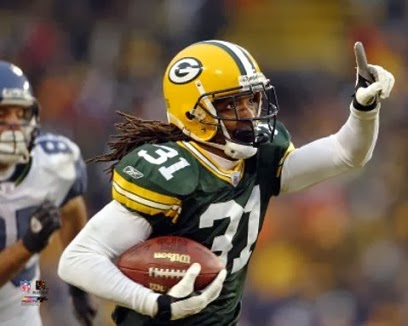
2004: Harris INT Return in Overtime Gives Packers Win Over Seahawks


The NFC Wild Card playoff game on January 4, 2004 featured the Green Bay Packers, winners of the NFC North with a 10-6 record, against the visiting Seattle Seahawks, also a 10-6 team that had placed second in the NFC West.

The Packers, coached by Mike Sherman for the fourth year, had struggled through much of the season and were at 6-6 after a Thanksgiving loss at Detroit, but won their remaining games to win the division. The key to the offense was 34-year-old QB Brett Favre (pictured above), as had been the case for over a decade. Seemingly indestructible, Favre had been playing with a broken thumb on his throwing hand for the previous eleven weeks. RB Ahman Green rushed for a NFC-leading 1883 yards during the season. Second-year WR Javon Walker emerged as a fine deep threat while WR Donald Driver remained the top receiver. The midseason addition of NT Grady Jackson boosted the defense and rookie MLB Nick Barnett led the club in tackles.

Seattle was coached by Mike Holmgren, who had led the Packers to two NFC Championships and a Super Bowl win in 1996-97. Now he had the Seahawks in the playoffs for the first time in four years, but while they had been undefeated at home, they were only 2-6 on the road. QB Matt Hasselbeck, who had originally been drafted by Green Bay, directed the offense with skill and RB Shaun Alexander was productive. The pass defense was suspect, ranking 27th in the NFL during the regular season.

It was a 20-degree day with a wind chill that was far lower and there were 71,457 fans in attendance at Lambeau Field. The Packers punted following their first possession and Seattle drove 57 yards in ten plays. Matt Hasselbeck completed consecutive passes to WR Koren Robinson for 11 and 15 yards to get the series underway and with Shaun Alexander contributing runs of 8 and 17 yards along the way, the Seahawks reached the Green Bay nine. However, from there Alexander lost yardage on two carries and, after Hasselbeck’s third down pass fell incomplete, Josh Brown kicked a 30-yard field goal.

The teams traded punts for the remainder of the opening period. Early in the second quarter, the Packers took possession at midfield following a punt and moved quickly to the Seattle 21 when Brett Favre threw to FB William Henderson for a 29-yard gain. Two carries by Ahman Green (pictured below) picked up eight yards and, after an incomplete pass on third down, Ryan Longwell tied the score with a 31-yard field goal.


The Seahawks came back with an eight-play, 51-yard drive. Hasselbeck had a 28-yard completion to WR Bobby Engram to get the ball to the Green Bay 28, but after getting a first down at the 17, Hasselbeck was held to three incomplete passes and Seattle settled for a 35-yard field goal by Brown that put the visitors back in front.

Green Bay came back quickly, taking five plays to advance 80 yards. Favre immediately connected with Javon Walker for a 44-yard gain to the Seattle 36. Another pass, this time to Green, picked up another 13 yards and Favre finished the series with a throw to TE Bubba Franks for a 23-yard touchdown. Longwell kicked the extra point and the Packers had a 10-6 lead.

The Seahawks lost yardage and had to punt following their next series and the Packers got the ball back in Seattle territory with 2:18 remaining in the half. In a possession featuring a Favre pass to Donald Driver that gained 23 yards, the Packers managed to add to their lead when Longwell booted a 27-yard field goal. The score was 13-6 at halftime.

The Seahawks had the first possession in the third quarter and drove 74 yards in ten plays. Hasselbeck completed five passes along the way, starting with a throw to WR Darrell Jackson that picked up 25 yards to start things off. TE Itula Mili had two receptions that totaled 29 yards and, on fourth-and-goal at the Green Bay one, Alexander scored a touchdown. Adding Brown’s extra point, the game was tied at 13-13.

Following a punt by the Packers, Seattle again mounted a scoring drive, this time advancing 77 yards in 11 plays. Six of the plays were Hasselbeck pass completions, including one to Engram for 15 yards on third-and-four and another to Robinson that picked up 33 yards to the Green Bay 19. Once again, Alexander ran for a one-yard TD and, adding on Brown’s PAT, the visitors were up by 20-13.

Green Bay came back with a 12-play, 60-yard series that extended into the fourth quarter. Favre completed all five of his passes and Green ran for two yards on a fourth-and-one play at the Seattle three. Green followed up by gaining the last yard for a touchdown and, with Longwell adding the extra point, the game was once again tied at 20-20 with ten minutes remaining in regulation.

The Seahawks went three-and-out on their next possession and Tom Rouen’s punt was returned 21 yards by WR Antonio Chatman for good field position at the Seattle 49. Favre completed three passes and Green again converted a fourth down with a two-yard carry (although he lost the ball at the end, it was ruled that his forward progress had been stopped before the fumble, much to the consternation of Mike Holmgren), one of his six during the 12-play, 51-yard drive. He picked up a total of 21 yards, including one yard for a TD. Longwell’s extra point again made it a seven-point contest with the clock now down to less than three minutes.

The Seahawks took over at their 33 following the kickoff and Hasselbeck immediately passed to Robinson for nine yards and Jackson for another 16. Now at the Green Bay 42, on the second play after the two-minute warning Hasselbeck connected with Engram for 34 yards to the eight. Alexander ran for two yards, a five-yard penalty moved the ball to the one, and it was Alexander going the final yard for a TD. Brown’s extra point again knotted the score at 27-27.

The Packers still had 51 seconds to work with and reached the Seattle 30 after Favre threw to Walker for 27 yards. But after letting the clock run down, Longwell’s 47-yard field goal attempt was unsuccessful and the game headed into overtime.

Seattle won the toss, with Hasselbeck shouting “We want the ball, we’re going to score”. The Seahawks didn’t, however, and the teams traded punts in OT. On Seattle’s second series, and facing third-and-11 at its own 45, Hasselbeck threw a pass that was intercepted by CB Al Harris (pictured below), who cut in front of WR Alex Bannister at the last moment. With clear sailing in front of him, Harris returned it 52 yards down the sideline for a touchdown and Green Bay came away with a stunning 33-27 win. It was the first time a defensive play ended a NFL overtime playoff game.


The Packers had the edge in total yards (397 to 340) while the teams were even with 22 first downs apiece. Neither club ran the ball consistently, with Green Bay compiling 78 yards on 32 carries and the Seahawks gaining 49 yards on 21 attempts. There was only one turnover in the game, and it was the game-winning play.

Brett Favre completed 26 of 38 passes for 319 yards and a touchdown with no interceptions. Donald Driver caught 6 passes for 66 yards while Javon Walker gained 111 yards on his 5 receptions. Ahman Green ran for 66 yards on 23 carries, including two TDs and the two big fourth down conversions, and contributed 5 catches for 44 more yards.


For the Seahawks, Matt Hasselbeck (pictured at right) was successful on 25 of 45 throws for 305 yards and no TDs with the one big interception. Shaun Alexander gained just 45 yards on 20 rushing attempts, but had the three short scoring carries. Koren Robinson led the club with 7 catches for 88 yards and Itula Mili had 6 receptions for 62 yards while Bobby Engram gained 83 yards on his four catches.

“This game came down to us making a play at the end,” said Coach Mike Sherman. “It could have gone either way.”

“I’m dying inside,” said Mike Holmgren from the losing side. “It hurts bad to lose this game today.”

The Packers went on to lose a close contest in overtime at Philadelphia in the Divisional round. They repeated as North Division champs in 2004 but lost in the Wild Card playoff game. Seattle had a lesser record at 9-7 but won the NFC West, also falling in the first round.

January 3, 2014

Rookie of the Year: Richmond Webb, 1990

Offensive Tackle, Miami Dolphins


Age: 23
College: Texas A & M
Height: 6’6”   Weight: 291

Prelude:
Although recruited out of high school to play defense, Webb was shifted to offensive tackle and was an All-Southwest Conference selection in 1989. He was chosen by the Dolphins in the first round (ninth overall) of the 1990 NFL draft. The team needed to retool the offensive line and Webb stepped directly into the starting lineup, not missing an offensive down during the regular season.

1990 Season Summary
Appeared in all 16 games

Postseason: 2 G

Awards & Honors:
NFL Rookie of the Year: Sporting News
AFC Rookie of the Year: UPI
2nd team All-AFC: UPI
Pro Bowl

Dolphins went 12-4 to finish second in the AFC East and qualify as a Wild Card team in the postseason while giving up the fewest sacks in the NFL (16). Won AFC Wild Card playoff over Kansas City Chiefs (17-16). Lost AFC Divisional playoff to Buffalo Bills (44-34).

Aftermath:
Webb was named to seven straight Pro Bowls and was also a consensus first-team All-NFL selection in 1992 and ’94, receiving first- or second-team recognition in two other seasons. While it was argued that he lacked the consistency of his rookie season, he was an outstanding pass blocker who protected star QB Dan Marino’s blind side from the left tackle position and had notable success against division-rival Buffalo’s star DE Bruce Smith. After missing two games due to injury in 1991, he didn’t miss another until seven years later, in 1998. With his skills declining from a Pro Bowl level, Webb still was a capable starter and played his last two seasons with the Bengals in 2001 and ’02. An abortive attempt to return to the Dolphins in 2003 ended with his eventual retirement. Overall, Webb played 13 seasons that included a total of 184 regular season games, all but one of which he started.

--


Rookie of the Year Profiles feature players who were named Rookie of the Year in the NFL (including NFC/AFC), AFL (1960-69), or USFL (1983-85) by a recognized organization (Associated Press – Offense or Defense, Newspaper Enterprise Association, United Press International, The Sporting News, or the league itself – Pepsi NFL Rookie of the Year).