Showing posts with label 1966 NFL season. Show all posts

November 24, 2016

1966: Cowboys Defeat Browns in Pivotal Thanksgiving Matchup


It was a Thanksgiving showdown for control of the NFL Eastern Conference as the Dallas Cowboys hosted the Cleveland Browns on November 24, 1966.

The Cowboys, meticulously guided by Head Coach Tom Landry since the franchise’s creation in 1960, had a 7-2-1 record and were on the way to their first winning season, with the possibility of also topping the conference. QB Don Meredith (pictured at right) was often maligned but coming into his own and HB Dan Reeves had proven to be effective in tandem with FB Don Perkins. Split end Bob Hayes provided speed on the outside, adding to the explosiveness of the offense. The defense was tough and aggressive, especially on the line anchored by DT Bob Lilly and at linebacker, with Chuck Howley and Dave Edwards on the outside and Lee Roy Jordan in the middle.

Cleveland, at 7-3 under Head Coach Blanton Collier, had topped the Eastern Conference in each of the previous two seasons and won a NFL title in ’64. While the Browns lost star FB Jim Brown to retirement, HB Leroy Kelly had proven to be a more-than-capable replacement and combined effectively with FB Ernie Green. QB Frank Ryan remained a good field general and had fine receivers in flanker Gary Collins and split end Paul Warfield. The Browns had won the previous meeting between the teams in Cleveland but the defense was injury-depleted.

There was a record crowd of 75,504 fans in attendance at the Cotton Bowl. Dallas got the first scoring opportunity following a 38-yard punt return by FS Mel Renfro to the Cleveland 20. But while the Cowboys advanced inside the ten yard line, they had to settle for an 11-yard Danny Villanueva field goal.

Dallas again had the ball in excellent field position shortly thereafter when Leroy Kelly fumbled and Bob Lilly recovered at the Cleveland 24. Once again the home team had to settle for three points, however, and Villanueva again connected, this time from 31 yards.

As the game headed into the second quarter, Cleveland had a shot at getting on the board, but Lou Groza missed wide on a 28-yard field goal attempt. On their next series, the Browns drove 81 yards, and this time didn’t come up empty. Frank Ryan threw to Gary Collins for 21 yards to the Dallas one and from there Kelly plunged into the end zone for a touchdown. Groza’s extra point put Cleveland ahead by 7-6.

The Cowboys put together an 87-yard advance that featured Don Meredith completing passes of 12 yards to Don Perkins, 17 to Dan Reeves, and 14 yards to TE Frank Clarke. Meredith completed the series by throwing a swing pass to Reeves for a six-yard TD on a third down play and, with Villanueva’s point after, the home team was back in front by 13-7.


Cleveland responded with an eight-play, 76-yard series that was helped along by a pass interference penalty on CB Warren Livingston. Ryan lobbed a pass to Ernie Green (pictured at left), who easily outran LB Chuck Howley for a 16-yard touchdown. Groza converted and, with 1:07 remaining in the first half, the visitors were ahead by 14-13.

In the third quarter, the Cowboys moved into scoring position thanks to a long pass interference penalty on CB Mike Howell at the Cleveland 21. Meredith picked up a first down on a 10-yard carry to the nine, but the Browns held and Dallas again turned to Villanueva, who was successful on a 12-yard field goal that put the Cowboys back in front by 16-14.

The Browns failed to put points on the board when Groza’s woes continued as he was again wide on a field goal attempt, this time from 31 yards. The Cowboys again drove into Cleveland territory and once more had to call on Villanueva, who was good on a 13-yard field goal that made the score 19-14 with seven seconds remaining in the period.

The Dallas lead was a tenuous 19-14 as the game headed into the fourth quarter, and the Browns were once again in scoring position. But in a pivotal turn of events, a 20-yard field goal attempt by Groza was blocked by SS Mike Gaechter and the Cowboys proceeded to drive 72 yards in 13 plays. The home team converted three third downs along the way as Meredith connected with Bob Hayes for 19 yards in a third-and-15 situation, ran for five yards on third-and-three, and passed to Reeves for seven yards when facing third-and-four at the Cleveland 16. The series ended with Don Perkins running 10 yards for a touchdown. Villanueva converted and, for all intents, sealed the 26-14 Dallas win.

The Browns had the edge in total yards (321 to 304) although Dallas had more first downs (25 to 18). Cleveland suffered the game’s only turnover and the Cowboys, who were aggressive in their pass rushing, recorded five sacks, to none by the visitors. A key factor was the kicking game as Danny Villanueva was perfect on four field goal attempts while Lou Groza failed three times (at age 42, there was speculation that Groza was at the end of his Hall of Fame career, but he did come back for one final season in 1967).


Don Meredith completed 16 of 24 passes for 131 yards and a touchdown while giving up no interceptions. Don Perkins (pictured at right) ran for 111 yards on 23 carries that included the game-clinching TD and Dan Reeves contributed 49 yards on 14 attempts as well as four catches for 32 yards and a score. Bob Hayes led the Dallas receivers with 6 catches for 54 yards.

For the Browns, Frank Ryan, who was constantly pressured by the Dallas pass rush, was successful on 12 of 26 throws for 190 yards and a TD and with none intercepted. Leroy Kelly gained 115 yards on 15 rushing attempts that included a touchdown and Ernie Green gained 24 yards on 8 attempts and also scored on his lone pass reception. Gary Collins had 5 pass receptions for 92 yards to top the club.

“Dallas just executed better than we did,” summed up Cleveland’s Coach Collier. “We had field position, we had our chances, but we couldn’t capitalize on them.”

The win gave the Cowboys the upper hand in the Eastern Conference race and they ended up first with a 10-3-1 record, losing a closely-fought NFL Championship game to the Green Bay Packers. Cleveland finished in a tie for second with Philadelphia at 9-5.

As a footnote, the arrival of Dallas as a playoff contender would prove to be lasting as the Cowboys went to the postseason in each of the next seven seasons and 18 of 20 between 1966 and ’85.

September 11, 2016

1966: Roland Stars as Cards Defeat Eagles


The St. Louis Cardinals were hoping to rebound from a disappointing 5-9 record in 1965 as they faced the Philadelphia Eagles on September 11, 1966. St. Louis had a new head coach in Charley Winner and plenty of veteran talent in QB Charley Johnson, FS Larry Wilson, and SS Jerry Stovall, all returning healthy from injury-plagued seasons in ’65. There were capable receivers in split end Sonny Randle, flanker Bobby Joe Conrad, and TE Jackie Smith, and a good stable of running backs that featured a newcomer in rookie HB Johnny Roland out of Missouri (pictured at right).

The Eagles were coached by Joe Kuharich and were also 5-9 in ’65 but swept the season series with the Cards. The defense had lost two disgruntled veteran stars, LB Maxie Baughan and CB Irv Cross, who both were dealt to Los Angeles and would be difficult to replace. QB Norm Snead had a strong arm, although was prone to inconsistency, and HB Timmy Brown was an outstanding all-purpose back. TE Pete Retzlaff was a reliable veteran and among the best at his position and the line, anchored by OT Bob Brown, was a good one.

It was the first regular season game for the Cardinals at the new Busch Memorial Stadium and there were 39,066 fans in attendance. Following an exchange of punts to start the first quarter, the Eagles drove 76 yards in 14 plays that featured six carries for 33 yards by FB Israel “Izzy” Lang and a screen pass from QB Norm Snead to Timmy Brown for 21 yards. Sam Baker kicked a 23-yard field goal to give the visitors the early lead.

HB Roy Shivers returned the ensuing kickoff 33 yards and St. Louis, helped along by a 15-yard penalty on the Eagles, started off near midfield and advanced into Philadelphia territory. However, after reaching the two, they were moved back by a delay of game penalty and had to settle for a nine-yard Jim Bakken field goal to tie the score at 3-3.

The Cardinals missed an opportunity when Johnny Roland returned a punt 52 yards for an apparent touchdown, but the play was nullified by a roughing-the-kicker penalty. The Eagles got another break on an interception by CB Jim Nettles, and while there was a clip on the return, the visitors took possession at the St. Louis 47. Snead completed a pass to Lang for 24 yards before Brown broke away for a 23-yard touchdown. Baker added the extra point and the score remained 10-3 at halftime.

St. Louis was having difficulty jelling on offense and finally added another long Bakken field goal from 47 yards to narrow Philadelphia’s lead to 10-6 in the third quarter. As the game headed into the final period, the Cards put together another promising drive but, following a sack of Johnson by LB Harold Wells, they faced a third-and-33 situation. Johnson threw to Sonny Randle, who bobbled the ball that was then deflected by FS Joe Scarpati and Roland alertly made the catch for a 37-yard gain to the Philadelphia 16. Johnson connected with Jackie Smith for nine yards and a pass interference penalty by Nettles in the end zone moved the ball to the one, from where Johnson plunged over for a touchdown. Bakken kicked the point after and the home team was ahead for the first time by 13-10.

The Eagles responded with a drive that featured a Snead pass to Pete Retzlaff for 17 yards and Baker capped it with a 33-yard field goal to tie the score at 13-13 with 1:56 remaining to play. With time running out for St. Louis, Johnson completed two passes to Randle, one for six yards that converted a third down and another for 15. Three plays later, FB Willis Crenshaw ran for 10 yards as the defense keyed on Roland and Johnson connected with Randle for six more yards. A fumbled snap lost three yards and Bakken came on to attempt a field goal that was made shorter when the Eagles were flagged for encroachment. With five seconds left on the clock, Bakken’s kick was good from 27 yards and the Cards came away winners by a final score of 16-13.

St. Louis had the edge in total yards (278 to 254) and first downs (20 to 18). The Cards also suffered the game’s only turnover and the Eagles, not known for their pass rush, were credited with four sacks, to one by St. Louis.

Johnny Roland had an impressive debut, rushing for 53 yards on 8 carries, catching two passes for 40 yards, and gaining 50 yards on two kickoff returns and 16 on two punt returns for a total of 159 all-around yards. Charley Johnson completed 19 of 26 passes for 191 yards and gave up an interception while scoring the only St. Louis TD. Sonny Randle had 6 catches for 58 yards and Jackie Smith gained 62 yards on his five pass receptions.


For the Eagles, Norm Snead was successful on 9 of 25 throws for 129 yards with no TDs but also none intercepted. Izzy Lang (pictured at left), who was particularly effective in the first half, gained 65 yards on 16 rushing attempts and caught two passes for 33 more yards while Timmy Brown ran for 59 yards on 13 attempts that included a touchdown, caught a team-leading three passes for 32 yards, and with 23 yards on two kickoff returns went over the 10,000-yard mark in career all-purpose yards. Pete Retzlaff was held to two catches, but his 36 yards led the club.

St. Louis won its first five games and surged to 7-1-1 before Charley Johnson suffered a knee injury and a late-season slump had them ending up at 8-5-1 and fourth place in the Eastern Conference. The Eagles had an up-and-down year in which they finished strong for a 9-5 record that tied for second in the conference with Cleveland.

Johnny Roland went on to an outstanding rookie season, most notably rushing for 695 yards and leading the NFL with an 11.1 punt return average. His all-purpose yardage total of 1476 yards ranked fifth in the league and he received Rookie of the Year honors from UPI as well as selection to the Pro Bowl.

June 8, 2016

1966: Rams Obtain Irv Cross from Eagles


On June 8, 1966, while the main focus of pro football followers was on the announcement of the AFL-NFL merger, the Philadelphia Eagles parted ways with Pro Bowl CB Irv Cross, who was sent to the Los Angeles Rams for DB Aaron Martin and HB/flanker Willie Brown.

It was the second trade by the Eagles to the Rams of a disgruntled defensive Pro Bowler during the turbulent offseason as discontent rose against Head Coach/GM Joe Kuharich. LB Maxie Baughan’s demand to be sent elsewhere was accommodated several weeks earlier. The 26-year-old Cross had been with the Eagles for five seasons, but threatened to quit unless traded.

Drafted by the Eagles in the seventh round out of Northwestern in 1961, Cross was thrust into the starting lineup when star CB Tom Brookshier suffered a broken leg in the eighth game. He intercepted two passes, recovered two fumbles, and suffered three concussions during the season. Cross remained in the starting lineup in 1962 and showed improvement as he intercepted five passes. By 1964, he was chosen to the Pro Bowl for the first of two consecutive seasons and was noted for his tackling ability as well as coverage skills. Thus far with the Eagles, he had intercepted 15 passes, one of which he returned for a 94-yard touchdown. He also was Philadelphia’s primary kick returner in ’65, running back 25 kickoffs for a 26.5-yard average and 14 punts at a 5.6-yard rate.

As for the players the Eagles received for Cross, Willie Brown was 24 and a third-year player who was drafted by the Rams in the third round in 1964 out of USC. He had primarily been used to return kicks and, as a halfback, rushed for 133 yards on 44 carries in ‘65. The Eagles had hopes of using him as a flanker. Aaron Martin, also 24, went undrafted out of North Carolina College and was signed by the Dallas Cowboys in 1964, who tried him on offense, but was released during the preseason after which the Rams picked him up. He started the ’65 season at cornerback and intercepted two passes before suffering a broken left arm in the fourth game that sidelined him for the remainder of the year.

The Rams, coming off of a 4-10 record (their seventh straight losing season) had a new head coach in the defense-minded George Allen, formerly an assistant under George Halas with the Bears (who did not let him go without a court battle). Allen inherited an excellent defensive line but the remainder of the unit needed bolstering. The addition of Baughan at outside linebacker was a plus and it was hoped that Cross could help in a defensive backfield that had one star in FS Ed Meador and inexperienced players at the other positions. 

Cross proved to be a good fit at right cornerback for the Rams, who improved to 8-6 in their first year under Coach Allen. He paired up well with young CB Clancy Williams on the other side and, while he intercepted only one pass, he returned it 60 yards for a touchdown, and continued to impress with his tackling.

Cross was with Los Angeles for three seasons, and with the outstanding defense leading the way, the Rams went 11-1-2 in 1967, reaching the postseason for the first time since 1955, and 10-3-1 in ’68. He intercepted a total of six passes and was also used to return kicks, averaging 7.5 yards running back 29 punts and 30.1 yards on 16 kickoff returns.

Cross was traded back to the Eagles in 1969 in the deal that brought All-Pro OT Bob Brown to LA. He was a player/coach in his final season, and after retiring as a player was an assistant coach in 1970 before moving to the broadcast booth. He became a fixture on "The NFL Today" on CBS from 1975 to ’89.  

As for the Eagles, the result of the transaction was disappointing. Willie Brown lasted one year with the club, catching no passes and returning a handful of kicks with mediocre results. Aaron Martin spent two seasons with Philadelphia, intercepted two passes and returned a punt for a touchdown, but was nothing special in the defensive backfield.

December 4, 2014

1966: Concannon Runs, Passes Eagles to Win Over Steelers


The Philadelphia Eagles were 6-5 and trying to put together their first winning season in five years as they hosted the Pittsburgh Steelers on December 4, 1966. Head Coach Joe Kuharich’s team had a fine offensive line anchored by OT Bob Brown and good group of running backs that included HB Timmy Brown and up-and-coming FB Tom Woodeshick. The passing game was a problem, however, as QB Norm Snead, typically the starter, was enduring a dreadful season. One of the other two quarterbacks, King Hill, led the team to a win at San Francisco the previous week, but now it was Jack Concannon (pictured at right) getting the call at home against Pittsburgh.

Concannon, a star at Boston College, was Philadelphia’s second-round draft choice in 1964 and had received a big contract to keep him away from the Patriots of the AFL.  Buried behind Snead and Hill on the depth chart, he saw little action but started one game against the Cowboys late in his rookie season and provided plenty of excitement with his flashy running ability, while throwing for 134 yards and two TDs in a win. That performance made him the backup most chanted for when the offense was performing badly, but being a fan favorite didn’t guarantee him playing time. He saw scant playing time in 1965 and Coach Kuharich tried him as a halfback, flanker, and punt returner during the ’66 season before finally giving him another starting shot at quarterback.

The Steelers, under the guidance of first-year Head Coach Bill Austin, were 3-7-1 and also had a change at quarterback. Bill Nelsen, having missed nine games due to a knee injury, was back behind center. But while there were good receivers, most notably flanker Gary Ballman, the line was inadequate and, other than FB Willie Asbury, the backs unimpressive. The defensive line was a strong point, and was a reason for Jack Concannon to get the starting assignment at quarterback for the Eagles because Coach Kuharich believed that his mobile, rollout style would match up well against it.

There were 54,275 fans in attendance at Franklin Field. The Steelers had first possession and punted and the Eagles, starting from their 30 yard line, drove 42 yards. Jack Concannon set the tone when, on a third-and-seven play, he took off and ran for 18 yards. He also had a five-yard carry and completed a pass to Tom Woodeshick that picked up 11 yards and set up a 35-yard field goal by Sam Baker.


Pittsburgh responded by advancing into Philadelphia territory, the big gain being a 45-yard carry to the ten yard line by Willie Asbury on a draw play. But Bill Nelsen was sacked for a loss of 14 yards by DE Gary Pettigrew (pictured at left) in between tossing two incomplete passes, and Mike Clark was unsuccessful on a 31-yard field goal attempt.

The Eagles turned the ball over on the next possession when Timmy Brown fumbled a handoff and DE Ben McGee recovered to give the Steelers the ball at the Philadelphia 19. In a series that stretched into the second quarter, Pittsburgh scored when Asbury ran seven yards for a touchdown and, adding Clark’s extra point, the visitors held a 7-3 lead.

Philadelphia again turned the ball over in its own territory when Concannon fumbled as he was hit by LB Andy Russell and safety Paul Martha recovered at the 34. The result was a 37-yard Clark field goal that extended Pittsburgh’s lead to 10-3.

The Eagles came back with an 80-yard drive in 11 plays. Concannon completed three passes and twice scrambled for sizable gains. An 11-yard completion to split end Fred Hill converted a third-and-ten situation, an 11-yard scramble led to another first down, and a 29-yard run on a third-and-six play advanced the ball to the Pittsburgh 25. Concannon threw to Brown for a 17-yard gain that converted yet another third down and set up a three-yard touchdown carry by Woodeshick. Baker converted to tie the score.

With just over two minutes to play in the first half, the Eagles took advantage of a turnover when Nelsen fumbled and LB Dave Lloyd recovered at the Pittsburgh 25. Concannon had runs of six and eight yards, but when he was finally thrown for a loss on third down, Philadelphia settled for a 22-yard Baker field goal.

There was still enough time for the Steelers, and Nelsen drove them down the field with completions of 11 yards to HB Dick Hoak, 18 yards to Gary Ballman, and 22 yards to Hoak. Clark kicked a 32-yard field goal on the last play before halftime and the score was tied at 13-13 at the intermission. Concannon had accounted for 47 passing yards and 77 by rushing.

The teams traded punts to start the third quarter until Pittsburgh put together a scoring possession. The big gain came on a Nelsen throw to Ballman for 26 yards to the Philadelphia 28 and, while the Steelers could get no further, they came away with another field goal by Clark, this time from 35 yards.

The Eagles responded by advancing 70 yards in 11 plays. Concannon completed passes to flanker Ron Goodwin for 29 yards and Hill for 11, and ran three times for 21 yards. Woodeshick ran the last yard for a TD and Baker’s PAT put the home team on top by 20-16.

Asbury fumbled on Pittsburgh’s next play from scrimmage and Pettigrew recovered at the Steelers’ 30. As the period wound down, Concannon scrambled for a 16-yard gain and completed a pass to Timmy Brown for eight more. On the fourth play of the fourth quarter, Concannon scored from a yard out on a quarterback sneak and Baker added the point after to put the Eagles up by 27-16.

The Steelers came right back as Ballman returned the ensuing kickoff 42 yards and Nelsen immediately went to the air and connected with flanker Roy Jefferson for 43 yards to the Philadelphia four. Asbury ran for a two-yard touchdown three plays later, Clark converted, and Philadelphia’s lead was narrowed to four points.

The teams exchanged punts and, with time running short for the Steelers as they took over possession on their own 47, Nelsen threw an incompletion, Asbury was stopped for no gain on a draw play, Ballman dropped a pass, and a fourth-down throw was also incomplete to turn the ball over on downs. Pittsburgh got one more shot following another Philadelphia punt, but a penalty and a sack by LB Harold Wells forced them into a deep hole from which they couldn’t escape. The Eagles won by a final score of 27-23.

Philadelphia led in total yards (304 to 250) and first downs (19 to 15). The Eagles also recorded four sacks, to one by Pittsburgh. Each team turned the ball over twice.

Jack Concannon completed 13 of 25 passes for 131 yards with no touchdowns, but also with none intercepted, but made an even bigger impression with his running as he gained 129 yards on 15 carries that included a TD. Tom Woodeshick gained 46 yards on 19 attempts with two short touchdowns and he also picked up 28 yards on three pass receptions. Timmy Brown, who ran for only five yards on nine carries, led the club with 5 catches for 43 yards.


For the Steelers, Bill Nelsen was successful on 11 of 25 throws for 195 yards, also throwing no TD passes or interceptions. Gary Ballman caught 6 passes for 93 yards and averaged 27.3 yards on four kickoff returns. Willie Asbury (pictured above) ran for 70 yards on 14 attempts that included two TDs.

“I ran a bit more today than I want to, and I hope I don’t have to do that again,” said Jack Concannon. “My timing was off from rustiness and our running attack wasn’t working the way I hoped that it would, so I ran more than a quarterback should.”

“We let Concannon go wide on us a couple of times and he hurt us each time,” said Coach Austin of the Steelers. “We didn’t get our people up quick enough to contain the rollouts.”

The Eagles won again the next week against the Browns, with Concannon again leading the way at quarterback, but it was King Hill behind center when they beat Washington in the finale to make it four straight victories to finish out the season. Philadelphia’s final record was 9-5, which was good for a second place tie with the Browns in the Eastern Conference and a spot in the Playoff Bowl, the postseason exhibition game that pitted the runners-up in each conference. They lost to the Colts with Hill and Concannon at quarterback. Pittsburgh also finished on a high note, scoring a combined 104 points behind the good play of Bill Nelsen in beating the Giants and expansion Falcons. The Steelers ended up sixth in the conference at 5-8-1.

Jack Concannon was traded to the Bears in the offseason. In three years with the Eagles, he completed just 43.7 percent of his 103 passes for 637 yards and four touchdowns against eight interceptions. However, he ran for 433 yards on 50 carries, averaging 8.7 yards per attempt and scoring two TDs. The team was 3-0 in his starts and the 129 rushing yards against the Steelers remained the single-game record for a Philadelphia quarterback until 2010, withstanding the presence of far more accomplished mobile Eagles quarterbacks over the years like Randall Cunningham and Donovan McNabb before it finally was exceeded by Michael Vick.

January 25, 2014

1966: Redskins Hire Otto Graham as Head Coach/GM


On January 25, 1966 it was announced that the Washington Redskins had hired Otto Graham, the Hall of Fame quarterback of the Cleveland Browns who had gone on to coach at the Coast Guard Academy, as head coach and general manager. The 44-year-old Graham replaced Bill McPeak, who was fired with a year left on his contract.

Graham was signed to a sizeable contract that team President Edward Bennett Williams called the richest deal that had ever been given to a coach of the Redskins. He had turned down pro coaching offers in the past, reportedly by the Eagles, Colts, and Browns, as well as the University of Oklahoma, while remaining at his secure position at the Coast Guard Academy, where he led the football team to an undefeated season in 1963. He also coached the College All-Stars for several years, starting in 1958, and the story of his signing with the Redskins first leaked when he contacted the Chicago Tribune, the game’s sponsor, to resign as coach.

The Redskins had not had a winning season since 1955 and had last appeared in a postseason contest ten years before that. In five years under McPeak, they had shown improvement but, after a second straight 6-8 record in 1965, Williams determined that a change was in order. In addition, under McPeak there had been disciplinary problems with many of the veterans, as well as widespread dissension.

The team that Graham inherited had a fine quarterback in 32-year-old Sonny Jurgensen. Not surprising for an ex-quarterback, especially considering Washington’s mediocre ground game, Graham chose to emphasize the passing attack (although, unlike his mentor with the Browns, Paul Brown, he let Jurgensen call his own plays).

Flanker Bobby Mitchell was well-established as a top receiver and Charley Taylor, who had started out as a halfback and was a fine receiver out of the backfield, was converted to split end during the season with even better results. Jerry Smith, breaking out in his second season, quickly established himself as one of the league’s best pass catching tight ends. Jurgensen led the NFL in pass attempts (436), completions (254), and yards (3209) and ranked second in TD passes (28) in 1966. Taylor, Mitchell, and Smith all finished in the league’s top 10 in pass receptions, with Taylor ranking at the top with 72 while Mitchell had 58 and Smith 54. Taylor’s 1119 yards placed third and his 12 touchdown receptions tied for second with Cleveland’s Gary Collins. Mitchell had 905 yards and 9 TDs and Smith contributed 686 yards and six scores.

The running game remained a problem, however. HB A.D. Whitfield, acquired from Dallas, led the team with 472 yards on just 93 carries for a healthy 5.0 average. But veteran fullbacks Steve Thurlow and temperamental Joe Don Looney were found wanting. Mitchell, formerly a halfback with the Browns, was briefly moved back to that position in an effort to generate a ground attack. In any event, the revamped offensive line had a rising star in center Len Hauss.

The defense contained seven new starting players. The line had talent in DT Joe Rutgens and DE Ron Snidow. Veteran linebackers Jimmy Carr and Bob Pellegrini retired to take assistant coaching jobs, but John Reger was talked into staying for another year and MLB Sam Huff, in his third season in Washington after a distinguished career with the Giants, also remained. Second-year OLB Chris Hanburger emerged to become a star, most notably as an outstanding blitzer, and was picked for the Pro Bowl. While FS Paul Krause was the biggest star in the backfield, rookie SS Brig Owens led the club with seven interceptions.

Another key newcomer was PK Charlie Gogolak, the team’s first draft choice out of Princeton. Brother of pioneering soccer-style kicker Pete Gogolak, he brought the same then-novel approach to placekicking to Washington and had a fine rookie year, booting 22 field goals in 32 attempts and scoring a total of 105 points.

Overall, the Redskins went 7-7 to break even for the first time in ten years. They started off at 5-3 before losing three straight games, including a 31-30 thriller against the eventual Capitol Division champs, the Cowboys. They then defeated the woeful Giants by a whopping 72-41 score, the highest-scoring game in NFL history (but not one in which the defense distinguished itself), and then upset the Cowboys in Dallas by a 34-31 tally.

Improving the ground game was a priority for 1967, and the Redskins used their first draft pick to take 240-pound FB Ray McDonald from Idaho. Inserted directly into the lineup, he suffered through a disappointing, injury-wracked season and gained only 223 yards. Once again, A.D. Whitfield led a mediocre running game, with 384 yards on 91 carries, but he also caught 36 passes for 494 yards.


The passing attack, if anything, got even better than it was in ’66. Sonny Jurgensen (pictured at left) topped the NFL in passing while setting a league record with 3747 yards through the air (over in the AFL, Joe Namath of the Jets passed for 4007 yards). He also set new league standards with 508 pass attempts and 288 completions and led the circuit in TD passes (31) and lowest percentage of interceptions (3.1) while his completion percentage of 56.7 ranked second. Receivers Taylor, Smith, and Mitchell placed first, second, and fourth – in that order – with 70, 67, and 60 catches, respectively. Taylor gained a sixth-ranked 990 yards and Mitchell placed ninth with 866 while Smith had the most scoring catches of the group with 12, which was second only to New York’s Homer Jones.

However, for all of the aerial excitement, Washington’s record regressed to 5-6-3. While the Redskins again played well against the division-leading Cowboys, and upset them once more at Dallas, they also were embarrassed by the expansion Saints, 30-14, and could only gain a tie against the 1-12-1 Atlanta Falcons. While the defensive line was still effective and Hanburger again played the one outside linebacker position with distinction, other than Krause (8 interceptions) the defensive backfield fared poorly. In addition, Gogolak was lost to a season-ending injury in the first week and the kickers who replaced him were a combined 6-of-22 on their field goal attempts (the best was ex-AFL star Gene Mingo, who kicked a team-leading four in 10 tries).

Sam Huff retired after the ’67 season, and that left a big hole at middle linebacker in 1968 (he would return to the team in ’69). Graham also traded Paul Krause to Minnesota before the season in a deal that would prove more beneficial to the Vikings.

Sonny Jurgensen had a sore shoulder, and his performance suffered accordingly as his passing yardage fell to 1980 and his touchdown total to 17. Veteran backup Jim Ninowski started two games while rookie Gary Beban, the Heisman Trophy winner out of UCLA whose rights were obtained by the Redskins from the Rams at the price of the first draft pick in 1969, was a flop at both quarterback and running back. Charley Taylor and Jerry Smith were still quality receivers, although Bobby Mitchell, at age 33, dropped off to 14 catches.

The running game continued to be a problem. HB Gerry Allen led the team with 399 yards, but averaged just 3.2 yards per carry, and of any backs who carried more than 30 times, Steve Thurlow had the best average at 3.6.

The defense still had too many holes, too. Joe Rutgens, still the best of the linemen, was showing wear. Hanburger continued to be outstanding at linebacker, but no one could adequately replace Huff. Ex-Cardinal CB Pat Fischer was a good addition to the defensive backfield, and Brig Owens bounced back, but rookie Jim “Yazoo” Smith, the first round pick out of Oregon who replaced Krause at free safety, was not as good and then suffered a neck injury in the season finale that finished his career.

Gogolak was back to handle the placekicking, and while better than the group from 1967, was not as proficient as he had been as a rookie.

Overall, the effect was a disappointing 5-9 record and Graham was replaced by Vince Lombardi, lured away from Green Bay where he had retired as head coach but was still the general manager.

While the Redskins had been an exciting offensive team during the Graham era, the failure to improve the running game and the problems on defense ultimately rendered his tenure a failure. The overall record for the three seasons was 17-22-3. Graham returned to the Coast Guard Academy, where he served as athletic director until retiring.

October 9, 2013

1966: Mira Leads 49ers to Upset of Packers


The San Francisco 49ers had gotten off to a slow start in the 1966 NFL season. They were 0-2-1 as they prepared to host the powerful Green Bay Packers on October 9. Following their first winning season in four years (7-6-1 in ’65), Head Coach Jack Christiansen’s team had plenty of talent on offense but also had a suspect defense and was coming off of two big losses to the Colts and Rams. Tenth-year QB John Brodie received a big contract extension in the offseason but endured two rough performances in those defeats. George Mira (pictured above), a third-year backup out of Miami, was getting his first start of the season at quarterback in place of Brodie, with the hope that his darting, scrambling style would prove effective against the vaunted Packers defense.

The prospect of facing Head Coach Vince Lombardi’s Packers did not promise any relief for the 49ers. Green Bay was the defending NFL Champion and off to a 4-0 start. QB Bart Starr didn’t typically throw often, but he was efficient when he did and had tossed six touchdown passes as opposed to just one interception thus far. The veteran backfield duo of FB Jim Taylor and HB Paul Hornung was wearing down, but the receiving corps was effective and the defense solid from front to back. If there was one discordant note for the Packers coming into San Francisco, it was that they had been having recent difficulty in games at Kezar Stadium, having not won there since 1963 (in 1965 they tied the 49ers in the last game, which forced a playoff for the Western Conference title with the Colts).

There were 39,290 fans in attendance at Kezar Stadium on a sunny afternoon. In the first quarter, the Packers drove to the San Francisco 32 yard line as Taylor and Hornung ran to good effect, but Don Chandler missed a 39-yard field goal attempt.

Following a San Francisco punt, Green Bay moved even deeper into 49ers territory on a series highlighted by Bart Starr throwing to split end Max McGee for a 39-yard gain, but, after getting to the eleven, had to settle for a Chandler field goal try that was successful from 18 yards.

Two possessions later, Mira’s first scoring pass came on a play when his mobility was put to good use. He first ran to his right and then reversed field to avoid the rush and threw on the run to HB John David Crow at the Green Bay one who then dove into the end zone for a 27-yard touchdown.

After the teams traded punts, Mira was shaken up in the second quarter and had to leave the game briefly. When John Brodie came onto the field as his replacement, he was greeted with a shower of boos from the home crowd. He did complete a six-yard pass to FB Ken Willard, but a 41-yard field goal attempt by Tommy Davis was unsuccessful with 29 seconds left in the half. Still, the Niners carried a 7-3 lead into the intermission.

The Packers had the first possession of the third quarter, and facing second-and-eight at their own 47, the 49ers put on a heavy rush and dumped Starr for a 12-yard loss. Starr was hit again on the next play, and this time it forced a fumble that was recovered by LB Matt Hazeltine, who then proceeded to run 22 yards for a touchdown. The successful PAT by Davis put San Francisco ahead by 14-3.

On the next series, the Packers responded by scoring on a quick three-play, 56-yard series.  Starr threw to a wide-open Hornung at the sideline for a 43-yard touchdown. Chandler’s extra point narrowed the home team’s margin to 14-10.

Mira was back behind center for the 49ers, but they went three-and-out and had to punt. Starting at their own 42, the Packers moved quickly into San Francisco territory. Starr completed passes to Taylor for 14 yards and flanker Carroll Dale for 24 down to the 15 yard line, but the drive stopped there. Chandler booted a 22-yard field goal that made it a one-point contest.

After another punt by the Niners, the Packers appeared to be driving toward a score when, on the first play of the fourth quarter, Starr was intercepted by safety Elbert Kimbrough, who returned it 44 yards before finally being hauled down by Jim Taylor at the Green Bay 37. Mira was immediately sacked for a nine-yard loss, but two plays later, and following a 38-yard run by the nimble quarterback, the 49ers capitalized when he tossed an eight-yard touchdown pass to Crow. Rather than the Packers potentially taking the lead, the Niners were up by 21-13.

The Packers bounced back by driving 69 yards in four plays that ended with Starr throwing to Dale for a 38-yard TD. Don Chandler’s extra point again made it a one-point contest and there was still plenty of time.

Green Bay’s defense proceeded to make a big play when LB Dave Robinson intercepted a Mira pass and returned it 32 yards to the San Francisco nine. The 49ers kept the Packers out of the end zone on three plays and, following an offensive pass interference penalty, the visitors were backed up to the 19  and Chandler missed a 26-yard field goal attempt.

Brodie again replaced Mira at quarterback and the 49ers put together a long, time consuming drive. HB Dave Kopay had a 25-yard run and FB Ken Willard also ran effectively. Facing fourth-and-one at the Green Bay two, San Francisco was unable to convert, but there was only a minute remaining as the Packers took over just two yards from their own goal line. Green Bay was unable to do anything offensively in the waning seconds and the 49ers came away with a 21-20 upset win.

The Packers ran up more total yards than San Francisco (368 to 248) and each team generated 17 first downs. However, Green Bay also led in turnovers with three, to two suffered by the 49ers, and missed opportunities – particularly those that also ended with failed field goal attempts – proved fatal to the defending champs.


George Mira completed 9 of 21 passes for 104 yards, but two of them were for touchdowns against one interception and he also ran for 46 yards on three carries to lead the club. Ken Willard gained 43 yards on 14 rushing attempts, Dave Kopay added 42 on only four tries, and John David Crow (pictured at left) had 9 carries for 23 yards to go along with a team-leading 5 catches for 53 yards that included two TDs.

For the Packers, Bart Starr was successful on 18 of 26 throws for 287 yards and two TDs as well as the one costly interception. Jim Taylor ran for 54 yards on 16 carries and caught four passes for 39 more yards while Paul Hornung rushed for 30 yards on 11 attempts and had three receptions for 51 yards and a touchdown. Carroll Dale gained 86 yards on his four catches that included one for a score.

The 49ers won their next two games, with John Brodie back at quarterback, but ended up with a 6-6-2 record to place fourth in the Western Conference. George Mira ended up completing 22 of 53 passes (41.5 %) for 284 yards and five touchdowns with two interceptions while chafing in Brodie’s shadow.

Green Bay recovered to top the conference at 12-2 and again win the NFL title. Moving on to the first Super Bowl, the Packers defeated the AFL Champion Kansas City Chiefs. Bart Starr threw just one more interception over the remainder of the season as he led the league in passing and was a consensus MVP selection.


June 3, 2013

Rookie of the Year: Johnny Roland, 1966

Running Back, St. Louis Cardinals


Age: 23
College: Missouri
Height: 6’2”   Weight: 207

Prelude:
A star on both offense and defense in college, Roland was chosen by the Cardinals in the fourth round of the 1966 NFL draft. While there was talk of putting him at safety, he was utilized at halfback on offense where his outside speed and pass receiving ability could be put to best use.

1966 Season Summary
Appeared in all 14 games
[Bracketed numbers indicate league rank in Top 20]

Rushing
Attempts – 192 [7]
Most attempts, game - 23 (for 76 yds.) at NY Giants 11/6
Yards – 695 [11]
Most yards, game – 109 yards (on 20 carries) at Washington 10/23
Average gain – 3.6 [15, tied with Junior Coffey]
TDs – 5 [11, tied with Ken Willard & Don Meredith]
100-yard rushing games – 1

Pass Receiving
Receptions – 21      
Most receptions, game – 4 (for 34 yds.) at Pittsburgh 11/13
Yards – 213
Most yards, game - 40 (on 2 catches) vs. Philadelphia 9/11
Average gain – 10.1
TDs – 0

Kickoff Returns
Returns – 15
Yards – 347
Most yards, game – 116 (on 4 ret.) vs. NY Giants 10/9
Average per return – 23.1 [16]
TDs – 0
Longest return – 33 yards

Punt Returns
Returns – 20 [6]
Yards – 221 [3]
Most yards, game – 142 (on 3 ret.) at Philadelphia 10/2
Average per return – 11.1 [1]
TDs – 1 [1, tied with five others]
Longest return – 86 yards

Passing
Attempts – 8
Completions – 5
Yards – 130
TDs – 1
INT – 0

All-Purpose Yards – 1476 [5]

Scoring
TDs – 6
Points – 36

Awards & Honors:
NFL Rookie of the Year: UPI
Pro Bowl

Cardinals went 8-5-1 to finish fourth in the NFL Eastern Conference.

Aftermath:
Roland followed up his outstanding rookie season with another Pro Bowl year in 1967. He rushed for 876 yards and 10 TDs and caught 20 passes for another 269 yards and a score. However, in the next to last game he suffered a knee injury that required surgery and, while he played for another six years, never again approached his early level of performance. His highs for rushing attempts and yards during the remainder of his career were 138 and 498, respectively, in 1969. In 1972, his last year with the Cards, he reached career highs with 38 pass receptions for 321 yards. Altogether with St. Louis he rushed 962 times for 3608 yards (3.8 avg.) and 27 touchdowns and caught 131 passes for 1240 yards and five TDs. He spent one last year with the New York Giants in ’73, gaining 142 yards on the ground and 190 yards on 22 receptions. With two punt returns for scores, he had a total of 36 TDs.

--

Rookie of the Year Profiles feature players who were named Rookie of the Year in the NFL, AFL (1960-69), or USFL (1983-85) by a recognized organization (Associated Press – Offense or Defense, Newspaper Enterprise Association, United Press International, The Sporting News, or the league itself – Pepsi NFL Rookie of the Year).


November 13, 2012

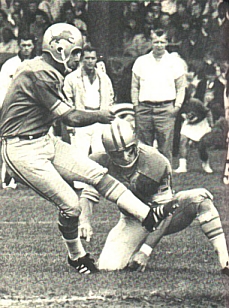
1966: Yepremian Kicks 6 Field Goals as Lions Defeat Vikings


Soccer-style placekickers were still a novelty in 1966 when Garo Yepremian joined the Detroit Lions. At 5’7” and 160 pounds, he was significantly undersized and had no background in the sport. The left-footed former semipro soccer player from Cyprus had, in fact, signed with the Lions just six weeks after arriving from London to visit his brother in Indianapolis, and had never seen an American football game prior to that. But on November 13, 1966 against the Minnesota Vikings he had a record-setting day in his new profession.

The Lions, coached by Harry Gilmer, started off the season with two wins in their first three games but had gone winless since (including a tie the week prior to the Minnesota game) and were a dismal 2-6-1. Adding to their problems, QB Karl Sweetan, who had taken over the starting job after veteran Milt Plum went down with an injury, was himself playing with broken ribs suffered the week before against the Bears.

Minnesota was 3-4-1 coming into the game, having won three of their previous four contests following a slow start. Head Coach Norm Van Brocklin’s team was suffering from inconsistency, not helped by conflict between the coach and starting QB Fran Tarkenton.

There were 43,939 in attendance at Metropolitan Stadium in Bloomington, Minnesota. In their first possession, the Vikings went 73 yards in 14 plays but the drive stalled at the Detroit 7 and they settled for a 15-yard Fred Cox field goal. Shortly thereafter, SS Dale Hackbart intercepted a pass by Sweetan and returned it for a touchdown that, with the successful extra point, made it 10-0.

Yepremian, who had connected on just one of his six field goal attempts since joining the team, missed his first attempt from 48 yards. However, he found the range in the second quarter. The Lions had drives of 50, 52, and 51 yards, respectively, to set up each of Yepremian’s first three field goals, from 33, 26, and 15 yards.

Just before the end of the first half, LB Mike Lucci intercepted a Tarkenton pass and returned it 16 yards to the Minnesota 13. Yepremian kicked his record fourth field goal of the quarter, from 20 yards, and the Lions went into halftime with a 12-10 lead.

The Vikings turned things around in a two minute span of the third quarter with help from the defense. First, FS Ed Sharockman intercepted a pass by QB Tommy Myers (who had come in for one play in place of Sweetan) and returned it 38 yards to set up a two-yard scoring carry by HB Dave Osborn. On the next series, DE Jim Marshall forced a fumble by Sweetan that was recovered by LB Roy Winston at the Detroit 12. FB Bill Brown scored from that distance and the Vikings were up by 24-12.

Yepremian missed a 39-yard field goal attempt in the third quarter, but shortly thereafter got another chance after Lucci again came up with an interception. This time he was successful from 28 yards to tie the existing NFL record for field goals in a game as well as narrow Minnesota’s lead to 24-15.

Following another interception of Tarkenton, this time by safety Tom Vaughn, Yepremian added his record-breaking sixth field goal from 32 yards. The diminutive Cypriot had thus far accounted for all 18 points scored by the Lions and it was now a six-point game.

In the fourth quarter, Lucci struck again, intercepting Tarkenton for the third time and on this occasion returning it 53 yards for a touchdown. With Yepremian’s successful extra point, the Lions were back in front at 25-24.

Soon afterward, DB John Robinson returned a punt 64 yards for the Lions to set up another touchdown. HB Bobby Felts, replacing the injured Amos Marsh, powered in for the three-yard TD and Yepremian added another extra point to improve Detroit’s margin to eight points.

With 2:42 left, the Vikings finally got on the board again. They drove 71 yards in 10 plays that ended with HB Billy Barnes running for a three-yard touchdown. Minnesota had one last shot, taking over with 1:01 on the clock, but couldn’t reach field goal range and ended up turning the ball over on downs to effectively end the game. Detroit won by a final score of 32-31.

The Lions had the edge in total yards (268 to 232) and first downs (16 to 15). Detroit failed to run the ball effectively, gaining just 50 yards on 22 carries, while the Vikings managed only 83 net passing yards. There were nine turnovers in all, with Minnesota accounting for five to four by Detroit.

Garo Yepremian had the biggest day, setting a then-league record with six field goals in eight attempts, including four in one quarter. The six field goals broke the previous NFL record of five that had been held by four players (Ernie Nevers, Bob Waterfield, Roger LeClerc, and Jim Bakken, who would in turn exceed Yepremian’s mark).


Karl Sweetan completed 24 of 41 passes for 226 yards with no touchdowns and one intercepted. Flanker Pat Studstill had 9 catches for 116 yards. FB Tom Nowatzke led Detroit’s anemic running attack with 18 yards on 10 carries, although he caught 5 passes for 35 yards. Mike Lucci (pictured at left) was the star on defense with his three interceptions, including one returned for a touchdown.

Fran Tarkenton had a rough outing for the Vikings as he was successful on just 11 of 24 throws for 106 yards with no scores and five interceptions. Bill Brown led the rushers with 45 yards on 13 carries that included a TD and Dave Osborn added 39 yards and a score on 16 attempts. Brown also was the top receiver with three catches for 17 yards. TE Preston Carpenter gained 40 yards on his two receptions.

Detroit won again the next week with an upset of the Colts but lost the remaining games, including the rematch with the Vikings. Both clubs finished at 4-9-1 and at the bottom of the Western Conference.

Garo Yepremian ended up kicking 13 field goals in 22 attempts (59.1 %) and was successful on all 11 of his extra points.  He returned for the 1967 season but entered the US Army and was let go by the Lions. After a stint in the Continental Football League, Yepremian caught on with the Miami Dolphins in 1970 and went on to have an outstanding career that finally came to an end with Tampa Bay in 1981. Overall, the unlikely-looking football player who had been ridiculed when he first joined the Lions for his lack of knowledge of the game ended up kicking 210 field goals out of 313 attempts (67.1 %) and 444 extra points for a total of 1074 points. He also was twice selected to the Pro Bowl and received All-NFL honors on two occasions. While his single-game field goal record didn’t last long – it was broken by Jim Bakken of the Cardinals in 1967 - the four field goals in a quarter remain a record, tied several times.

August 19, 2012

Rookie of the Year: Tommy Nobis, 1966

Linebacker, Atlanta Falcons


Age: 23 (Sept. 20)
College: Texas
Height: 6’2”    Weight: 230

Prelude:
Nobis, a two-time All-American and winner of the 1965 Outland Trophy, was the first overall selection by the expansion Falcons in the ’66 NFL draft and received a large bonus to keep him away from the Houston Oilers of the rival AFL, who also took him in the first round. He became the centerpiece of the new club’s defense, moving directly into the starting lineup at middle linebacker.

1966 Season Summary
Appeared in all 14 games
(Bracketed numbers indicate league rank in Top 20)

Sacks – N/A
Interceptions – 0
Fumble recoveries – 1

Awards & Honors:
NFL Rookie of the Year: NEA, Sporting News
Pro Bowl

Falcons went 3-11 to finish seventh in the NFL Eastern Conference.

Aftermath:
Nobis followed up his noteworthy rookie season by achieving first-team All-Pro honors in 1967 from the Associated Press and New York Daily News as well as a second Pro Bowl selection. He was again a Pro Bowl selection in ’68, along with being a consensus second-team All-Pro, but knee injuries cost him most of the 1969 and ’71 seasons. When healthy, he was still a premier linebacker and was selected to two more Pro Bowls, following 1970 and ’72. Nobis played through 1976, a total of 11 years and 133 games, and ended up with 12 interceptions – two of which he returned for touchdowns – 13 fumble recoveries, and five Pro Bowl selections while playing for a team that never reached the postseason. The Falcons retired his #60.

--

Rookie of the Year Profiles feature players who were named Rookie of the Year in the NFL (including NFC/AFC), AFL (1960-69), or USFL (1983-85) by a recognized organization (Associated Press – Offense or Defense, Newspaper Enterprise Association, United Press International, The Sporting News, or the league itself – Pepsi NFL Rookie of the Year).