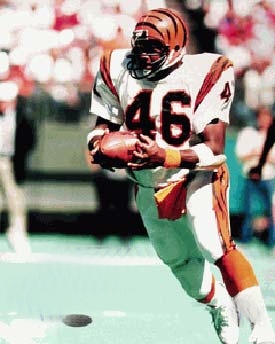
Showing posts with label James Brooks. Show all posts

November 2, 2015

Highlighted Year: James Brooks, 1981

Running Back, San Diego Chargers


Age: 23 (Dec. 28)
1st season in pro football
College: Auburn
Height: 5’9”   Weight: 180

Prelude:
Brooks was an all-purpose star in college, rushing for 3523 yards while averaging 5.7 yards per carry and returning 68 kickoffs for an average of 25.4 yards. Those numbers included a SEC-leading 1208 rushing yards in 1979 and 1314 yards as a senior in ’80. Brooks was an All-SEC selection, along with his teammate RB Joe Cribbs, in 1979 and received second-team All-American honors from the Associated Press and NEA in addition to All-SEC recognition again in ’80. He was chosen by the Chargers in the first round of the 1981 NFL draft (24th overall).

1981 Season Summary
Appeared in 14 of 16 games
[Bracketed numbers indicate league rank in Top 20]

Rushing
Attempts – 109
Most attempts, game – 17 (for 97 yds.) at Oakland 11/22, (for 50 yds.) at Tampa Bay 12/13
Yards – 525
Most yards, game – 97 yards (on 17 carries) at Oakland 11/22
Average gain – 4.8 [6]
TDs – 3

Pass Receiving
Receptions – 46
Most receptions, game – 9 (for 90 yds.) at Seattle 11/16
Yards – 329
Most yards, game – 90 (on 9 catches) at Seattle 11/16
Average gain – 7.2
TDs – 3

Kickoff Returns
Returns – 40 [4]
Yards – 949 [5]
Most yards, game – 123 (on 5 ret.) at Seattle 11/16
Average per return – 23.7 [8]
TDs – 0
Longest return – 47 yards

Punt Returns
Returns – 22
Yards – 290 [14]
Most yards, game – 79 (on 2 ret.) at Oakland 11/22
Average per return – 13.2 [2, 1st in AFC]
TDs – 0
Longest return – 42 yards

All-Purpose yards – 2093 [1]

Scoring
TDs – 6
Points – 36

Postseason: 2 G
Rushing attempts – 9
Most rushing attempts, game – 6 at Cincinnati, AFC Championship
Rushing yards – 42
Most rushing yards, game – 23 at Cincinnati, AFC Championship
Average gain rushing – 4.7
Rushing TDs – 0

Pass receptions – 6
Most pass receptions, game – 4 at Miami, AFC Divisional playoff
Pass receiving yards – 36
Most pass receiving yards, game – 31 at Miami, AFC Divisional playoff
Average yards per reception – 6.0
Pass Receiving TDs – 2

Kickoff returns – 9
Kickoff return yds. – 172
Most yards, game – 87 (on 4 ret.) at Cincinnati, AFC Championship
Kickoff return avg. – 19.1
Kickoff return TDs – 0

Punt returns – 1
Punt return yds. – 8
Punt return TDs – 0

Chargers went 10-6 to finish first in the AFC West while leading the NFL in total yards (6744), passing yards (4739), touchdowns (61), and scoring (478 points). Won AFC Divisional playoff over Miami Dolphins (41-38). Lost AFC Championship to Cincinnati Bengals (27-7).

Aftermath:
Brooks followed up his outstanding rookie season by again leading the NFL in all-purpose yards with 1383 in the strike-shortened 1982 season. He gained another 1475 total yards in ’83 but became disgruntled and was traded to the Cincinnati Bengals for FB Pete Johnson in 1984. Brooks continued in a limited role for a year before being used more extensively at running back in ’85 and rushed for 929 yards and gained another 576 yards on 55 pass receptions. In 1986 he ran for 1087 yards and had 54 catches for 686 yards and was selected to the Pro Bowl. Following a lesser year in ’87 when he suffered an ankle injury, Brooks went to the Pro Bowl after each of the next three seasons. He rushed for a career-high 1239 yards in 1988 as the Bengals won the AFC title. Despite being undersized, Brooks proved to be a tough and dependable runner and productive as a receiver out of the backfield. He finished his career with Cleveland and Tampa Bay in 1992. Overall, Brooks ran for 7962 yards on 1685 carries (4.7 avg.), caught 383 passes for 3621 yards (9.5 avg.), returned 52 punts for a 10.9-yard average, 132 kickoffs for a 20.9 avg., and scored a total of 79 touchdowns. Of those totals, 1471 rushing yards and 84 catches for 610 yards came with the Chargers, along with all of the punt returns and the majority of the kickoff returns. He received first-team All-AFC recognition once, second-team honors after three other seasons, and was selected to the Pro Bowl four times.  

--

Highlighted Years features players who were consensus first-team All-League* selections or league* or conference** leaders in the following statistical categories:

Rushing: Yards, TDs (min. 10)
Passing: Yards, Completion Pct., Yards per Attempt, TDs, Rating
Receiving: Catches, Yards, TDs (min. 10)
Scoring: TDs, Points, Field Goals (min. 5)
All-Purpose: Total Yards
Defense: Interceptions, Sacks
Kickoff Returns: Average
Punt Returns: Average
Punting: Average

*Leagues include NFL (1920 to date), AFL (1926), AFL (1936-37), AAFC (1946-49), AFL (1960-69), WFL (1974-75), USFL (1983-85)

**NFC/AFC since 1970

December 31, 2014

1988: Bengals Dominate First Half, Defeat Seahawks in AFC Divisional Playoff Game


The Cincinnati Bengals were the top-seeded team in the AFC as they hosted the Seattle Seahawks in a Divisional Playoff game on December 31, 1988. The Bengals were 4-11 in 1987 but climbed to the top of the AFC Central with a 12-4 record in ’88. Head Coach Sam Wyche’s team operated a high-powered offense that was the league’s most productive and was directed by QB Boomer Esiason, who received multiple MVP honors but struggled with a sore shoulder late in the season. The running game topped the NFL and featured veteran RB James Brooks plus unheralded rookie FB Ickey Woods (pictured above), who entertained fans with the “Ickey Shuffle” after each of his 15 touchdowns. The defense was less heralded, utilizing a 3-4 alignment anchored by All-Pro NT Tim Krumrie.

Seattle, coached by Chuck Knox, topped the AFC West with a 9-7 record, which reflected the team’s inconsistency. QB Dave Krieg missed time with a shoulder separation and 34-year-old WR Steve Largent had injury problems that limited his effectiveness. The Seahawks were better at running the ball with RB Curt Warner and FB John L. Williams, but the team was typically outgained by its opponents as the defense ranked 24th in the NFL.

It was a cold and cloudy late afternoon at Riverfront Stadium, where the Bengals had not lost all season, with 58,560 fans in attendance. Cincinnati had the game’s first possession and went 85 yards in 11 plays. Boomer Esiason completed passes to WR Cris Collinsworth for 30 yards and WR Eddie Brown for 23 and Ickey Woods ran effectively. FB Stanley Wilson ran gained the last three yards for a touchdown and Jim Breech added the extra point.

The teams traded punts before a long pass by Dave Krieg was intercepted by CB Eric Thomas. In a series that extended into the second quarter, the Bengals drove 75 yards in 10 plays. Esiason started off with a pass to TE Rodney Holman for 11 yards and James Brooks (pictured below) followed up with a 26-yard run to the Seattle 38. Woods and Brooks ran the ball to the 15, Esiason again connected with Holman for a gain of nine, and two plays later, Wilson ran for another three-yard TD. Breech converted to make the score 14-0.


A short series by the Seahawks that ended with a punt was followed by a five-play, 56-yard Cincinnati possession. Woods took off for 30 yards on the first play, Brooks had a 17-yard carry, and Wilson gained eight to reach the Seattle one. Two plays later, it was Woods reaching the end zone and Breech’s PAT had the Bengals up by a comfortable 21-0 score, and that remained the tally at halftime. Cincinnati had dominated on the ground, rolling up 165 rushing yards in the first thirty minutes, to none for Seattle.

The teams exchanged punts to start the third quarter. Seattle finally put together a promising drive as Krieg completed passes to WR Brian Blades for 13 yards and John L. Williams for 24. A sack by LB Reggie Williams had the Seahawks facing a third-and-21 situation at the Cincinnati 45, but a pass interference penalty erased the deficit and advanced the ball to the 21. Krieg passed the Seahawks to the three, but a fourth-and-two throw was broken up in the end zone by CB Rickey Dixon and the visitors came up empty.

The Bengals responded with a long drive of 95 yards with Woods and Brooks largely carrying the load. Esiason completed three passes, the first to Holman for 24 yards and the last to Brooks for nine yards to set up a fourth-and-two situation at the Seattle three. Woods came up short on the next play and the Seahawks had the ball back on downs, but at their own two with the period almost over.

Two plays into the fourth quarter, a Krieg pass was intercepted to give the Bengals the ball at their own 40, but two plays after that Esiason fumbled while being sacked and NT Joe Nash recovered for Seattle. Krieg threw to Blades for 17 yards and TE John Spagnola for seven to reach the Cincinnati seven, and three plays later the Seahawks finally got on the board on a seven-yard pass to Williams. Norm Johnson added the point after.

A three-and-out series by the Bengals resulted in a punt and the Seahawks drove 69 yards in nine plays. Krieg connected with WR Paul Skansi for 11 yards in a third-and-ten situation and a completion to WR Ray Butler for 32 yards advanced the ball to the Cincinnati 12. Three plays later, Krieg kept the ball himself for a one-yard TD, but, critically, Johnson missed the extra point and Seattle remained behind by eight points with just under six minutes to play.

Another short Cincinnati series resulted in a punt, but this time the Seahawks were unable to move the ball as Krieg threw three incomplete passes and the visitors punted as well. With the help of a 20-yard run by Woods, the Bengals reached the Seattle 44 on their next series before punting and pinning the Seahawks back at their two yard line with 2:40 remaining on the clock. Krieg was able to complete four passes, but not his last three as the drive – and Seattle’s season – ended at the Cincinnati 44. The Bengals won by a final score of 21-13.

Cincinnati had the lead in total yards (345 to 294), with 254 yards of that total coming on the ground as opposed to just 18 rushing yards for the Seahawks. The Bengals also had the edge in first downs (22 to 19) and time of possession (35:19 to 24:41). Seattle turned the ball over three times, to two suffered by Cincinnati.

Ickey Woods gained 126 yards on 23 rushing attempts that included a touchdown and James Brooks added 72 yards on 13 carries. Stanley Wilson contributed 45 yards on 7 rushes that included the two short TDs. Boomer Esiason completed just 7 of 19 passes for 108 yards and no TDs but also gave up no interceptions. Rodney Holman was the only Cincinnati receiver with more than one catch, pulling in three passes for 44 yards.


For the Seahawks, Dave Krieg was successful on 24 of 50 throws for 297 yards and a touchdown while being intercepted twice. John L. Williams (pictured at left), who gained just 10 rushing yards on 7 attempts, caught 11 passes for 137 yards and a TD. Brian Blades contributed 5 catches for 78 yards. Curt Warner was held to 11 yards on 8 carries.

“They (the Bengals) did a good job the first half, we didn’t, and that’s where we lost the game,” summed up Dave Krieg for the Seahawks.

The Bengals won again the next week as they defeated Buffalo for the AFC Championship, but then lost a closely-contested Super Bowl to the 49ers. Seattle dropped to 7-9 in 1989 and didn’t return to the postseason until 1999.

The loss to Cincinnati also was Chuck Knox’s last postseason coaching appearance. His teams (the Rams and Bills in addition to the Seahawks) reached the playoffs a total of eleven times, compiling a 7-11 record (3-4 with Seattle).   

May 29, 2012

1984: Bengals Obtain James Brooks from Chargers for Pete Johnson


On May 29, 1984 the Cincinnati Bengals and San Diego Chargers made a straight-up trade of disgruntled running backs, with the Bengals sending Pete Johnson to San Diego for James Brooks (pictured at right).

Johnson was 30 and had been taken by the Bengals in the second round out of Ohio State in 1977. He led Cincinnati in rushing in all seven years that he was with the team, totaling 5421 yards and making him the franchise’s all-time rushing leader at the time. He also was the club leader in career touchdowns with 70. A classic fullback at 6’0” and 252 pounds, Johnson’s best season came in 1981 as he rushed for 1077 yards, caught 46 passes for 320 more yards, and scored 16 TDs. He was named to the Pro Bowl and the offensively-potent Bengals won their first AFC title. 

In 1983, Johnson was suspended for the first four games of the season due to cocaine use (he and a teammate, DE Ross Browner, received immunity to testify in a federal trial regarding their purchase of cocaine from a Cincinnati plumber). He had reported late and overweight for training camp, but still rushed for 763 yards and tied for the AFC lead in rushing touchdowns (along with Seattle’s Curt Warner) with 14.

Johnson (pictured below) was insisting on a contract re-negotiation and made clear that he would not stay in Cincinnati past its expiration in ’84, looking at the USFL as a possible alternative. He skipped a mandatory minicamp, likely the final straw for the front office.

GM Paul Brown of the Bengals had been angered by Johnson’s behavior but was gracious in sending him off: “Pete Johnson has contributed greatly for us over the years, and now the time has come for us to part and go separate ways. We wish him well.”


As for the 25-year-old Brooks, he was San Diego’s first draft choice in 1981 out of Auburn and led the NFL in all-purpose yardage in ’81 and ’82. Small and fast at 5’10” and 177 pounds, Brooks had been critical of his use by Head Coach Don Coryell in San Diego. “It started about the second game last season,” he explained. “I didn’t want them to put me at fullback…San Diego wanted me to block instead of letting me go one-on-one with linebackers in passing situations.” While he had received assurances from Coryell in minicamp that the team would run the ball more often, he was instead dealt to Cincinnati.

In ’83, the Chargers were coming off their first losing season under Coryell, who had taken over as head coach during the 1978 season. The team went 6-10 and, among the many problems, star RB Chuck Muncie had a substandard performance. While he gained 886 yards and scored 13 touchdowns, he averaged 3.8 yards per carry, his lowest total with the Chargers and second-lowest of his eight-season career that began in New Orleans, and also fumbled eight times (as did Brooks).  

Meanwhile, the Bengals had a new head coach in the unorthodox Sam Wyche and were looking to open up the offense and provide a more varied running attack.

The trade ended up being very one-sided in Cincinnati’s favor. Johnson failed to last the season in San Diego, performing badly over the course of three games (19 carries for 46 yards). He was dealt off to Miami where he finished up the year – and his career.

James Brooks went on to have a long and outstanding stint with the Bengals. He started off slowly in ’84, still used more as the change-of-pace back that he had been in San Diego and running the ball just 103 times for 396 yards and catching 34 passes for 268 more while another big fullback, Larry Kinnebrew, and veteran Charles Alexander received more of the carries. But in 1985 Brooks was used more extensively and set a team record for total yards in a season as he rushed for 929 yards on 192 attempts (4.8 avg.) and caught 55 passes for 576 yards while scoring 12 touchdowns.

In four of the next five years, Brooks was selected to the Pro Bowl and gained over a thousand yards rushing on three occasions, with a high of 1239 in ’89. His 1773 total yards in 1986 were also a career high in a season in which he led the NFL in average gain per carry (5.3 on 205 attempts for 1087 yards). He stayed in Cincinnati through 1991 and ended up rushing for 6447 yards (surpassing Johnson’s team mark) with a 4.8-yard average (he averaged over five yards per carry in each of his thousand-yard rushing seasons) and gaining another 3012 yards on 297 pass receptions (a fine 10.1 average out of the backfield) while totaling 64 touchdowns.

The Bengals also won a conference title along the way, in 1988, with Brooks effective but overshadowed by power-running rookie sensation Ickey Woods (who proved to have far less staying power). The combination of the two made Cincinnati the top running team in the NFL that season. But when Woods was lost to injury in ’89, the Bengals still led the league in rushing with Brooks carrying most of the load. He proved in Cincinnati that, despite the small size that had been considered a limiting factor in San Diego, he was a tough and dependable runner as well as an outstanding pass receiver. He also ended up having surprising longevity (he was 32 when last selected to the Pro Bowl for the 1990 season) and was one of the most productive all-around backs of his era. 

December 25, 2010

1989: Karlis & Vikings Defense Sink the Bengals, Secure Playoff Spot


The two teams meeting at the Hubert H. Humphrey Metrodome in Minneapolis on Christmas night, December 25, 1989, were both trying to secure playoff spots in the season’s final week of play. The Minnesota Vikings, under Head Coach Jerry Burns, had been tied with Green Bay atop the NFC Central at 9-6 and, with the Packers having won the day before, needed a victory to win the division (they had the advantage over Green Bay in the division record tiebreaker and would not be able to gain wild card entry with a second place finish). The visiting Cincinnati Bengals, coached by Sam Wyche, were 8-7 and couldn’t win the AFC Central, but still had a chance at a wild card spot.

The Vikings had been underachieving contenders the previous two years, considering the talent on the roster, and had swung a huge deal during the season to obtain RB Herschel Walker from Dallas (ultimately, the Cowboys profited far more than Minnesota). But while unbeatable in the Metrodome, they had gone 2-6 on the road, including an overtime loss the previous week at Cleveland. After making an initial splash, Walker proved to be ill-suited in an offense which further suffered from QB Wade Wilson’s inconsistency and injury-plagued performances by WR Anthony Carter and TE Steve Jordan, who had held out during training camp (contract issues were a significant behind-the-scenes problem). Defense had kept the Vikings alive, in particular the play of DE Chris Doleman (pictured at top) and DT Keith Millard, who led an outstanding pass rush.


Cincinnati had won the AFC Championship in 1988, losing a close Super Bowl contest to the 49ers, but FB Ickey Woods, the key to the ground game in ’88, went down for the year in the season’s second contest. After getting off to a 4-1 start, the Bengals played inconsistently despite the presence of QB Boomer Esiason (pictured at left), wide receivers Eddie Brown and Tim McGee, TE Rodney Holman, and RB James Brooks. The undersized defensive line had difficulty mounting a pass rush, although the backfield, led by SS David Fulcher, was formidable.

The Vikings started off well as Wilson passed to RB Rick Fenney for a 26-yard gain on the game’s first play from scrimmage and proceeded to drive 65 yards in 10 plays, culminating in a 31-yard field goal by Rich Karlis. Following a Cincinnati punt, Minnesota marched to another Karlis field goal, of 37 yards, and held a 6-0 lead after one quarter.

It appeared that Minnesota might take decisive control in the second quarter as Karlis booted two more field goals, from 22 and 42 yards, and in between, following an interception of an Esiason pass by safety Darrell Fullington, Wilson tossed an 11-yard touchdown pass to Fenney. The score was 19-0 midway through the period. The Bengals finally got on the board, however, thanks to a 10-play, 77-yard drive that was capped by Esiason’s 34-yard touchdown pass to Brown.

Cincinnati got the ball back once more in the last two minutes of the half, and Esiason came out throwing but, after the Bengals had driven into Minnesota territory at the 43, he was intercepted by LB Scott Studwell. A 50-yard pass play from Wilson to WR Hassan Jones got the Vikings down to the Cincinnati seven, and Karlis, who had already tied the existing league record with a seven-field goal performance earlier in the season, booted his fifth, from 24 yards. It was 22-7 at the half, but could have been far more lopsided.

Three plays into the third quarter, the margin narrowed as Esiason connected with Holman for a 65-yard touchdown. While it was now 22-14, both offenses bogged down, and the Vikings sacked Esiason three times and forced two fumbles. After the second fumble recovery, Minnesota drove to the Cincinnati 15 but Fenney fumbled and DE Jason Buck recovered for the Bengals to snuff out the threat.

Near the end of the period, Vikings LB Mark Dusbabek intercepted Esiason at the Cincinnati 43, but the ensuing possession failed to add to the Minnesota lead when, now into the fourth quarter, Karlis missed a 52-yard field goal that hit the right upright and bounced away.

The Bengals drove down the field, converting a third-and-fifteen situation with an Esiason completion to McGee for 18 yards. Five plays later, the quarterback threw to RB Craig Taylor for an 18-yard touchdown, and with the successful extra point by Jim Breech, Minnesota’s lead was now down to one point at 22-21.

It was the turn of the Vikings to put together a long drive and, helped along by three penalties on the Bengals, they got down to the one yard line. On a fourth-and-goal play, Coach Burns passed up the easy field goal and chose to go for the touchdown - he was rewarded when Wilson completed a pass to reserve TE Brent Novoselsky for a TD. The successful PAT by Karlis put Minnesota up by eight points.

The teams traded punts and, with just over three minutes remaining, Cincinnati took over on its own five yard line and began to move methodically down the field. Esiason was successful on his first eight passes and a 17-yard completion to McGee on fourth-and-two took the Bengals to the Minnesota 22 yard line. The drive stalled, however, and an apparent fourth-down scoring pass to Brown was wiped out by a penalty. The Vikings held on to win by a score of 29-21.

The Bengals outgained Minnesota (309 yards to 274) and had the edge in first downs (26 to 24), but also gave up five turnovers, as opposed to one by the Vikings. Minnesota’s pass rushers sacked Esiason six times (Chris Doleman accounted for four of them), although the Bengals got to Wilson on four occasions (LB Reggie Williams had two).


Wade Wilson (pictured at right) completed 19 of 35 passes for 303 yards with two touchdowns and none intercepted. Anthony Carter caught 7 passes for 118 yards and Hassan Jones added another 90 yards on four receptions. Rick Fenney led the team in rushing with 62 yards on 17 attempts and also grabbed 5 passes for another 51 yards and a TD. Herschel Walker gained just 43 yards on 12 carries.

Boomer Esiason, playing catchup almost all the way and being hit often, went to the air 54 times and had 31 completions for 367 yards with three touchdowns but also three interceptions. James Brooks had a typically productive day leading the team with 93 yards on 15 carries and also catching 12 passes for 66 more yards. Eddie Brown gained 109 yards on 6 catches with a TD and Rodney Holman contributed 84 yards on his three receptions that included a touchdown.

Minnesota won the NFC Central with the resulting 10-6 record but lost badly to the 49ers in the Divisional playoff. At 8-8, Cincinnati ended up not only out of the postseason but at the bottom of the AFC Central (the three other teams all made it into the playoffs, although Houston and Pittsburgh were only a game better than the Bengals at 9-7. The Steelers would have been eliminated had Cincinnati won).

Boomer Esiason was the top-rated passer in the AFC (92.1 rating) and also threw the most touchdown passes (28). He was selected to the Pro Bowl for the second straight year.

James Brooks ran for a career-high 1239 yards on 221 carries for an AFC-leading 5.6 average (the highest among NFL running backs as Eagles QB Randall Cunningham led the league with a 6.0 average). His 1545 yards from scrimmage ranked fifth in the NFL. He, too, went to the Pro Bowl for the second consecutive time and third of an eventual four.

Chris Doleman led the NFL with 21 sacks and was a consensus first team All-NFL selection as well as being named to the Pro Bowl for the third (of an eventual four) straight years. Teammate Keith Millard ranked third with 18 as Minnesota ended up recording a total of 71 sacks, the second-most in NFL history.


Despite playing in just 13 games, the barefoot-kicking Rich Karlis (pictured at left) had a career-year in leading the NFL with 31 field goals, out of 39 attempts. He had played seven seasons with the Broncos but was a late preseason cut following a contract dispute. Following his big year, Karlis held out again in 1990 and the Vikings, after picking up Donald Igwebuike off waivers from Tampa Bay, chose to let him go. He signed on with the Lions during the season, covering for injured veteran Eddie Murray for six games, but was let go when Murray returned. It proved to be his final year in the NFL.