Showing posts with label Pete Johnson. Show all posts

May 29, 2012

1984: Bengals Obtain James Brooks from Chargers for Pete Johnson


On May 29, 1984 the Cincinnati Bengals and San Diego Chargers made a straight-up trade of disgruntled running backs, with the Bengals sending Pete Johnson to San Diego for James Brooks (pictured at right).

Johnson was 30 and had been taken by the Bengals in the second round out of Ohio State in 1977. He led Cincinnati in rushing in all seven years that he was with the team, totaling 5421 yards and making him the franchise’s all-time rushing leader at the time. He also was the club leader in career touchdowns with 70. A classic fullback at 6’0” and 252 pounds, Johnson’s best season came in 1981 as he rushed for 1077 yards, caught 46 passes for 320 more yards, and scored 16 TDs. He was named to the Pro Bowl and the offensively-potent Bengals won their first AFC title. 

In 1983, Johnson was suspended for the first four games of the season due to cocaine use (he and a teammate, DE Ross Browner, received immunity to testify in a federal trial regarding their purchase of cocaine from a Cincinnati plumber). He had reported late and overweight for training camp, but still rushed for 763 yards and tied for the AFC lead in rushing touchdowns (along with Seattle’s Curt Warner) with 14.

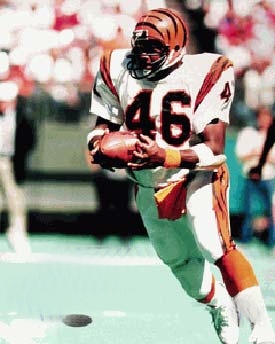
Johnson (pictured below) was insisting on a contract re-negotiation and made clear that he would not stay in Cincinnati past its expiration in ’84, looking at the USFL as a possible alternative. He skipped a mandatory minicamp, likely the final straw for the front office.

GM Paul Brown of the Bengals had been angered by Johnson’s behavior but was gracious in sending him off: “Pete Johnson has contributed greatly for us over the years, and now the time has come for us to part and go separate ways. We wish him well.”


As for the 25-year-old Brooks, he was San Diego’s first draft choice in 1981 out of Auburn and led the NFL in all-purpose yardage in ’81 and ’82. Small and fast at 5’10” and 177 pounds, Brooks had been critical of his use by Head Coach Don Coryell in San Diego. “It started about the second game last season,” he explained. “I didn’t want them to put me at fullback…San Diego wanted me to block instead of letting me go one-on-one with linebackers in passing situations.” While he had received assurances from Coryell in minicamp that the team would run the ball more often, he was instead dealt to Cincinnati.

In ’83, the Chargers were coming off their first losing season under Coryell, who had taken over as head coach during the 1978 season. The team went 6-10 and, among the many problems, star RB Chuck Muncie had a substandard performance. While he gained 886 yards and scored 13 touchdowns, he averaged 3.8 yards per carry, his lowest total with the Chargers and second-lowest of his eight-season career that began in New Orleans, and also fumbled eight times (as did Brooks).  

Meanwhile, the Bengals had a new head coach in the unorthodox Sam Wyche and were looking to open up the offense and provide a more varied running attack.

The trade ended up being very one-sided in Cincinnati’s favor. Johnson failed to last the season in San Diego, performing badly over the course of three games (19 carries for 46 yards). He was dealt off to Miami where he finished up the year – and his career.

James Brooks went on to have a long and outstanding stint with the Bengals. He started off slowly in ’84, still used more as the change-of-pace back that he had been in San Diego and running the ball just 103 times for 396 yards and catching 34 passes for 268 more while another big fullback, Larry Kinnebrew, and veteran Charles Alexander received more of the carries. But in 1985 Brooks was used more extensively and set a team record for total yards in a season as he rushed for 929 yards on 192 attempts (4.8 avg.) and caught 55 passes for 576 yards while scoring 12 touchdowns.

In four of the next five years, Brooks was selected to the Pro Bowl and gained over a thousand yards rushing on three occasions, with a high of 1239 in ’89. His 1773 total yards in 1986 were also a career high in a season in which he led the NFL in average gain per carry (5.3 on 205 attempts for 1087 yards). He stayed in Cincinnati through 1991 and ended up rushing for 6447 yards (surpassing Johnson’s team mark) with a 4.8-yard average (he averaged over five yards per carry in each of his thousand-yard rushing seasons) and gaining another 3012 yards on 297 pass receptions (a fine 10.1 average out of the backfield) while totaling 64 touchdowns.

The Bengals also won a conference title along the way, in 1988, with Brooks effective but overshadowed by power-running rookie sensation Ickey Woods (who proved to have far less staying power). The combination of the two made Cincinnati the top running team in the NFL that season. But when Woods was lost to injury in ’89, the Bengals still led the league in rushing with Brooks carrying most of the load. He proved in Cincinnati that, despite the small size that had been considered a limiting factor in San Diego, he was a tough and dependable runner as well as an outstanding pass receiver. He also ended up having surprising longevity (he was 32 when last selected to the Pro Bowl for the 1990 season) and was one of the most productive all-around backs of his era. 

September 6, 2011

1981: Schonert Comes Off Bench to Lead Bengals to Win Over Seahawks


The Cincinnati Bengals had endured three straight losing seasons from 1978 to ’80 and, while the team had a new look with their tiger-striped uniforms being worn for the first time in regular season play, things did not look promising after one quarter of action in the 1981 season-opening game on September 6 against the Seattle Seahawks. Already, many of the 41,177 fans in attendance at Riverfront Stadium were booing the home team.

Ken Anderson, a talented quarterback who had suffered along with the rest of the club during the down period and had lost his job briefly in 1980, had a dreadful opening period. He completed just 5 of 15 passes for 39 yards, and two of his passes had been intercepted. The first led directly to a score when FS John Harris returned it 29 yards for a touchdown. Benefiting from the inept play of the Bengals offense, Seattle scored on a 36-yard pass play from QB Jim Zorn to WR Steve Largent and a one-yard rush by FB Jim Jodat to lead by 21-0 at the end of the first quarter.

With the fans voicing their frustration, second-year Head Coach Forrest Gregg pulled Anderson for Turk Schonert (pictured above), the third-string quarterback and second-year player out of Stanford, who was appearing in his first regular season game. The regular backup, Jack Thompson, aka “the Throwin’ Samoan”, was unavailable due to injury.

Things started inauspiciously when Schonert fumbled the ball away on his first snap, but the game completely turned around from that point on. Cincinnati’s defense shut down the Seahawks for the remaining three quarters while the young backup directed the offense on five scoring drives.

In the second quarter, Jim Breech got the Bengals on the board with a 25-yard field goal. Shortly before the end of the half, FB Pete Johnson bulled over from three yards out to cut Seattle’s lead to 21-10 at the intermission.

Following another Breech field goal of 40 yards in the third quarter, the Seahawks missed an opportunity to extend their lead when Efren Herrera failed on a 37-yard field goal attempt. Cincinnati capitalized, driving 80 yards to a three-yard touchdown carry by RB Archie Griffin. It was the former two-time Heisman Trophy winner’s first rushing TD since his rookie year in 1976 and, with the successful PAT, put the Bengals behind by just a point with three minutes remaining in the period.

Cincinnati’s game-winning drive came in the fourth quarter and covered 84 yards, capped by Johnson’s two-yard touchdown with just over five minutes to play. With the Seahawks unable to respond, the Bengals came away with a 27-21 come-from-behind victory.

Cincinnati ended up outgaining the Seahawks (375 yards to 290) and had more first downs (24 to 17). But while the visitors had more passing yards (230 to 169), they gained just 60 yards on 23 rushing attempts, to Cincinnati’s 210. Both teams turned the ball over four times.

Turk Schonert completed 9 of 18 passes for 130 yards, and while he threw for no touchdowns, he also gave up no interceptions and ran for 41 yards on 7 carries. Pete Johnson led the running attack with 84 yards on 20 attempts and two touchdowns. Rookie WR Cris Collinsworth caught 4 passes for 65 yards.

For the Seahawks, Jim Zorn was successful on 21 of 41 passes for 230 yards with a TD and an interception. Steve Largent caught 8 passes for 114 yards and a touchdown. But Jim Jodat was the leading rusher with just 21 yards on 8 attempts and the short TD.


“When you hear fans booing, it gets you charged up,” said Pete Johnson (pictured at left). “We showed that we can come back, but I hope we don't have to do it that way again.”

While Coach Gregg considered starting Schonert or Thompson the following week, he stayed with Anderson. The Bengals came from behind once again, this time with the veteran quarterback going the distance, to beat the Jets. Cincinnati went on to win the AFC Central with a 12-4 record, including seven victories in the last eight games, and advanced to the Super Bowl before succumbing to another upstart team, the San Francisco 49ers. Anderson recovered from the humiliating start to put together an MVP season, leading the league in passing while throwing for 3754 yards with 29 touchdowns against 10 interceptions – just eight in the 15 games following the abysmal first quarter against Seattle.

The rookie Cris Collinsworth, who led the Bengals in receiving in the opener, went on to be a key component of the offense as he caught 67 passes for 1009 yards and eight TDs. Pete Johnson continued to lead the running attack, gaining 1077 yards on 274 carries (3.9 avg.) while scoring 12 touchdowns.

For the Seahawks, coached by Jack Patera, the failure to hold the lead in Cincinnati not only resulted in the sixth straight opening-game loss for the franchise, but proved to be a portent of things to come. They lost five of their next six games and ended up with a 6-10 record that put them in last place in the AFC West. The acquisition of RB Theotis Brown from the Cardinals during the season helped bolster the running game, a weak area as evidenced in the opening loss.

Turk Schonert returned to the bench and threw just one more pass in 1981. He remained a backup with the Bengals for eight of his nine seasons and saw his most significant action in 1983 and ’84, when injuries put him back in the starting lineup for three games apiece (he had his most starts – five – in his one year with Atlanta in 1986). The opening-day win in 1981 remained the most memorable performance of his career.