November 28, 2010

1974: Clint Longley Rallies Cowboys Past Redskins


The Dallas Cowboys were in the midst of a transition season as they hosted the arch-rival Washington Redskins in a Thanksgiving Day game on November 28, 1974 at Texas Stadium. Having started off at 1-4, they won four straight games prior to losing at Washington eleven days earlier. While they beat the Oilers the previous Sunday, Dallas was 6-5 and languishing behind both the Redskins and Cardinals in the NFC East. Head Coach Tom Landry’s club had a great deal of youth on offense, and young defensive ends Ed “Too Tall” Jones and Harvey Martin were still transitioning into the reforming defense.

Head Coach George Allen’s Redskins had won four straight contests and were 8-3 as they sought to keep pace with St. Louis. Whether 40-year-old Sonny Jurgensen or Billy Kilmer, 35 years old and in his 12th season, were at quarterback, Washington scored points. The veteran team was also sound on defense, Allen’s specialty.

The first half was low-scoring. Efren Herrera kicked a 24-yard field goal in the first quarter to put the first points on the board, concluding a drive kept alive by a fake punt in which punter Duane Carrell passed to DB Benny Barnes for a 37-yard gain. But the Redskins had replied with three Mark Moseley field goals, of 45, 34, and 39 yards, to hold a 9-3 lead at halftime.

It seemed as though the Redskins had taken control of the game in the third quarter. Following a fumble on the opening play of the second half by RB Walt Garrison, former Cowboys RB Duane Thomas caught a swing pass from Kilmer and went nine yards for a touchdown. The score was now 16-3, and when Dallas QB Roger Staubach was hit hard by LB Dave Robinson and forced from the game with just under ten minutes remaining in the period, it seemed as though all hope was lost for the Cowboys.

Replacing Staubach at quarterback was Clint Longley (pictured at top), a rookie out of Abilene Christian who had never appeared in a regular season game as a pro. He had actually been chosen by Cincinnati in the 1974 supplemental draft, but was dealt to the Cowboys just prior to the start of training camp. Longley earned the nickname “The Mad Bomber” when he threw an errant pass that hit Coach Landry’s tower during a workout.

Prior to the contest, Washington DT Diron Talbert had told reporters that he hoped Staubach would try running with the ball against the Redskins because if they could knock him out of the game, they would be facing the untested rookie at quarterback. Those words would come back to haunt him.

Longley promptly moved the offense downfield, and capped the drive with a 35-yard touchdown pass to TE Billy Joe Dupree that narrowed Washington’s lead to 16-10. On the next possession, the Cowboys again drove deep into Redskins territory. When Garrison plowed over for a touchdown from a yard out and Herrera booted the extra point, Dallas was in the lead at 17-16. The previously-subdued Texas Stadium crowd had come alive.

However, Washington was far from finished. Early in the fourth quarter the Redskins regained the lead, again thanks to Thomas, who ran 19 yards for a touchdown and 23-17 tally. It looked as though they would further pad their margin after DE Ron McDole recovered a fumble by Dallas RB Charley Young. Washington moved into field goal range with five minutes remaining on the clock, but “Too Tall” Jones blocked Moseley’s 24-yard attempt.

It seemed as though the break was for nothing when RB Preston Pearson fumbled the ball back to the Redskins. However, Washington’s offense, playing conservatively, ran three plays and punted. Now with 1:45 remaining and no timeouts, Longley and the Cowboys had one more shot.

Washington’s defense seemed on the verge of squelching the threat, but on a fourth-and-six play, Longley passed to WR Bob Hayes for exactly six yards and a first down at the 50 yard line. After tossing an incompletion, Longley then sent WR Drew Pearson long, hit him in stride at the four yard line, and the wide receiver continued on into the end zone. Herrera was successful on the PAT, and the Cowboys had a one-point lead with 28 seconds to play.

There would be no last-second heroics for the Redskins, however, as Dallas recovered a Kilmer fumble on the first play to preserve the 24-23 win.

The Cowboys ended up outgaining Washington, 373 yards to 207, and led in first downs by 23 to 11. But they were nearly undone by giving up five turnovers, as opposed to one by the Redskins.

The flu-ridden Roger Staubach had completed only three of 11 passes for 32 yards with an interception before being forced out of the game – he had even been outpassed by the punter Carrell, with his one completion for 37 yards. But Clint Longley was good on 11 of 20 passes for 203 yards with the two touchdowns and no interceptions.

Drew Pearson (pictured at bottom), who caught the winning TD, had a big day with 5 catches for 108 yards. Billy Joe Dupree added three receptions for 65 yards and a TD. With top runner Calvin Hill out due to injury, RB Robert Newhouse led the Cowboys with 66 yards on 16 attempts.

For Washington, Billy Kilmer went to the air 17 times, completing 8 for 112 yards and a touchdown. Duane Thomas (pictured at left) had 18 rushing attempts for 55 yards and a TD and had the most pass receptions for the club with three, for 24 yards and a score. RB Moses Denson was right behind in the rushing column with 50 yards on 15 carries. WR Roy Jefferson had the most receiving yards, with 49 on his two catches.

“Football is an incredible game,” said Tom Landry afterward. “This is what makes it so unbelievable. Anything can happen in football.”

“I don't have very much to say,” said a disappointed George Allen. “It was probably the toughest loss we ever had.”

The win didn’t salvage the season for the Cowboys – they ended up outside the postseason for the first time since 1965 with an 8-6 record that put them in third place in the NFC East. Washington ended up tied with the Cardinals with a 10-4 mark, but due to St. Louis having swept the season series, the Cards won the division title and the Redskins entered the playoffs as a wild card. They lost to the Rams in the Divisional playoff game.

The astonishing performance off the bench didn’t portend better things for Longley, either. Staubach was back in action the next week and beyond and the young backup was sparsely used through the 1975 season. Following the demise of the World Football League, QB Danny White was acquired and, with his WFL experience and ability to double as the team’s punter, Longley’s roster spot was insecure for ’76. Bad blood had developed between he and Staubach, and when Longley sucker-punched the star quarterback in the locker room during training camp, his career in Dallas swiftly ended. He was dealt to San Diego, where he backed up Dan Fouts and threw a total of 24 passes in his last NFL season.

November 27, 2010

1955: Cardinals Hand Bears Key Defeat in Major Upset


The Chicago Bears were 6-3 and had won six straight games as they took on their cross-town rivals, the Chicago Cardinals, at Comiskey Park on November 27, 1955. George Halas, the owner and in his third stint as head coach, had announced that this would be his last season on the sideline and the club was focused on winning one last title for “the Papa Bear.” They were in first place in the Western Conference, a half game in front of the Rams, a club they had beaten twice.

The Cardinals were 3-5-1 and had lost their last two games coming into the annual intercity contest with the Bears. Under first-year Head Coach Ray Richards, the club had some outstanding talent in HB Ollie Matson (pictured above) and defensive halfback Dick “Night Train” Lane, but was by no means considered a match for its rival. They were 16.5-point underdogs coming into the game.

There were 47,314 fans in attendance in a heavy snowstorm, and even though it was the Cardinals’ home field, many of those were Bears fans, judging from the cheers for the Bears’ players during the pregame introductions. The turf was soft and muddy due to the weather conditions and the lights were turned on during the first quarter.

The tone for the game was set early as the Cardinals took the opening kickoff and drove 73 yards in 13 plays for the first score. QB Lamar McHan threw a pass intended for end Gern Nagler that was deflected but grabbed by end Don Stonesifer, who completed the play for a 28-yard touchdown.

The Bears took possession and were forced to punt. Matson received the kick at his own 23 yard line and returned it 77 yards for another Cardinals TD. Before the opening period was over, rookie HB Dave Mann scored on a 19-yard run to open up a 21-0 margin for the Cards.

The lead was extended to 27-0 in the second quarter after FB John Olszewski ran for a 41-yard touchdown. While PK Pat Summerall missed the extra point, it hardly mattered. The Bears finally got on the board when QB George Blanda ran for a one-yard TD, but were in a deep hole at 27-7 as the first half ended.

Any hopes that the Bears might climb out of that hole ended when they fumbled the ball away in their first two possessions of the second half. Summerall kicked field goals of 12 and 40 yards, and Mann contributed a long touchdown dash of 61 yards to add to the rout at 40-7 after three periods.

Matson and Stonesifer finished off the scoring in the fourth quarter, with the Hall of Fame halfback plunging in for a TD from a yard out and the end catching a seven-yard pass from McHan. The Bears scored an inconsequential touchdown in the last minutes as third string QB Bob Williams connected with end John Hoffman on a 23-yard pass play. The final score of the stunning upset was 53-14.


The Cardinals gained 301 yards on the ground, averaging 5.7 yards per attempt, and 175 passing for an overall total of 474, to 211 yards for the Bears. Dave Mann (pictured at left) led the club in rushing with 108 yards and two TDs. The Cards also led in first downs, 20 to 12, while the Bears turned the ball over five times (four interceptions, one fumble) to just two suffered by the Cardinals.

The Cardinals also led with 9 penalties, to four by the Bears. While tempers flared occasionally, a fight broke out near the end that caused two Bears and a Cardinal to be ejected.

The Bears, who were the top rushing team in the NFL, gained only 25 yards on the ground, with 186 through the air. QB Ed Brown, normally a reliable thrower, missed on all seven of his pass attempts. It was the worst beating the Cardinals had inflicted on the Bears since 1929, when Ernie Nevers scored six touchdowns.

“When you’re a Cardinal, part of the job is beating the Bears,” said veteran Charley Trippi, a Hall of Fame halfback in his prime who was finishing his career as a punter. “We beat them at their own game, with good blocking and good tackling.”

The loss proved devastating to the Bears’ postseason hopes – they dropped behind the Rams, and while they won their last two games to end up with an 8-4 record, LA did likewise to win the Western Conference title at 8-3-1. The Cardinals went 4-7-1 and tied the Eagles for fourth in the Eastern Conference.

Ollie Matson led the NFL in punt return average (18.8 yards on 13 returns) and, with the touchdown against the Bears, was the only player in the league to return two for scores during the season. His 1325 all-purpose yards (475 rushing, 237 receiving, 245 returning punts, 368 returning kickoffs) ranked second.

Dave Mann ran for 336 yards on 85 carries and caught 16 passes. He also ran back kickoffs as he totaled 609 all-purpose yards and handled much of the team’s punting (in addition to Trippi).

Don Stonesifer (pictured below) led the Cardinals in pass receiving with 28 catches for 330 yards and five touchdowns.

As for George Halas, while he did indeed step down as head coach (while continuing to run the club from the front office), it did not prove to be a permanent retirement. He returned to the sideline in 1958 and won another championship in ’63 before finally retiring for good after the 1967 season.

November 26, 2010

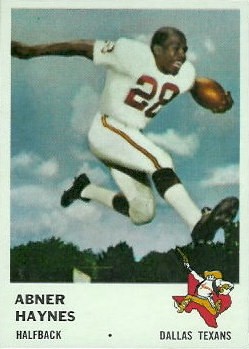
1961: Abner Haynes Scores 5 TDs as Texans Defeat Raiders


The Dallas Texans were in the midst of a disappointing season in the American Football League’s second year as they hosted the Oakland Raiders at the Cotton Bowl on November 26, 1961. The club had gone 8-6 in the inaugural ’60 season and had plenty of talent and an able head coach in Hank Stram. The Texans had hoped to challenge the Chargers for supremacy in the Western Division, but after a promising 3-1 start, they had lost six straight games coming into the contest against Oakland.

QB Cotton Davidson lacked accuracy and consistency, and the loss of FB Jack Spikes in the sixth game had hurt the inside running game. It was one of several injuries that had exposed issues with the club’s depth. Still, the team had HB Abner Haynes, an exciting multi-purpose talent who could run, catch, and return kicks equally well. Haynes had been suffering from a shoulder injury at the beginning of the season, but was now healthy – as Oakland would find out.

The Raiders were a 2-8 basket case. After losing their first two games by a combined score of 99-0, Eddie Erdelatz was fired as head coach and replaced by assistant Marty Feldman. It didn’t help much, but Oakland had given the Texans a tough contest in their earlier meeting (Feldman’s first game). The offense, led by capable QB Tom Flores, lacked enough punch and the defense had too many holes. It didn’t help that the situation with the front office was chaotic and the club played its home games across the bay from Oakland in San Francisco. The first meeting had been a back-and-forth struggle, but not this one.

There were 14,500 fans present at the Cotton Bowl as the Texans scored on their first possession. Davidson threw a pass to HB Johnny Robinson for a 30-yard touchdown and quick 7-0 lead. They never looked back.

Later in the first quarter, Haynes caught a pass from Davidson and went 66 yards for his first touchdown. In the second quarter, following a 65-yard run by FB Bo Dickinson, Haynes ran for a five-yard TD and Dallas was up by 21-0.

Meanwhile, Oakland’s offense reached the Dallas seven in the first quarter and came up empty, and a drive to the 11 in the second quarter also ended up without a score. George Fleming finally kicked a 45-yard field goal just before halftime, making it 21-3, but missed on three other attempts.

In the third quarter, Haynes accounted for all but seven of 61 yards in a drive that ended with the fleet halfback scoring from the one. He scored twice more in the same period, first on a 33-yard run over right tackle (followed by a successful two-point conversion) and then a 26-yard carry to the left side.

With the game well in hand at 43-3, Haynes sat out most of the fourth quarter, but did have a 25-yard run to finish off his day. Most of his successful runs came on pitchouts, giving him room to fake out defenders on the flanks.

Flores was relieved in the third quarter. Backup QB Nick Papac finally got the Raiders into the end zone in the fourth quarter with a quarterback sneak and they successfully converted for two points, providing the final score of 43-11.

The Texans piled up 495 yards, to 254 for the Raiders, with 284 on the ground and 228 through the air (147 by Davidson and 81 by backup Randy Duncan). Bo Dickinson, thanks to the long run in the second quarter, gained 79 yards on six carries and split end Chris Burford had a good performance with four catches for 68 yards. But the star of the game was Abner Haynes, who rushed for 158 yards on 14 carries with four touchdowns and caught two passes for 84 yards and a TD, thus accounting for 242 yards from scrimmage.

The touchdown and rushing yardage totals set new records for the young AFL. Haynes broke his old mark of 157, set against the New York Titans in ’60. He had also shared the old record for touchdowns in a game with three.

The 6’0”, 185-pound Haynes had been an unknown coming out of North Texas State in 1960, passing up offers from the NFL’s Pittsburgh Steelers and CFL’s Winnipeg Blue Bombers to sign with the new team in his native state of Texas. He made a huge impact in the AFL’s first season, leading the league in rushing with 875 yards on 156 carries (5.6 avg.) and punt returning with a 15.4 average on 14 returns. He also caught 55 passes for 576 yards and scored a total of 12 touchdowns while piling up 2100 all-purpose yards. For his efforts, he was named AFL Player of the Year by the Associated Press and UPI.

Haynes, considered the new league’s first home-grown star, had a distinctive running style, with deceiving speed and shiftiness – and a habit of carrying the football in his hand like a loaf of bread (he led the league with 11 fumbles).

The Texans ended the season on a high note, winning their last two games, for a 6-8 record that placed them second in the Western Division – well behind the Chargers. Oakland had the league’s worst record at 2-12.

Abner Haynes, despite missing three games, still finished third among the AFL’s rushers with 841 yards; his nine TDs on the ground tied for first (with San Diego’s Paul Lowe). He caught 34 passes for 558 yards and three more scores and ranked fourth with a 10.3 punt returning average. Haynes returned a kickoff for a TD, one of 13 on the year. His 1399 yards from scrimmage ranked third in the AFL and 1865 all-purpose yards ranked second.

November 25, 2010

1990: Division Rivals Knock Giants & 49ers From Ranks of Unbeaten


Ten games into the 1990 NFL season, both the defending-champion San Francisco 49ers and New York Giants were sporting perfect 10-0 records. With the teams scheduled to meet in San Francisco the next week, speculation was rampant that it could be a showdown of unbeaten teams for supremacy in the NFC. But first they each had to face fierce division rivals on November 25.

In the case of the Giants, coached by Bill Parcells, it meant traveling to Philadelphia’s Veterans Stadium to take on Buddy Ryan’s Eagles. The Giants had been successful with a conservative offense that rarely turned the ball over, in combination with a solid defense. The Eagles played in the style of the brash Ryan, aggressive on defense while dependent upon the flashy skills of QB Randall Cunningham (pictured above) on offense. They had gotten off to a slow start in ’90, going 1-3 to begin the season (including an opening-game loss to New York at Giants Stadium), but had won their last four games prior to hosting the Giants and were 6-4 overall.

The first half was closely fought. New York scored initially on a 15-yard pass from QB Phil Simms to WR Mark Ingram and the Eagles responded as Cunningham connected with WR Fred Barnett for a 49-yard TD. In the second quarter, Cunningham capped a drive of over nine minutes by leaping into the end zone for a touchdown from a yard out. TE Mark Bavaro caught a four-yard scoring pass from Simms, but the extra point was missed and the Eagles led by the slender margin of 14-13 at halftime.

Roger Ruzek kicked a 39-yard field goal to extend Philadelphia’s lead to 17-13 in the third quarter, but in a span of 22 seconds in the fourth quarter the Eagles essentially put the game away. First, Cunningham passed to WR Calvin Williams for a six-yard touchdown. Then, LB Seth Joyner deflected a Simms pass that was intercepted by MLB Byron Evans, who ran untouched for a 23-yard TD. That provided the final score of 31-13 as the Eagles toppled the Giants.

The Eagles controlled the ball for over 38 minutes and rolled up the most yards against the Giants thus far with 405. The Giants, who typically ran the ball 60 percent of the time, were forced to throw 40 passes. Phil Simms, who had only been intercepted twice in the previous ten games, was picked off twice by the Eagles and completed only 17 of his passes.

Randall Cunningham passed for 229 yards and two touchdowns, with no interceptions, and ran for 66 yards on 9 carries with a TD. He was named NFC Offensive Player of the Week for his efforts. RB Keith Byars caught 8 passes for 128 yards.

It was the first regular season loss for the Giants in 14 games dating back to December 1989, and the Eagles had beaten them then. It also delayed the Giants from clinching the NFC East title.

Meanwhile, at San Francisco’s Candlestick Park, the 49ers ran into trouble against the Los Angeles Rams. The Rams, under Head Coach John Robinson, were having a poor season and came into the game at 3-7 and hardly seemed a match for the two-time defending league champions that had won a record-tying 18 straight games. Under Head Coach George Seifert, the 49ers were known for their passing offense, led by QB Joe Montana and WR Jerry Rice.

However, in the wind and rain at Candlestick Park, the Rams forced four turnovers in the first half and took a 21-7 lead. RB Cleveland Gary accounted for the first two TDs of the game, first on a 22-yard option pass from FB Buford McGee and then on a 10-yard run in the second quarter. The 49ers scored on a five-yard pass from Montana to WR John Taylor, but McGee ran for a six-yard touchdown to provide the 14-point margin at the half.

It appeared that the 49ers might pull off a successful comeback in the third quarter. Montana threw a screen pass to RB Harry Sydney that was good for a 23-yard touchdown. Mike Cofer booted a 42-yard field goal before the period was over that pulled the Niners to within 21-17.

But on San Francisco’s next possession, Montana was intercepted by Rams SS Vince Newsome and LA went 90 yards in 17 plays to score a game-clinching touchdown as Gary ran in from a yard out. The final score was 28-17.

The Rams outgained the 49ers, 350 yards to 291, and turned the ball over twice, as compared to a total of six times by the Niners. Joe Montana threw for 235 yards and two touchdowns, but was intercepted three times. Jerry Rice caught 7 passes for 72 yards, but gave up one of the fumbles.


Meanwhile, WR Willie “Flipper” Anderson caught 8 passes for 149 yards and Cleveland Gary (pictured at left) ran for 68 yards on 24 carries and caught three passes for 27 yards while scoring three touchdowns. QB Jim Everett was successful on 16 of 27 passes for 224 yards with one picked off.

The 49ers won the showdown against the Giants the next week, stripped of the glamour of being a battle of unbeatens, by a low score of 7-3. San Francisco lost once more in the regular season to finish atop the NFC West at 14-2. New York ended up winning the NFC East at 13-3. The two teams met in the NFC Championship game, where the Giants prevailed and went on to win the Super Bowl over Buffalo.

The Eagles lost their next two games after upsetting the Giants, and ended up in second place in the NFC East at 10-6. They qualified for the playoffs as a wild card team, but lost to the Redskins in the first round, costing Ryan his job. For the Rams, the upset of the 49ers was the high point of an otherwise dismal year. They defeated the Browns the next week, but lost their last four games to finish at 5-11 for third place in the NFC West.

November 24, 2010

1974: James Harris Rallies Rams to Win Over Vikings


The Los Angeles Rams were coming off of a division title-winning season in 1973, their first under Head Coach Chuck Knox, and were leading the NFC West again with a 7-3 record as they faced the Minnesota Vikings on November 24, 1974 at the Memorial Coliseum. The team featured a conservative offense with an effective ground game that was led by RB Lawrence McCutcheon and a solid defense.

What was surprising was the change at quarterback six games into the season. 34-year-old veteran John Hadl, who had been obtained from the Chargers prior to the ’73 season and proceeded to put together a Pro Bowl performance, started the year but, in an astonishing move, was traded to Green Bay for five draft picks in October. His replacement was James Harris (pictured above), a castoff from the Buffalo Bills.

The 6’4”, 210-pound Harris had started a total of three games in three years with the Bills before being waived in 1972. Signed by the Rams for ’73, he sat on the bench backing up Hadl, but now he was being handed the starting job for a contending team in midseason. If the inexperience factor was not enough, the fact that the Grambling product was at that point the only African-American starting quarterback in the NFL added to the pressure. Thus far, he had risen to the challenge, as the club had gone 4-1 with him leading the offense.

The Vikings, under eighth-year Head Coach Bud Grant, were the defending NFC champions. They were still known for their defense, although age was beginning to creep into the picture. The offense featured QB Fran Tarkenton, a 14th-year veteran, and versatile RB Chuck Foreman. Minnesota was also 7-3 and leading the NFC Central division. Moreover, the Rams had lost to the Vikings in each of their last five meetings.

There was a huge crowd of 90,266 fans at the cavernous Memorial Coliseum, the most to watch a Rams game since 1959. It was an unseasonably hot day in which the temperature rose to 90 degrees at field level.

There was no scoring in the first quarter, but Fred Cox put the Vikings on the board in the second quarter with a 36-yard field goal. Minnesota followed with a 96-yard drive in five plays that was highlighted by Tarkenton passes of 48 yards to WR Jim Lash and 45 yards to WR John Gilliam. Foreman ran for a one-yard touchdown that made the score 10-0.

The Rams came back as Harris led them on a 63-yard, 10-play drive for their first score. Harris capped the drive himself as he dove for a TD from a yard out, but David Ray’s extra point attempt hit the right upright and was unsuccessful – even though the Vikings had only 10 players on the field – and Minnesota maintained a four-point advantage at 10-6.

The Vikings came back on their next possession that started with just 48 seconds left in the half, moving 65 yards in seven plays, five of which were passes. Foreman’s second TD occurred on the last of those throws from Tarkenton, from 12 yards out. Minnesota held a 17-6 lead at the half.

LA had been dogged by mistakes and penalties in the first half. In particular, a 60-yard punt return for an apparent TD by RB Cullen Bryant was called back due to a clip. The large and restless crowd had been doing its share of booing.

In the first possession of the third quarter, Harris injured his ankle on a 10-yard scramble and was forced to miss a series. In relief, rookie Ron Jaworski completed his first regular season NFL pass, of 19 yards to WR Lance Rentzel, although a second, to TE Bob Klein down to the Minnesota one yard line, was called back due to clipping. 15 more yards were tacked on when Coach Knox was penalized for arguing the call.

With his ankle re-taped, Harris came back into the game. Another scoring opportunity was missed when rookie RB John Cappelletti fumbled after catching a Harris pass at the Vikings’ 20, with Minnesota recovering. In the meantime, the Vikings offense had turned conservative and no points were scored in the period.

However, the Rams offense came alive in the fourth quarter. The Vikings had been pinned down deep in their own territory following an excellent punt by LA’s Mike Burke that went out at the Minnesota six (Burke had a great day, and greatly helped in the battle for field position, as he dropped five punts inside the 20 and four of those inside the 10). Following a sack of Tarkenton by DT Larry Brooks, the Rams were able to get good field position on the ensuing punt (and despite a penalty on the return) at the Vikings’ 43.

Harris threw to WR Jack Snow for a 24-yard gain, and followed up with passes to Cappelletti for five yards and McCutcheon for 13 down to the one yard line. From there, Harris again gained the last yard, diving into the end zone for a touchdown. Getting the PAT this time, the Rams were now behind by 17-13.

The Vikings got the ball back with eight minutes remaining and again faced inspired play by the Los Angeles defense. The defensive line of ends Fred Dryer and Jack Youngblood and tackles Merlin Olsen and Larry Brooks was especially effective in throttling the Vikings. They were forced to punt again, with the Rams taking over at their 31 yard line with just under four minutes on the clock.

Harris was once again able to find holes in Minnesota’s five-deep coverage. He first threw to WR Harold Jackson, who made a diving catch at the sideline for a 15-yard gain. Then he hit Cappelletti for eight yards and Klein for 17 down to the Vikings’ 23. Following the two-minute warning, Harris tossed to Cappelletti once again for six yards and then to McCutcheon, who gained nine yards to the eight yard line. With 1:14 remaining to play, Harris lobbed a pass into the end zone over substitute CB Jackie Wallace that Snow pulled in for the go-ahead touchdown.

Minnesota had time for one last shot, but Tarkenton was intercepted by LB Ken Geddes to nail down the 20-17 win for the Rams.

Los Angeles outgained the Vikings, with 380 yards to 301, and had the edge in first downs with 25 to 18. Each team turned the ball over once, although the six LA penalties had been costly.


James Harris completed his last ten passes and was successful on 24 of 37 overall for 249 yards with a touchdown and no interceptions. Lawrence McCutcheon gained 64 yards rushing on 15 carries and added 7 pass receptions for 58 yards. Jack Snow (pictured at left) also caught 7 passes, including the game-winning TD, and gained 91 receiving yards.

For the Vikings, Fran Tarkenton connected on 19 of 35 passes for 217 yards with a touchdown and an interception. Chuck Foreman was the leading receiver, with 9 catches for 88 yards and a TD, as well as leading ground gainer with 49 yards on 12 attempts, including a score.

Chuck Knox called the second half comeback “the best half of our season. We made it hard on ourselves, but I'm real proud of the way our guys hung in there.”

“I give more of the credit to the offensive line,” said Harris. “Minnesota had us pretty well covered and I had to look for secondary receivers. They gave me time to do that.”

“The play was a quick go,” said Snow of the winning TD. “Wallace came up to bump me at the start. I made a little quick move and got past him. James laid it right out there. No man could drop a pass so perfectly placed. There was no way I was going to flub it. This moment has been a long time coming.”

The Rams were able to clinch the NFC West following the next night’s win by the Steelers over New Orleans. They ended up at 10-4 and beat the Redskins in the Divisional round of the playoffs before meeting up once again with Minnesota in the NFC Championship game and losing this time, 14-10. The Vikings had gone on to win the NFC Central for the sixth time in seven years, also with a 10-4 tally, and handily defeated the Cardinals to get to the conference championship game. They lost to Pittsburgh in the Super Bowl.

James Harris surprised the skeptics, ranking second in the NFC in passing (85.1 rating). His overall numbers were modest, due to the nature of the offense and his not starting for the whole season, as he passed for 1544 yards with 11 touchdowns and 6 interceptions. But he topped NFC passers in yards per attempt (7.8) and yards per completion (14.6) and the club went 7-2 in his starts. Harris was selected to the Pro Bowl and was named MVP of the game.

November 23, 2010

2003: Ravens Overcome 17-Point Deficit to Force OT & Beat Seahawks


The Baltimore Ravens were 5-5 and had lost their previous two games as they prepared to host the Seattle Seahawks at M & T Bank Stadium on November 23, 2003. Moreover, while Head Coach Brian Billick’s rebuilding team still had an outstanding defense, the offense was being directed for just the second time by QB Anthony Wright (pictured at right), in place of the injured Kyle Boller. Wright had been with the Cowboys for two seasons and had already gained a reputation as a career backup, at best, with limited skills. While RB Jamal Lewis was a capable runner, the passing game was suspect.

Seattle was leading the NFC West with a 7-3 record under Head Coach Mike Holmgren, who was steadily improving the club. The offense, with Matt Hasselbeck in his first full season as the starting quarterback and star RB Shaun Alexander, was becoming more explosive. But while they were a perfect 6-0 at home, the Seahawks were a disconcerting 1-3 on the road.

It appeared that the game would be a low-scoring affair after a scoreless first quarter. Josh Brown put Seattle on the board first with a 45-yard field goal three minutes into the second quarter, and the Ravens matched it late in the period with a 21-yard Matt Stover kick. But in the final minute of the half, the Seahawks scored twice. First, they capped a 13-play, 80-yard drive with Hasselbeck tossing a two-yard touchdown pass to WR Darrell Jackson. Then, as the Ravens were attempting to run out the clock, the Seahawks recovered a fumble by RB Chester Taylor at the Baltimore 10 yard line and Hasselbeck threw a quick 10-yard TD pass to WR Bobby Engram with a second left on the clock. In short order, Seattle had built a 17-3 halftime lead.

The Ravens came right back in their first possession of the third quarter, with a six-play drive highlighted by pass from Wright to WR Travis Taylor that covered 43 yards. Wright then tossed a 13-yard touchdown pass to WR Marcus Robinson that cut Seattle’s margin to 17-10.

The reduced margin didn’t last long as, on the third play of the next possession, Hasselbeck connected with WR Koren Robinson for a 38-yard touchdown. Seattle added to its lead following a 24-yard punt by Baltimore’s Dave Zastudil that provided good field position and set up a 46-yard field goal by Brown to make the tally 27-10.

Once again the Ravens narrowed the margin as Wright completed a five-play drive with a 50-yard TD pass to Marcus Robinson. And once again the Seahawks came right back with a score as Hasselbeck immediately completed an 80-yard touchdown pass to Jackson. There was still time left in the eventful third quarter, and Wright found Marcus Robinson for a third touchdown pass that covered 25 yards. The period ended with Seattle up by 10 at 34-24.

Early in the fourth quarter, it seemed as though the Seahawks had finally put the game away when Hasselbeck tossed his fifth touchdown pass, of five yards to Engram, for a renewed 17-point lead of 41-24. But with 6:41 remaining on the clock, Baltimore safety Ed Reed blocked a Jeff Feagles punt and returned it 16 yards for a touchdown. The Ravens got the ball back when LB Ray Lewis recovered a fumble at his own 29 and Wright led the team on a 71-yard drive through a soft Seattle defense that ended with a nine-yard scoring pass to Marcus Robinson.

The Seahawks still led by 41-38 with 1:12 remaining, and it appeared that they would prevail when they recovered an attempted onside kickoff by the Ravens. But in a pivotal play at the Baltimore 33 with 39 seconds left, Hasselbeck’s quarterback sneak was stopped for no gain on fourth-and-one, and the Ravens got the ball back. A 44-yard pass interference penalty on Seattle CB Marcus Trufant set up the game-tying 40-yard field goal by Stover, and the teams headed into overtime.

The Seahawks had the initial possession in the extra period but were forced to punt. The Ravens responded with a 55-yard drive, with the key play being a 19-yard pass from Wright to Marcus Robinson in a third-and-15 situation. Stover booted a 42-yard field goal, and Baltimore came away with an improbable 44-41 win.

Reflecting the closeness of the final score, each team gained 426 yards of total offense. The Ravens had the edge in rushing yards (150 to 133) while Seattle had the most net passing yards (293 to 276). Both teams sacked the opposing quarterback six times apiece. The Seahawks gave up three turnovers, as opposed to two by Baltimore, while the Ravens were penalized 14 times for 112 yards, compared to Seattle being flagged six times for 89 yards.

Anthony Wright had a career game, completing 20 of 37 passes for 319 yards with four touchdowns – all to Marcus Robinson – and none intercepted. Robinson, for his part, caught 7 passes for 131 yards and the four TDs. Jamal Lewis gained 117 rushing yards on 26 carries.


In defeat, Matt Hasselbeck (pictured at left) was successful on 23 of 41 passes for 333 yards and five touchdowns with no interceptions. Darrell Jackson was the top receiver with 7 catches for 146 yards and two of the TDs. Shaun Alexander ran for 72 yards on 22 attempts.

Said Wright afterward, “It was looking very, very dim. But we just let it all hang out. Everything came together. It's unbelievable, for us to be down as much as were and to come back.” He was then off to the hospital where his wife was expecting delivery of a baby girl.

“We let them back in the football game,” said a disappointed Mike Holmgren. “It was just a bizarre, bizarre ending.”

Referring to the failed quarterback sneak that could have sealed the game in regulation, Matt Hasselbeck said, “We just needed one more play. One more play and we could have won the game. We should have won the game, and we just didn't make it.”

The Ravens built upon the stunning comeback victory to win five of their last six games and finish first in the AFC North with a 10-6 record. They lost to Tennessee in the Wild Card playoff game. The loss to Baltimore knocked Seattle out of first place, but the Seahawks also completed the regular season at 10-6 to end up second in the NFC West. Qualifying for the postseason as a wild card, they too lost in the first round, in overtime to the Green Bay Packers, Holmgren’s previous coaching stop.

Anthony Wright’s performance was easily the greatest of his career. He ended up throwing for 1199 yards with 9 touchdowns and 8 interceptions in ’03, and was 5-2 as the starting quarterback. He never again came close to passing for 300 yards in a game, or tossing more than two TD passes in a contest, and missed the 2004 season altogether due to injury.

Jamal Lewis topped the NFL with 2066 yards rushing on 387 carries (5.3 avg.) with 14 touchdowns and remained the key player on offense.

Marcus Robinson’s four touchdown receptions represented two thirds of his total output of six for the year. He caught 31 passes for 451 yards (14.5 avg.) all told.

Matt Hasselbeck, who had a big passing day in defeat, ranked fourth in the NFL in passing yards (3841) and tied for third in TD passes (26). His 7.5 yards per attempt ranked fourth (tied with Peyton Manning of the Colts) and 12.3 yards per completion placed second. He was selected for the Pro Bowl.

November 22, 2010

1962: Lions Hand Packers Only Defeat of Season in “Thanksgiving Day Massacre”


After ten weeks of the 1962 NFL season, the Green Bay Packers were undefeated at 10-0 and apparently cruising toward a second consecutive league title. The Detroit Lions were 8-2 with four games left to play and had lost a hard-fought 9-7 game at Green Bay in Week 4. The clubs were scheduled to meet at Tiger Stadium on Thanksgiving Day, November 22, and the Lions were determined to exact their revenge.

Head Coach Vince Lombardi’s Packers were the highest-scoring team in the league, as well as the best all-around. The offensive line, which contained two future Hall of Famers in center Jim Ringo and tackle Forrest Gregg and an outstanding tandem of guards in All-Pro Jerry Kramer and Fred “Fuzzy” Thurston, allowed the team to roll up yardage on the ground. FB Jim Taylor already had 1121 yards rushing. QB Bart Starr could pass effectively (he came into the game ranked second in the NFL) and had outstanding receivers in flanker Boyd Dowler, split end Max McGee, and TE Ron Kramer (also an outstanding blocker).

Detroit, coached by George Wilson, had long been established as a premier defensive club. Tackles Alex Karras and Roger Brown, MLB Joe Schmidt, CB Dick “Night Train” Lane, and safety Yale Lary were all among the best at their positions (Lary was also an outstanding punter). The Packers had been fortunate to beat them in the first meeting, and therein lay the seeds of discontent among Detroit’s offensive and defensive units.

Pro Bowl QB Milt Plum had been obtained by the Lions from the Browns in the previous offseason, and there was speculation that the upgrade at quarterback might boost Detroit past the Packers in the Western Conference. However, the offense continued to lag, and it was an interception thrown by Plum that had set up Green Bay’s winning field goal in the first meeting.

It didn’t take long for the attacking Detroit defense to stop the Packers in their tracks. Before an enthusiastic sellout home crowd of 57,598, they dumped Starr for a 15-yard loss the first time he dropped back to pass on Green Bay’s third play. Later in the first quarter, Dowler shanked a punt that traveled only 15 yards and gave the Lions the ball on the Green Bay 41. On a third-and-two play, Plum froze the defense by faking a handoff to FB Nick Pietrosante and then fired a pass to split end Gail Cogdill who ran past two defenders for a 33-yard touchdown.

Detroit put the Packers away in the second quarter. Green Bay HB Tom Moore, substituting for the injured Paul Hornung, fumbled and LB Carl Brettschneider recovered at his own 47 yard line. Shortly thereafter, Plum hit Cogdill again for a 27-yard TD and 14-0 lead.


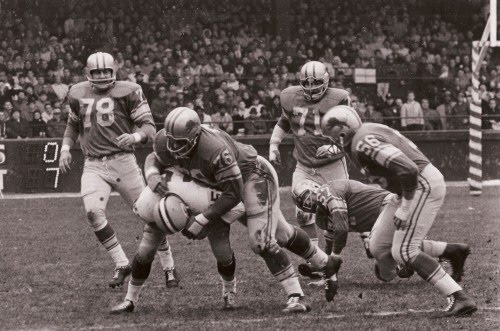
On Green Bay’s next possession, Roger Brown (pictured at left) hit Starr while setting up to pass and forced a fumble that DE Sam Williams picked up and ran into the end zone for a six-yard touchdown. When the Packers got the ball back, again pinned deep in their own territory, Starr faded back into his end zone and was sacked for a safety by Brown, who had run over both Thurston and Taylor in his pursuit of the quarterback. The Lions had scored 16 points in under three minutes of action.

Green Bay got a break late in the second quarter when McGee was roughed while punting from his end zone and the offense put together a sustained drive of 56 yards that included five completed passes by Starr. But Jerry Kramer’s field goal attempt missed after being partially blocked and the Lions carried the 23-0 lead into halftime.

Detroit didn’t let up in the third quarter, as Lane intercepted Starr’s first pass of the second half to set up a 47-yard field goal by Plum. That was the end of the scoring for the Lions. The Packers managed two late touchdowns in the fourth quarter – one by the defense – and the final score was 26-14.

Detroit’s domination of the game that came to be referred to as “The Thanksgiving Day Massacre” was more complete than the score indicated. While both teams turned the ball over five times, the Lions outgained the Packers, 304 yards to 122. The usually unstoppable Green Bay running attack was held to just 73 yards on 27 attempts. Bart Starr was sacked 10 times for a net loss of 93 yards, giving Green Bay just 49 net passing yards (Plum was not sacked at all).

While the defense dominated, Detroit’s offense played just well enough. Milt Plum completed 8 of 16 passes for 137 yards with two touchdowns and two interceptions. FB Ken Webb, who took over for the injured Nick Pietrosante, gained 62 yards on 11 carries while HB Tom Watkins ran the ball 17 times for 55 yards. Gail Cogdill (pictured below) caught three passes for 79 yards and the two big TDs.


As for the Packers, when Bart Starr was able to throw, he completed 11 of 19 for 142 yards with no TDs and two interceptions. Jim Taylor gained just 47 yards on 13 carries with a touchdown – most of it came later in the game, as he was held to -3 yards in the first half. Ron Kramer caught four passes for 62 yards, and Boyd Dowler also had four receptions, for 41 yards.

“It's a known fact that the Detroit defense is good,” summed up Vince Lombardi. “They
completely overpowered us in the first half…My club wasn't flat. We were ready. They just overwhelmed us.”

Green Bay didn’t lose another game (they came back the next week to thrash the hapless Rams by a score of 41-10) and finished the season at 13-1 atop the Western Conference. They defeated the Giants once again to repeat as NFL champions. The Lions lost the season finale to end up at 11-3 and in second place; their reward was a trip to Miami for the meaningless Playoff Bowl for the third straight year.

The Detroit defense was ranked number one overall in the NFL, giving up a total of 3217 yards (30 yards less than the Packers), and were also best against the run (1231 yards). The 177 points allowed was second best to Green Bay’s 148. Roger Brown, Joe Schmidt, “Night Train” Lane, and Yale Lary were all consensus first team All-Pro selections and were selected to the Pro Bowl along with Alex Karras.