November 19, 2016

Highlighted Year: Benny Friedman, 1927

Tailback/Defensive Back, Cleveland Bulldogs


Age: 22
1st season in pro football
College: Michigan
Height: 5’10” Weight: 183

Prelude:
Friedman established himself as an outstanding passer in college and was a consensus first-team All-American in 1925 and ’26. Turning pro, he proved to be extremely accurate, if not possessed of an exceptionally strong arm, and was innovative in his willingness to pass on any down despite the less-streamlined ball in use at the time and rules that discouraged reliance on throwing the ball. Friedman was also a capable runner and fair kicker.

1927 Season Summary
Appeared in all 13 games
[Bracketed numbers indicate league rank in Top 20]

Passing
TD Passes – 11 [1]

Scoring
Rushing TDs – 2 [14, tied with twelve others]
Receiving TDs – 0
Other TDs – 0
Total TDs – 2
Field Goals – 0
Extra Points – 11 [2]
Points – 23 [19]

Awards & Honors:
1st team All-NFL: Chicago Tribune, Green Bay Press-Gazette

Bulldogs went 8-4-1 to finish fourth in the NFL while leading the league in touchdowns (30) and scoring (209 points).

Aftermath:
Friedman moved on to the Detroit Panthers in 1928 and again led the NFL with 9 TD passes as well as rushing touchdowns (6, tied with two others). The franchise was bought out by Tim Mara of the Giants and Friedman went to New York and continued to lead the league in touchdown passes for the next two years, including a remarkable 20 in 1929 (the runner-up threw 6). Friedman received consensus first team All-NFL honors in each of his first four NFL seasons, but a leg injury reduced his effectiveness in 1931 and he moved on to the Brooklyn Dodgers in ’32. He finished up with one game for the Dodgers in 1934, having already moved into assistant coaching at the college level that reduced his playing time. While passing statistics are incomplete for that era, Friedman was certainly far ahead of the rest of the field in passing yards (7650) and TD passes (68), and his single-season record of 20 lasted until 1942. Friedman went on to become a college head coach at City College of New York and Brandeis University, where he also served as athletic director. His brashness might have been off-putting, but he was a keen student of the game and one of its early innovators and notable performers. Friedman was inducted into the Pro Football Hall of Fame, Class of 2005.

--

Highlighted Years features players who were consensus first-team All-League* selections or league* or conference** leaders in the following statistical categories:

Rushing: Yards, TDs (min. 10)
Passing: Yards, Completion Pct., Yards per Attempt, TDs, Rating
Receiving: Catches, Yards, TDs (min. 10)
Scoring: TDs, Points, Field Goals (min. 5)
All-Purpose: Total Yards
Defense: Interceptions, Sacks
Kickoff Returns: Average
Punt Returns: Average
Punting: Average

*Leagues include NFL (1920 to date), AFL (1926), AFL (1936-37), AAFC (1946-49), AFL (1960-69), WFL (1974-75), USFL (1983-85)

**NFC/AFC since 1970

November 18, 2016

1973: Broncos Rally to Upset Battered Steelers


The Denver Broncos were fighting to stay in the AFC West playoff hunt as they faced the Pittsburgh Steelers on November 18, 1973. Coached by John Ralston, the Broncos had overcome a slow start to compile a 4-3-2 record thus far. Veteran QB Charley Johnson effectively directed the offense that included HB Floyd Little (pictured at right) and TE Riley Odoms, who was breaking out in his third season.

The Steelers, under Head Coach Chuck Noll, were at 8-1 and had won four straight games and 13 in a row at home. However, they were also having injury problems and were without QB Terry Bradshaw and HB John “French” Fuqua, while DT “Mean Joe” Greene was suffering from a back injury and would not be in the starting lineup for the first time in his career (he did enter the game in the fourth quarter to spell his replacement, DT Tom Keating).

There were 48,580 fans in attendance at Three Rivers Stadium and they saw the home team run into trouble at the very start. HB Rocky Bleier fumbled while returning the opening kickoff and DB Maurice Tyler recovered to give the Broncos possession at the Pittsburgh 15. They weren’t able to move the ball, but Jim Turner kicked a 32-yard field goal to give Denver the early 3-0 advantage.

The Steelers responded with a series in which QB Terry Hanratty completed passes of nine yards to HB Preston Pearson and 22 yards to WR Ron Shanklin, but after reaching the Denver 16 they came up empty when Roy Gerela was wide on a 23-yard field goal try. Later in the period, Pittsburgh again advanced deep into Denver territory, the key plays being a Hanratty completion to TE John McMakin for 44 yards and a 17-yard run by FB Franco Harris on a sweep. This time Gerala tied the score with a 15-yard field goal.

Turner attempted a long field goal for the Broncos from 52 yards early in the second quarter, but it was short. The Steelers were on the move again when Hanratty threw to WR Frank Lewis for a 40-yard gain. Again having to try for a field goal, Gerela was successful from 18 yards but DE Lyle Alzado was penalized for roughing-the-kicker and Pittsburgh chose to take the points off the board and keep the ball. Shortly thereafter they ended up having to call on Gerela again, and he was again good from 13 yards. Late in the period, the Broncos threatened, reaching the Pittsburgh four with a 69-yard advance before having to settle for a Turner field goal from 11 yards and the teams were tied at 6-6 going into halftime.

Denver HB Otis Armstrong returned the second half kickoff 32 yards and that spurred the Broncos to a 10-play, 67-yard drive, helped along by a 25-yard pass interference penalty on CB Mel Blount. Floyd Little ran the last ten yards for a touchdown and Turner converted to put the visitors up by 13-6.


Early in the fourth quarter, the Steelers finished off an 80-yard advance in just four plays. Hanratty (pictured at left) threw to Lewis for 19 yards, Harris ran for four yards around end, and it was then Hanratty to McMakin for 15 yards and to Shanklin for a 42-yard TD. Gerela added the game-tying point after.

A 41-yard drive in ten plays by the Broncos that featured Little’s running and short completions by Charley Johnson ended when Turner kicked a field goal from 46 yards that hit the cross bar but bounced over, putting them ahead by 16-13.

On the ensuing kickoff, HB Steve Davis fumbled and the Broncos recovered at the Pittsburgh 27. Little was stopped for a three-yard loss on first down, but FB Joe Dawkins ran for 25 and, three plays later, Denver capitalized when Johnson tossed a two-yard touchdown pass to TE Riley Odoms. Turner converted to put the visitors ahead by ten. It was too much for the Steelers to recover from and the Broncos held on to win by a final score of 23-13.

Pittsburgh led in total yards (300 to 257) while the Broncos had more first downs (20 to 12). Denver outrushed the Steelers (184 to 83) while the home team compiled far more net passing yards (217 to 73). Pittsburgh turned the ball over three times, to none by the Broncos.


Charley Johnson (pictured at right) completed 13 of 20 passes for 86 yards and a touchdown with no interceptions. Floyd Little rushed for 88 yards on 27 carries that included a TD and also had four catches for 23 yards. Riley Odoms topped the Denver receivers with 6 pass receptions for 47 yards and a touchdown.

For the Steelers, Terry Hanratty was successful on 10 of 19 throws for 217 yards and a TD while also not being picked off. Franco Harris gained 53 yards on 11 rushing attempts. John McMakin caught three passes for 64 yards and Ron Shanklin also accumulated 64 yards on his two receptions that included a touchdown.

“In all fairness to Pittsburgh, I think we were fortunate to be in the right spot on their schedule,” said Denver’s Coach Ralston. “They’d just had three hard wins over Cincinnati, Washington, and Oakland, and games like that take something out of you.”

The Broncos split their last four games and, while they failed to make it to the playoffs, the resulting 7-5-2 record placed second in the AFC West and was the first winning season in franchise history. The hobbled Steelers lost their next two contests but won the last two to end up at 10-4 and second in the AFC Central, although still good enough for a Wild Card playoff berth. Pittsburgh lost to Oakland in the Divisional round.

November 17, 2016

Highlighted Year: Larry Brown, 1970

Halfback, Washington Redskins


Age: 23 (Sept. 19)
2nd season in pro football & with Redskins
College: Kansas State
Height: 5’11” Weight: 195

Prelude:
Brown played two seasons at Kansas State after transferring from Dodge City Junior College and had an undistinguished career, rushing for 684 yards and catching 13 passes. An eighth round pick by the Redskins in the 1969 NFL draft, Brown led the team in rushing as a rookie with 888 yards on 202 carries (4.4 avg.) and caught 34 passes for another 302 yards. He was selected to the Pro Bowl.

1970 Season Summary
Appeared in 13 of 14 games
[Bracketed numbers indicate league rank in Top 20]

Rushing
Attempts – 237 [2]
Most attempts, game – 27 (for 110 yds.) at Philadelphia 10/4
Yards – 1125 [1]
Most yards, game – 139 yards (on 17 carries) vs. NY Giants 11/29
Average gain – 4.7 [3]
TDs – 5 [13, tied with eleven others]
100-yard rushing games – 6

Pass Receiving
Receptions – 37      
Most receptions, game – 9 (for 76 yds.) at Oakland 10/19
Yards – 341
Most yards, game – 76 (on 9 catches) at Oakland 10/19
Average gain – 9.2
TDs – 2

Scoring
TDs – 7 [18, tied with nine others]
Points – 42

Awards & Honors:
1st team All-NFL: AP, PFWA, NEA, Pro Football Weekly
1st team All-NFC: AP, UPI, Pro Football Weekly, Sporting News
Pro Bowl

Redskins went 6-8 to finish fourth in the NFC East.

Aftermath:
Brown’s production dropped off to 948 yards in 1971 as defenses keyed on him, but he was selected to a third Pro Bowl and received consensus first-team All-NFC recognition. He was the consensus league MVP in ’72 as he led the NFC in rushing with 1216 yards and the Redskins reached the Super Bowl. Brown ran for 860 yards and caught 40 passes in 1973, but the workhorse runner began to show signs of wear in ’74 and totaled just 838 yards over the last three seasons of a career spent entirely with Washington that ended in 1976. Overall, he rushed for 5875 yards on 1530 attempts (3.8 avg.) and caught 238 passes for 2485 yards (10.4 avg.) while scoring a total of 55 touchdowns. Brown was a consensus first-team All-NFL selection twice, received first-team All-NFC honors after one other season, and was selected to four Pro Bowls.

--

Highlighted Years features players who were consensus first-team All-League* selections or league* or conference** leaders in the following statistical categories:

Rushing: Yards, TDs (min. 10)
Passing: Yards, Completion Pct., Yards per Attempt, TDs, Rating
Receiving: Catches, Yards, TDs (min. 10)
Scoring: TDs, Points, Field Goals (min. 5)
All-Purpose: Total Yards
Defense: Interceptions, Sacks
Kickoff Returns: Average
Punt Returns: Average
Punting: Average

*Leagues include NFL (1920 to date), AFL (1926), AFL (1936-37), AAFC (1946-49), AFL (1960-69), WFL (1974-75), USFL (1983-85)

**NFC/AFC since 1970

November 16, 2016

1930: Nagurski’s 2 TDs Lead Bears to Win Against Giants


The Chicago Bears were a team in transition as they faced the New York Giants on November 16, 1930. Coming off of a disappointing 4-9-2 record in 1929, the Bears were in their first season under Head Coach Ralph Jones, with George Halas concentrating on front office duties. Jones revamped the offense and benefited from the arrival of two rookies in the backfield, QB Carl Brumbaugh and power-running FB Bronko Nagurski (pictured at right). Thus far the Bears were at 4-4-1 as they faced the Giants, a powerful club under Head Coach Roy Andrews that had a 10-1 record including five straight wins at home and an offense that featured tailback Benny Friedman, the best passer in pro football.

There were 5000 fans in attendance on a rainy day at the Polo Grounds and the field was muddy. The teams slogged through three scoreless quarters, with Chicago’s ground game dominating. Early in the first quarter, the Bears drove from their 27 to the New York 15, but the visitors came up empty when three runs and a pass came up short and they had to turn the ball over on downs.

In the third quarter, Chicago put together another promising drive fueled by the running of Bronko Nagurski  and halfbacks Red Grange and Joe Lintzenich. But after reaching the New York six, the Bears again failed to reach the end zone and had to turn the ball over on downs.

Early in the fourth quarter, the Bears took possession at their 41 and again moved the ball effectively. Nagurski ran for nine yards, Grange gained enough for a first down and followed up with a pass to end Luke Johnsos for 28 yards to the New York 22. Carries by Grange and Carl Brumbaugh got the ball down to the seven and Nagurski barreled over for a touchdown from there, but Garland Grange failed on the extra point attempt.

The Giants started out deep in their own territory following the kickoff.  Benny Friedman came out passing, but his third toss was intercepted by Lintzenich at the New York 20. He returned the ball to the 10 and, four plays later, Nagurski dove into the end zone from a yard out for a second touchdown. The try for point after was again unsuccessful, but it was of no consequence. Chicago won by a final score of 12-0.

The Bears led in first downs (13 to 5) and otherwise dominated the game. It was a precursor of good things to come as they won their remaining four contests to finish with a 9-4-1 record that placed third in the league standings. New York defeated Green Bay in a key battle the next week but lost two of four to finish second at 13-4.

For Bronko Nagurski, the two touchdowns against the Giants were part of five that he scored on the year. He received second-team All-NFL honors from Collyers Eye and the Green Bay Press-Gazette.

November 14, 2016

Highlighted Year: Billy Cannon, 1961

Halfback, Houston Oilers


Age: 24
2nd season in pro football & with Oilers
College: LSU
Height: 6’1”   Weight: 212

Prelude:
Cannon was a star all-purpose halfback in college who rushed for 1867 yards while averaging 5.2 yards-per-carry, caught 31 passes for 522 yards, and scored 21 touchdowns. He was a two-time consensus first-team All-American and winner of the 1959 Heisman Trophy, following a season in which he also returned a punt 89 yards to key a LSU win against Mississippi. Cannon was chosen by the Los Angeles Rams as the first overall pick of the 1960 NFL draft, but signed with both the Rams and Oilers of the new AFL. A judge’s decision awarded him to the Oilers and he had a fair rookie season, rushing for a team-leading 644 yards and scoring a touchdown in the AFL Championship game on an 88-yard pass play. He was a second-team All-AFL selection by the league and UPI.

1961 Season Summary
Appeared in all 14 games
[Bracketed numbers indicate league rank in Top 20]

Rushing
Attempts – 200 [2]
Most attempts, game – 25 (for 216 yds.) at NY Titans 12/10
Yards – 948 [1]
Most yards, game – 216 yards (on 25 carries) at NY Titans 12/10
Average gain – 4.7 [1]
TDs – 6 [4, tied with Jack Kemp]
200-yard rushing games – 1
100-yard rushing games – 3

Pass Receiving
Receptions – 43 [11, tied with Don Maynard]
Most receptions, game – 7 (for 122 yds.) vs. NY Titans 11/19
Yards – 586 [15]
Most yards, game – 122 (on 7 catches) vs. NY Titans 11/19
Average gain – 13.6 [16]
TDs – 9 [3, tied with Jim Colclough]
100-yard receiving games – 2

Passing
Attempts – 5
Completions – 0
Yards – 0
TD passes – 0
Interceptions – 1 [20, tied with seven others]

Kickoff Returns
Returns – 18 [3, tied with Al Frazier]
Yards – 439 [5]
Most yards, game – 84 (on 3 ret.) vs. Boston 11/12
Average per return – 24.4 [6]
TDs – 0
Longest return – 47 yards

Punt Returns
Returns – 9 [6]
Yards – 70 [9]
Most yards, game – 20 (on 1 ret.) vs. Buffalo 10/8
Average per return – 7.8
TDs – 0
Longest return – 20 yards

All-Purpose yards – 2043 [1]

Scoring
TDs – 15 [2]
Points – 90 [4]

Postseason: 1 G (AFL Championship at San Diego)
Rushing attempts – 15
Rushing yards – 48
Average gain rushing – 3.2
Rushing TDs – 0

Pass receptions – 5
Pass receiving yards – 53
Average yards per reception – 10.6
Pass receiving TDs – 1

Awards & Honors:
1st team All-AFL: League, AP, UPI, NY Daily News, Sporting News
AFL All-Star Game

Oilers went 10-3-1 to finish first in the AFL Eastern Division while leading the league in total yards (6288), passing yards (4392), touchdowns (66), and scoring (513 points). Won AFL Championship over San Diego Chargers (10-3).

Aftermath:
Cannon suffered a back injury that limited his effectiveness in 1962, holding him to 474 rushing yards although he still caught 32 passes for 451 yards and scored a total of 13 touchdowns. He saw little action in an injury-plagued 1963 season and was traded to the Oakland Raiders, where he was tried at fullback with some success before being shifted to tight end in 1965. While Cannon caught only 21 passes combined in his first two seasons at the new position, his production increased significantly in 1967, when he had 32 catches for 629 yards and 10 TDs and received first-team All-AFL honors from UPI and the Associated Press. He spent two more years with the Raiders and was an AFL All-Star in 1969. Cannon spent one last year with Kansas City as a backup in 1970. Altogether, he rushed for 2455 yards on 602 carries (4.1 avg.) with 17 TDs and caught 236 passes for 3656 yards (15.5 avg.) and 47 touchdowns. Cannon was a consensus first-team All-AFL selection after one season, received some first- or second-team recognition after three other seasons, and was chosen to two AFL All-Star Games. His son Billy Jr. played linebacker for the Cowboys for one year.

--

Highlighted Years features players who were consensus first-team All-League* selections or league* or conference** leaders in the following statistical categories:

Rushing: Yards, TDs (min. 10)
Passing: Yards, Completion Percentage, Yards per Attempt, TDs, Rating
Receiving: Catches, Yards, TDs (min. 10)
Scoring: TDs, Points, Field Goals (min. 5)
All-Purpose: Total Yards
Defense: Interceptions, Sacks
Kickoff Returns: Average
Punt Returns: Average
Punting: Average

*Leagues include NFL (1920 to date), AFL (1926), AFL (1936-37), AAFC (1946-49), AFL (1960-69), WFL (1974-75), USFL (1983-85)

**NFC/AFC since 1970

November 13, 2016

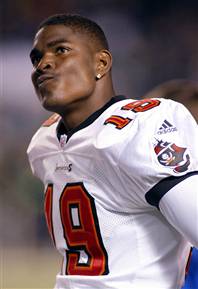
Highlighted Year: Keyshawn Johnson, 2001

Wide Receiver, Tampa Bay Buccaneers


Age: 29
6th season in pro football, 2nd with Buccaneers
College: Southern California
Height: 6’4”   Weight: 212

Prelude:
In two seasons at USC after transferring from West Los Angeles College, Johnson caught 168 passes for 2796 yards (16.6 avg.) and 16 touchdowns, including 102 for 1434 yards and 7 TDs in 1995. He received consensus first-team All-America recognition and was chosen by the New York Jets as the top overall selection in the 1996 NFL draft. Johnson showed off his potential, with 63 receptions for 844 yards and 8 TDs as a rookie, but also a distracting brashness. Big and physical, if not particularly fast, he followed up with another solid season in ’97 and, with the club improving dramatically overall, had consecutive Pro Bowl seasons in 1998 and ’99 as he caught over 80 passes and gained a thousand yards in each, scoring a combined 18 touchdowns. Johnson was traded to Tampa Bay in 2000 and had a lesser year, catching 71 passes for 874 yards and 8 TDs.

2001 Season Summary
Appeared in 15 of 16 games
[Bracketed numbers indicate league rank in Top 20]

Pass Receiving
Receptions – 106 [4, 1st in NFC]  
Most receptions, game – 12 (for 89 yds.) vs. Chicago 11/18
Yards – 1266 [7]
Most yards, game – 159 (on 10 catches) vs. Pittsburgh 10/21
Average gain – 11.9
TDs – 1
100-yard receiving games – 4

Scoring
TDs – 1
Points – 6

Postseason: 1 G (NFC Wild Card playoff at Philadelphia)
Pass receptions – 3
Pass receiving yards – 75
Average yards per reception – 25.0
Pass Receiving TDs – 0

Awards & Honors:
Pro Bowl

Buccaneers went 9-7 to finish third in the NFC Central and qualified for a Wild Card playoff spot. Lost NFC Wild Card playoff to Philadelphia Eagles (31-9).

Aftermath:
Johnson followed up with 76 catches for 1088 yards (14.3 avg.) and five touchdowns in 2002 as the Buccaneers won the NFL title, but as his relationship with the coaching staff deteriorated, he was deactivated for the last seven games of the ’03 season. Dealt to the Dallas Cowboys in 2004, Johnson continued to be a productive possession receiver for two seasons and finished up by catching 70 passes for 815 yards with Carolina in 2006. For his career, Johnson had 814 pass receptions for 10,571 yards (13.0 avg.) and 64 TDs. Of those totals, 298 for 3828 yards and 17 TDs were with Tampa Bay. He was selected to three Pro Bowls.

--

Highlighted Years features players who were consensus first-team All-League* selections or league* or conference** leaders in the following statistical categories:

Rushing: Yards, TDs (min. 10)
Passing: Yards, Completion Pct., Yards per Attempt, TDs, Rating
Receiving: Catches, Yards, TDs (min. 10)
Scoring: TDs, Points, Field Goals (min. 5)
All-Purpose: Total Yards
Defense: Interceptions, Sacks
Kickoff Returns: Average
Punt Returns: Average
Punting: Average

*Leagues include NFL (1920 to date), AFL (1926), AFL (1936-37), AAFC (1946-49), AFL (1960-69), WFL (1974-75), USFL (1983-85)

**NFC/AFC since 1970

November 12, 2016

1979: Eagles Defeat Cowboys in Monday Night Showdown


The Philadelphia Eagles faced an uphill battle as they took on the Dallas Cowboys in a Monday night game on November 12, 1979. Head Coach Dick Vermeil’s team had gotten off to a 6-1 start but, following three straight losses, was at 6-4 and in danger of falling out of contention in the NFC East. QB Ron Jaworski provided gritty leadership, HB Wilbert Montgomery was highly productive both running and receiving, and WR Harold Carmichael (pictured at right) had set a new NFL record by catching a pass in his 106th consecutive game the previous week. The defense lost its leader, MLB Bill Bergey, to a knee injury in the third week but was proving to be formidable and the kicking game, which had been a sore spot the previous year, was also much improved with the arrival of the barefoot-kicking rookie Tony Franklin.

The Cowboys were the defending NFC Champions and atop the division with an 8-2 record. In their twentieth season under Head Coach Tom Landry, they remained strong on offense with QB Roger Staubach throwing the ball and HB Tony Dorsett carrying, while the defense had weathered some key losses to retirement and injury to keep the club on track. Moreover, they had not lost to the Eagles at home since 1965 and were nine-point favorites.

There were 62,417 fans in attendance at Texas Stadium as well as a national television audience. The Cowboys had the first possession and, after Tony Dorsett ran for 24 yards on a sweep and FB Scott Laidlaw gained another eight, they came through with a big play when Roger Staubach went long to WR Tony Hill for a 48-yard touchdown. Rafael Septien added the extra point for the early 7-0 advantage.

Following a short series by the Eagles that resulted in a punt, Dallas was again on the move thanks to the running of Dorsett as well as Staubach but, after catching a second down pass, Dorsett was stripped of the ball by LB Jerry Robinson at the Philadelphia 41. It looked as though the reprieve would be a short one, but helped by a defensive holding call that nullified a third down sack, the Eagles maintained possession and Ron Jaworski passed to Harold Carmichael for 16 yards. A few plays later the drive stalled and, facing fourth-and-six, Tony Franklin was short on a 53-yard field goal attempt, but once again a Dallas penalty intervened and moved the visitors up five yards. Now facing fourth-and-one, the offense returned to the field and took the Cowboys by surprise as Jaworski passed to Carmichael for a 32-yard TD. Franklin added the game-tying point after.

Midway through the second quarter, the Eagles were back in scoring position after DB John Sciarra returned a Dallas punt 32 yards. Jaworski threw to Wilbert Montgomery for 15 yards but the series ultimately came up empty when Franklin was wide to the left on a 45-yard field goal try. With Staubach out due to a thigh injury, QB Danny White entered the game and the Cowboys were forced to punt following a short possession.

The Eagles lost their quarterback as well when Jaworski also had to leave the game due to a wrist injury suffered when he was hit by DE Harvey Martin and they turned to their backup, John Walton. The series ended with a punt but WR Steve Wilson of the Cowboys muffed the kick and LB Frank LeMaster recovered at the Dallas 29 with a minute remaining in the first half. The visitors immediately capitalized when Walton threw to WR Charlie Smith for a 29-yard touchdown and, with Franklin’s conversion, Philadelphia was ahead by 14-7.

However, the Eagles weren’t done as SS Randy Logan intercepted a White pass on the ensuing series at the Dallas 42 that set up a club-record 59-yard field goal by Franklin, giving the Eagles not only a 17-7 halftime lead but a psychological lift.

Both starting quarterbacks were back in the game in the third quarter. In a drive that featured the running of Montgomery and FB Leroy Harris, the Eagles advanced into Dallas territory and scored on a Jaworski pass to Carmichael in the right corner of the end zone for a 13-yard touchdown. Franklin added the extra point to make it a 24-7 contest.

The Cowboys, now in a deeper hole, responded with a five-play possession that started with Staubach passing to Hill for 36 yards to the Philadelphia 31, but they came up empty when Septien’s field goal attempt from 47 yards was short. Later in the period, the Eagles failed to extend their lead when Franklin missed from 52 yards.


With six minutes left to play, Dallas finally got on the board again in electrifying fashion when Staubach threw long again to Hill (pictured at left) for a 75-yard touchdown. Getting the ball back with 2:48 remaining on the clock, the Cowboys advanced 72 yards in nine plays that concluded with another Staubach scoring pass, this time to TE Billy Joe DuPree from five yards out. Septien successfully converted after each TD and the margin was thus narrowed further to 24-21 with 1:19 to play. But any hopes of a stunning comeback were dashed when, on the following series and facing a crucial third down, the Eagles sealed the win as Montgomery broke away for a 37-yard TD. Franklin’s point after capped the 31-21 victory.

The Cowboys had the edge in total yards (408 to 328) while the teams were even with 17 first downs apiece. However, Dallas turned the ball over five times, to none by the Eagles, and Philadelphia recorded five sacks, to three by the home team.

Ron Jaworski completed just 12 of 29 passes for 145 yards, but two were for touchdowns and there were no interceptions. John Walton was two-of-six for 41 yards and a TD in his relief appearance. Wilbert Montgomery rushed for 127 yards on 25 carries that included a touchdown. Harold Carmichael had four catches for 69 yards and two TDs and Charlie Smith contributed four receptions for 54 yards and a score. John Sciarra had an outstanding night averaging 13.8 yards on six punt returns. Tony Franklin made good on only one of his four field goal attempts, but it was a big one.

For the Cowboys, Roger Staubach was successful on 17 of 28 throws for 308 yards and three TDs with none intercepted. Tony Hill (pictured at left) had a big night in defeat, catching 7 passes for 213 yards and two touchdowns. Tony Dorsett gained 53 yards on 13 rushing attempts and had 7 catches for 64 more yards.

The Eagles climbed to a game behind Dallas with the win. It was the first of four straight and five in the last six games, but Philadelphia lost the rematch with the Cowboys and, while both clubs finished at 11-5, it was Dallas winning the division and the Eagles placing second, although reaching the postseason as a Wild Card. They defeated the Bears in the first round but lost to Tampa Bay at the Divisional level. Dallas also fell in the Divisional round, losing to the Rams.

Both Harold Carmichael and Wilbert Montgomery had Pro Bowl seasons, with Carmichael catching 52 passes for 872 yards (16.8 avg.) and 11 touchdowns and Montgomery gaining 2006 yards from scrimmage (1512 on 338 rushing attempts, 494 on 41 pass receptions) and compiling 14 TDs.


Tony Franklin (pictured at right) ended up kicking 23 field goals out of 31 attempts, with three of them coming from over 50 yards. Prone to inconsistency, his 74.2 percentage was the best of his five years in Philadelphia, although he would go on to better years in New England. The 59-yard field goal against the Cowboys remained his career high by far.

Tony Hill ended up with 60 catches for 1062 yards (17.7 avg.) and 10 touchdowns, and received Pro Bowl honors for the second year. His 213-yard pass receiving total against the Eagles remained his career best.