May 8, 2016

Highlighted Year: John Harris, 1981

Safety, Seattle Seahawks


Age: 25
4th season in pro football & with Seahawks
College: Arizona State
Height: 6’2”   Weight: 200

Prelude:
Harris intercepted 12 passes in his last two collegiate seasons and also excelled as a kick returner, garnering All-Western Athletic Conference honors after each. He was chosen by the Seahawks in the seventh round of the 1978 NFL draft and moved directly into the starting lineup at free safety. Harris suffered through an injury-plagued ’79 season that limited him to seven games, but bounced back to regain his starting job in 1980, intercepting six passes. 1981 marked the arrival of rookie first draft choice Ken Easley, who moved into the lineup at strong safety and created an effective tandem with Harris.

1981 Season Summary
Appeared in all 16 games
[Bracketed numbers indicate league rank in Top 20]

Interceptions – 10 [2, 1st in AFC]
Most interceptions, game – 2 at Oakland 9/20, at Green Bay 11/1
Int. return yards – 155 [8, tied with Ken Easley]
Most int. return yards, game – 60 (on 2 int.) at Green Bay 11/1
Int. TDs – 2 [2, tied with Darrol Ray & Cedric Brown]
Fumble recoveries – 3

Scoring
TDs – 2
Points – 12

Seahawks went 6-10 to finish fifth in the AFC West.

Aftermath:
Harris spent another four years with the Seahawks, starting every game as part of a talented overall secondary. Over the course of eight seasons with Seattle, he intercepted 41 passes, two of which he returned for touchdowns, recovered 11 fumbles, and appeared in 119 games, 112 of which he started. Harris was traded to Minnesota just prior to the 1986 season and spent the last three years of his career there. He ended up with a total of 50 interceptions and added another five in the postseason, four of them with Seattle and two in the AFC Divisional playoff loss to Miami following the 1984 season.  

--

Highlighted Years features players who were consensus first-team All-League* selections or league* or conference** leaders in the following statistical categories:

Rushing: Yards, TDs (min. 10)
Passing: Yards, Completion Pct., Yards per Attempt, TDs, Rating
Receiving: Catches, Yards, TDs (min. 10)
Scoring: TDs, Points, Field Goals (min. 5)
All-Purpose: Total Yards
Defense: Interceptions, Sacks
Kickoff Returns: Average
Punt Returns: Average
Punting: Average

*Leagues include NFL (1920 to date), AFL (1926), AFL (1936-37), AAFC (1946-49), AFL (1960-69), WFL (1974-75), USFL (1983-85)

**NFC/AFC since 1970

May 6, 2016

1984: Gamblers Rally but Panthers Win in Overtime


The Michigan Panthers hosted the Central Division-rival Houston Gamblers in a United States Football League game on May 6, 1984 with hopes of ending a four-game losing streak.

The Panthers were the defending USFL Champions under Head Coach Jim Stanley and had started the season fast with six straight wins before going into the swoon to stand at 6-4 and in a three-way battle for the division lead. QB Bobby Hebert (pictured at right) was hampered by a bad knee and the losses had begun when star WR Anthony Carter went down for the year with a broken arm. The offensive line, a strength coming into the season, was injury-ridden as well, but the defense remained one of the league’s better units.

Houston, a first-year club coached by Jack Pardee, was also at 6-4 and was coming off a tough overtime loss the previous week. Rookie QB Jim Kelly had been outstanding in operating the run-and-shoot passing offense, although he had taken many sacks. The Gamblers had lost starting RB Sam Harrell to injury and Todd Fowler, a lightly-regarded rookie out of Stephen F. Austin, was taking his place.

There were 29,068 fans in attendance at the Astrodome. The first quarter was scoreless until, following an interception by LB John Corker that gave the Panthers the ball at the Houston 39, the home team advanced in four plays to a touchdown on a 13-yard pass from Bobby Hebert to a wide-open RB Ken Lacy. Novo Bojovic added the extra point for the 7-0 lead.

With the Michigan defense keeping the Gamblers in check, the Panthers moved methodically in a 12-play, 61-yard series that extended into the second quarter and ended with another Hebert TD pass, this time to WR Walter Broughton from four yards out. Bojovic converted and Michigan was up by 14-0.

The next possession by the Panthers ended with Hebert being picked off by CB Mike Mitchell and the Gamblers capitalized when Kelly completed a third down pass to WR Ricky Sanders for a 37-yard touchdown. Toni Fritsch added the extra point to narrow the score to 14-7.

A short Michigan possession led to a punt and Bojovic, normally just the placekicker but forced to do double duty due to an injury to SS/P David Greenwood, boomed a 59-yard kick that pinned the Gamblers inside their 10 yard line. The teams traded punts for the remainder of the half and the score remained unchanged.

The Panthers had first possession in the third quarter and, with Hebert passing effectively and RB John Williams picking up 17 yards on a key carry, they drove 72 yards in nine plays to a TD on a seven-yard run by Williams. Bojovic converted to put Michigan ahead by 14 points at 21-7.

Todd Fowler ran effectively on Houston’s next series that ended with Kelly firing long to Sanders for a 44-yard touchdown. Fritsch’s point after narrowed Michigan’s lead to seven points once more. But it didn’t take long for the Panthers to respond as, on their third play of the next series, Williams took off down the right sideline for a 68-yard TD. Bojovic booted the extra point and the score was 28-14 in favor of the home team.

WR Clarence Verdin returned the ensuing kickoff 39 yards and the Gamblers again interspersed draw plays by Fowler to good effect. With the game now early in the fourth quarter, they scored on a five-yard bootleg by Kelly to complete the six-play, 61-yard drive. Fritsch successfully converted to make the score 28-21.

An onside kick by Houston was recovered by the Panthers and, while they were unable to capitalize, Bojovic’s punt was downed at the Gamblers’ seven yard line. Fowler immediately took off for a 20-yard run and caught a third-and-10 screen pass for a first down, but the visitors were ultimately forced to punt. However, they got the ball back at the Michigan 14 when Hebert fumbled while being sacked and FS Tommy Myers recovered. Fowler hit the line repeatedly, the last time for a touchdown from less than a yard out. Fritsch’s kick tied the score at 28-28 with 4:37 remaining in regulation. Neither team was able to get into scoring position the rest of the way and the contest headed into overtime.

The Gamblers won the toss for the overtime period but the squibbed kick hit a Houston player and was recovered by Michigan center Max Gill at the Houston 49. However, Hebert was sacked on first down and two passes fell incomplete to force a punt. The Gamblers drove into Michigan territory, converting two third downs along the way, and appeared set to win until Fritsch’s 30-yard field goal attempt was partially deflected by John Corker and missed to the left. Granted a reprieve, the Panthers drove methodically in 12 plays with Williams running well and Hebert hitting key passes. Bojovic kicked a 29-yard field goal and Michigan won by a final score of 31-28 with 59 seconds remaining in the extra period.   

Both teams rolled up significant yardage, with the Panthers coming out ahead (420 to 405) and also holding the edge in first downs (24 to 21) and time of possession (40:54 to 33:07). Michigan gained 246 yards on the ground to 181 for the normally air-oriented Gamblers. The Panthers accumulated five sacks, to three for Houston and the Gamblers turned the ball over three times, to two by the home team.

Bobby Hebert completed 20 of 36 passes for 199 yards and a touchdown while giving up an interception. John Williams had a big day with 165 yards on 22 carries that included two TDs. WR Derek Holloway and Walter Broughton each caught five passes, for 61 and 46 yards, respectively, and Broughton scored a touchdown. On defense, DE Larry Bethea accounted for three of Michigan’s sacks.


For the Gamblers, Jim Kelly was successful on 23 of 36 throws for 249 yards and two TDs, along with two interceptions. Todd Fowler (pictured at left) rushed for 140 yards on 22 attempts with a touchdown, his best outing to date. Ricky Sanders had 9 pass receptions for 120 yards and two TDs and Richard Johnson also caught 9, for 67 yards.

The win put the Panthers alone in first place in the Central Division, but they lost their next three games and had to rally to finish second and grab a wild card playoff slot with a 10-8 record. They lost an epic First Round playoff game to the Los Angeles Express in the third overtime period. Houston, having now lost two straight games in overtime, reeled off seven consecutive wins to close out the season in first place at 13-5. However, the Gamblers then fell to Arizona in a close First Round contest.

Both John Williams and Todd Fowler remained productive on the ground. Williams rushed for 984 yards on 194 carries for a 5.0 average and scored eight touchdowns. Fowler, barely a footnote during the first half of the season, ended up gaining 1003 yards on 170 attempts (5.9 avg.), including 208 in a single game, and compiled 11 TDs.  

May 5, 2016

Highlighted Year: Dwight Clark, 1981

Wide Receiver, San Francisco 49ers


Age: 24
3rd season in pro football & with 49ers
College: Clemson
Height: 6’3”   Weight: 205

Prelude:
Playing across from star WR Jerry Butler in college, Clark caught 33 passes for 571 yards (17.3 avg.) and three touchdowns and was chosen by the 49ers in the 10th round of the 1979 NFL draft. He started three games as a rookie and had 18 catches for 232 yards, but broke out in 1980 with 82 receptions for 991 yards and eight touchdowns. An overachieving possession receiver, he proved to be a comfortable fit in San Francisco’s West Coast passing offense.

1981 Season Summary
Appeared in all 16 games
[Bracketed numbers indicate league rank in Top 20]

Pass Receiving
Receptions – 85 [2, 1st in NFC]    
Most receptions, game – 9 (for 77 yds.) at Atlanta 9/20
Yards – 1105 [9]
Most yards, game – 135 (on 4 catches) vs. Dallas 10/11
Average gain – 13.0
TDs – 4
100-yard receiving games – 3

Rushing
Attempts – 3
Yards – 32
Average gain – 10.7
TDs – 0

Passing
Attempts – 1
Completions – 0
Yards – 0
Interceptions – 0

Scoring
TDs – 4
Points – 24

Postseason: 3 G
Pass receptions – 17
Most pass receptions, game – 8 vs. Dallas, NFC Championship
Pass receiving yards – 269
Most pass receiving yards, game – 120 vs. Dallas, NFC Championship
Average yards per reception – 15.8
Pass Receiving TDs – 2

Rushing attempts – 2
Rushing yards – 4
Yards per attempt – 2.0
Rushing TDs – 0

Awards & Honors:
2nd team All-NFC: UPI
Pro Bowl

49ers went 13-3 to finish first in the NFC West. Won NFC Divisional playoff over New York Giants (38-24), NFC Championship over Dallas Cowboys (28-27) & Super Bowl over Cincinnati Bengals (26-21).

Aftermath:
While the 49ers dipped from their championship form in 1982, Clark led the NFL with 60 catches, for 913 yards (15.2 avg.) and five touchdowns, in the strike-shortened season and was a consensus first-team All-NFL as well as Pro Bowl selection. He had 70 receptions for 840 yards and 8 TDs in ’83, but also had knee surgery. Clark remained a dependable clutch receiver until 1987, when further knee problems ended his career after nine seasons, all with the 49ers. Overall, he caught 506 passes for 6750 yards (13.3 avg.) and 48 touchdowns. He added another 48 receptions for 726 yards (15.1 avg.) and three TDs in the postseason, which included his dramatic NFC Championship game-winning catch in 1981. Clark was a consensus first-team All-NFL choice once and was chosen to two Pro Bowls. The 49ers retired his #87.

--

Highlighted Years features players who were consensus first-team All-League* selections or league* or conference** leaders in the following statistical categories:

Rushing: Yards, TDs (min. 10)
Passing: Yards, Completion Pct., Yards per Attempt, TDs, Rating
Receiving: Catches, Yards, TDs (min. 10)
Scoring: TDs, Points, Field Goals (min. 5)
All-Purpose: Total Yards
Defense: Interceptions, Sacks
Kickoff Returns: Average
Punt Returns: Average
Punting: Average

*Leagues include NFL (1920 to date), AFL (1926), AFL (1936-37), AAFC (1946-49), AFL (1960-69), WFL (1974-75), USFL (1983-85)

**NFC/AFC since 1970

May 3, 2016

Highlighted Year: Wes Chandler, 1982

Wide Receiver, San Diego Chargers


Age: 26
5th season in pro football, 2nd with Chargers (1st complete)
College: Florida
Height: 6’0”   Weight: 183

Prelude:
Playing wide receiver in a wishbone offense in college, Chandler caught 93 passes for 1994 yards (21.4 avg.) and 22 touchdowns, adding 353 rushing yards and six TDs in his senior season of 1977. He received some All-American recognition after both the 1976 and ’77 seasons and was chosen by the New Orleans Saints in the first round (third overall) of the 1978 NFL draft. Chandler caught 35 passes for 472 yards (13.5 avg.) as a rookie and broke out in 1979 with 65 receptions for 1069 yards (16.4 avg.) and six TDs, gaining selection to the Pro Bowl as well as second-team All-NFL honors from NEA. He followed up with another solid year in ’80, catching 65 passes for 975 yards (15.0 avg.) and six touchdowns. The Chargers obtained him during the 1981 season after having dealt disgruntled WR John Jefferson to Green Bay, and Chandler proved to fit perfectly in the high-powered “Air Coryell” (for Head Coach Don Coryell) passing offense. Of his 69 catches for 1142 yards and six TDs, 52 for 857 yards (16.5 avg.) and five scores came with San Diego.

1982 Season Summary
Appeared in 8 of 9 games
[Bracketed numbers indicate league rank in Top 20]

Pass Receiving
Receptions – 49 [4, tied with Cris Collinsworth & Ozzie Newsome]  
Most receptions, game – 10 (for 260 yds.) vs. Cincinnati 12/20
Yards – 1032 [1]
Most yards, game – 260 (on 10 catches) vs. Cincinnati 12/20
Average gain – 21.1 [2]
TDs – 9 [1]
200-yard receiving games – 1
100-yard receiving games – 6

Rushing
Attempts – 5
Yards – 32
Average gain – 6.4
TDs – 0

Scoring
TDs – 9 [4, tied with Wilbert Montgomery & Chuck Muncie]
Points – 54 [15, tied with Wilbert Montgomery, Chuck Muncie & Joe Danelo]

Postseason: 2 G
Pass receptions – 11
Most pass receptions, game – 9 at Pittsburgh, AFC First Round playoff
Pass receiving yards – 162
Most pass receiving yards, game – 124 at Pittsburgh, AFC First Round playoff
Average yards per reception – 14.7
Pass Receiving TDs – 0

Awards & Honors:
1st team All-NFL: AP, PFWA, NEA, Pro Football Weekly
1st team All-AFC: UPI
Pro Bowl

Chargers went 6-3 in the strike-shortened season and were fifth seed in the AFC playoff tournament that replaced the usual postseason format while leading the NFL in total yards (4048), passing yards (2927), touchdowns (34), and scoring (288 points). Won First Round playoff over Pittsburgh Steelers (31-28). Lost Second Round playoff to Miami Dolphins (34-13).

Aftermath:
Although hampered by a sprained foot, Chandler caught 58 passes for 845 yards (14.6 avg.) and five touchdowns in 1983 and was again selected for the Pro Bowl. He slipped further in ’84 but bounced back with 67 catches for a career-high 1199 yards (17.9 avg.) and 10 TDs in 1985, earning another Pro Bowl trip. Following lesser seasons in 1986 and ’87, and with the team in decline, Chandler was traded to San Francisco in 1988 where he caught four passes in four games in his last year. Overall, Chandler caught 559 passes for 8966 yards (16.0 avg.) and 56 touchdowns, with 373 of those receptions for 6132 yards (16.4 avg.) and 41 TDs coming with the Chargers. He was a consensus first-team All-NFL selection once, received second-team honors after one other season, and was chosen to four Pro Bowls.

--

Highlighted Years features players who were consensus first-team All-League* selections or league* or conference** leaders in the following statistical categories:

Rushing: Yards, TDs (min. 10)
Passing: Yards, Completion Pct., Yards per Attempt, TDs, Rating
Receiving: Catches, Yards, TDs (min. 10)
Scoring: TDs, Points, Field Goals (min. 5)
All-Purpose: Total Yards
Defense: Interceptions, Sacks
Kickoff Returns: Average
Punt Returns: Average
Punting: Average

*Leagues include NFL (1920 to date), AFL (1926), AFL (1936-37), AAFC (1946-49), AFL (1960-69), WFL (1974-75), USFL (1983-85)

**NFC/AFC since 1970

April 30, 2016

1983: Stars Even Score with Defeat of Bandits


The Philadelphia Stars had a 7-1 record in the inaugural United States Football League season and faced a rematch on April 30, 1983 with the one team that had beaten them thus far, the Tampa Bay Bandits. Coached by Jim Mora, the Stars featured a ball-control offense led by QB Chuck Fusina and star rookie RB Kelvin Bryant as well as a tough and opportunistic defense. They survived a close call against the Boston Breakers the previous week that provided them with a two-game cushion in the Atlantic Division.

Tampa Bay had won its first four games before losing two of three and was at 6-2 and trying to hold off the Chicago Blitz in the Central Division. Under the guidance of Head Coach Steve Spurrier, the Bandits had a strong passing attack and while they had lost veteran QB John Reaves to a broken wrist, young backup QB Jimmy Jordan out of Florida State was performing well in his place.

There were 41,559 fans in attendance at Tampa Stadium for the Saturday contest. The Stars set the tone on their first possession, driving 77 yards in 11 plays. RB Allen Harvin had a 10-yard carry and Kelvin Bryant ran the last 10 for a touchdown, with David Trout adding the extra point for the early 7-0 advantage.

Still in the opening period, a fumble by Tampa Bay RB Sam Platt after a nine-yard gain on a reverse was recovered by SS Scott Woerner. Four plays later, the Stars added three points with a 44-yard Trout field goal.

Early in the second quarter, the Bandits got on the board as the result of an eight-play, 52-yard series that featured a pass from Jimmy Jordan to WR Eric Truvillion for a 33-yard gain. It was Jordan to Truvillion again for a two-yard TD to finish the possession off and Zenon Andrusyshyn converted to make it a three-point game.

The home team had an opportunity to tie the score with 1:28 remaining in the first half, but Andrusyshyn was wide to the left on a 37-yard field goal attempt. The Stars remained ahead by 10-7 at halftime.

Philadelphia started off the third quarter with a methodical drive, mixing runs and passes. Facing second-and-ten at the Tampa Bay 20, Harvin took off on a sweep to the right for a touchdown. Trout added the point after and the visitors were now up by 17-7. The Bandits responded with a series that resulted in a 25-yard Andrusyshyn field goal to make it a seven-point contest.

Tampa Bay had largely controlled Bryant in the first half, but on the ensuing Philadelphia possession the star rookie took charge as he broke away for a 22-yard carry to the Tampa Bay nine, gained six yards on the next play, and finished the drive with a three-yard touchdown run with 2:35 remaining in the third quarter. Trout again converted to extend the visitors’ lead to 14 points.

The Bandits had opportunities in the fourth quarter, but failed to capitalize. A poor 27-yard punt by Philadelphia’s Sean Landeta from his own end zone gave Tampa Bay the ball at the Stars’ 39. But on a third down play, a Jordan pass was intercepted by CB Antonio Gibson to snuff out the threat. It proved to be all the Stars needed as they won convincingly by a final score of 24-10.

Philadelphia had the edge in total yards (332 to 321), almost evenly split between rushing (175) and passing (157) yards, while the Bandits were held to 69 yards on the ground while gaining 252 through the air. The Stars also led in first downs (20 to 16) and time of possession (32:44 to 27:16). Tampa Bay accumulated six sacks, to just one by Philadelphia, but also turned the ball over four times, to two suffered by the visitors.

Chuck Fusina completed 17 of 28 passes for 232 yards and gave up one interception. Kelvin Bryant rushed for 106 yards on 22 carries that included two touchdowns and also had four catches for 21 yards while Allen Harvin contributed 67 yards on 9 rushing attempts that also included a TD. WR Willie Collier led the Philadelphia receivers with five catches for 73 yards.

For the Bandits, Jimmy Jordan was successful on 24 of 47 throws for 260 yards and a touchdown, but also was intercepted three times. Eric Truvillion and Sam Platt had seven catches apiece, for 81 and 56 yards, respectively, and Truvillion scored a TD while Platt also led the club in rushing with 46 yards on 10 attempts.

“Philadelphia played well,” said a frustrated Coach Steve Spurrier,” but we hurt ourselves a lot. We were just a little bit away from making the big plays.”

The Stars continued to play well and cruised to a 15-3 record, reaching the USFL Championship game before falling to the Michigan Panthers. Tampa Bay won its next three games but collapsed down the stretch and ended up at 11-7, third in the Central Division and out of the playoffs. 

The win over the Bandits was the sixth hundred-yard rushing game for Kelvin Bryant, who led the USFL at that point with 929 yards, and in the end he was second to New Jersey’s Herschel Walker with 1442 yards, scoring 16 touchdowns along the way. He also caught 53 passes for another 410 yards and a score and received MVP honors from the league.

April 28, 2016

Highlighted Year: Bob Boyd, 1954

Offensive End, Los Angeles Rams


Age: 26
4th season in pro football & with Rams
College: Loyola Marymount
Height: 6’2”   Weight: 200

Prelude:
Boyd was a versatile athlete in college (track & field and boxing as well as football) and was the NCAA champion in the 100-yard dash as a senior. Undrafted by the NFL, he signed with the Rams in 1950 and was a backup among a talented group of receivers during his first two seasons, catching a total of 18 passes for 348 yards (19.3 avg.) and five touchdowns. After missing the ’52 season due to military service, Boyd broke out in 1953 with 24 pass receptions for 548 yards and a league-leading 22.8 yards per catch.

1954 Season Summary
Appeared in all 12 games
[Bracketed numbers indicate league rank in Top 20]

Pass Receiving
Receptions – 53 [3] 
Most receptions, game – 8 (for 128 yds.) at Detroit 10/10, (for 131 yds.) vs. Chi. Bears 10/24
Yards – 1212 [1]
Most yards, game – 157 (on 5 catches) vs. San Francisco 10/3
Average gain – 22.9 [2]
TDs – 6 [11, tied with Dorne Dibble & Ray Mathews]

Scoring
TDs – 6 [20, tied with five others]
Points – 36

Awards & Honors:
1st team All-NFL: AP, NY Daily News
2nd team All-NFL: UPI
Pro Bowl

Rams went 6-5-1 to finish fourth in the NFL Western Conference while leading the league in total yards (5187).

Aftermath:
Boyd’s production dropped in 1955 as he missed five games with a knee injury, ending up with just 22 catches for 383 yards (17.4 avg.) and three touchdowns. He played two more seasons, grabbing 30 passes for 586 yards (19.5 avg.) and 7 TDs in ’56 and 29 for 534 yards (18.4 avg.) in 1957. Overall, Boyd caught 176 passes for 3611 yards (20.5 avg.) and 28 touchdowns over the course of seven seasons and 79 games, all with the Rams. Noteworthy for the speed he brought to LA’s passing attack, the 1954 season was the only one in which Boyd received All-NFL and Pro Bowl honors.

--

Highlighted Years features players who were consensus first-team All-League* selections or league* or conference** leaders in the following statistical categories:

Rushing: Yards, TDs (min. 10)
Passing: Yards, Completion Percentage, Yards per Attempt, TDs, Rating
Receiving: Catches, Yards, TDs (min. 10)
Scoring: TDs, Points, Field Goals (min. 5)
All-Purpose: Total Yards
Defense: Interceptions, Sacks
Kickoff Returns: Average
Punt Returns: Average
Punting: Average

*Leagues include NFL (1920 to date), AFL (1926), AFL (1936-37), AAFC (1946-49), AFL (1960-69), WFL (1974-75), USFL (1983-85)

**NFC/AFC since 1970

April 26, 2016

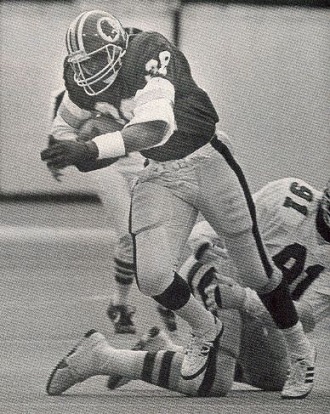
1985: Redskins Obtain George Rogers from Saints


A trade that had been widely rumored was finalized on the afternoon of April 26, 1985 as the Washington Redskins dealt their first pick in the upcoming NFL draft to New Orleans for RB George Rogers plus the Saints’ fifth, tenth, and eleventh-round draft choices.

The 26-year-old, power-running Rogers had won the 1980 Heisman Trophy while at South Carolina. Chosen in the first round of the ’81 NFL draft by the Saints, he had a big rookie season, rushing for a league-leading 1674 yards with 13 touchdowns. The 6’2”, 225-pound Rogers was a consensus first-team All-NFL choice and was named to the Pro Bowl, an honor he received again in the strike-shortened 1982 season when he rushed for 535 yards in six games and the Saints contended for a playoff spot.  

However, there were off-field drug problems and Rogers was further hampered by a knee injury in ’83. He still ran for 1144 yards in 13 games but, in 1984, found competition from newly-acquired RB Earl Campbell, who was obtained from the Houston Oilers and reunited with Bum Phillips, once head coach in Houston and now in New Orleans. Rogers’ rushing total fell to 914 yards and he scored only two touchdowns. After four seasons and 4267 rushing yards, the Saints were willing to swing the trade with Washington (and would find that the once-great Campbell was at the end of his Hall of Fame career).

The Redskins were still a fundamentally sound team under Head Coach Joe Gibbs, having won back-to-back NFC Championships in 1982 and ’83, with the former resulting in a Super Bowl victory, and topped the NFC East with an 11-5 record in 1984 before succumbing to the Bears in the Divisional playoff round.

However, Washington’s once-formidable ground game had become a source of concern due to uncertainty surrounding star RB John Riggins, who rushed for 1239 yards but was 35 years old and hindered by a back injury, and Joe Washington, who was 31 and missed nine games with a knee injury (and was separately traded to Atlanta for draft choices).

Riggins returned to the club for the 1985 season, but it was Rogers carrying most of the rushing load. He accumulated four hundred-yard performances, capping the year with 206 yards on 34 attempts in a win against the Cardinals. Overall, he gained 1093 yards on 231 carries, for a career-best 4.7-yard average, and scored seven touchdowns. Riggins contributed 677 yards and Keith Griffin, handling the third-down role that had been Joe Washington’s specialty, gained 473 rushing yards and caught 37 passes for 285 more (Rogers and Riggins had ten catches between them). The team went 10-6, but while the Cowboys and Giants did likewise, tiebreakers put Washington third in the NFC East and out of the playoffs.

With Riggins retired in 1986, Rogers carried 303 times for 1203 yards (4.0 avg.) and a league-leading 18 touchdowns. The Redskins grabbed a Wild Card slot with their 12-4 record and, in his first opportunity to appear in the postseason, Rogers added another 202 yards on the ground, but while that included 115 yards on 29 carries in a first round win over the Rams, he was held to 15 yards on nine attempts in the NFC Championship loss to the Giants.

Rogers spent an injury-plagued 1987 season running for 613 yards in 11 games and saw limited action in the Super Bowl victory over Denver in which RB Timmy Smith, a little-used reserve during the regular season, gained 204 yards on 22 carries. It was the end of the line for Rogers at age 29. He retired, citing nagging injuries. Overall for his three seasons with the Redskins, he ran the ball 697 times for 2909 yards (4.2 avg.) and scored 31 touchdowns. Rarely used as a pass receiver, he had 11 catches for 76 yards.

As for the rest of the transaction involving Rogers, the 1985 draft choices that Washington received were used to take RB Raphael Cherry from Hawaii in the fifth round, Texas RB Terry Orr in the tenth, and G Raleigh McKenzie of Tennessee in the eleventh. Cherry was converted to strong safety, started five games as a rookie when veteran Tony Peters was injured, and intercepted two passes in his only season with the Redskins. Orr was on injured reserve and thus saw no action in ’85 but, utilized at tight end, spent most of the next eight years with Washington and caught 52 passes. McKenzie didn’t contribute much in his first year but he ended up staying with the Redskins until 1994 and started a total of 113 games at both left and right guard as well as center. He moved on to the Eagles in ’95 and finished his career with Green Bay in 2000.

With the first round pick obtained from Washington, which was 24th overall, the Saints selected Tennessee LB Alvin Toles. He spent four seasons with the club, primarily as a reserve among a strong corps of linebackers, and his career was cut short by a serious knee injury during the 1988 season.