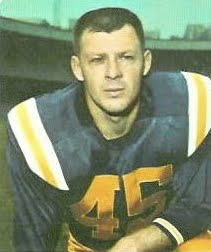
Showing posts with label Art Powell. Show all posts

December 8, 2015

1963: Raiders Score 31 Points in Fourth Quarter to Defeat Chargers


The Oakland Raiders were the American Football League’s most improved team as they hosted the San Diego Chargers on December 8, 1963. Under new Head Coach Al Davis, the Raiders had a new look and attitude, and a 7-4 record which, for a club that had won a total of three games over the last two seasons, was noteworthy enough. The duo of Tom Flores and Cotton Davidson handled the quarterbacking and HB Clem Daniels (pictured above) had emerged as a top rusher and receiver out of the backfield while split end Art Powell was a productive receiver. The defense, although better, was still a work in progress.

San Diego, at 9-2, was the team the Raiders were trying to catch, and they had upset the Chargers earlier in the year on the road. Head Coach Sid Gillman’s club featured an explosive offense directed by 35-year-old QB Tobin Rote. The receiving corps led by flanker Lance Alworth was outstanding and the running back combination of HB Paul Lowe and FB Keith Lincoln productive. The defense was tough, led by a rugged front line that featured DE Earl Faison and DT Ernie Ladd. 

There were 20,249 fans in attendance at Frank Youell Field in Oakland in what was viewed as the biggest game thus far in the Raiders’ brief history. However, it was the Chargers striking quickly on the game’s opening possession. Tobin Rote threw to Keith Lincoln on the first play to pick up 26 yards to the Oakland 26 and, while the visitors lost yardage on the next two plays, Rote passed to split end Don Norton on a third-and-16 play that resulted in a 32-yard touchdown. George Blair added the extra point for the early 7-0 advantage.

The teams exchanged punts before the Raiders, taking possession at their 40, drove to the San Diego 30. Clem Daniels threw an option pass to Art Powell for 10 yards in a third-and-seven situation and QB Tom Flores connected with Daniels for 14 yards to the San Diego 33. Mike Mercer kicked a 37-yard field goal to make it a 7-3 game.

The Chargers again punted following a short series and Oakland was driving as the game headed into the second quarter but also was forced to punt from midfield after Flores was sacked on third down. San Diego proceeded to drive 89 yards in six plays. Rote passed to Lance Alworth for a big pickup of 54 yards to the Oakland 35 and then connected with TE Dave Kocurek for another nine yards. Rote carried for five yards and a first down, threw to Norton for seven yards, and two plays later FB Bobby Jackson ran 14 yards for a TD. Blair again successfully converted and the visitors were up by 14-3.

Oakland responded with a scoring drive of 70 yards in six plays. Flores completed consecutive passes to Daniels, the longest for 21 yards, and while a holding penalty cost the Raiders 15 yards, Flores completed a throw to FB Alan Miller for 20 yards while facing second-and-22. A Daniels carry lost a yard, but on fourth down Flores fired down the middle for Powell (pictured below) and the result was a 45-yard touchdown. Mercer added the point after and the San Diego lead was narrowed to 14-10.


Alworth returned the ensuing kickoff 34 yards to give the Chargers good starting field position at their 44 and Rote immediately threw to Paul Lowe for 12 yards. But the series stalled at the Oakland 38 and Blair was wide on a 45-yard field goal attempt. The Raiders reached the San Diego 39 on their next possession but turned the ball over on downs and, with time running down in the first half, the Chargers moved 61 yards in five plays. Rote hit Norton twice, for 22 and 36 yards, to reach the Oakland three and, after losing ground on a running play, it was Rote to TE Jacque MacKinnon for a five-yard TD. Blair missed the extra point but the Chargers took a 20-10 lead into halftime.

The Raiders, with Cotton Davidson now at quarterback, had the first possession in the third quarter and thanks primarily to a run by Daniels for 23 yards they advanced into San Diego territory. But a holding penalty moved them back after reaching the 24 and after a long throw by Davidson intended for Powell in the end zone fell incomplete, Mercer was short on a 48-yard try for a field goal.

The teams again traded punts before the Chargers advanced 75 yards in six plays. A pass interference penalty helped San Diego along and Rote completed a pass to Kocurek for 40 yards. Rote finished the series off with a toss to Alworth for a 15-yard touchdown and, with Blair successful on the extra point, the Chargers carried a seemingly-comfortable 27-10 lead into the fourth quarter.

The Raiders had to punt early in the final period but got the ball back when Jackson fumbled after gaining 24 yards on a screen pass and safety Tom Morrow recovered for Oakland. Daniels took off on a 35-yard run and while Davidson was sacked by Earl Faison on the next play, he connected with Powell in the end zone on third down for a 10-yard TD. Mercer converted and the Raiders were down by ten points at 27-17.

On the second play of San Diego’s next possession, Lowe fumbled and safety Joe Krakoski recovered for the Raiders at the Chargers’ 23. Davidson tossed three incomplete passes but Mercer kicked a 30-yard field goal to narrow the margin to 27-20.

A short series by the Chargers resulted in a punt and Paul McGuire, after fielding a bad snap, kicked short to his own 43. Davidson threw a swing pass to Miller for six yards on second down and scrambled for 12 yards to the 22. Another pass and a run by Daniels got the ball to the nine, and from there Davidson ran for a touchdown. Mercer added the point after and the score was tied at 27-27.

Another short San Diego possession resulted in a punt and a good return by CB Claude Gibson had 15 yards tacked on due to a face mask penalty on the Chargers. Three plays later, Davidson passed to Powell in the end zone for a 40-yard TD. With Mercer’s kick, the Raiders were now in front by 34-27.

John Hadl was at quarterback when the reeling Chargers had the ball next, and he completed his first two passes, the longest of 18 yards to Norton to reach the Oakland 38. But the next three throws were incomplete and, on fourth down, Hadl’s pass was intercepted by LB Clancy Osborne, who returned it 48 yards to the San Diego 12. Miller ran for a two-yard touchdown that was the final nail in San Diego’s coffin. With the 31-point fourth quarter explosion, Oakland came away the winner by a final score of 41-27.

The Raiders led in total yards (406 to 336) and first downs (24 to 17). They held San Diego’s vaunted running attack to just 45 yards while gaining 154 yards of their own. San Diego also turned the ball over three times, with catastrophic results in the fourth quarter, while Oakland had no turnovers. However, the Raiders were penalized eight times, at a cost of 101 yards, to two flags thrown on the Chargers.

Tom Flores was 11 of 23 for 173 yards and a touchdown before being relieved by Cotton Davidson, who completed 6 of 17 passes for 95 yards and two TDs and ran seven times for 41 yards and a score. Clem Daniels rushed for 90 yards on 17 carries and had 7 catches for another 90 yards and also completed a 10-yard pass. Art Powell caught 6 passes for 132 yards and three touchdowns.


For the Chargers, Tobin Rote was successful on 17 of 25 throws for 284 yards and three TDs. Don Norton (pictured at right) had 6 pass receptions for 119 yards and a touchdown and Lance Alworth contributed three catches for 71 yards and a TD as well. However, Bobby Jackson led the team in rushing with 33 yards on five attempts that included a score while Paul Lowe was held to five yards on six carries and Keith Lincoln to no yards on two attempts.

“I didn’t really feel we were out of it at any time,” said Oakland’s Coach Davis. “We were always in there but just couldn’t do things right for awhile.”

The stunning win kept the Raiders in contention in the Western Division and they won their last two games, for a total of eight straight, to finish with a 10-4 record. However, San Diego also won its remaining contests and topped the division at 11-3. The Chargers went on to demolish the Boston Patriots to win the AFL Championship.

With Tom Flores passing for 2101 yards and Cotton Davidson 1276, the Raiders accumulated 3377 yards through the air and a league-leading 31 touchdowns. Clem Daniels set a new AFL record with 1099 rushing yards and also led the circuit by averaging 22.8 yards on 30 pass receptions. Art Powell topped the league with 16 touchdown receptions and 1304 receiving yards on his second-ranked 73 catches.

September 10, 2015

1967: Bills Rally in Fourth Quarter to Defeat Jets


The refurbished Buffalo Bills hosted the New York Jets in an American Football League season-opening game on September 10, 1967. Coached by Joe Collier for the second year, the Bills had won the last three Eastern Division titles but, after advancing to consecutive league championships in 1964 and ‘65, failed to win the AFL title game in ’66, thus costing them a spot in the first Super Bowl. The team made major trades during the offseason in an effort to upgrade at key positions. QB Tom Flores and split end Art Powell were obtained from Oakland and HB Keith Lincoln from San Diego.  All three were highly regarded veterans and Flores moved ahead of QB Jack Kemp (pictured above), who had been behind center during the previous successful seasons. The Bills even had a new placekicker in Mike Mercer, an experienced hand who performed ably for the Chiefs in 1966.

New York, entering the fifth year under Head Coach Weeb Ewbank, was coming off of a 6-6-2 record in ’66, which was a step up from four consecutive five-win seasons. Talented QB Joe Namath had a strong arm and quick release that could yield big gains through the air but also gave up many interceptions. There were outstanding receivers in flanker Don Maynard and split end George Sauer, and an effective running tandem in FB Matt Snell and HB Emerson Boozer. However, the defense had been a sore spot and would need to improve if the club was to rise further in the standings.

There were 45,478 fans in attendance at War Memorial Stadium and they saw both teams miss scoring opportunities in the first quarter. Mike Mercer attempted a 46-yard field goal for the Bills that was blocked by DB Cornell Gordon and New York’s Jim Turner was wide to the left on a 16-yard field goal try.

During the second quarter, the Jets put together a 10-play, 57-yard series that was helped along by a pass interference penalty on LB John Tracey. Three plays later, Joe Namath threw to Don Maynard, who outmaneuvered CB Booker Edgerson for a 19-yard touchdown. Turner added the extra point.


Buffalo responded with a promising possession, but after Keith Lincoln (pictured at left) ran for 23 yards to the New York 35, a holding penalty and two sacks moved the Bills back. On the next series, the Jets took just five plays to advance 71 yards. Namath again connected with Maynard, this time for a 56-yard TD with 21 seconds left in the first half. Turner’s conversion staked New York to a 14-0 lead at halftime.

The Bills were unable to put together sustained drives with Flores behind center and a twisted knee suffered late in the second quarter forced him to the bench. Jack Kemp took his place in the second half, although the results were not immediately different. One of his passes was intercepted by safety Jim Hudson, and the result was that the Jets increased their lead less than five minutes into the third quarter when Turner kicked a 32-yard field goal.

The home team continued to struggle on offense and another New York interception, this time by Cornell Gordon, who was injured on the play, nearly led to another score but Turner missed a field goal attempt from 40 yards.

Down 17-0 after three quarters, the Bills came to life early in the final period. They advanced 46 yards in five plays, although it nearly was for naught when Lincoln fell while running a pass route and Solomon Brannan, the replacement for Gordon, dropped a potential interception. On the next play, Kemp passed to Art Powell for a 24-yard touchdown and Mercer added the point after.

The Jets had to punt following their next possession and Curley Johnson’s 29-yard kick was returned seven yards by CB Butch Byrd to the New York 37. On the next play Kemp threw long to Powell in the end zone for another TD. Mercer’s conversion narrowed the tally to 17-14 with 4:39 on the clock.

New York fought back as Namath completed two passes and a personal foul penalty again moved the visitors into scoring territory. However, Turner once again failed on an attempted field goal, this time from 35 yards. The Bills were forced to punt but Paul Maguire’s kick traveled 50 yards and was downed at the New York one yard line. The Jets had to punt in turn, and while three plays by Buffalo gained nothing, Mercer kicked a 51-yard field goal (a new club record at the time) to tie the score with 2:27 remaining to play.

Another series by the Jets resulted in a punt and the Bills had the ball at their 18 with 1:20 to go. Kemp tossed a swing pass to Lincoln that gained 24 yards and then threw to TE Paul Costa, who made a leaping catch for 21 yards. With the clock down to four seconds, Mercer booted a 43-yard field goal and Buffalo won by a final score of 20-17.


New York had the edge in total yards (287 to 248) although the Bills led in first downs (15 to 14). Buffalo also suffered the only two turnovers of the game and sustained four sacks by the Jets while recording two of its own.  However, while Mike Mercer (pictured at right) kicked the two big field goals for Buffalo, Jim Turner missed on three of his four attempts.

Jack Kemp completed 12 of 23 passes for 167 yards and two touchdowns while giving up two interceptions in relief of Tom Flores, who was 6 of 11 for 40 yards and no TDs (or interceptions) in the first half. Keith Lincoln rushed for 81 yards on 13 carries and netted another 23 yards on three pass receptions. Flanker Elbert Dubenion caught 6 passes for 54 yards while Art Powell gained 91 yards on his 5 receptions that included the two touchdowns.

For the Jets, Joe Namath was successful on 11 of 23 throws for 153 yards and two TDs while having none picked off. Don Maynard caught 5 of those passes for 106 yards and two touchdowns. Matt Snell topped the rushers with 95 yards on 19 attempts and Emerson Boozer contributed 53 yards on his 16 carries.

While Buffalo fans might have felt optimistic following the come-from-behind win, particularly with newcomers Art Powell, Keith Lincoln, and Mike Mercer having starring roles (if not Tom Flores), the season went downhill from there. The Bills lost their next three games on their way to a 4-10 record that tied with Miami for third place in the Eastern Division that they had previously dominated. While Lincoln and Mercer performed well, Powell lasted for six games before going out with a knee injury that required surgery and Flores, suffering from a sore arm, completed only 34.4 percent of his 64 passes and threw for no touchdowns while giving up eight interceptions, thus being relegated to the bench. Adding insult to injury, QB Daryle Lamonica, the backup who was sent to Oakland in the deal for Flores and Powell, had a MVP season as the Raiders won the AFL Championship.


The Jets went 5-0-1 over the next six weeks and appeared to be the successors to the Bills, who they defeated in the rematch at New York, until a late-season collapse caused them to finish second to Houston with an 8-5-1 tally. Joe Namath passed for a record 4007 yards but threw for more interceptions (28) than touchdowns (26). Don Maynard (pictured at left) caught 71 passes, second only to teammate George Sauer, for a league-leading 1434 yards and 10 TDs.

September 9, 2014

1962: Grosscup’s 3 TD Passes Spur NY Titans to Win Over Raiders


In the opening week of the American Football League’s third season, two of the new circuit’s more problematic franchises faced each other on September 9, 1962. The New York Titans and Oakland Raiders had both suffered from difficulties in the front office, on the field, and at the gate.

The Titans had broken even at 7-7 in each of their first two seasons. Mercurial owner Harry Wismer replaced Head Coach Sammy Baugh, once an all-time great quarterback in Washington, with another ex-NFL great in Clyde “Bulldog” Turner, formerly of the Bears. The team had outstanding receivers in flanker Don Maynard and split end Art Powell, but veteran QB Al Dorow was dealt away and replaced by 38-year-old Butch Songin, obtained from the Patriots. Just a few days prior to the opener, Lee Grosscup (pictured above) was picked up after being waived by the Minnesota Vikings. Grosscup was a highly-touted passer out of Utah who failed to make the grade with the Giants and, cut by them at the end of July, had only been with Minnesota for a short time before his release.

Oakland had the AFL’s worst record the previous year at 2-12. Marty Feldman replaced Eddie Erdelatz as head coach during the season and was still at the helm. One positive change was that, after playing in San Francisco the first two years (Kezar Stadium in 1960, Candlestick Park in ’61), the Raiders finally had a home field in Oakland. A temporary stadium called Frank Youell Field had been erected until a projected new facility was ready. However, promising QB Tom Flores was out for the year with tuberculosis and Don Heinrich, formerly of the Giants and Cowboys, had been signed to take his place. Like the Titans, the Raiders had difficulty in signing rookie draft choices, thus making it all the harder to become more competitive.

There were 12,893 fans in attendance for the first Raiders home game actually played in Oakland. The teams traded punts to start the contest before the Raiders, starting at their own 38, drove deep into New York territory. HB Clem Daniels had a 12-yard run and a 12-yard reception on a swing pass from Don Heinrich, but after reaching the 18 yard line, Jackie Simpson’s 25-yard field goal attempt was wide to the right.

On the next play, Butch Songin threw long and was picked off by safety Tom Morrow, who returned it 29 yards to the New York 16. However, the Raiders again came up empty when they once more had to try for a field goal and Simpson missed from 16 yards.

The game remained scoreless heading into the second quarter. A fumble on a lateral gave the Raiders possession at the New York 41 and, spurred by a six-yard carry by HB Bo Roberson and an eight-yard run by FB Alan Miller, they drove 20 yards. This time Simpson successfully kicked a 28-yard field goal to stake the home team to a 3-0 advantage.

Following the kickoff, it was Lee Grosscup replacing Songin at quarterback for the Titans. With the ball at his own 20, he made a quick impression by going long for Art Powell (pictured below), who pulled the ball in at the Oakland 35, and the fleet receiver continued on for an 80-yard touchdown. Bill Shockley added the extra point for a 7-3 lead.


It didn’t take long for the Titans to regain possession and strike again. On the first play after the kickoff, LB Larry Grantham sacked Heinrich for a nine-yard loss and then a bad pass was intercepted by safety Billy Atkins to give the Titans the ball at the Oakland 19. Grosscup threw to HB Dick Christy, who was wide open on the left, and it was good for another TD. Shockley added the PAT and, in just two plays, Grosscup had accounted for two scores and New York was ahead by 14-3.

The Raiders moved methodically down the field on their next series, with M.C. Reynolds now in at quarterback. He completed two passes and had a nine-yard scramble, but again it came down to a field goal attempt by Simpson, and he missed badly from 36 yards. The score remained unchanged at the half.

Butch Songin was back behind center when the Titans started off the third quarter and, taking a cue from Grosscup, he threw to Powell for seven yards before connecting with Maynard, who broke an attempted tackle by CB Fred Williamson for a 64-yard touchdown. Shockley added the extra point and the tally stood at 21-3.

Miller fumbled the ensuing kickoff and DB Wayne Fontes recovered for the Titans at the Oakland 34, but the Raiders got the ball back on the next play when Songin’s throw was intercepted by Simpson, a linebacker as well as placekicker. Oakland had to punt, and Grosscup was back in at quarterback for the Titans, but this time the visitors were also forced to kick it away.

Taking over at their 17, the Raiders came alive on offense after Miller ran for four yards up the middle. Heinrich, returning at quarterback, fired a pass to end Max Boydston that picked up 58 yards and, on the following play, he threw to HB Gene White for a 21-yard touchdown. Simpson kicked the extra point and New York’s lead was cut to 21-10.

The Titans again had to punt following their next possession and Oakland moved into New York territory, helped by a pass interference penalty. Heinrich threw to HB Charley Fuller for 25 yards, but a throw into the end zone was dropped by Roberson. Three more passes fell incomplete and it was New York’s ball on downs. Four plays later, Grosscup once again went long for Powell, and it was complete for a 64-yard TD. Shockley added another extra point.

Oakland wasn’t finished yet, however, and in a series that ended early in the fourth quarter, Miller blasted into the end zone from a yard out. Simpson converted to narrow the margin to eleven points. On their next series after a punt by the Titans, Daniels took off for a 50-yard gain to the New York 14. But from there, the Titans took control on defense. Roberson was trapped for a six-yard loss, Heinrich was sacked for the loss of another 14 yards, a pass was incomplete, and on fourth-and-30, Heinrich’s pass intended for White was knocked down by safety Lee Riley.

The Raiders got the ball back on an interception at their own 26, but Heinrich was picked off by Fontes and the Titans were able to run out the clock, winning by a final score of 28-17.

New York had the edge in total yards (424 to 313) although the Raiders accumulated more first downs (20 to 13). The Titans hurt themselves with five turnovers, to three suffered by the Raiders, and they also drew 11 penalties, at a cost of 111 yards, while Oakland was flagged only twice. However, New York also registered six sacks on defense while giving up three. The Raiders were further hurt by their inability to reach the end zone when they had opportunities, and those failures were compounded by Jackie Simpson’s three missed field goals in four attempts.

In limited action, Lee Grosscup completed 5 of 8 passes, but they were good for 186 yards and three touchdowns, while he gave up one interception. Butch Songin was 7 of 16 for 114 yards and a TD as well as two interceptions. Art Powell had 5 catches for 175 yards that included the two long touchdowns and Don Maynard gained 85 yards on his three receptions that also included one for a score. Dick Christy ran for 106 yards on 10 carries and added another 40 yards on four catches that included a TD.


For the Raiders, Don Heinrich was successful on just 10 of 29 throws for 156 yards and a touchdown while being picked off twice. Clem Daniels (pictured at right) had 101 yards on 10 rushing attempts and caught three passes for 21 more yards. Alan Miller ran the ball 16 times for 56 yards and a TD and Max Boydston gained 82 yards on three pass receptions.

The Titans won only one of their next six games, finishing at 5-9 and at the bottom of the Eastern Division. Harry Wismer was forced to give up the team, which was operated by the league to complete the season, and that set the stage for new and more stable ownership. Oakland suffered through a dreadful 1-13 campaign and Coach Feldman was replaced by Red Conkright, although that also set the stage for the hiring of a dynamic new head coach and general manager in ‘63, Al Davis.

Lee Grosscup played well until sidelined by injury, passing for 855 yards and eight touchdowns against eight interceptions. Butch Songin saw less action, and it was ex-Bills QB Johnny Green behind center for most of the way. Art Powell went on to catch 64 passes for 1130 yards (17.7 avg.) and eight touchdowns and Don Maynard had 56 receptions for 1041 yards (18.6 avg.) and another eight TDs. Dick Christy was the AFL’s all-purpose yardage leader, gaining 535 yards on 114 rushing attempts, 538 on 62 catches and, with kick returns added in, totaled 2147 yards.

The Raiders also sought another answer at quarterback. Don Heinrich was done after the opening loss and a trade was made with the Dallas Texans for Cotton Davidson. Clem Daniels broke out to rush for 766 yards on 161 carries (4.8 avg.) and caught 24 passes for 318 yards (13.3 avg.), and would be part of the team’s dramatic improvement the next year. 

November 22, 2012

1962: NY Titans Pull Out Wild Win Over Broncos


As the 1962 American Football League season progressed, the state of the third-year league’s New York City franchise, the Titans, was precarious, at best. Flamboyant and controversial owner Harry Wismer was in serious financial straits and the club was a poor draw at the decrepit Polo Grounds. By early November the league had taken over the running of the Titans.

The team’s original head coach, all-time great quarterback Sammy Baugh, had been demoted to assistant coach following the ’61 season and replaced by ex-Bears star Bulldog Turner. Still, despite all of the chaos, the Titans were competitive and showing signs of life on the field. Starting out at 2-1, they lost four straight before running off consecutive wins against the Chargers and Raiders prior to succumbing to the Dallas Texans. Coming into their Thanksgiving Day matchup at Denver on November 22, New York’s record stood at 4-6.

The Broncos, under first year Head Coach Jack Faulkner, had gotten off to a 7-2 start but were losers their two most recent games. The passing attack, with QB Frank Tripucka primarily throwing to split end Lionel Taylor and flanker Bob Scarpitto, made Denver exciting and capable of putting points on the board, but the running game and defense were suspect. They very much needed a win against the Titans to remain in contention in the Western Division.

There were 15,776 fans in attendance at Bears Stadium for the nationally televised game. It was all Titans in the early going. FB Bill Mathis ran for a one-yard touchdown and HB Dick Christy caught a pass from QB Johnny Green (pictured above) for a six-yard score that put New York ahead by 14-0 in the first quarter.

It was 17-0 in the second quarter following a 28-yard field goal by Bill Shockley (pictured below) before the home team finally got on the board. Tripucka threw to Scarpitto for a 35-yard touchdown and Gene Mingo added the extra point. The Titans responded with another score, however, as Green threw to split end Art Powell for a four-yard TD. But Denver managed to whittle away at New York’s lead with two field goals by Mingo, of 45 and 8 yards, to make it 24-13 at the half. It still seemed to be a comfortable margin for the Titans.


In the third quarter, the tables turned in favor of the Broncos. First, star DT Bud McFadin picked up a fumble and ran 69 yards for a touchdown. Then QB George Shaw, in for the injured Tripucka, tossed a six-yard TD pass to Scarpitto. Denver was in front by a score of 27-24.

The Titans narrowed the margin to 27-26 when Shaw recovered a loose ball in his own end zone for a safety. New York regained the lead thanks to a Green pass to flanker Don Maynard for a 35-yard touchdown. While the attempt to run for a two-point conversion failed, New York was on top by 32-27 heading into the fourth quarter.

Once again the Broncos rallied. Shaw connected with Taylor for a three-yard TD, followed it up with a two-point conversion, and then CB Jim McMillin intercepted a pass and returned it 59 yards for another touchdown, followed by Mingo’s kick. When Mingo kicked a 49-yard field goal with the wind at his back, Denver held a 45-32 lead with six minutes remaining to play.

The Titans proceeded to drive for another touchdown, this time on a five-yard pass from Green to Christy. Shockley’s extra point narrowed the score to 45-39, but the six points still seemed formidable as time was running down. Denver took over at its own 20 following a long kickoff by Shockley and New York proceeded to get a huge break when HB Al Frazier fumbled a handoff and FS Lee Riley recovered for the Titans.

With the time now down to three minutes, New York capitalized when Green tossed his fifth touchdown pass, of three yards, to Powell. Shockley’s extra point was successful and the Titans were staked to a one-point lead.

The Broncos still had a chance, and managed to get into New York territory, but with time running out Mingo attempted a 52-yard field goal that was straight but too short. The Titans came away with a thrilling 46-45 win.

The Titans led in total yards (381 to 294) and first downs (25 to 19). Each club turned the ball over four times. Denver was especially hurt by penalties, drawing 11 flags at a cost of 130 yards to four for 27 yards on New York.

Johnny Green had a noteworthy performance, completing 22 of 46 passes for 292 yards with five touchdowns and three interceptions. Bill Mathis rushed for 49 yards and a TD on 13 carries. Dick Christy (pictured below) caught 9 passes for 82 yards and two scores, ran the ball 9 times for another 30 yards, and returned a kickoff 28 yards. Don Maynard had 105 yards on four pass receptions that included a TD and Art Powell had three catches for 57 yards and two touchdowns.


For the Broncos, Frank Tripucka was successful on 9 of 15 throws for 113 yards with a TD and two interceptions before leaving the game and George Shaw added 12 completions in 26 attempts for 117 yards with two TDs and an interception. FB Bo Dickinson was the leading rusher with 48 yards on 6 carries and also contributed 5 catches for 57 yards. Lionel Taylor had 6 pass receptions for 60 yards and a TD and Bob Scarpitto gained 89 yards and scored twice on his 5 catches.

The exciting win at Denver was the last for the Titans – they lost their remaining three games to finish at the bottom of the Eastern Division with a 5-9 record. The franchise was sold during the offseason to an ownership group headed by Sonny Werblin and was revamped and rechristened the Jets for 1963.

The loss wiped out any lingering hopes for the Broncos of winning the Western Division title. They, too, lost their remaining games and closed out at 7-7 for second place. It would prove to be their best record until 1973.

Johnny Green, formerly of the Buffalo Bills, saw the most action at quarterback for the Titans in ’62 and completed 49.6 percent of his passes for 1741 yards with 10 touchdowns and 18 interceptions. While he had a strong arm, he lacked accuracy and consistency and saw little action in his last year with the Jets in 1963.

As the numbers from the Denver game indicated, Dick Christy was a productive all-purpose halfback who led the AFL in total yards with 2147 (535 rushing on 114 carries, 538 on 62 pass receptions, 824 on 38 kickoff returns, and 250 on 15 punt returns). He was selected to the AFL All-Star Game.

Don Maynard caught 56 passes for 1041 yards (18.6 avg.) and eight touchdowns and went on to star with the Jets. Art Powell had 64 receptions for 1130 yards (17.7 avg.) and eight TDs as well. Disgruntled after three years in New York, he moved on to the Raiders in ’63 and also continued to excel. 

October 27, 2012

1963: Raiders Upset Chargers in Wild Cliffhanger


The Oakland Raiders were a franchise transformed in 1963. After three seasons in the American Football League that produced a 9-33 record and little fan support, 34-year-old Al Davis was hired away from the San Diego Chargers to become head coach and general manager. He brought a new attitude as well as a new look to the club, and it was beginning to show on the field. By the time the Raiders faced Davis’ old team, the Chargers, on October 27 the record was just 3-4 – but that was two more wins than they had in all of 1962.

San Diego, under Head Coach Sid Gillman, was a powerful and well-balanced team with a 5-1 record. Veteran QB Tobin Rote directed an offense that was potent both on the ground with HB Paul Lowe and all-purpose FB Keith Lincoln as well as through the air thanks to flanker Lance Alworth. Moreover, the Raiders had never beaten the Chargers, going back six games in series history, and most of the scores had been lopsided.

There were 30,182 fans at Balboa Stadium in San Diego. They saw the Raiders get a major break following a first quarter interception by LB Archie Matsos, who lateraled to CB Claude “Hoot” Gibson for a 13-yard return to the San Diego 25. After two short carries by HB Clem Daniels, split end Art Powell, who was double-covered all day, put Oakland on the board by catching a 20-yard pass from QB Tom Flores.

Keith Lincoln returned the ensuing kickoff for San Diego 43 yards to near midfield. In a series highlighted by a 17-yard run by Paul Lowe and 13-yard Keith Lincoln carry, the Chargers advanced to the Oakland 16 where the defense stiffened and George Blair kicked a 23-yard field goal.

A punt by the Raiders from deep in their own territory gave the Chargers good starting field position at their own 42 on their next possession. Rote threw to Alworth for 15 yards and Lowe ran for 10. On first down, Rote fired to Alworth in the end zone for a 32-yard touchdown and, with the successful extra point, San Diego was in front by 10-7.

Following the touchdown by Alworth, Al Davis moved CB Fred Williamson to cover him, with good results as the fleet receiver was essentially shut down the rest of the way.

In the second quarter, Williamson set up Oakland’s second touchdown with an interception at the San Diego 30. Daniels got the ball to the 10 on two carries and, after advancing to the five, Flores threw to FB Alan Miller for a TD. The Raiders were back in front at 14-10.

The Chargers retook the lead by 17-14 after a pass from QB John Hadl, subbing for Rote, to TE Jacque MacKinnon that covered 69 yards and concluded the first half scoring. In addition, Oakland’s Flores had to leave the game late in the second quarter due to a head injury and was replaced by Cotton Davidson.

On the second play of the third quarter, CB Dick Harris returned an interception 23 yards for a TD to make it 23-14. Blair’s extra point attempt failed following a bad snap. A fumble recovery by Gibson set up a 39-yard scoring pass from Davidson to flanker Dobie Craig that, with Mike Mercer’s successful PAT, brought the Raiders back to within two points behind. George Blair kicked another field goal for San Diego, this time from 36 yards, to make it a five-point game at 26-21 heading into the final period.

On the first play of the fourth quarter, Powell (pictured below) scored another touchdown, this time on an outstanding 46-yard catch on a pass from Davidson in which he pulled the ball in over his shoulder while well-covered by two defenders. The Raiders were back in front at 28-26.


Oakland’s lead didn’t last long, however. San Diego’s Lincoln took off on a 51-yard scoring run on the next series. Following a key defensive stand by the Raiders, they got the ball back with just under four minutes remaining on the clock. Daniels took off on a 41-yard run to the San Diego 20. Davidson, unable to find any receivers on the next play, ran for 11 yards to the nine. Two plays lost a yard before Davidson, with 1:52 left on the clock, scrambled for time and threw to FB Glenn Shaw in the end zone for a ten-yard touchdown. A two-point conversion attempt failed, but Oakland had the lead.

There was still time for the Chargers, but Rote was tossed for a 20-yard loss and then Gibson intercepted a pass with a minute left to seal the exciting 34-33 win for the Raiders.

The Chargers had more total yards (380 to 296) and first downs (18 to 13) than Oakland, but they also turned the ball over six times against three turnovers by the Raiders.


In relief of Tom Flores, who was successful on three of 11 passes for 31 yards with two touchdowns and two interceptions, Cotton Davidson (pictured at left) was very effective, completing 5 of 10 throws for 115 yards with three good for TDs against one intercepted. He also gained 27 yards on five runs. Clem Daniels was outstanding as he rushed for 125 yards on 19 carries. Art Powell caught three passes for 77 yards, two of them for scores.

As for the Chargers, Tobin Rote, who encountered heavy pressure, had a subpar performance as he completed 6 of 14 passes for 67 yards and a TD with four interceptions. Keith Lincoln was sensational in rushing for 130 yards and a touchdown on 15 carries, but while Paul Lowe gained 82 yards on 12 attempts, most of that came in the first half - he was largely a nonfactor in the last two quarters. Thanks to the long TD reception, Jacque MacKinnon had 111 yards on three catches while Lance Alworth gained 50 yards, also on three receptions.

San Diego’s a great football team, but we’ve got a great bunch on our club and they just wanted that game so badly today they wouldn’t quit,” summed up Al Davis.

The win for Oakland was the second straight of an eventual eight in a row to close out the season and included another victory over the Chargers at home. The Raiders, at 10-4, ended up second to San Diego (11-3) in the AFL Western Division. The Chargers routed the Boston Patriots in the league’s title game.

Clem Daniels went on to lead the AFL in rushing with 1099 yards on 215 carries (5.1 avg.). Art Powell ranked second with 73 pass receptions for a league-leading 1304 yards and 16 touchdowns. Both were All-AFL selections and Daniels received Player of the Year consideration from The Sporting News.

March 14, 2012

1967: Raiders Obtain Daryle Lamonica from Bills


Concurrent with the first combined NFL/AFL draft, there were several major trades. Perhaps the biggest occurred on March 14, 1967, the first day of the draft, as the Oakland Raiders dealt QB Tom Flores, split end Art Powell, and a second round draft choice to the Buffalo Bills for QB Daryle Lamonica, split end Glenn Bass, and two draft picks (third and fifth round).

The 25-year-old Lamonica (he turned 26 prior to the ’67 season) had been taken by the Bills in the 24th round of the 1963 AFL draft out of Notre Dame (he was chosen by Green Bay in the NFL). He proved to be an effective backup to veteran Jack Kemp with the Bills and, with ideal size (6’3”, 215), a strong arm, and outstanding ability as a long passer, often relieved Kemp if a change of pace seemed in order in his first few seasons. He was also mobile and, even in a part-time role, led AFL quarterbacks in rushing with 289 yards in 1964. By 1966, however, he was seeing less action and was restless in Kemp’s shadow.

Meanwhile, Tom Flores, a week short of his 30th birthday at the time of the trade, was an original member of the Raiders in 1960 and was coming off a very solid year for a team that went 8-5-1. He ranked third in passing and achieved career highs with 2638 yards and 24 touchdown passes, earning selection to the AFL All-Star Game. However, there was a sense that the team’s managing general partner, Al Davis, and head coach, John Rauch, had concluded that Flores was not the quarterback to take the team to the next level.

As for the two receivers involved, Powell had been one of the best in the AFL since joining the New York Titans in 1960. After moving to the Raiders in ’63, he had never scored fewer than 11 touchdowns in a season (with a high of 16 in that first year) and had been over a thousand yards receiving in three of four years, including 1026 on 53 catches in 1966. Considered temperamental, he was nevertheless highly talented.

By contrast, Glenn Bass had caught just 10 passes for 130 yards in ’66. While he had 82 receptions in his first two seasons and had pulled in 43 throws for 897 yards and 7 touchdowns in 1964, Bass had been having physical problems, including a major ankle injury in 1965, and lost his starting job to rookie Bobby Crockett in ’66. At age 27, there were certainly doubts regarding his future.

At the time, the trade was viewed as a major gamble by the Raiders, who were giving up two experienced and accomplished players for a backup quarterback and injury-prone receiver. Meanwhile, Buffalo had topped the Eastern Division for three straight years, but after back-to-back AFL Championships, the Bills were badly beaten by Kansas City for the ’66 league title. The trade with Oakland, in conjunction with other deals, seemed likely to strengthen the club for a possible Super Bowl run in 1967.

In fact, the results proved to be very different and, ultimately, very one-sided for the Raiders. Bass failed to make the team, but Lamonica more than made up for it with a MVP performance. The player who came to be known as “The Mad Bomber” proved to be an excellent fit in Oakland’s offense with his ability to throw deep and also displayed strong leadership skills. Despite the lack of a legitimate deep threat, flanker Fred Biletnikoff, split end Bill Miller, and TE Billy Cannon performed capably. The Raiders went 13-1 and won the AFL Championship, succumbing to the NFL’s Green Bay Packers in the Super Bowl.

Things did not go as well for Buffalo. Flores initially gained the starting job but had arm problems and, even with Kemp playing erratically, saw limited action – he threw a total of 64 passes, none for touchdowns but with 8 of them intercepted. Powell played in only six games and went down with a knee injury, catching 20 passes for 346 yards and four TDs. Instead of contending, and despite the efforts of a still-formidable defense, the Bills fell to 4-10.

Lamonica and the Raiders were 24-3-1 over the next two seasons, although they fell short of another AFL title both times. Still, Lamonica remained one of the league’s best quarterbacks and again received MVP recognition in 1969 as he passed for 3302 yards and 34 touchdowns. The arrival of fleet WR Warren Wells provided an effective deep threat to pair with Biletnikoff.

With the AFL merging into the NFL in 1970, Lamonica was still the starting quarterback for the Raiders and was selected to the Pro Bowl following the ’70 and ’72 seasons. However, the team, while still fundamentally strong, was not as successful and zone defenses began to neutralize the strong-armed quarterback. He began to yield playing time to the younger Ken Stabler and signed with the World Football League’s Southern California Sun, where he ended his career. It was an outstanding one – in eight years in Oakland (six as the primary starting quarterback) he passed for 16,655 yards and 148 TDs and the team went 62-16-6 in his starts and qualified for the playoffs in five of those first six seasons.

As for the Bills, the decline in ’67 continued through 1972, long after Tom Flores and Art Powell were gone. Flores appeared in one game in 1968 after being injured during the preseason, was dealt to the Chiefs during the ’69 season to provide veteran insurance when QB Len Dawson missed time due to injury, and retired afterward. He would eventually return to the Raiders as a head coach, leading the team to two NFL titles. Powell was gone in 1968, catching one pass for the Minnesota Vikings before his career also came to an end.

As for the draft choices the Raiders received, the third round selection was used to take Bill Fairbrand, linebacker from Colorado, and the fifth round pick went for LB Mike Hibler of Stanford. The second round choice the Bills got from Oakland was used for TE Jim LeMoine from Utah State. None of them were of consequence.

A risky trade that worked far better for the team that took the bigger chance proved a dud for the club that was seeking to retool and remain successful with veteran acquisitions. For the Oakland Raiders, it meant going from a promising team to a champion – and with a quarterback whose style of play came to define the franchise. But for the Buffalo Bills, it symbolized a descent from championship-level play to mediocrity.

December 22, 2011

1963: Records Fall as Raiders Beat Oilers in High-Scoring Thriller


By the time the Oakland Raiders faced the Houston Oilers in their season finale on December 22, 1963, they had long ago become the talk of the American Football League. In the first three years of the AFL’s existence, the Raiders had been one of its poorest clubs – both on and off the field. They had gone a combined 9-33, including a dreadful 1-13 in ’62, under three head coaches. That all changed in 1963 as 34-year-old Al Davis, previously an assistant under Sid Gillman with the Chargers, took over as head coach and general manager. The team had a new look, in silver-and-black uniforms, and a new attitude summed up in the phrase “pride and poise”. Their record coming into the contest with Houston was 9-4, having won seven straight after a 2-4 start, and the Raiders were just a game behind division-leading San Diego.


The Oilers, under Head Coach Frank “Pop” Ivy, were going in the opposite direction. They had finished on top of the Eastern Division in each of the first three AFL seasons, and were overall champions after the first two. However, following six wins in the first ten games, Houston had lost three straight to fall out of contention at 6-7. With 36-year-old QB George Blanda (pictured at right) and an able group of receivers, the Oilers were still capable of putting points on the board – as they would prove against the Raiders.

There were 17,401 in attendance at Frank Youell Field, the temporary structure built by the city of Oakland while a new facility was awaiting construction. The crowd may have been small, but it was enthusiastic and on its feet for much of the game.

Still, the Raiders offense started slowly, not getting a first down during the first quarter, although they got a quick score when CB Claude “Hoot” Gibson returned a punt 68 yards for a touchdown.

The Oilers came back with a four-yard scoring pass from Blanda to flanker Charley Hennigan that capped an 11-play series. Before the first quarter was over, Blanda’s passing set up another touchdown as he tossed a swing pass to FB Dave Smith for a 32-yard gain – Smith then followed up with a two-yard touchdown run.

Houston seemed to be getting the breaks as a Flores pass was deflected by LB Doug Cline and intercepted by FS Fred Glick, who returned it 14 yards to the Oakland 27. An unnecessary roughness penalty moved the ball to the 12 and Houston’s lead was 21-7 after Blanda immediately threw to end Willard Dewveall for a TD.

The Raiders fought back as Flores hit on three passes, to split end Art Powell (pictured at top) and flanker Bo Roberson, and connected with TE Ken Herock for a seven-yard touchdown that capped a six-play, 49-yard drive. A few minutes later, the score was tied when Flores took advantage of Powell and Roberson splitting the defenders to opposite sides and threw to star HB Clem Daniels, an outstanding receiver out of the backfield as well as runner from scrimmage, straight down the middle for a 56-yard touchdown.

The second quarter scoring was far from over and it was Houston again with Smith catching a pass from Blanda at the 10 and pulling away from LB Jackie Simpson for 25 yards and a TD. The possession had lasted for six plays and covered 64 yards.

The Raiders again tied the game at 28-28 as Flores, having been sacked for a nine-yard loss but seeing that the Oilers were continuing to go with single-coverage on Powell, connected with the star split end for an 81-yard touchdown - the ball traveling some 60 yards in the air.

Houston came right back in four plays, with Blanda throwing to Dewveall for 35 yards to the Oakland nine and was helped along by a pass interference penalty in the end zone. FB Charlie Tolar crashed over from the one to put the Oilers back in front at 35-28.

Getting the ball back with just over a minute left in the half, the Raiders scored in six plays, four of them Flores passes, the last of which was to Powell in the corner of the end zone for a 20-yard TD. Mercer tied the game once again with the extra point.

The tally was 35-35 at the half, with the teams having combined for 49 points in the second quarter alone and 21 inside the last two minutes. Each quarterback had completed 12 passes - Flores already had accumulated 277 yards and Blanda 222.

On the first play from scrimmage of the third quarter, Daniels ran for 11 yards, fumbled, and recovered when a Houston defender inadvertently kicked the ball back to him. Still, the Raiders, who had scored on their last four possessions, finally had to punt.

Oakland got the ball back and advanced into Houston territory - it appeared that Daniels had run 62 yards for a TD but an official ruled that he had stepped out of bounds at the 35, cutting the gain to 27 yards. After the Raiders were pushed back by a holding penalty, Powell scored again, splitting two defenders and pulling in a Flores pass for a 46-yard TD. It gave Oakland the lead for the first time.

Down 42-35, the Oilers came back, taking four plays to get to the Oakland 26 from where Blanda fired to Dewveall, who made a tumbling catch for a touchdown to finish off the 69-yard drive. The score was tied at 42-42 with just over seven minutes remaining in the third quarter.

The Raiders had to punt and Houston scored again on a Blanda pass play to TE Bob McLeod, who outmaneuvered CB Fred “the Hammer” Williamson, that covered 21 yards for a TD with 2:22 to go in the period. The Oilers had gone 67 yards in seven plays.

At this point, the teams exchanged interceptions. On the first play of the fourth quarter, Flores was picked off in the Houston end zone by CB Bobby Jancik. A pass thrown under pressure by Blanda was then intercepted by LB Archie Matsos to give the Raiders the ball at the Houston 24.

Flores went to Powell for a 23-yard touchdown, with the receiver pulling in the ball at the ten, stumbling, and then leading three defenders into the end zone. Once again the score was tied at 49-49 and there were still nearly twelve minutes to play.

Houston again drove into scoring position but Gibson intercepted Blanda’s pass on the goal line. The Raiders proceeded to drive from their 20 to the Houston 32. Mike Mercer, attempting the only field goal of the game by either team, was successful from 39 yards with 4:37 remaining on the clock.

There was still plenty of time, but the Oakland defense rose to the occasion. DE Jon Jelacic hit Blanda and forced a fumble, which the Oilers recovered. Rushed hard again, Blanda’s poorly-thrown pass was incomplete intended for Dewveall. DE Dan Birdwell knocked down another pass that was intended for McLeod and Houston was forced to punt.


Taking over on their own four, the Raiders successfully maintained possession to run out the clock, giving the ball to Daniels (pictured at left) six times in eight plays. On the final play of the game, and with the home crowd chanting his name, Daniels ran for three yards to break the AFL season rushing record. Oakland won the offensive scoring fest by a final score of 52-49.

The 101 points broke the previous record of 93 by the Chargers and Titans in 1960 and would remain the highest-scoring game in the AFL’s 10-year history. Records were also set for combined passing yards (749), combined TD passes (11), total yards (1063), and combined TDs (14).

The Raiders gained the most yards (540 to 468) while Houston led in first downs (27 to 21). Each team turned the ball over two times, but the Oilers sacked Tom Flores seven times and the Raiders were penalized on 9 occasions, for a loss of 88 yards, as opposed to 6 flags thrown on Houston.

Art Powell had an especially noteworthy performance as he caught 10 passes for a club-record 247 yards and four touchdowns. Tom Flores threw for 407 yards and 6 touchdowns as he completed 17 of 29 passes and had two intercepted. Clem Daniels rushed for 158 yards on 22 carries and gained 76 more yards on his two pass receptions that included the one long TD.

For the Oilers, George Blanda was successful on 20 of 32 throws for 342 yards with 5 touchdowns and two picked off. Willard Dewveall hauled in 7 of those passes for 137 yards and two scores. Dave Smith gained 94 yards out of the backfield on 4 catches that included a touchdown and also ran for 43 yards on 8 carries and a TD. Charlie Tolar was the team’s leading rusher as he gained 65 yards on 12 attempts and scored once.

It was the eighth straight win to close out the year for the resurgent Raiders, but San Diego walloped Denver to clinch the Western Division title. Still, the 10-4 tally marked a huge turnaround for the franchise as well as a second place finish. Houston came in third in the Eastern Division at 6-8.

“I’m not crying,” said Al Davis. “We’ve had a fantastic year. The only problem was, no one else could knock off the Chargers, so they’re the champs. But these guys are my champs. They’ve given more than a football team should be asked to give, and they deserve every bit of praise and honor that comes their way.” It was the beginning of what would be a long association between Davis and the Raiders – although he was head coach for only the first three years of that association.

Art Powell, in his first year with the Raiders following three with the New York Titans, led the league with 1304 receiving yards and 16 touchdowns on his second-ranked 73 catches. He averaged 17.9 yards per reception, was a consensus first-team all-league selection and chosen for the AFL All-Star Game.

In addition to accumulating his record 1099 rushing yards on 215 carries, Clem Daniels also led the league in yards per reception (22.8) as he gained 685 yards on 30 catches. He, too, was a consensus first-team All-AFL choice and was named to the league All-Star Game. He also received MVP honors from The Sporting News.


Tom Flores (pictured at right) led the league in yards per completion (18.6) and percentage of TD passes (8.1) as he threw for 2101 yards with 20 touchdown passes and 13 interceptions. It was a great comeback for a player who had missed all of the 1962 season due to a bout with tuberculosis.

October 1, 2011

1961: NY Titans Overcome Early Miscues & Cappelletti to Beat Patriots


The Week 4 American Football League matchup at New York’s Polo Grounds on October 1, 1961 featured two division rivals, both with 2-1 records, that had already met in the first week of the season.

The host New York Titans, coached by former all-time great quarterback Sammy Baugh, featured an offense that could score points and a defense that gave up points just as readily. QB Al Dorow (pictured above) was mobile and had outstanding receivers to throw to in split end Art Powell and flanker Don Maynard. Much attention was drawn to the club off the field by colorful and controversial owner Harry Wismer.

The visiting Boston Patriots, under Head Coach Lou Saban, scored the fewest points in the AFL’s first season in 1960 and had taken steps to rectify the situation. QB Babe Parilli and FB Billy Lott were obtained in a trade with the Raiders, although Butch Songin, the starting quarterback in the inaugural year, continued to split time with the newcomer and was the starter against New York.

The Patriots had lost a close 21-20 decision to the Titans in the first week and considered the rematch to be a must-win game.

There were 15,189 in attendance at the decrepit venue. In the first ten minutes of the game, the New York offense played poorly and gave up the ball in its own territory on each of its first four possessions. The Patriots recovered three fumbles and gained possession after a poor snap on a punt made it impossible to get the kick away.

However, Boston was only able to get three field goals, of 34, 30, and 16 yards by Gino Cappelletti, and another attempt from 26 yards hit the goal post and was unsuccessful. Songin was 0-for-7 passing in the first quarter as the Patriots squandered the chance to bury the Titans early and the score was 9-0 after one period of play

The second quarter belonged to New York. FB Bill Mathis started the scoring with a two-yard touchdown carry. Dorow threw a five-yard TD pass to TE Thurlow Cooper, after which an attempted two-point conversion failed. Still, the Titans were ahead by 13-9.

Dorow had to leave the game temporarily later in the period due to a neck injury and backup QB Bob Scrabis threw a touchdown pass of four yards to Powell in his absence. New York took a 20-9 lead into halftime.

In the third quarter, and down by 11 points, the multi-talented Cappelletti threw a touchdown pass to HB Larry Garron on a fake field goal attempt to cut the Titans’ margin to 20-16. Bill Shockley responded with a 26-yard field goal for New York, but Songin threw to flanker Jim Colclough for a 33-yard TD, and with Cappelletti’s successful PAT, the score was tied at 23-23 going into the final period.

Mathis put the Titans back in front with another two-yard scoring run, but Cappelletti tied the game once more with a spectacular catch of a 32-yard Songin pass in the end zone, followed by his kick for the extra point.

With the tally now at 30-30, the Titans moved the ball down the field and were helped by an interference penalty that put them on the Boston 13. From there, Dorow tossed a touchdown pass to Maynard, who wrestled the ball away from FS Fred Bruney with six minutes remaining to play. The Patriots still had a chance, but a fourth-down pass was intercepted by FS Lee Riley, thus nailing down the 37-30 win for New York.

The Titans outgained Boston (353 yards to 239) and had more first downs (26 to 11). However, they also turned the ball over three times (all in the first quarter), to two suffered by the Patriots.


Al Dorow completed 14 of 29 passes for 195 yards with two touchdowns and none intercepted; he also ran the ball six times for 26 yards. Bill Mathis gained 109 yards on 19 carries with two TDs. Don Maynard (pictured at left) caught 6 passes for 87 yards and a score, while Art Powell contributed 5 receptions for 37 yards and a TD.

For the Patriots, Butch Songin went most of the way at quarterback but was successful on just 10 of 23 throws for 131 yards and two touchdowns, although he was not picked off. Babe Parilli added four completions in eight attempts for 25 yards while Gino Cappelletti tossed the one 27-yard TD pass (the third quarterback, Tom Yewcic, gave up the clinching interception). Altogether, Cappelletti scored 18 points (one TD, three field goals, and three extra points) and passed for six more. Larry Garron was the team’s leading rusher with 38 yards on 6 attempts while Billy Lott added 33 yards on three carries.

“Our defense kept us in the ball game in the first quarter,” said Sammy Baugh. “We never could have won if it hadn’t.”

As Boston’s Coach Saban saw it, “We blew our opportunity right there. We had four shots and didn’t score a touchdown. We never hit a pass. We should have been at least three touchdowns ahead right from the opening period.”

It was the third win in four games for the Titans and put them on top of the Eastern Division. They lost their next two contests, however, and ended up in third place with a 7-7 record.

Despite losing twice to New York, the Patriots managed to finish ahead of the Titans in the end. After falling to 2-3, Coach Saban was fired and replaced by Mike Holovak. The team responded by going 7-1-1 the rest of the way for a 9-4-1 overall tally.

Al Dorow ranked at the top of the league in pass attempts (438), completions (197), and more unfortunately, interceptions (30). His 19 touchdown passes ranked second and 2651 passing yards third. For the second year, he also led all AFL quarterbacks in rushing (317 yards). The 32-year-old veteran was chosen for the league All-Star Game.

Art Powell and Don Maynard weren’t as productive as they were in ’60, but still were among the young league’s best receivers. Powell caught 71 passes for 881 yards and five touchdowns while Maynard had 43 receptions for 629 yards and 8 TDs.

Gino Cappelletti (pictured below) continued to be productive as both a receiver and placekicker and led the AFL in scoring with 147 points. He also led in field goals (17) as well as three-point attempts (32) and caught 45 passes for 768 yards and 8 touchdowns.

June 19, 2011

1963: Raiders Obtain Archie Matsos from Buffalo


It had been a rocky first three years for the Oakland Raiders franchise. They had been a late entry into the American Football League, after the Minneapolis ownership group defected to the NFL, and had played their home games in San Francisco the first two seasons (Kezar Stadium in 1960, Candlestick Park in ’61). While they finally found a temporary home in Oakland in ’62 at Frank Youell Field, the struggling club went a dreadful 1-13. Their combined record from 1960 through ’62, under three head coaches, was 9-33.

The Raiders had a new head coach and general manager for 1963 in 34-year-old Al Davis, who had been an assistant under Sid Gillman with the Chargers. Davis immediately set about refurbishing the team and on June 19, 1963 made a significant trade to help the defense, sending CB Hank Rivera, DT Pete Nicklas, and DT George Shirkey to the Buffalo Bills for an established AFL star middle linebacker, Archie Matsos.

Matsos (often referred to simply as Arch) had been drafted out of Michigan State by the Baltimore Colts in the 16th round in 1958, but at 6’0 and 212 pounds was considered too small to be a NFL linebacker. He joined the Bills in the newly-formed AFL in 1960 and proved that, while he may have lacked size, he made up for it with speed and agility. In that first season, he intercepted eight passes and was a consensus first-team All-AFL selection. He played in every game for Buffalo in his three years there, received first-team All-AFL honors again in 1961 and was selected for the first two AFL All-Star Games, played after the 1961 and ’62 seasons.

“He's not as big as we'd like but he is fast and is agile,” said Davis. “He is good against both the pass and run and figures to make a big contribution to the team in '63.”

Two of the players traded for Matsos, Rivera and Nicklas, were rookies in 1962 while Shirkey was a three-year veteran who had been with Houston in 1960 and ‘61. Rivera played in just three games in his lone season in Buffalo, while Nicklas and Shirkey failed to make the team, ultimately making the deal appear to be a major steal by Davis.

Oakland’s offense was boosted by the other major acquisition of that offseason, split end Art Powell, who was signed after playing out his option with the New York Titans (renamed Jets for ’63). Powell left college early and had played both split end and defensive back with Toronto in the Canadian Football League, then spent one year as a defensive back/kick returner for the Philadelphia Eagles in 1959 before moving on to the Titans in the AFL. He put up big numbers, along with flanker Don Maynard, but had also gained a reputation as a malcontent – the type of player that Al Davis would regularly stock up on over the years, often with great success.

The Raiders won their first two games in ’63, but then reverted to form by losing four straight. However, they didn’t lose again the rest of the way, running off a string of eight consecutive wins to stun the league with a 10-4 record. It was second only to the champion Chargers in the Western Division (a team Oakland defeated twice).

The 29-year-old Matsos had his greatest season, intercepting four passes and gaining consensus first-team All-AFL recognition once more. Moreover, he helped solidify a young unit that included DE Dalva Allen, rookie DT Dave Costa, and two other All-AFL players, CB Fred Williamson and safety Tom Morrow.

On offense, Davis used a tandem of Cotton Davidson and Tom Flores at quarterback, who combined for 3377 yards and 31 TD passes. Powell was sensational, catching 73 passes for 1304 yards and 16 touchdowns. Equally sensational was holdover HB Clem Daniels, who led the AFL in rushing with 1099 yards and also showed outstanding downfield receiving ability out of the backfield, catching 30 passes for 685 yards (a league-leading 22.8 yards-per-reception). Two solid veterans, center Jim Otto and guard Wayne Hawkins, anchored the line.

To be sure, there were still plenty of holes to fill on the team, and Davis cautioned Oakland fans not to expect too much too soon. “You’ve got to understand, it isn’t realistic to hope for all good bounces, to think of a title in 1964 or 1965,” he told a banquet audience after the ’63 season. “We’re building.”

The words of warning were appropriate, for the Raiders dropped to 5-7-2 in 1964. But they improved to 8-5-1 in both 1965 and ’66 and were AFL Champions in 1967.

Matsos was gone by then. Suffering from the flu at the start of the ’64 season, he was not at full strength (and likely was playing at under 200 pounds) but regained form steadily as the campaign progressed. He played one more season with the Raiders in 1965, but with a group of good young linebackers joining the team, Matsos was traded to Denver for Hewritt Dixon, a tight end that was converted to running back in Oakland with good results. One of the good new linebackers, Dan Conners, replaced Matsos in the starting lineup. The Broncos dealt him to San Diego during the ’66 season – his last - after the Chargers lost their starting middle linebacker, Chuck Allen, to a broken leg.


Overall, Archie Matsos ended up receiving first team All-AFL recognition three times and was chosen for three AFL All-Star Games. With his speed at the middle linebacker position, he intercepted a total of 22 passes, one of which he returned for a touchdown. A stalwart performer of the new league’s early years, he brought ability and leadership to the rebuilding Raiders.

Likewise, Art Powell was a standout on offense in Oakland, gaining selection to four straight AFL All-Star Games and catching 254 passes for 4491 yards (a healthy 17.7 avg.) and 50 touchdowns. However, like Matsos he wasn’t around by the time the Raiders won a championship – he was traded to Buffalo following the 1966 season in the deal that brought QB Daryle Lamonica to Oakland, who had an MVP year in leading the club to the top of the AFL.