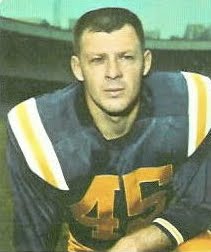
Showing posts with label George Shaw. Show all posts

September 25, 2016

1955: Ameche Spurs Colts to Upset of Bears


The Baltimore Colts were heavy underdogs as they hosted the Chicago Bears in their season-opening game on September 25, 1955. Coming off of a 3-9 record in Head Coach Weeb Ewbank’s first season, the team had 12 rookies on the roster, most notably FB Alan “the Horse” Ameche, the Heisman Trophy winner out of Wisconsin, and QB George Shaw, the bonus first draft pick out of Oregon. The defense featured established players in DE Gino Marchetti, DT Art Donovan, DE Don Joyce, and safety Bert Rechichar, who also handled the placekicking. However, the Colts were without injured star HB Buddy Young.

Chicago was coming off of an 8-4 record in 1954 but there was an extra element at play. Owner George Halas had already indicated that his thirtieth year doubling as head coach would be his last, and there was a sense of urgency to send him out with one last NFL title.

There were 36,167 fans in attendance at Memorial Stadium and the home crowd saw the Colts start off in stunning fashion. On the second play from scrimmage, Alan Ameche carried the ball for the first time and charged down the left sideline for a 79-yard touchdown. Bert Rechichar added the extra point. Midway through the first quarter the Colts scored again when Rechichar kicked a 23-yard field goal and the home team led by 10-0.

Early in the second quarter, it was George Shaw spurring a Baltimore drive, completing all three of his passes as the club advanced 67 yards. Two of them were to end Lloyd Colteryahn, for a gain of 15 yards and, two plays later, for an 11-yard TD. Rechichar again converted to put the Colts up by 17-0.

The Bears finally got on the board with four minutes remaining in the first half when QB George Blanda threw to end Harlon Hill for a touchdown from 10 yards out, completing a 65-yard drive, and Blanda also booted the point after. But Rechichar’s long kickoff return set up his second field goal from 43 yards five plays later and the halftime score was 20-7.

In the third quarter, a pass interference penalty on the Colts gave Chicago a first down at the Baltimore three. From there, HB Bob Watkins ran around left end for a TD and, with Blanda’s conversion, the Baltimore lead was narrowed to 20-14. However, just before the end of the period, the Colts were able to get into scoring territory and came away with a third field goal by Rechichar, this time from 10 yards.

The Bears missed opportunities in the fourth quarter. Blanda failed on a 37-yard field goal attempt and Rechichar came up with a key interception at his 12 yard line to thwart another potential Chicago scoring threat. In one other foray into Baltimore territory, the Colts sacked Blanda on consecutive plays, but he followed up with a 49-yard field goal that again made it a six-point game.

In the final seconds, the desperate Bears resorted to a trick play from their own 19 as end Bill McColl threw to Hill, who gained 59 yards to the Baltimore 22, but the clock ran out on the visitors at that point. The Colts pulled off the upset by a final score of 23-17.

Chicago, playing from behind from the start, led in total yards (361 to 306) and first downs (23 to 14). However, the Bears also turned the ball over four times, to one by Baltimore, and the Colts did well keeping the ball on the ground, gaining 226 yards on 45 running plays. Prior to Bill McColl’s long pass play at the end, Chicago’s quarterback combination of George Blanda and Ed Brown accounted for 227 yards on 20 completions with a touchdown and two interceptions. But the Colts sacked Chicago quarterbacks five times for losses totaling 47 yards while suffering only two in return.

Alan Ameche rushed for 194 yards on 21 carries that included the long touchdown and George Shaw completed 7 of 12 passes for 97 yards and a TD with no interceptions. For the Bears, Harlon Hill had 5 catches for 107 yards and a TD in a losing cause.

Baltimore’s win was the first of three straight to open the season, but the Colts were badly beaten in the second meeting with the Bears and had only two more victories the rest of the way. They finished fourth in the Western Conference with a 5-6-1 record. Chicago took an opposite course, losing its first three contests before the victory in the return engagement with the Colts spurred a six-game winning streak. However, an upset loss to the cross-town Cardinals derailed the Bears at that point and, while winning their two remaining games, they ended up second in the conference at 8-4, just behind the Rams, who were 8-3-1.

Alan Ameche led the NFL in rushing with 961 yards on 213 carries (4.5 avg.) and scored nine touchdowns. He received consensus first-team All-NFL honors as well as Rookie of the Year recognition from UPI and The Sporting News, and was selected to the first of four consecutive Pro Bowls. His 194-yard single-game performance against the Bears remained the franchise record until 1971.

Beyond Ameche and George Shaw, other rookies began to emerge from among Baltimore’s first-year crop, such as HB L.G. Dupre and end Raymond Berry, and they would eventually become part of the team that won back-to-back titles in 1958 and ’59.

As a further footnote, George Halas’ retirement, which was always more of a formality than a reality, lasted for two years before he returned to the sideline in 1958. He finally retired for good following the 1967 season, his fortieth.

October 8, 2015

1955: Colts Break Out to Early Lead, Hold Off Packers


Two NFL Western Conference teams that were sporting surprising 2-0 records, the Baltimore Colts and Green Bay Packers, met in Milwaukee on October 8, 1955. The Colts, coached by Weeb Ewbank, had been 3-9 in ’54 but were benefiting from the play of two rookies. FB Alan “The Horse” Ameche, the Heisman Trophy winner out of Wisconsin, gained over a hundred yards in each of his first two games and QB George Shaw (pictured at right), the first overall draft choice out of Oregon, tossed touchdown passes in each as well. There was other young talent on the club interspersed among able veterans such as HB Buddy Young, DE Gino Marchetti, DT Art Donovan, and safety/PK Bert Rechichar.

Green Bay was coming off of a 4-8 record under Head Coach Lisle Blackbourn the previous year. QB Tobin Rote was a good runner and, at his best, a fine passer, although he lacked consistency. End Billy Howton was an outstanding deep receiver and FB Howie Ferguson was developing into a productive runner. The defense was tough, with LB Roger Zatkoff and safety Bobby Dillon key members of the unit.  

There were 40,119 fans in attendance at County Stadium on a Saturday, the biggest crowd to date to see a football game there. The Packers scored quickly after Alan Ameche fumbled on the first play from scrimmage and Roger Zatkoff recovered for Green Bay at the Colts’ 38. Tobin Rote rolled to his left and fired a pass to Billy Howton, who outran three defenders for a 38-yard touchdown. Fred Cone added the extra point for the early 7-0 lead.

Shortly thereafter, it was Baltimore’s turn to benefit from a turnover when Rote fumbled and DE Don Joyce fell on it at the Green Bay 12. Ameche ran for a five-yard TD and Bert Rechichar converted to tie the score. The Colts scored again when George Shaw threw to Buddy Young (pictured below), who blew past Bobby Dillon and went 82 yards for a touchdown. Rechichar again added the point after. Just before the end of the period, Shaw passed to end Jim Mutscheller for a 40-yard TD and Rechichar’s conversion gave the visitors a 21-7 lead heading into the second quarter.


Dillon intercepted a Shaw pass in Baltimore territory and that set up an eight-play, 26-yard series that concluded with Howie Ferguson taking a pitchout and running for a touchdown from a yard out. Cone kicked the extra point to narrow the margin to 21-14 and that is how the contest remained at halftime.

In the third quarter, the Packers, starting from their 38, put together a promising drive keyed by the running of Ferguson, HB Breezy Reid, and HB Veryl Switzer. After reaching the Baltimore 41, three Rote passes fell incomplete, but Cone kicked a 47-yard field goal that just made it over the crossbar. Green Bay was four points behind at 21-17.

Late in the period, DHB Carl Taseff of the Colts recovered another Rote fumble on the Green Bay 21. Ameche ran the ball twice, with a carry by Shaw in between, but an aroused Packer defense kept them out of the end zone. Rechichar kicked a 10-yard field goal and Baltimore’s lead was extended to 24-17.

DHB Doyle Nix intercepted a Shaw pass that was intended for Mutscheller and the Packers began to advance on offense with Rote completing throws to end Gary Knafelc and Howton. But after reaching the Baltimore 18, an offside penalty moved the home team back and they settled for a 28-yard Cone field goal to again make it a four-point game with less than five minutes on the clock.

The Colts were unable to move and punted on their next series and the Packers took over again at their 40 with two minutes remaining. Rote threw to Ferguson for 11 yards and, after overthrowing Knafelc, he connected with Switzer for a first down at the Baltimore 35. Passes to Switzer and Knafelc gained eight and 16 yards, respectively, but with time slipping away, a Rote toss into the end zone was out of Howton’s reach. The Colts held on for a 24-20 win.

Green Bay had more total yards (322 to 255) and first downs (17 to 8) than the Colts, and outgained the visitors both on the ground (136 to 103) and through the air (186 to 152). However, the Packers spent most of the game trying to catch up to Baltimore, who made key plays to take the early lead. The Colts turned the ball over four times, to three by Green Bay.

George Shaw completed just 6 of 16 passes for 162 yards, but two of them were for touchdowns, although three were intercepted. Alan Ameche was held to 63 yards on 20 carries, one of which was good for a TD.


For the Packers, Tobin Rote was successful on 19 of 39 throws for 191 yards and a TD. Billy Howton caught 6 passes for 86 yards and a touchdown. Howie Ferguson (pictured at right) rushed for 71 yards on 20 attempts, thus coming out ahead of Ameche in the anticipated showdown between the two fullbacks.

Reaching 3-0 proved to be the high point for Baltimore’s season. The Colts lost their next two games, beat the Packers again, and then won only once more on the way to a 5-6-1 record that placed them fourth in the Western Conference. The best years for Ewbank’s team were yet to come. Despite sweeping the season series, they also managed to finish behind the Packers, who ended up third at 6-6.

George Shaw continued to show promise as he threw for 1586 yards and 10 touchdowns while giving up 19 interceptions, but that promise would go largely unfulfilled. Alan Ameche led the NFL in rushing with 961 yards and rushing TDs with nine. He was a consensus first-team All-league selection and went on to perform a key role as the team rose to back-to-back NFL Championships by the end of the decade.

Tobin Rote threw for 1977 yards and a league-leading 17 TD passes (along with San Francisco’s Y.A. Tittle) and also rushed for 332 yards and five touchdowns. Billy Howton received Pro Bowl recognition as he accumulated 44 catches for 697 yards (15.8 avg.) and scored five TDs. Howie Ferguson also was named to the Pro Bowl after rushing for 859 yards on 192 carries (4.5 avg.) which placed second to Ameche.

November 27, 2014

1960: Eagles Come Back to Beat Giants in Eastern Showdown


The Philadelphia Eagles were 7-1 as they faced the New York Giants in the second of back-to-back games between the clubs on November 27, 1960 that would effectively determine the winner of the NFL Eastern Conference. Coached by Buck Shaw, Philadelphia was an overachieving team. QB Norm Van Brocklin was the undisputed leader of the offense and had reliable receivers in flanker Tommy McDonald and ends Pete Retzlaff and Bobby Walston, who was also the placekicker. When FB Clarence Peaks went down with a season-ending broken leg, rookie Ted Dean (pictured above) stepped in admirably and when LB Bob Pellegrini likewise was lost to injury, center Chuck Bednarik returned to that role, playing both ways in doing so. Rookie LB Maxie Baughan and veteran safety Don Burroughs, obtained from the Rams, also helped to bolster a much-improved defense.

In beating the Giants at Yankee Stadium the previous week, Bednarik had deprived New York of star HB Frank Gifford with a famously jolting tackle and now the 5-2-1 Giants, who topped the conference in each of the previous two seasons, were in a must-win situation. New York was also without veteran QB Charlie Conerly and relying on George Shaw to guide the offense. Still, under the direction of Head Coach Jim Lee Howell, this was a good veteran club with a sound defense and plenty of remaining capable players on offense.

There were 60,547 fans in attendance at Franklin Field for the final showdown between the two rivals. The Giants struck quickly on their first play from scrimmage as George Shaw went long for end Kyle Rote, who went the distance for a 71-yard touchdown. Pat Summerall added the extra point.

The Eagles turned the ball over when QB Norm Van Brocklin’s long bomb was intercepted by DHB Lindon Crow and New York scored again, this time driving 83 yards in eight plays. HB Ed Sutton ran around end for 34 yards on first down and HB Joe Morrison caught a pass for 17 yards and then rushed for 19 on the next play. Once again Shaw passed to Rote for a TD, this time from 11 yards out. Summerall’s conversion had the visitors up by 14-0.

The teams exchanged punts before Van Brocklin threw a pass that was intercepted by LB Harland Svare near midfield and returned to the Philadelphia 18. However, the Giants lost yardage from there and end Bob Schnelker dropped a third-down pass in the end zone, but they added three more points with a 35-yard Summerall field goal.

As the game headed into the second quarter, the Eagles had to punt and New York moved the ball effectively. However, safety Bobby Freeman intercepted a Shaw pass at the Philadelphia 44 and returned it all the way to the New York nine. The home team couldn’t reach the end zone from there, with a pass to Tommy McDonald in the end zone ruled out of bounds, but Bobby Walston kicked a 15-yard field goal to get the Eagles on the board.


Once again the Eagles intercepted a Shaw pass, this time the culprit being Maxie Baughan to give them possession at the New York 26. Van Brocklin (pictured at left) threw to Ted Dean for a 25-yard touchdown and, with Walston’s point after, the New York lead was narrowed to 17-10.

For the third time, Shaw was picked off, with Don Burroughs giving the Eagles the ball at the New York 33. Dean ran for 17 yards and Van Brocklin completed two passes to reach the six. From there, HB Billy Barnes ran to the one but fumbled, and OT J.D. Smith outmaneuvered two defenders to recover the ball in the end zone for a TD. Walston again converted and the score was tied at 17-17.

With time running out in the first half, the Giants, who had been reeling through most of the period, advanced into Philadelphia territory. FB Mel Triplett and Sutton combined for 18 yards on the ground and then Shaw completed a pass to Rote for 35 yards. New York moved back on top with a 31-yard Summerall field goal and the score was 20-17 heading into halftime.

Following a three-and-out series by the Eagles to start the third quarter, the Giants drove to the Philadelphia eight. Triplett and Morrison ran the ball well and Shaw tossed a pass to HB Alex Webster for 14 yards along the way. Summerall booted another field goal, this time from 15 yards, and the visitors were ahead by six points.

Again the Eagles had to punt, and once more Burroughs intercepted a pass, this time putting the home team in possession at the New York 49 to start the fourth quarter. On the next play, Van Brocklin fired long for Dean, who gathered in the pass at the 15 and, helped along by a block by Pete Retzlaff, ran the rest of the way for a 49-yard touchdown. Walston’s extra point gave Philadelphia the lead by a 24-23 score.

The Eagles forced another turnover on the next series when DE Joe Robb knocked the ball loose from Morrison and DHB Jimmy Carr recovered at the New York 30. Philadelphia again made the most of the opportunity, advancing 30 yards in eight plays. After converting a fourth-and-one play with Dean diving over the stacked defense for the necessary yard, Van Brocklin connected with Barnes for an eight-yard TD and, with Walston’s PAT, the Eagles were up by eight points.

The teams each had short possessions and punted, and Lee Grosscup came in at quarterback for the Giants. While Grosscup completed two passes, a penalty and a sack by Chuck Bednarik negated the gains. The Giants attempted to convert a fourth-and-one play from their 36, but Triplett was stopped short and the Eagles were able to run out the clock to win by a score of 31-23.

New York had the edge in total yards (337 to 211) and first downs (13 to 12). However, the Giants also turned the ball over five times, to three by Philadelphia, and that made the difference.

Norm Van Brocklin completed 13 of 23 passes for 147 yards and three touchdowns, along with three interceptions. Ted Dean ran for just 28 yards on 11 carries but also caught 5 passes for 74 yards and two TDs. Billy Barnes gained 35 yards on 17 attempts but his lone pass reception was good for a touchdown. Tommy McDonald contributed three catches for 46 yards. On defense, Don Burroughs accounted for two of the interceptions.


For the Giants, George Shaw was successful on 9 of 19 throws for 179 yards and two TDs, but gave up the four big interceptions. Kyle Rote (pictured at right) caught four passes for 124 yards and two touchdowns. Ed Sutton topped the club in rushing with 57 yards on five carries and Joe Morrison added 54 yards on 17 attempts.    

The win over the Giants was also Philadelphia’s last home game of the regular season, but the Eagles went 2-1 on the road to wrap up the Eastern Conference with a 10-2 record. They defeated Green Bay for the NFL Championship. New York dropped to third at 6-4-2.

Norm Van Brocklin was a consensus MVP as well as All-NFL and Pro Bowl selection. He ranked second in pass attempts (284), completions (153), yards (2471), and TD passes (24) in what was his last year before moving to the sidelines as head coach of the expansion Minnesota Vikings.

Ted Dean rushed for 304 yards, gained 281 more on 15 pass receptions, and adding in kick returns, accumulated 1120 total yards. He capped a promising rookie season by starring in the NFL Championship game, where he scored the game-winning touchdown.

Kyle Rote had a solid season at age 32, catching 42 passes for 750 yards (17.9 avg.) and scoring a career-high 10 TDs.

November 22, 2012

1962: NY Titans Pull Out Wild Win Over Broncos


As the 1962 American Football League season progressed, the state of the third-year league’s New York City franchise, the Titans, was precarious, at best. Flamboyant and controversial owner Harry Wismer was in serious financial straits and the club was a poor draw at the decrepit Polo Grounds. By early November the league had taken over the running of the Titans.

The team’s original head coach, all-time great quarterback Sammy Baugh, had been demoted to assistant coach following the ’61 season and replaced by ex-Bears star Bulldog Turner. Still, despite all of the chaos, the Titans were competitive and showing signs of life on the field. Starting out at 2-1, they lost four straight before running off consecutive wins against the Chargers and Raiders prior to succumbing to the Dallas Texans. Coming into their Thanksgiving Day matchup at Denver on November 22, New York’s record stood at 4-6.

The Broncos, under first year Head Coach Jack Faulkner, had gotten off to a 7-2 start but were losers their two most recent games. The passing attack, with QB Frank Tripucka primarily throwing to split end Lionel Taylor and flanker Bob Scarpitto, made Denver exciting and capable of putting points on the board, but the running game and defense were suspect. They very much needed a win against the Titans to remain in contention in the Western Division.

There were 15,776 fans in attendance at Bears Stadium for the nationally televised game. It was all Titans in the early going. FB Bill Mathis ran for a one-yard touchdown and HB Dick Christy caught a pass from QB Johnny Green (pictured above) for a six-yard score that put New York ahead by 14-0 in the first quarter.

It was 17-0 in the second quarter following a 28-yard field goal by Bill Shockley (pictured below) before the home team finally got on the board. Tripucka threw to Scarpitto for a 35-yard touchdown and Gene Mingo added the extra point. The Titans responded with another score, however, as Green threw to split end Art Powell for a four-yard TD. But Denver managed to whittle away at New York’s lead with two field goals by Mingo, of 45 and 8 yards, to make it 24-13 at the half. It still seemed to be a comfortable margin for the Titans.


In the third quarter, the tables turned in favor of the Broncos. First, star DT Bud McFadin picked up a fumble and ran 69 yards for a touchdown. Then QB George Shaw, in for the injured Tripucka, tossed a six-yard TD pass to Scarpitto. Denver was in front by a score of 27-24.

The Titans narrowed the margin to 27-26 when Shaw recovered a loose ball in his own end zone for a safety. New York regained the lead thanks to a Green pass to flanker Don Maynard for a 35-yard touchdown. While the attempt to run for a two-point conversion failed, New York was on top by 32-27 heading into the fourth quarter.

Once again the Broncos rallied. Shaw connected with Taylor for a three-yard TD, followed it up with a two-point conversion, and then CB Jim McMillin intercepted a pass and returned it 59 yards for another touchdown, followed by Mingo’s kick. When Mingo kicked a 49-yard field goal with the wind at his back, Denver held a 45-32 lead with six minutes remaining to play.

The Titans proceeded to drive for another touchdown, this time on a five-yard pass from Green to Christy. Shockley’s extra point narrowed the score to 45-39, but the six points still seemed formidable as time was running down. Denver took over at its own 20 following a long kickoff by Shockley and New York proceeded to get a huge break when HB Al Frazier fumbled a handoff and FS Lee Riley recovered for the Titans.

With the time now down to three minutes, New York capitalized when Green tossed his fifth touchdown pass, of three yards, to Powell. Shockley’s extra point was successful and the Titans were staked to a one-point lead.

The Broncos still had a chance, and managed to get into New York territory, but with time running out Mingo attempted a 52-yard field goal that was straight but too short. The Titans came away with a thrilling 46-45 win.

The Titans led in total yards (381 to 294) and first downs (25 to 19). Each club turned the ball over four times. Denver was especially hurt by penalties, drawing 11 flags at a cost of 130 yards to four for 27 yards on New York.

Johnny Green had a noteworthy performance, completing 22 of 46 passes for 292 yards with five touchdowns and three interceptions. Bill Mathis rushed for 49 yards and a TD on 13 carries. Dick Christy (pictured below) caught 9 passes for 82 yards and two scores, ran the ball 9 times for another 30 yards, and returned a kickoff 28 yards. Don Maynard had 105 yards on four pass receptions that included a TD and Art Powell had three catches for 57 yards and two touchdowns.


For the Broncos, Frank Tripucka was successful on 9 of 15 throws for 113 yards with a TD and two interceptions before leaving the game and George Shaw added 12 completions in 26 attempts for 117 yards with two TDs and an interception. FB Bo Dickinson was the leading rusher with 48 yards on 6 carries and also contributed 5 catches for 57 yards. Lionel Taylor had 6 pass receptions for 60 yards and a TD and Bob Scarpitto gained 89 yards and scored twice on his 5 catches.

The exciting win at Denver was the last for the Titans – they lost their remaining three games to finish at the bottom of the Eastern Division with a 5-9 record. The franchise was sold during the offseason to an ownership group headed by Sonny Werblin and was revamped and rechristened the Jets for 1963.

The loss wiped out any lingering hopes for the Broncos of winning the Western Division title. They, too, lost their remaining games and closed out at 7-7 for second place. It would prove to be their best record until 1973.

Johnny Green, formerly of the Buffalo Bills, saw the most action at quarterback for the Titans in ’62 and completed 49.6 percent of his passes for 1741 yards with 10 touchdowns and 18 interceptions. While he had a strong arm, he lacked accuracy and consistency and saw little action in his last year with the Jets in 1963.

As the numbers from the Denver game indicated, Dick Christy was a productive all-purpose halfback who led the AFL in total yards with 2147 (535 rushing on 114 carries, 538 on 62 pass receptions, 824 on 38 kickoff returns, and 250 on 15 punt returns). He was selected to the AFL All-Star Game.

Don Maynard caught 56 passes for 1041 yards (18.6 avg.) and eight touchdowns and went on to star with the Jets. Art Powell had 64 receptions for 1130 yards (17.7 avg.) and eight TDs as well. Disgruntled after three years in New York, he moved on to the Raiders in ’63 and also continued to excel. 

December 4, 2011

1960: Cowboys Tie Giants for Only Non-Loss of First Season


It had been a rough first year for the expansion Dallas Cowboys as they took on the New York Giants on December 4, 1960. Under Head Coach Tom Landry, who had previously been defensive coach of the Giants, the team was 0-10. The Cowboys had a capable quarterback in diminutive (5’9”, 168) Eddie LeBaron (pictured at right), formerly of the Redskins and dissuaded from retiring in order to lead the offense until rookie Don Meredith was ready. There were some capable veterans to throw to, such as flanker Billy Howton and TE Jim Doran, and the defense had a star in MLB Jerry Tubbs, but for the most part the new team was awash in mediocre players.

New York, coached by Jim Lee Howell, had won the Eastern Conference the previous two years, but the aging and injury-riddled club was 5-3-1 and coming off of back-to-back losses to the Philadelphia Eagles that had assured they would not finish first a third time. 39-year-old QB Charlie Conerly was one of the injured players, and backup George Shaw was behind center against the Cowboys. HB Alex Webster was also out, as was star HB Frank Gifford, who had been finished for the year – and the whole next season – after a noteworthy tackle by LB Chuck Bednarik in the first loss to Philadelphia.

There were 55,033 fans at Yankee Stadium, the smallest home crowd of the year for the Giants on a sunny afternoon. New York scored quickly on its first possession, taking just four plays with Shaw completing a 41-yard pass to end Bill Kimber and then throwing 10 yards to FB Mel Triplett for the touchdown. HB Joe Morrison followed up with a one-yard scoring plunge and the Giants had a 14-0 lead.


However, before the first quarter was over, HB L.G. Dupre (pictured at left) ran in for a five-yard TD to get the Cowboys on the board. Still, Shaw extended New York’s margin in the second quarter as he connected with end Kyle Rote on a 28-yard scoring play.

Dallas continued to fight back. LeBaron, who nearly sat the game out with a rib injury, tossed a pass to Dupre for a 21-yard TD and Fred Cone kicked an 11-yard field goal to narrow the score to 21-17 at halftime.

Pat Summerall posted the only points of the third quarter with a 26-yard field goal that gave the Giants a seven-point lead. The Cowboys knotted things up in the fourth quarter thanks to a 56-yard drive capped by LeBaron throwing again to Dupre for a 23-yard touchdown, followed by Cone’s extra point.

First-year backup QB Lee Grosscup put the Giants back ahead 5:45 into the final period with a 26-yard touchdown pass to end Bob Schnelker. With five minutes to go, Dallas DT Bill Herchman recovered a fumble by Morrison. LeBaron passed to Doran for 32 yards to the New York nine and two plays later connected with Howton for an 11-yard TD. Cone kicked the tying extra point, and that was it. The game ended in a 31-31 draw, the first non-losing game in Dallas franchise history.

The statistics reflected the evenness of the score. The Cowboys outgained New York by just one yard (328 to 327) and each team had 19 first downs. The Giants turned the ball over three times, to two by Dallas.


Eddie LeBaron completed 17 of 35 passes for 267 yards with three touchdowns and two intercepted. Billy Howton (pictured at right) caught 6 passes for 78 yards and a TD and Jim Doran added three receptions for 62 yards. The game’s scoring star, L.G. Dupre, accumulated the most receiving yards, however, with 82 on three catches that included two touchdowns while also rushing for 27 yards on 8 carries with another TD. HB Don McIlhenny was the leading ground gainer for the Cowboys with 34 yards on 8 attempts.

For the Giants, George Shaw was successful on 8 of 16 throws for 149 yards and two TDs against one interception. Lee Grosscup added five completions in 11 attempts that gained 75 yards and a touchdown (his only one of the season). Bob Schnelker hauled in 5 passes for 69 yards and a TD and Kyle Rote also gained 69 yards on his three receptions that included a score. HB Ed Sutton topped the running attack with 62 yards on 7 carries.

The Cowboys lost their season finale at Detroit and finished at the bottom of the Western Conference with a record of 0-11-1 (they shifted to the Eastern Conference in ’61). New York split its last two games and placed third in the conference at 6-4-2.

Eddie LeBaron had a respectable season for a bad team, although he led the NFL by tossing 25 interceptions. Still, he was in the top five in pass attempts (225), yards (1736), and yards per completion (15.6). L.G. Dupre’s accomplishments were more modest as he led the club in rushing with just 362 yards and caught 21 passes for 216 more. His three touchdowns against the Giants accounted for most of his season total of five.

July 30, 2011

1959: Colts Trade George Shaw to Giants


On July 30, 1959 the Baltimore Colts complied with backup QB George Shaw’s request for a trade, sending him to the New York Giants for that team’s second-round 1960 draft choice (originally reported to be a first-round pick and used to take G Bo Terrell from Mississippi, who opted for the AFL).

It was the end of an association with the Colts that had begun with great promise. Shaw was chosen by Baltimore as the first overall pick (or, at that time, bonus selection) in the 1955 NFL draft out of Oregon, passing up on a baseball contract offer from the New York Yankees.

A versatile player in college (in addition to playing quarterback, he sometimes played as a halfback or receiver on offense, safety on defense, and also handled placekicking and punting), Shaw led the nation in total offense as a senior with 1536 yards. The 6’0”, 185-pound passer showed promise as a rookie, moving right into the starting lineup and completing 50.2 percent of his 237 passes for 1586 yards with 10 touchdowns and 19 interceptions. He also displayed impressive mobility, rushing for 301 yards on 68 carries.

While there were questions about Shaw’s leadership ability, he went into the ’56 season as the starting quarterback. A broken kneecap suffered in the fifth game prematurely ended his year and, ultimately, his starting career in Baltimore. Unknown backup Johnny Unitas took over and soon established himself as a rising talent. Shaw remained as a second-stringer and saw action in 1958 when Unitas was sidelined by a rib injury, but he was clearly not in the same class with the rapidly-developing all-time great who led the Colts to the NFL Championship.

In the ensuing offseason, Shaw requested a trade when it became apparent that he wouldn’t be getting any further playing time as long as Unitas was healthy and, while the Colts hoped to hold onto him as a backup, they eventually acquiesced. Both the Eagles and Cardinals reportedly showed interest, but in the end it was the Giants who made the preseason deal for the 26-year-old quarterback.

Coming to the Giants, Shaw faced a crowded quarterback situation that included the 38-year-old starter, Charlie Conerly, plus veteran backup Don Heinrich, and the team’s first draft choice, rookie Lee Grosscup. In addition, star HB Frank Gifford was being given a trial at quarterback, although he ended up staying put at running back.

Shaw made the team, but was hindered by an injured thumb on his throwing hand. He started one game in place of Conerly, who had an outstanding season as the Giants won the Eastern Conference for the third time in four years, and was a more effective passer than Heinrich when he did play - he completed 66.7 percent of his throws for 433 yards while Heinrich was successful on just 37.9 percent for 329 yards while tossing 22 more passes than Shaw (58 to 36); he also threw six interceptions to Shaw’s one, and each threw a TD pass. Grosscup was shunted off to the taxi squad.

In 1960, Heinrich was gone to the expansion Dallas Cowboys and Conerly suffered through an injury-plagued season that gave Shaw more of an opportunity to play. While he led the team in pass attempts (155), completions (76), and yards (1263) and had some good performances, he also threw 13 interceptions (a few which came at particularly inopportune times), as opposed to 11 TDs, for the 6-4-2 Giants. Moreover, questions regarding his lack of confidence and inability to command the veteran-filled offense led the team to write him off.

Moving on to the expansion Minnesota Vikings for 1961, it was anticipated that Shaw would have an opportunity to show what he could do as a starting quarterback, particularly under the guidance of Head Coach Norm Van Brocklin. But while he started the opening game, he was quickly replaced by rookie Fran Tarkenton, who was the first-string quarterback for the rest of the year (and beyond). Shaw went next to the AFL, where he played one season as a backup to QB Frank Tripucka in Denver (and completed a team-record 97-yard touchdown pass to WR Jerry Tarr), before retiring.

In the end, Shaw’s career that started with so much promise was ultimately disappointing. After losing the starting job in Baltimore, he was never more than a decent backup. Indeed, at the time of his trade to the Giants, he expressed a concern that he had developed “second-stringitis”. He went so far as to confess in an article in Sports Illustrated: “When you go in, you feel the responsibility so much. A couple of years ago, when Johnny (Unitas) was hurt, I played two games at quarterback. I wasn't relaxed and I wasn't confident because I was afraid of playing poorly. Not afraid of giving a bad performance myself, but afraid of failing the team. Maybe I shouldn't say it, but you know when you're out there that the guys up in the line aren't making as much money as the quarterback. When they are great players on a team which is about to win a championship, they demand a lot from a quarterback. They expect you to be as good as they are, or better. It's a big load.”

An offseason banker, Shaw’s personality lacked fire and, in particular with the Giants, that worked against him. Displaced by two Hall of Fame quarterbacks, Unitas and Tarkenton, he became an example of a quarterback drafted in the first round who failed to make the grade at the pro level.