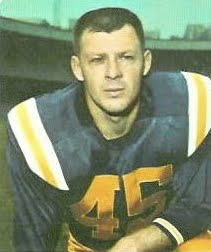
Showing posts with label Frank Tripucka. Show all posts

October 30, 2014

1960: Texans Edge Broncos as Late Field Goal Attempt Fails


The Dallas Texans of the new American Football League were coming off of three straight losses and had a 2-4 record as they faced the Denver Broncos on October 30, 1960. Owned by the league’s founder, Lamar Hunt, and coached by Hank Stram, the Texans had a good defense and an exciting all-purpose weapon on offense in rookie HB Abner Haynes (pictured above). Split end Chris Burford was good, too, but QB Cotton Davidson lacked consistency and passing accuracy.

Denver, coached by Frank Filchock, was less talented overall but had a better record at 4-2. QB Frank Tripucka, a 32-year-old CFL veteran, directed the attack with little ground support (especially at fullback), other than ex-Green Bay HB Al Carmichael. Unheralded end Lionel Taylor was coming on as a possession receiver.

It was a cold, clear day at Bears Stadium with 13,002 fans in attendance. The Texans took the opening kickoff and drove into Denver territory with Abner Haynes and FB Jack Spikes running effectively. But facing second-and-11 at the 17, Cotton Davidson’s deflected pass was intercepted by safety Al Romine. However, Dallas got the ball back two plays later when Al Carmichael fumbled and LB Ted Greene recovered at the Denver 37. The Texans didn’t come up empty, scoring in four plays. The biggest was a screen pass from Davidson to Haynes that covered 34 yards and Spikes scored a touchdown standing up from a yard out. Spikes, who doubled as placekicker, added the extra point and the visitors led by 7-0.

The teams exchanged punts before the Broncos put together a 61-yard drive in three plays. Frank Tripucka threw to end Lionel Taylor for 14 yards and, after another long pass was almost picked off, Carmichael (pictured below), making up for the earlier fumble, broke away for a 47-yard TD. Gene Mingo converted to tie the score.


As the game moved into the second quarter, a three-and-out series by the Texans ended with a punt and the Broncos did the same. However, DB Clem Daniels fumbled the kick and OT Eldon Danenhauer recovered for Denver at the Dallas 31. Tripucka completed passes to Gene Mingo, a halfback as well as kicker, and Carmichael to reach the 16, but Taylor lost two yards on an end-around and Tripucka’s next two aerials were overthrown. Mingo attempted a 26-yard field goal that was wide to the right and the home team came up empty.

The clubs again traded punts before the Texans put together an eight-play, 64-yard drive. Haynes ran the ball five times for 19 yards and caught a swing pass for another ten, and his last carry of three yards was good for a touchdown. Spikes added the point after to put Dallas back in front by 14-7.

The Broncos drove into Dallas territory on their next series. Tripucka passed to Mingo for 18 yards to midfield on a third-and-eight play and two defensive holding penalties on the Texans helped keep the drive alive. But after reaching the 24, HB Bob Stransky fumbled after catching a pass and DT Ray Collins recovered for Dallas. The first half ended with Dallas still in front by seven.

Denver started the third quarter off with a short possession and punted. Starting from their 20, the Texans moved methodically down the field. Davidson threw to Chris Burford for 15 yards to convert a third-and-seven situation and, after Haynes and Spikes ran the ball to the Denver 22, Davidson completed a third-down pass to Haynes for 14 yards to give the visitors a first-and-goal at the eight. Davidson’s first down pass was incomplete, but he connected with Haynes on second down for a five-yard gain to the three.  Spikes plowed down to the one and, electing to go for it on fourth down, Davidson kept the ball on a quarterback sneak but was stopped a foot short of the goal line.

The Broncos ran three times and punted, and the Texans regained possession at the Denver 49. Once again the Texans chipped away as Spikes gained eight yards and Haynes six. Davidson threw to Burford for a 25-yard gain to the ten yard line but the drive stalled at the four and Spikes booted an 11-yard field goal. Dallas was now up by 17-7.

On Denver’s second play following the ensuing kickoff, Tripucka’s pass was intercepted by Daniels at the Broncos’ 26. However, the opportunity for the Texans to pad the lead was lost when Haynes fumbled and DE Chuck Gavin recovered for the Broncos at the Denver 16.

On the first play of the fourth quarter, a Tripucka bomb was intercepted by CB Duane Wood at the Dallas 10. The Texans picked up nine yards and punted, but retained possession when Carmichael fumbled and OT Jerry Cornelison recovered at his 42. Two plays later, CB John Pyeatt intercepted a throw by Davidson to give the Broncos the ball at their 24.

It didn’t look promising when Tripucka was sacked on first down by DE Paul Miller for a ten-yard loss, but after Mingo gained back four yards, on third-and-16 Tripucka threw to Carmichael for 22 yards. Carmichael picked up another five yards shortly thereafter and then Tripucka connected with HB Bob McNamara on a play that covered 55 yards for a touchdown. Mingo converted and the Broncos were now three points behind with 8:48 to play.

The Texans managed to convert two third downs as they ran the clock down to just over three minutes on their next series, but after reaching the Denver 47 they had to punt. Tripucka came out throwing, completing six passes, two of them on third down plays, to get the Broncos to the Dallas 21. McNamara dropped a pass at the 15 and Carmichael lost a yard on a draw play, setting up a 29-yard game-tying field goal attempt by Mingo. The kick was wide to the left and Dallas came away with a 17-14 win.

The Texans had the edge in total yards (308 to 302) and first downs (19 to 13). Denver turned the ball over five times, to four suffered by Dallas, while the Broncos recorded four sacks, to two by the Texans.

Abner Haynes was typically productive in his all-purpose role, rushing for 81 yards on 27 carries that included a touchdown, catching 7 passes for 96 yards, and returning two kickoffs for 38 yards. Cotton Davidson completed 12 of 23 throws for 187 yards and gave up two interceptions. Chris Burford contributed 78 yards on four pass receptions. Jack Spikes (pictured below) gained 50 yards on 18 rushes that included a TD and also kicked a field goal in addition to both extra points.


For the Broncos, Frank Tripucka was successful on 14 of 31 aerials for a TD as well as two interceptions. Al Carmichael ran for 61 yards on six attempts that included a touchdown and also caught three passes for 40 yards. Gene Mingo had a team-leading four receptions for 50 yards in addition to 42 rushing yards on 8 attempts, but missed both of his field goal tries. Bob McNamara had the most receiving yards with 55 on his lone scoring catch.

The team’s fortunes shifted as the season continued. Dallas went on to win its next two games, including the rematch with the Broncos, and finished strong for an overall 8-6 record that placed second in the Western Division. Meanwhile, Denver didn’t win another game, while tying one, and ended up at the bottom of the division at 4-9-1.

Abner Haynes had a spectacular first year, leading the AFL in rushing with 875 yards on 156 carries (5.6 avg.) and in all-purpose yards (2100) thanks to his team-leading 55 catches for 576 yards, 215 yards on 14 punt returns (a league-leading 15.4 avg.), and 19 kickoff returns that totaled 434 yards. He scored 12 touchdowns and was named AFL Player of the Year by UPI.

Al Carmichael ran for 211 yards on 41 attempts (5.1 avg.) and added 616 yards on 32 pass receptions (19.3 avg.), scoring a total of seven TDs, before a leg injury ended his season in the tenth game. Gene Mingo had better kicking performances as he led the AFL with 18 field goals, a 64.3 field goal percentage, and 123 points. Frank Tripucka led the league in pass attempts (478), completions (248), and yards (3038), but also interceptions (34). 

November 27, 2012

1952: Dallas Texans Stun Bears for Only Win


The Dallas Texans entered the 1952 NFL season with great expectations, having purchased the assets of the failed New York Yanks franchise with the intent of establishing a viable team in the football hotbed of Texas. Instead, the Texans averaged just 15,000 fans per game for four losses at the Cotton Bowl and the owners pulled out, with the league taking over operation of the club for the remainder of the schedule. The team wasn’t even based in Dallas any longer, having become a traveling club based out of Hershey, Pennsylvania.

Coached under these difficult circumstances by Jimmy Phelan, the Texans had talent on the roster, most notably halfbacks George Taliaferro and Buddy Young on offense and rookie DE Gino Marchetti and second-year DT Art Donovan on defense. But there were not nearly enough quality players and the team’s record stood at 0-9 as it hosted the Chicago Bears in Akron, Ohio on November 27.

Chicago, under owner and Head Coach George Halas, was suffering through a rare down year. The offense was missing the retired Johnny Lujack at quarterback and unproven quantities George Blanda, Steve Romanik, and Bob Williams split the job with inadequate results. The Bears came into the matchup with the Texans sporting a 4-5 tally, but were still a heavy favorite against the hapless road team – an opponent they had handily beaten earlier in the year at Dallas.

There were just 3000 in attendance at the Rubber Bowl for the Thanksgiving Day contest – far fewer than the 14,800 who turned out in the morning for a high school game. The first quarter was scoreless and then the Bears put the first points on the board when DHB Don Kindt tackled Buddy Young in the end zone for a safety. However, turnovers set up scores by the Texans during the second quarter.

First, LB Pat Cannamela recovered a fumble by HB Eddie Macon at the Chicago 45 and five plays later, FB Zollie Toth scored from two yards out, although the extra point attempt failed. Then, just before the half, end Gene Schroeder fumbled at his own 38 and DHB John Petitbon recovered for the Texans. The ensuing four-play drive resulted in George Taliaferro throwing to end Dick Wilkins for a 13-yard TD. This time the PAT was successful and the score stood at 13-2 in favor of Dallas at the half.


In the third quarter, DHB Stan Williams intercepted a pass for the Texans and returned it 25 yards to the Chicago 40. Dallas kept the ball on the ground, taking seven plays to score on a one-yard carry by QB Frank Tripucka. But the 20-2 lead proved to not be safe.

While Chicago had two drives end with pass interceptions in the fourth quarter, the Bears still rallied furiously to score three touchdowns and take the lead. DE Ed Sprinkle recovered a Tripucka fumble at the Dallas one to set up an easy TD for HB Billy Stone. George Blanda threw to HB Babe Dimancheff for a 41-yard touchdown and then to Schroeder for another TD from 35 yards out. Blanda successfully added the extra points after each and, with a 23-20 edge it appeared that the Bears would send the unfortunate Texans to another defeat.

However, with a minute to go Dallas drove 75 yards to score the deciding touchdown, including six pass completions by Tripucka – the last and biggest an 18-yard throw to end Tom Keane that moved the ball to the Chicago two yard line (he also hit Toth and ends Barney Poole and Ray Pelfrey along the way). For the second time Tripucka gained the last yard himself, diving into the end zone with 34 seconds left on the clock. The Texans came away with an unlikely 27-23 win.

Dallas had the most total yards (334 to 317) and first downs (22 to 15) although also the most penalties (7 for 82 yards, to 5 at a cost of 54 yards on the Bears). Chicago turned the ball over eight times, to four by the Texans.


Frank Tripucka (pictured at right) completed 16 of 26 passes for 205 yards for Dallas and also scored on the two short touchdown carries. George Blanda completed 9 of 16 aerials for 138 yards and two TDs in nearly pulling out a win for Chicago.

“Unaccustomed as I am to winning, I feel all right,” said a happy Coach Jimmy Phelan.

“It’s pretty hard for a team like ours to keep morale up with no home ties,” added Phelan. “We have nobody to play for except (NFL Commissioner) Bert Bell.”

It was the high point of a dismal season for the Texans. They lost their remaining two games to finish at the bottom of the National Conference with a 1-11 record before fading into oblivion – the last NFL franchise to fold. The Texans were replaced the following year by the re-born Baltimore Colts, and while just 13 players who had been with Dallas made the Baltimore roster, they included Buddy Young and George Taliaferro, as well as the future Hall of Famers Gino Marchetti and Art Donovan. Frank Tripucka, the fourth-year quarterback, moved on to Canada and eventually the American Football League in 1960.

The Bears ended up a spot above Dallas in the standings with a 5-7 tally – the club’s worst since 1945.

November 22, 2012

1962: NY Titans Pull Out Wild Win Over Broncos


As the 1962 American Football League season progressed, the state of the third-year league’s New York City franchise, the Titans, was precarious, at best. Flamboyant and controversial owner Harry Wismer was in serious financial straits and the club was a poor draw at the decrepit Polo Grounds. By early November the league had taken over the running of the Titans.

The team’s original head coach, all-time great quarterback Sammy Baugh, had been demoted to assistant coach following the ’61 season and replaced by ex-Bears star Bulldog Turner. Still, despite all of the chaos, the Titans were competitive and showing signs of life on the field. Starting out at 2-1, they lost four straight before running off consecutive wins against the Chargers and Raiders prior to succumbing to the Dallas Texans. Coming into their Thanksgiving Day matchup at Denver on November 22, New York’s record stood at 4-6.

The Broncos, under first year Head Coach Jack Faulkner, had gotten off to a 7-2 start but were losers their two most recent games. The passing attack, with QB Frank Tripucka primarily throwing to split end Lionel Taylor and flanker Bob Scarpitto, made Denver exciting and capable of putting points on the board, but the running game and defense were suspect. They very much needed a win against the Titans to remain in contention in the Western Division.

There were 15,776 fans in attendance at Bears Stadium for the nationally televised game. It was all Titans in the early going. FB Bill Mathis ran for a one-yard touchdown and HB Dick Christy caught a pass from QB Johnny Green (pictured above) for a six-yard score that put New York ahead by 14-0 in the first quarter.

It was 17-0 in the second quarter following a 28-yard field goal by Bill Shockley (pictured below) before the home team finally got on the board. Tripucka threw to Scarpitto for a 35-yard touchdown and Gene Mingo added the extra point. The Titans responded with another score, however, as Green threw to split end Art Powell for a four-yard TD. But Denver managed to whittle away at New York’s lead with two field goals by Mingo, of 45 and 8 yards, to make it 24-13 at the half. It still seemed to be a comfortable margin for the Titans.


In the third quarter, the tables turned in favor of the Broncos. First, star DT Bud McFadin picked up a fumble and ran 69 yards for a touchdown. Then QB George Shaw, in for the injured Tripucka, tossed a six-yard TD pass to Scarpitto. Denver was in front by a score of 27-24.

The Titans narrowed the margin to 27-26 when Shaw recovered a loose ball in his own end zone for a safety. New York regained the lead thanks to a Green pass to flanker Don Maynard for a 35-yard touchdown. While the attempt to run for a two-point conversion failed, New York was on top by 32-27 heading into the fourth quarter.

Once again the Broncos rallied. Shaw connected with Taylor for a three-yard TD, followed it up with a two-point conversion, and then CB Jim McMillin intercepted a pass and returned it 59 yards for another touchdown, followed by Mingo’s kick. When Mingo kicked a 49-yard field goal with the wind at his back, Denver held a 45-32 lead with six minutes remaining to play.

The Titans proceeded to drive for another touchdown, this time on a five-yard pass from Green to Christy. Shockley’s extra point narrowed the score to 45-39, but the six points still seemed formidable as time was running down. Denver took over at its own 20 following a long kickoff by Shockley and New York proceeded to get a huge break when HB Al Frazier fumbled a handoff and FS Lee Riley recovered for the Titans.

With the time now down to three minutes, New York capitalized when Green tossed his fifth touchdown pass, of three yards, to Powell. Shockley’s extra point was successful and the Titans were staked to a one-point lead.

The Broncos still had a chance, and managed to get into New York territory, but with time running out Mingo attempted a 52-yard field goal that was straight but too short. The Titans came away with a thrilling 46-45 win.

The Titans led in total yards (381 to 294) and first downs (25 to 19). Each club turned the ball over four times. Denver was especially hurt by penalties, drawing 11 flags at a cost of 130 yards to four for 27 yards on New York.

Johnny Green had a noteworthy performance, completing 22 of 46 passes for 292 yards with five touchdowns and three interceptions. Bill Mathis rushed for 49 yards and a TD on 13 carries. Dick Christy (pictured below) caught 9 passes for 82 yards and two scores, ran the ball 9 times for another 30 yards, and returned a kickoff 28 yards. Don Maynard had 105 yards on four pass receptions that included a TD and Art Powell had three catches for 57 yards and two touchdowns.


For the Broncos, Frank Tripucka was successful on 9 of 15 throws for 113 yards with a TD and two interceptions before leaving the game and George Shaw added 12 completions in 26 attempts for 117 yards with two TDs and an interception. FB Bo Dickinson was the leading rusher with 48 yards on 6 carries and also contributed 5 catches for 57 yards. Lionel Taylor had 6 pass receptions for 60 yards and a TD and Bob Scarpitto gained 89 yards and scored twice on his 5 catches.

The exciting win at Denver was the last for the Titans – they lost their remaining three games to finish at the bottom of the Eastern Division with a 5-9 record. The franchise was sold during the offseason to an ownership group headed by Sonny Werblin and was revamped and rechristened the Jets for 1963.

The loss wiped out any lingering hopes for the Broncos of winning the Western Division title. They, too, lost their remaining games and closed out at 7-7 for second place. It would prove to be their best record until 1973.

Johnny Green, formerly of the Buffalo Bills, saw the most action at quarterback for the Titans in ’62 and completed 49.6 percent of his passes for 1741 yards with 10 touchdowns and 18 interceptions. While he had a strong arm, he lacked accuracy and consistency and saw little action in his last year with the Jets in 1963.

As the numbers from the Denver game indicated, Dick Christy was a productive all-purpose halfback who led the AFL in total yards with 2147 (535 rushing on 114 carries, 538 on 62 pass receptions, 824 on 38 kickoff returns, and 250 on 15 punt returns). He was selected to the AFL All-Star Game.

Don Maynard caught 56 passes for 1041 yards (18.6 avg.) and eight touchdowns and went on to star with the Jets. Art Powell had 64 receptions for 1130 yards (17.7 avg.) and eight TDs as well. Disgruntled after three years in New York, he moved on to the Raiders in ’63 and also continued to excel. 

December 10, 2011

1960: Chargers Come From Behind to Beat Broncos, Clinch Division Title


The Los Angeles Chargers had an 8-4 record and seemed poised to win the Western Division in the first year of the new American Football League as they hosted the Denver Broncos on December 10, 1960. Under Head Coach Sid Gillman, they started slowly and were 2-3 before winning six of their next seven games to take control of the division. The club developed a quick-striking offense guided by NFL-castoff QB Jack Kemp (pictured at right) and featuring rookie HB Paul Lowe. However, fielding an exciting and winning team was not enough to bring fans to the huge Memorial Coliseum, and the Chargers regularly played before a large expanse of empty seats.

The Broncos came into the game at 4-7-1, meanwhile, having started off respectably at 4-2 before losing five of their next six, with a tie interspersed. Head Coach Frank Filchock’s team had far more penurious ownership than the Chargers and were esthetically lacking in their ugly brown and gold (more appropriately yellow) uniforms with the infamous vertically-striped socks. QB Frank Tripucka, a veteran of both the NFL and CFL (as was Filchock), passed often, mostly to end Lionel Taylor. HB/PK Gene Mingo was another notable performer, but at this point Denver was a losing team that was playing out the schedule – and looking to be a spoiler. LA had won the first meeting of the two teams in Denver by a close score of 23-19.

There was a typically sparse turnout of 9928 at the Coliseum for the Saturday game. Denver took the early lead thanks to a 41-yard field goal by Mingo and added to it when Tripucka connected with Taylor for a 49-yard touchdown.

However, the Chargers came right back with Kemp throwing to FB Howie Ferguson for a 39-yard TD and, before the first quarter was over, gained the lead on a three-yard run by Lowe that made it 14-10.

Mingo put the Broncos back in front in the second quarter with a one-yard plunge and added the extra point that made it 17-14. It was Mingo adding more points with a 12-yard field goal before flanker Royce Womble caught a 12-yard scoring pass from Kemp to again put LA in the lead at 21-20. 41-year-old placekicking specialist Ben Agajanian added a 23-yard field goal to make it a four-point game before Mingo kicked another three-pointer, this time from 13 yards near the end of the first half, and the Chargers narrowly led by 24-23 at halftime.

The game continued to be a close, back-and-forth affair until midway through the fourth quarter. In the third quarter, Denver went back in front thanks to a pass play from Tripucka to end Jim Greer that covered 21 yards. Agajanian booted a field goal of 40 yards for the Chargers to start off the final period and Mingo responded in kind from 28 yards. The Chargers were behind by 33-27 with just under seven minutes remaining.

In the key play of the game, the Chargers took advantage of a shanked 20-yard punt by George Herring, who was reacting to a fierce rush led by DB Bob Zeman, giving them possession on the Denver 35. San Diego methodically drove to a touchdown with Kemp going in from a yard out. Agajanian’s extra point put LA in front by a point at 34-33.

LA then scored again thanks to an interception less than two minutes later as DE Maury Schleicher picked off a deflected Tripucka pass and returned it five yards to the Denver 20. Kemp followed up with a 15-yard TD throw to end Don Norton running a slant pattern behind the goal post, effectively finishing off the Broncos. The Chargers won the game by a score of 41-33 and clinched a berth in the AFL title game.

The Chargers had actually lost out on two additional scores before finally putting the feisty Broncos away. Zeman picked up a fumble and ran 52 yards for an apparent TD, but the play had been whistled dead. The other occurred when Mingo fielded a kickoff but fumbled on his three yard line. The ball rolled into the end zone and the Chargers appeared to recover but an offside penalty negated the play.

Denver outgained the Chargers with 391 yards to 347, although Los Angeles had more first downs (22 to 20) and fewer turnovers (two, to four by the Broncos). Denver also sacked Kemp four times while the Chargers got to Tripucka once.


Paul Lowe (pictured at left) rushed for 106 yards on 19 carries that included a touchdown. Jack Kemp completed 15 of 32 passes for 205 yards with three TDs and two intercepted. Don Norton had 5 catches for 81 yards and a score.

For Denver, Frank Tripucka went to the air 35 times and completed 17 for 291 yards with two touchdowns and two interceptions apiece. Lionel Taylor (pictured below) typically paced the pass receivers as he recorded 9 catches for 171 yards and a TD, and as a result increased his league-leading season total to 88, which exceeded the existing NFL record of 84 that was set by Tom Fears of the Rams ten years earlier. FB Dave Rolle carried the ball 17 times for 68 yards and Gene Mingo added 37 yards on 12 attempts, one of which was a touchdown that was part of the 21 points in all that he scored.


The Chargers ended the regular season with a 10-4 record and went on to lose the first AFL Championship game to the Houston Oilers. Following the season, the franchise relocated to San Diego. The Broncos were last in the Western Division at 4-9-1.

By the system in use at the time, Jack Kemp led the AFL in passing (by today’s system, he ranked fourth) while placing second in attempts (406), completions (211), yards (3018), and completion percentage (52.0). He also led the league by averaging 7.4 yards per attempt while he tossed 20 touchdown passes but also 25 interceptions. Leading him in most categories was Frank Tripucka, who topped the AFL in attempts (478), completions (248), yards (3038), and interceptions (34).

Paul Lowe placed second among the new league’s rushers with 855 yards on just 136 carries, giving him an AFL-best 6.3 yards-per-carry. He scored eight rushing TDs (as did Kemp). Lionel Taylor finished at the top of the pass receivers for the first of five times (four consecutive) with 92 catches. His 1235 yards ranked third and 12 touchdown receptions tied for second with Houston’s Bill Groman. Gene Mingo led the AFL in scoring with 123 points that included a league-leading 18 field goals. He also scored six touchdowns and 33 extra points.

September 7, 2011

1962: New-Look Broncos Upset Chargers


Coming into the 1962 American Football League season, the Denver Broncos had undergone a transformation – at least in terms of leadership and appearance. In 1960 and ’61, the club had a decidedly austere air about it. Coached by Frank Filchock, a former NFL quarterback and CFL coach, the team had little money to work with (especially during the inaugural season, when owned by the Howsam family), epitomized by the uniforms of gold (more accurately mustard yellow) jerseys and brown pants with vertically-striped brown-and-yellow socks that had been purchased cheaply from the organizers of a defunct college all-star game (the Copper Bowl).

Frank Tripucka, who last played in the NFL with the ill-fated Dallas Texans in 1952 before heading north to Canada, originally came to the Broncos in ’60 to be a coach but ended up becoming the starting quarterback for Filchock’s pass-oriented attack. There was talent on the club in split end Lionel Taylor, the AFL’s leading receiver in each of its first two seasons (including an even 100 catches in ’61); HB/PK Gene Mingo, the league’s leading scorer in 1960; All-League DT Bud McFadin; and safety Austin “Goose” Gonsoulin, who intercepted 17 passes in two years. Still, the team lost far more than it won, going a combined 7-20-1.

For 1962, there was a new head coach/GM in Jack Faulkner (pictured above), who had been an assistant with the Chargers under Sid Gillman. The team’s offices were revamped, and so were the uniforms. The new outfits were orange, blue, and white with a cartoon bucking bronco on the helmet, and the hated vertically-striped socks were publicly burned amid great ceremony prior to an intrasquad scrimmage before a cheering crowd (at least one pair survived to eventually reach the Pro Football Hall of Fame).


The team that took the field on September 7 for the season-opening game at Bears Stadium against San Diego still contained most of the same key personnel, including Tripucka, Taylor, Mingo, McFadin, and Gonsoulin. But there was a new enthusiasm present as a crowd of 28,000 turned out for the Friday night contest, a new high for the franchise.

The team the Broncos were hosting, the Chargers, had won the Western Division in each of the previous two seasons and was expected to provide an ample test for the refurbished club. However, San Diego’s potent offense had already been crippled by the loss of star HB Paul Lowe, who was gone for the year due to a fractured wrist suffered in training camp.

The Broncos started off the scoring with a first quarter drive that covered 56 yards, capped by Mingo’s five-yard touchdown carry. Mingo added the extra point and then, later in the opening period, kicked a 12-yard field goal to put Denver ahead by 10-0 after a quarter of play.

San Diego responded with a seven-yard TD pass from QB Jack Kemp to split end Don Norton to narrow the score to 10-7 in the second quarter. But the Broncos came back with another drive that concluded with a long pass play of 49 yards (17 in the air) from Tripucka to flanker Bob Scarpitto, a newcomer to the club.

On Denver’s next possession, Tripucka completed eight passes, the last for a two-yard TD to FB Bo Dickinson. The 34-year-old quarterback completed 20 of 33 passes for 252 yards in the first half as the Broncos raced out to a 24-7 lead. His protection was excellent, as well as his accuracy.

Mingo padded the lead to 30-7 in the third quarter with field goals of 41 and 53 yards. The Chargers, who made it into Denver territory just twice more after scoring their first touchdown, finally got on the board again on the last play of the third quarter when CB Claude Gibson returned a pass interception 35 yards for a touchdown.

San Diego’s rookie QB John Hadl led the Chargers on a 55-yard drive in the fourth quarter that ended with a 15-yard scoring pass to FB Bobby Jackson, but the result was not in doubt. The Broncos came away with a convincing 30-21 win.

Denver’s offensive output of 505 yards was impressive and easily outdistanced the Chargers, who gained 208. The Broncos not only dominated through the air (384 yards to 123), but on the ground also (121 to 96) and had twice as many first downs (28 to 14). It was Denver’s first-ever win over the Chargers following four defeats.


Frank Tripucka had an outstanding day as he completed 28 of 47 passes for 376 yards with two touchdowns and two interceptions. Lionel Taylor and TE Gene Prebola each caught 7 passes, with Taylor gaining 79 yards to Prebola’s 69. Thanks to the long scoring reception, Bob Scarpitto was right behind with 68 yards on just two receptions. HB Al Frazier was the team’s leading rusher with 72 yards on 14 carries. Through both rushing and placekicking, Gene Mingo accounted for 18 points.

For the Chargers, the usually capable Jack Kemp went to the air 27 times and had only 8 completions for 108 yards, including one TD and one interception. TE Dave Kocurek caught 4 passes for 66 yards. Bobby Jackson ran for 51 yards on 9 carries.

The Broncos continued to play well under Faulkner as they won six of their first seven games to move into contention in the Western Division. They were 7-2 after beating the Chargers again in San Diego, but the roof fell in on the overachieving club after that – the Broncos didn’t win another game the rest of the way and finished in second place with a 7-7 record. Still, it was progress and Faulkner received AFL Coach of the Year honors.

San Diego recovered to win handily the next week, but lost Jack Kemp to a hand injury and when the club waived him in an administrative move, he was lost to the Buffalo Bills. The loss of Lowe and Kemp was just the beginning as many starters fell to injury along the way. The Chargers advanced as far as 3-2 with rookie John Hadl at quarterback, but proceeded to lose eight of the last nine games to finish far out of the running in third place with a 4-10 record.

September 9, 2010

1960: Broncos Defeat Patriots as AFL Debuts


The fourth, and ultimately most successful, organization to be known as the American Football League (AFL) had its regular season debut on September 9, 1960 as the Boston Patriots played host to the Denver Broncos. There were 21,597 fans in attendance at Boston University’s Nickerson Field (on the site of the former Braves Field) on a muggy Friday night as Patriots tackle Tony Discenzo booted the opening kickoff to the Broncos.

The Patriots, coached by Lou Saban and having badly beaten the Broncos in a preseason game a few weeks earlier, were considered to be heavy favorites coming into the opening game. Their biggest problem had been securing a home field (a chronic issue that would not be fully resolved until 1971, when the club moved to Foxboro, Massachusetts), having been turned down by Boston College, Harvard University, and baseball’s Red Sox, who owned Fenway Park. With help from the mayor, Boston University was prevailed upon to make its stadium available.


As for Denver, Head Coach Frank Filchock, a former NFL quarterback who went to the CFL, had been coaching with Saskatchewan and followed his general manager, Dean Griffing, to Colorado. Filchock recruited Frank Tripucka, a product of Notre Dame who had also played in the NFL and CFL, as an assistant coach but by the time the season rolled around Tripucka was the starting quarterback. As was the case with several of the AFL teams, money was tight and the Broncos wore uniforms that had been discarded by a defunct college all-star contest known as the Copper Bowl and became the joke of the league: mustard yellow (charitably called gold) jerseys with brown pants and helmets and vertically-striped brown and yellow socks.

The Broncos wasted no time in showing off some razzle-dazzle in returning the Patriots’ opening kickoff as HB Bob McNamara handed off to HB Al Carmichael, who had once returned a kickoff 106 yards for the Packers, on a reverse; Carmichael made it to his 17 yard line. Denver kept the ball on the ground, with Carmichael running five yards on the first play from scrimmage, and had to punt.

36-year-old QB Ed “Butch” Songin, a local product from Boston College who had also played briefly in Canada, completed the AFL’s first pass, to end Jim Colclough. There was no scoring until late in the period when Gino Cappelletti, who had played collegiately at the University of Minnesota and briefly in the CFL after going undrafted by the NFL, kicked a 35-yard field goal that put the Patriots up by 3-0.

Denver got on the board in the second quarter when Tripucka threw a swing pass to Carmichael who dashed 59 yards for a touchdown and the score stood at 7-3 at halftime.

The Broncos scored on another big play in the third quarter as HB Gene Mingo returned a punt 76 yards for a TD; however the exhausted Mingo, who also was the team’s placekicker, missed the ensuing extra point attempt.

Both defenses played well, and the Patriots made a big play defensively in the fourth quarter when DB Chuck Shonta intercepted a pass and returned it 52 yards to set up a 10-yard touchdown pass from Songin to Colclough. The Broncos held on, however, and won by a final score of 13-10.


Denver outgained the Patriots with 323 total yards to 219, and especially held an edge in rushing yards with 149 to 79. Gene Mingo was the top rusher, gaining 66 yards on 8 attempts. Al Carmichael was the all-around star, leading the Broncos with 130 yards on 6 pass receptions, including the one TD, while adding 24 yards on 9 carries and returning two kickoffs for a total of 54 yards. Frank Tripucka completed 10 of 15 passes for 180 yards with a TD and an interception.

Butch Songin went to the air 24 times and had 12 completions for 145 yards with a touchdown and two interceptions (both by Denver safety Goose Gonsoulin, on his way to leading the AFL with 11). FB Jim Crawford led the team in rushing with 29 yards on 8 carries; HB Larry Garron was right behind at 26 yards on 7 attempts. Jim Colclough caught 4 passes for 42 yards and a TD; Crawford also had 42 receiving yards on his two receptions.

Ultimately, both teams completed the season at the bottom of their respective divisions. The Patriots had a 5-9 record, while Denver was 4-9-1.

Gene Mingo led the AFL in scoring (123 points) and field goals (18) while contributing 33 extra points and six touchdowns; his 76-yard punt return was the longest in the league’s first season. Denver ranked at the bottom in team rushing and Frank Tripucka went to the air often, leading the league in passing attempts (478), completions (248), and yards (3038) - he also led the circuit by throwing 34 interceptions.


By the passer rating system then in use in the AFL, Butch Songin ranked fourth and behind Tripucka in third. However, by the modern system he ranked second (70.9) and his Denver counterpart seventh, and had a far better touchdown-to-interception ratio (22 TDs and 15 INTs to Tripucka’s 24 touchdowns and 34 interceptions). Gino Cappelletti scored just 60 points in ’60, but he would be shifted from the defensive backfield to offensive end and become the all-time scoring leader in the AFL’s ten-year history.