November 22, 2012

1962: NY Titans Pull Out Wild Win Over Broncos


As the 1962 American Football League season progressed, the state of the third-year league’s New York City franchise, the Titans, was precarious, at best. Flamboyant and controversial owner Harry Wismer was in serious financial straits and the club was a poor draw at the decrepit Polo Grounds. By early November the league had taken over the running of the Titans.

The team’s original head coach, all-time great quarterback Sammy Baugh, had been demoted to assistant coach following the ’61 season and replaced by ex-Bears star Bulldog Turner. Still, despite all of the chaos, the Titans were competitive and showing signs of life on the field. Starting out at 2-1, they lost four straight before running off consecutive wins against the Chargers and Raiders prior to succumbing to the Dallas Texans. Coming into their Thanksgiving Day matchup at Denver on November 22, New York’s record stood at 4-6.

The Broncos, under first year Head Coach Jack Faulkner, had gotten off to a 7-2 start but were losers their two most recent games. The passing attack, with QB Frank Tripucka primarily throwing to split end Lionel Taylor and flanker Bob Scarpitto, made Denver exciting and capable of putting points on the board, but the running game and defense were suspect. They very much needed a win against the Titans to remain in contention in the Western Division.

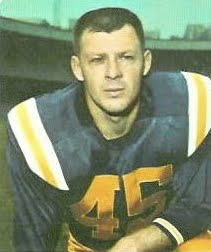
There were 15,776 fans in attendance at Bears Stadium for the nationally televised game. It was all Titans in the early going. FB Bill Mathis ran for a one-yard touchdown and HB Dick Christy caught a pass from QB Johnny Green (pictured above) for a six-yard score that put New York ahead by 14-0 in the first quarter.

It was 17-0 in the second quarter following a 28-yard field goal by Bill Shockley (pictured below) before the home team finally got on the board. Tripucka threw to Scarpitto for a 35-yard touchdown and Gene Mingo added the extra point. The Titans responded with another score, however, as Green threw to split end Art Powell for a four-yard TD. But Denver managed to whittle away at New York’s lead with two field goals by Mingo, of 45 and 8 yards, to make it 24-13 at the half. It still seemed to be a comfortable margin for the Titans.


In the third quarter, the tables turned in favor of the Broncos. First, star DT Bud McFadin picked up a fumble and ran 69 yards for a touchdown. Then QB George Shaw, in for the injured Tripucka, tossed a six-yard TD pass to Scarpitto. Denver was in front by a score of 27-24.

The Titans narrowed the margin to 27-26 when Shaw recovered a loose ball in his own end zone for a safety. New York regained the lead thanks to a Green pass to flanker Don Maynard for a 35-yard touchdown. While the attempt to run for a two-point conversion failed, New York was on top by 32-27 heading into the fourth quarter.

Once again the Broncos rallied. Shaw connected with Taylor for a three-yard TD, followed it up with a two-point conversion, and then CB Jim McMillin intercepted a pass and returned it 59 yards for another touchdown, followed by Mingo’s kick. When Mingo kicked a 49-yard field goal with the wind at his back, Denver held a 45-32 lead with six minutes remaining to play.

The Titans proceeded to drive for another touchdown, this time on a five-yard pass from Green to Christy. Shockley’s extra point narrowed the score to 45-39, but the six points still seemed formidable as time was running down. Denver took over at its own 20 following a long kickoff by Shockley and New York proceeded to get a huge break when HB Al Frazier fumbled a handoff and FS Lee Riley recovered for the Titans.

With the time now down to three minutes, New York capitalized when Green tossed his fifth touchdown pass, of three yards, to Powell. Shockley’s extra point was successful and the Titans were staked to a one-point lead.

The Broncos still had a chance, and managed to get into New York territory, but with time running out Mingo attempted a 52-yard field goal that was straight but too short. The Titans came away with a thrilling 46-45 win.

The Titans led in total yards (381 to 294) and first downs (25 to 19). Each club turned the ball over four times. Denver was especially hurt by penalties, drawing 11 flags at a cost of 130 yards to four for 27 yards on New York.

Johnny Green had a noteworthy performance, completing 22 of 46 passes for 292 yards with five touchdowns and three interceptions. Bill Mathis rushed for 49 yards and a TD on 13 carries. Dick Christy (pictured below) caught 9 passes for 82 yards and two scores, ran the ball 9 times for another 30 yards, and returned a kickoff 28 yards. Don Maynard had 105 yards on four pass receptions that included a TD and Art Powell had three catches for 57 yards and two touchdowns.


For the Broncos, Frank Tripucka was successful on 9 of 15 throws for 113 yards with a TD and two interceptions before leaving the game and George Shaw added 12 completions in 26 attempts for 117 yards with two TDs and an interception. FB Bo Dickinson was the leading rusher with 48 yards on 6 carries and also contributed 5 catches for 57 yards. Lionel Taylor had 6 pass receptions for 60 yards and a TD and Bob Scarpitto gained 89 yards and scored twice on his 5 catches.

The exciting win at Denver was the last for the Titans – they lost their remaining three games to finish at the bottom of the Eastern Division with a 5-9 record. The franchise was sold during the offseason to an ownership group headed by Sonny Werblin and was revamped and rechristened the Jets for 1963.

The loss wiped out any lingering hopes for the Broncos of winning the Western Division title. They, too, lost their remaining games and closed out at 7-7 for second place. It would prove to be their best record until 1973.

Johnny Green, formerly of the Buffalo Bills, saw the most action at quarterback for the Titans in ’62 and completed 49.6 percent of his passes for 1741 yards with 10 touchdowns and 18 interceptions. While he had a strong arm, he lacked accuracy and consistency and saw little action in his last year with the Jets in 1963.

As the numbers from the Denver game indicated, Dick Christy was a productive all-purpose halfback who led the AFL in total yards with 2147 (535 rushing on 114 carries, 538 on 62 pass receptions, 824 on 38 kickoff returns, and 250 on 15 punt returns). He was selected to the AFL All-Star Game.

Don Maynard caught 56 passes for 1041 yards (18.6 avg.) and eight touchdowns and went on to star with the Jets. Art Powell had 64 receptions for 1130 yards (17.7 avg.) and eight TDs as well. Disgruntled after three years in New York, he moved on to the Raiders in ’63 and also continued to excel. 

November 21, 2012

1976: Falcons Upset Cowboys with Fourth Quarter Scoring Flurry


The Atlanta Falcons were stumbling along at 3-7 as they hosted the Dallas Cowboys on November 21, 1976. Head Coach Marion Campbell had already been let go and Pat Peppler, the general manager, took over in the interim. The Falcons had also lost second-year QB Steve Bartkowski to a knee injury and journeyman QB Scott Hunter was starting in his place. While they had beaten the 49ers the previous week, they were heavy underdogs against Dallas, a club they had never won against in five regular-season meetings.

The Cowboys had been to the postseason nine times in the previous ten years under Head Coach Tom Landry and sported a 9-1 record coming into the game at Atlanta. While they lacked speed at running back, they had a decent stable of runners and a proficient passing game led by QB Roger Staubach. The defense was typically strong. However, there were danger signs in that the Cowboys were coming off of two mediocre performances against the Giants and Bills, although they won both contests.

There were 47,947 fans in attendance on a 47-degree day at Atlanta-Fulton County Stadium. The Cowboys scored on a 16-yard run by FB Scott Laidlaw in the first quarter. However, there was little further excitement as neither team was able to generate much additional offense and the score remained 7-0 at the half.

In the third quarter, the Cowboys added a 23-yard Efren Herrera field goal. While they were only up by 10-0, it seemed likely to be enough against the hapless Falcons. But in a five minute span of the fourth quarter, Atlanta took control with the help of two interceptions and a short Dallas punt that put 17 points on the board.

First, LB Dewey McClain intercepted a Staubach pass to set up a 21-yard field goal by Nick Mike-Mayer. The next Dallas series ended with a poor 15-yard punt by Danny White and Atlanta capitalized when HB Mike Esposito scored on a 35-yard run.


With the score tied, SS Ray Brown (pictured at left) then intercepted a pass and the Falcons scored on a Scott Hunter quarterback keeper from a yard out. Dallas still had opportunities, but came up empty on a drive to the Atlanta 28 and, with 1:12 left on the clock, LB Tommy Nobis intercepted a Staubach pass at the Atlanta nine to seal the 17-10 upset.

The Cowboys outgained Atlanta (307 yards to 230) and had more first downs (15 to 13). However, Dallas also turned the ball over four times – twice leading to Atlanta scores – while the Falcons turned the ball over on two occasions. The Falcons also sacked Staubach four times, three of them by DE Claude Humphrey (pictured at top) - an unofficial total, as individual sacks were not yet a recognized statistic. Dallas committed a total of eight penalties, at a cost of 70 yards, to four flags thrown on Atlanta.

Scott Hunter was successful on just 8 of 20 pass attempts for 99 yards with no touchdowns and one interception. Mike Esposito paced the running game with 82 yards and a TD on 13 carries and also was one of two Falcons to catch a team-leading three passes, along with WR Alfred Jenkins. Jenkins gained 60 yards to Esposito’s 19.

For the Cowboys, Roger Staubach had a rough day as he completed 13 of 28 passes for 157 yards with no TDs and had three intercepted. Scott Laidlaw rushed for 88 yards and a touchdown on 15 attempts and HB Preston Pearson contributed 61 yards on 16 carries. Laidlaw and Pearson each caught four passes to lead the club, with Pearson gaining 47 yards and Laidlaw 39. Tellingly, only three of Staubach’s passes were completed to wide receivers, for a total of 39 yards.

“We moved the ball well when we weren’t making mistakes,” summed up Tom Landry. “But we had too many holding penalties, interceptions, and dropped passes.”

The loss for the Cowboys set up a Thanksgiving battle just three days later with the Cardinals for the NFC East lead. They won and went on to finish atop the division with an 11-3 record before losing to the Rams in the Divisional round of the playoffs. Atlanta lost its remaining three contests to end up fourth in the NFC West at 4-10. The result was an organizational refurbishing that brought former NFL quarterback Eddie LeBaron in as general manager and Leeman Bennett as head coach.

November 20, 2012

1994: Andre Reed Catches 15 Passes as Bills Hold Off Packers


The Buffalo Bills, under Head Coach Marv Levy, had won four straight AFC titles from 1990 through ’93 but after getting off to a 5-3 start in 1994 had lost two straight contests and were just 5-5 as they hosted the Green Bay Packers on November 20. Age and the resulting wear-and-tear were beginning to catch up to 34-year-old QB Jim Kelly and seventh-year RB Thurman Thomas, although the other vital cog in the offense, WR Andre Reed (pictured above), was coming back successfully from an off-year in 1993. The defense, although it still contained outstanding performers in DE Bruce Smith, LB Cornelius Bennett, and FS Henry Jones, was no longer as formidable as it had once been – and Smith was out for the game with the Packers due to a shoulder injury.

Green Bay, with Mike Holmgren at the helm for the third year, was a team moving in the opposite direction. Coming off their first postseason appearance in eleven years, the Packers had an up-and-coming quarterback in Brett Favre, an excellent wide receiver in Sterling Sharpe, and a defensive line anchored by the All-Pro DE Reggie White. Moreover, the Packers were on a roll, having won their previous three games, and came into the contest at Buffalo with a 6-4 record.

There was a crowd of 79,029 at Rich Stadium. The Bills had first possession and drove 78 yards in nine plays, the big one a 26-yard Kelly completion to WR Billy Brooks to the Green Bay 12 yard line and capped by a five-yard scoring carry by Thurman Thomas.

Following a punt by the Packers, Buffalo put together another long 15-play drive that covered 80 yards. Kelly completed eight passes along the way, including the final one to Andre Reed for 15 yards and another TD. The Bills were up by 14-0 after a quarter of play.

The Packers still couldn’t get into Buffalo territory on offense and had to punt. Once more the Bills had a long series of 14 plays for 66 yards, helped along by a defensive pass interference penalty that nullified an incompletion in a third-and-six situation. The methodical drive reached the Green Bay five, but this time the Bills were unable to penetrate the end zone as Kelly was sacked by DE Sean Jones for a 14-yard loss. They settled for a 38-yard field goal by Steve Christie to extend the lead to 17-0.

The teams traded punts as the Packers finally held the Buffalo offense to a three-and-out series, but a pass by Brett Favre was intercepted by CB Mickey Washington who returned it 36 yards to the Green Bay 13. Two plays later Kelly passed to Reed for a 10-yard touchdown and the Bills were seemingly in complete command at 24-0.

With time running out in the second quarter, the Packers responded with a scoring drive of 60 yards in five plays. All were pass completions by Favre, including a 29-yard TD throw to Sterling Sharpe. However, Chris Jacke’s extra point attempt was blocked and the score remained 24-6. It wasn’t the end of the first half scoring as the Bills, taking over with 58 seconds on the clock, went 42 yards in five plays, the most notable a Kelly completion to WR Russell Copeland for 35 yards. Christie kicked a 51-yard field goal on the last play of the half and it was 27-6 at the intermission.

The Packers narrowed the margin with their first series in the third quarter. Favre completed eight passes as Green Bay went 70 yards in 11 plays, the last one for a five-yard touchdown to RB Edgar Bennett. This time the extra point attempt was successful and the tally now stood at 27-13.

The Bills made it to midfield on their ensuing possession and punted. Helped by Favre passes and an 18-yard run by Bennett, the Packers went 77 yards in eight plays and once again it was Favre passing to Sharpe, this time for a 26-yard TD. With the extra point it was 27-20 and the visitors were back in the game entering the fourth quarter.

It seemed as though the momentum was surely in Green Bay’s favor when a Kelly pass was intercepted by CB Terrell Buckley, who returned it 26 yards to give the Packers good starting field position at the Buffalo 49. However, they were unable to advance as Favre threw three straight incomplete passes and they were forced to punt.

The Bills responded with another long, methodical drive. Kelly converted two third downs with passes to Reed and, while Thomas was unable to gain anything on the ground, Buffalo reached the Green Bay seven. But Christie’s 25-yard field goal try hit the right upright and was no good, keeping the Packers just seven points behind with over six minutes still on the clock.

Once again Buffalo’s defense held and the Packers punted from their 30. Trying to run the clock out, the Bills converted a third-and-nine play on their next series on another Kelly throw to Reed that covered 15 yards. After reaching the 50, Buffalo finally punted and pinned the Packers down at their 10 yard line with 2:25 remaining thanks to an outstanding play by special teams star Steve Tasker to drop WR Robert Brooks in his tracks before he could make any sort of return.

There was no stunning comeback for Green Bay on this day. With the crowd roaring, Favre tossed an incompletion, was sacked for a nine-yard loss back to the one and, fading back on a third-and-19 play, a holding penalty not only nullified a great catch by WR Anthony Morgan for an apparent 27-yard gain but, because it occurred in the end zone, gave Buffalo two points and forced the Packers to have to kick the ball away. That was all the Bills needed as they ran out the clock for a 29-20 win.

The Bills dominated in total yards (455 to 266), first downs (27 to 18), and time of possession (38:23 to 21:37). Each team turned the ball over once.


Andre Reed set a club record with 15 catches for 191 yards that included two touchdowns. Jim Kelly (pictured at right) completed 32 of 44 passes for 365 yards with two TDs and an interception. Thurman Thomas had a rough outing, gaining 80 yards on 31 carries (2.6 avg.) while scoring once – he also added 25 yards on four pass receptions.

For Green Bay, Brett Favre was successful on 22 of 40 throws for 214 yards with three touchdowns and an interception. Sterling Sharpe had 5 catches for 86 yards that included two TDs. Robert Brooks gained 40 yards on his 5 pass receptions and Edgar Bennett also caught 5 passes, for 22 yards and a TD, while leading the club in rushing with 45 yards on 8 carries.

“They (the Bills) just got after us,” said Mike Holmgren. “They just dominated the first half. We just couldn’t do anything about what they were doing early on.”

The victory over the Packers did not signal resurgence by the Bills – they won only one more game and finished a disappointing fourth in the AFC East at 7-9, which was the club’s first losing record since 1987. Green Bay lost its next two contests but recovered to end up at 9-7 for the third straight year, good enough for second place in the NFC Central and a Wild Card berth in the playoffs. The Packers edged Detroit in the first round before losing to Dallas at the Divisional level.

Andre Reed caught a career-high 90 passes for 1303 yards (14.5 avg.) and eight touchdowns. He was selected to the Pro Bowl for the seventh consecutive year.

Jim Kelly, who missed two games, completed a NFL career-high 63.6 percent of his passes for 3114 yards with 22 touchdowns and 17 interceptions. Brett Favre ranked second in the league in passing (90.7 rating) while achieving new highs for yards (3882) and TD passes (33) – numbers that would quickly be surpassed in the MVP seasons that followed.

November 18, 2012

2007: Odd Field Goal Ties Game, Sends Browns to Overtime Win Over Ravens


The Cleveland Browns were seeking to build upon a 5-4 record as they faced the division-rival Baltimore Ravens at M & T Bank Stadium on November 18, 2007. Head Coach Romeo Crennel’s team had won three straight contests before losing at Pittsburgh the previous week. Tall (6’6”) and strong-armed QB Derek Anderson was proving to be a pleasant surprise and ex-Ravens RB Jamal Lewis was beginning to come on as a dependable runner. However, the defense was prone to giving up far too many yards.

The Ravens, coached by Brian Billick, were long known for tough defense but were having trouble on offense. Coming off a 13-3 record in 2006, Baltimore started off the ’07 season at 4-2 but had lost three consecutive games and desperately needed a win. Hobbled 34-year-old veteran QB Steve McNair was benched in favor of fifth-year QB Kyle Boller.

Things started off slowly in the first quarter with neither team moving the ball effectively. Cleveland got a break when Ravens RB Cory Ross fumbled a punt that DB Mike Adams recovered at the Baltimore 28. But after advancing nine yards, Phil Dawson’s 35-yard field goal attempt was wide.

Later in the period QB Kyle Boller fumbled while being sacked and LB Willie McGinest recovered for the Browns at the Baltimore 23. This time the Browns capitalized, with Dawson (pictured above) successful on a 28-yard field goal try.

The Browns added to their lead on the first possession of the second quarter. An 80-yard drive in eight plays was highlighted by Derek Anderson (pictured below) completing a pass to TE Kellen Winslow for 18 yards to the Baltimore one yard line, from where Jamal Lewis scored a touchdown.


Down 10-0, the Ravens could still get nothing going offensively on their next series, but on the second play following their punt LB Ray Lewis intercepted an Anderson pass and returned it 35 yards for a TD. With the successful extra point, Cleveland’s lead was cut to 10-7.

The Browns responded with a 13-play, 42-yard possession that included a 21-yard carry by Jamal Lewis. Dawson again successfully kicked a field goal, this time from 39 yards, and it was a 13-7 tally at the half.

The Ravens had been dismal on offense in the first half, but they drove to a score in their first series of the third quarter. Boller had completions of 16 and 21 yards to WR Derrick Mason and RB Willis McGahee had a 24-yard run that set up his two-yard scoring carry to complete the 75-yard drive in eight plays. With Matt Stover’s successful extra point, it was a 14-13 tally in favor of Baltimore.

Following a short Cleveland series, the Ravens had to punt in turn from deep inside their own territory. Sam Koch’s short kick was returned 26 yards by WR Josh Cribbs to the Baltimore 11 and from there the Browns scored in three plays to regain the lead with Anderson getting the last yard for a touchdown on a quarterback sneak.

The Ravens moved into Cleveland territory on their next series as Boller completed a pass to WR Devard Darling for 26 yards and McGahee had an 18-yard run up the middle to the 20. But Boller, firing for the end zone on his next throw, was intercepted by DB Brodney Pool who returned it 100 yards for a Browns TD. With the successful PAT, Cleveland was up by 13 points at 27-14.

The Ravens responded with a 14-play, 62-yard drive that stretched into the fourth quarter and was helped along by defensive penalties. Matt Stover successfully booted a 34-yard field goal to make it a ten-point game with plenty of time left on the clock.

On their next possession, the Ravens again moved methodically down the field in nine plays that covered 43 yards and ended with another Stover field goal, this time from 41 yards. A short Cleveland series ended with a punt that had the Ravens taking over at their 17 yard line with 5:12 remaining in regulation. Boller immediately threw to Darling for a 42-yard gain and, three plays later, to Darling again for a 27-yard TD. Stover’s extra point was successful and the game was tied up at 27-27.

Upon getting the ball back, Baltimore again drove to a score. Boller completed four passes and ran four yards for a first down in a third-and-two situation. With 31 seconds left on the clock, Stover kicked a 47-yard field goal and it seemed as though the Ravens, up by 30-27 after scoring 16 unanswered points, had the game won.

The Browns got a 39-yard kickoff return from Cribbs and followed up with two passes by Anderson that gained 24 yards. With the remaining time now down to three seconds, Dawson came in to attempt a 51-yard field goal. Dawson’s kick struck the left upright and seemed to strike the crossbar before bouncing back onto the field. The initial call by the officials was that it was no good, and the Ravens began to celebrate and head for the locker room, along with disappointed Cleveland players.

However, some players insisted that the ball had passed through the uprights and hit the center support before bouncing back. Referee Pete Morelli attempted to review the play but was told by the replay official that field goals were not reviewable. Conferencing with the other officials, one of the back judges felt strongly that the ball had passed through the goal posts and Morelli agreed to reverse the initial call and declare it a successful kick (subsequent review of the film proved the reversal to be correct). With the score now tied, the teams were ordered back onto the field and the game went into overtime.

The Browns got the ball first for the extra period and never gave it up. Anderson completed four passes, the most crucial to Winslow for 18 yards to the Baltimore 30. Cleveland picked up an extra 14 yards in four running plays and Dawson came in and successfully kicked a 33-yard field goal of which there was no doubt (pictured below). The Browns came away winners by a final score of 33-30.


Cleveland had the edge in total yards (380 to 368) although the Ravens had more first downs (23 to 22). Baltimore turned the ball over four times, to two by the Browns, and Boller was sacked six times. However, the Browns hurt themselves by being penalized 12 times at a cost of 104 yards (as opposed to two flags for 15 yards on the Ravens).

Derek Anderson completed 24 of 38 passes for 274 yards with no touchdowns and one intercepted. Jamal Lewis was effective, rushing for 92 yards on 22 carries that included a TD. Braylon Edwards caught 8 passes for 85 yards and WR Joe Jurevicius accumulated 82 yards on his four receptions. Josh Cribbs had a big day returning kicks, averaging 35.0 yards on seven kickoff returns and 15.3 returning four punts.

For the Ravens, Kyle Boller overcame a slow start to complete 22 of 41 throws for 279 yards with a TD and two interceptions. Willis McGahee gained 102 yards and scored a touchdown on 21 rushing attempts. Devard Darling gained 107 yards on four pass receptions that included a touchdown while Derrick Mason had 6 catches for 83 yards and TE Quinn Sypniewski also pulled in 6 passes, gaining 53 yards.

Phil Dawson, in talking about the uncertainty over the game-tying field goal at the end of regulation, said “I could tell by the way it glanced off the upright, it looked like it went forward. But we had people down near the goal post who were screaming at the top of their lungs that it had hit whatever that bar you call it.”

“This team, for whatever reason, thrives on adversity,” added Dawson. “The tougher the situation, the better we do. We all had a feeling when we got the call and went into overtime, what a shame it would have been not to capitalize on it.”

Cleveland went on to finish out the season at 4-2 for an overall record of 10-6, good enough for second place in the AFC North while just missing out on a playoff spot. It was the club’s first winning record in five years. The defeat seemed back-breaking for the Ravens, who failed to win again until the season finale. The resulting 5-11 record was the worst since 1996 and marked the end of Brian Billick’s tenure as head coach. Fortunes would subsequently reverse for both clubs.

In his ninth year with the Browns, Phil Dawson was successful on 26 of 30 field goal attempts (86.7 %) – with likely no others as memorable as the barely-successful game-tying kick at Baltimore.

November 17, 2012

1975: Ken Anderson Passes for 447 Yards as Bengals Beat Bills


The Monday night matchup on November 17, 1975 featured the Cincinnati Bengals, with their proficient passing offense led by QB Ken Anderson (pictured at right), against the Buffalo Bills and their outstanding ground attack keyed by RB O.J. Simpson.

Under the guidance of 67-year-old coaching legend Paul Brown, the Bengals were 7-1 and fighting it out with Pittsburgh for supremacy in the AFC Central. Meanwhile, Buffalo, coached by Lou Saban, was 5-3. The Bills had won their first four games but lost three of the previous four coming into the contest at Cincinnati.

There was a capacity crowd on hand at Riverfront Stadium. The Bengals scored the first time they had the ball, driving 90 yards. Anderson completed a five-yard touchdown pass to HB Lenvil Elliott to cap the series, although the extra point attempt failed. The Bills responded with a 28-yard John Leypoldt field goal to make the score 6-3 after one quarter.

In the second quarter, HB Stan Fritts extended Cincinnati’s lead with a one-yard TD carry, this time followed by a successful PAT. Simpson, who had 154 yards in the first half that included runs of 59 and 44 yards, kept the Bills in the game. He contributed a two-yard scoring carry to narrow the tally to 13-10. But Anderson, consistently finding the weaknesses in Buffalo’s pass defense, threw to WR Charlie Joiner for a 20-yard touchdown and the Bengals carried a 20-10 lead into halftime.

Simpson again scored a touchdown for Buffalo in the third quarter, this time from a yard out, to again make it a three-point contest. Dave Green was successful on a 28-yard field goal attempt later in the period, but the Bengals lost star WR Isaac Curtis with a twisted ankle midway through the third quarter.

Another one-yard scoring carry by Fritts extended Cincinnati’s lead in the fourth quarter, but Buffalo fought back and closed the margin to six points with eight minutes remaining in the contest when QB Joe Ferguson connected with WR J.D. Hill for a ten-yard TD. The Bengals came back with a 79-yard drive that concluded with a Green field goal of 18 yards and, with 1:57 remaining to play, and that sealed it. Cincinnati came away the winner by a final tally of 33-24.

The Bengals generated significantly more total yards (553 to 335) and first downs (34 to 20) – this despite Buffalo compiling 242 rushing yards. The Bengals never punted although Dave Green kicked two field goals in three attempts. There were just three turnovers, with the Bills accounting for two of them.

Ken Anderson completed 30 of 46 passes for a career-high 447 yards with two touchdowns and no interceptions, breaking his own club record of 352 passing yards against the Oilers in 1974 with his precision throwing. Isaac Curtis had 7 catches for 139 yards before having to leave the contest and WR Chip Myers added 7 receptions for 108 yards. FB Boobie Clark paced the ground game with 60 yards on 16 carries and also pulled in 6 passes for 64 yards.

For the Bills, O.J. Simpson (pictured below) had an outstanding performance with 197 yards on just 17 rushes that included two short TDs. Most of his productivity came in the first half. FB Jim Braxton added 40 yards on 10 attempts. Joe Ferguson was successful on 9 of 18 throws for 106 yards and a touchdown with no interceptions. J.D. Hill was the top receiver with three catches for 33 yards and a score.


 “We knew what we had to do,” said Ken Anderson. “We had to put some points up on the board against them, because there was no way we could control them all night.”

“Anderson was superb,” summed up Paul Brown. “The game went the way we were afraid it would go – we couldn’t stop them and they couldn’t stop us. In the past, it’s been the defense that has done the job for us. This time, it was the offense.”

The win put the Bengals in a first-place tie with Pittsburgh atop the AFC Central, but they lost at Cleveland the next week and once more in the Week 13 showdown against the Steelers to end up second at 11-3. In the Divisional playoff round, Cincinnati was eliminated by the Oakland Raiders. Buffalo, continuing to suffer from defensive lapses, finished third in the AFC East with an 8-6 record.

Ken Anderson led the NFL in passing for the second straight year (93.9 rating) and also topped the league in yards (3169) and yards per attempt (8.4). The 26-year-old in his fifth year ranked second in attempts (377), completions (228), and completion percentage (60.5) and was selected for the Pro Bowl.

O.J. Simpson was ahead of his record-breaking 1973 pace following the game against the Bengals but came up short, although by a league-leading 1817 yards on 329 carries (5.5 avg.). Altogether, he scored 23 touchdowns, at the time a single-season NFL record.

November 15, 2012

1970: Paul Brown’s Bengals Defeat Browns


Paul Brown (pictured above) had returned to pro football as a head coach (and GM and part owner) with the expansion Cincinnati Bengals of the AFL in 1968. He had been away from the game after being summarily fired by Cleveland Browns owner Art Modell following the ’62 season, ending a brilliant head coaching stint with the Browns going back to 1946 in the All-America Football Conference that included four AAFC titles and three NFL Championships. The parting had been a bitter one for Brown.

The AFL/NFL merger that culminated in 1970 made possible regular season meetings between the Bengals and Browns, particularly since both teams were now members of the new AFC Central Division. Cincinnati won a preseason contest between the clubs, but in their first meeting that counted in the standings the Browns had prevailed at Cleveland in Week 4. Now, on November 15, the clubs faced off once again in Cincinnati.

It had been a tough season thus far for the third-year Bengals. They were at 2-6 coming into the rematch with the Browns, having won their opening game before losing six straight contests and then thrashing the Bills the previous week. With the loss of their 1969 phenom, QB Greg Cook, to what would prove to be a career-ending shoulder injury, the Bengals were using the weak-armed but intelligent Virgil Carter under center. With the help of offensive assistant Bill Walsh’s redesigned offense that emphasized short passes, and with good mobility, Carter was improving and there was plenty of other promising young talent on the roster.

Cleveland, still coached by Brown’s successor Blanton Collier, had gotten off to a 4-2 start but lost its last two games to drop to an even 4-4. First-round rookie QB Mike Phipps out of Purdue was starting his first pro game against Cincinnati, in place of gimpy-kneed veteran Bill Nelsen, and Collier would be calling the plays from the sideline – a practice pioneered by Paul Brown.

There was a big crowd of 60,007 in attendance at Riverfront Stadium. The Browns went 77 yards in six plays following the opening kickoff, with the big play a 33-yard Phipps completion to TE Milt Morin. HB Leroy Kelly swept around left end for a nine-yard touchdown.

Near the end of the first quarter, an attempted screen pass by Carter to FB Jess Phillips bounced off of the running back’s hand and was ruled a lateral by the officials. Cleveland DT Jerry Sherk picked up the live ball and carried it 15 yards to the Cincinnati 20. A furious Paul Brown complained about the call, but to no avail. Seven plays later, Don Cockroft kicked a 15-yard field goal and the Browns held a 10-0 lead.

The turnover on the questionable call seemed to fire up the Bengals, however, and they went 80 yards in eight plays on the ensuing possession. Carter passed to Phillips for a 13-yard touchdown of which there was no doubt. Late in the second quarter Carter took off after rolling out for a 73-yard gain but fumbled at the Cleveland 10 when hit by CB Erich Barnes, who recovered to end the scoring opportunity. The tally remained 10-7 at halftime.

In the third quarter, the Bengals put together an eight-play, 85-yard drive. HB Paul Robinson finished it off with a one-yard touchdown carry. Meanwhile, the Bengals defense rose to the occasion and thoroughly bottled up the Cleveland offense during the second half.

The Browns were hurt in the fourth quarter when a Phipps pass was intercepted. However, they got a break in the closing minutes when CB Lemar Parrish, while calling for a fair catch, muffed a punt and WR Dave Jones recovered for Cleveland. Four plays later, rather than keeping the ball on the ground and relying on the strong running game, Phipps passed in a fourth-and-three situation at the Cincinnati 30 with less then four minutes remaining in the game. The throw was intended for Morin, but safety Al Coleman batted the ball away at the last second. As an unfortunate side note, Coleman suffered a major knee injury on the play when he fell while tangled with Morin and Parrish.

That was the last shot for the Browns as Cincinnati’s offense controlled the ball for the rest of the game. The Bengals came away with a 14-10 win. When the final gun went off, the usually calm Paul Brown leaped up and tossed his hat into the air, running across the field ahead of his players.

Cincinnati outgained the Browns (333 yards to 296) although Cleveland had the edge in first downs (15 to 14). In particular, the Bengals outrushed the Browns by 210 yards to 153. However, Cincinnati turned the ball over three times, to one by Cleveland, although the Browns hurt themselves with eight penalties, as opposed to three flags thrown on the home team.


QB Virgil Carter (pictured at left) completed 10 of 17 passes for 123 yards and a touchdown with no interceptions and was also the game’s leading rusher with 110 yards on nine carries - the running plays were part of the game plan and came in some typical passing situations. Paul Robinson added 63 yards and a TD on 14 rushing attempts. WR Chip Myers was the team’s top receiver with three catches for 67 yards. MLB Bill Bergey had a noteworthy performance for the Bengals, accounting for 11 tackles, five assists, and a deflected pass.

As for the Browns, Mike Phipps was successful on 11 of 25 throws for 170 yards with no TDs and one interception. Leroy Kelly led the running attack with 60 yards on 21 carries that included a touchdown. Milt Morin caught three passes for 78 yards.

“This is my best victory. This one made it all worthwhile,” said Paul Brown, who shed tears while congratulating his players afterward.

“I like a November football team – one that stays in there,” added Brown. “They (the Bengals) may not be 100 percent in a lot of ways, but they sure battle, and that’s for me.”

“Errors and penalties hurt us,” summed up Coach Collier for the Browns.

Despite their losing record, the Bengals were in the thick of the race in the new AFC Central and would make the most of it the rest of the way. They didn’t lose again during the remainder of the regular season, a total of seven straight wins, and topped the division with an 8-6 record – a big achievement for a third-year expansion team in the pre-free agency era.

For the Browns, it was the third straight loss – the first time they had lost that many in a row in 11 years. They ended up placing second to Cincinnati at 7-7 and Blanton Collier retired afterward.

Virgil Carter was solid if not spectacular, passing for 1647 yards with nine touchdowns and nine interceptions. He rushed for 246 yards on 34 carries for an average gain of 7.2 yards.

The new Ohio rivalry was sealed by the fans. Between the preseason encounter (57,112) and two regular season games (83,520 in Cleveland plus 60,007 for the contest at Riverfront Stadium), attendance totaled 200,639.

November 14, 2012

1993: Salisbury’s Passing, Irwin’s Blocked Kicks Propel Vikings Over Broncos


The Minnesota Vikings were 4-4 and coming off of two straight losses as they faced the Denver Broncos on November 14, 1993. Head Coach Dennis Green’s team had difficulty scoring and offensive coordinator Jack Burns was already a casualty. Brittle veteran QB Jim McMahon was injured and Sean Salisbury (pictured above) had taken over. A star for two years in the CFL, leading Winnipeg to a Grey Cup title, Salisbury had been strictly a backup in the NFL. The loss of RB Terry Allen for the year with a knee injury further hampered the offense.

Denver was 5-3 and had just won two consecutive games. Under a new head coach in Wade Phillips, following twelve seasons with Dan Reeves at the helm, the key to the offense was still veteran QB John Elway, and he was thriving in offensive coordinator Jim Fassel’s West Coast offense.

A morning snowstorm had dropped six inches of snow on Denver. While the field at Mile High Stadium was clear, footing was slippery and the temperature was around 30 degrees at kickoff.

Minnesota had the first possession and punted, but Elway fumbled away his first snap, thus giving the Vikings an early break as they took possession at the Denver 34. Three plays later, Sean Salisbury threw to WR Anthony Carter but Carter, having broken a tackle, tripped and fell at the one yard line after gaining 27 yards. It proved to be significant on the next play when Salisbury fumbled while being sacked and LB Karl Mecklenburg recovered for the Broncos.

Denver went three-and-out, but three plays after punting CB Frank Robinson intercepted a Salisbury pass and returned it 13 yards to give the Broncos possession at the Minnesota 31. Elway completed four passes as the home team scored in six plays that included a four-yard throw to WR Derek Russell for a touchdown. However, tackle Tim Irwin blocked the extra point attempt and the score remained 6-0.

The Vikings responded by going 71 yards in seven plays. Following a nine-yard carry by eleventh-year RB Roger Craig to start off the series, Salisbury threw to Anthony Carter for 30 yards to get into Broncos territory. Two plays later he hit Carter again for 39 yards but the drive stalled at the Denver seven yard line and Minnesota settled for a 25-yard field goal by Fuad Reveiz. The Broncos led by a 6-3 score.

Russell returned the ensuing kickoff 49 yards to give Denver good starting field position at the Minnesota 49. In a series that extended into the second quarter, the Broncos scored in seven plays as RB Robert Delpino ran for a three-yard TD. This time the extra point was successful and Denver’s lead was extended to ten points.

Minnesota’s next possession ended with a fumble by RB Barry Word, forced by Mecklenburg, and once again the Broncos had the ball in good field position at the Vikings’ 37. Again they capitalized, driving methodically down the field in six plays that ended with Elway tossing a 13-yard scoring pass to WR Vance Johnson.

Now down by 17 points midway through the second quarter, the Vikings came back on a series that was highlighted by Salisbury throwing to TE Steve Jordan for a 53-yard gain to the Denver 11. Two plays later Salisbury completed a nine-yard touchdown pass to WR Cris Carter.

Following a Denver punt, the Vikings took possession at their 45 yard line with 1:39 left in the half. It took four plays to cover 55 yards as Salisbury threw to Cris Carter for 23 yards, Anthony Carter for 15, and Craig for a 17-yard touchdown. Going into halftime, Minnesota had narrowed Denver’s lead to 20-17.

After a punt by the Broncos, Minnesota tied the game in its first series of the third quarter. However, it had seemed as though the Vikings would do more than that when Salisbury threw to Cris Carter for 26 yards and, following a pass interference penalty, they had first-and-goal on the Denver three. But two runs by Craig failed to reach the end zone and Salisbury tossed an incomplete pass. Minnesota ended up with a 19-yard Reveiz field goal.

Elway came out throwing on Denver’s next series, but an apparent long completion to TE Shannon Sharpe was nullified by an illegal formation penalty and the Broncos ultimately had to punt. The Vikings had to kick it back and once more Elway passed the Broncos down the field, hitting Johnson for 17 yards and Russell for 30. However, after getting to the Minnesota nine, a 26-yard field goal try by Jason Elam was blocked by Irwin.

As the game entered the fourth quarter, neither team was able to mount another threat until the Vikings took possession at the Denver 40 following a punt. They were able to drive into scoring position and Reveiz kicked a 35-yard field goal. But Denver responded in kind, going 45 yards in six plays that ended with Elam booting a field goal from 53 yards.

The trading of three-pointers continued when the Vikings advanced to the Denver 25 on a series highlighted by a Salisbury pass to Cris Carter for 55 yards. Reveiz added a 43-yard field goal to put Minnesota back in front.

With a little under three minutes left on the clock, Elway and the Broncos mounted another promising drive that was helped along by two defensive penalties. But RB Glyn Milburn’s fumble after catching a pass from Elway at the Minnesota 21 with 54 seconds left stopped the potential comeback in its tracks and sealed the 26-23 win for the Vikings.

Minnesota led in total yards (427 to 342), with all but 70 of that total coming through the air. However, the Broncos had more first downs (25 to 18) and recorded four sacks to one of Elway by the Vikings. Denver also turned the ball over four times, to three suffered by Minnesota. There were 23 penalties in all, with 13 of those called on the Vikings.

Sean Salisbury had an outstanding performance, completing 19 of 37 passes for 366 yards with two touchdowns and an interception. Cris Carter caught 6 of those throws for 134 yards and a TD while Anthony Carter contributed 111 yards on four receptions. Steve Jordan pulled in 6 passes for 85 yards. Roger Craig was the leading rusher with 41 yards on 14 carries. Tim Irwin (pictured below) blocked a short field goal and extra point, giving him eight blocked kicks thus far in his career.


For the Broncos, John Elway was successful on 30 of 40 throws for 290 yards with two TDs and one interception. Shannon Sharpe caught 7 passes for 104 yards. Rod Bernstine gained 37 yards on 8 rushes and added 6 catches for another 37 yards. Glyn Milburn gained 30 yards on four attempts, caught 5 passes for 27 yards, and had another 116 yards returning kicks, but also had the critical fumble at the end.

“Salisbury is throwing the ball well, hitting the open receiver and using good judgment,” summed up Dennis Green. “Our defense did a good job, holding them to three points in the second half.”

The Vikings lost their next two games but won four of their last five to finish second in the NFC Central with a 9-7 record and qualify for the playoffs as a Wild Card. They lost to the Giants in the first round. Denver also made it to the postseason with an identical 9-7 tally. The Broncos were a Wild Card entry as well, placing third in the AFC West, and lost to the division-rival Raiders in the initial round.

Sean Salisbury started a total of four games for the Vikings in 1993. Overall, he completed 115 of 195 passes (59 %) for 1413 yards with 9 touchdowns and 6 interceptions. The 366-yard passing performance against Denver was his NFL career high and the second of back-to-back 300-yard games.

The ‘93 season proved to be the finale for Tim Irwin’s 13 years with the Vikings. He ended up with a total of 10 blocked kicks.